
The Muscular System Chapter 4 Objectives Describe the
The Muscular System Chapter 4
Objectives • Describe the functions and structures of the muscular system including muscle fibers, fascia, tendons and the three types of muscle • Recognize, define, spell and pronounce the terms related to muscle movements and explain how the muscles are named • Recognize, define, pronounce, and spell the terms related to the pathology and the diagnostic and tx procedures of the muscular system

Word Parts • • Bi-cele Dys. Fasci/o Fibr/o -ia -ic • Kines/o kinesi/o • My/o • -plegia • -rrhexis • Tax/o • Ten/o, tendin/o • Ton/o • Tri-
Fxns of the Muscular System • mm hold the body erect and make movement possible • m movement generates nearly 85% of the heat that keeps the body warm • mm move food through the digestive system • m movement, such as walking, aids the flow of blood through veins as it returns to the heart • m axn moves fluids through the ducts and tubes associated c other body systems
Structures of the Muscular System • Our bodies have more than 600 mm • Our mm make up about 40 -45% of our body weight • Skeletal m is made up of fibers, covered c fascia, and are attached to bones by tendons
Structures of the Muscular System • Muscle Fibers – Long, slender cells that make up mm – Held together by connective tissue and is enclosed in a fibrous sheath • Fascia – The sheet of fibrous connective tissue that covers, supports and separates mm or groups of mm – Flexible but not elastic • Myofascial – pertaining to m tissue and fascia
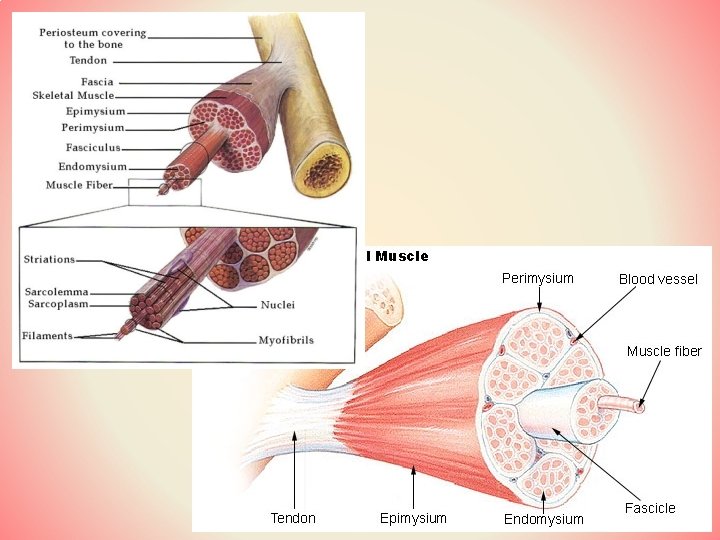
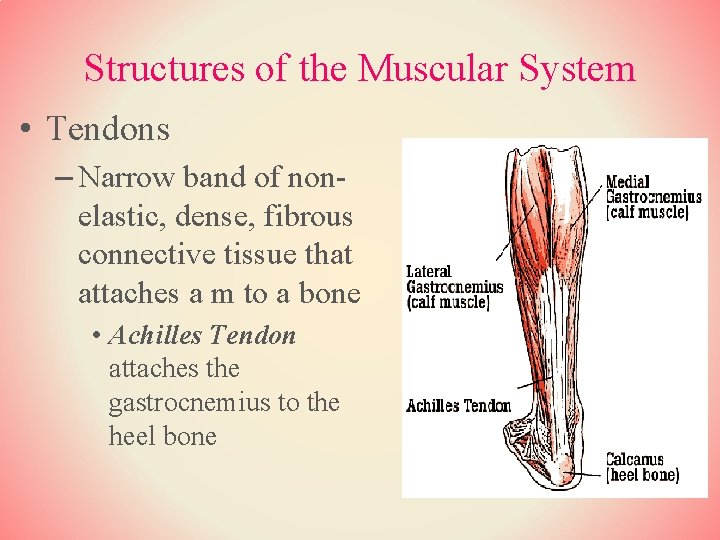
Structures of the Muscular System • Tendons – Narrow band of nonelastic, dense, fibrous connective tissue that attaches a m to a bone • Achilles Tendon attaches the gastrocnemius to the heel bone
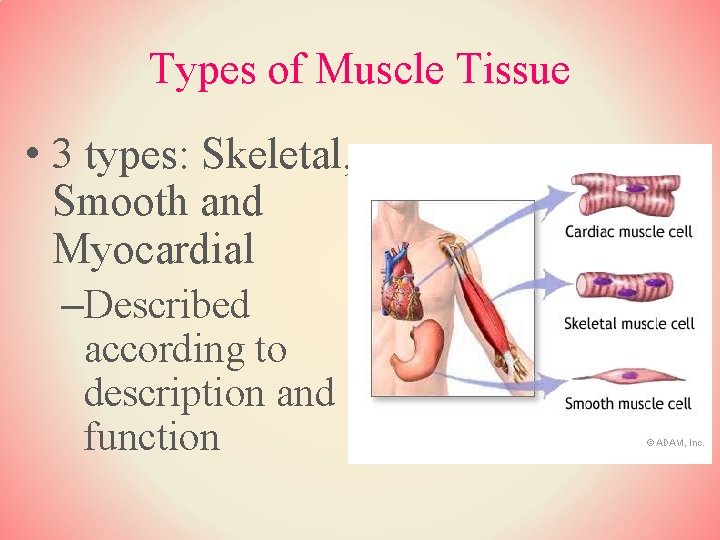
Types of Muscle Tissue • 3 types: Skeletal, Smooth and Myocardial –Described according to description and function
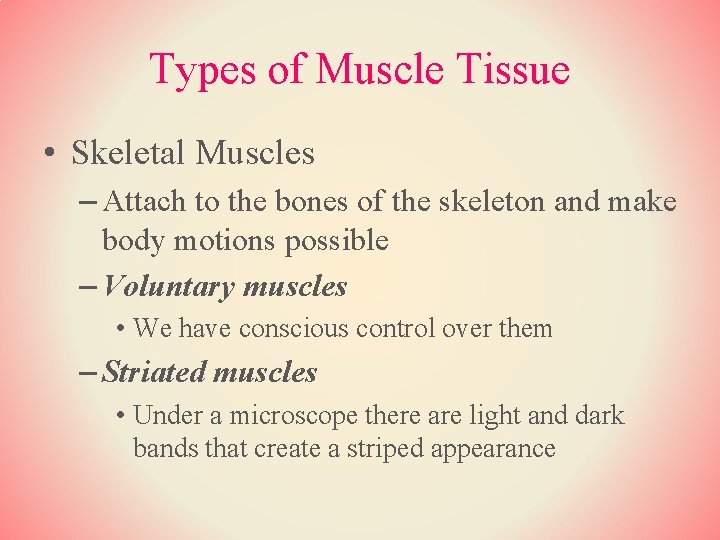
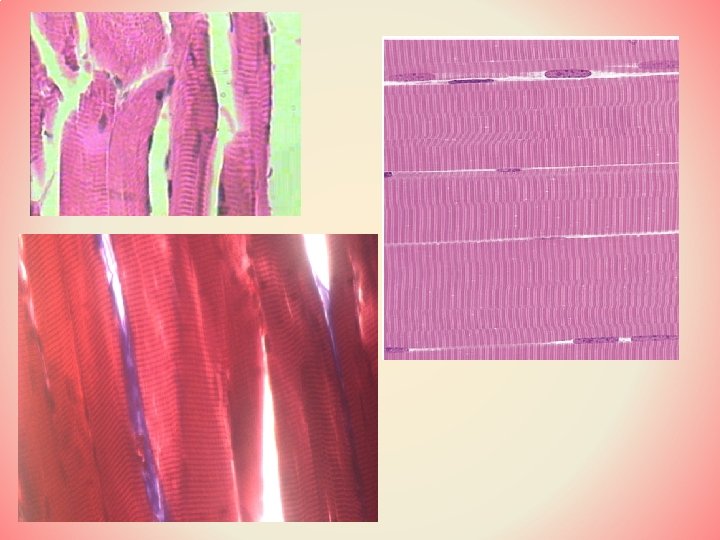
Types of Muscle Tissue • Skeletal Muscles – Attach to the bones of the skeleton and make body motions possible – Voluntary muscles • We have conscious control over them – Striated muscles • Under a microscope there are light and dark bands that create a striped appearance
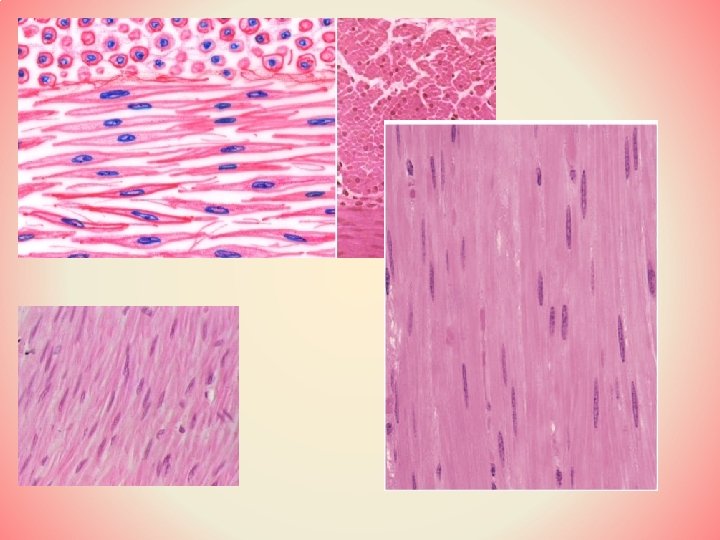
Types of Muscle Tissue • Smooth Muscles – located in the walls of internal organs • Digestive tract, blood vessels, and ducts – Fxn: move and control the flow of fluids though these structures – Involuntary muscles • Under the control of the ANS – Unstriated – Visceral • Found in Lg int organs
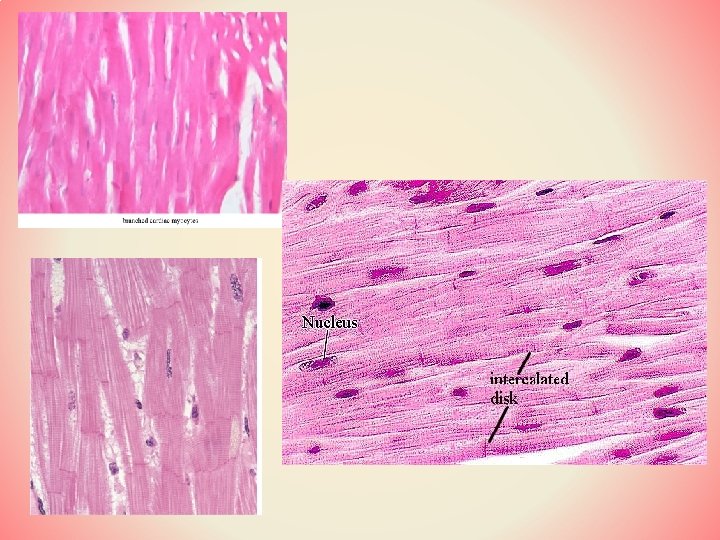
Types of Muscle Tissue • Myocardial Muscle – Myocardium or Cardiac Muscle – Forms the muscular walls of the heart – Striated like skeletal muscle, but involuntary like smooth muscle – It’s contraction and relaxation causes our heartbeat!

Review from yesterday!!!!
Muscle Contraction and Relaxation • Muscle Innervation – The stimulation of a muscle by an impulse transmitted by a motor nerve • Neuromuscular – pertaining to the relationship between nerve and muscle • Antagonist Muscle Pairs – Antagonist – working in opposition to each other • Contraction – tightening of a m • Relaxation – when a m returns to it original form
Contrasting Muscle Motion • Abduction and Adduction (ABD & ADD) – AB-Duction – mvmt of a limb AWAY FROM the midline – AD-Duction – mvmt of a limb TOWARD the midline • Flexion and Extension ( & /) – Flexion – decreasing the angle between two bones by bending a limb at the joint – Extension – increasing the angle between two bones or the straightening of a limb • Hyperextension – extreme or overextension of a limb/body part beyond normal limits
• Elevation and Depression – Elevation – the act of raising or lifting a body part – Depression – the act of lowering a body part • Rotation and Circumduction – Rotation – circular mvmt around an axis such as the shoulder joint/neck – Circumduction – the circular mvmt of a limb at the far end (the swinging motion @ the distal end of the arm)
• Supination and Pronation – Supination – the act of rotating the arm or leg so that the palm/sole is turned forward or upward – Pronation – the act of rotating the arm or leg so that the palm/sole is turned downward or backward • Dorsiflexion and Plantar Flexion – Dorsiflexion - D √ - the mvmt that bends the foot upward at the ankle – Plantar Flexion – P √ – the mvmt that bends the foot downward at the ankle

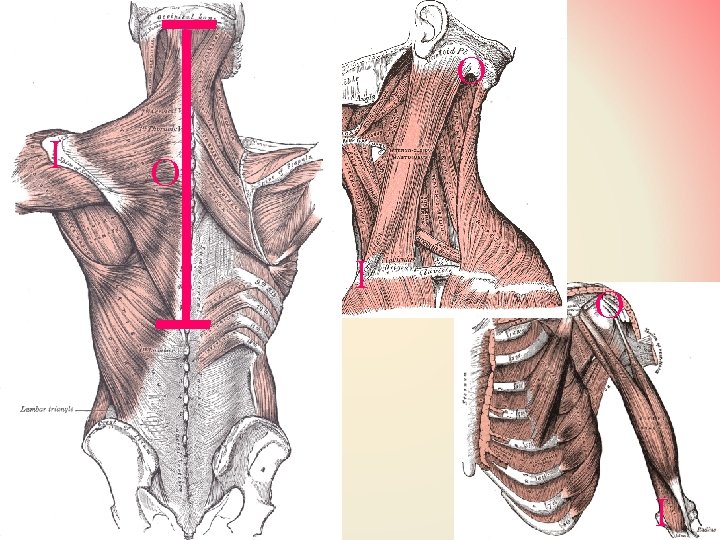
1 How Muscles are Named • Muscles are named for their origin and insertion – The 2 points where the muscle attaches – Origin • The less moveable attachment where the muscle BEGINS • Located nearest the midline – Insertion • The more moveable attachment where the muscle ENDS attaching to bone or tendon
O I O I

How Muscles are Named • Muscles named for their Action 2 –Named if they’re flexors or extensors –Flexor digiti minimi, extensor carpi and flexor carpi muscles

How Muscles are Named • Muscles names for their location – Named for the part of the body or organ they’re near – Pectoralis major – the thick fan-shaped muscle on the front of the chest; pectoral means chest – Lateralis (lateral) and Medialis (medial) – External or Oblique, and Internal 3
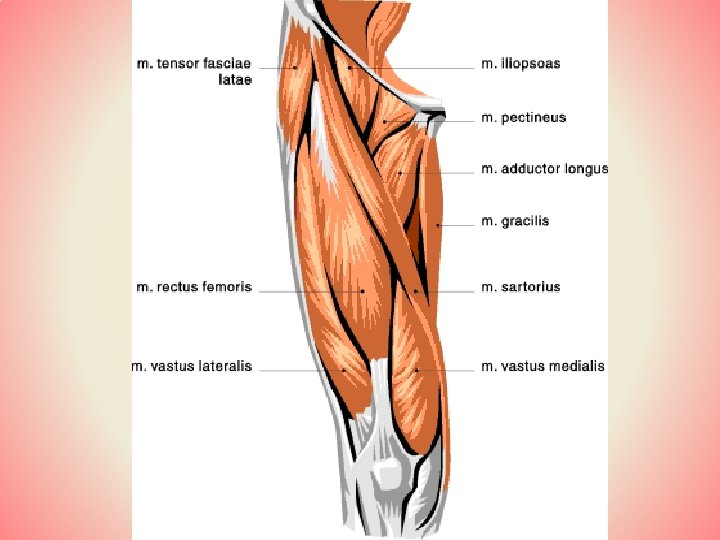
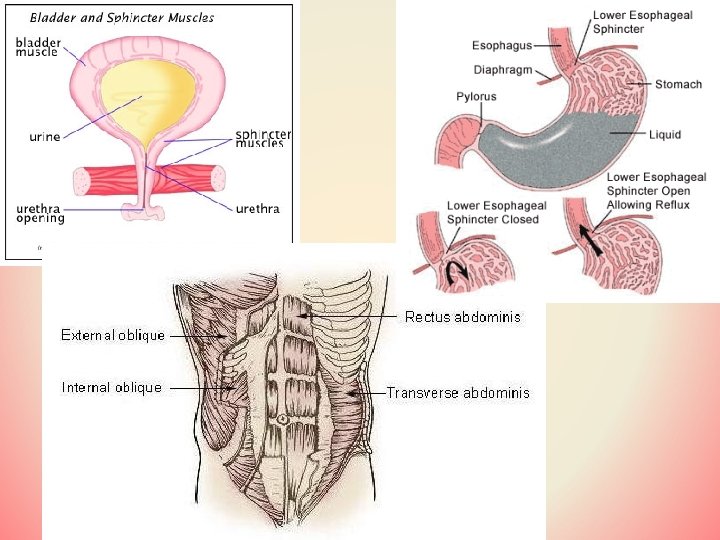
4 How Muscles are Named • Muscles named for Fiber Direction – Oblique – slanted or at an angle – Rectus – straight alignment with the vertical axis of the body – Sphincter – a ring like muscle that tightly constricts the opening of a passage – Transverse – crosswise direction
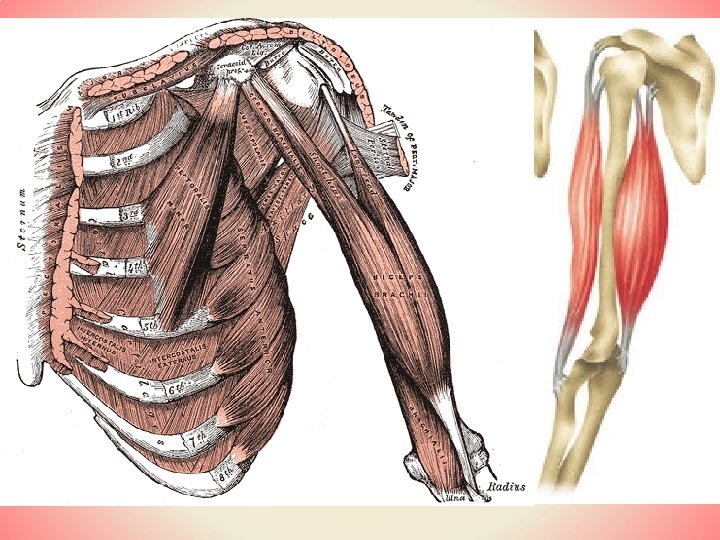
How Muscles are Named 5 • Muscles named for Number of Divisions –Biceps brachii – biceps; formed from 2 divisions –Triceps brachii – triceps; formed from 3 divisions
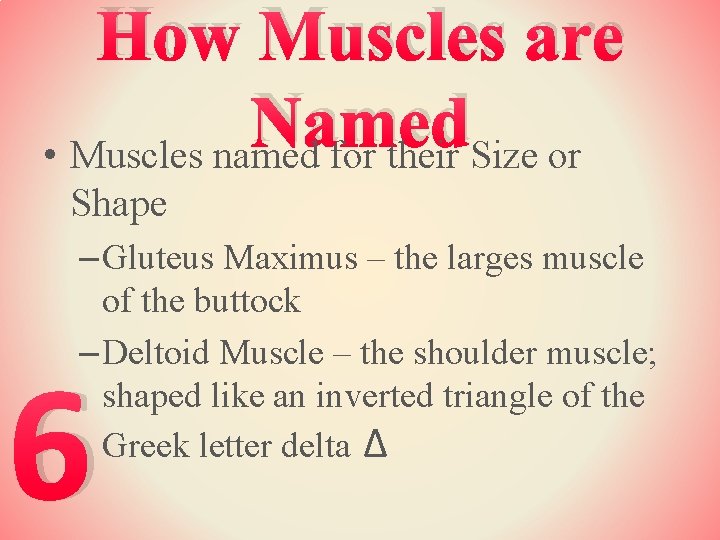
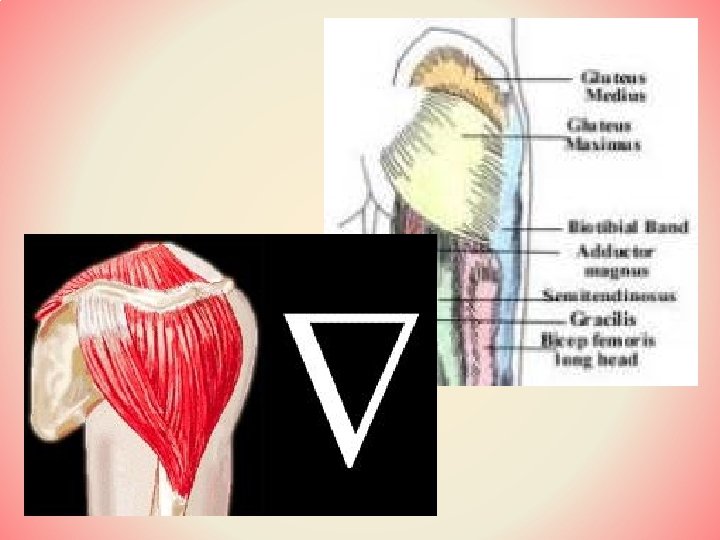
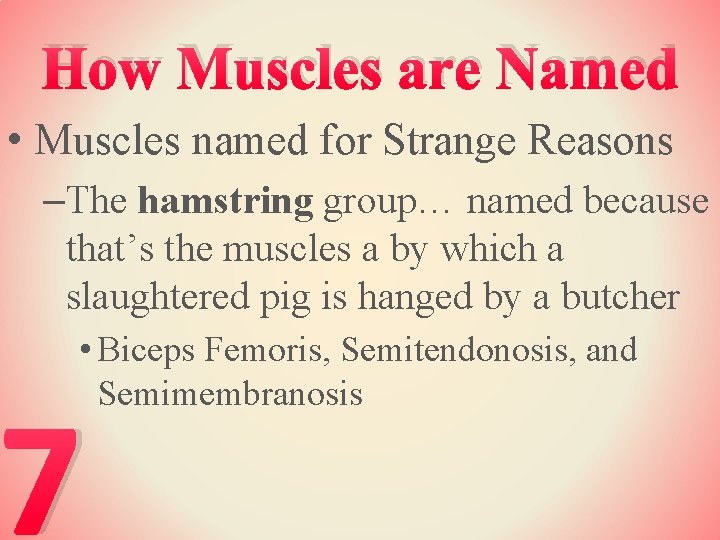
How Muscles are Named • Muscles named for their Size or Shape – Gluteus Maximus – the larges muscle of the buttock – Deltoid Muscle – the shoulder muscle; shaped like an inverted triangle of the Greek letter delta Δ 6
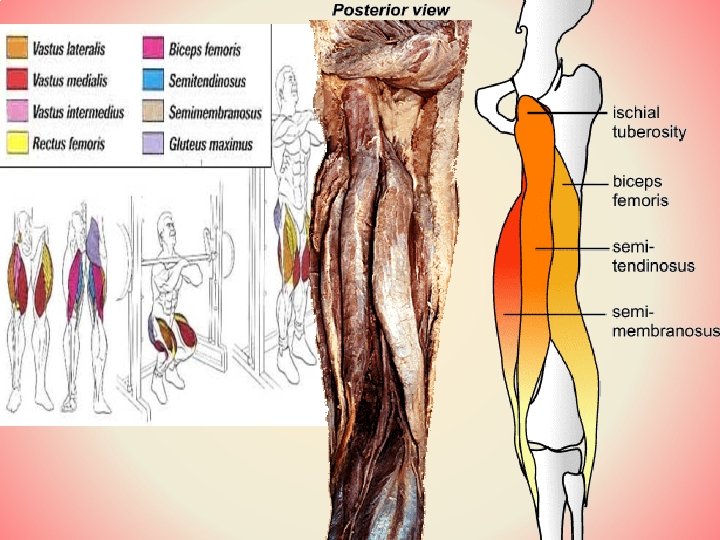
How Muscles are Named • Muscles named for Strange Reasons –The hamstring group… named because that’s the muscles a by which a slaughtered pig is hanged by a butcher • Biceps Femoris, Semitendonosis, and Semimembranosis 7
Medical Specialties Related to the Muscular System • Exercise Physiologist – works under a physician to develop, implement and coordinate exercise programs • Neurologist – Specialized in muscular disorders where there is loss of fxn • Physiatrist – Physician who specializes in physical medicine and rehab
Medical Specialties Related to the Muscular System • Rheumatologist – Physician who specializes in the dx and tx of arthritis, and disorders like osteoporosis, fibromyalgia and tendonitis • Sports Medicine Physician – Specializes in the tx of sports-related injuries of the bone, joints, and mm
Pathology of the Muscular System • Fibers, Fascia and Tendons – Fasciitis – inflammation of the fascia – Fibromyalgia Syndrome – chronic condition characterized by fatigue, diffuse or specific m, jt or bone p! – Tenodynia – p! in the tendon – Tendinitis – inflammation of a tendon – Chronic Fatigue Syndrome • Chronic, debilitating condition. Not like fibromyalgia because it does not go away c rest

Pathology of the Muscular System • Muscle Disorders – Adhesions – a band of fibrous tissue that holds structures together abnormally – Atrophy – weakness or wearing away of body tissues and structures – Myalgia – tenderness or p! in the m – Myocele – the herniation of m substance thought a tear in the fascia surrounding it
Pathology of the Muscular System • Muscle Disorders – Myolysis – degeneration of m tissue – Myomalacia – abnormal softening of m tissue – Myorrhexis – rupture or tear of a m – Polymyositis – m disease characterized by simultaneous inflammation and weakness of voluntary mm – Sarcopenia – loss of m mass, strength, and pxn that comes c age
Pathology of the Muscular System • Muscle Disorders – Muscle Tone • Known as tonus; the state of balanced m tension • Atonic – lacking normal m tone or strength • Dystonia – abnormal m tone that causes the impairment of voluntary m movement
Pathology of the Muscular System • Muscle Disorders – Muscle Tone • Hypertonia – excessive tone of the skeletal mm • Hypotonia – diminished tone of the skeletal mm • Myotonia – a meuromuscular disorder characterized by the slow relaxation of the mm after voluntary contraction
How Muscles are Named • Muscles are named for – Origin and insertion – Their Action – Their location – Fiber Direction – Number of Divisions – Their Size or Shape – Strange Reasons

PATHOLOGY!!!!!!!
Pathology of the Muscular System • Fibers, Fascia and Tendons – Fasciitis – inflammation of the fascia – Fibromyalgia Syndrome – chronic condition characterized by fatigue, diffuse or specific m, jt or bone p! – Tenodynia – p! in the tendon – Tendinitis – inflammation of a tendon – Chronic Fatigue Syndrome • Chronic, debilitating condition. Not like fibromyalgia because it does not go away c rest
Pathology of the Muscular System • Muscle Disorders – Adhesions – a band of fibrous tissue that holds structures together abnormally – Atrophy – weakness or wearing away of body tissues and structures – Myalgia – tenderness or p! in the m – Myocele – the herniation of m substance thought a tear in the fascia surrounding it
Pathology of the Muscular System • Muscle Disorders – Myolysis – degeneration of m tissue – Myomalacia – abnormal softening of m tissue – Myorrhexis – rupture or tear of a m – Polymyositis – m disease characterized by simultaneous inflammation and weakness of voluntary mm – Sarcopenia – loss of m mass, strength, and pxn that comes c age
Pathology of the Muscular System • Muscle Disorders – Muscle Tone • Known as tonus; the state of balanced m tension • Atonic – lacking normal m tone or strength • Dystonia – abnormal m tone that causes the impairment of voluntary m movement
Pathology of the Muscular System • Muscle Disorders – Muscle Tone • Hypertonia – excessive tone of the skeletal mm • Hypotonia – diminished tone of the skeletal mm • Myotonia – a meuromuscular disorder characterized by the slow relaxation of the mm after voluntary contraction
Muscle Disorders • Voluntary Muscle Movement – Ataxia • The inability to coordinate m activity during voluntary movement – Dystaxia • Partial ataxia • A mild form of ataxia – Contracture • The permanent tightening of structures occurring when normal connective tissue is replaced w non-elastic fibrous tissues
Muscle Disorders • Voluntary Muscle Movement – Intermittent Claudication • P! in the leg mm during exercise; goes away c rest – Spasm • Sudden, violent, involuntary contraction of one or more mm – Cramp • Localized m cramp named for its cause (heat cramp, writer’s cramp, etc) – Spasmotic Torticollis • Wryneck • A spasmotic contracture of the neck

Muscle Disorders • Muscle Function – Bradykinesia • Extreme slowness in movement – Dyskinesia • Distortion or impairment of voluntary movement such as a tic or spasm – Hyperkinesia • Hyperactivity • Abnormally increased m fxn or activity – Hypokinesia • Abnormally decreased m fxn or activity
Muscle Disorders • Myoclonus – The sudden, involuntary jerking of a m or group of mm – Nocturnal Myoclonus • Thee jerking of limbs that can occur normally as a person is falling asleep – Singultus • Hiccups • Myoclonus of the diaphragm that causes the characteristic hiccup sound c each spasm
Muscular Disorders • Myasthenia Gravis –Chronic autoimmune disease that affects the neuromuscular junction and produces serious weakness of voluntary mm
Still Pathology…
Muscle Disorders • Muscular Dystrophy – A group of more than 30 genetic diseases that cause progressive weakness and degeneration of skeletal muscle – Duchenne Muscular Dystrophy – most common; usually in boys 3 -5 y/o; by 12 most can’t walk and need a respirator – Becker Muscular Dystrophy – similar, but less sever than Duchenne.
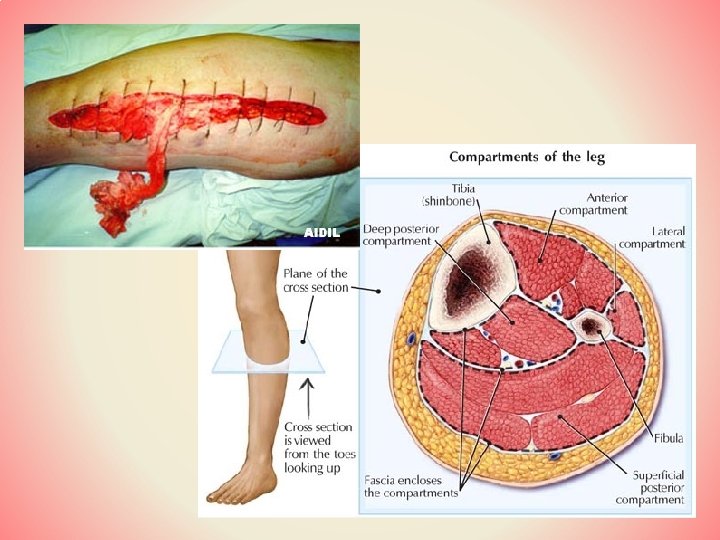
Repetitive Stress Disorders • Caused by repeated motions performed in the course of normal work, ADLs, or sports • Compartment Syndrome – Compression of nerves and blood vessels in a specific compartment created by the fascia that separates groups of mm • Overuse Injuries – Minor injuries that have not been given sufficient time to heal
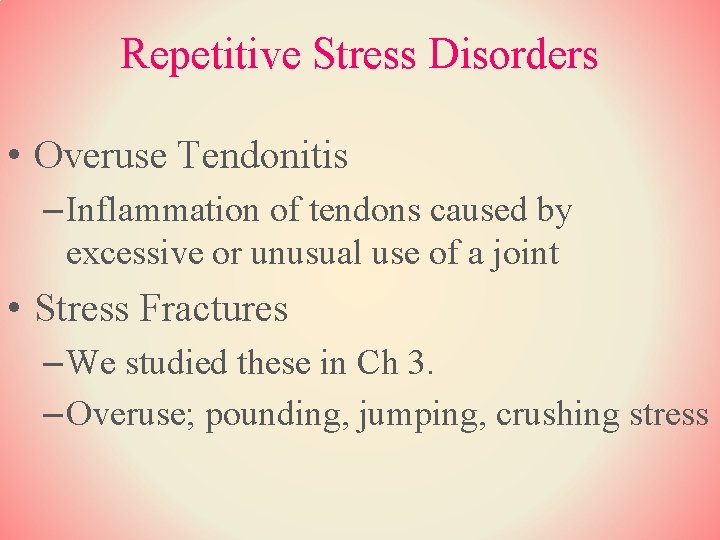
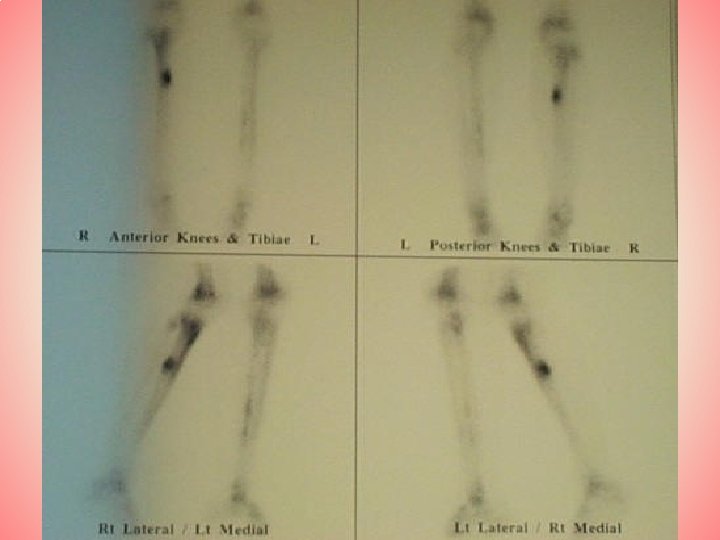
Repetitive Stress Disorders • Overuse Tendonitis – Inflammation of tendons caused by excessive or unusual use of a joint • Stress Fractures – We studied these in Ch 3. – Overuse; pounding, jumping, crushing stress
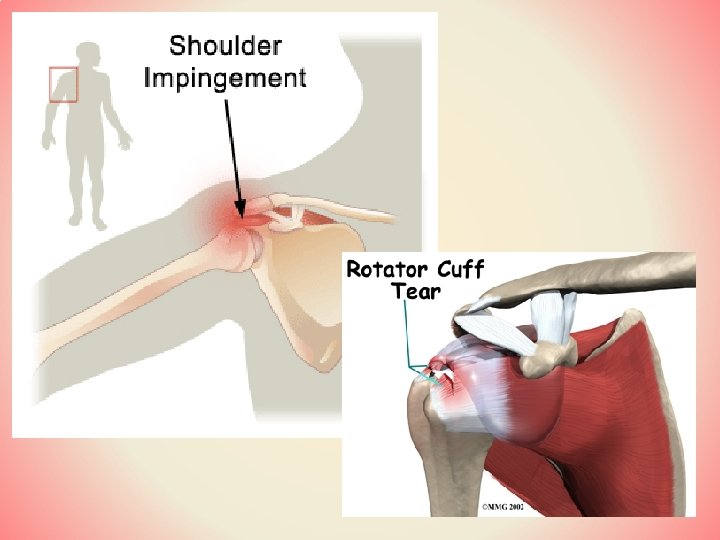
Repetitive Stress Disorders • Myofascial P! Syndrome – Chronic p! disorder caused by the development of trigger points • Rotator Cuff Injuries – Impingement Syndrome • Occurs when inflamed tendons are caught in the narrow spaces between the bone in the shoulder – Rotator Cuff Tendonitis • Inflammation of the tendons in the shoulder – Ruptured Rotator Cuff • Untreated tendonitis weakens tendons and they can tear
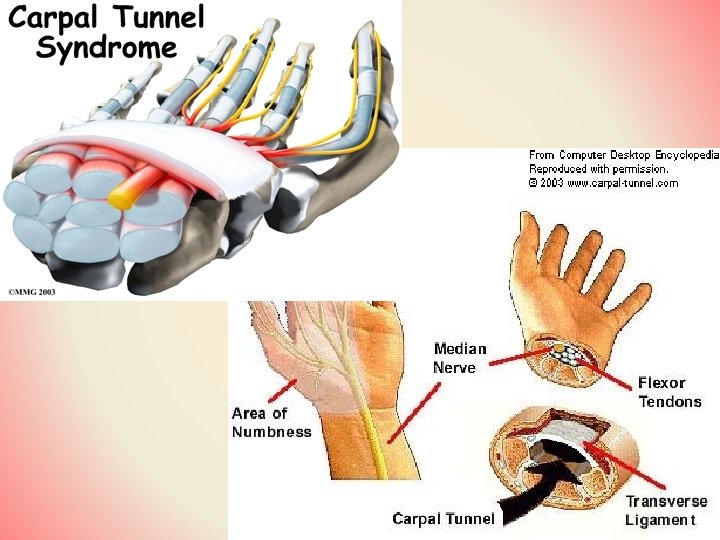
Repetitive Stress Disorders • Carpal Tunnel Syndrome – Occurs when the tendons that pass through the carpal tunnel are overused and become inflamed and swollen – Creates pressure on the median nerve – Causes p!, burning and parasthesia in the thumb, index and middle fingers – Release • Surgical fix where the tunnel is enlarged
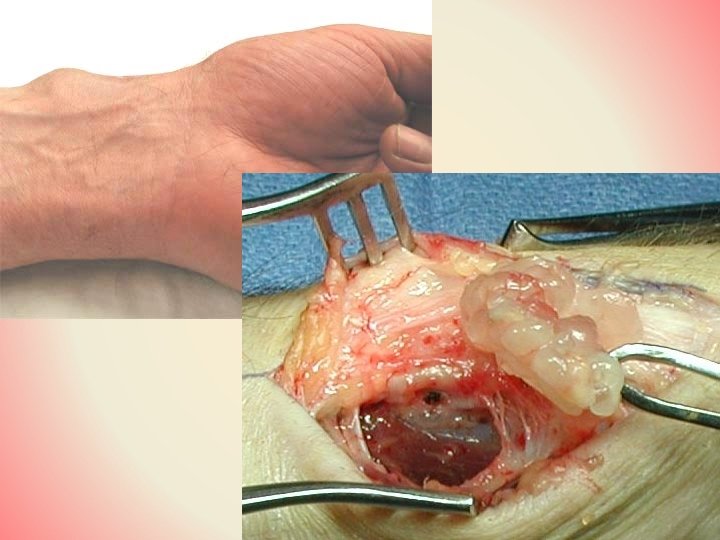
Repetitive Stress Disorders • Ganglion Cyst – A harmless fluid filled swelling that occurs most commonly on the outer surface of the wrist • Epicondylitis – Inflammation of the tissues surrounding the elbow – Lateral • Tennis Elbow – Medial • Golfer’s or Little Leaguer’s Elbow
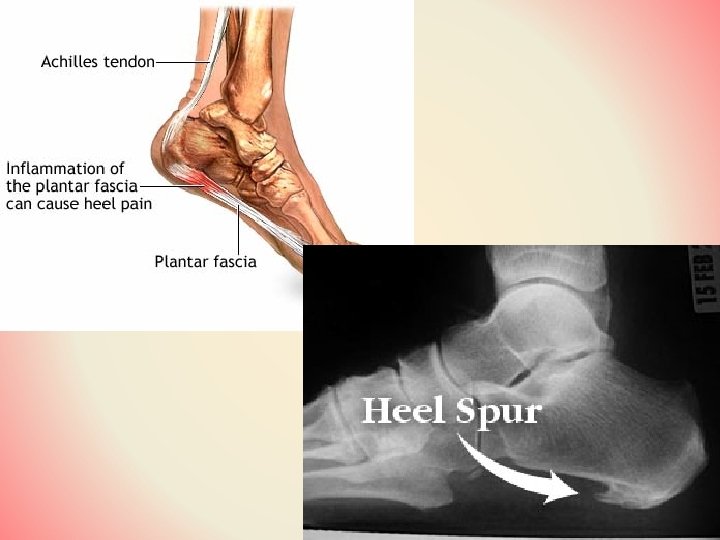
Repetitive Stress Disorders • Ankle and Feet Problems –Heel Spurs • A calcium deposit in the plantar fascia near its attachment to the calcaneus –Plantar Fasciitis • Inflammation of the plantar fascia on the sole of the foot
Sports Injuries • Sprain – LIGAMENT injury • Strain – MUSCULAR injury • Shin Splint – Condition caused by the m pulling away from the tibia (shin bone) • Hamstring injury – Any injury, strain or tear, to the mm of the hamstring group • Achilles Tendonitis – Inflammation of the Achilles Tendon
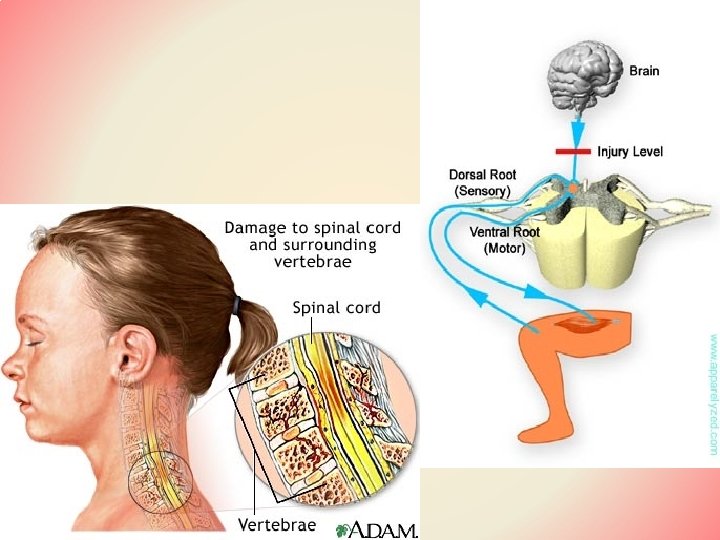
Spinal Cord Injuries • The spinal cord is the consistency of toothpaste, basically, so protection is extremely necessary • The type or paralysis is determined by the level of the vertebra closest to the injury – The higher up, the great the area of the body that may be affected • When the spinal cord is injured, communication with the brain and the area below the injury may be gone or diminished
Spinal Cord Injuries • Incomplete Injury – The person will have some function below the level or injury, even though that function will not be normal • Complete Injury – There is complete loss of sensation and m control below the level of the injury. – Doesn’t mean to give up hope!
Spinal Cord Injuries • Types of Paralysis – the loss of sensation and voluntary m movements in m through disease or injury to its nerve supply – Myoparesis – weakness or slight muscular paralysis – Hemiparesis – slight paralysis or weakness affecting one side of the body – Hemiplegia – total paralysis affecting only one side of the body • (L brain = R side of the body and vice versa)
Spinal Cord Injuries • Paraplegia – paralysis of both legs and the lower body • Quadriplegia – paralysis of all four extremities • Cardioplegia –Cardiac Arrest; paralysis of the heart m – Caused by direct blow or trauma, or medically induced
Diagnostic Procedures of the Muscular System
• Deep Tendon Reflexes (DTR) - tested by striking a reflex hammer on a tendon • Range of Motion testing (ROM) – procedure used to evaluate joint mobility and muscle strength • Electromyography – a test that measures the electrical activity within m fibers in response to nerve stimulation • Electroneuromyography – nerve conduction tests; testing and recording neuromuscular activity by electric stimulation of the nerve trunk that carries fibers to and from the m
Treatment Procedures of the Muscular System
• Medication – Antispasmotic • Anticholinergic; suppresses smooth m contractions of the stomach, intestine or bladder – Skeletal m relaxant • Administered to relax certain mm and to relieve the stiffness, p! and discomfort caused by strains, sprains, or other m injuries – Neuromuscular blocker • A drug that causes temporary paralysis by blocking the transmission of nerve stimuli to the mm
• Ergonomics – the study of the human factors that affect the design and operation of tools and the work environment • Occupational and Physical Therapy – OT – rehab for ADLs. Bathing, grooming, eating, dressing, etc – PT – tx to prevent disability or to restore fxn through the use of exercise, heat, massage, and other methods to improve circulation, flexibility and m strength • Myofascial Release – soft tissue manipulation to ease p! • Therapeutic Ultrasound – high-frequency sound wave to produce deep heat to ease p!, decrease m spasm and accelerate healing
• Still under OT and PT – RICE – Rest, Ice, Compression and Elevation; the recipe for injury healing during the 1 st few days post-injury • Fascia – Fasciotomy – surgical incision through the fascia to relieve tension or pressure – Fascioplasty – the surgical repair of fascia
• Tendons – Tenodesis – surgical suturing of a tendon to the bone – Tenolysis – a release of a tendon from adhesions – Tenectomy – surgical resection/removal of a portion of tendon – Tenoplasty – surgical repair of tendons – Tenorrhaphy – surgical suturing of divided ends of a tendon – Tenotomy – surgical division of a tendon for relief of a deformity caused by the abnormal shortening of a m
• Muscles – Myectomy – surgical excision of a portion of m – Myoplasty – the surgical repair of a m – Myorrhaphy – the surgical suturing of a m wound – Myotomoy – a surgical incision into a m
- Slides: 82