
THE MUSCULAR SYSTEM CH 7 Strong fibrous white
THE MUSCULAR SYSTEM CH. 7
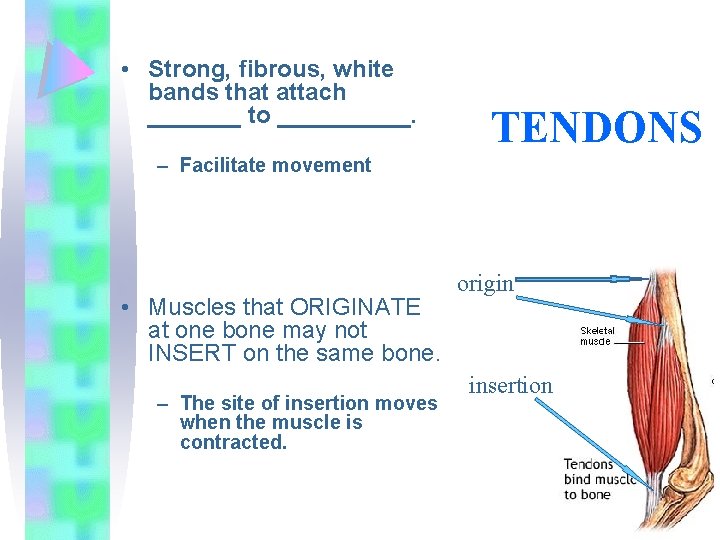
• Strong, fibrous, white bands that attach _______ to _____. TENDONS – Facilitate movement • Muscles that ORIGINATE at one bone may not INSERT on the same bone. – The site of insertion moves when the muscle is contracted. origin insertion

APONEUROSIS • Broad sheet of flat connective tissue that serves as a tendon to attach muscles to bone or to bind muscles together • Flat and ribbon-like TENDON SHEATH • Connective tissue surrounding tendons where there is a long distance to the distal attachment or where the tendon pulls over a joint
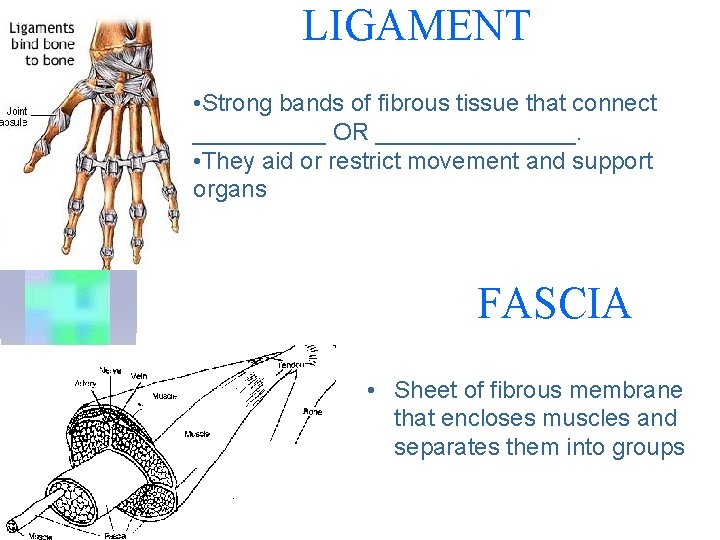
LIGAMENT • Strong bands of fibrous tissue that connect _____ OR ________. • They aid or restrict movement and support organs FASCIA • Sheet of fibrous membrane that encloses muscles and separates them into groups
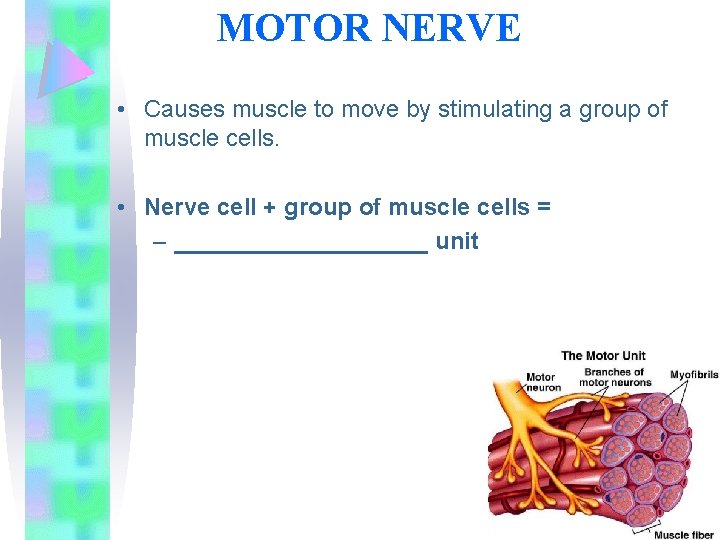
MOTOR NERVE • Causes muscle to move by stimulating a group of muscle cells. • Nerve cell + group of muscle cells = – __________ unit

circumduction • ______ – bending at a joint • _______ – straightening at a joint • _______ – moving a body part away from the body • _______ – moving a body part toward the body • _______ – turning a body part on its axis • ________ – circular movement
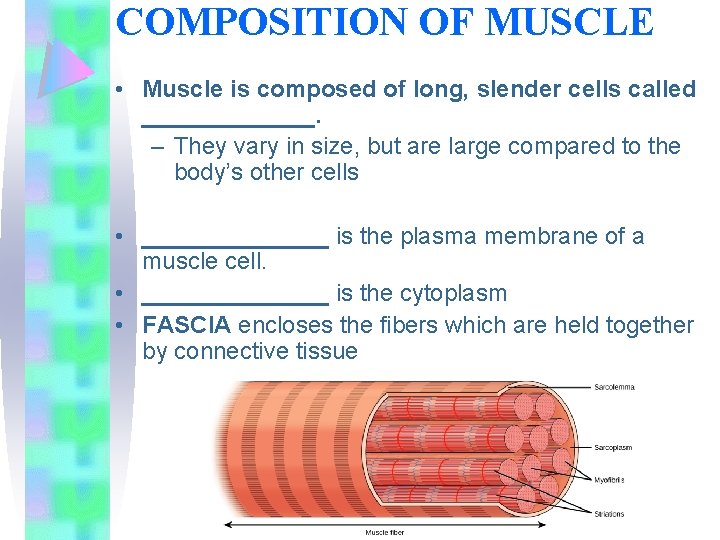
COMPOSITION OF MUSCLE • Muscle is composed of long, slender cells called _______. – They vary in size, but are large compared to the body’s other cells • _______ is the plasma membrane of a muscle cell. • _______ is the cytoplasm • FASCIA encloses the fibers which are held together by connective tissue
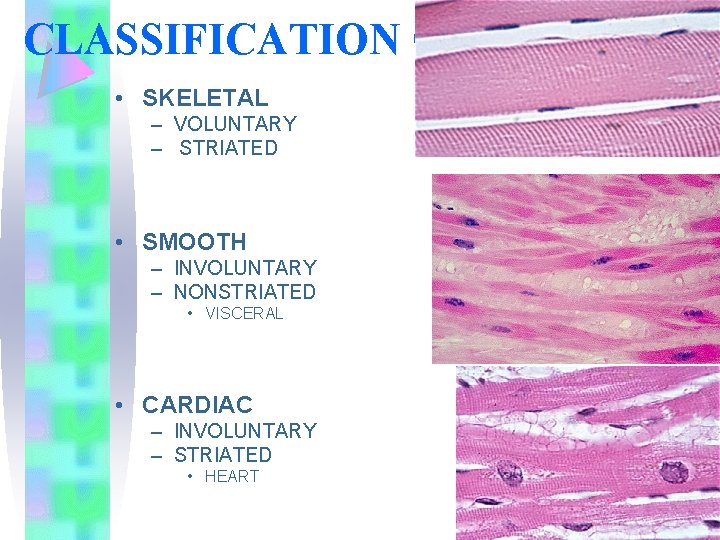
CLASSIFICATION OF MUSCLES • SKELETAL – VOLUNTARY – STRIATED • SMOOTH – INVOLUNTARY – NONSTRIATED • VISCERAL • CARDIAC – INVOLUNTARY – STRIATED • HEART
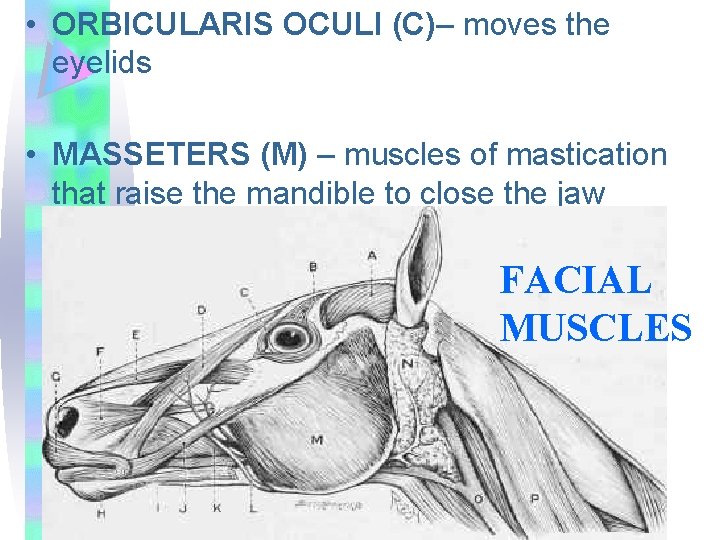
• ORBICULARIS OCULI (C)– moves the eyelids • MASSETERS (M) – muscles of mastication that raise the mandible to close the jaw FACIAL MUSCLES
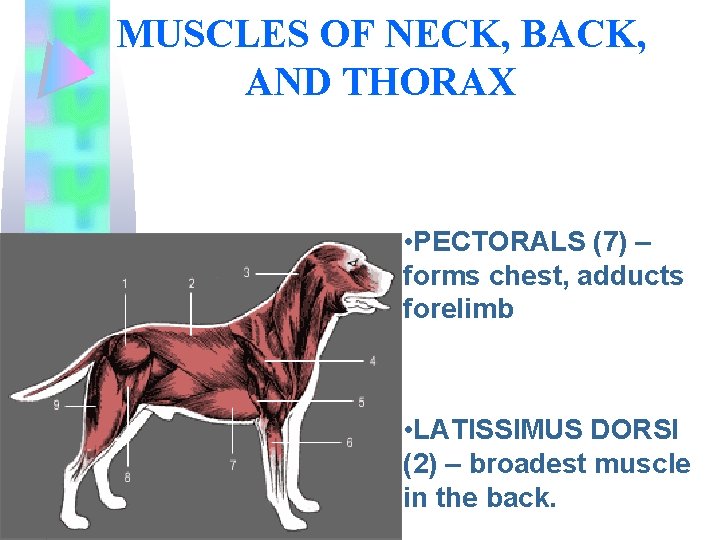
MUSCLES OF NECK, BACK, AND THORAX • PECTORALS (7) – forms chest, adducts forelimb • LATISSIMUS DORSI (2) – broadest muscle in the back.
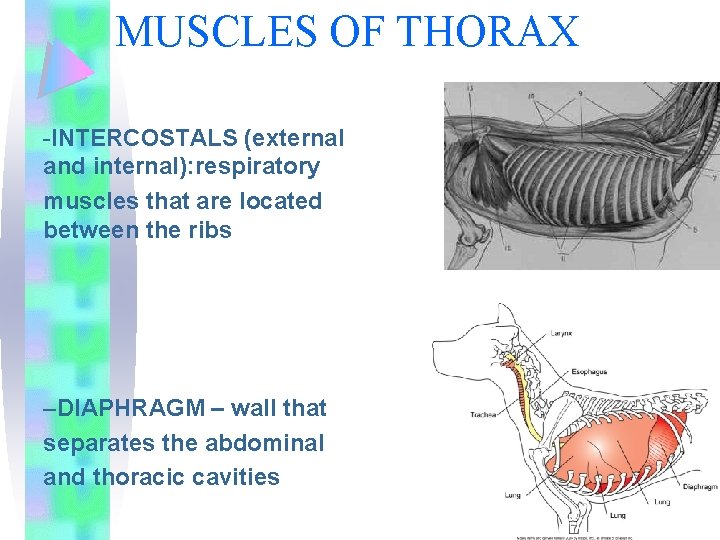
MUSCLES OF THORAX -INTERCOSTALS (external and internal): respiratory muscles that are located between the ribs –DIAPHRAGM – wall that separates the abdominal and thoracic cavities
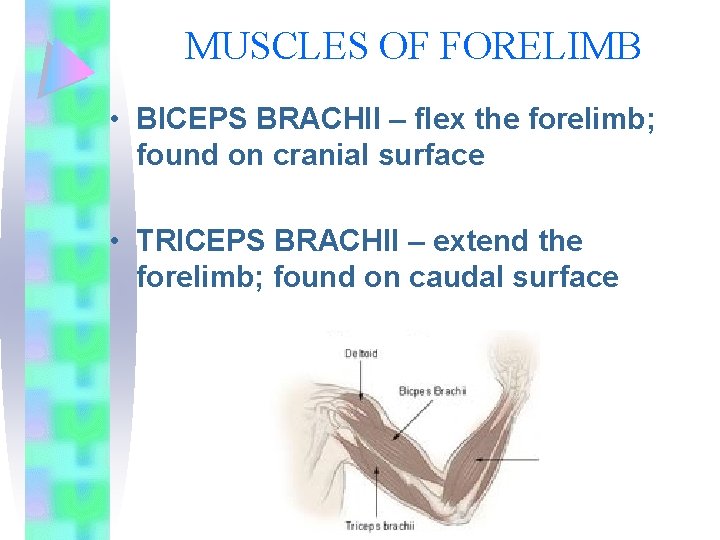
MUSCLES OF FORELIMB • BICEPS BRACHII – flex the forelimb; found on cranial surface • TRICEPS BRACHII – extend the forelimb; found on caudal surface
ABDOMINAL MUSCLES • KEEP VISCERA IN PLACE, SUPPORT AND COMPRESS THE ABDOMEN, CONTRACT (DURING PARTURITION, DEFECATION, URINATION, COUGHING), ROTATE THE VERTEBRAL COLUMN • • EXTERNAL OBLIQUE INTERNAL OBLIQUE RECTUS ABDOMINUS TRANSVERSUS ABDOMINUS • _______ – fibrous band of connective tissue that is the center of attachment of the abdominal muscles on the ventral abdominal wall
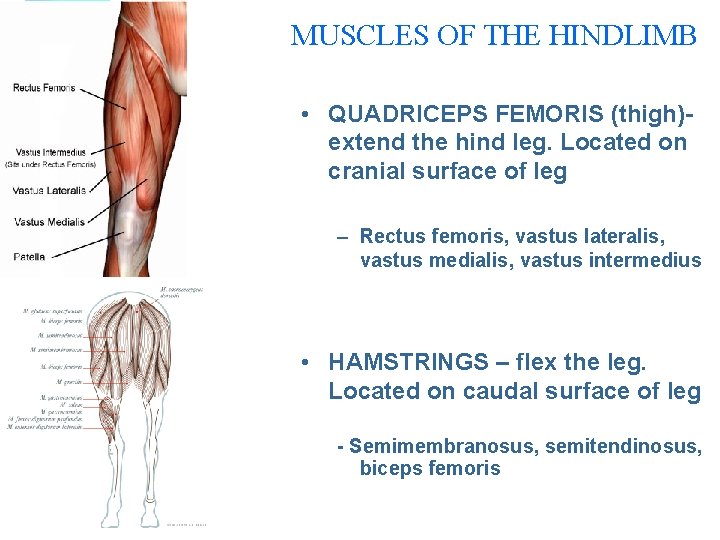
MUSCLES OF THE HINDLIMB • QUADRICEPS FEMORIS (thigh)extend the hind leg. Located on cranial surface of leg – Rectus femoris, vastus lateralis, vastus medialis, vastus intermedius • HAMSTRINGS – flex the leg. Located on caudal surface of leg - Semimembranosus, semitendinosus, biceps femoris
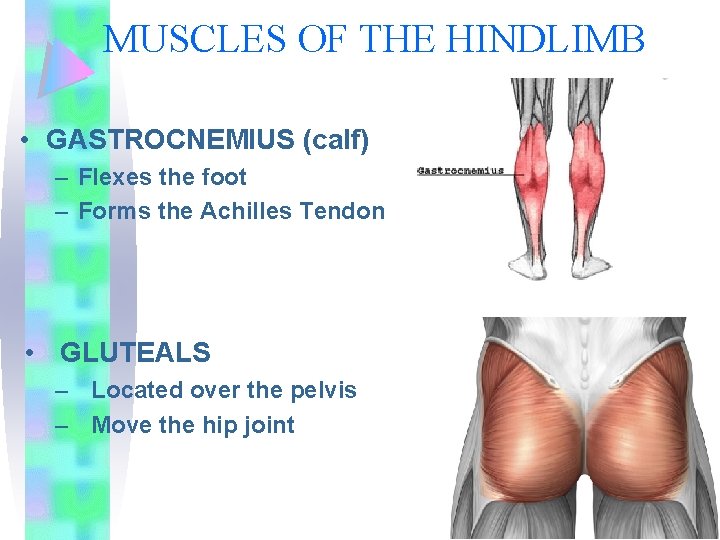
MUSCLES OF THE HINDLIMB • GASTROCNEMIUS (calf) – Flexes the foot – Forms the Achilles Tendon • GLUTEALS – Located over the pelvis – Move the hip joint
- Slides: 15