
The Muons Magnetic Moment Whats all the fuss


- Slides: 33
The Muon’s Magnetic Moment What’s all the fuss about anyway? B. Lee Roberts Department of Physics Boston University roberts@bu. edu http: //physics. bu. edu/roberts. html B. Lee Roberts, Hampton University, 23 March 2007 1
In this talk I Must Explain: • The Fuss • The Muon (What? ) • Spin and Magnetic Moments (Why and How? ) • So What? B. Lee Roberts, Hampton University, 23 March 2007 2
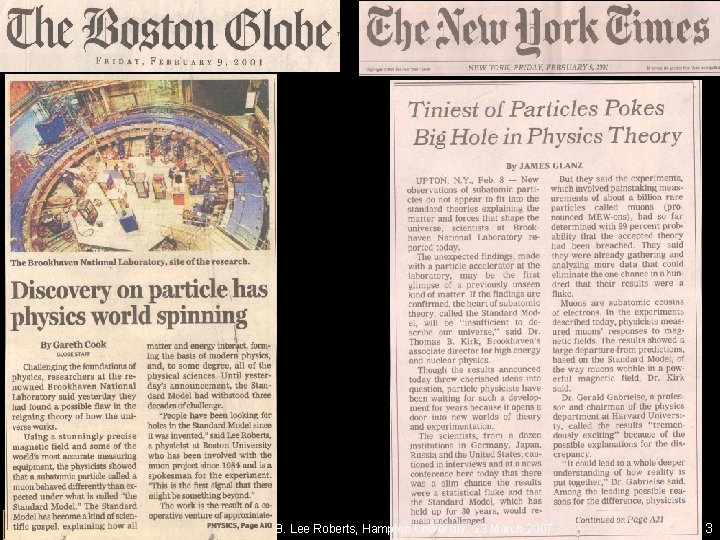
B. Lee Roberts, Hampton University, 23 March 2007 3
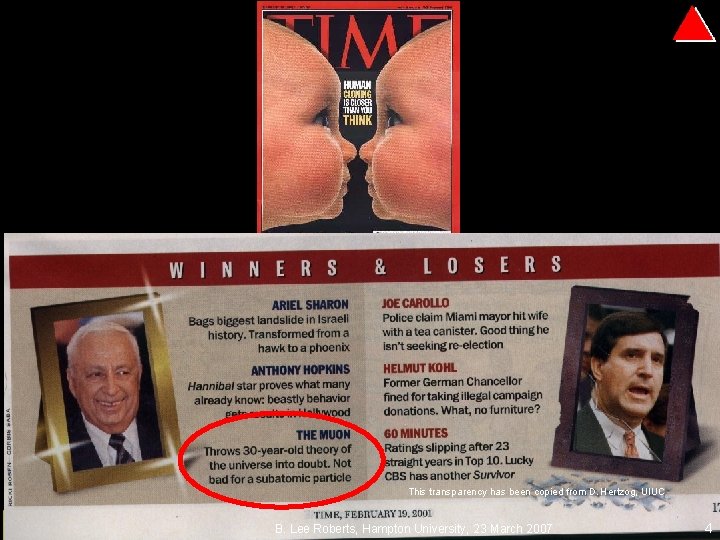
This transparency has been copied from D. Hertzog, UIUC B. Lee Roberts, Hampton University, 23 March 2007 4
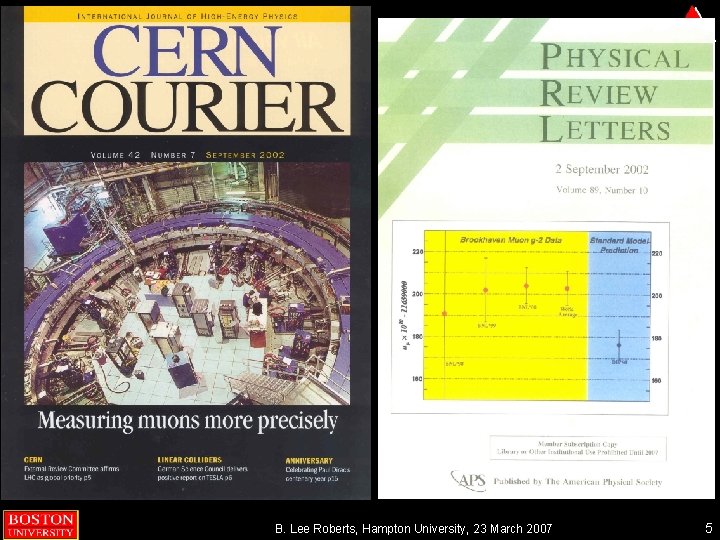
B. Lee Roberts, Hampton University, 23 March 2007 5
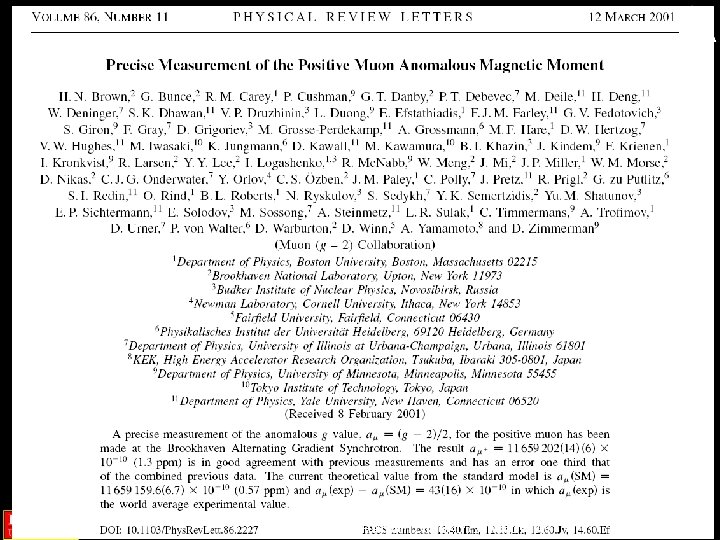
After only 17 years work B. Lee Roberts, Hampton University, 23 March 2007 6
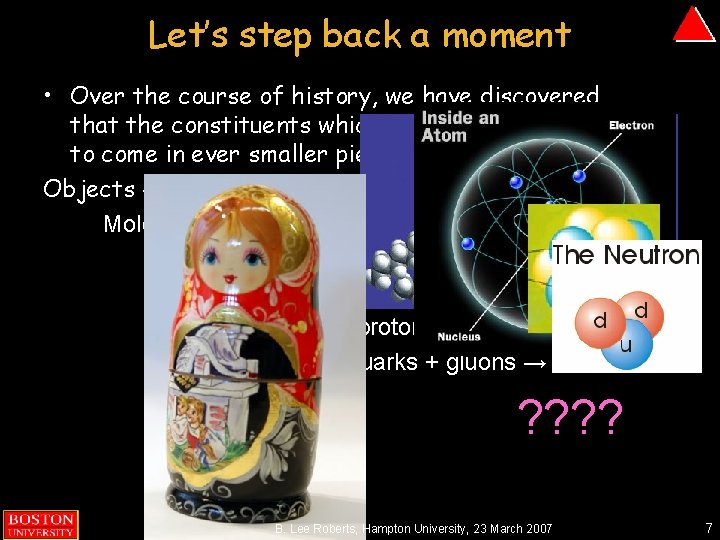
Let’s step back a moment • Over the course of history, we have discovered that the constituents which make up matter seem to come in ever smaller pieces Objects → Molecules → Atoms → electrons + nuclei → neutrons + protons → leptons quarks + gluons → ? ? B. Lee Roberts, Hampton University, 23 March 2007 7
What? The Muon • The muon is a “lepton” (light particle) • It appears to be like an electron, except heavier. • It undergoes radioactive decay after 2. 2 ms (millionths of a second) • When it was discovered in 1936, it was a big surprise! B. Lee Roberts, Hampton University, 23 March 2007 8
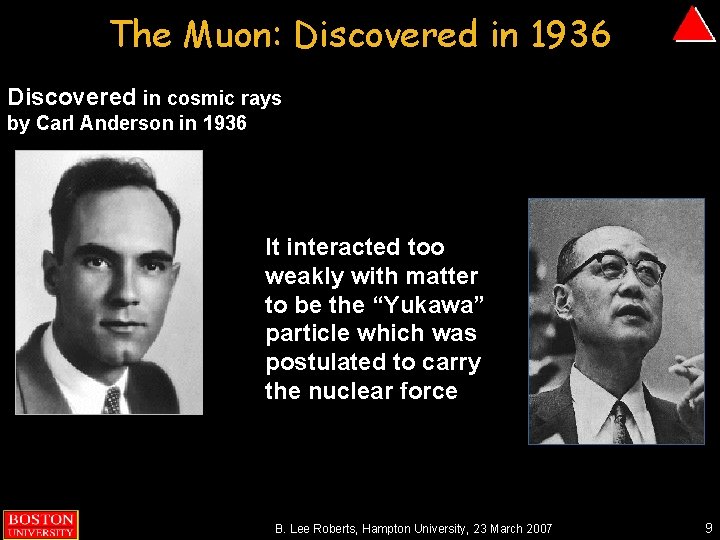
The Muon: Discovered in 1936 Discovered in cosmic rays by Carl Anderson in 1936 It interacted too weakly with matter to be the “Yukawa” particle which was postulated to carry the nuclear force B. Lee Roberts, Hampton University, 23 March 2007 9
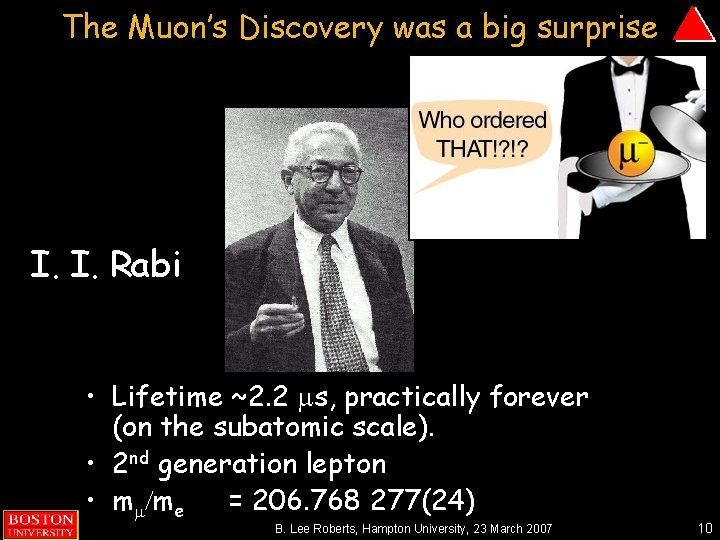
The Muon’s Discovery was a big surprise I. I. Rabi • Lifetime ~2. 2 ms, practically forever (on the subatomic scale). • 2 nd generation lepton • mm/me = 206. 768 277(24) B. Lee Roberts, Hampton University, 23 March 2007 10
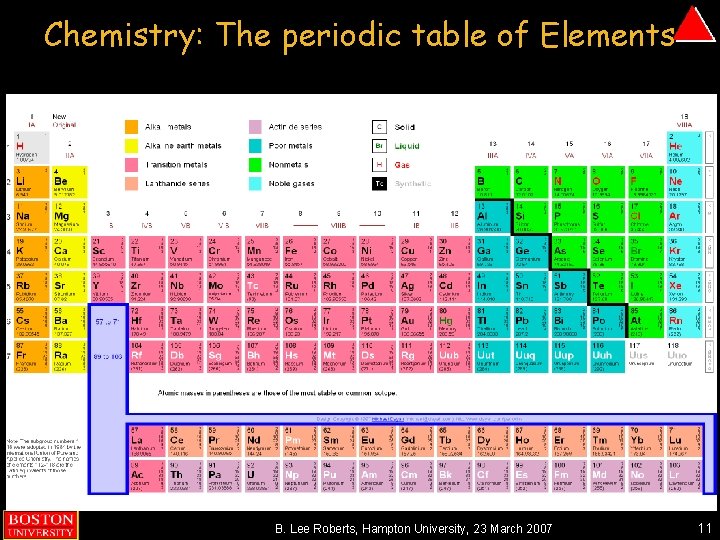
Chemistry: The periodic table of Elements B. Lee Roberts, Hampton University, 23 March 2007 11
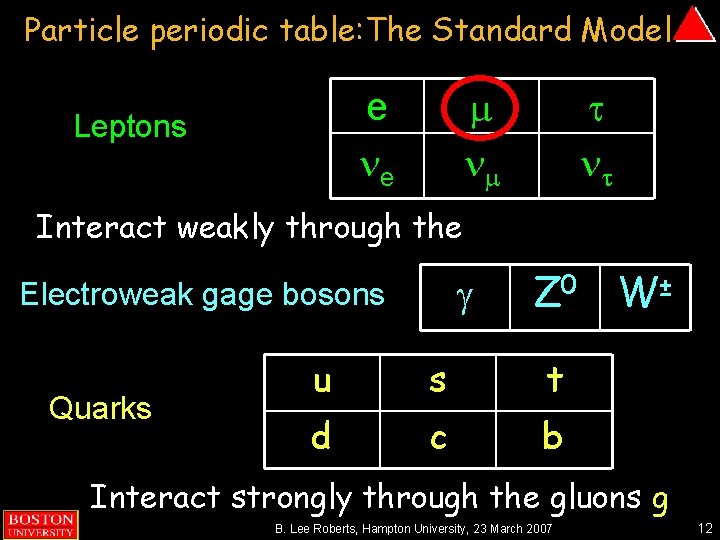
Particle periodic table: The Standard Model m nm e ne Leptons t nt Interact weakly through the g Electroweak gage bosons Quarks Z 0 u s t d c b W± Interact strongly through the gluons g B. Lee Roberts, Hampton University, 23 March 2007 12
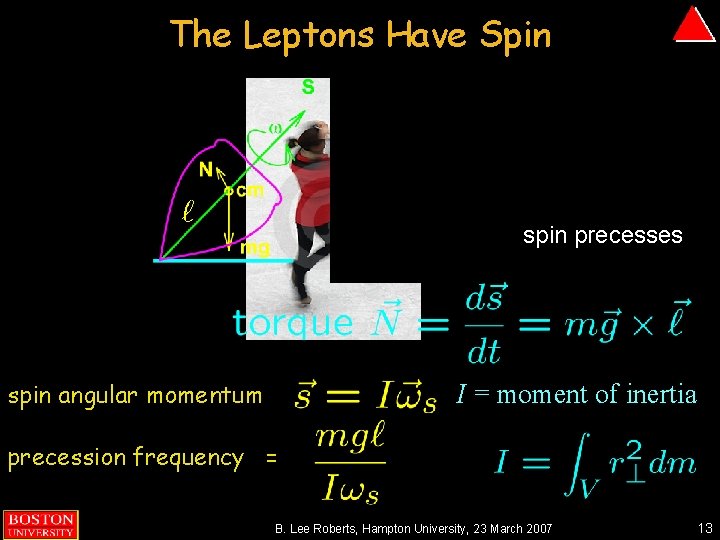
The Leptons Have Spin spin precesses spin angular momentum I = moment of inertia precession frequency = B. Lee Roberts, Hampton University, 23 March 2007 13
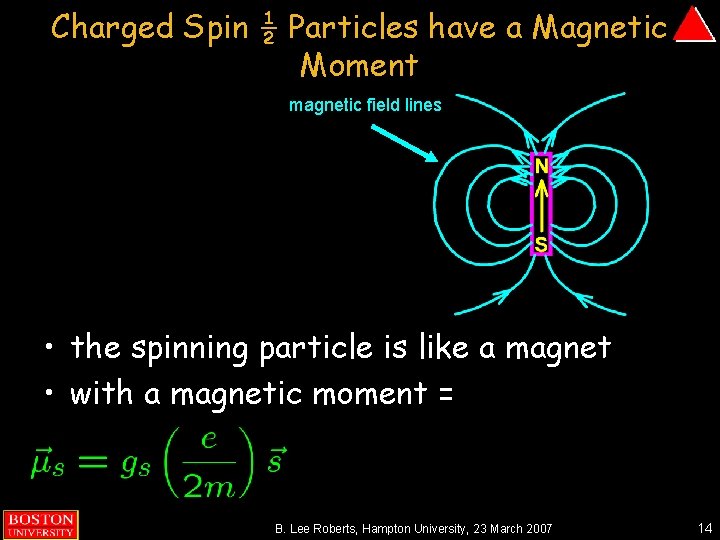
Charged Spin ½ Particles have a Magnetic Moment magnetic field lines • the spinning particle is like a magnet • with a magnetic moment = in the simplest theory, g ≡ 2 for spin B. Lee Roberts, Hampton University, 23 March 2007 14
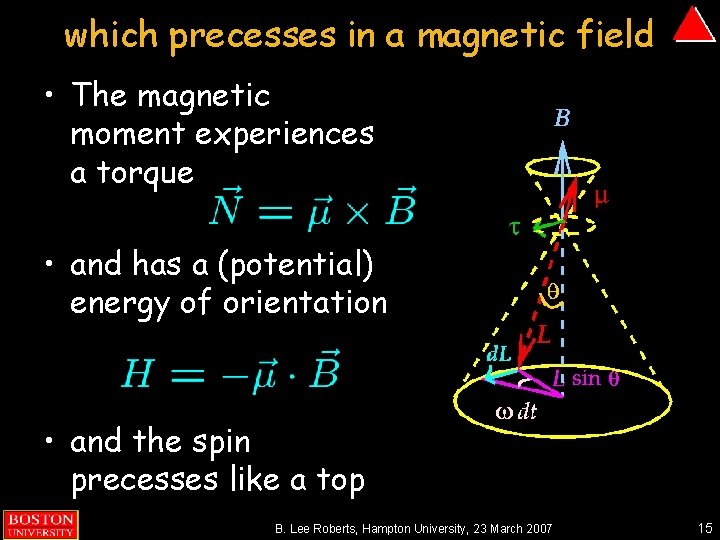
which precesses in a magnetic field • The magnetic moment experiences a torque • and has a (potential) energy of orientation • and the spin precesses like a top B. Lee Roberts, Hampton University, 23 March 2007 15
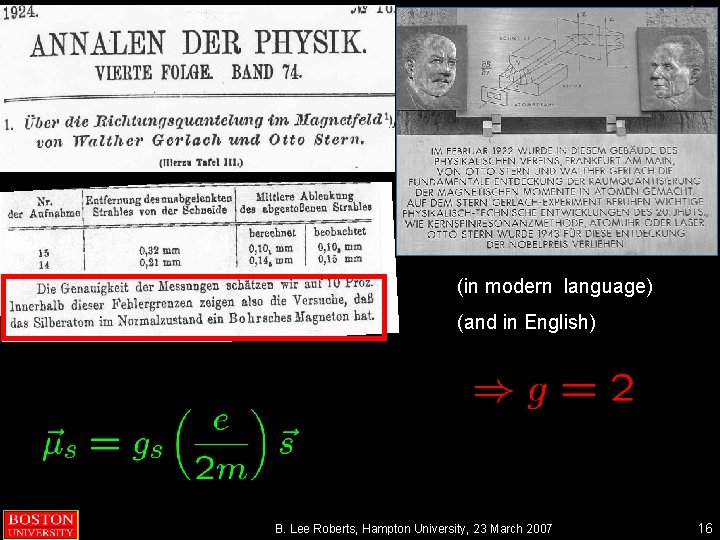
(in modern language) (and in English) B. Lee Roberts, Hampton University, 23 March 2007 16
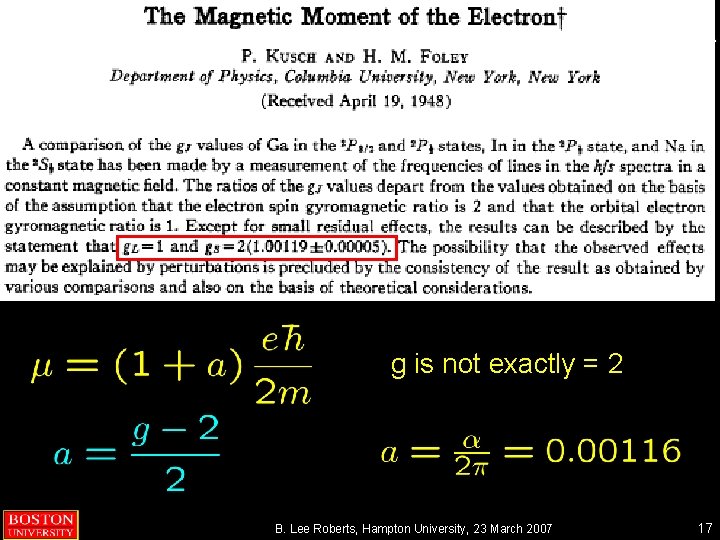
g is not exactly = 2 B. Lee Roberts, Hampton University, 23 March 2007 17
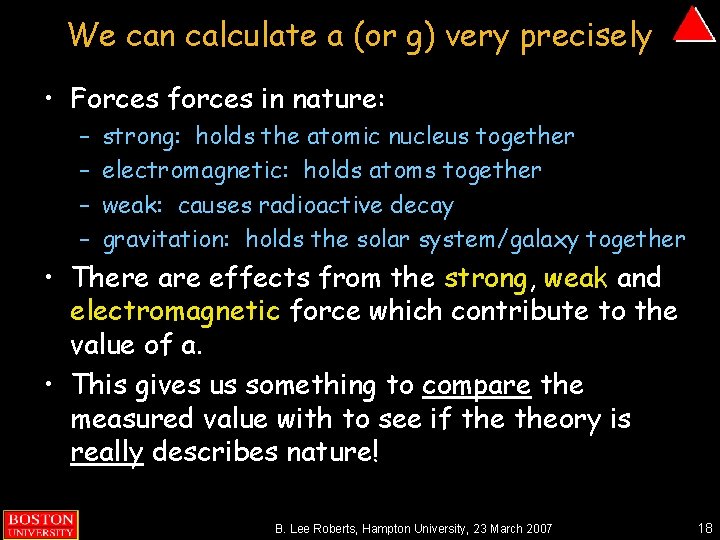
We can calculate a (or g) very precisely • Forces forces in nature: – – strong: holds the atomic nucleus together electromagnetic: holds atoms together weak: causes radioactive decay gravitation: holds the solar system/galaxy together • There are effects from the strong, weak and electromagnetic force which contribute to the value of a. • This gives us something to compare the measured value with to see if theory is really describes nature! B. Lee Roberts, Hampton University, 23 March 2007 18
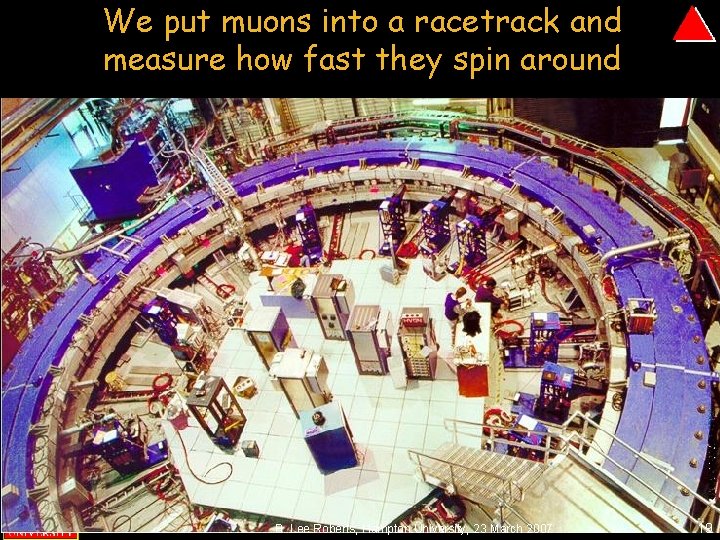
We put muons into a racetrack and measure how fast they spin around B. Lee Roberts, Hampton University, 23 March 2007 19
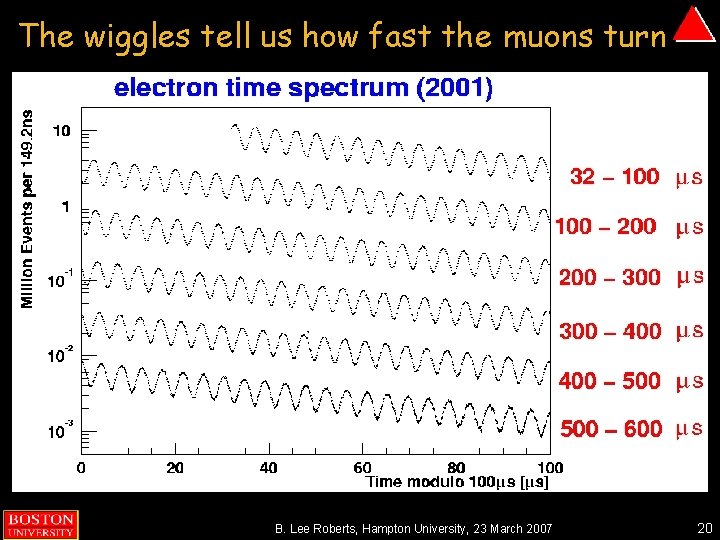
The wiggles tell us how fast the muons turn B. Lee Roberts, Hampton University, 23 March 2007 20
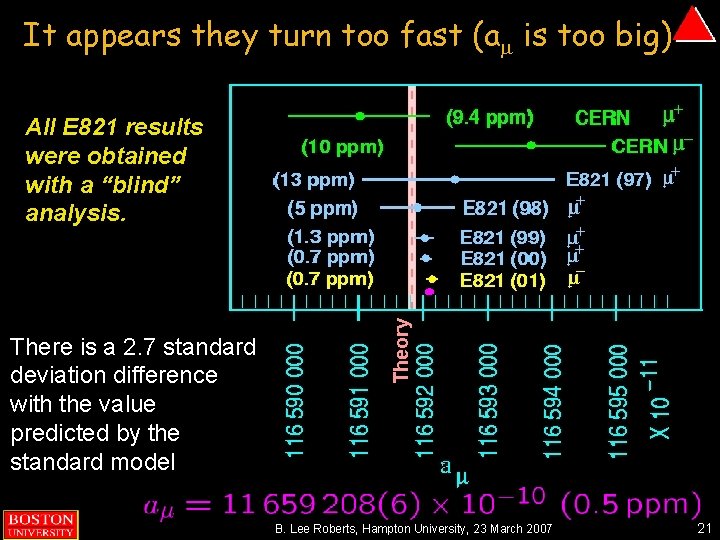
It appears they turn too fast (am is too big) There is a 2. 7 standard deviation difference with the value predicted by the standard model Theory All E 821 results were obtained with a “blind” analysis. B. Lee Roberts, Hampton University, 23 March 2007 21
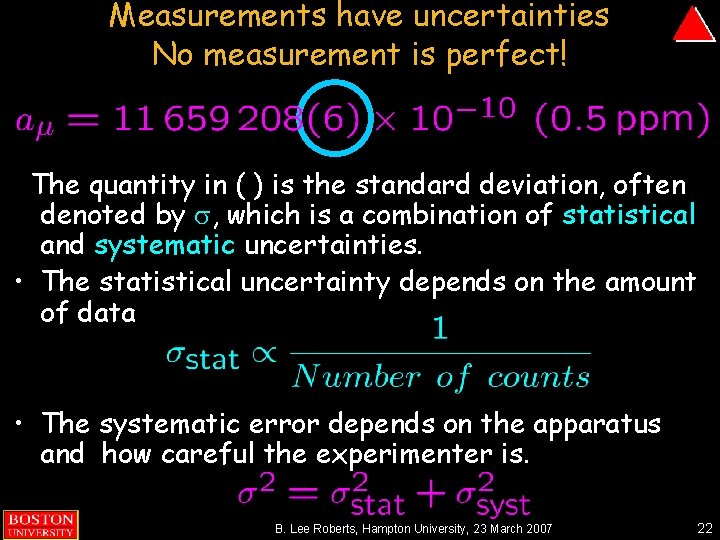
Measurements have uncertainties No measurement is perfect! The quantity in ( ) is the standard deviation, often denoted by s, which is a combination of statistical and systematic uncertainties. • The statistical uncertainty depends on the amount of data • The systematic error depends on the apparatus and how careful the experimenter is. B. Lee Roberts, Hampton University, 23 March 2007 22
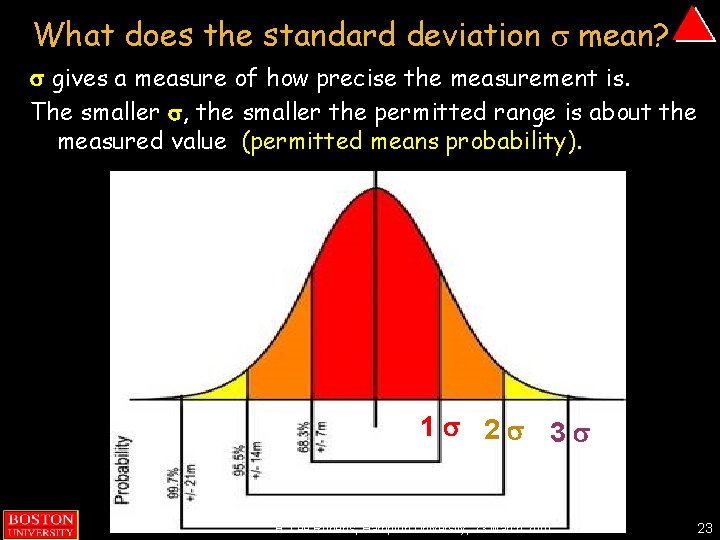
What does the standard deviation s mean? s gives a measure of how precise the measurement is. The smaller s, the smaller the permitted range is about the measured value (permitted means probability). 1 s 2 s 3 s B. Lee Roberts, Hampton University, 23 March 2007 23
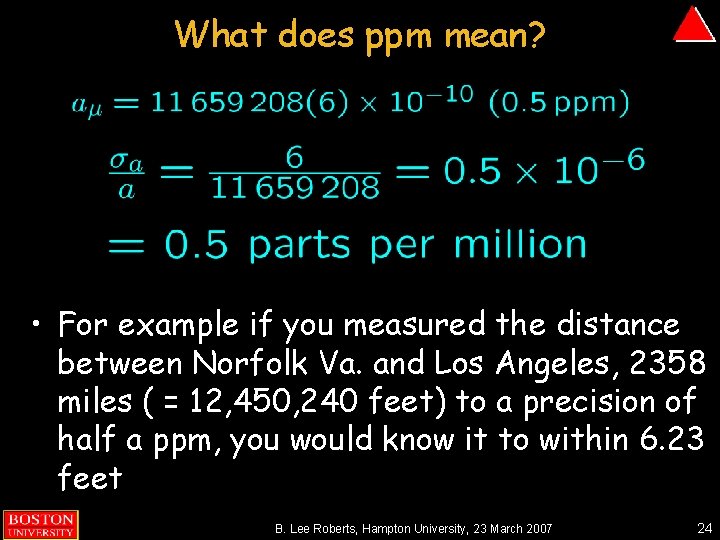
What does ppm mean? • For example if you measured the distance between Norfolk Va. and Los Angeles, 2358 miles ( = 12, 450, 240 feet) to a precision of half a ppm, you would know it to within 6. 23 feet B. Lee Roberts, Hampton University, 23 March 2007 24
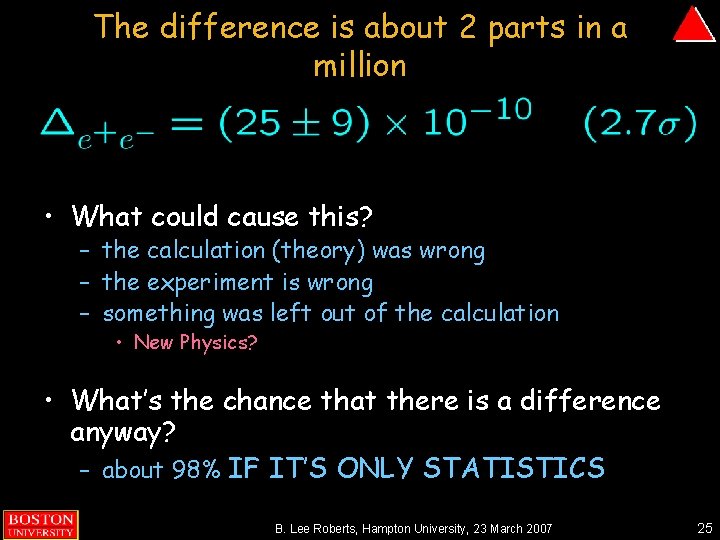
The difference is about 2 parts in a million • What could cause this? – the calculation (theory) was wrong – the experiment is wrong – something was left out of the calculation • New Physics? • What’s the chance that there is a difference anyway? – about 98% IF IT’S ONLY STATISTICS B. Lee Roberts, Hampton University, 23 March 2007 25
So what does 98% mean? • If there’s a 98% chance of rain, would you schedule a picnic? – Probably not. • If there’s a 98% chance you could double your life’s savings, would you risk losing all of them? – Probably not. • If there’s a 98% chance you will arrive safely home after an airplane flight, would anyone fly? – Probably not B. Lee Roberts, Hampton University, 23 March 2007 26
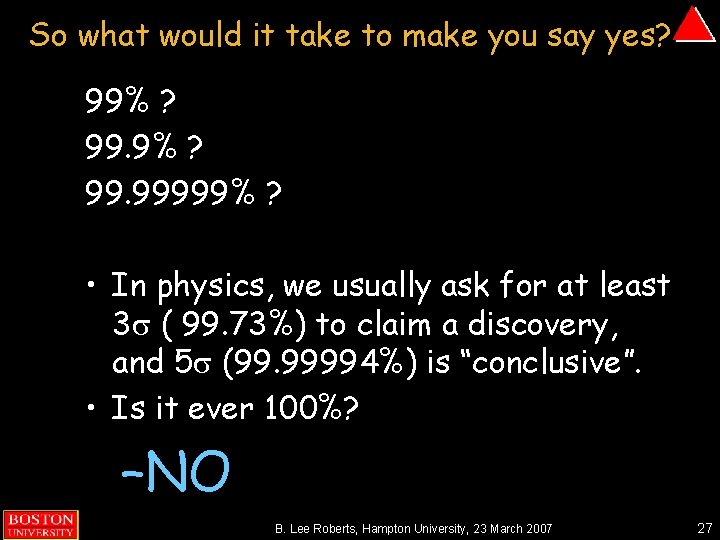
So what would it take to make you say yes? 99% ? 99. 99999% ? • In physics, we usually ask for at least 3 s ( 99. 73%) to claim a discovery, and 5 s (99. 99994%) is “conclusive”. • Is it ever 100%? –NO B. Lee Roberts, Hampton University, 23 March 2007 27
SO W HAT? B. Lee Roberts, Hampton University, 23 March 2007 28
So what might it mean? • Have we seen a hint of new physics? • Is there a mistake? – well at least our analysis was blind so we didn’t bias the answer • How do we “make sure” there is something new rather than a statistical fluctuation? – need at least 3 s, 5 s is definitive B. Lee Roberts, Hampton University, 23 March 2007 29
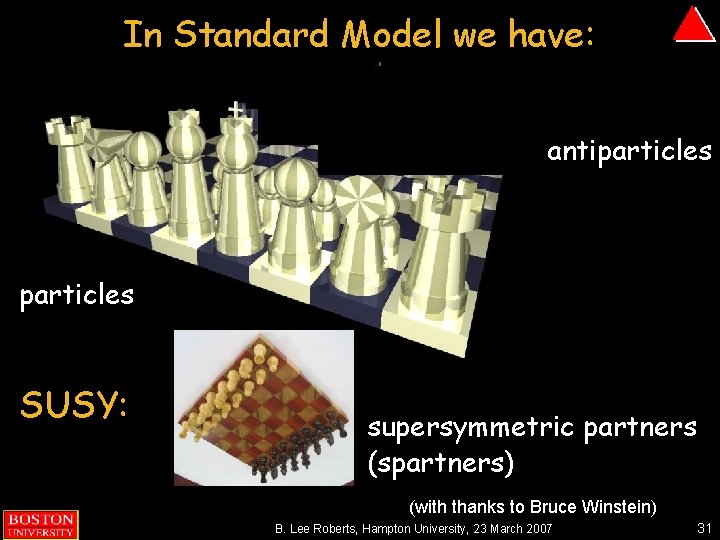
A Flight of Fancy • Some people claim that we have seen the first evidence for “supersymmetry” – a theory which says that for every particle we know about, there is a companion partner (which we have never seen before) B. Lee Roberts, Hampton University, 23 March 2007 30
In Standard Model we have: antiparticles SUSY: supersymmetric partners (spartners) (with thanks to Bruce Winstein) B. Lee Roberts, Hampton University, 23 March 2007 31
Have we discovered something new? Like much of science, this is a work in progress… STAY TUNED B. Lee Roberts, Hampton University, 23 March 2007 32
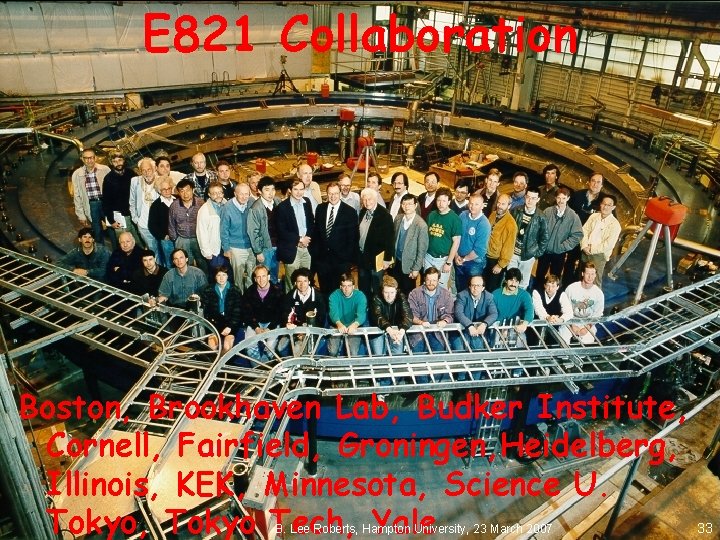
E 821 Collaboration Boston, Brookhaven Lab, Budker Institute, Cornell, Fairfield, Groningen, Heidelberg, Illinois, KEK, Minnesota, Science U. Tokyo, Tokyo Tech, Yale 33 B. Lee Roberts, Hampton University, 23 March 2007