
The Multiscale Modeling Framework MMF with a Cloudresolving
- Slides: 6
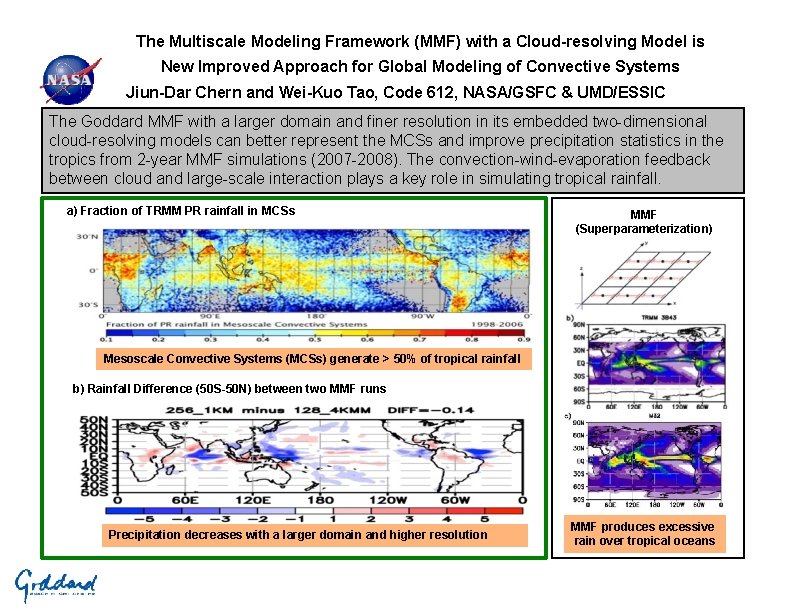
The Multiscale Modeling Framework (MMF) with a Cloud-resolving Model is New Improved Approach for Global Modeling of Convective Systems Jiun-Dar Chern and Wei-Kuo Tao, Code 612, NASA/GSFC & UMD/ESSIC The Goddard MMF with a larger domain and finer resolution in its embedded two-dimensional cloud-resolving models can better represent the MCSs and improve precipitation statistics in the tropics from 2 -year MMF simulations (2007 -2008). The convection-wind-evaporation feedback between cloud and large-scale interaction plays a key role in simulating tropical rainfall. a) Fraction of TRMM PR rainfall in MCSs MMF (Superparameterization) Mesoscale Convective Systems (MCSs) generate > 50% of tropical rainfall b) Rainfall Difference (50 S-50 N) between two MMF runs Precipitation decreases with a larger domain and higher resolution MMF produces excessive rain over tropical oceans
Name: Jiun-Dar Chern, NASA/GSFC, Code 612 E-mail: jiun-dar. chern-1@nasa. gov Phone: 301 -614 -6175 References: Tao, W. -K. , and J. -D. Chern (2017), The impact of simulated mesoscale convective systems on global precipitation: A multi-scale modeling study, J. Adv. Model. Earth Syst. , 9, doi: 10. 1002/2016 MS 000836. Chern, J. -D. , W. -K. Tao, S. E. Lang, T. Matsui, J. -L. F. Li, K. I. Mohr, G. M. Skofronick-Jackson, and C. D. Peters-Lidard (2016), Performance of the Goddard multiscale modeling framework with Goddard ice microphysical schemes, J. Adv. Model. Earth Syst. , 7, doi: 10. 1002/2015 MS 000469. Data Sources: The two-year hourly model diagnostics dataset came from a series of Goddard Multiscale Modeling Framework (GMMF) simulations with different model configurations. The model outputs used in this study data are available upon request from wei-kuo. tao 1@nasa. gov. The dataset will also be available in a public domain with ftp access made available from Goddard Cloud Library, http: //cloud. gsfc. nasa. gov. The GPCP and TRMM datasets used in this study are accessible from http: //precip. gsfc. nasa. gov. Technical Description of Figures: The Multiscale Modeling Framework (MMF) wherein conventional cloud parameterizations are replaced with a cloud-resolving model (CRM) in each grid column of a traditional global atmospheric model is a new approach for global modeling. One of the systematic biases in MMFs is the excessive rainfall over the West Pacific and other tropical oceans when compared against TRMM/GPM satellite estimates (right panels). The importance of precipitating mesoscale convective systems (MCSs) has been quantified from TRMM precipitation radar and microwave imager retrievals. MCSs generate more than 50% of tropical rainfall (a). MCSs usually have horizontal scales of a few hundred kilometers; therefore, a large domain (> 256 km) and a fine model grid-spacing (1 km) is required for realistically simulating MCSs. The Goddard MMF (GMMF), with a larger domain and higher resolution in its embedded CRMs, produces less tropical precipitation over oceans, reducing the model systematic biases (b). The GMMF modeling results also show the intensities of the Hadley circulations and mean zonal and regional vertical velocities are weaker, and the amounts of surface evaporation and surface rainfall are reduced in the GMMF when using more CRM grid points and higher CRM resolution. In addition, the results indicate that large-scale surface evaporation and wind feedback are key processes for determining the surface rainfall amount in the GMMF. Scientific significance, societal relevance, and relationships to future missions: The Goddard MMF is an economical approach to global cloud-resolving (or cloud-permitting) modeling that removes the uncertainties associated with cloud parameterizations in traditional global models. This study demonstrates the importance of model domain size and grid spacing in simulating mesoscale convective systems in the tropics. A realistic representation of MCSs in global models will advance our understanding of energy and water cycles and of nonlinear cloud and large-scale interactions. The high-resolution cloud-resolving model dataset from the GMMF simulations has been incorporated into a satellite-retrieval database for the cross-track scanning sensors of the Global Precipitation Measurement (GPM) constellation satellites. The improvement of global rainfall simulation in the GMMF will lead to better GPM surface rainfall retrieval products. Earth Sciences Division - Atmospheres
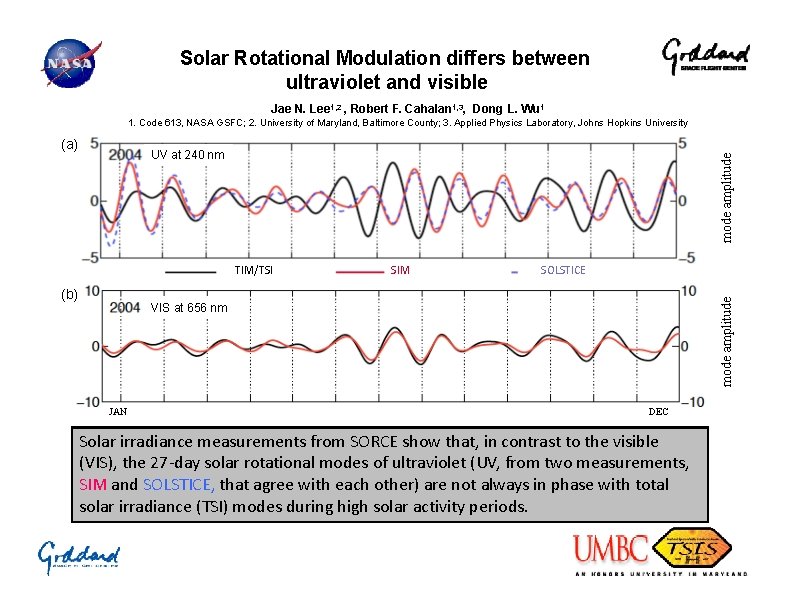
Solar Rotational Modulation differs between ultraviolet and visible Jae N. Lee 1, 2 , Robert F. Cahalan 1, 3, Dong L. Wu 1 1. Code 613, NASA GSFC; 2. University of Maryland, Baltimore County; 3. Applied Physics Laboratory, Johns Hopkins University (a) mode amplitude UV at 240 nm (b) SIM SOLSTICE mode amplitude TIM/TSI VIS at 656 nm JAN DEC Solar irradiance measurements from SORCE show that, in contrast to the visible (VIS), the 27‐day solar rotational modes of ultraviolet (UV, from two measurements, SIM and SOLSTICE, that agree with each other) are not always in phase with total solar irradiance (TSI) modes during high solar activity periods.
Name: Jae N. Lee, NASA/GSFC, Code 613, University of Maryland, Baltimore County E-mail: jae. n. lee@nasa. gov Phone: 301 -614 -6189 References: Lee, J. N. , R. F. Cahalan, and D. L. Wu, 2015. The 27 -Day Rotational Variations in Total Solar Irradiance Observations: from SORCE/TIM, ACRIM III, and SOHO/VIRGO, J. Atmos. Sol-Terr. Physics, 132, 64 -73, doi: 10. 1016/j. jastp. 2015. 07. 001. Lee, J. N. , R. F. Cahalan, and D. L. Wu, 2016. Solar Rotational Modulations of Spectral Irradiance and Correlations with the Variability of Total Solar Irradiance, J. Space Weather Space Climate, 6 (A 33): [http: //dx. doi. org/10. 1051/swsc/2016028] Data Sources: 1. Solar Radiation and Climate Experiment (SORCE) Total Solar Irradiance Monitor (TIM) 2. SORCE SOLar STellar Irradiance Comparison Experiment (SOLSTICE) 3. SORCE Spectral Solar Irradiance Monitor (SIM) Technical Description of Figures: Figure Solar Rotational Modulations of ultraviolet (UV) and visible (VIS) and their relations with Total Solar Irradiance (TSI). (a)Comparison of rotational variation from the SORCE TIM TSI (black), SIM SSI (red), and SOLSTICE SSI (blue dot) at 240 nm during 2004. Vertical lines denote Carrington rotational cycle. The normalized amplitudes are estimated with intrinsic mode function, I, by removing the mean and low frequency variations of solar irradiances over the analysis time and by dividing with its standard deviation, for TSI and UV, respectively. Numbers in right and left axis indicate the normalized amplitude of the rotational variations of TSI and UV. (b) Same as Figure 1(a), but comparison of rotational modulation of VIS at Hydrogen-α (656. 3 nm) with TSI. Scientific significance, societal relevance, and relationships to future missions Solar Spectral Irradiance variations can produce significant changes in Earth’s upper, middle, and lower atmospheres. Understanding the complex response of terrestrial atmosphere to solar variations is essential for assessing climate variability. While the VIS and UV portion of the solar spectrum may have not yet been observed with sufficient accuracy and precision to determine the 11 -year solar cycle variations, the National Climate Data Record (CDR) of TSI and SSI uses 27 -day solar rotational variations to simulate them. The temporal variations over one hundred cycles of solar rotations independent of the two solar cycles in which they are embedded show distinct solar rotational modulations at the UV and VIS parts of the solar spectrum measured by SORCE. Uninterrupted long term records of TSI and Spectral Solar Irradiance (SSI) are critical for determining solar impact on climate variability. The Total and Spectral Solar Irradiance Sensor-1 (TSIS-1) due for deployment on the International Space Station in late 2017 will extend TSI and SSI observations after SORCE. To fill any possible gap in the future solar irradiance measurements between SORCE and TSIS-1, the Total Solar Irradiance Calibration Transfer Experiment (TCTE) operating since December 2013 provides cross-calibration between SORCE and TSIS-1. Earth Sciences Division - Atmospheres
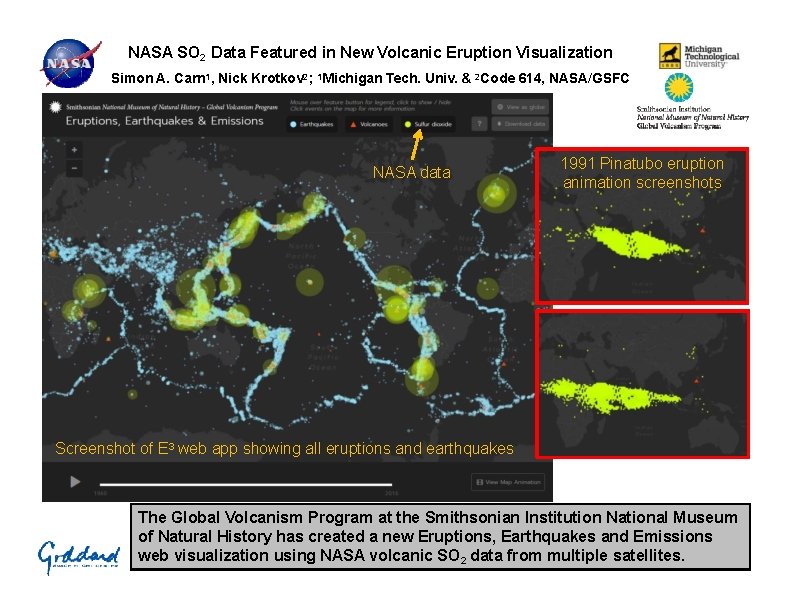
NASA SO 2 Data Featured in New Volcanic Eruption Visualization Simon A. Carn 1, Nick Krotkov 2; 1 Michigan Tech. Univ. & 2 Code 614, NASA/GSFC NASA data 1991 Pinatubo eruption animation screenshots Screenshot of E 3 web app showing all eruptions and earthquakes The Global Volcanism Program at the Smithsonian Institution National Museum of Natural History has created a new Eruptions, Earthquakes and Emissions web visualization using NASA volcanic SO 2 data from multiple satellites.
Name: Simon Carn (Michigan Technological University, Houghton, MI) and Nick Krotkov (NASA/GSFC, Code 614) E-mail: scarn@mtu. edu; Nickolay. A. Krotkov@nasa. gov Phone: (906) 487 -1756; (301) 614 -5553 References: Global Volcanism Program (2016). Eruptions, Earthquakes & Emissions, v. 1. 0 (internet application). Smithsonian Institution. Accessed 15 Feb 2017 (http: //volcano. si. edu/E 3/). Data Sources: Total Ozone Mapping Spectrometer (TOMS), Ozone Monitoring Instrument (OMI) and Ozone Mapping and Profiler Suite (OMPS) observations of volcanic SO 2 clouds between 1978 and 2015. New OMI and OMPS volcanic SO 2 products produced by the Goddard OMI SO 2 team at code 614 (Can Li (614/ESSIC) and Nickolay A. Krotkov (PI-614)) are described in this paper: Li, C. , Krotkov, N. A. , Carn, S. , Zhang, Y. , Spurr, R. J. D. , and Joiner, J. (2017). New-generation NASA Aura Ozone Monitoring Instrument (OMI) volcanic SO 2 dataset: algorithm description, initial results, and continuation with the Suomi-NPP Ozone Mapping and Profiler Suite (OMPS), Atmos. Meas. Tech. , 10, 445 -458, doi: 10. 5194/amt-10 -445 -2017. Technical Description of Figures: Graphic 1 (left): This shows a screenshot of the Smithsonian Institution Eruptions, Earthquakes & Emissions (E 3) web application with all volcanoes with recorded eruptions (red triangles), SO 2 emissions (yellow circles; circle size is proportional to SO 2 emissions measured by TOMS, OMI or OMPS) and earthquakes (blue dots) shown. The web app shows an animated time sequence of these events from 1960 to present. NASA volcanic SO 2 data are available from 1978. The application can be paused at any time to view animations of volcanic SO 2 cloud transport after major eruptions (e. g. , Graphic 2). Graphic 2 (right): This shows two screenshots of an animation of the 1991 Pinatubo (Philippines) volcanic SO 2 cloud. Scientific significance, societal relevance, and relationships to future missions: The Smithsonian Institution Global Volcanism Program (GVP) is the world’s most authoritative source of information on global volcanic activity, both for the scientific community and the general public. The GVP Volcanoes of the World (VOTW) database is the most comprehensive record of Holocene volcanic activity available. To develop the E 3 application, volcanic SO 2 data from NASA satellites (TOMS, OMI, OMPS) was added to the VOTW database for the first time, where it will be publicly accessible to database users. This will significantly increase the visibility of NASA data and permit broader use of the data for public outreach and scientific analysis. Joint analysis of volcanic eruption records, SO 2 emission data and earthquake frequency could yield new insight into geological and volcanic processes. Earth Sciences Division - Atmospheres