
The Mu 2 e and Muon g2 Experiments





- Slides: 42
The Mu 2 e and Muon g-2 Experiments Precision windows into physics beyond the standard model Andrew Norman University of Virginia For the Mu 2 e & g-2 Collaborations
Introduction The world is poised for the LHC to turn on give us direct access to physics at the Terascale…. But there are other windows into new physics that can reach far beyond the energies of the world’s largest colliders Two of these windows are here at Fermilab Mu 2 e and g-2 will probe: new physics, new models new energy scales with ultra-rare searches and precision measurements A. Norman, U. Virginia FNAL Users Meeting 2009 2
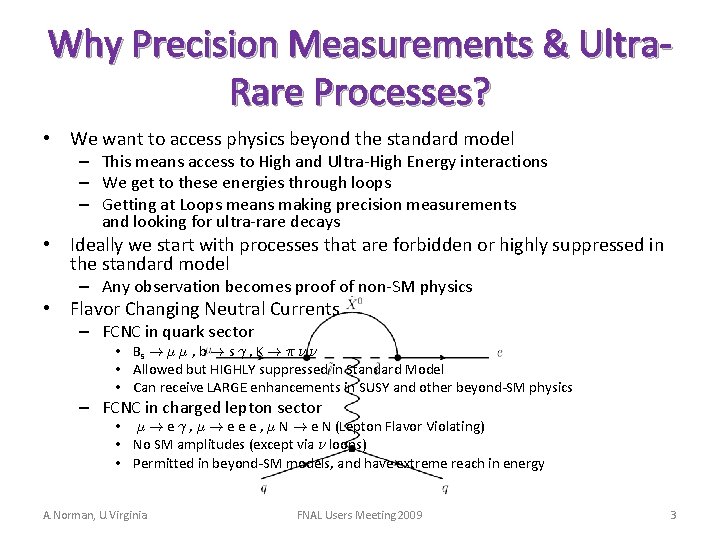
Why Precision Measurements & Ultra. Rare Processes? • We want to access physics beyond the standard model – This means access to High and Ultra-High Energy interactions – We get to these energies through loops – Getting at Loops means making precision measurements and looking for ultra-rare decays • Ideally we start with processes that are forbidden or highly suppressed in the standard model – Any observation becomes proof of non-SM physics • Flavor Changing Neutral Currents – FCNC in quark sector • Bs ! ¹ ¹ , b ! s ° , K ! ¼ º º • Allowed but HIGHLY suppressed in Standard Model • Can receive LARGE enhancements in SUSY and other beyond-SM physics – FCNC in charged lepton sector • ¹ ! e ° , ¹ ! e e e , ¹ N ! e N (Lepton Flavor Violating) • No SM amplitudes (except via º loops) • Permitted in beyond-SM models, and have extreme reach in energy A. Norman, U. Virginia FNAL Users Meeting 2009 3
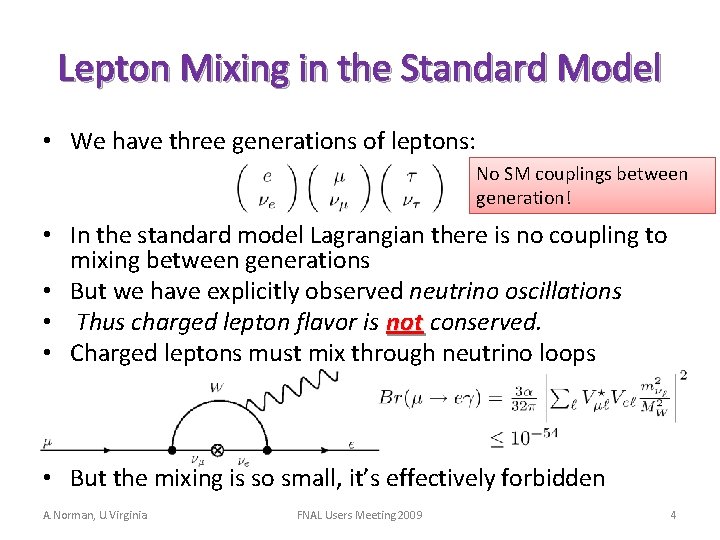
Lepton Mixing in the Standard Model • We have three generations of leptons: No SM couplings between generation! • In the standard model Lagrangian there is no coupling to mixing between generations • But we have explicitly observed neutrino oscillations • Thus charged lepton flavor is not conserved. • Charged leptons must mix through neutrino loops • But the mixing is so small, it’s effectively forbidden A. Norman, U. Virginia FNAL Users Meeting 2009 4
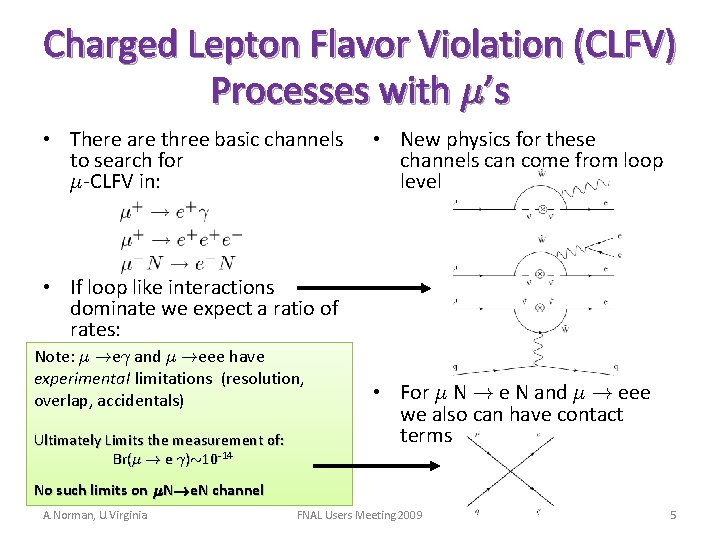
Charged Lepton Flavor Violation (CLFV) Processes with ¹’s • There are three basic channels to search for ¹-CLFV in: • New physics for these channels can come from loop level • If loop like interactions dominate we expect a ratio of rates: ¼ 400 to 2 to 1 Note: ¹ !e° and ¹ !eee have experimental limitations (resolution, overlap, accidentals) • If contact terms dominate then ¹N!e. N can have rates Ultimately Limits the measurement of: 200 times that of ¹!e° -14 • For ¹ N ! e N and ¹ ! eee we also can have contact terms Br(¹ ! e °)» 10 No such limits on ¹N!e. N channel A. Norman, U. Virginia FNAL Users Meeting 2009 5
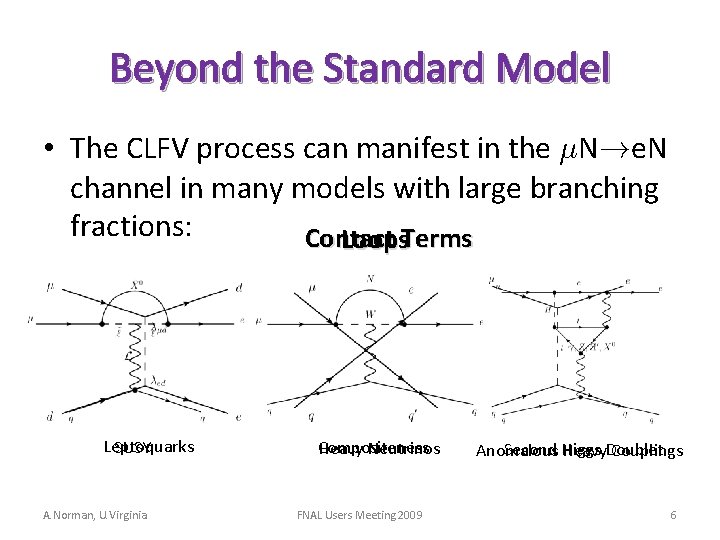
Beyond the Standard Model • The CLFV process can manifest in the ¹N!e. N channel in many models with large branching fractions: Contact Loops. Terms Leptoquarks SUSY A. Norman, U. Virginia Compositeness Heavy Neutrinos FNAL Users Meeting 2009 Second Higgs Doublet Anomalous Heavy Couplings 6
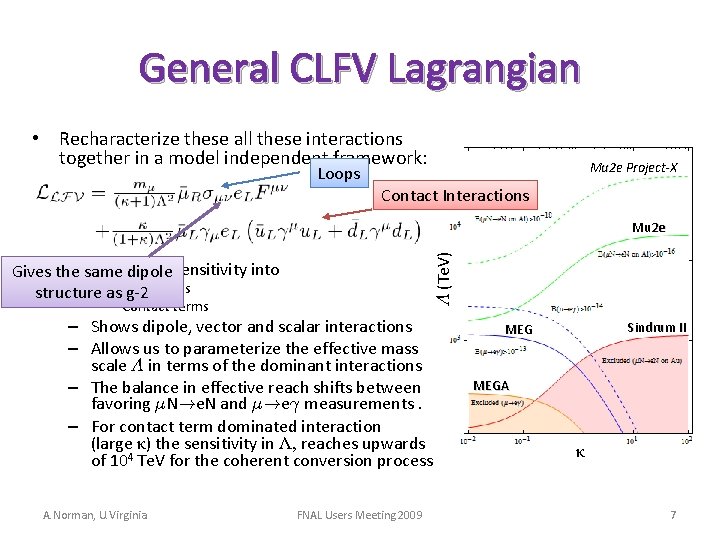
General CLFV Lagrangian • Recharacterize these all these interactions together in a model independent framework: Mu 2 e Project-X Loops Contact Interactions ¤ (Te. V) Mu 2 e – Splits CLFV sensitivity into Gives the same dipole • Loop terms structure as g-2 • Contact terms – Shows dipole, vector and scalar interactions – Allows us to parameterize the effective mass scale ¤ in terms of the dominant interactions – The balance in effective reach shifts between favoring ¹N!e. N and ¹!e° measurements. – For contact term dominated interaction (large κ) the sensitivity in Λ, reaches upwards of 104 Te. V for the coherent conversion process A. Norman, U. Virginia FNAL Users Meeting 2009 Sindrum II MEGA κ 7
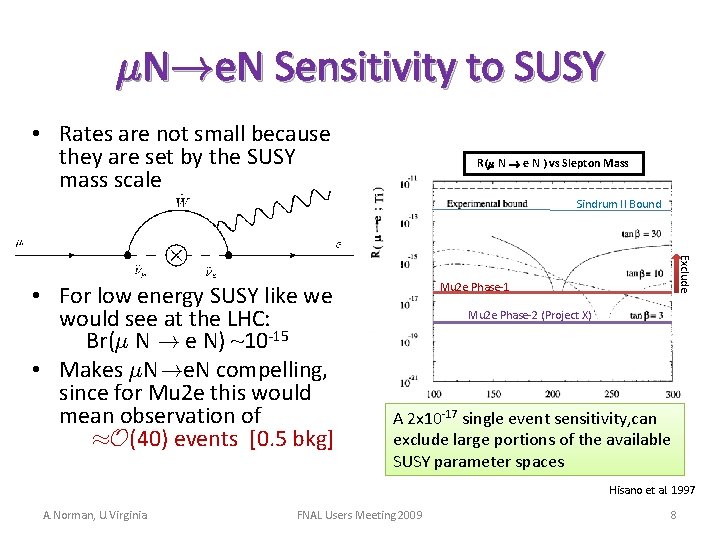
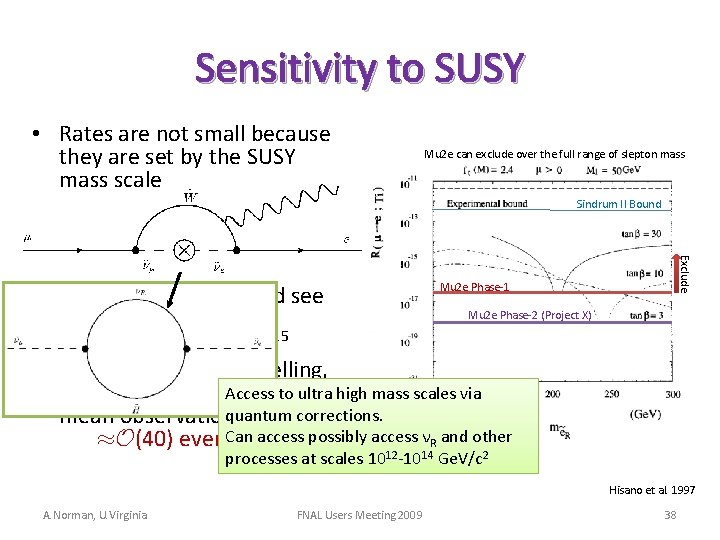
¹N!e. N Sensitivity to SUSY • Rates are not small because they are set by the SUSY mass scale R(¹ N ! e N ) vs Slepton Mass Sindrum II Bound Exclude • For low energy SUSY like we would see at the LHC: Br(¹ N ! e N) ~10 -15 • Makes ¹N!e. N compelling, since for Mu 2 e this would mean observation of ¼O(40) events [0. 5 bkg] Mu 2 e Phase-1 Mu 2 e Phase-2 (Project X) A 2 x 10 -17 single event sensitivity, can exclude large portions of the available SUSY parameter spaces Hisano et al. 1997 A. Norman, U. Virginia FNAL Users Meeting 2009 8
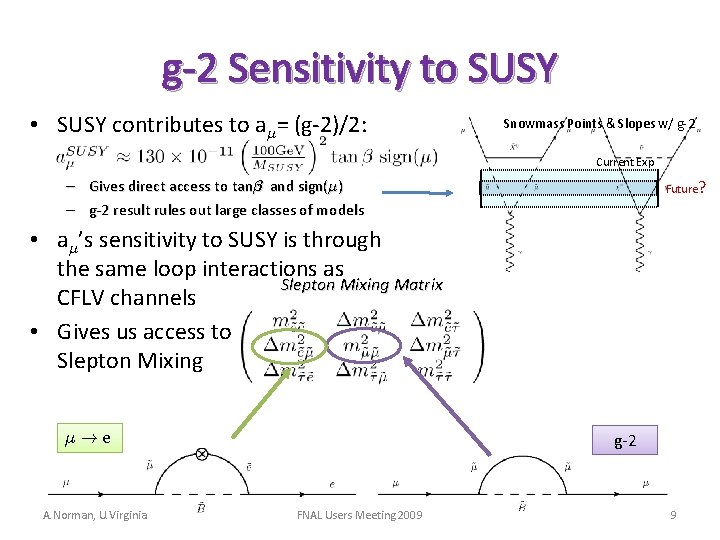
g-2 Sensitivity to SUSY • SUSY contributes to a¹= (g-2)/2: Snowmass Points & Slopes w/ g-2 Current Exp – Gives direct access to tan¯ and sign(¹) – g-2 result rules out large classes of models Future? • a¹’s sensitivity to SUSY is through the same loop interactions as Slepton Mixing Matrix CFLV channels • Gives us access to Slepton Mixing g-2 ¹ ! e A. Norman, U. Virginia FNAL Users Meeting 2009 9
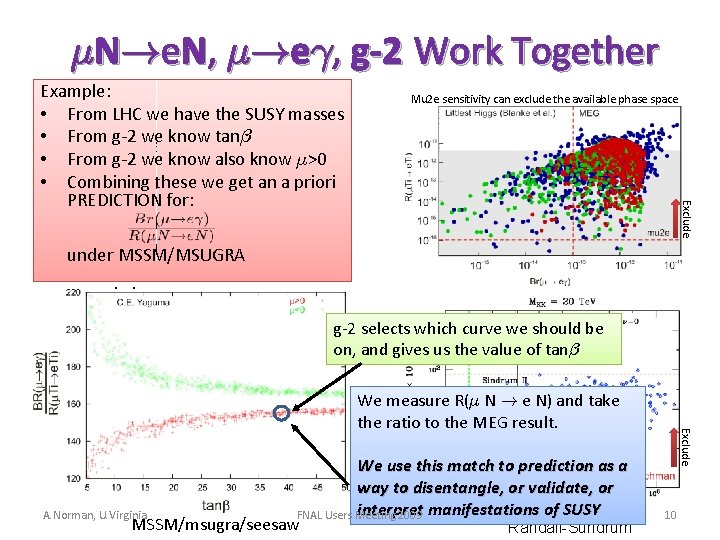
¹N!e. N, ¹!e°, g-2 Work Together Mu 2 e sensitivity can exclude the available phase space Exclude Example: • From LHC we have the SUSY masses • • From g-2 we know tan¯ Knowing ¹N!e. N, ¹!e° • From g-2 we know also know ¹>0 allow us to exclude SUSY • Combining these we get an a priori phase space PREDICTION for: We use this match to prediction as a way to disentangle, or validate, or interpret manifestations of SUSY A. Norman, U. Virginia FNAL Users Meeting 2009 MSSM/msugra/seesaw Randall-Sundrum Exclude • Also knowing the g-2 results allows us to then under MSSM/MSUGRA over constrain SUSY models g-2 selects which curve we should be • In some cases this permits on, and gives us the value of tan¯ us to make strong, testable predictions for We measure R(¹ N ! e N) and take our models in terms of Br(¹!e°) & R(¹N!e. N) the ratio to the MEG result. 10
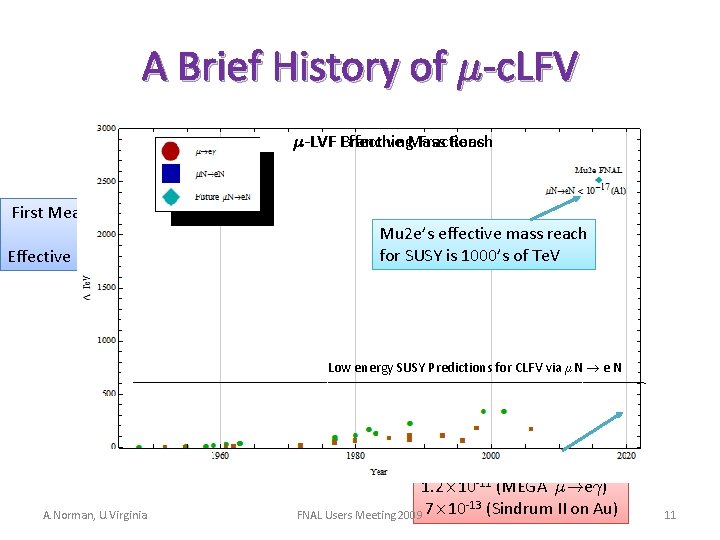
A Brief History of ¹-c. LFV ¹-LVF Effective Mass Reach ¹-LVF Branching Fractions First Measurement (Pontecorvo) 6£ 10 -2 in 1948 Effective Mass Reach 1. 2 Te. V!! Te. V Mu 2 e’s effective mass reach for SUSY is 1000’s of Te. V Low energy SUSY Predictions for CLFV via ¹N ! e N Mu 2 e will push the ¹N!e. N limit down four orders of magnitude. Below the SUSY prediction A. Norman, U. Virginia Current Limits: 1. 2£ 10 -11 (MEGA ¹!e°) -13 FNAL Users Meeting 2009 7£ 10 (Sindrum II on Au) 11
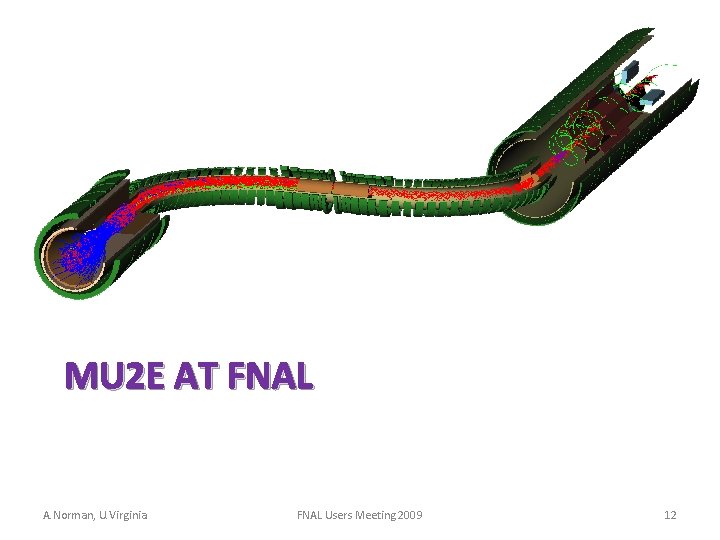
MU 2 E AT FNAL A. Norman, U. Virginia FNAL Users Meeting 2009 12
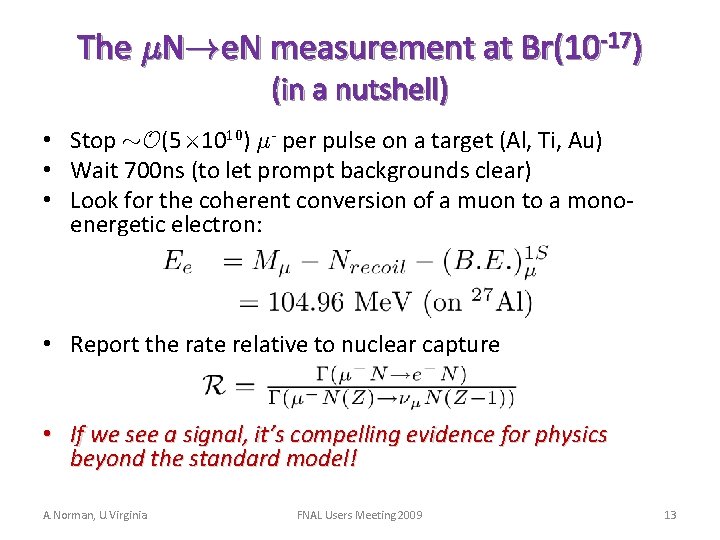
The ¹N!e. N measurement at Br(10 -17) (in a nutshell) • Stop » O(5£ 1010) ¹- per pulse on a target (Al, Ti, Au) • Wait 700 ns (to let prompt backgrounds clear) • Look for the coherent conversion of a muon to a monoenergetic electron: • Report the rate relative to nuclear capture • If we see a signal, it’s compelling evidence for physics beyond the standard model! A. Norman, U. Virginia FNAL Users Meeting 2009 13
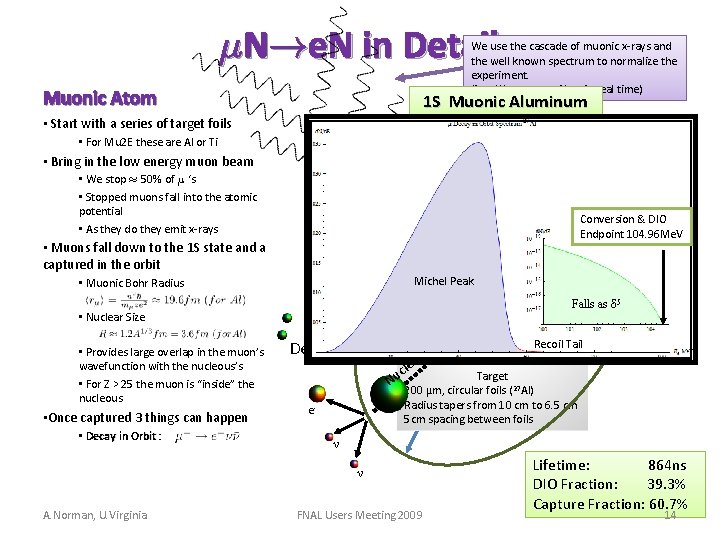
¹N!e. N in Detail We use the cascade of muonic x-rays and the well known spectrum to normalize the experiment. (i. e. We measure Nstop in real time) Muonic Atom 1 S Muonic Aluminum • Start with a series of target foils • For Mu 2 E these are Al or Ti • Bring in the low energy muon beam • We stop ¼ 50% of ¹ ‘s • Stopped muons fall into the atomic potential • As they do they emit x-rays ¼ 50% stop in target • Muons fall down to the 1 S state and a captured in the orbit Falls as δ 5 • Nuclear Size • Decay in Orbit : Decay In Orbit oil a cle Nu e- r Al Target Foils Recoil Target 200 μm, circular foils (27 Al) Radius tapers from 10 cm to 6. 5 cm 5 cm spacing between foils ν ν A. Norman, U. Virginia c Re ¼ 2 0 fm • Once captured 3 things can happen ¼ 4 fm Michel Peak • Muonic Bohr Radius • Provides large overlap in the muon’s wavefunction with the nucleous’s • For Z > 25 the muon is “inside” the nucleous Conversion & DIO Endpoint 104. 96 Me. V FNAL Users Meeting 2009 Lifetime: 864 ns DIO Fraction: 39. 3% Capture Fraction: 60. 7% 14
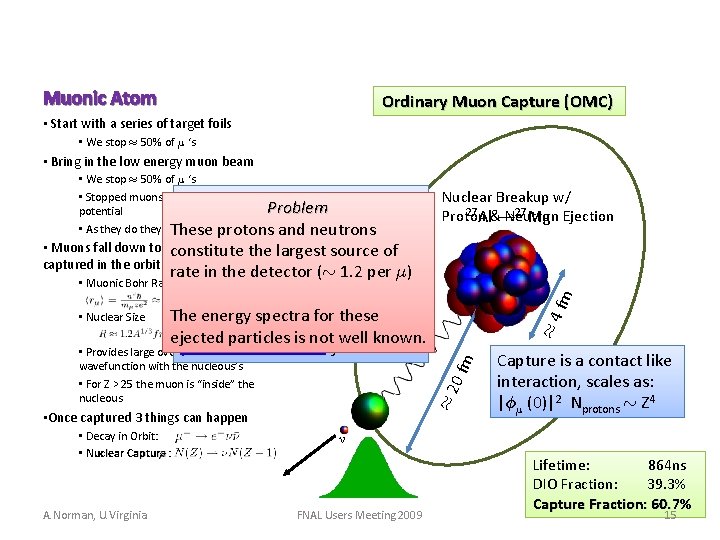
Muonic Atom 1 S Muonic Aluminum Ordinary Muon Capture (OMC) • Start with a series of target foils • We stop ¼ 50% of ¹ ‘s • Bring in the low energy muon beam • We stop ¼ 50% of ¹ ‘s • Stopped muons fall into the atomic 2009 Measurements Problem potential Mu 2 E Collaboration will • As they do they emit x-rays These protons and neutrons Nuclear Breakup w/ 27 Al → 27 Mg Proton & Neutron Ejection measure the spectra for muon • Muons fall down to the 1 S state and a constitute the largest source of captured in the orbit capture induced nucleon rate in the detector (» 1. 2 per ¹) test beam. The energy spectra for these Contact: Peter Kammel (U. of Illinois) ejected particles is not well known. pkammel@illinois. edu for details • Provides large overlap in the muon’s wavefunction with the nucleous’s • For Z > 25 the muon is “inside” the nucleous • Once captured 3 things can happen • Decay in Orbit: • Nuclear Capture : A. Norman, U. Virginia ¼ 2 0 fm W • Nuclear Size ¼ 4 fm • Muonic Bohr Radiusemission this summer at the PSI Capture is a contact like interaction, scales as: |Á¹ (0)|2 Nprotons » Z 4 ν FNAL Users Meeting 2009 Lifetime: 864 ns DIO Fraction: 39. 3% Capture Fraction: 60. 7% 15
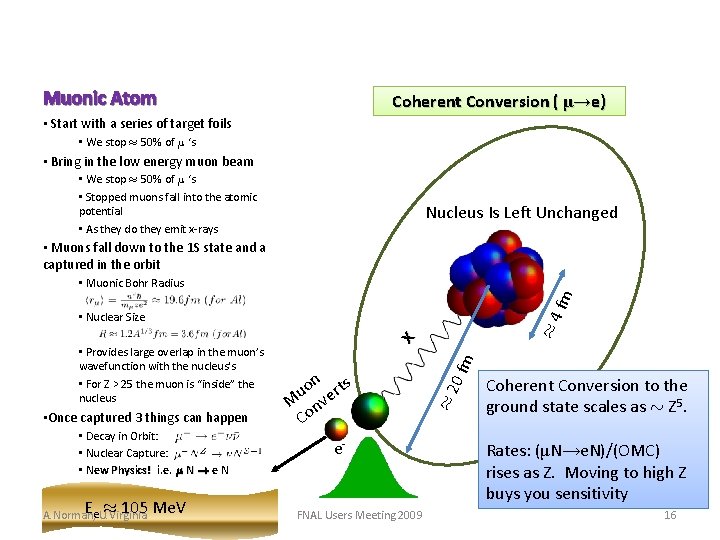
Muonic Atom 1 S Muonic Aluminum Coherent Conversion ( μ→e) • Start with a series of target foils • We stop ¼ 50% of ¹ ‘s • Bring in the low energy muon beam • We stop ¼ 50% of ¹ ‘s • Stopped muons fall into the atomic potential • As they do they emit x-rays Nucleus Is Left Unchanged • Muons fall down to the 1 S state and a captured in the orbit ¼ 4 fm • Muonic Bohr Radius • Once captured 3 things can happen • Decay in Orbit: • Nuclear Capture: • New Physics! i. e. ¹ N ! e N Ee ¼ 105 Me. V A. Norman, U. Virginia n s uo vert M n Co e- FNAL Users Meeting 2009 ¼ 2 0 fm • Provides large overlap in the muon’s wavefunction with the nucleus's • For Z > 25 the muon is “inside” the nucleus X • Nuclear Size Coherent Conversion to the ground state scales as » Z 5. Rates: (μN→e. N)/(OMC) rises as Z. Moving to high Z buys you sensitivity 16
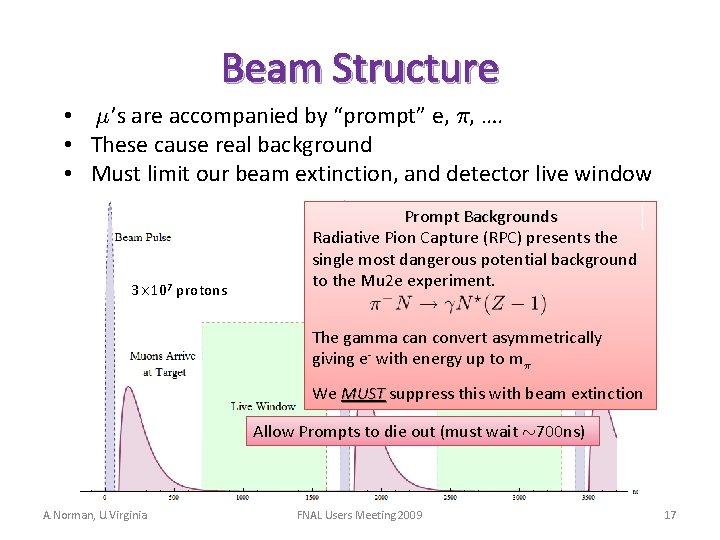
Beam Structure • ¹’s are accompanied by “prompt” e, ¼, …. • These cause real background • Must limit our beam extinction, and detector live window Prompt Backgrounds Radiative Pion Capture (RPC) presents the single most dangerous potential background to the Mu 2 e experiment. Extinction of 10^{-7} demonstrated at BNL AGS 3£ 107 protons Extinction < 10 -9 The gamma can convert asymmetrically giving e- with energy up to m¼ We MUST suppress this with beam extinction MUST Allow Prompts to die out (must wait » 700 ns) A. Norman, U. Virginia FNAL Users Meeting 2009 17
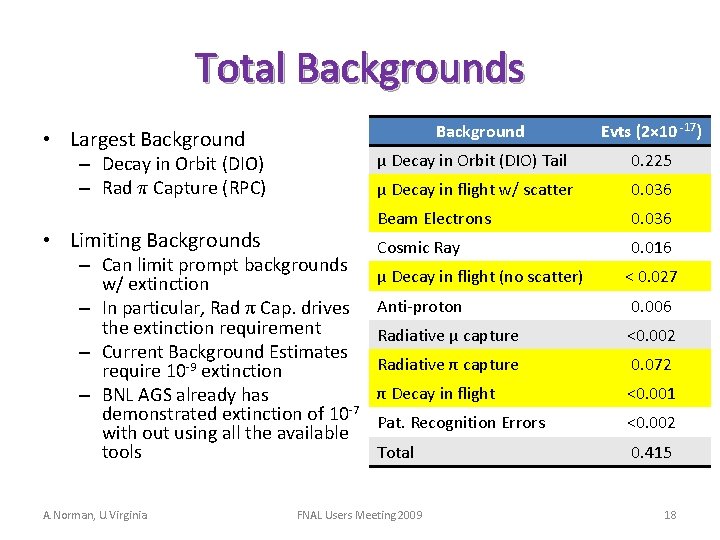
Total Backgrounds Background • Largest Background – Decay in Orbit (DIO) – Rad ¼ Capture (RPC) • Limiting Backgrounds – Can limit prompt backgrounds w/ extinction – In particular, Rad π Cap. drives the extinction requirement – Current Background Estimates require 10 -9 extinction – BNL AGS already has demonstrated extinction of 10 -7 with out using all the available tools A. Norman, U. Virginia Evts (2× 10 -17 ) μ Decay in Orbit (DIO) Tail 0. 225 μ Decay in flight w/ scatter Radiative pion capture 0. 036 0. 072 Beam Electrons 0. 036 Cosmic Ray 0. 016 μ Decay in flight (no scatter) < 0. 027 Anti-proton 0. 006 Radiative μ capture <0. 002 Radiative π capture 0. 072 π Decay in flight <0. 001 Pat. Recognition Errors <0. 002 Total 0. 415 FNAL Users Meeting 2009 18
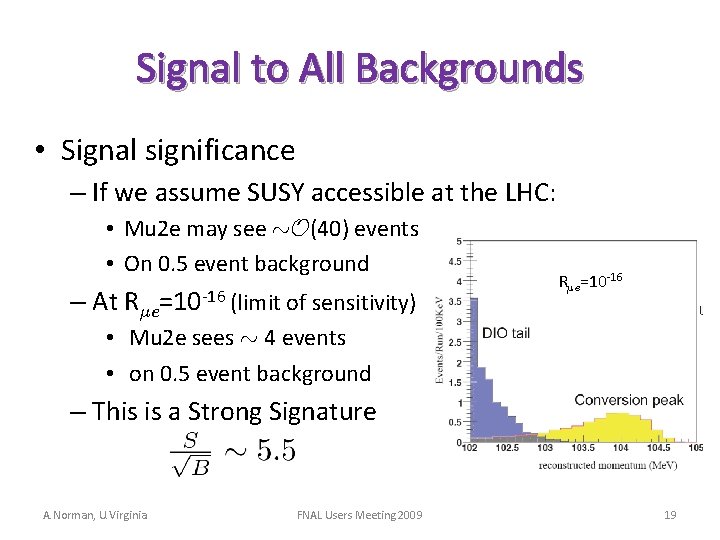
Signal to All Backgrounds • Signal significance – If we assume SUSY accessible at the LHC: • Mu 2 e may see » O(40) events • On 0. 5 event background – At R¹e=10 -16 (limit of sensitivity) R¹e=10 -16 • Mu 2 e sees » 4 events • on 0. 5 event background – This is a Strong Signature A. Norman, U. Virginia FNAL Users Meeting 2009 19
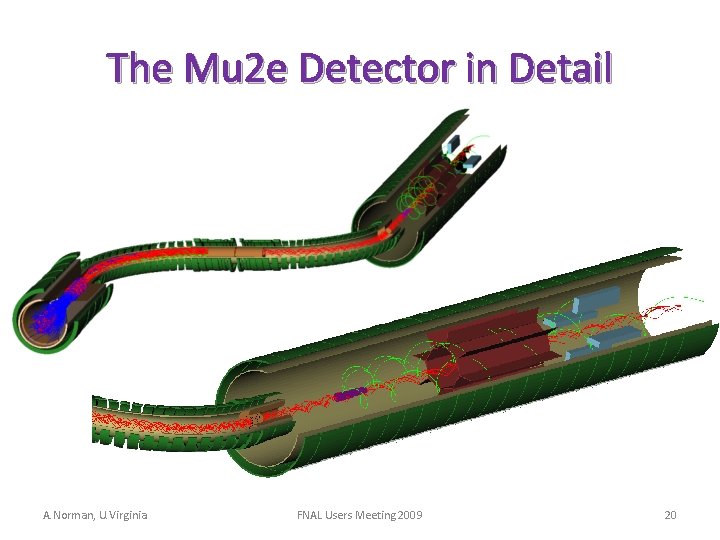
The Mu 2 e Detector in Detail A. Norman, U. Virginia FNAL Users Meeting 2009 20
Production Solenoid Magnetic Mirror Effect 8 Ge. V Incident Proton Flux 3× 10⁷ p/pulse (34 ns width) p 2. 5 T Primary π production off gold target Field oid n e l o S t Gradien π 5 T μ ¹ π decays to μ μ is captured into the transport solenoid and proceeds to the stopping targets A. Norman, U. Virginia FNAL Users Meeting 2009 21
Transport Solenoid • Designed to sign select the muon beam – Collimator blocks the positives after the first bend – Negatives are brought back on axis by the second bend A. Norman, U. Virginia Sign Selecting Collimator FNAL Users Meeting 2009 22
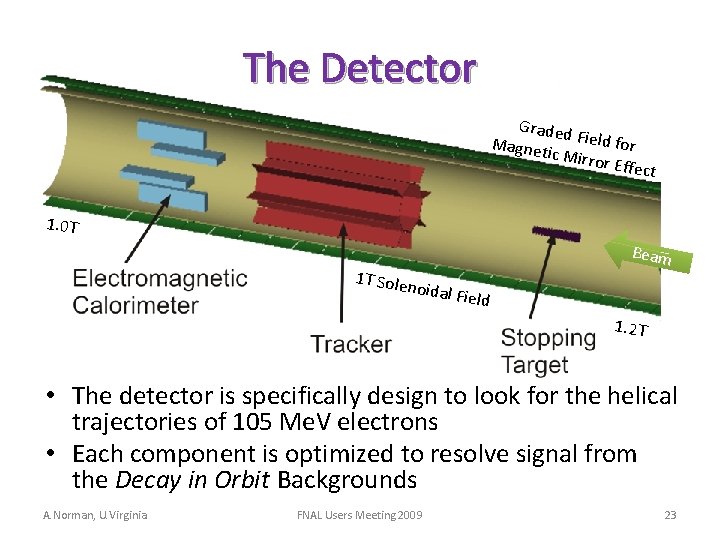
The Detector Graded Magnet Field for ic Mirro r Effect 1. 0 T Beam 1 T Sole noidal F ield 1. 2 T • The detector is specifically design to look for the helical trajectories of 105 Me. V electrons • Each component is optimized to resolve signal from the Decay in Orbit Backgrounds A. Norman, U. Virginia FNAL Users Meeting 2009 23
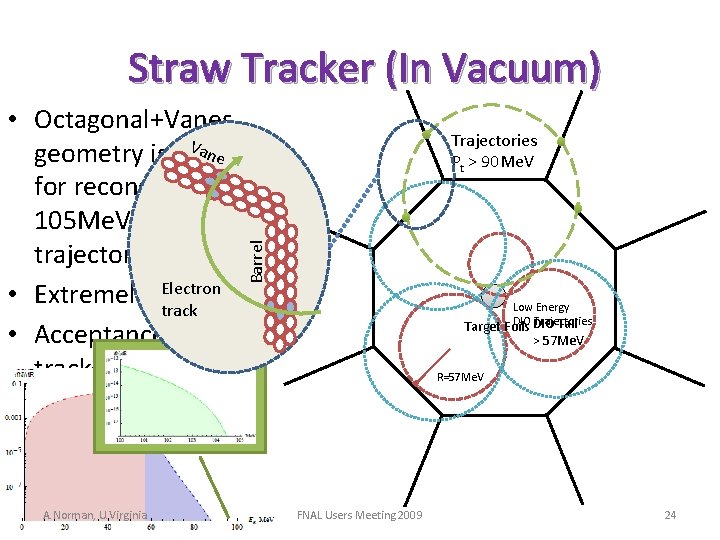
Straw Tracker (In Vacuum) • Octagonal+Vanes Van geometry is optimized e for reconstruction of 105 Me. V helical trajectories Electron • Extremely low mass track • Acceptance for DIO tracks < 10 -13 Barrel Trajectories Pt > 90 Me. V A. Norman, U. Virginia Low Energy DIO Trajectories DIO Tail Target Foils > 57 Me. V R=57 Me. V FNAL Users Meeting 2009 24
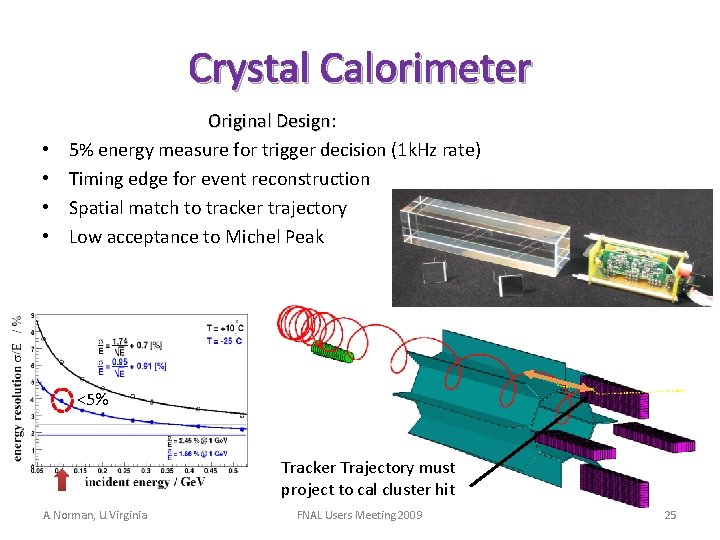
Crystal Calorimeter • • Original Design: 5% energy measure for trigger decision (1 k. Hz rate) Timing edge for event reconstruction Spatial match to tracker trajectory Low acceptance to Michel Peak <5% Tracker Trajectory must project to cal cluster hit A. Norman, U. Virginia FNAL Users Meeting 2009 25
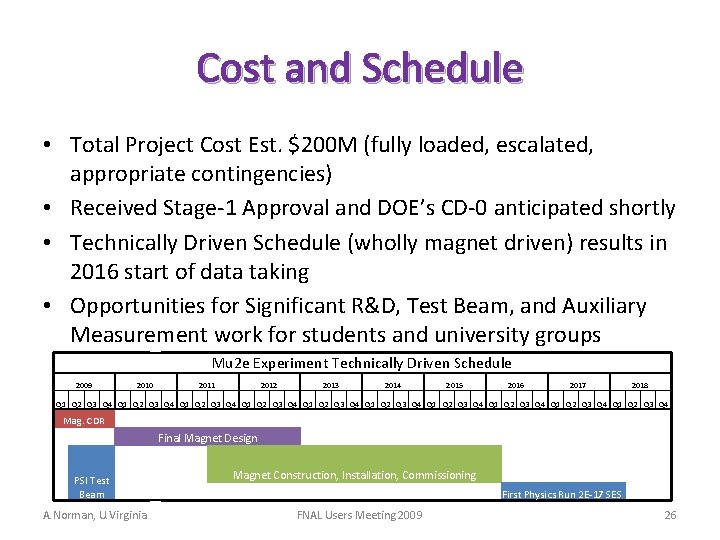
Cost and Schedule • Total Project Cost Est. $200 M (fully loaded, escalated, appropriate contingencies) • Received Stage-1 Approval and DOE’s CD-0 anticipated shortly • Technically Driven Schedule (wholly magnet driven) results in 2016 start of data taking • Opportunities for Significant R&D, Test Beam, and Auxiliary Measurement work for students and university groups Mu 2 e Experiment Technically Driven Schedule 2009 2010 2011 2012 2013 2014 2015 2016 2017 2018 Q 1 Q 2 Q 3 Q 4 Q 1 Q 2 Q 3 Q 4 Q 1 Q 2 Q 3 Q 4 Mag. CDR Final Magnet Design PSI Test Beam Magnet Construction, Installation, Commissioning A. Norman, U. Virginia FNAL Users Meeting 2009 First Physics Run 2 E-17 SES 26
G-2 AT FNAL A. Norman, U. Virginia FNAL Users Meeting 2009 27
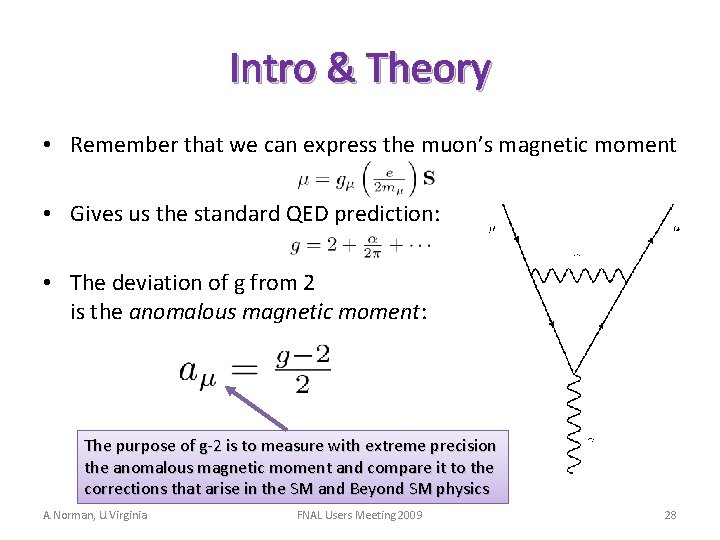
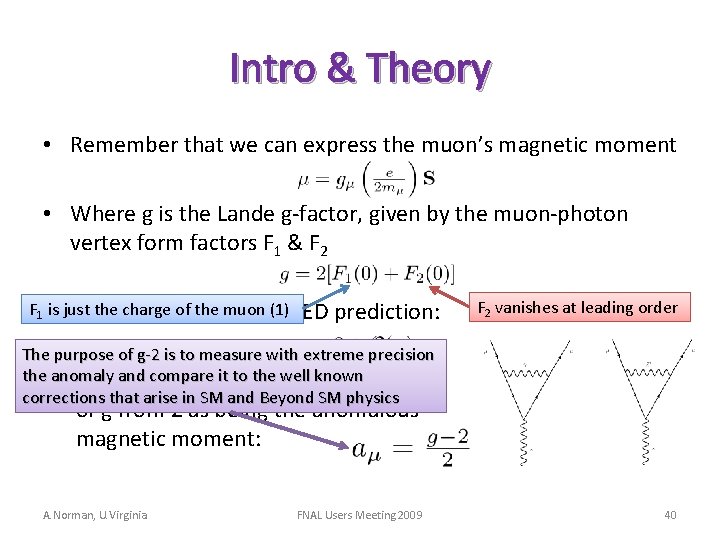
Intro & Theory • Remember that we can express the muon’s magnetic moment • Gives us the standard QED prediction: • The deviation of g from 2 is the anomalous magnetic moment: The purpose of g-2 is to measure with extreme precision the anomalous magnetic moment and compare it to the corrections that arise in the SM and Beyond SM physics A. Norman, U. Virginia FNAL Users Meeting 2009 28
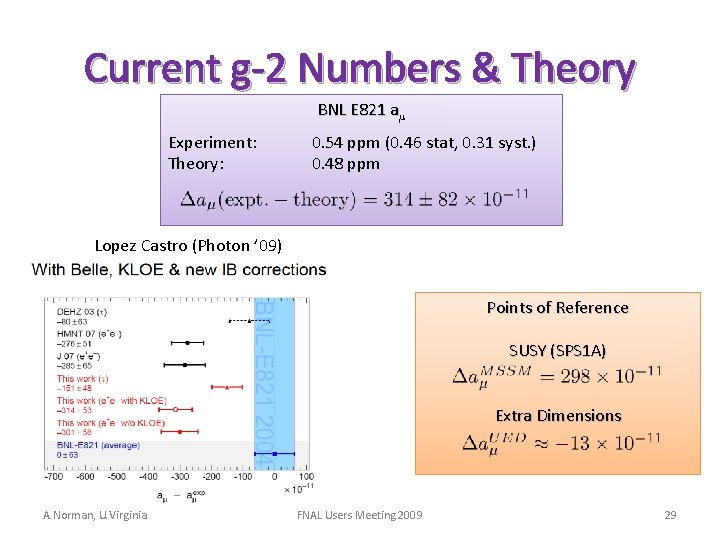
Current g-2 Numbers & Theory BNL E 821 a¹ Experiment: Theory: 0. 54 ppm (0. 46 stat, 0. 31 syst. ) 0. 48 ppm Lopez Castro (Photon ’ 09) Points of Reference SUSY (SPS 1 A) Extra Dimensions A. Norman, U. Virginia FNAL Users Meeting 2009 29
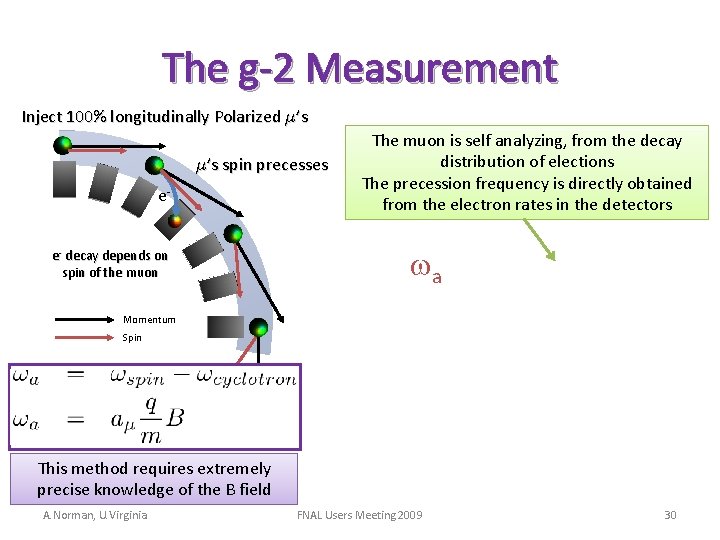
The g-2 Measurement Inject 100% longitudinally Polarized ¹’s spin precesses ee- decay depends on spin of the muon The muon is self analyzing, from the decay distribution of elections The precession frequency is directly obtained from the electron rates in the detectors wa Momentum Spin This method requires extremely precise knowledge of the B field A. Norman, U. Virginia FNAL Users Meeting 2009 30
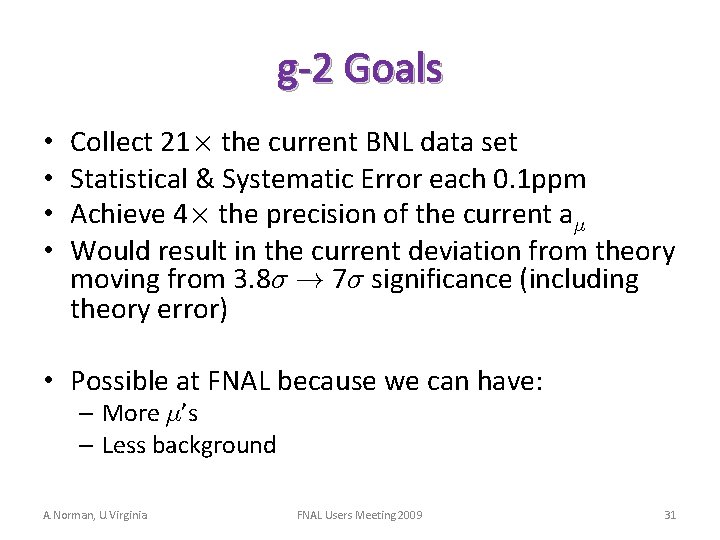
g-2 Goals • • Collect 21£ the current BNL data set Statistical & Systematic Error each 0. 1 ppm Achieve 4£ the precision of the current a¹ Would result in the current deviation from theory moving from 3. 8¾ ! 7¾ significance (including theory error) • Possible at FNAL because we can have: – More ¹’s – Less background A. Norman, U. Virginia FNAL Users Meeting 2009 31
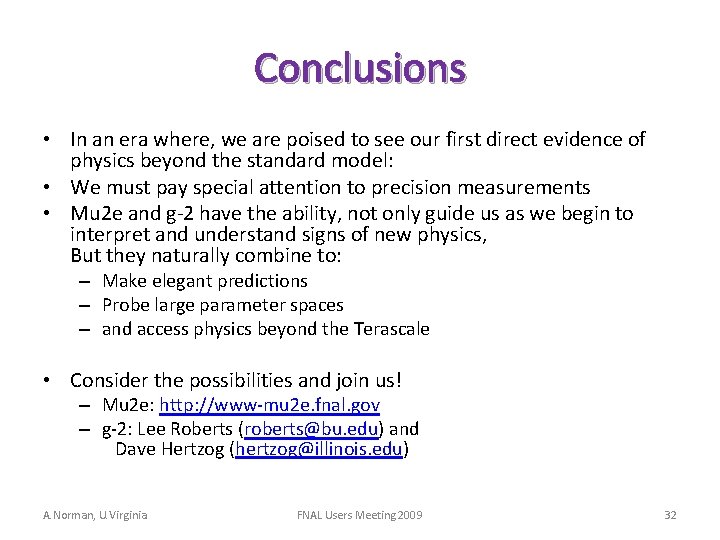
Conclusions • In an era where, we are poised to see our first direct evidence of physics beyond the standard model: • We must pay special attention to precision measurements • Mu 2 e and g-2 have the ability, not only guide us as we begin to interpret and understand signs of new physics, But they naturally combine to: – Make elegant predictions – Probe large parameter spaces – and access physics beyond the Terascale • Consider the possibilities and join us! – Mu 2 e: http: //www-mu 2 e. fnal. gov – g-2: Lee Roberts (roberts@bu. edu) and Dave Hertzog (hertzog@illinois. edu) A. Norman, U. Virginia FNAL Users Meeting 2009 32
BACKUP SLIDES A. Norman, U. Virginia FNAL Users Meeting 2009 33
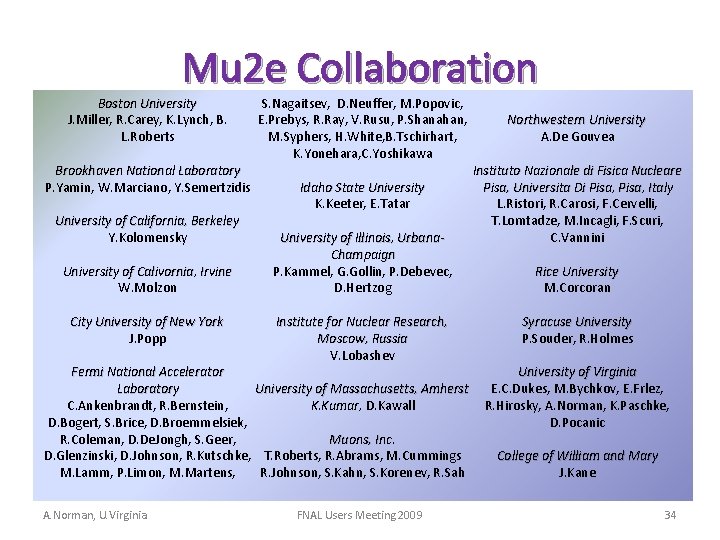
Mu 2 e Collaboration Boston University J. Miller, R. Carey, K. Lynch, B. L. Roberts S. Nagaitsev, D. Neuffer, M. Popovic, E. Prebys, R. Ray, V. Rusu, P. Shanahan, M. Syphers, H. White, B. Tschirhart, K. Yonehara, C. Yoshikawa • Brookhaven 17 Institutions National Laboratory P. Yamin, W. Marciano, Y. Semertzidis Idaho State University • Over 70 physicists K. Keeter, E. Tatar University of California, Berkeley Y. Kolomensky University of Calivornia, Irvine W. Molzon City University of New York J. Popp University of Illinois, Urbana. Champaign P. Kammel, G. Gollin, P. Debevec, D. Hertzog Institute for Nuclear Research, Moscow, Russia V. Lobashev Fermi National Accelerator University of Massachusetts, Amherst Laboratory K. Kumar, D. Kawall C. Ankenbrandt, R. Bernstein, D. Bogert, S. Brice, D. Broemmelsiek, Muons, Inc. R. Coleman, D. De. Jongh, S. Geer, D. Glenzinski, D. Johnson, R. Kutschke, T. Roberts, R. Abrams, M. Cummings M. Lamm, P. Limon, M. Martens, R. Johnson, S. Kahn, S. Korenev, R. Sah A. Norman, U. Virginia FNAL Users Meeting 2009 Northwestern University A. De Gouvea Instituto Nazionale di Fisica Nucleare Pisa, Universita Di Pisa, Italy L. Ristori, R. Carosi, F. Cervelli, T. Lomtadze, M. Incagli, F. Scuri, C. Vannini Rice University M. Corcoran Syracuse University P. Souder, R. Holmes University of Virginia E. C. Dukes, M. Bychkov, E. Frlez, R. Hirosky, A. Norman, K. Paschke, D. Pocanic College of William and Mary J. Kane 34
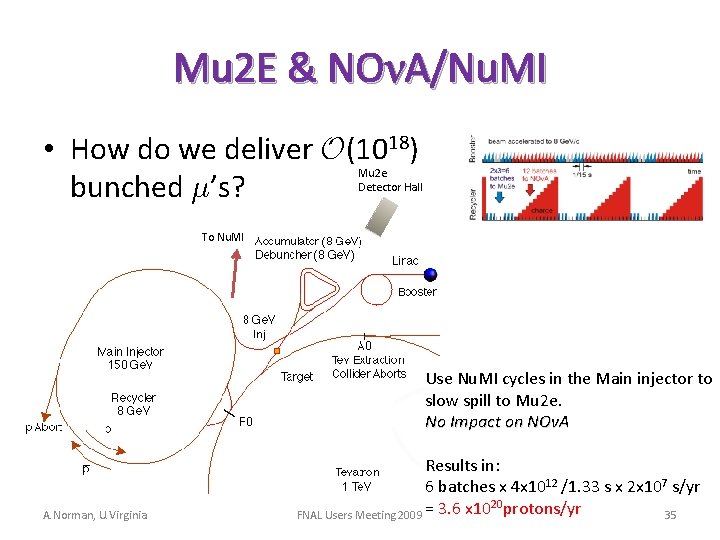
Mu 2 E & NOνA/Nu. MI • How do we deliver O(1018) bunched ¹’s? Mu 2 e Detector Hall To Nu. MI Use Nu. MI cycles in the Main injector to slow spill to Mu 2 e. No Impact on NOv. A A. Norman, U. Virginia Results in: 6 batches x 4 x 10¹² /1. 33 s x 2 x 107 s/yr 20 FNAL Users Meeting 2009 = 3. 6 x 10 protons/yr 35
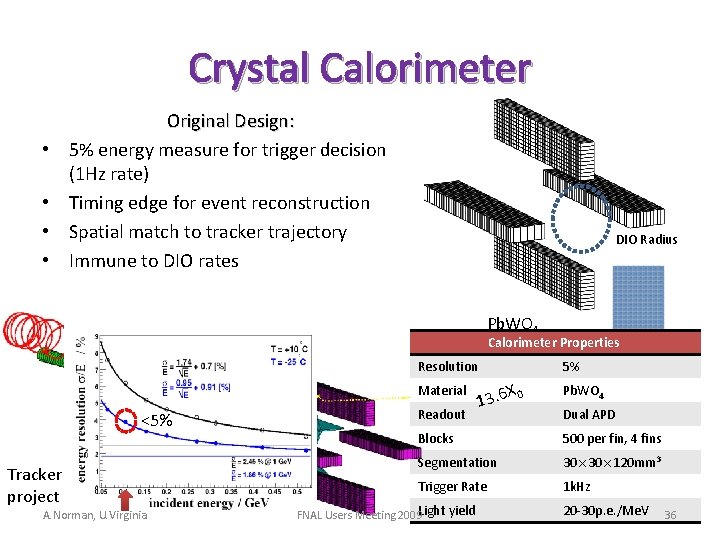
Crystal Calorimeter • • Original Design: 5% energy measure for trigger decision (1 Hz rate) Timing edge for event reconstruction Spatial match to tracker trajectory Immune to DIO rates DIO Radius Resolution Material Tracker Trajectory must project to cal cluster hit A. Norman, U. Virginia Readout X 0 Pb. WO 4 Dual APD Blocks 30 mm <5% 13. 6 5% Segmentation 30 mm Trigger Rate 50 blocks Pb. WO 4 Calorimeter Properties Crystal Geometry 500 per fin, 4 fins m 30£ 120 mm 3 m 120 Single Crystal FNAL Users Meeting 2009 Light yield 1 k. Hz 10 blocks 20 -30 p. e. /Me. V Calorimeter Fin 36
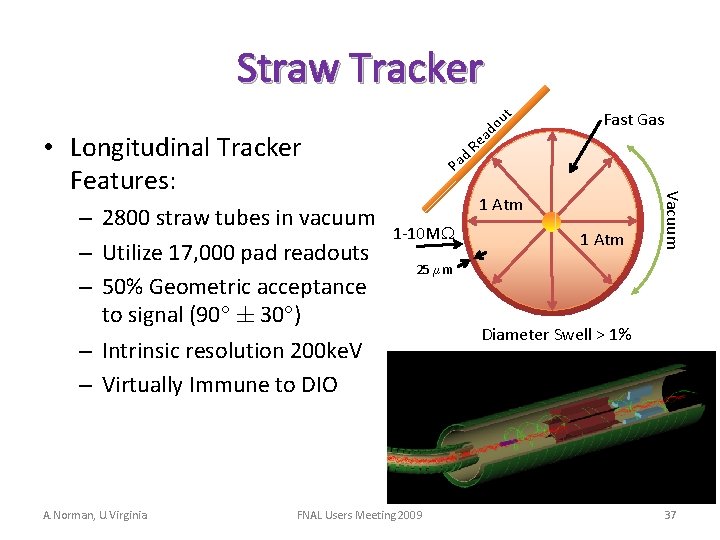
do ut Straw Tracker A. Norman, U. Virginia R Pa d 1 Atm 1 -10 M 1 Atm Vacuum – 2800 straw tubes in vacuum – Utilize 17, 000 pad readouts – 50% Geometric acceptance to signal (90° § 30°) – Intrinsic resolution 200 ke. V – Virtually Immune to DIO ea • Longitudinal Tracker Features: Fast Gas 25 ¹m FNAL Users Meeting 2009 Diameter Swell > 1% 37
Sensitivity to SUSY • Rates are not small because they are set by the SUSY mass scale Mu 2 e can exclude over the full range of slepton mass Sindrum II Bound Exclude Mu 2 e Phase-1 • For SUSY like we would see Mu 2 e Phase-2 (Project X) at the LHC: Br(¹ N ! e N) ~10 -15 • Makes ¹N!e. N compelling, Access to ultra high mass scales via since for Mu 2 e this would quantum corrections. mean observation of Can access possibly access νR and other ¼O(40) events processes at scales 1012 -1014 Ge. V/c 2 Hisano et al. 1997 A. Norman, U. Virginia FNAL Users Meeting 2009 38
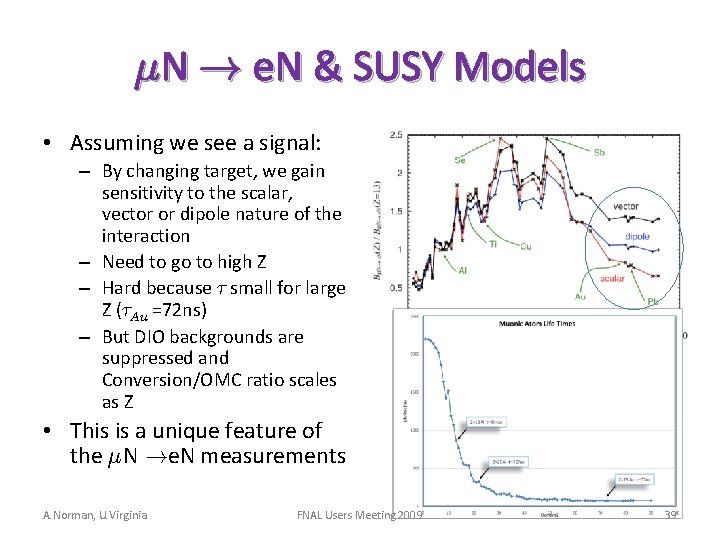
¹N ! e. N & SUSY Models • Assuming we see a signal: – By changing target, we gain sensitivity to the scalar, vector or dipole nature of the interaction – Need to go to high Z – Hard because ¿ small for large Z (¿Au =72 ns) – But DIO backgrounds are suppressed and Conversion/OMC ratio scales as Z • This is a unique feature of the ¹N !e. N measurements A. Norman, U. Virginia FNAL Users Meeting 2009 39
Intro & Theory • Remember that we can express the muon’s magnetic moment • Where g is the Lande g-factor, given by the muon-photon vertex form factors F 1 & F 2 F 1 • is just the charge of the muon (1) Gives us the standard QED prediction: F 2 vanishes at leading order The purpose of g-2 is to measure with extreme precision the anomaly and compare it to the well known • We can talk now about the deviation corrections that arise in SM and Beyond SM physics of g from 2 as being the anomalous magnetic moment: A. Norman, U. Virginia FNAL Users Meeting 2009 40
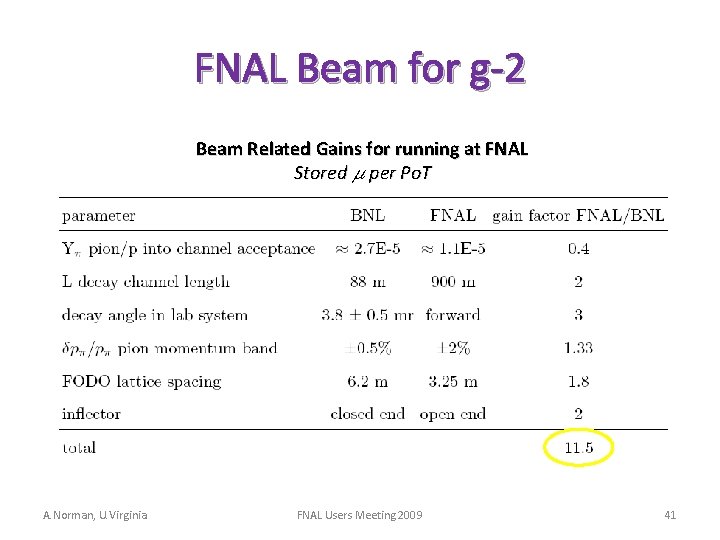
FNAL Beam for g-2 Beam Related Gains for running at FNAL Stored ¹ per Po. T I • Beam line setup is almost identical to the 8 Ge. V scheme used for Mu 2 e • Uses 6 of 20 batches* – Parasitic to Nu. MI program • Uses target and lens at the present p -bar program • Modified AP 2 line (+ quads) • Need a new beam stub into ring Goal: Deliver polarized muons and stored in the • Detector is in a simple building near g-2 ring at the magic momentum, 3. 094 Ge. V/c cryo services A. Norman, U. Virginia FNAL Users Meeting 2009 41 *Can use all 20 if MI program is off
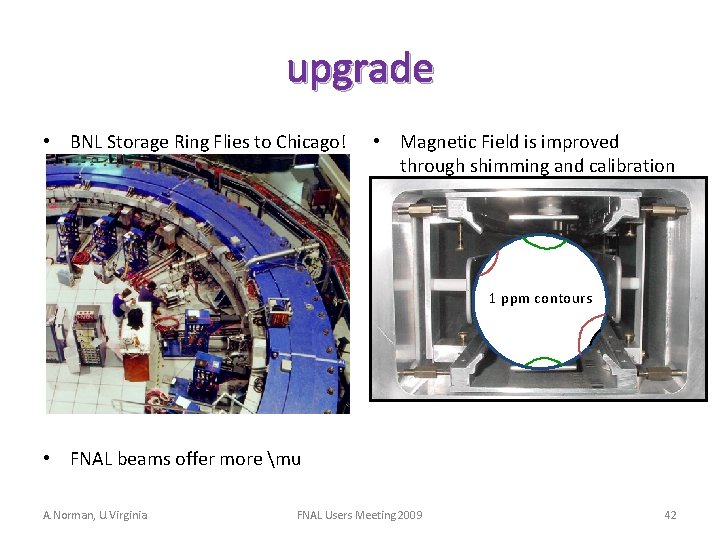
upgrade • BNL Storage Ring Flies to Chicago! • Magnetic Field is improved through shimming and calibration 1 ppm contours • FNAL beams offer more mu A. Norman, U. Virginia FNAL Users Meeting 2009 42