
The MTL role in memory and perception Contents

- Slides: 19
The MTL role in memory and perception
Contents The Medial Temporal Lobe - Anatomy The Medial Temporal Lobe and Memory Hippocampus, Basics and the traditional view Functional specialization within the MTL Beyond declarative memory 2
The MTL and LTM – the traditional view Dissociation between declarative and procedural memory in amnesia. Dissociation between short and long term memory in amnesia Consolidation and the hippocampus – HM A single system in the MTL crucial for declarative memory – a unitary view The hippocampus plays only a temporal role in memory formation Ofrit 3 Back
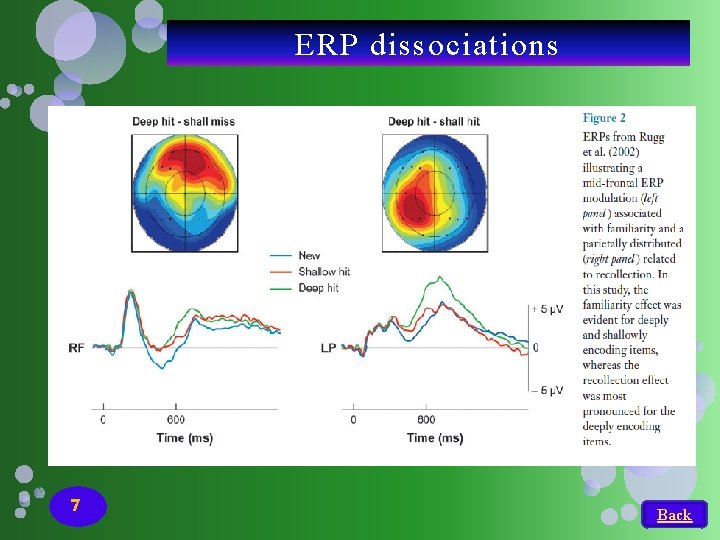
The MTL in recognition memory Recollection and familiarity Evidence from normal performance ERP evidence for different timing Evidence for anatomical dissociation from amnesia. Evidence from f. MRI 4
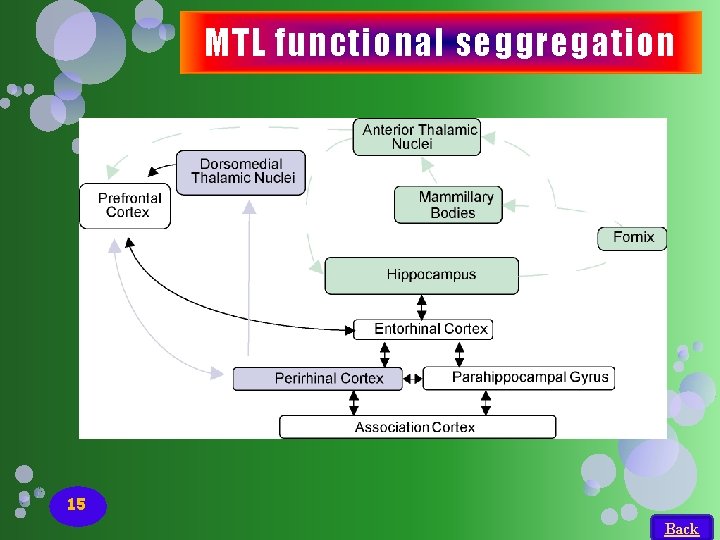
Functional distinctions within the MTL Two independent MTL networks: The hippocampal-diencephalic (hippocampus, fornix, mamillary bodies and anterior thalamus) – critical for encoding an recall for episodic information. The non hippocampal MTL (perirhinal cortex and medial dorsal thalamus) – critical for familiarity judgments. Natalie 5
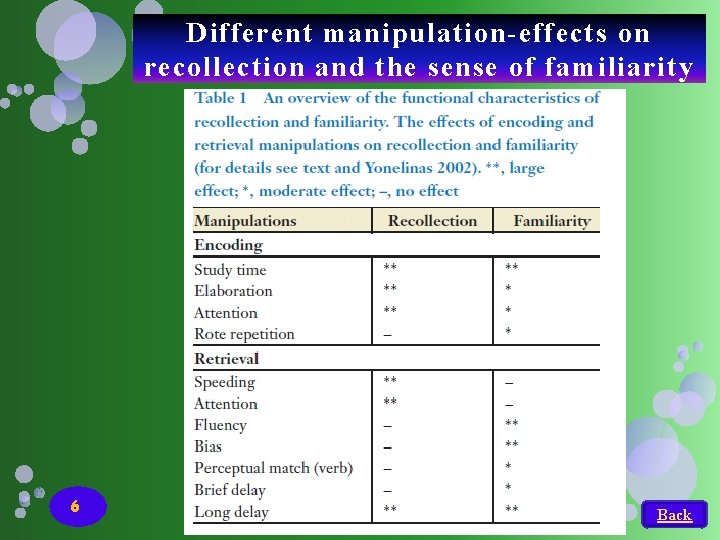
Different manipulation-effects on recollection and the sense of familiarity 6 Back
ERP dissociations 7 Back
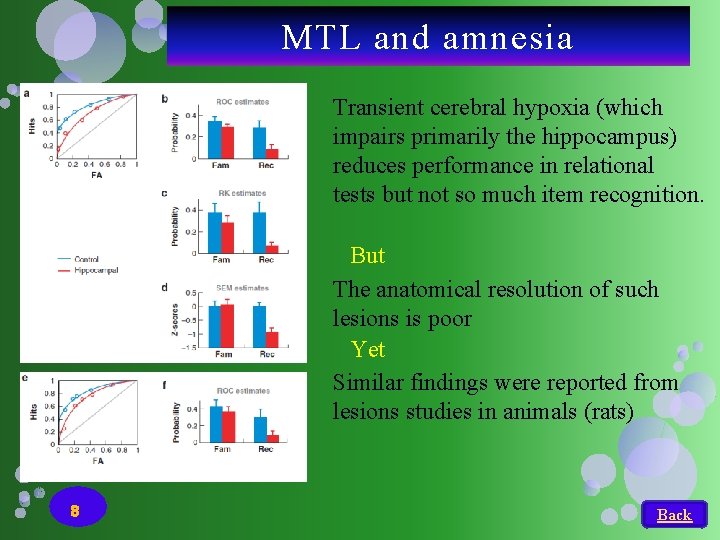
MTL and amnesia Transient cerebral hypoxia (which impairs primarily the hippocampus) reduces performance in relational tests but not so much item recognition. But The anatomical resolution of such lesions is poor Yet Similar findings were reported from lesions studies in animals (rats) 8 Back
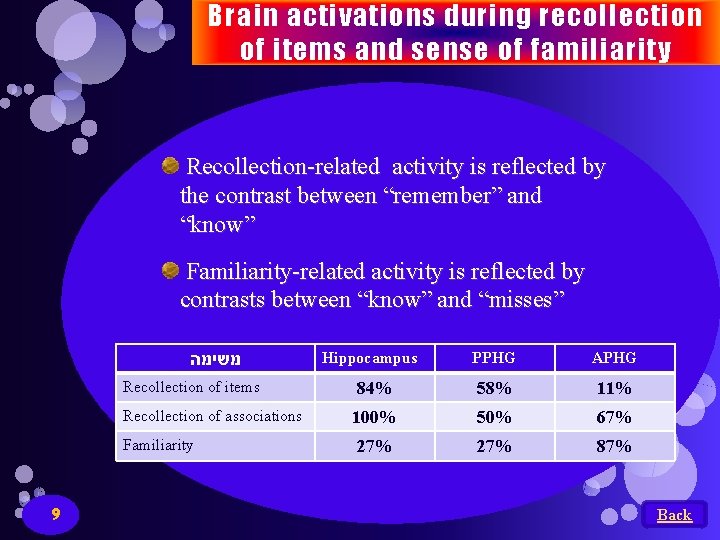
Brain activations during recollection of items and sense of familiarity Recollection-related activity is reflected by the contrast between “remember” and “know” Familiarity-related activity is reflected by contrasts between “know” and “misses” משימה 9 Hippocampus PPHG APHG Recollection of items 84% 58% 11% Recollection of associations 100% 50% 67% Familiarity 27% 87% Back
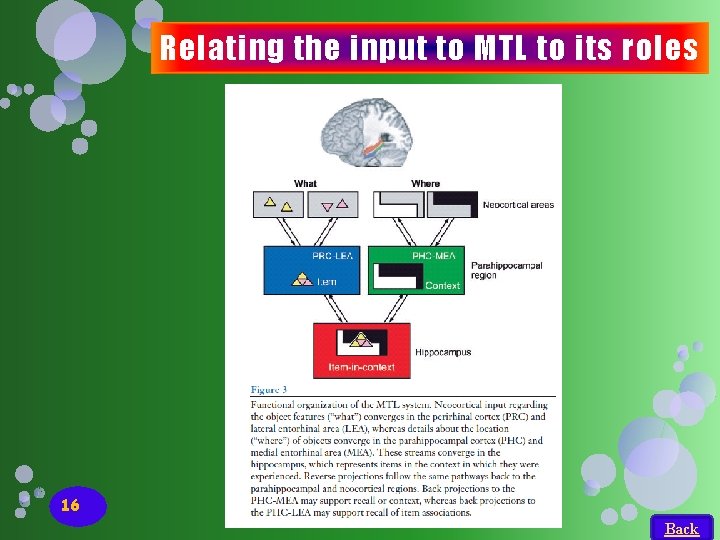
Further fractionalization of the MTL A related view: The hippocampus is involved in rapid learning of associations between individual items and their context, while the parahippocampal region, particularly the perirhinal cortex support memory for individual objects. The “Binding of item and context” (BIC) model: Three functionally distinct MTL regions: Perirhinal cortex (responsible for encoding and retrieving of information about items. Posterior parahippocampal cortex stores information about context. The hippocampus binds the item with the context. 10
The role of the MTL in memory: The alternative view The hippocampus and the perirhinal cortex are differently involved in memory: Hippocampus and the parahippocampus - recollection Perirhinal – familiarity All MTL structures (including the hippocampus) are continuously involved in encoding and retrieval. The Multiple-Trace Theory (MTT) Reut 11 Back
Beyond declarative memory MTL (focus on hippocampus) amnesia a patient’s view. The role of MTL in visual discrimination The role of the MTL in oddity judgments Outstanding questions and future directions 12
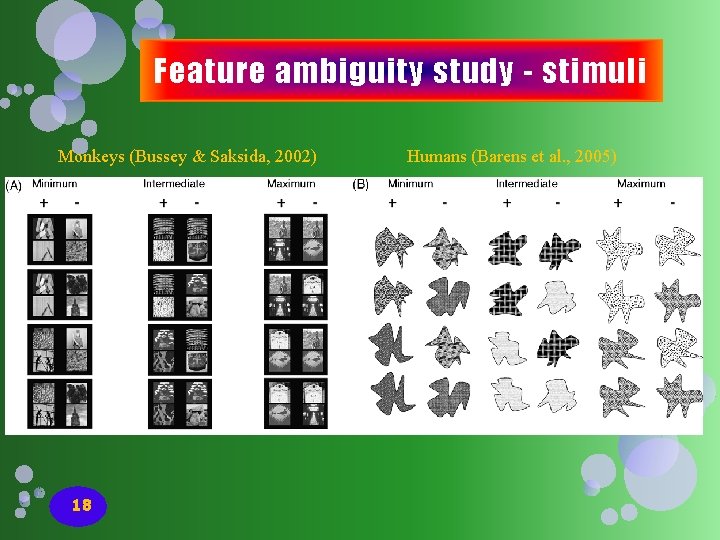
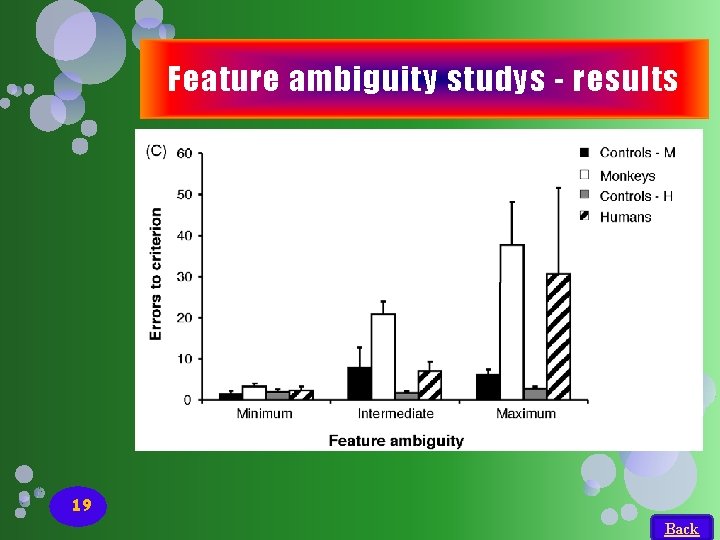
Visual discrimination and MTL The perirhinal cortex is the apex of the ventral system. It is responsible for processing and storing of representations of complex feature conjunctions Resolving “feature ambiguity” 13
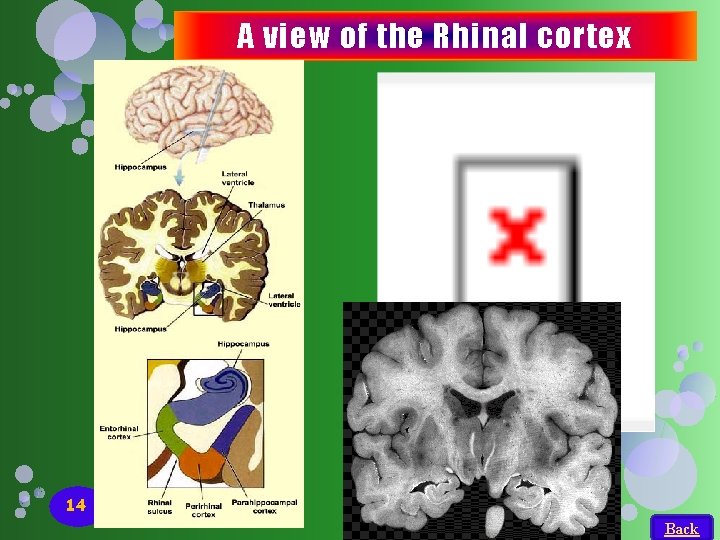
A view of the Rhinal cortex 14 Back
MTL functional seggregation 15 Back
Relating the input to MTL to its roles 16 Back
A patient’s view “The areas of my life that I find most challenging are when I am given a series of directions, remembering my way around somewhere (familiar or unfamiliar 1), how I got into a building and how I can get out of it again, driving somewhere not only for the first time, but many times, remembering where I left my car and how I got into the car park in the first place, which way to turn out of a car park to get home. . Whichever angle I look, everything looks the same”. 17 Back
Feature ambiguity study - stimuli Monkeys (Bussey & Saksida, 2002) 18 Humans (Barens et al. , 2005)
Feature ambiguity studys - results 19 Back