
The Movement of Ocean Water S 6 E
- Slides: 11
The Movement of Ocean Water S 6 E 3. d Explain the causes of waves, currents, and tides.
Imagine that you are on a voyage sailing around the world. Two weeks into your trip your motor quit on your boat. How are you going to complete your voyage?
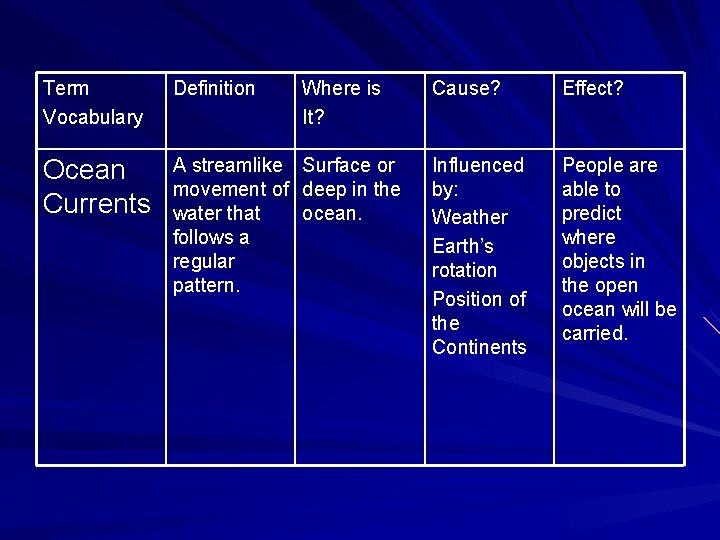
Term Vocabulary Definition Where is It? Cause? Effect? Ocean Currents A streamlike movement of water that follows a regular pattern. Surface or deep in the ocean. Influenced by: Weather Earth’s rotation Position of the Continents People are able to predict where objects in the open ocean will be carried.
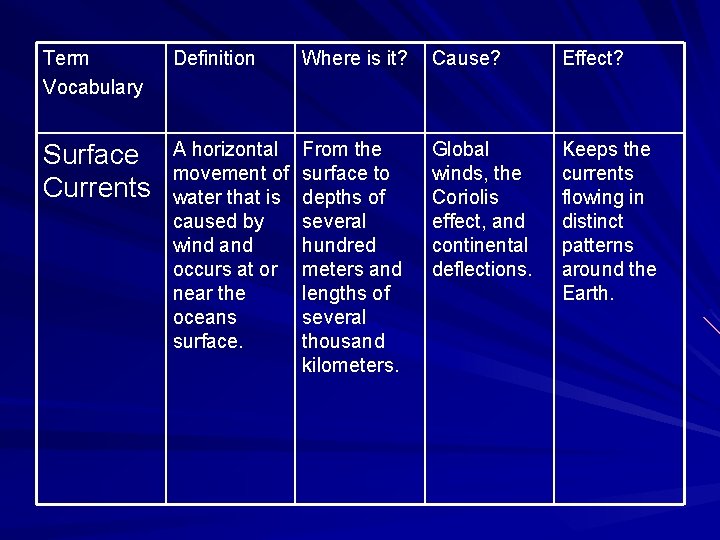
Term Vocabulary Definition Where is it? Cause? Effect? Surface Currents A horizontal movement of water that is caused by wind and occurs at or near the oceans surface. From the surface to depths of several hundred meters and lengths of several thousand kilometers. Global winds, the Coriolis effect, and continental deflections. Keeps the currents flowing in distinct patterns around the Earth.
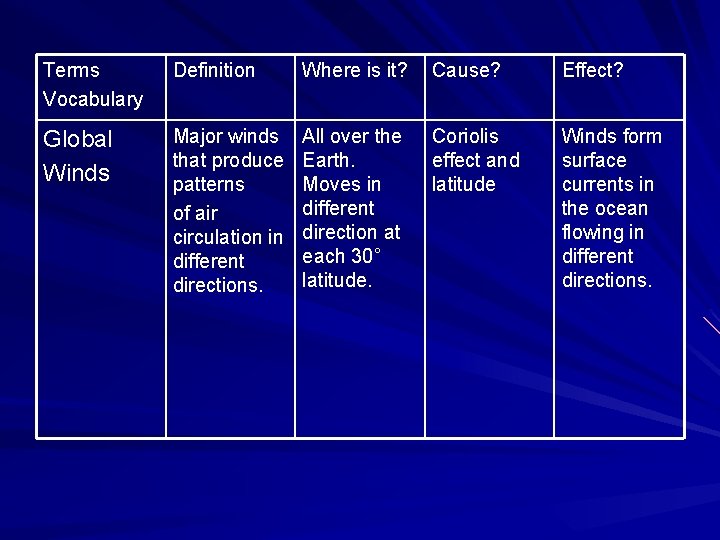
Terms Vocabulary Definition Where is it? Cause? Effect? Global Winds Major winds that produce patterns of air circulation in different directions. All over the Earth. Moves in different direction at each 30° latitude. Coriolis effect and latitude Winds form surface currents in the ocean flowing in different directions.
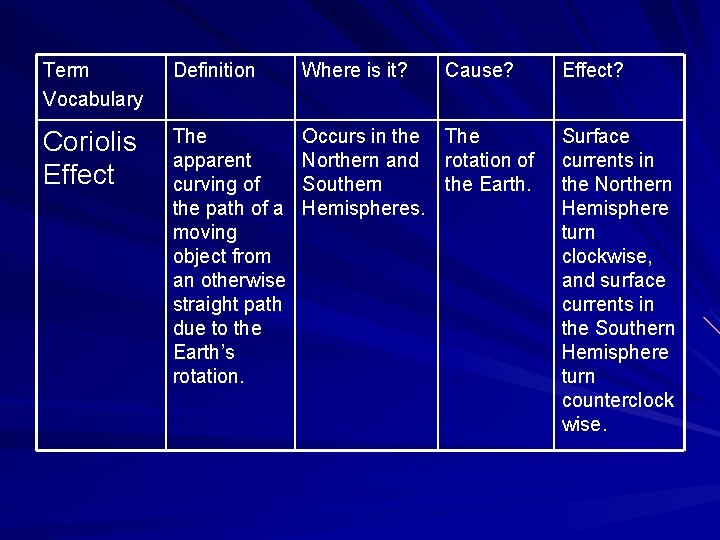
Term Vocabulary Definition Where is it? Cause? Coriolis Effect The apparent curving of the path of a moving object from an otherwise straight path due to the Earth’s rotation. Occurs in the The Northern and rotation of Southern the Earth. Hemispheres. Effect? Surface currents in the Northern Hemisphere turn clockwise, and surface currents in the Southern Hemisphere turn counterclock wise.
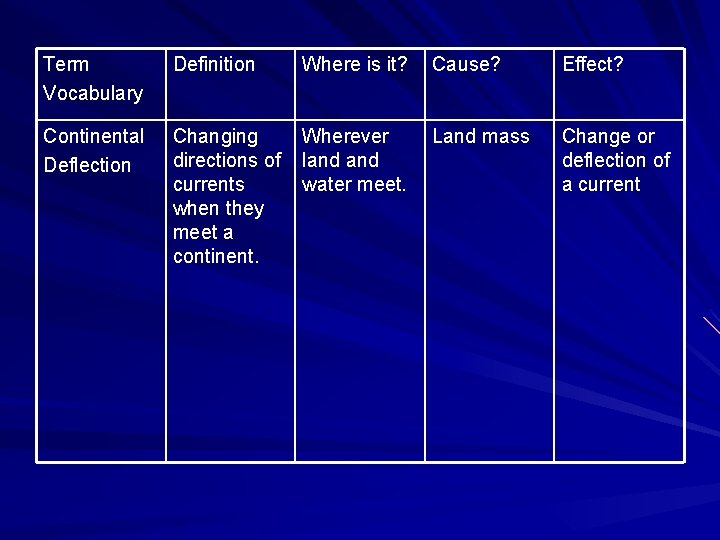
Term Vocabulary Definition Where is it? Cause? Effect? Continental Deflection Changing directions of currents when they meet a continent. Wherever land water meet. Land mass Change or deflection of a current
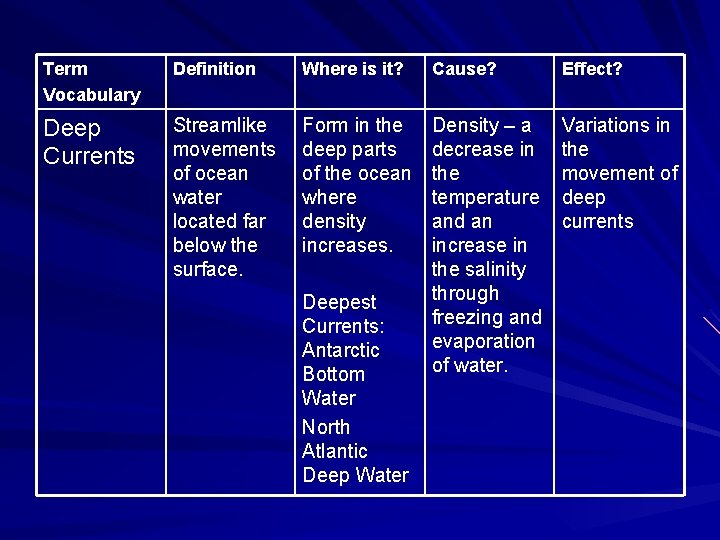
Term Vocabulary Definition Where is it? Cause? Effect? Deep Currents Streamlike movements of ocean water located far below the surface. Form in the deep parts of the ocean where density increases. Density – a decrease in the temperature and an increase in the salinity through freezing and evaporation of water. Variations in the movement of deep currents Deepest Currents: Antarctic Bottom Water North Atlantic Deep Water
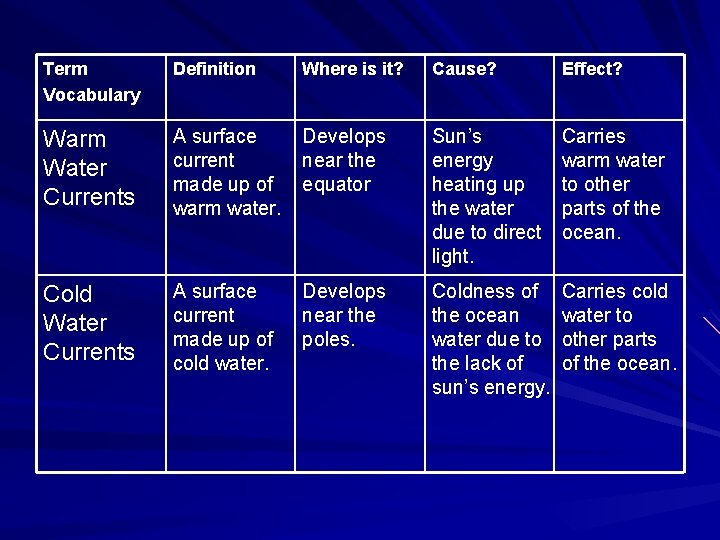
Term Vocabulary Definition Warm Water Currents Cold Water Currents Where is it? Cause? Effect? A surface Develops current near the made up of equator warm water. Sun’s energy heating up the water due to direct light. Carries warm water to other parts of the ocean. A surface current made up of cold water. Coldness of the ocean water due to the lack of sun’s energy. Carries cold water to other parts of the ocean. Develops near the poles.
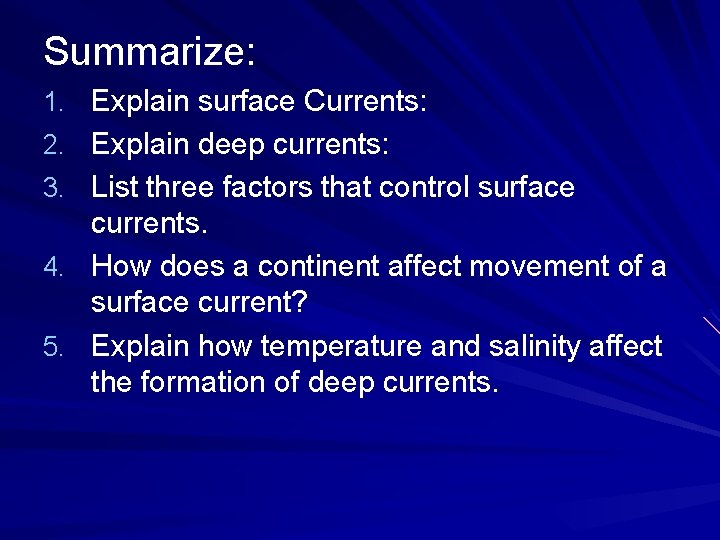
Summarize: 1. Explain surface Currents: 2. Explain deep currents: 3. List three factors that control surface currents. 4. How does a continent affect movement of a surface current? 5. Explain how temperature and salinity affect the formation of deep currents.