
The Motor Effect Charge deflection by a magnetic
The Motor Effect

Charge deflection by a magnetic field S + N Electric charges are deflected by magnetic fields provided they are not travelling parallel to the field lines. Positive and negative charges are deflected in opposite directions.
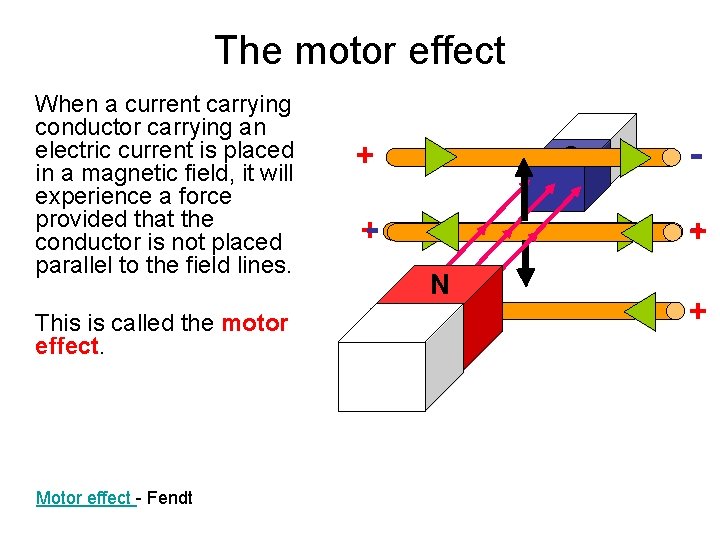
The motor effect When a current carrying conductor carrying an electric current is placed in a magnetic field, it will experience a force provided that the conductor is not placed parallel to the field lines. This is called the motor effect. Motor effect - Fendt + S +- - -+ N +
The force increases if: – the strength of the magnetic field is increased – the current is increased The direction of the force is reversed if either the direction of the current or the direction of the magnetic field is reversed. Motor effect - Fendt
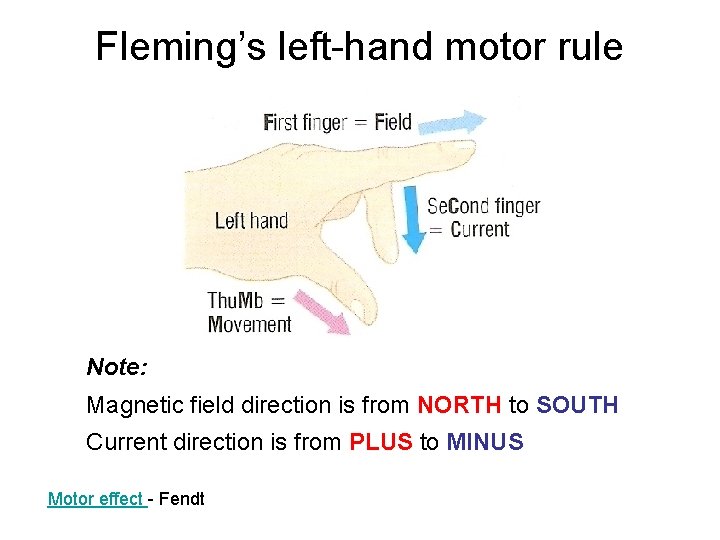
Fleming’s left-hand motor rule Note: Magnetic field direction is from NORTH to SOUTH Current direction is from PLUS to MINUS Motor effect - Fendt
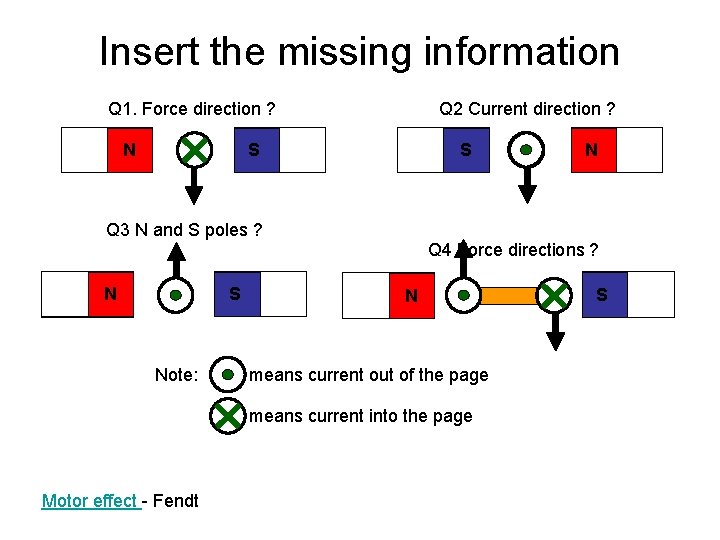
Insert the missing information Q 1. Force direction ? N Q 2 Current direction ? S S N Q 3 N and S poles ? Q 4 Force directions ? N S Note: N means current out of the page means current into the page Motor effect - Fendt S
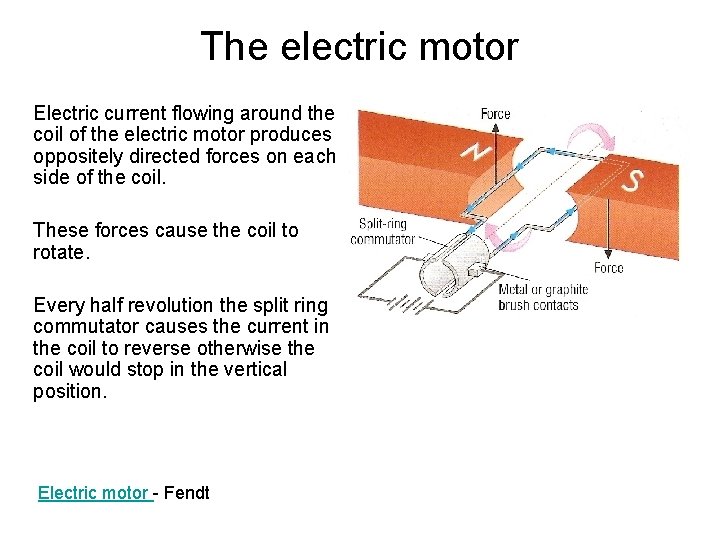
The electric motor Electric current flowing around the coil of the electric motor produces oppositely directed forces on each side of the coil. These forces cause the coil to rotate. Every half revolution the split ring commutator causes the current in the coil to reverse otherwise the coil would stop in the vertical position. Electric motor - Fendt
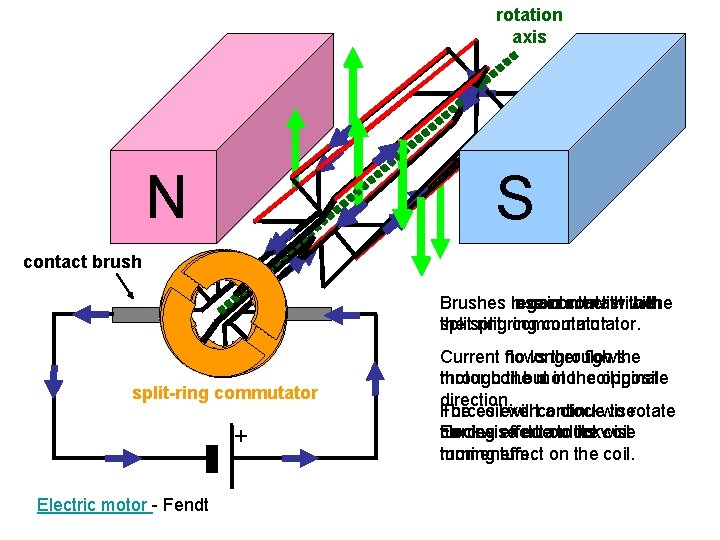
rotation axis N S contact brush Brushes regain in contact lose contact with thethe split the ring commutator. split-ring commutator + Electric motor - Fendt Current flows no longer through flows the through motor coil thebut motor in the coil. opposite original direction. Forces The coilexert will continue a clockwise to rotate turning exert clockwise Forces effect dueaon to clockwise the its coil momentum. turning effect on the coil.
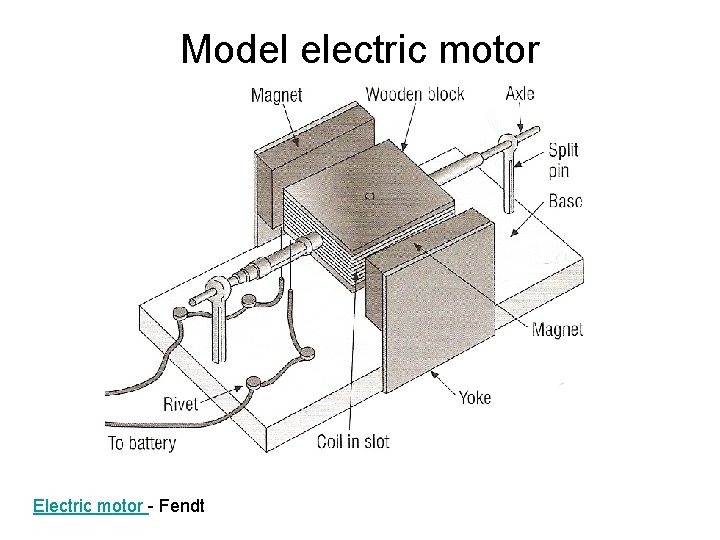
Model electric motor Electric motor - Fendt
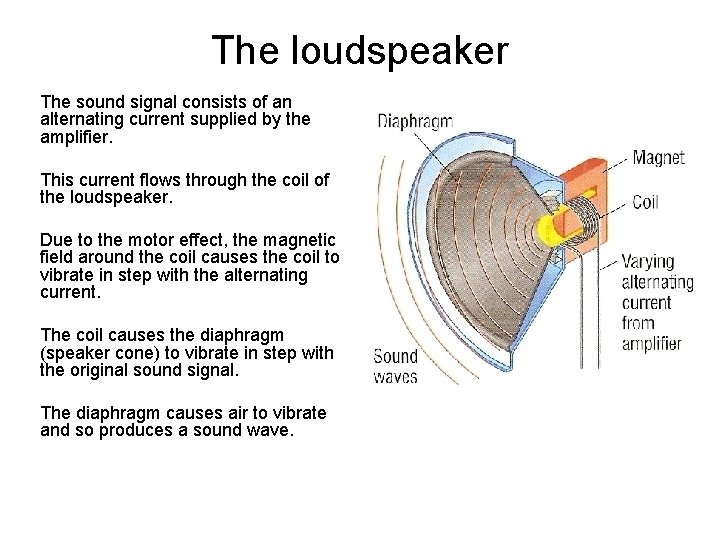
The loudspeaker The sound signal consists of an alternating current supplied by the amplifier. This current flows through the coil of the loudspeaker. Due to the motor effect, the magnetic field around the coil causes the coil to vibrate in step with the alternating current. The coil causes the diaphragm (speaker cone) to vibrate in step with the original sound signal. The diaphragm causes air to vibrate and so produces a sound wave.
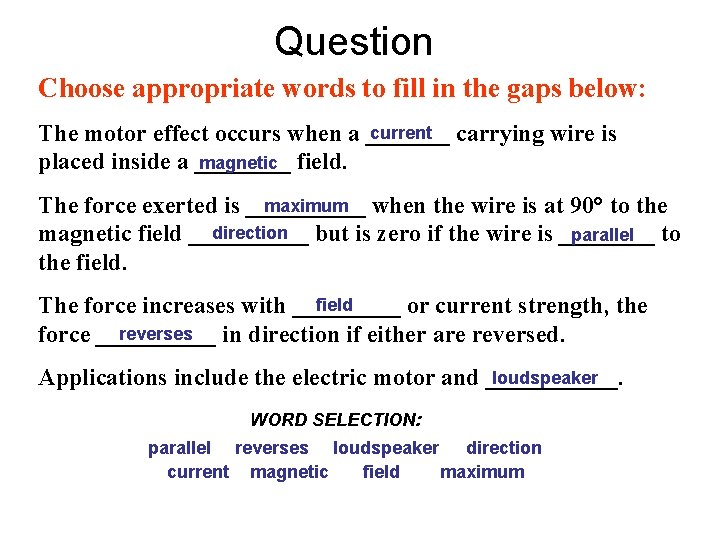
Question Choose appropriate words to fill in the gaps below: current carrying wire is The motor effect occurs when a _______ magnetic field. placed inside a ____ maximum when the wire is at 90° to the The force exerted is _____ direction parallel magnetic field _____ but is zero if the wire is ____ to the field The force increases with _____ or current strength, the reverses force _____ in direction if either are reversed. loudspeaker Applications include the electric motor and ______. WORD SELECTION: parallel reverses loudspeaker direction field current magnetic maximum
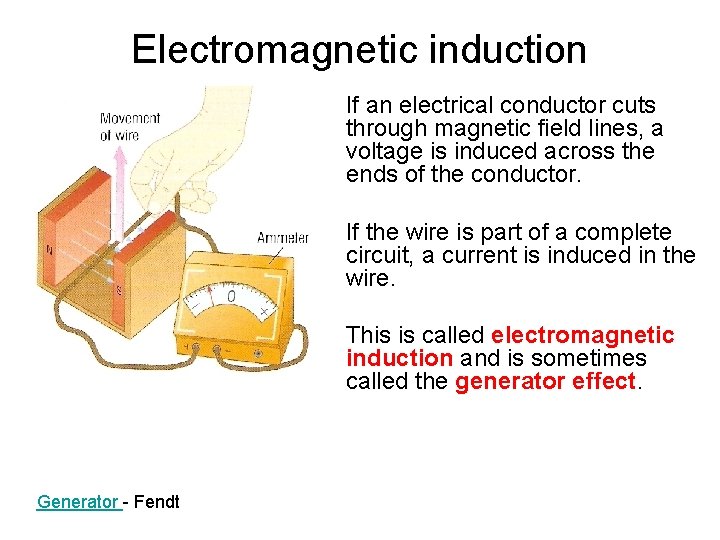
Electromagnetic induction If an electrical conductor cuts through magnetic field lines, a voltage is induced across the ends of the conductor. If the wire is part of a complete circuit, a current is induced in the wire. This is called electromagnetic induction and is sometimes called the generator effect. Generator - Fendt
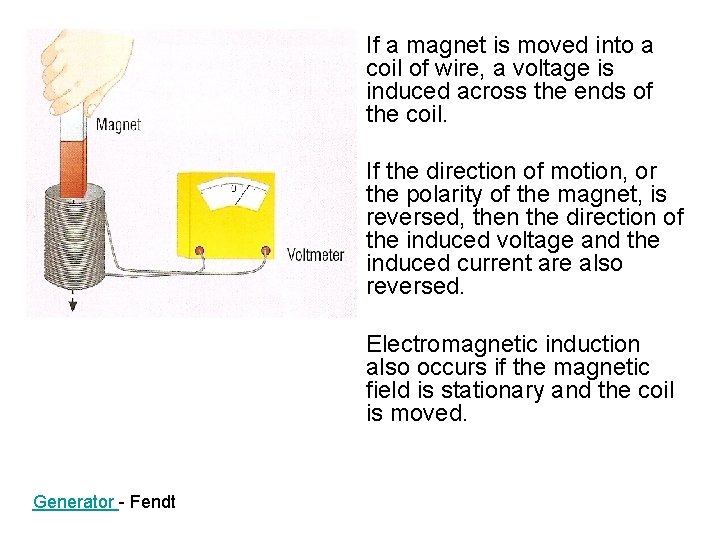
If a magnet is moved into a coil of wire, a voltage is induced across the ends of the coil. If the direction of motion, or the polarity of the magnet, is reversed, then the direction of the induced voltage and the induced current are also reversed. Electromagnetic induction also occurs if the magnetic field is stationary and the coil is moved. Generator - Fendt
The size of the induced voltage increases when: – – the speed of the movement increases the strength of the magnetic field increases the number of turns on the coil increases the area of the coil is greater. Generator - Fendt
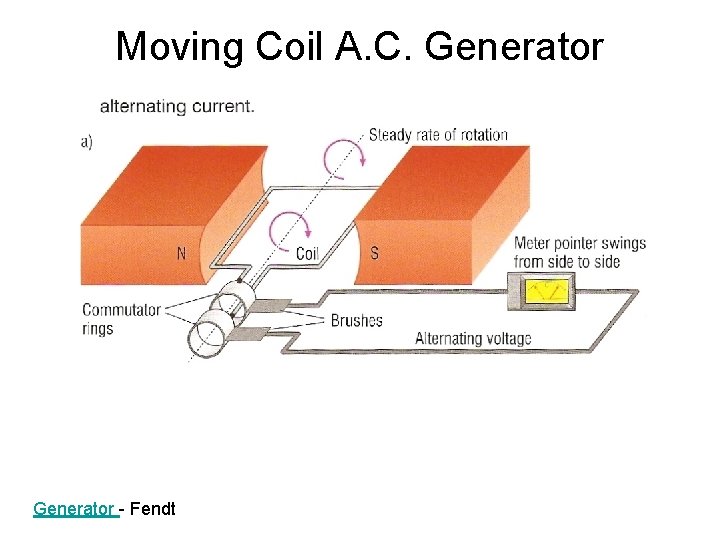
Alternating Current Generators Most electricity is produced using the ‘generator effect’. The simplest generators and the types used in power stations produce alternating current (A. C. ) Generator - Fendt
Moving Coil A. C. Generator - Fendt
Generator - Fendt
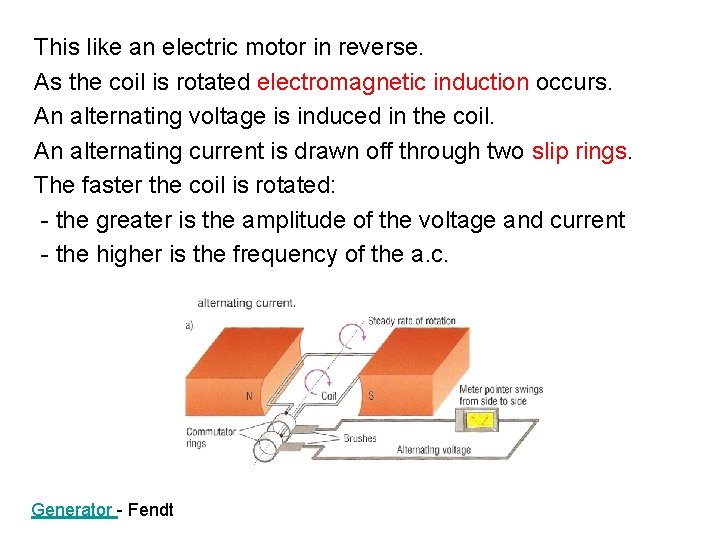
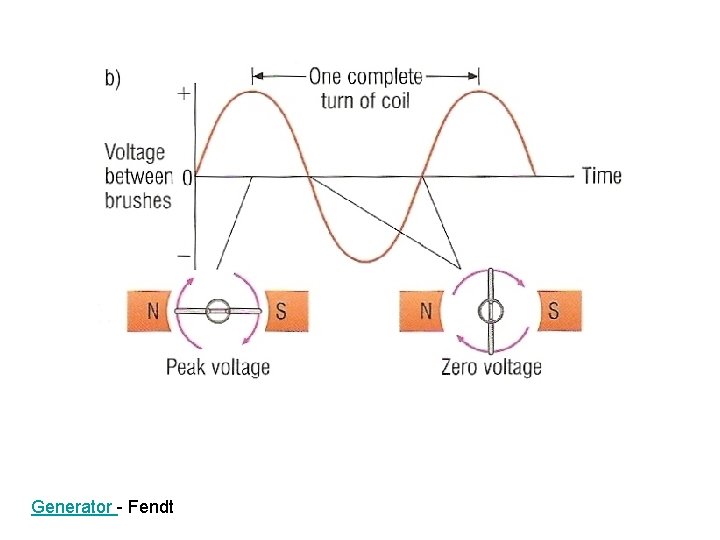
This like an electric motor in reverse. As the coil is rotated electromagnetic induction occurs. An alternating voltage is induced in the coil. An alternating current is drawn off through two slip rings. The faster the coil is rotated: - the greater is the amplitude of the voltage and current - the higher is the frequency of the a. c. Generator - Fendt
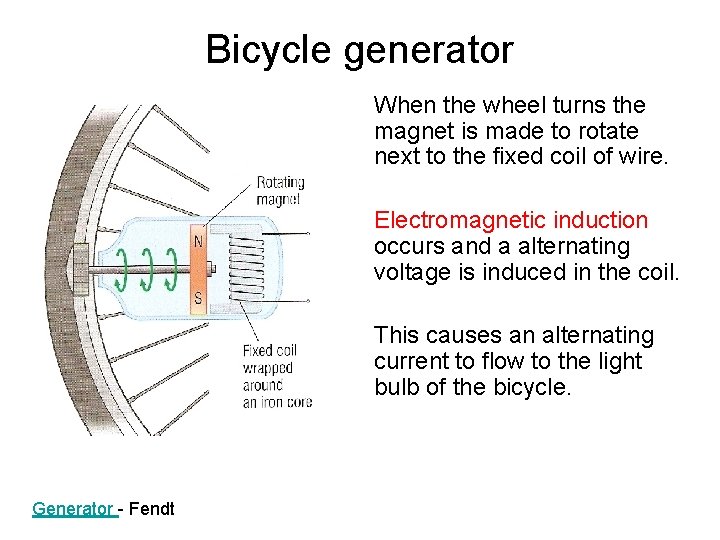
Bicycle generator When the wheel turns the magnet is made to rotate next to the fixed coil of wire. Electromagnetic induction occurs and a alternating voltage is induced in the coil. This causes an alternating current to flow to the light bulb of the bicycle. Generator - Fendt
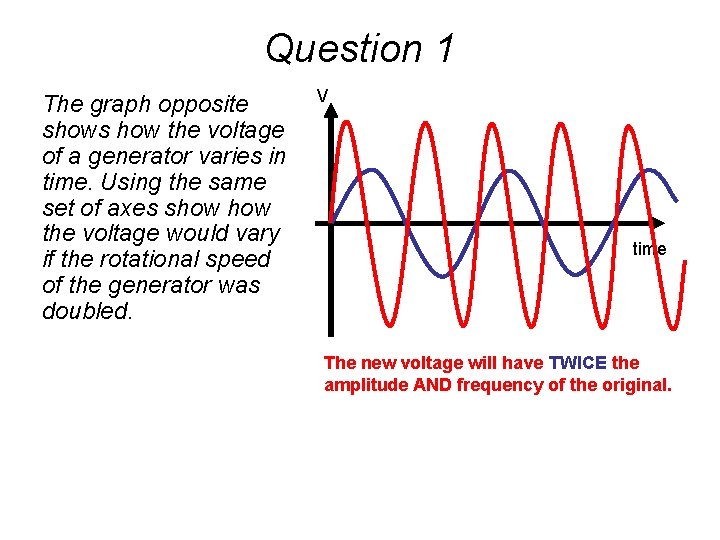
Question 1 The graph opposite shows how the voltage of a generator varies in time. Using the same set of axes show the voltage would vary if the rotational speed of the generator was doubled. V time The new voltage will have TWICE the amplitude AND frequency of the original.
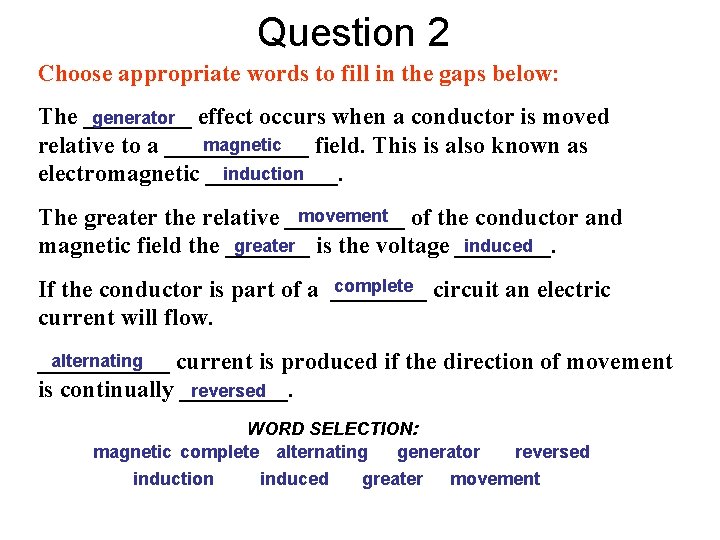
Question 2 Choose appropriate words to fill in the gaps below: The _____ generator effect occurs when a conductor is moved magnetic relative to a ______ field. This is also known as induction electromagnetic ______. movement of the conductor and The greater the relative _____ greater is the voltage ____. induced magnetic field the _______ complete circuit an electric If the conductor is part of a ____ current will flow. alternating ______ current is produced if the direction of movement reversed is continually _____. WORD SELECTION: generator magnetic complete alternating induction induced greater reversed movement
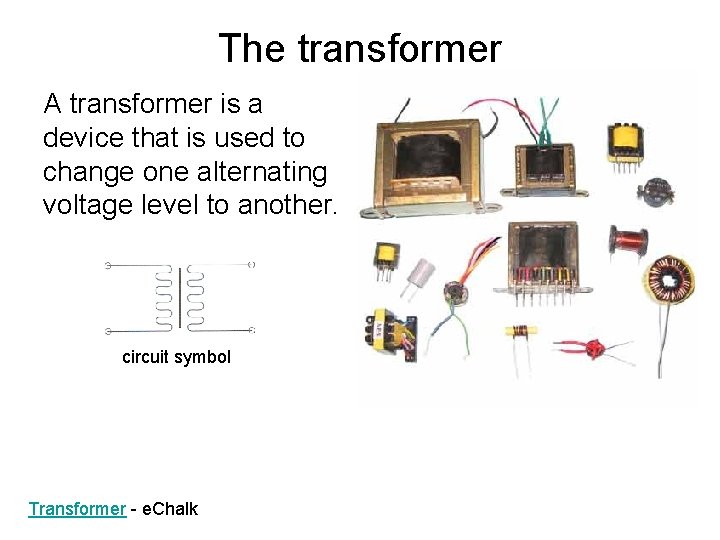
The transformer A transformer is a device that is used to change one alternating voltage level to another. circuit symbol Transformer - e. Chalk
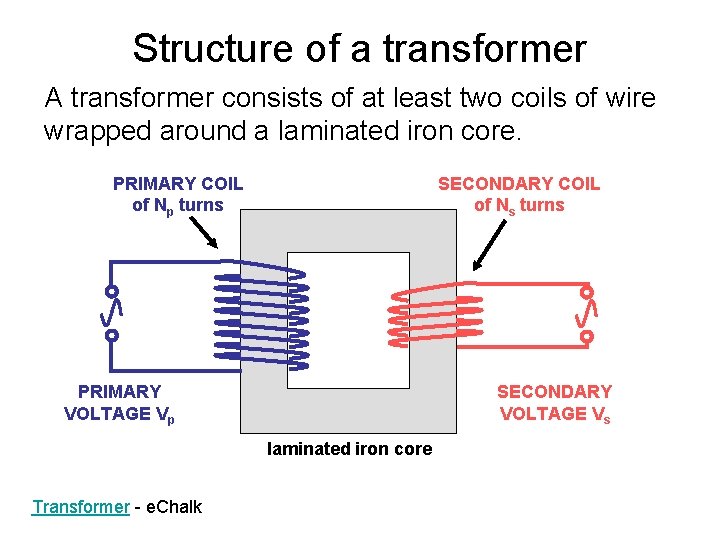
Structure of a transformer A transformer consists of at least two coils of wire wrapped around a laminated iron core. PRIMARY COIL of Np turns SECONDARY COIL of Ns turns PRIMARY VOLTAGE Vp SECONDARY VOLTAGE Vs laminated iron core Transformer - e. Chalk
How a transformer works When an alternating voltage, Vp is applied to the primary coil of Np turns it causes an alternating to flow in this coil. This current causes a changing magnetic field in the laminated iron core which cuts across the secondary coil of Ns turns. Electromagnetic induction occurs in this coil which produces an alternating voltage, Vs. Transformer - e. Chalk
Question Why can a transformer not change the level of the voltage output of a battery? – A battery produces a steady (DC) voltage. – This voltage would cause a constant direct current in the primary coil of a transformer. – This current would produce an unchanging magnetic field in the iron core. – This unchanging magnetic field would NOT cause electromagnetic induction in the secondary coil. – There would therefore be no secondary voltage.
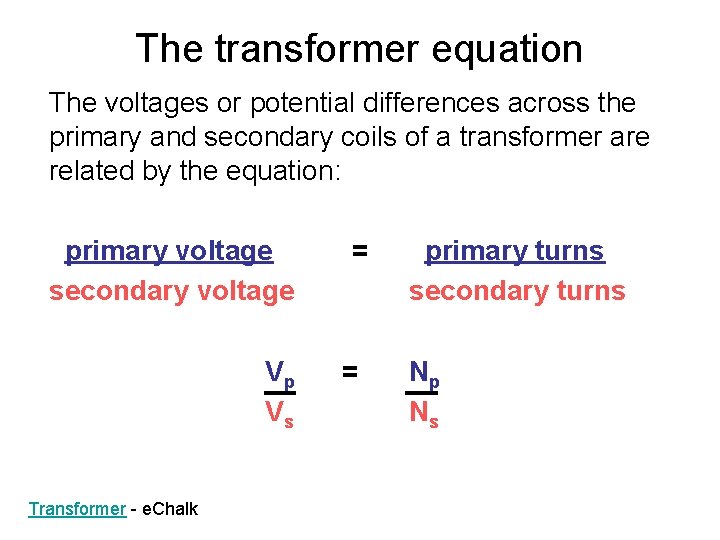
The transformer equation The voltages or potential differences across the primary and secondary coils of a transformer are related by the equation: primary voltage secondary voltage Vp Vs Transformer - e. Chalk = = primary turns secondary turns Np Ns
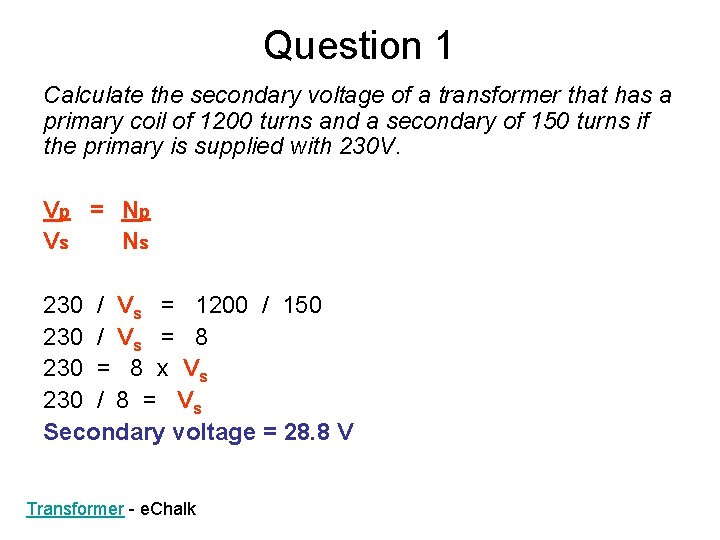
Question 1 Calculate the secondary voltage of a transformer that has a primary coil of 1200 turns and a secondary of 150 turns if the primary is supplied with 230 V. V p = Np Vs Ns 230 / Vs = 1200 / 150 230 / Vs = 8 230 = 8 x Vs 230 / 8 = Vs Secondary voltage = 28. 8 V Transformer - e. Chalk
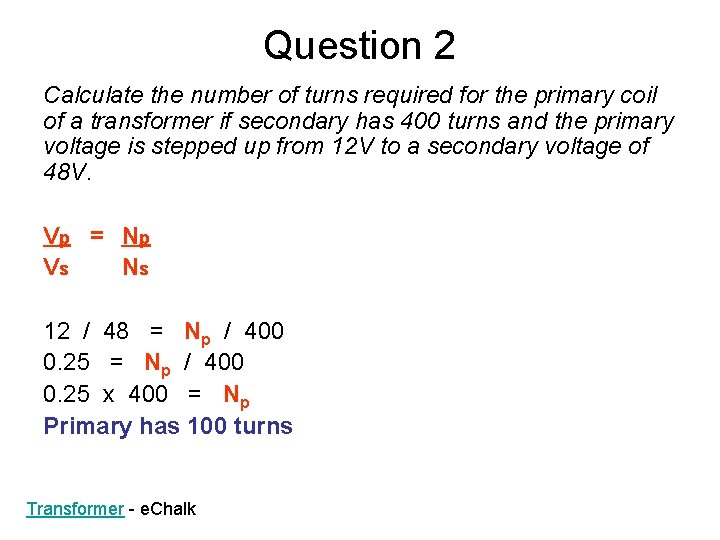
Question 2 Calculate the number of turns required for the primary coil of a transformer if secondary has 400 turns and the primary voltage is stepped up from 12 V to a secondary voltage of 48 V. V p = Np Vs Ns 12 / 48 = Np / 400 0. 25 x 400 = Np Primary has 100 turns Transformer - e. Chalk
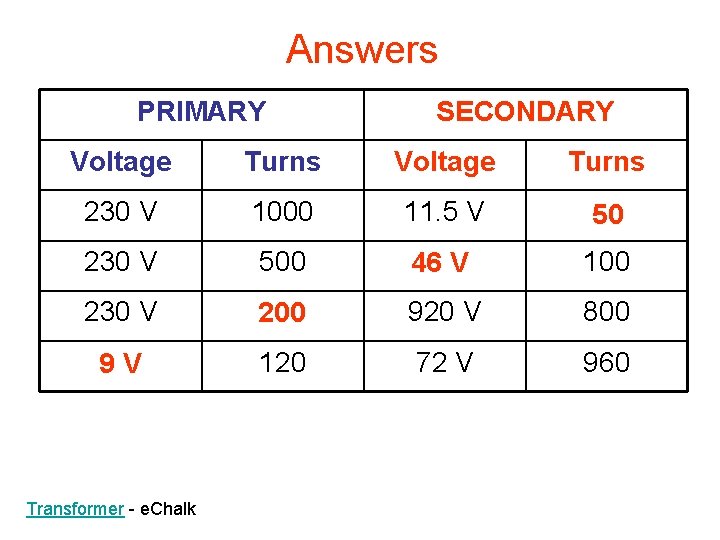
Answers Complete: PRIMARY SECONDARY Voltage Turns 230 V 1000 11. 5 V 50 230 V 500 46 VV 46 100 230 V 200 920 V 800 9 V 120 72 V 960 Transformer - e. Chalk
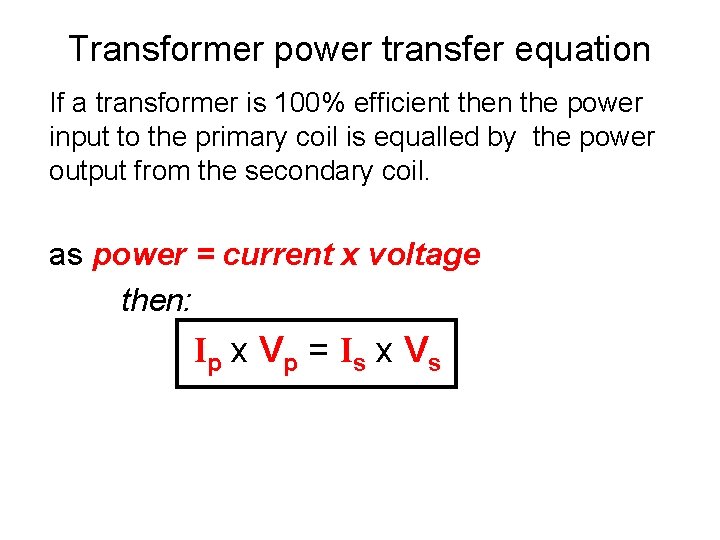
Transformer power transfer equation If a transformer is 100% efficient then the power input to the primary coil is equalled by the power output from the secondary coil. as power = current x voltage then: Ip x V p = Is x V s
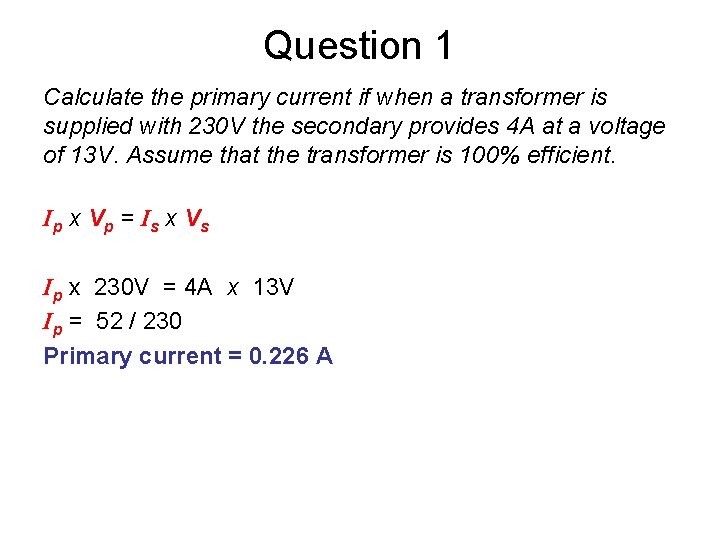
Question 1 Calculate the primary current if when a transformer is supplied with 230 V the secondary provides 4 A at a voltage of 13 V. Assume that the transformer is 100% efficient. Ip x V p = Is x V s Ip x 230 V = 4 A x 13 V Ip = 52 / 230 Primary current = 0. 226 A
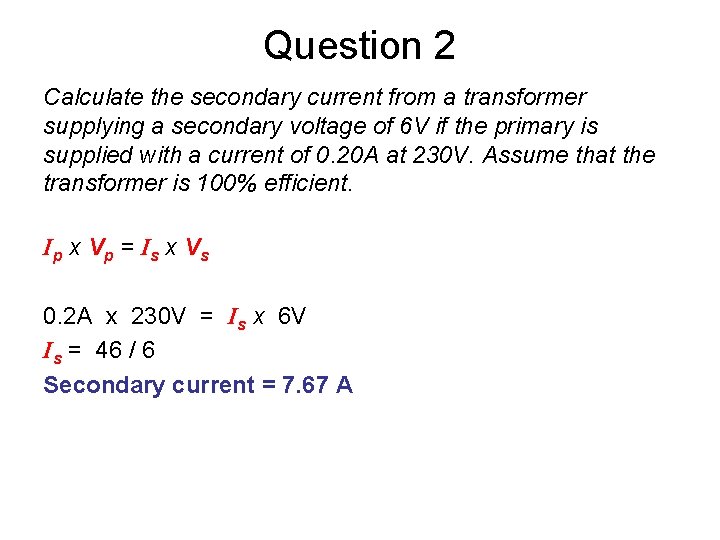
Question 2 Calculate the secondary current from a transformer supplying a secondary voltage of 6 V if the primary is supplied with a current of 0. 20 A at 230 V. Assume that the transformer is 100% efficient. Ip x V p = Is x V s 0. 2 A x 230 V = Is x 6 V Is = 46 / 6 Secondary current = 7. 67 A
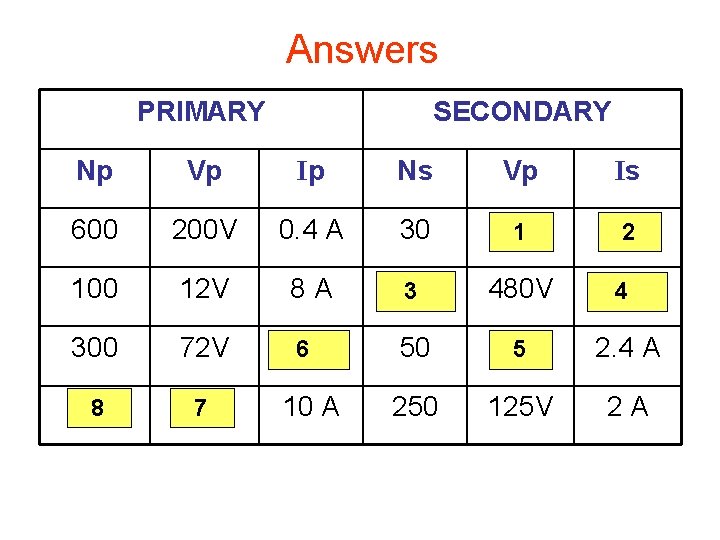
Answers Complete: PRIMARY SECONDARY Np Vp Ip Ns Vp Is 600 200 V 0. 4 A 30 10 V 1 82 A 100 12 V 8 A 4000 3 480 V 0. 2 4 A 300 72 V 0. 4 6 A 50 12 V 5 2. 4 A 8 50 7 25 V 10 A 250 125 V 2 A
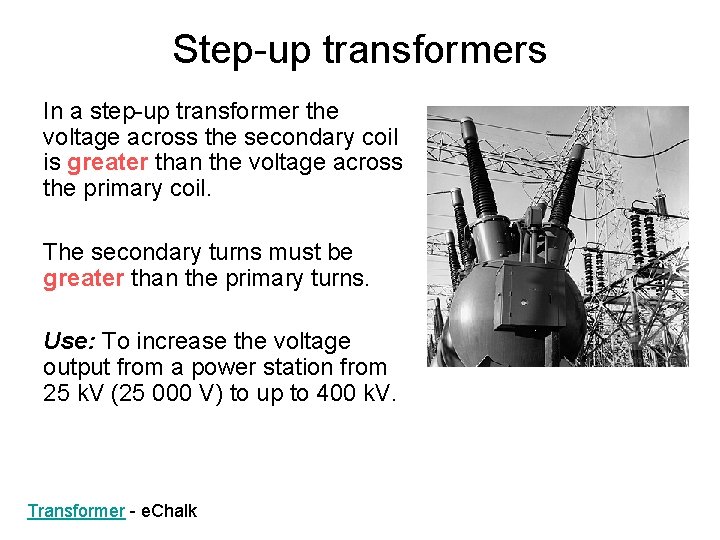
Step-up transformers In a step-up transformer the voltage across the secondary coil is greater than the voltage across the primary coil. The secondary turns must be greater than the primary turns. Use: To increase the voltage output from a power station from 25 k. V (25 000 V) to up to 400 k. V. Transformer - e. Chalk
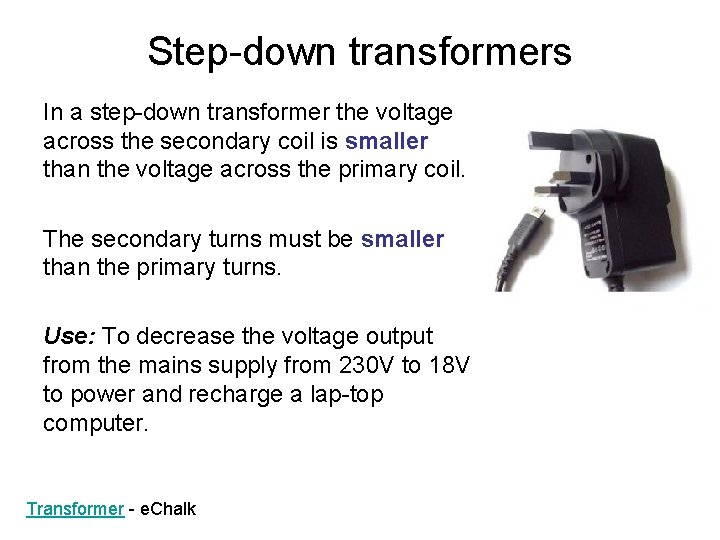
Step-down transformers In a step-down transformer the voltage across the secondary coil is smaller than the voltage across the primary coil. The secondary turns must be smaller than the primary turns. Use: To decrease the voltage output from the mains supply from 230 V to 18 V to power and recharge a lap-top computer. Transformer - e. Chalk
Transformers and the National Grid The National Grid is the system of cables used to deliver electrical power from power stations to consumers. The higher the voltage used, the greater is the efficiency of energy transmission. Lower voltages result in higher electric currents and greater energy loss to heat due to the resistance of the cables.
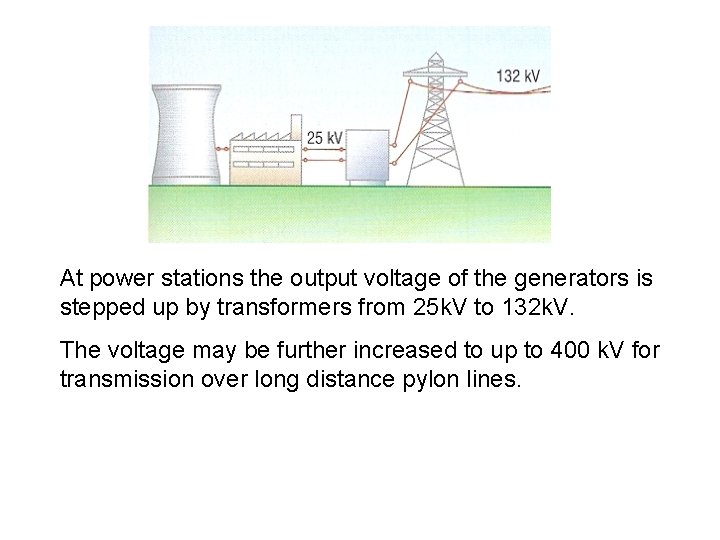
At power stations the output voltage of the generators is stepped up by transformers from 25 k. V to 132 k. V. The voltage may be further increased to up to 400 k. V for transmission over long distance pylon lines.
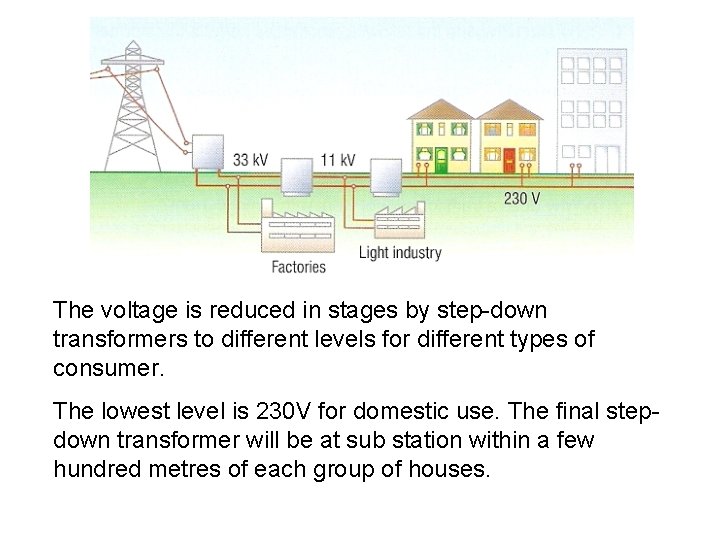
The voltage is reduced in stages by step-down transformers to different levels for different types of consumer. The lowest level is 230 V for domestic use. The final stepdown transformer will be at sub station within a few hundred metres of each group of houses.
Question 1 Why is electrical energy transmitted over the National Grid in the form of alternating current? – – To maximise efficiency high voltages must be used. Voltage therefore needs to be changed in level. Transformers are needed to change voltage levels. Transformers only work with alternating current.
Question 2 Choose appropriate words to fill in the gaps below: Transformers are used to change one ______ voltage alternating level to another. They do not work with ______current. direct increase the voltage because their Step-up transformers _____ secondary ______ coil has more turns than the primary. 25 k. V National Transformers are used in the _____ Grid. The _______ 400 k. V output of a power station is increased to up to _______. A high energy resistance voltage reduces the ____ lost to heat due to the _____ of the power lines. WORD SELECTION: energy direct increase National 400 k. V secondary resistance alternating 25 k. V
Electromagnetism Simulations Motor effect - Fendt Electric motor - Fendt Faraday Electromagnetic Lab – Ph. ET Play with a bar magnet and coils to learn about Faraday's law. Move a bar magnet near one or two coils to make a light bulb glow. View the magnetic field lines. A meter shows the direction and magnitude of the current. View the magnetic field lines or use a meter to show the direction and magnitude of the current. You can also play with electromagnets, generators and transformers! Faraday's Law - Ph. ET - Light a light bulb by waving a magnet. This demonstration of Faraday's Law shows you how to reduce your power bill at the expense of your grocery bill. Generator - Fendt Transformer - load can be changed but not turns ration netfirms Transformer - e. Chalk
Electric Motors and Electromagnetic Induction 1. 2. 3. 4. 5. 6. 7. 8. 9. (a) What is the motor effect? (b) What factors determine the size of the force exerted on a conductor in a magnetic field? (c) With the aid of a diagram show Fleming’s left-hand rule can be used to find the direction of the force on a conductor. Copy figures 22. 5 and 22. 6 and explain how a moving coil loudspeaker and electric motor work. (a) Draw diagrams and explain what is meant by ‘electromagnetic induction’? (b) What factors determine the size of the voltage produced? Copy figure 22. 12 and use it to explain how a simple generator works. Copy figure 22. 16 and use it to explain how a transformer works. Copy the two transformer equations on pages 193 and 194 and find the secondary current and voltage for a 100% efficient transformer that has a primary coil of 800 turns supplied with 2 A at 40 V if the secondary coil has 100 turns. Explain what is meant by step-up and step-down transformers and how they are used in the UK’s National Grid system. Answer the questions on pages 195 and 196. Verify that you can do all of the items listed in the end of chapter checklist on page 195.
Electric Motors and Electromagnetic Induction Notes questions from pages 187 to 196 1. 2. 3. 4. 5. (a) What is the motor effect? (b) What factors determine the size of the force exerted on a conductor in a magnetic field? (c) With the aid of a diagram show Fleming’s left-hand rule can be used to find the direction of the force on a conductor. Copy figures 22. 5 and 22. 6 and explain how a moving coil loudspeaker and electric motor work. (a) Draw diagrams and explain what is meant by ‘electromagnetic induction’? (b) What factors determine the size of the voltage produced? Copy figure 22. 12 and use it to explain how a simple generator works. Answer questions 1, 2 and 3 on pages 195 and 196.
- Slides: 43