
The most effective notetaking is active not passive
- Slides: 5
The most effective note-taking is active not passive. Note taking Active learning helps you to make meaning from what you learn; passive learning is allowing yourself to be an empty vessel into which knowledge is poured with no way of organising or making meaning from it. You are less likely to remember things you learn passively, which means more checking your notes while you're writing assignments, and more repeated effort when you come to revise.
• underlining words • cutting and pasting from online documents • trying to write everything you hear in a lecture Passive notetaking includes: • copying slides from the screen • copying lots of direct quotes rather than putting the ideas in your own words • writing notes on everything you read, because you're not sure what will turn out to be important • not evaluating or criticising the sources you use, but just accepting them as suitable evidence
thinking about what you want to get out of your research before you start looking for answers to any questions you may have about the topic Active notetaking means: looking for connections within the topic you're studying, and to other topics on your course writing notes mostly in your own words - your own explanation of what something says or means recording direct quotes only when it's important to have the exact words that someone else has used (i. e. when how they say something is as significant as what they say)
You'll know how good your notes are when you try to use them! Here are some suggestions to make your notes easier to read, easier to understand easier to find when you need them. Making your notes userfriendly Make your notes brief and be selective Keep them well-spaced so you can see individual points and add more details later if necessary Show the relationships between the main points (link with a line along which you write how they relate to each other, for instance) Use your own words to summarise - imagine someone has asked you "so what did x say about this? " and write down your reply
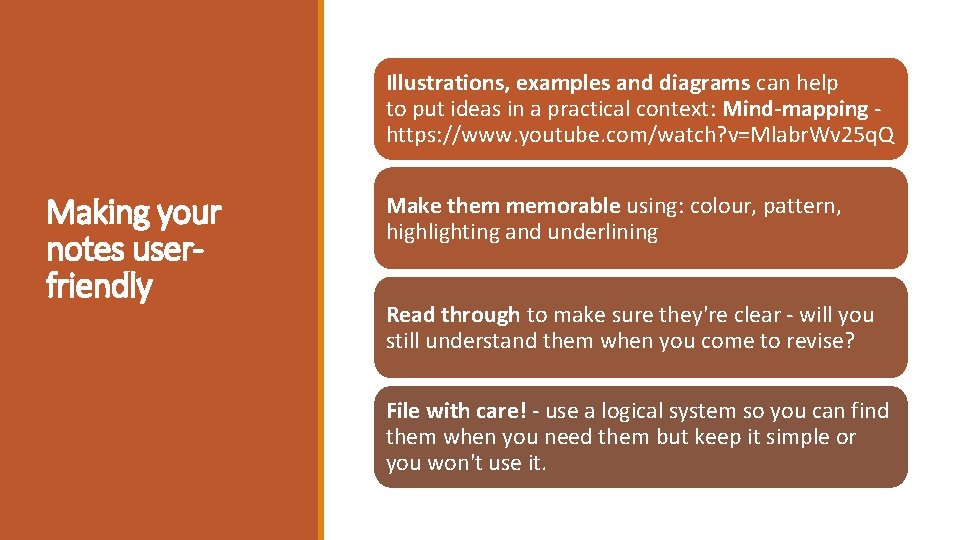
Illustrations, examples and diagrams can help to put ideas in a practical context: Mind-mapping https: //www. youtube. com/watch? v=Mlabr. Wv 25 q. Q Making your notes userfriendly Make them memorable using: colour, pattern, highlighting and underlining Read through to make sure they're clear - will you still understand them when you come to revise? File with care! - use a logical system so you can find them when you need them but keep it simple or you won't use it.