
The Most Common Errors Understanding Clauses A clause
- Slides: 9
The Most Common Errors
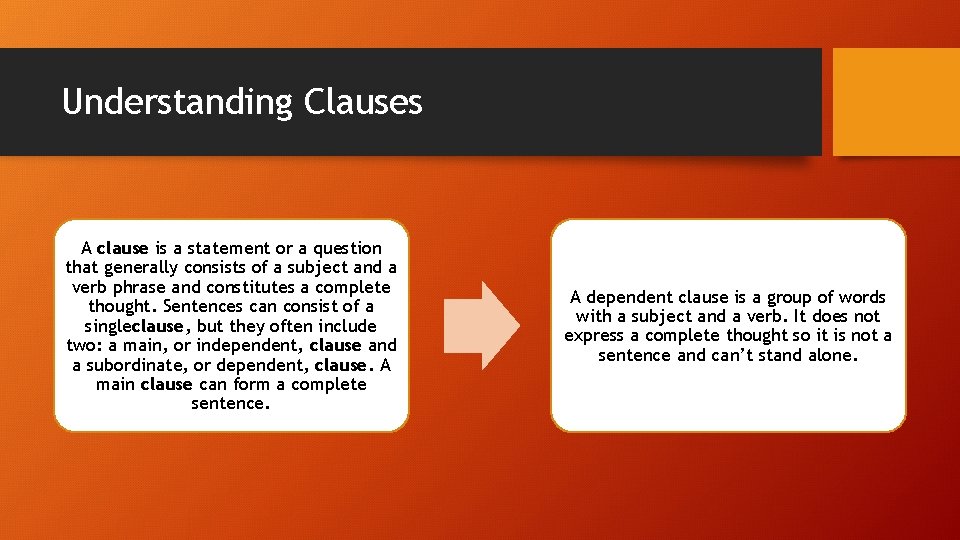
Understanding Clauses A clause is a statement or a question that generally consists of a subject and a verb phrase and constitutes a complete thought. Sentences can consist of a singleclause, but they often include two: a main, or independent, clause and a subordinate, or dependent, clause. A main clause can form a complete sentence. A dependent clause is a group of words with a subject and a verb. It does not express a complete thought so it is not a sentence and can’t stand alone.
Dependent Clause 1 • Nonessential Clause: If you leave out the element or put it somewhere else in the sentence, does the essential meaning of the sentence change? If so, the element is essential; if not, it is nonessential. • Example: I was driving through the mountains, while listening to the radio, when I hit a dear. • (note the nonessential clause is separated by a comma before and after the statement)
Dependent Clause 2 • Introductory Clause: Introductory clauses are dependent clauses that provide background information or "set the stage" for the main part of the sentence, the independent clause. • Example: As the man was walking into the store, he came face to face with his childhood sweetheart. • (Note how the introductory clause is separated from the main thought by a comma)
If, Then comma rule • Obvious example: If I don’t get my car fixed, then I won’t make it to class. • Less obvious example: Without a steady income, I can’t buy a home. • Note: The if, then rule is based on a cause and effect relationship. “If” being the condition that must occur, “then” being the consequence of that condition.
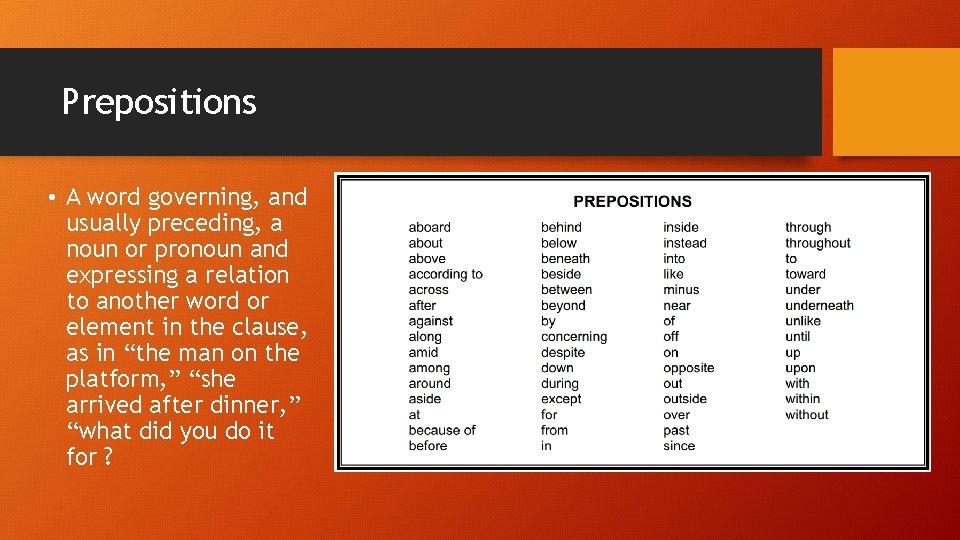
Prepositions • A word governing, and usually preceding, a noun or pronoun and expressing a relation to another word or element in the clause, as in “the man on the platform, ” “she arrived after dinner, ” “what did you do it for ?
The Box Rule • A creative cheat for understanding when to use a preposition. 1. Imagine the object of a sentence is a cardboard box. 2. Look at the preposition that precedes your box. 3. Is it literally possible for your subject to be in, on, around, exc. In relation to the box? 4. If yes, you are using the correct preposition.
Understanding Tense • Tense is a form of a verb that shows time, action, or state of being. Verbs are the only words in English that can show tense. English verbs have six tenses: present (walk), past (walked), future (will walk), present perfect (have walked), past perfect (had walked), future perfect (will have walked). Tense must be consistent throughout the entire paper, not just a phrase, sentence or paragraph. • Simple examples to get you started 1. Past: ed 2. Present or is performing an action: ing 3. Future: the word “will” precedes the verb. • (Note: avoid future tense, write in past tense as much as possible)
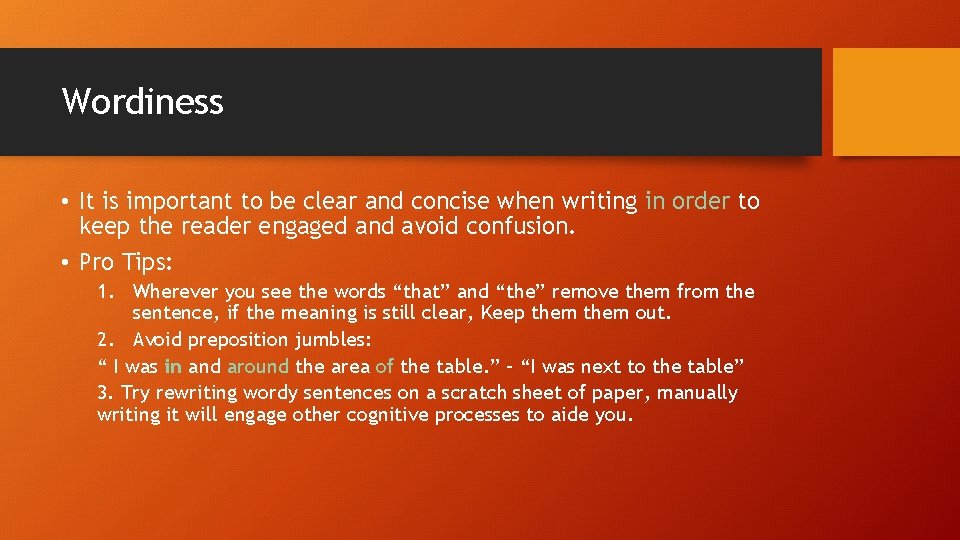
Wordiness • It is important to be clear and concise when writing in order to keep the reader engaged and avoid confusion. • Pro Tips: 1. Wherever you see the words “that” and “the” remove them from the sentence, if the meaning is still clear, Keep them out. 2. Avoid preposition jumbles: “ I was in and around the area of the table. ” – “I was next to the table” 3. Try rewriting wordy sentences on a scratch sheet of paper, manually writing it will engage other cognitive processes to aide you.