
The Moon Our nearest neighbor in space the
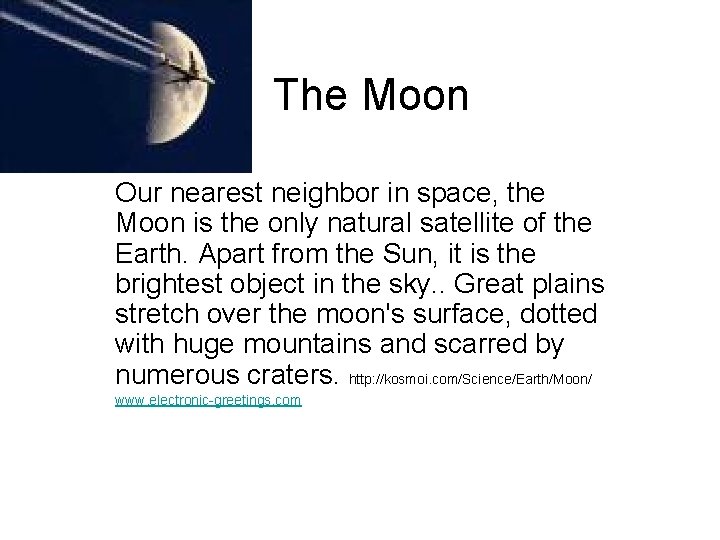
The Moon Our nearest neighbor in space, the Moon is the only natural satellite of the Earth. Apart from the Sun, it is the brightest object in the sky. . Great plains stretch over the moon's surface, dotted with huge mountains and scarred by numerous craters. http: //kosmoi. com/Science/Earth/Moon/ www. electronic-greetings. com
BRIEF SURVEY OF THE MOON • • • Mean Distance from earth 384, 403 km (238, 856 mi) Diameter 3480 km (2160 mi) Period of revolution 27. 322 earth days Eccentricity of orbit 0. 055 Inclination of orbit 5° 9´ Rotation period (sidereal day 27. 322 earth days Period of phases 29. 53 earth days Mass (earth = 1) 0. 012 Mean density (water = 1) 0. 605 • http: //www. worldalmanacforkids. com/explore/space/moon. html • antwrp. gsfc. nasa. gov
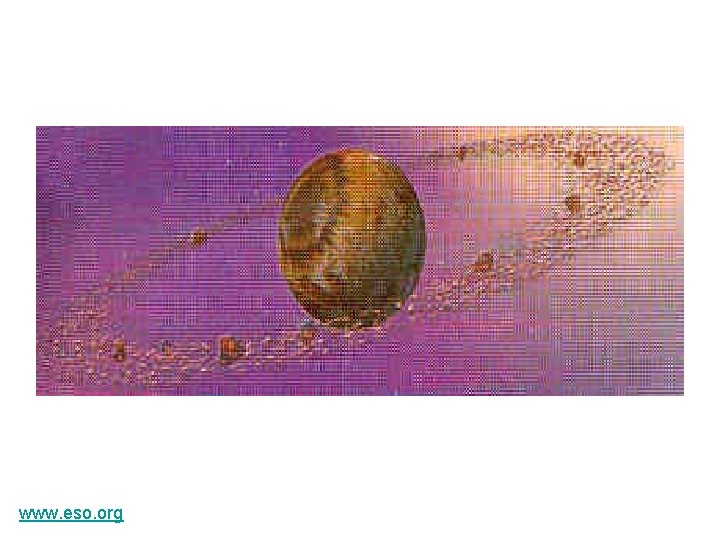
The Moon's Origin is Uncertain. • There are three hypothesis concerning the Moon’s origin. – that the Moon and the Earth formed at the same time from the Solar Nebula; – that the Moon split off of the Earth; – that the Moon formed elsewhere and was subsequently captured by the Earth. – http: //kosmoi. com/Science/Earth/Moon/
That the Moon and the Earth formed at the same time from the Solar Nebula This theory proposes that the earth and moon, and all other bodies of the solar system, condensed independently out of the huge cloud of cold gases and solid particles that constituted the primordial solar nebula. Much of this material finally collected at the center to form the sun. • http: //kosmoi. com/Science/Earth/Moon/
www. eso. org
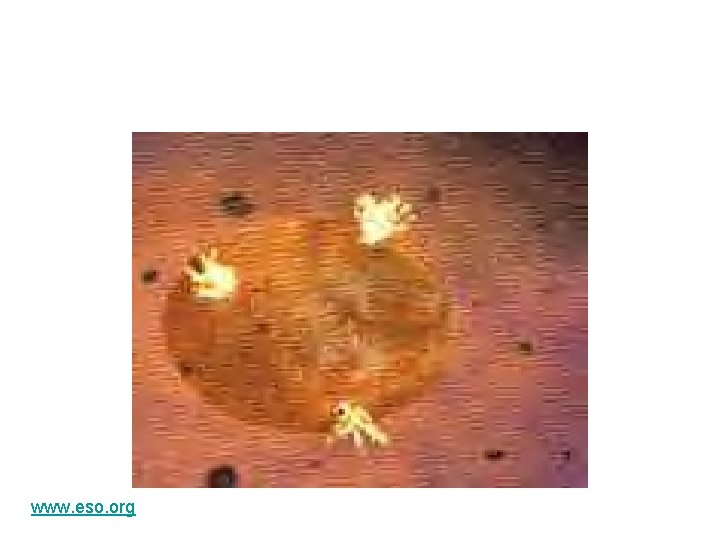
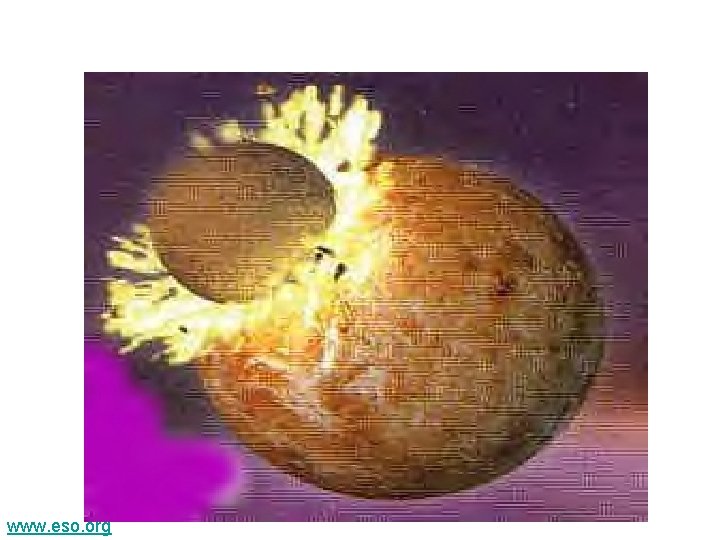
2 nd Hypothesis That the Moon split off from the Earth • New and detailed information from the Moon rocks led to theory that a Mars -sized object collided with the Earth soon after it was formed, a geyser of molten material spewed into space, and entered orbit around Earth. Some of this material fell back to Earth, but much of it coalesced to form the Moon. • http: //kosmoi. com/Science/Earth/Moon/
www. eso. org
2 nd Hypothesis That the Moon split off from the Earth (continued). • Planetismal impact. First published in 1975, this theory proposes that early in the earth’s history, well over 4 billion years ago, the earth was struck by a large body called a planetismal, about the size of Mars. The catastrophic impact blasted portions of the earth and the planetismal into earth orbit, where debris from the impact eventually coalesced to form the moon. http: //www. worldalmanacforkids. com/explore/space/moon. html
2 nd Hypothesis That the Moon split off from the Earth (continued). • This theory, after years of research on moon rocks in the 1970 s and ’ 80 s, has became the most widely accepted one for the moon’s origin. The major problem with theory is that it would seem to require that the earth melted throughout, following the impact, whereas the earth’s geochemistry does not indicate such a radical melting. http: //www. worldalmanacforkids. com/explore/space/moon. html
www. eso. org
Formation by fission from the Earth. 2 nd version, 2 nd hypothesis • The modern version of this theory proposes that the moon was spun off from the earth when the earth was young and rotating rapidly on its axis. This idea gained support partly because the density of the moon is the same as that of the rocks just below the crust, or upper mantle, of the earth. A major difficulty with this theory is that the angular momentum of the earth, in order to achieve rotational instability, would have to have been much greater than the angular momentum of the present earth-moon system. • http: //www. worldalmanacforkids. com/explore/space/moon. html
3 rd Hypothesis That the Moon formed elsewhere and was subsequently captured by the Earth. • The last hypothesis says the moon was a small planet traveling around the sun. The Earth's gravity captured the moon, making it the Earth's satellite. It should be noted that the moon’s orbit is getting larger each year by 3 to 4 centimeters per year (not by much).
Chapters In The Moon’s History • Lunar evolution models based on Lunar Orbiter mapping of the Moon and on Apollo and Luna sample analyses suggest five principal episodes: • 1. accretion and large-scale melting; • 2. crustal separation and concurrent massive meteoritic bombardment; • 3. partial melting at depth diminished bombardment; • 4. with further melting at depth and emplacement of mare basalts; • 5. cessation of volcanism and gradual internal cooling. • http: //kosmoi. com/Science/Earth/Moon/
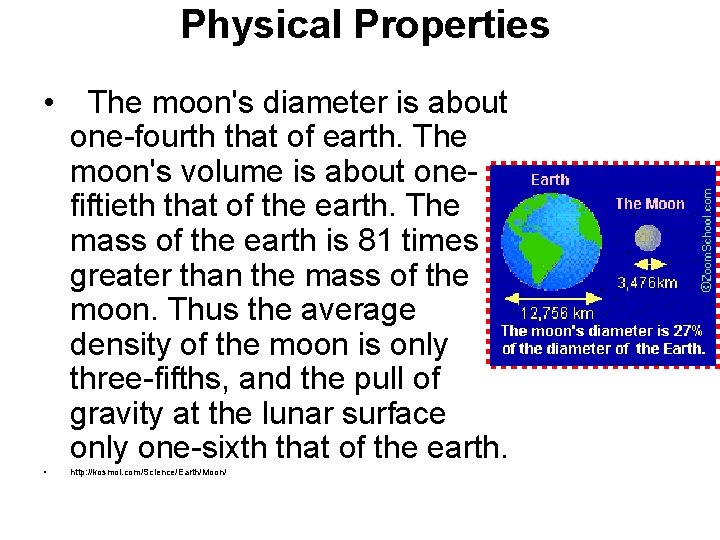
Physical Properties • The moon's diameter is about one-fourth that of earth. The moon's volume is about onefiftieth that of the earth. The mass of the earth is 81 times greater than the mass of the moon. Thus the average density of the moon is only three-fifths, and the pull of gravity at the lunar surface only one-sixth that of the earth. • http: //kosmoi. com/Science/Earth/Moon/
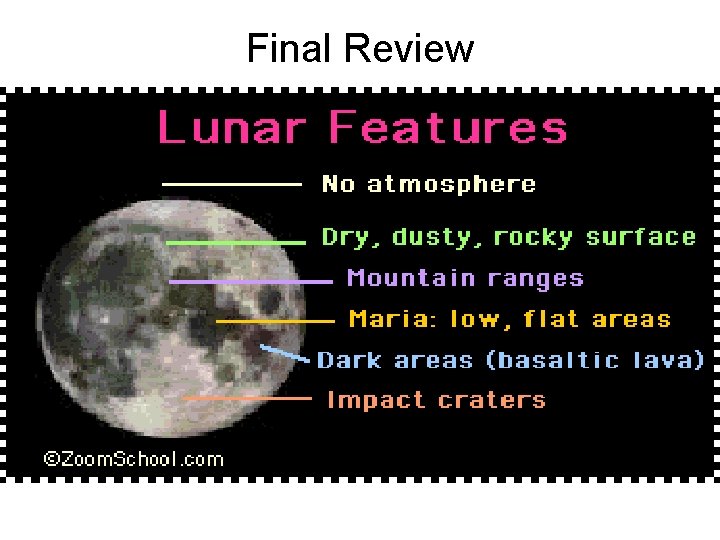
Physical Properties • The Moon has no atmosphere. Any early atmosphere that the Moon might have had, has escaped from the Moon's feeble gravitational pull. Because of the lack of any atmosphere, the temperature of the Moon's surface varies between -180 C and 110 C. The Moon offers little protection from the solar wind, cosmic rays or micrometeorites and so it is not surprising that there is no form of life on the Moon. • http: //kosmoi. com/Science/Earth/Moon/
What is the Composition of the Moon? • The lunar crust is composed of a variety of primary elements, including uranium, thorium, potassium, oxygen, silicon, magnesium, iron, titanium, calcium, aluminum, and hydrogen. • http: //kosmoi. com/Science/Earth/Moon/
Below the Surface • The Moon's crust averages 68 km thick and varies from essentially 0 km under Mare Crisium to 107 km north of the crater Korolev on the lunar far side. Below the crust is a mantle and probably a small core (roughly 340 km radius and 2% of the Moon's mass). Unlike the Earth's mantle, however, the Moon's mantle is only partially molten. Curiously, the Moon's center of mass is offset from its geometric center by about 2 km in the direction toward the Earth. Also, the crust is thinner on the lunar near side. • http: //kosmoi. com/Science/Earth/Moon/
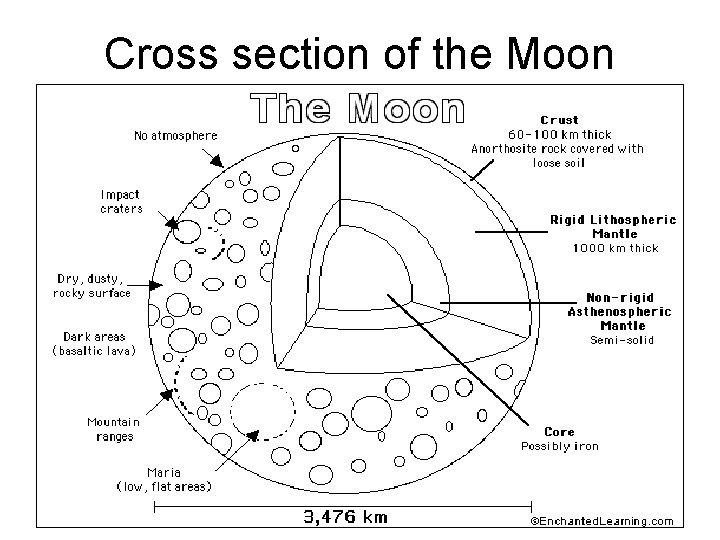
Cross section of the Moon
Where did all the Moon Gas Go? • The moon has no free water and essentially no atmosphere, and no weather exists to change its surface; yet it is not totally inert. Evidence from Clementine suggested that there may be water ice in some deep craters near the Moon's south pole which are permanently shaded. This has now been confirmed by Lunar Prospector. There is apparently ice at the north pole as well. http: //kosmoi. com/Science/Earth/Moon/
Topography • The study of lunar topography began with the invention of the telescope. Galileo studied the moon through a telescope in 1609. Later astronomers made maps of its physical features, discovering mountains and plains, some large craters, and long valleys. Some of them thought the plains on the moon were covered with water and called them 'Maria' (Latin for seas). This name has persisted, though it's now known that there's no water on the moon's surface. • http: //kosmoi. com/Science/Earth/Moon/
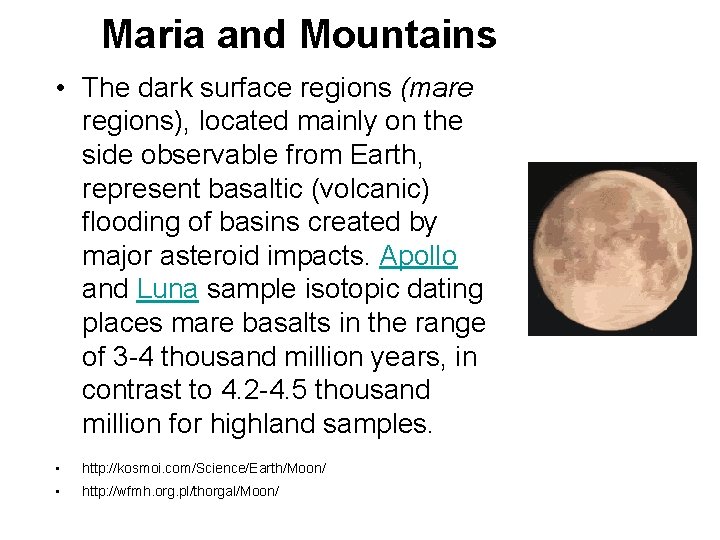
Maria and Mountains • The dark surface regions (mare regions), located mainly on the side observable from Earth, represent basaltic (volcanic) flooding of basins created by major asteroid impacts. Apollo and Luna sample isotopic dating places mare basalts in the range of 3 -4 thousand million years, in contrast to 4. 2 -4. 5 thousand million for highland samples. • http: //kosmoi. com/Science/Earth/Moon/ • http: //wfmh. org. pl/thorgal/Moon/
• The brighter surface regions (highlands) represent the original lunar crustal material shaped by saturation bombardment of meteoritic material. The brighter, densely cratered, mountainous highland regions (sometimes called terrae), are found mainly on the southern part of the Moon's near side, and over the entire far side. • http: //kosmoi. com/Science/Earth/Moon/
Craters • Much of the Moon's surface is covered with craters. These are the result of impacts by meteors. The largest are about 200 km in diameter, the smallest are only about a meter across. Most of these craters were formed between 3000 and 4000 million years ago. Many of the craters were made by meteoric impacts. Some of the craters are large enough to encircle several cities as big as New York, with mountains higher than the Rockies rising up from their floors. • http: //kosmoi. com/Science/Earth/Moon/
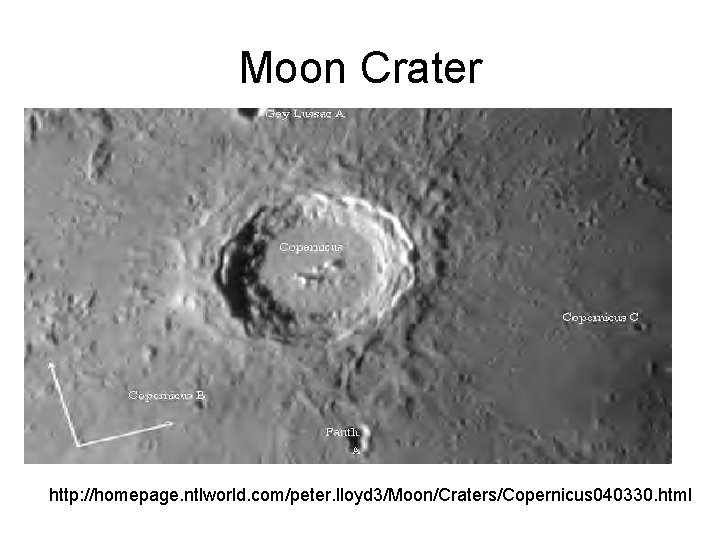
Moon Crater http: //homepage. ntlworld. com/peter. lloyd 3/Moon/Craters/Copernicus 040330. html
Oh Earth, Where have all your Craters Gone? • When a meteor strikes Earth, it makes a crater, just as it does on the Moon. But on Earth, wind, rain, and the motions of the crust erase or fill in these craters. • Since the Moon has no atmosphere, there is no rain or wind to erode the craters. And because the Moon's interior is no longer hot and active like Earth's, there are no active volcanoes on the Moon. So craters formed by meteorites on the Moon last a long time. • http: //kosmoi. com/Science/Earth/Moon/
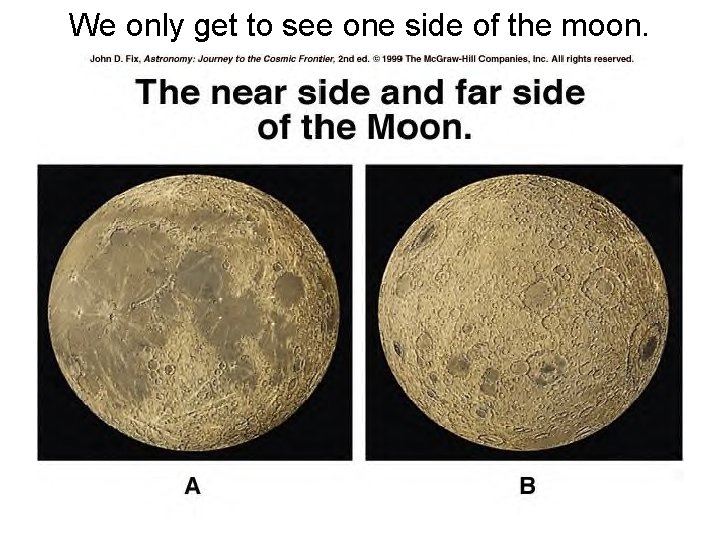
We only get to see one side of the moon.
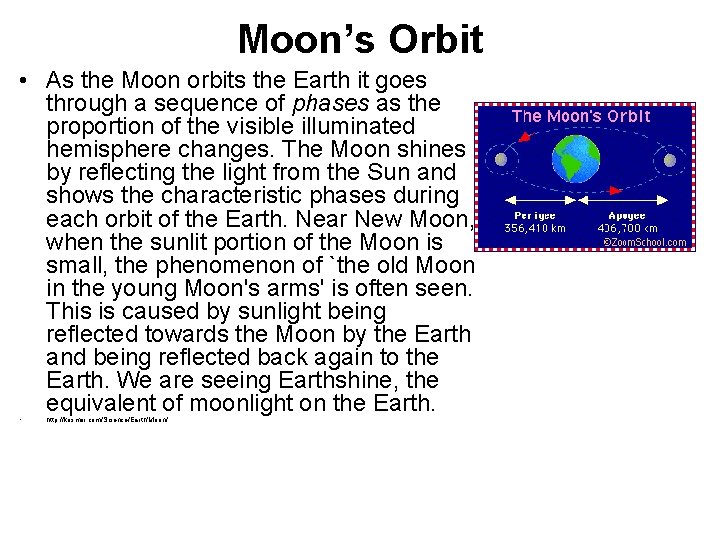
Moon’s Orbit • As the Moon orbits the Earth it goes through a sequence of phases as the proportion of the visible illuminated hemisphere changes. The Moon shines by reflecting the light from the Sun and shows the characteristic phases during each orbit of the Earth. Near New Moon, when the sunlit portion of the Moon is small, the phenomenon of `the old Moon in the young Moon's arms' is often seen. This is caused by sunlight being reflected towards the Moon by the Earth and being reflected back again to the Earth. We are seeing Earthshine, the equivalent of moonlight on the Earth. • http: //kosmoi. com/Science/Earth/Moon/
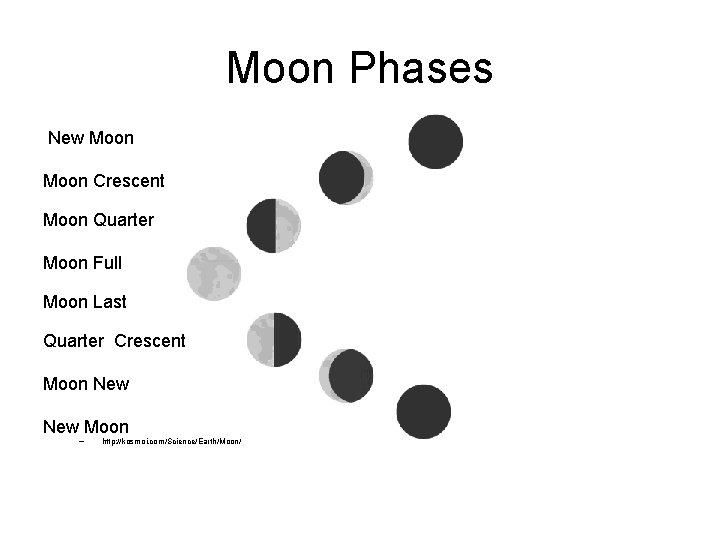
Moon Phases New Moon Crescent Moon Quarter Moon Full Moon Last Quarter Crescent Moon New Moon – http: //kosmoi. com/Science/Earth/Moon/
Around and Around it goes and where it stop nobody knows. • The lunar orbit is elliptical. The moon and the Earth orbit around their common center of gravity. The moon's orbital period around the earth, and also its rotation period, is 27. 322 days. Since the period of the orbit is the same as the Moon's rotational period (or lunar day), we always see the same side of the Moon facing us. • http: //kosmoi. com/Science/Earth/Moon/
Tides and Gravity • The pull of the moon's gravity causes the tides. The Moon's gravitational attraction is stronger on the side of the Earth nearest to the Moon and weaker on the opposite side. This causes two small bulges in the sea water, one in the direction of the Moon and one directly opposite. Because the Earth rotates much faster than the Moon moves in its orbit, the bulges move around the Earth about once a day giving two high tides per day. • http: //kosmoi. com/Science/Earth/Moon/
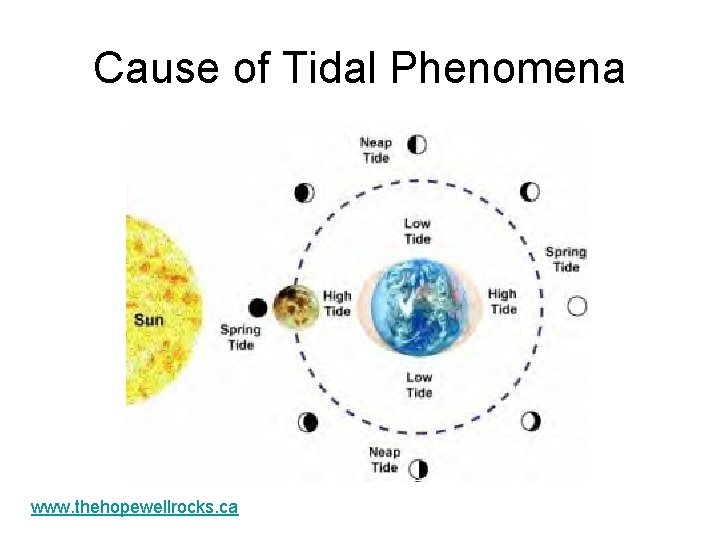
Cause of Tidal Phenomena www. thehopewellrocks. ca
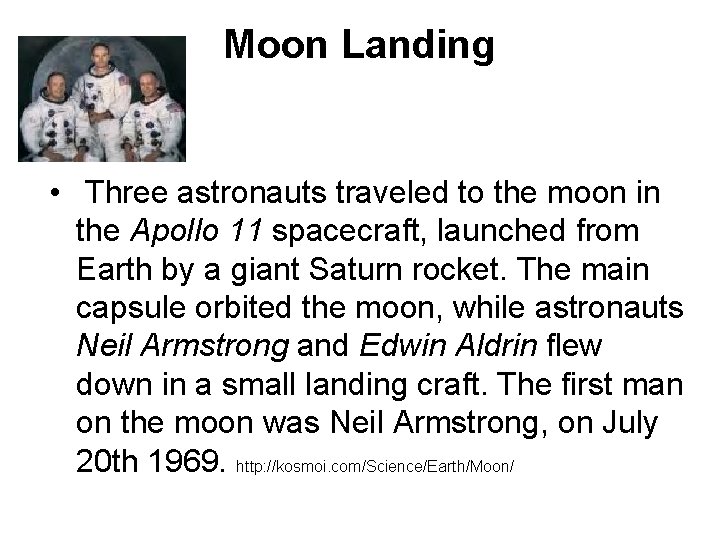
Moon Landing • Three astronauts traveled to the moon in the Apollo 11 spacecraft, launched from Earth by a giant Saturn rocket. The main capsule orbited the moon, while astronauts Neil Armstrong and Edwin Aldrin flew down in a small landing craft. The first man on the moon was Neil Armstrong, on July 20 th 1969. http: //kosmoi. com/Science/Earth/Moon/
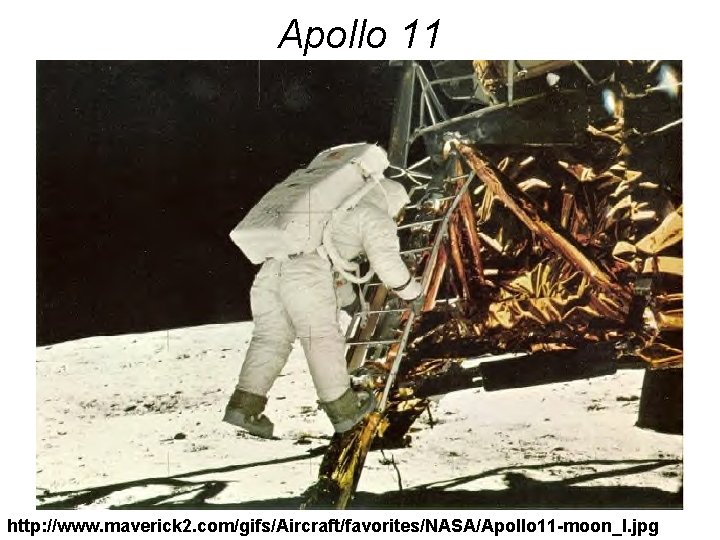
Apollo 11 http: //www. maverick 2. com/gifs/Aircraft/favorites/NASA/Apollo 11 -moon_l. jpg
• From 1969 to 1972, six Apollo missions sent 12 astronauts to the Moon's surface. They gathered lunar rocks and soil and brought them back to Earth. They also left behind four special mirrors aimed at Earth. Astronomers beamed pulses of laser light to the Moon and measured the time it takes for the light to reflect back to Earth. This technique has established the exact distance from Earth to the Moon to within a fraction of an inch. • http: //kosmoi. com/Science/Earth/Moon/
Final Review
- Slides: 35