
The Monocots Part 2 Commelinid Monocots Spring 2014










- Slides: 50
The Monocots: Part 2 Commelinid Monocots Spring 2014
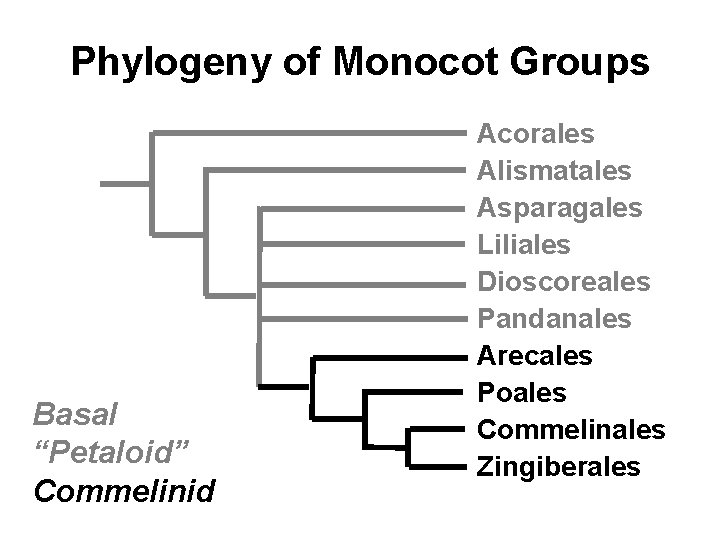
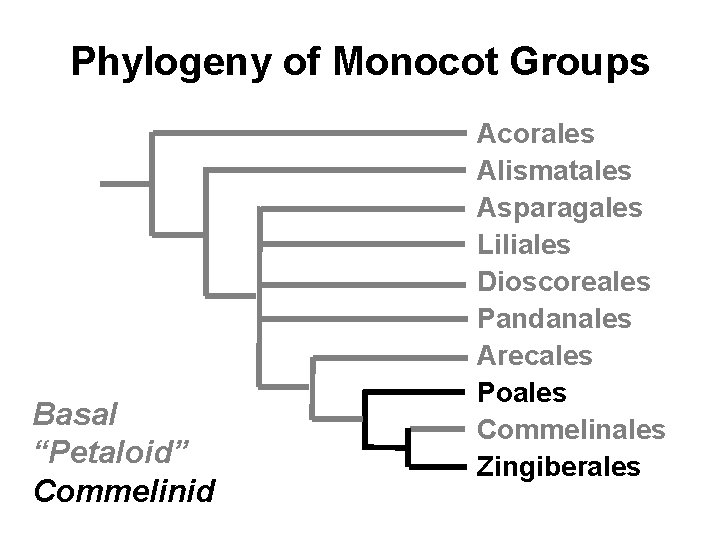
Phylogeny of Monocot Groups Basal “Petaloid” Commelinid Acorales Alismatales Asparagales Liliales Dioscoreales Pandanales Arecales Poales Commelinales Zingiberales
Fig. 7. 17
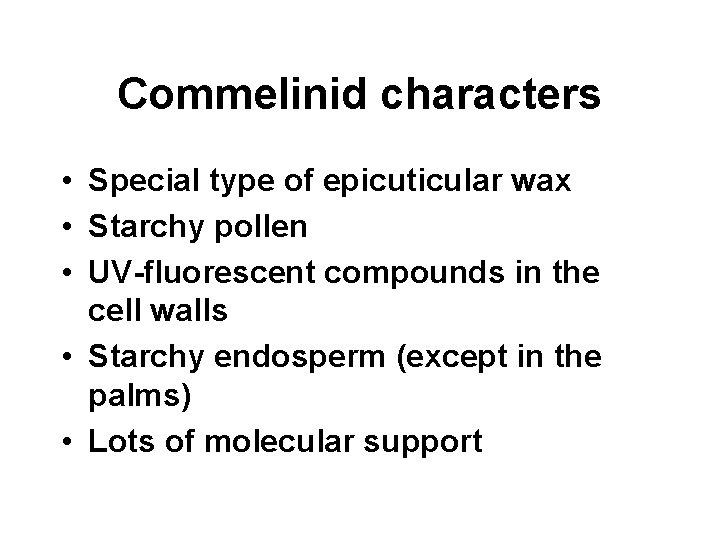
Commelinid characters • Special type of epicuticular wax • Starchy pollen • UV-fluorescent compounds in the cell walls • Starchy endosperm (except in the palms) • Lots of molecular support
Fig. 7. 45
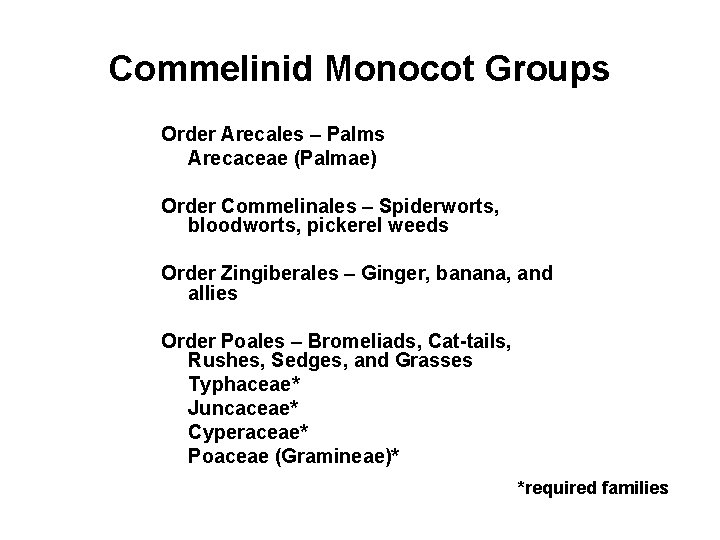
Commelinid Monocot Groups Order Arecales – Palms Arecaceae (Palmae) Order Commelinales – Spiderworts, bloodworts, pickerel weeds Order Zingiberales – Ginger, banana, and allies Order Poales – Bromeliads, Cat-tails, Rushes, Sedges, and Grasses Typhaceae* Juncaceae* Cyperaceae* Poaceae (Gramineae)* *required families
Commelinoid Monocots: Arecales: Arecaeae (Palmae) • • Widespread throughout tropical and warm temperate regions “Trees” or “shrubs”, typically unbranched Diversity: ca. 2, 000 species in 190 genera Flowers: usually sessile, in compound-spicate inflorescences, these subtended by a bract (spathe); ovule 1 per locule Significant features: Leaves alternate or spiral, blades plicate, splitting in a pinnate or palmate manner Special uses: coconut (Cocos nucifera), date (Phoenix dactylifera), rattan (Calamus), oils and waxes, ornamentals Family not required
Arecaceae – Cocos nucifera
Arecaceae Economic plants and products: Cocos nucifera Coconut, oil
Arecaceae Economic plants and products: Phoenix dactylifera Dates
Phylogeny of Monocot Groups Basal “Petaloid” Commelinid Acorales Alismatales Asparagales Liliales Dioscoreales Pandanales Arecales Poales Commelinales Zingiberales
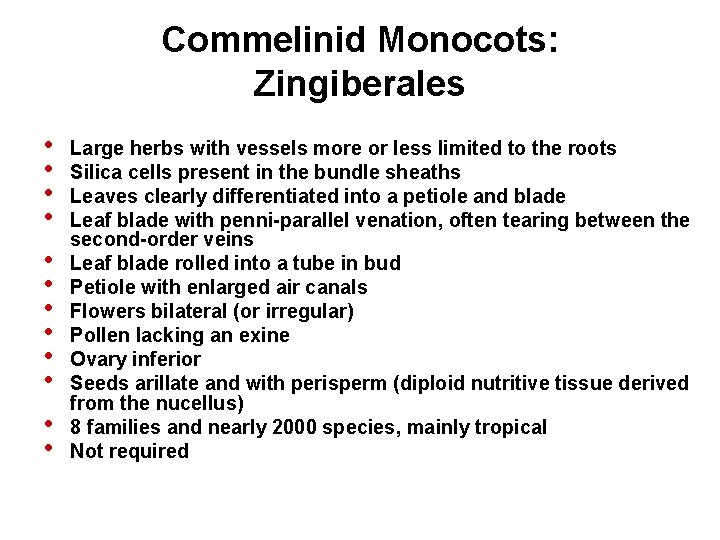
Commelinid Monocots: Zingiberales • • • Large herbs with vessels more or less limited to the roots Silica cells present in the bundle sheaths Leaves clearly differentiated into a petiole and blade Leaf blade with penni-parallel venation, often tearing between the second-order veins Leaf blade rolled into a tube in bud Petiole with enlarged air canals Flowers bilateral (or irregular) Pollen lacking an exine Ovary inferior Seeds arillate and with perisperm (diploid nutritive tissue derived from the nucellus) 8 families and nearly 2000 species, mainly tropical Not required
Fig. 7. 55
Zingiberales diversity
Fig. 7. 56
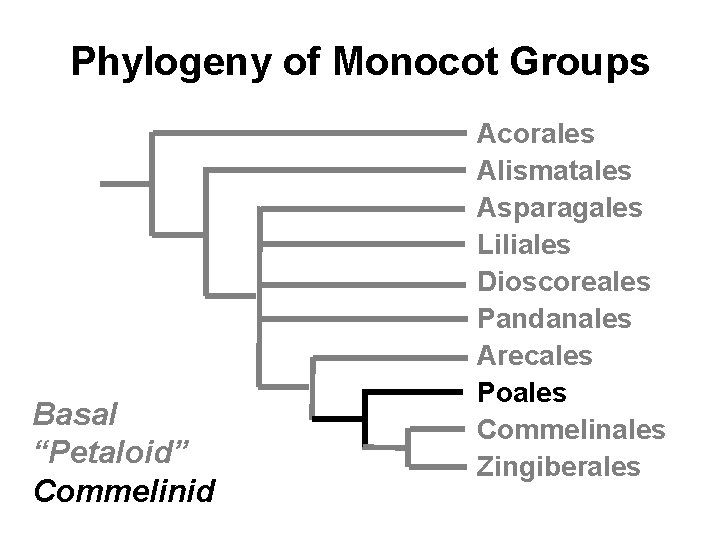
Phylogeny of Monocot Groups Basal “Petaloid” Commelinid Acorales Alismatales Asparagales Liliales Dioscoreales Pandanales Arecales Poales Commelinales Zingiberales
Characters of Poales • Silica bodies (in silica cells) in the epidermis • Styles strongly branched • Loss of raphide (needle-like) crystals in most • Much molecular support for monophyly • Wind pollination has evolved several times independently within the order • Ecologically extremely important
Fig. 7. 63
Commelinoid Monocots—Poales: Typhaceae (The Cattail Family) • Widely distributed, especially in Northern Hemisphere • Emergent aquatic rhizomatous herbs • Diversity: 8 -13 species in 1 genus • Flowers: small, unisexual; separated spatially • • • on dense, compact spicate inflorescences; placentation apical Significant features: rhizomatous; long slender leaves; characteristic inflorescence Special uses: ornamental aquatics Required taxa: Typha
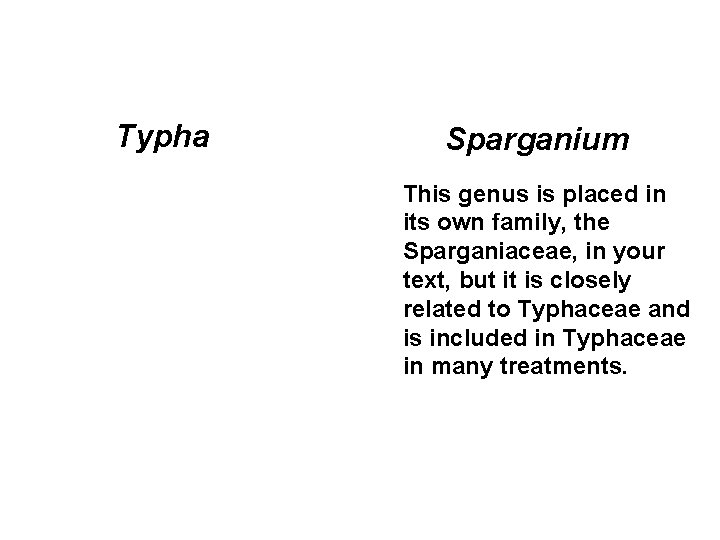
Typha Sparganium This genus is placed in its own family, the Sparganiaceae, in your text, but it is closely related to Typhaceae and is included in Typhaceae in many treatments.
Commelinid Monocots—Poales: Juncaceae (The Rush Family) • • Worldwide, mostly temperate regions; wet or damp habitats Rhizomatous herbs, stems round and solid Diversity: 350 species in 6 genera Flowers: tepals 6, distinct; carpels 3 in superior ovary; stamens 6; fruit a loculicidal capsule Significant features: leaves 3 -ranked, sheaths usually open Special uses: leaves used to weave rush baskets; some ornamentals Required taxa: Juncus
Juncaceae Juncus Distichia
Juncaceae: Juncus -important in many wetland habitats
Commelinid Monocots—Poales: Cyperaceae • • (The Sedge Family) Worldwide, usually in damp or semi-aquatic sites Rhizomatous herbs, stems usually triangular in cross section and solid Diversity: 5, 000 species in 104 genera Flowers: with 1 subtending bract; tepals absent or reduced to 3 -6 scales or hairs; stamens 1 -3; carpels 2 -3 in superior ovary; fruit an achene (nutlet) Significant features: Inflorescence a complex group of spikelets; leaf sheaths closed, ligule lacking; silica bodies conical Special uses: Papyrus used originally for paper; “water chestnuts” and a few other rhizomes edible, leaves used for weaving; some ornamentals. Required taxa: Carex
Cyperaceae versus Juncaceae: Field Character “Sedges have edges… …and rushes roll. ”
Fig. 7. 66 D Fig. 7. 65
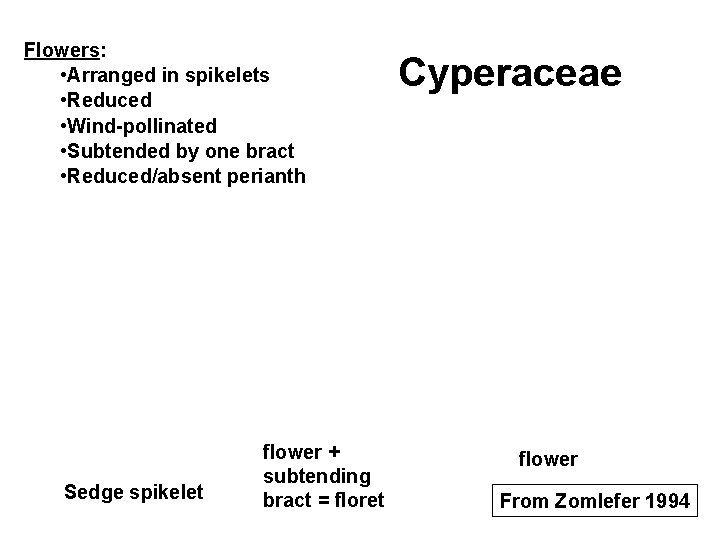
Flowers: • Arranged in spikelets • Reduced • Wind-pollinated • Subtended by one bract • Reduced/absent perianth Sedge spikelet flower + subtending bract = floret Cyperaceae flower From Zomlefer 1994
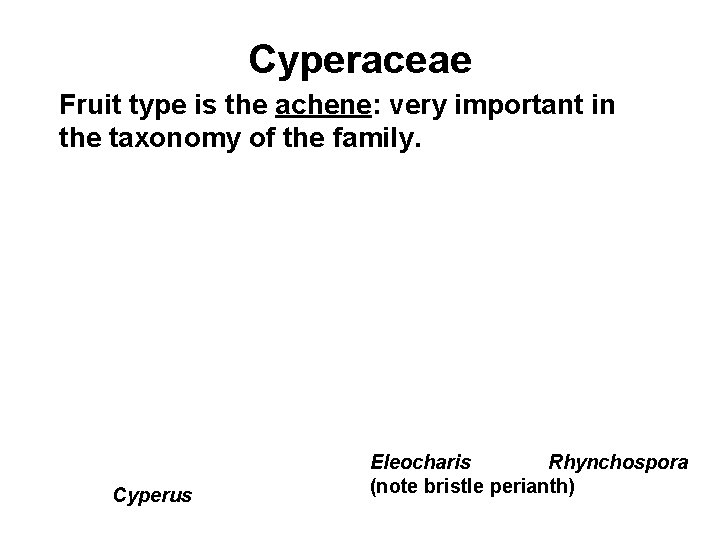
Cyperaceae Fruit type is the achene: very important in the taxonomy of the family. Cyperus Eleocharis Rhynchospora (note bristle perianth)
Cyperaceae http: //waynesword. palomar. edu/termfl 3. htm
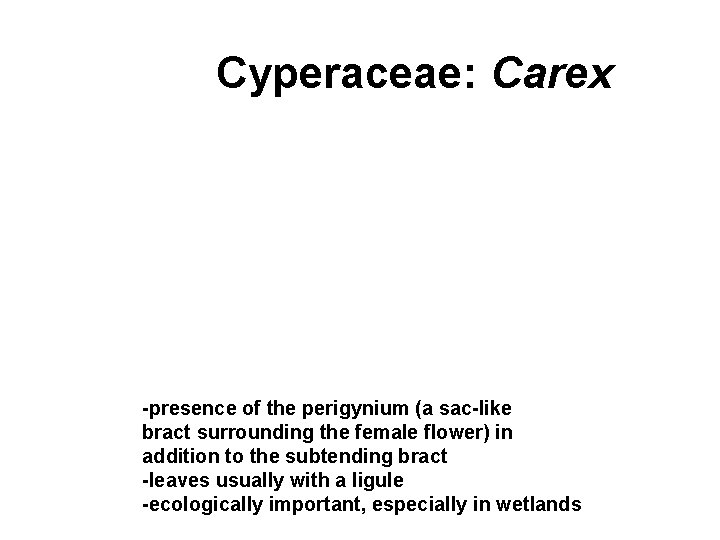
Cyperaceae: Carex -presence of the perigynium (a sac-like bract surrounding the female flower) in addition to the subtending bract -leaves usually with a ligule -ecologically important, especially in wetlands
Cyperaceae: Carex
Commelinid Monocots—Poales: Poaceae (Gramineae) • • (The Grass Family) Cosmopolitan Primarily herbs, often rhizomatous; “trees” in most bamboos; stems are called culms, hollow or solid Diversity: >11, 000 species in ca. 650 genera Flowers: small petals reduced to lodicules; each flower enclosed by two bracts (lemma and palea) = floret; stamens typically 3; carpels 3, but appearing as 2; fruit a caryopsis Significant features: 1 -many florets aggregated into spikelets, each with usually 2 empty bracts (glumes) at the base; leaf with a ligule Special uses: many – grains, turf, fodder/forage, structural uses (e. g. , bamboo). Required family
Ecological importance
bamboo sugar cane weeds Economic importance Zea mays Oryza sativa Triticum aestivum
Poaceae: vegetative structure ligule
Poaceae: spikelet and flower structure flower Images from Grasses of Iowa (mostly)
Anatomy of the Caryopsis (Grain) • The fruit wall (pericarp) is completely fused to the seed coat. • Endosperm (3 N; triploid) contains the bulk of starch storage in the seed. • The embryo is a pre-formed grass plant, with apical meristems (for both shoot and root) and protective organs (coleoptile and coleorhiza) which emerge first during germination.
Poaceae: caryopsis (grain) Zea mays corn or maize Setaria foxtail
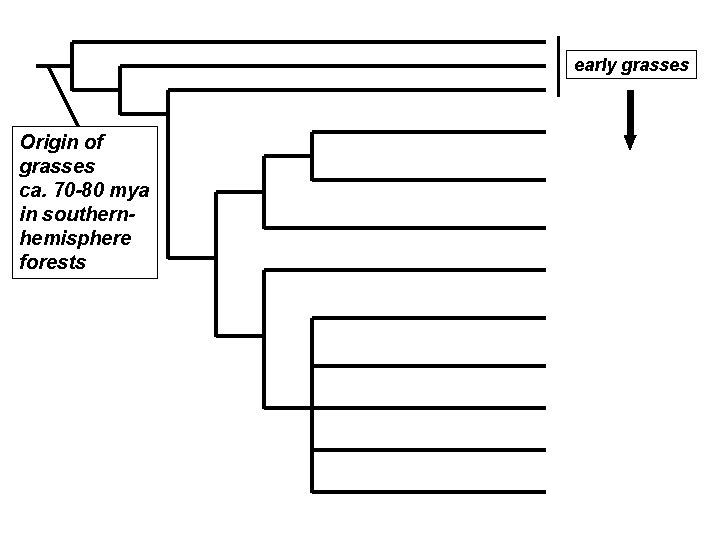
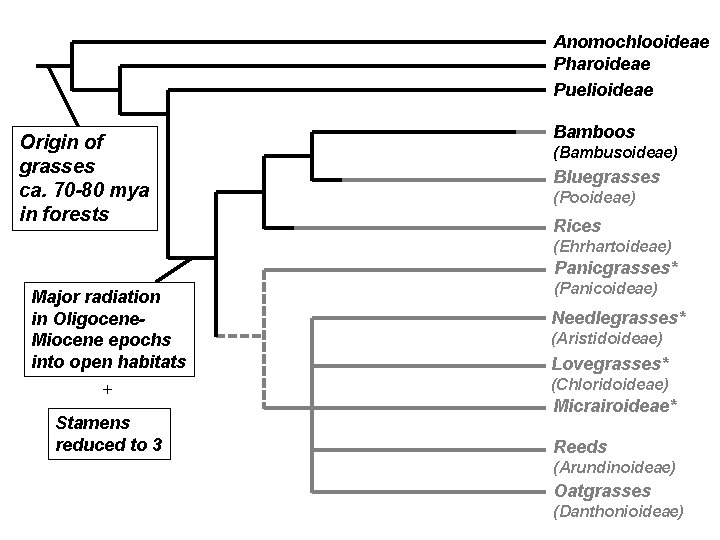
early grasses Origin of grasses ca. 70 -80 mya in southernhemisphere forests
Anomochlooideae Pharoideae Puelioideae Origin of grasses ca. 70 -80 mya in forests Bamboos (Bambusoideae) Bluegrasses (Pooideae) Rices (Ehrhartoideae) Panicgrasses* Major radiation in Oligocene. Miocene epochs into open habitats + Stamens reduced to 3 (Panicoideae) Needlegrasses* (Aristidoideae) Lovegrasses* (Chloridoideae) Micrairoideae* Reeds (Arundinoideae) Oatgrasses (Danthonioideae)
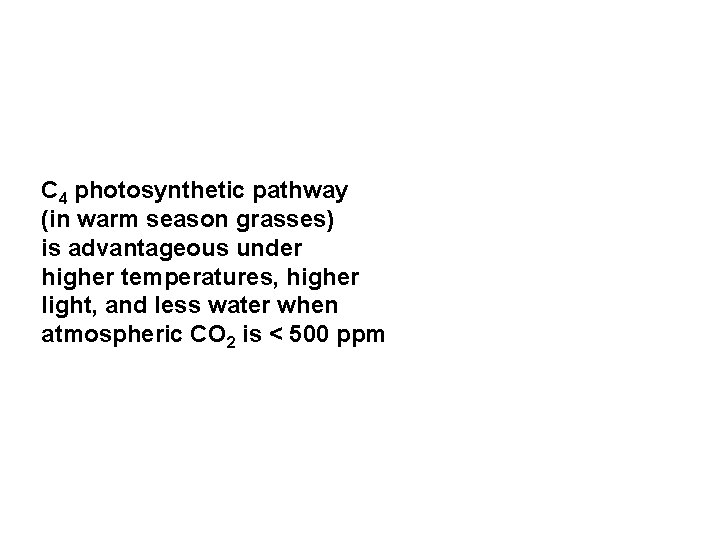
C 4 photosynthetic pathway (in warm season grasses) is advantageous under higher temperatures, higher light, and less water when atmospheric CO 2 is < 500 ppm
Dispersal!
Poaceae: Bamboos
Oryza (rice)
Triticum (wheat)
Zea (maize or corn)
For more information and images: http: //www. eeob. iastate. edu/research/iowagrasses/ The Grasses of Iowa
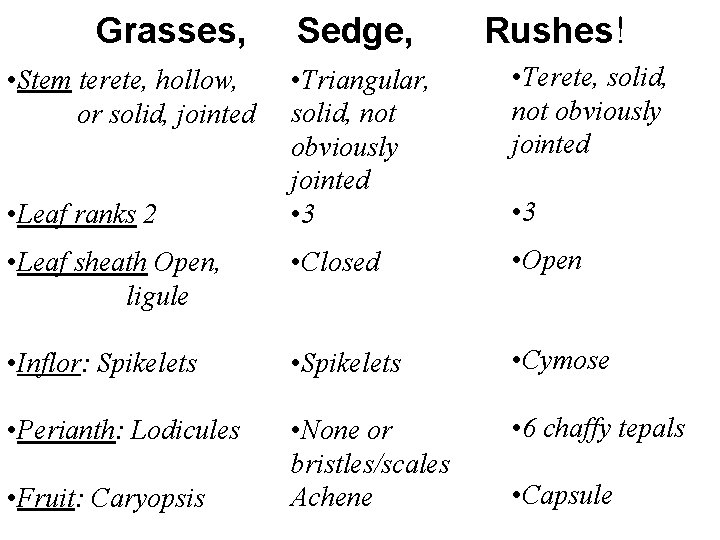
Grasses, Sedge, Rushes! • Triangular, solid, not obviously jointed • 3 • Terete, solid, not obviously jointed • Leaf sheath Open, ligule • Closed • Open • Inflor: Spikelets • Cymose • Perianth: Lodicules • None or bristles/scales Achene • 6 chaffy tepals • Stem terete, hollow, or solid, jointed • Leaf ranks 2 • Fruit: Caryopsis • 3 • Capsule
“Graminoids” - Comparison
Next time: The “Basal” Eudicots…