
The Mongol Empire THE MONGOLS MADE NO TECHNOLOGICAL
- Slides: 21
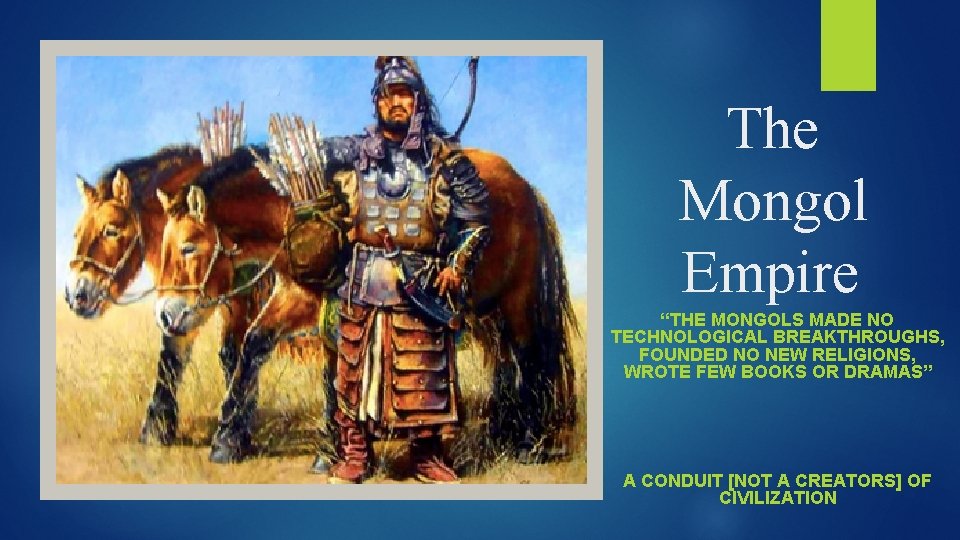
The Mongol Empire “THE MONGOLS MADE NO TECHNOLOGICAL BREAKTHROUGHS, FOUNDED NO NEW RELIGIONS, WROTE FEW BOOKS OR DRAMAS” A CONDUIT [NOT A CREATORS] OF CIVILIZATION
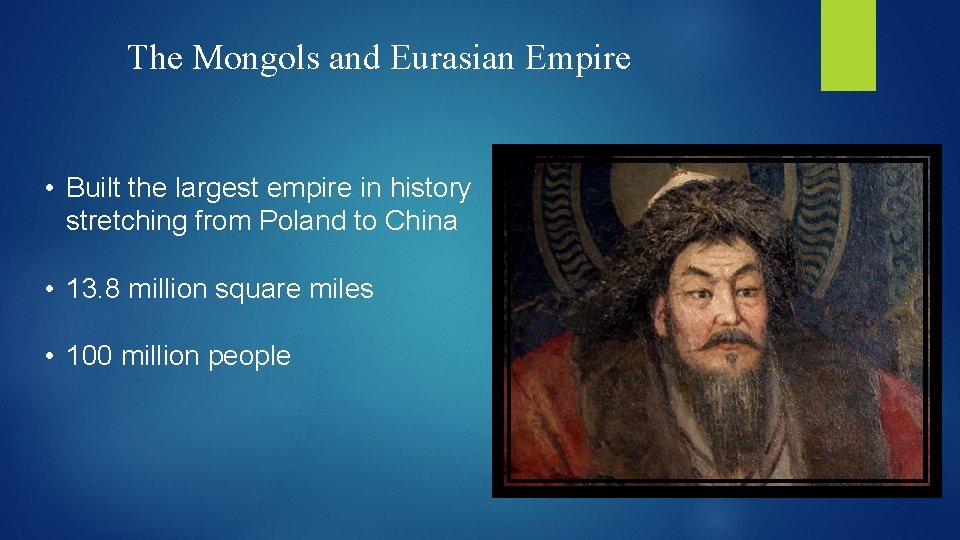
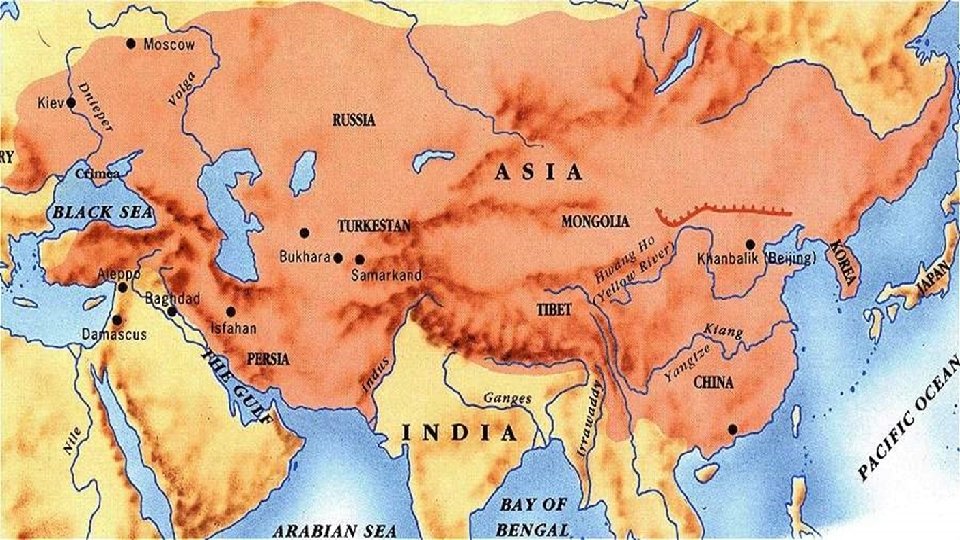
The Mongols and Eurasian Empire • Built the largest empire in history stretching from Poland to China • 13. 8 million square miles • 100 million people
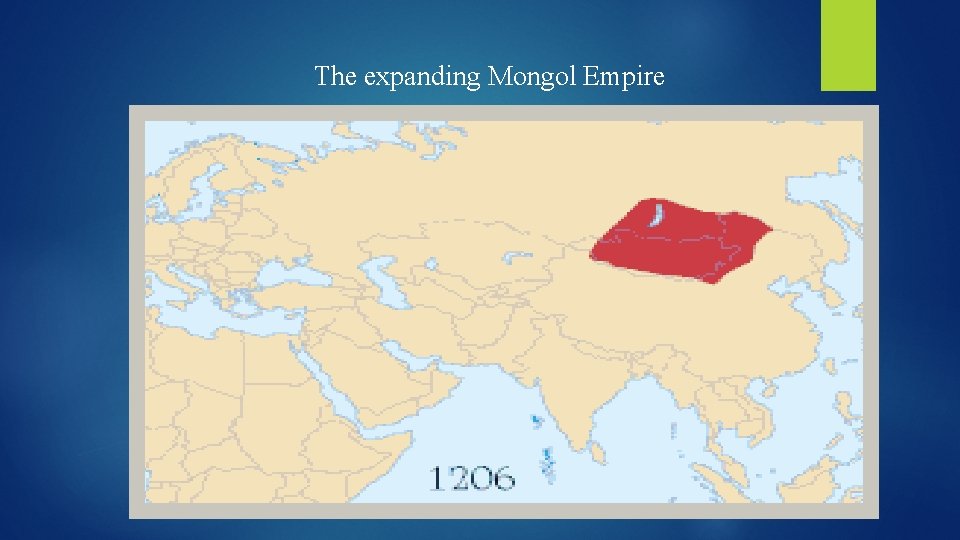
The expanding Mongol Empire
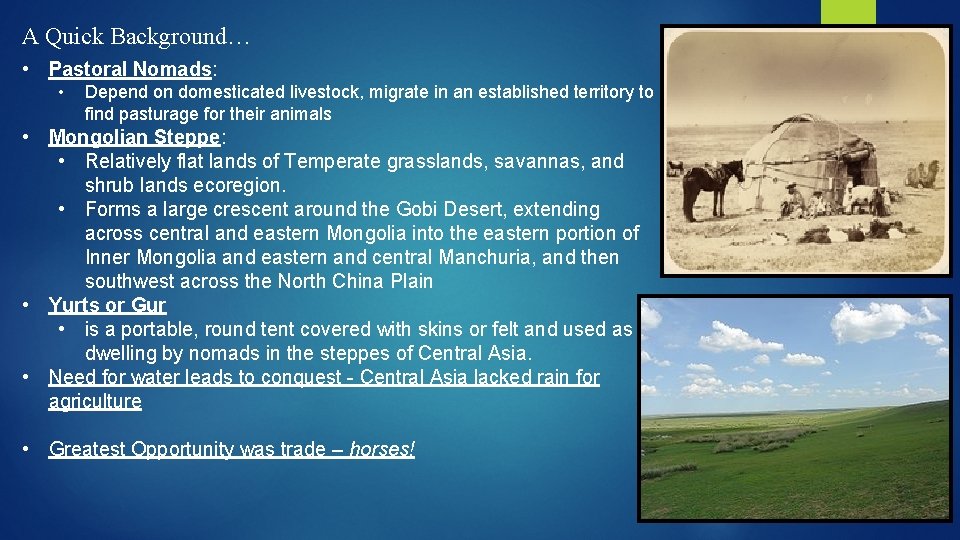
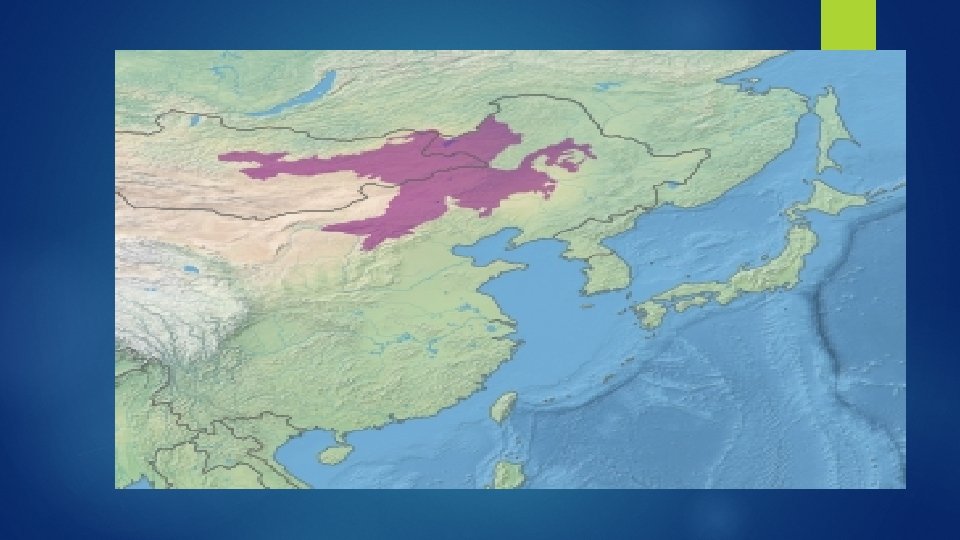
A Quick Background… • Pastoral Nomads: • Depend on domesticated livestock, migrate in an established territory to find pasturage for their animals • Mongolian Steppe: • Relatively flat lands of Temperate grasslands, savannas, and shrub lands ecoregion. • Forms a large crescent around the Gobi Desert, extending across central and eastern Mongolia into the eastern portion of Inner Mongolia and eastern and central Manchuria, and then southwest across the North China Plain • Yurts or Gur • is a portable, round tent covered with skins or felt and used as a dwelling by nomads in the steppes of Central Asia. • Need for water leads to conquest - Central Asia lacked rain for agriculture • Greatest Opportunity was trade – horses!
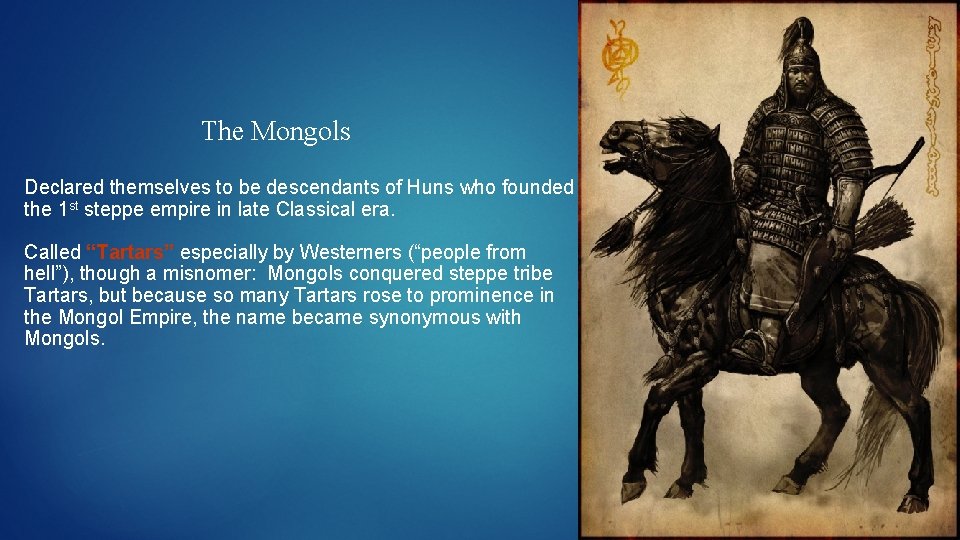
The Mongols Declared themselves to be descendants of Huns who founded the 1 st steppe empire in late Classical era. Called “Tartars” especially by Westerners (“people from hell”), though a misnomer: Mongols conquered steppe tribe Tartars, but because so many Tartars rose to prominence in the Mongol Empire, the name became synonymous with Mongols.
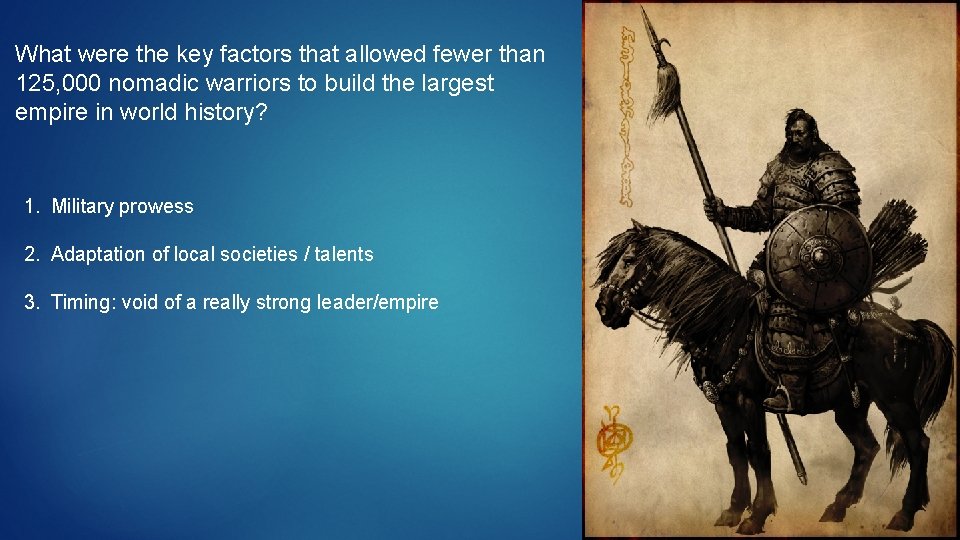
What were the key factors that allowed fewer than 125, 000 nomadic warriors to build the largest empire in world history? 1. Military prowess 2. Adaptation of local societies / talents 3. Timing: void of a really strong leader/empire
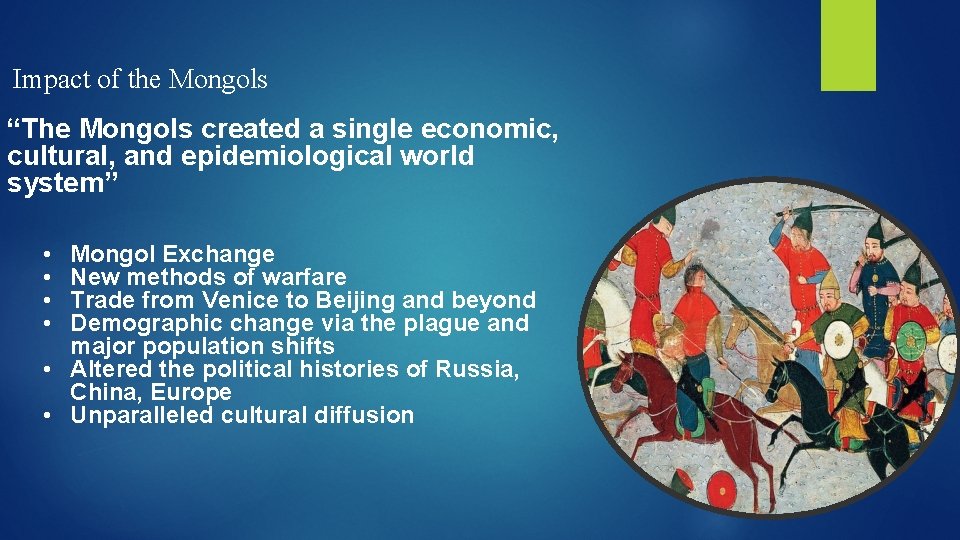
Impact of the Mongols “The Mongols created a single economic, cultural, and epidemiological world system” • • Mongol Exchange New methods of warfare Trade from Venice to Beijing and beyond Demographic change via the plague and major population shifts • Altered the political histories of Russia, China, Europe • Unparalleled cultural diffusion
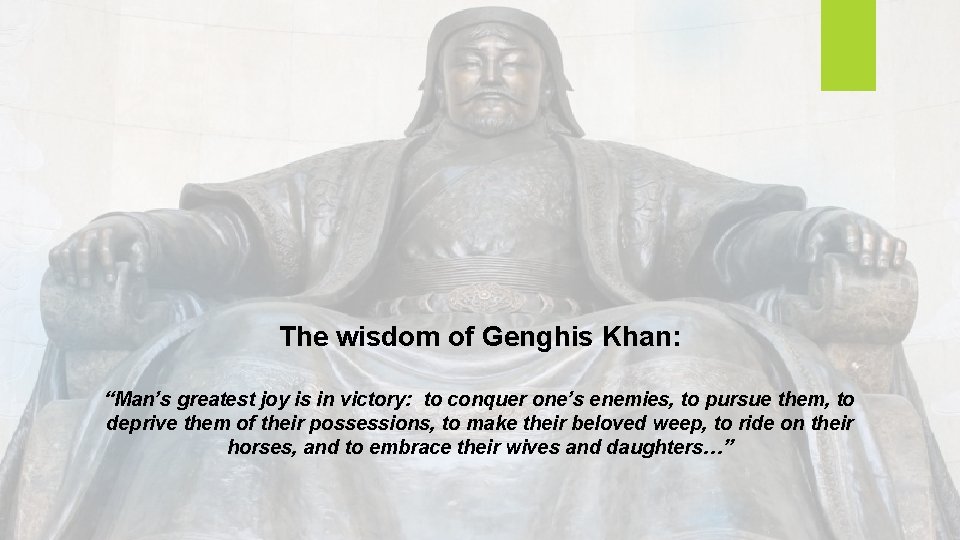
The wisdom of Genghis Khan: “Man’s greatest joy is in victory: to conquer one’s enemies, to pursue them, to deprive them of their possessions, to make their beloved weep, to ride on their horses, and to embrace their wives and daughters…”
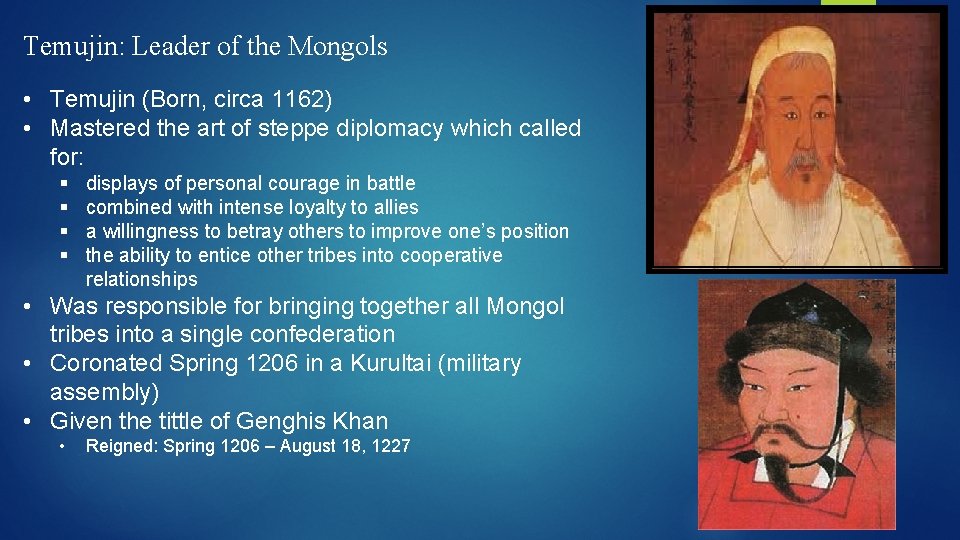
Temujin: Leader of the Mongols • Temujin (Born, circa 1162) • Mastered the art of steppe diplomacy which called for: § § displays of personal courage in battle combined with intense loyalty to allies a willingness to betray others to improve one’s position the ability to entice other tribes into cooperative relationships • Was responsible for bringing together all Mongol tribes into a single confederation • Coronated Spring 1206 in a Kurultai (military assembly) • Given the tittle of Genghis Khan • Reigned: Spring 1206 – August 18, 1227
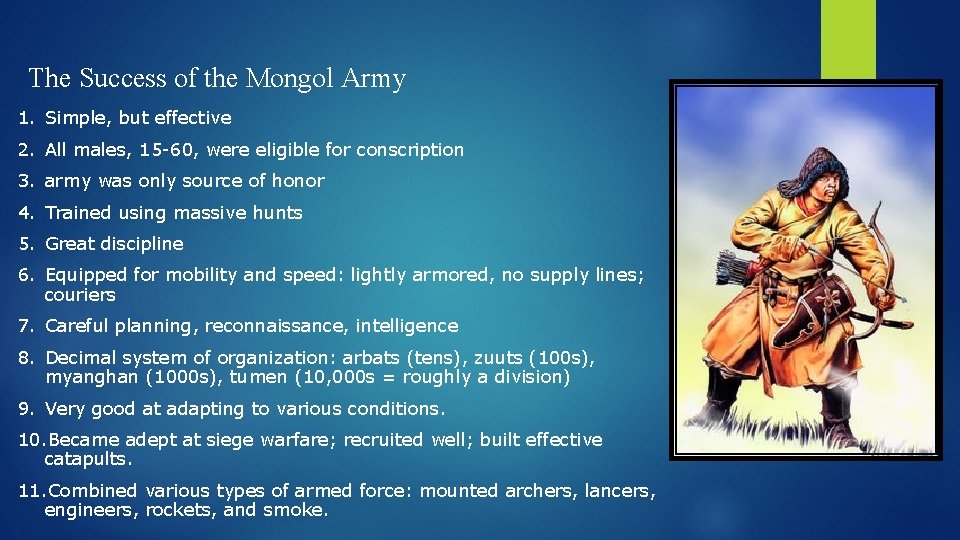
The Success of the Mongol Army 1. Simple, but effective 2. All males, 15 -60, were eligible for conscription 3. army was only source of honor 4. Trained using massive hunts 5. Great discipline 6. Equipped for mobility and speed: lightly armored, no supply lines; couriers 7. Careful planning, reconnaissance, intelligence 8. Decimal system of organization: arbats (tens), zuuts (100 s), myanghan (1000 s), tumen (10, 000 s = roughly a division) 9. Very good at adapting to various conditions. 10. Became adept at siege warfare; recruited well; built effective catapults. 11. Combined various types of armed force: mounted archers, lancers, engineers, rockets, and smoke.
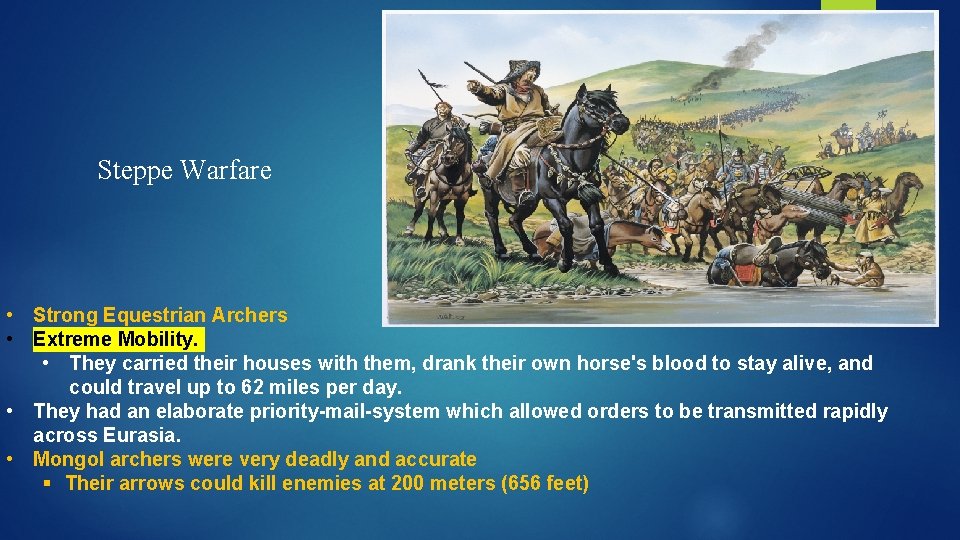
Steppe Warfare • Strong Equestrian Archers • Extreme Mobility. • They carried their houses with them, drank their own horse's blood to stay alive, and could travel up to 62 miles per day. • They had an elaborate priority-mail-system which allowed orders to be transmitted rapidly across Eurasia. • Mongol archers were very deadly and accurate § Their arrows could kill enemies at 200 meters (656 feet)
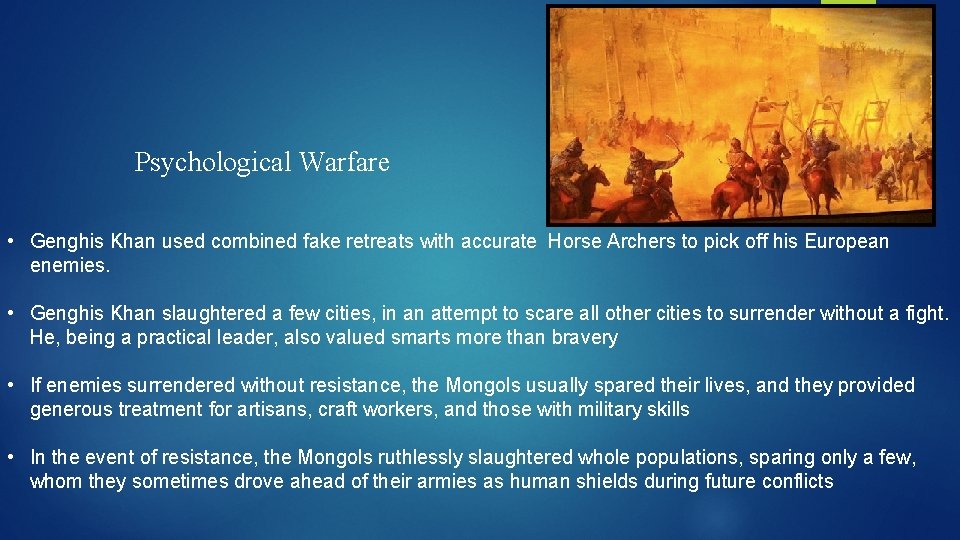
Psychological Warfare • Genghis Khan used combined fake retreats with accurate Horse Archers to pick off his European enemies. • Genghis Khan slaughtered a few cities, in an attempt to scare all other cities to surrender without a fight. He, being a practical leader, also valued smarts more than bravery • If enemies surrendered without resistance, the Mongols usually spared their lives, and they provided generous treatment for artisans, craft workers, and those with military skills • In the event of resistance, the Mongols ruthlessly slaughtered whole populations, sparing only a few, whom they sometimes drove ahead of their armies as human shields during future conflicts
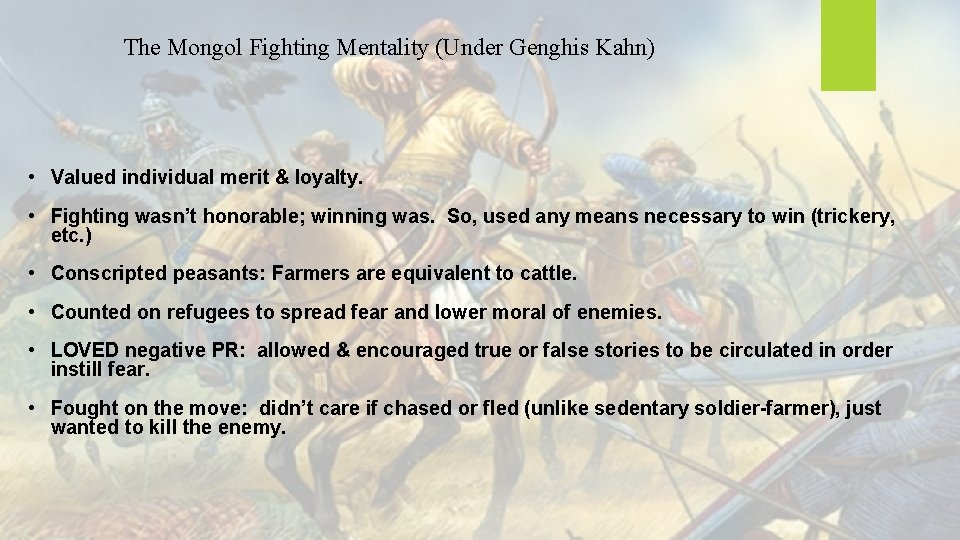
The Mongol Fighting Mentality (Under Genghis Kahn) • Valued individual merit & loyalty. • Fighting wasn’t honorable; winning was. So, used any means necessary to win (trickery, etc. ) • Conscripted peasants: Farmers are equivalent to cattle. • Counted on refugees to spread fear and lower moral of enemies. • LOVED negative PR: allowed & encouraged true or false stories to be circulated in order instill fear. • Fought on the move: didn’t care if chased or fled (unlike sedentary soldier-farmer), just wanted to kill the enemy.
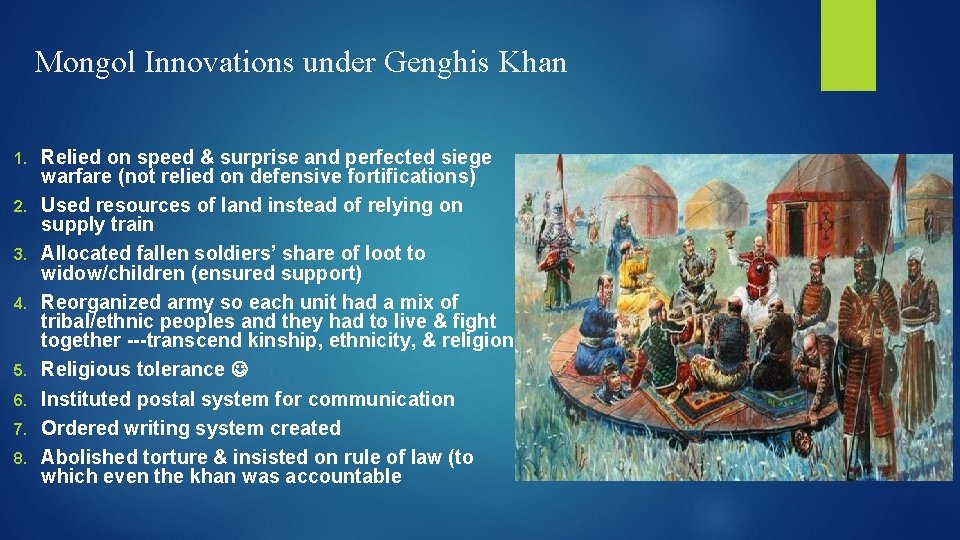
Mongol Innovations under Genghis Khan 1. 2. 3. 4. 5. 6. 7. 8. Relied on speed & surprise and perfected siege warfare (not relied on defensive fortifications) Used resources of land instead of relying on supply train Allocated fallen soldiers’ share of loot to widow/children (ensured support) Reorganized army so each unit had a mix of tribal/ethnic peoples and they had to live & fight together ---transcend kinship, ethnicity, & religion. Religious tolerance Instituted postal system for communication Ordered writing system created Abolished torture & insisted on rule of law (to which even the khan was accountable
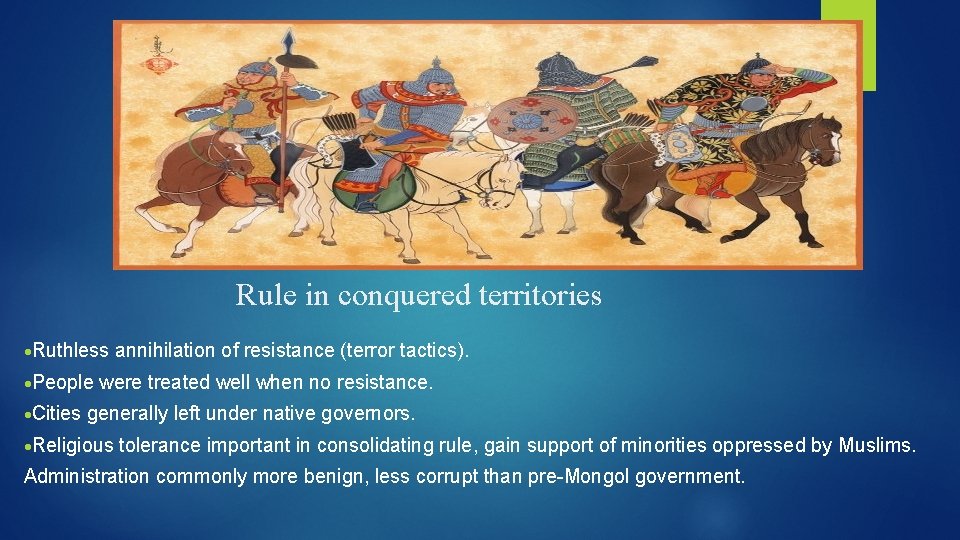
Rule in conquered territories ·Ruthless ·People ·Cities annihilation of resistance (terror tactics). were treated well when no resistance. generally left under native governors. ·Religious tolerance important in consolidating rule, gain support of minorities oppressed by Muslims. Administration commonly more benign, less corrupt than pre-Mongol government.
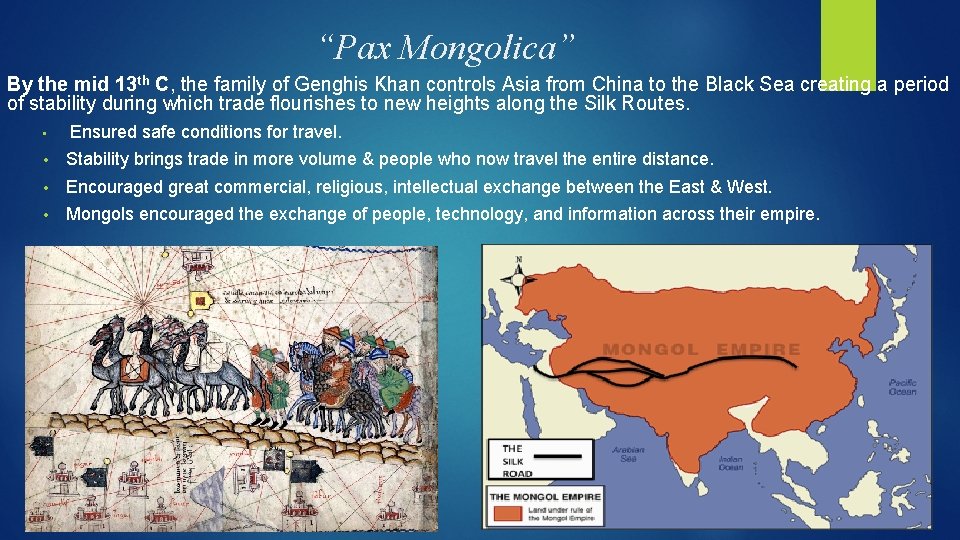
“Pax Mongolica” By the mid 13 th C, the family of Genghis Khan controls Asia from China to the Black Sea creating a period of stability during which trade flourishes to new heights along the Silk Routes. • Ensured safe conditions for travel. • Stability brings trade in more volume & people who now travel the entire distance. • Encouraged great commercial, religious, intellectual exchange between the East & West. • Mongols encouraged the exchange of people, technology, and information across their empire.
Mongol Accomplishments “The Good” 1. MILITARY STRATEGY & INNOVATION – CAVALRY, HORSE ARCHERS, SURPRISE ATTACKS, SIEGES - GENGHIS FIRST NEEDED TO DISBAND TRIBAL LOYALTIES 2. RELIGIOUS TOLERANCE (CONVERTED TO ALL FAITHS IN REGION EXCEPT HINDUISM) 3. COMMON LEGAL CODE (THE GREAT YASSA) 4. UTILIZED SKILLS OF CONQUERED PEOPLES – ARTISANS, SOLDIERS 5. DISCIPLINE, OBEDIENCE TO OWN LAWS 6. MONGOLS WERE THE ONLY GROUP TO SUCCESSFULLY CONQUER RUSSIA 7. CREATED LARGEST CONTINENTAL EMPIRE IN HISTORY 8. TRADE – SOURCE OF DIFFUSION – GOODS, IDEAS & PEOPLE - UNDER MONGOL RULE IT WAS LESS RISKY PAX MONGOLICA
Failures and Struggles “The Bad” 1. Constant in-fighting for power – “Khan” 2. Genghis never setup centralized rule, Kublai struggled with it (Yuan Dynasty) 3. Kublai failed to conquer Vietnam, Burma, Cambodia & Japan 4. Inability to control China without considerable force 5. Over-spending 6. THE PLAGUE!!! 7. Over-extension 8. Struggle between nomadic lifestyle and need to settle (centralized government)
Social Costs “The Ugly” 1. Looting & Destruction of Cities 2. Population displacement as never seen before • Mainly skilled workers and women 3. Countless Massacres • Siege of Baghdad, 1258 (200, 000 to 800, 000 according to Western Sources) 4. Use of organized tactical terror • Wholesale slaughter, rape, and indiscriminate destruction 5. Estimated death toll of 30 to 40 million • Before Mongol conquest China’s population = 120 million • After Mongol conquest China’s population = 60 million