
The Molecule of Life Important Scientists in the
- Slides: 54
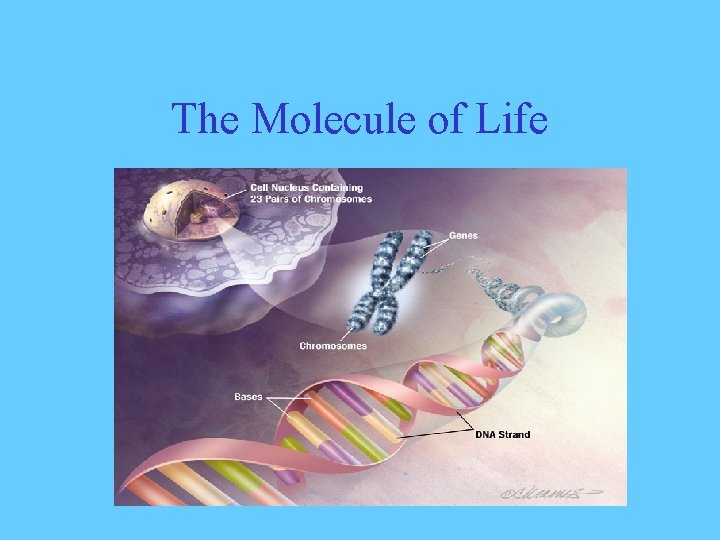
The Molecule of Life
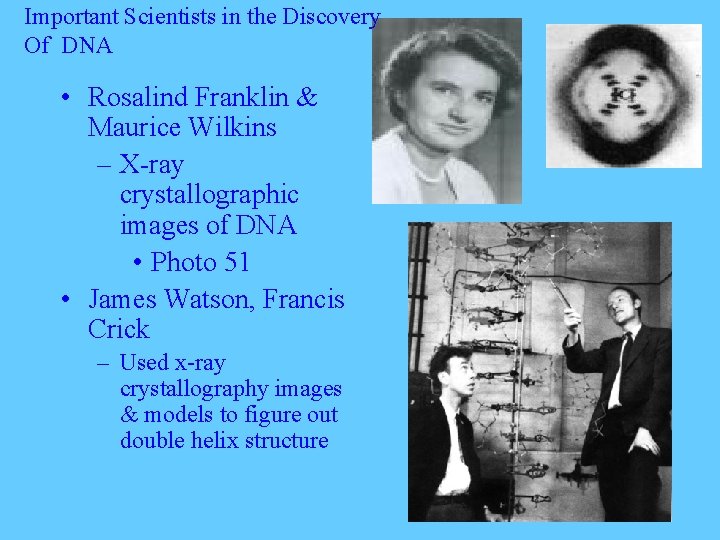
Important Scientists in the Discovery Of DNA • Rosalind Franklin & Maurice Wilkins – X-ray crystallographic images of DNA • Photo 51 • James Watson, Francis Crick – Used x-ray crystallography images & models to figure out double helix structure
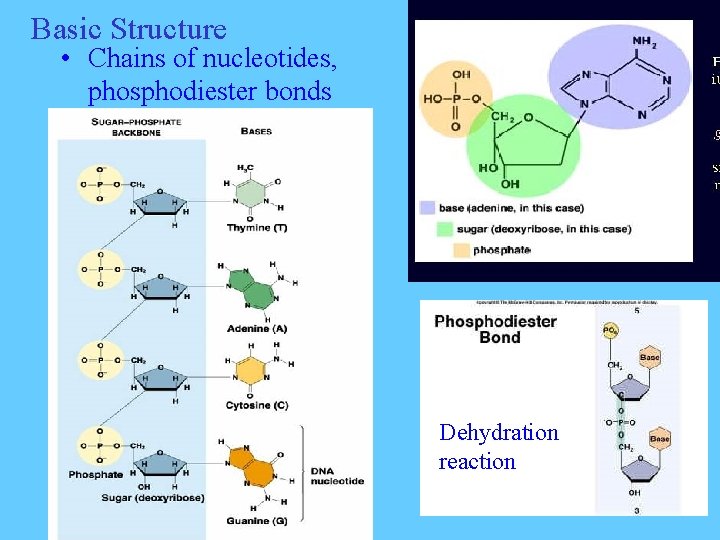
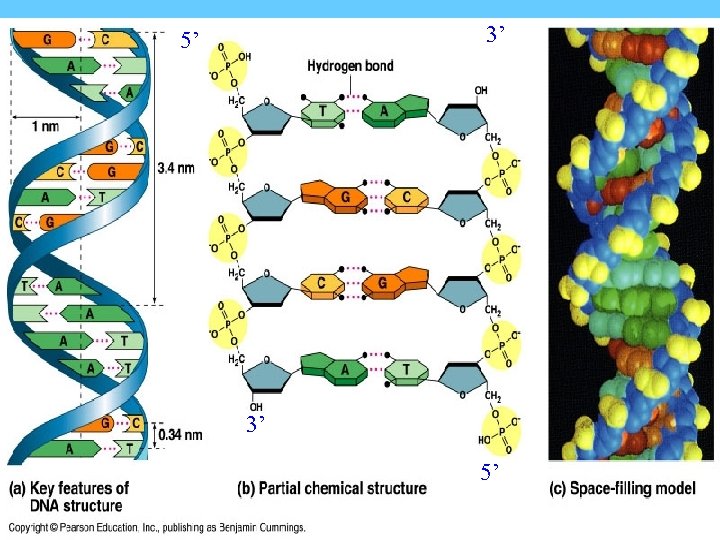
Basic Structure • Chains of nucleotides, phosphodiester bonds Dehydration reaction
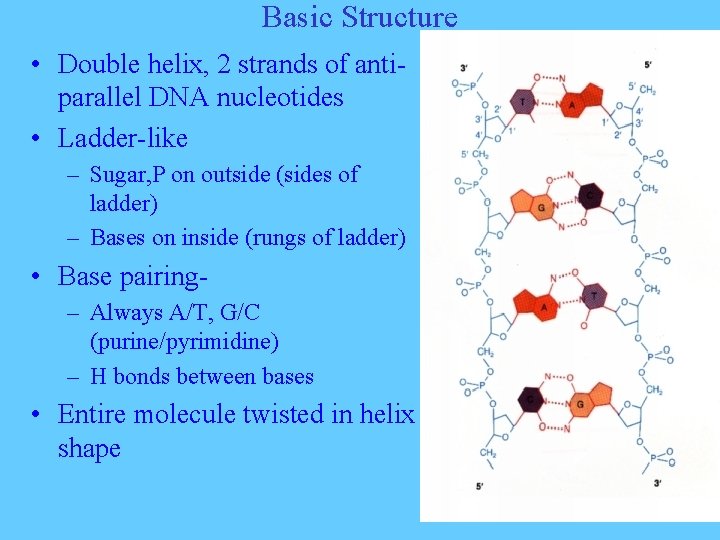
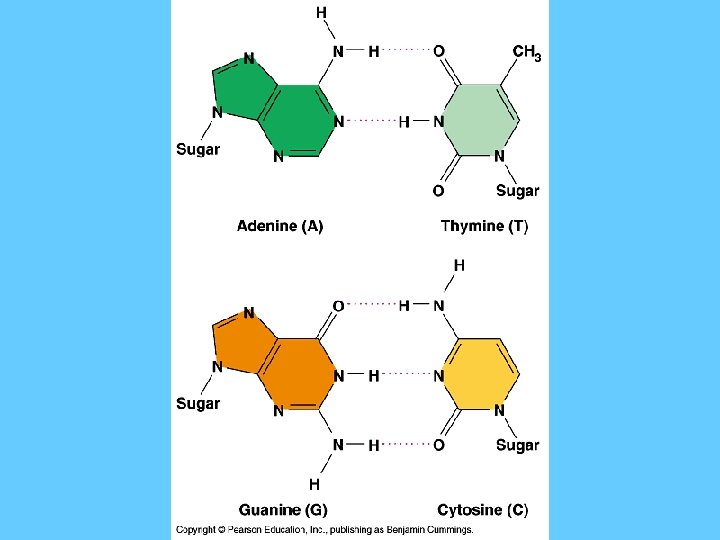
Basic Structure • Double helix, 2 strands of antiparallel DNA nucleotides • Ladder-like – Sugar, P on outside (sides of ladder) – Bases on inside (rungs of ladder) • Base pairing- – Always A/T, G/C (purine/pyrimidine) – H bonds between bases • Entire molecule twisted in helix shape
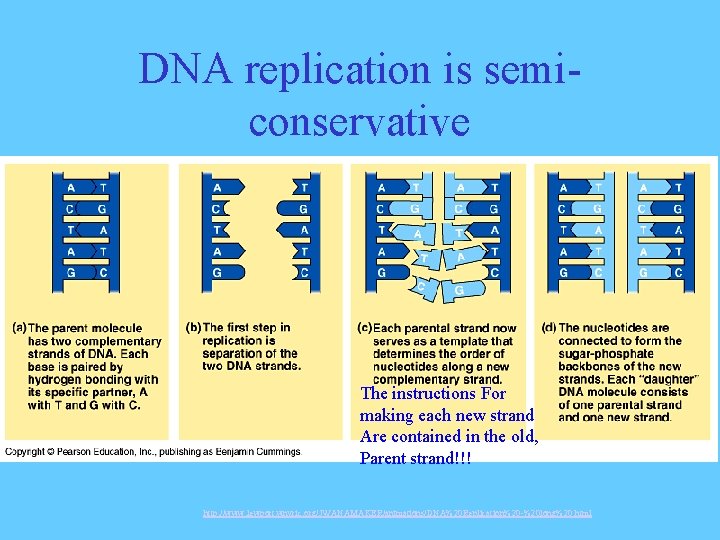
DNA replication is semiconservative The instructions For making each new strand Are contained in the old, Parent strand!!! http: //www. lewport. wnyric. org/JWANAMAKER/animations/DNA%20 Replication%20 -%20 long%20. html
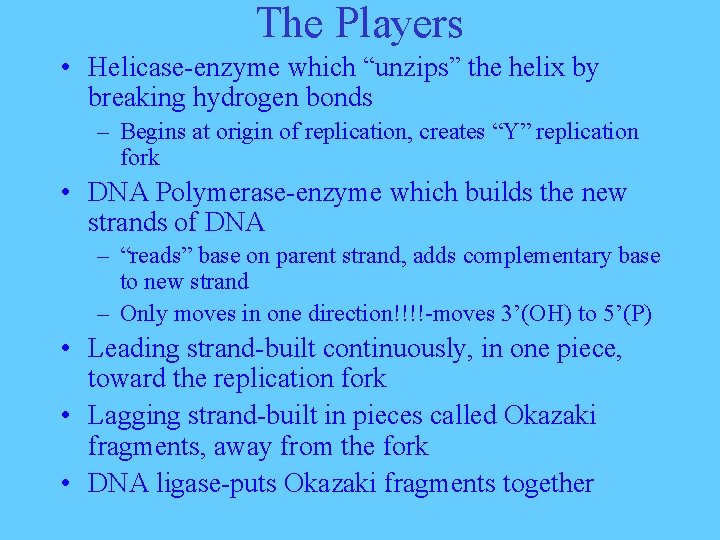
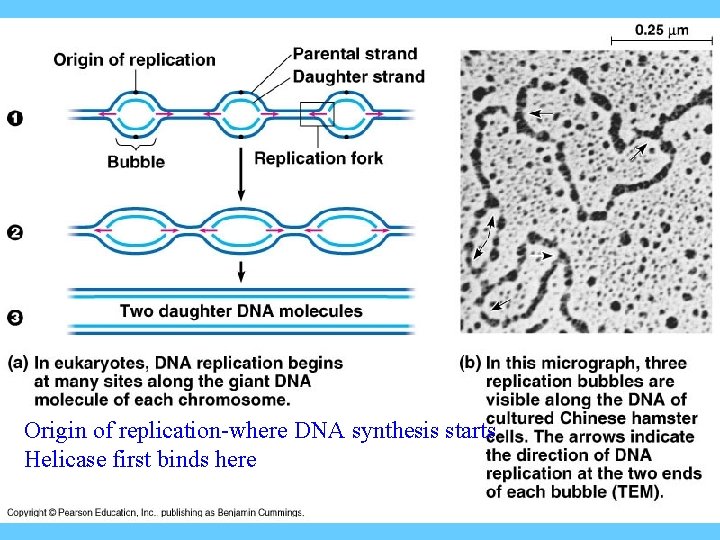
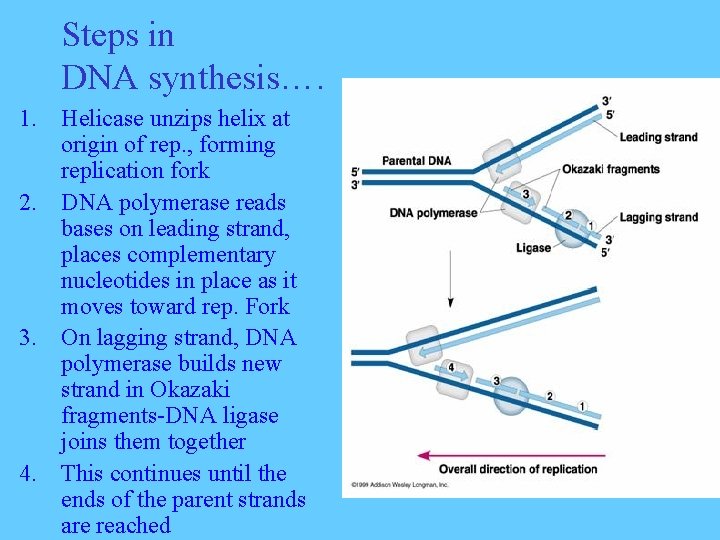
The Players • Helicase-enzyme which “unzips” the helix by breaking hydrogen bonds – Begins at origin of replication, creates “Y” replication fork • DNA Polymerase-enzyme which builds the new strands of DNA – “reads” base on parent strand, adds complementary base to new strand – Only moves in one direction!!!!-moves 3’(OH) to 5’(P) • Leading strand-built continuously, in one piece, toward the replication fork • Lagging strand-built in pieces called Okazaki fragments, away from the fork • DNA ligase-puts Okazaki fragments together
Origin of replication-where DNA synthesis starts Helicase first binds here
Steps in DNA synthesis…. 1. Helicase unzips helix at origin of rep. , forming replication fork 2. DNA polymerase reads bases on leading strand, places complementary nucleotides in place as it moves toward rep. Fork 3. On lagging strand, DNA polymerase builds new strand in Okazaki fragments-DNA ligase joins them together 4. This continues until the ends of the parent strands are reached
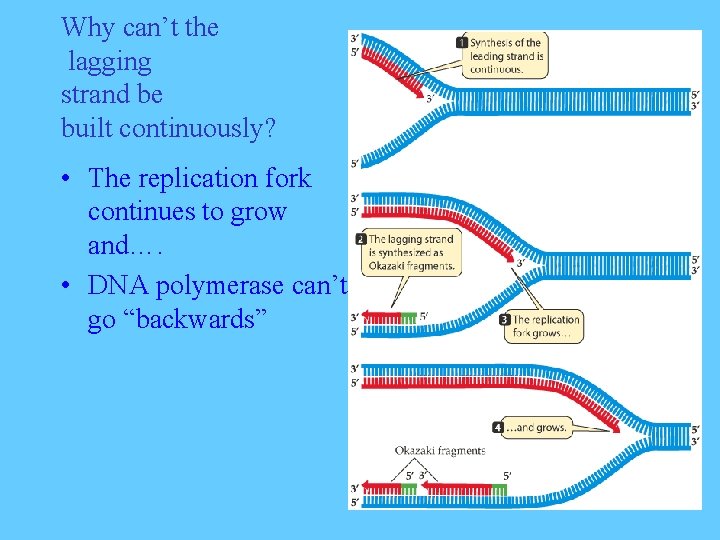
Why can’t the lagging strand be built continuously? • The replication fork continues to grow and…. • DNA polymerase can’t go “backwards”
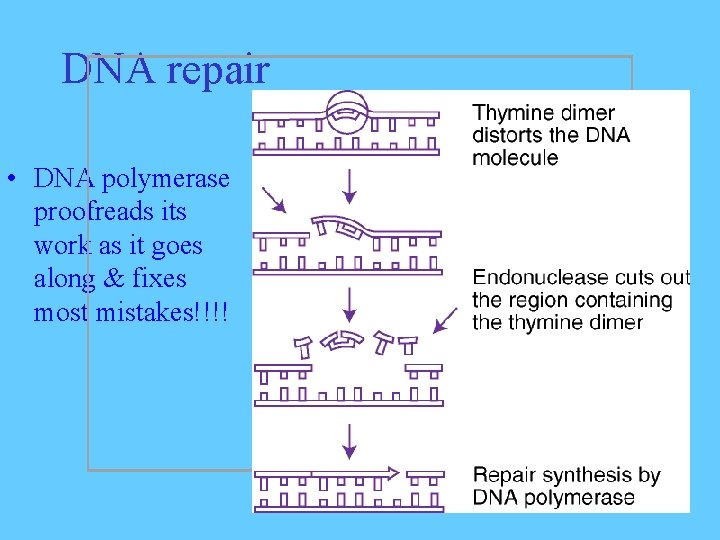
DNA repair • DNA polymerase proofreads its work as it goes along & fixes most mistakes!!!!
Transcription DNA to RNA
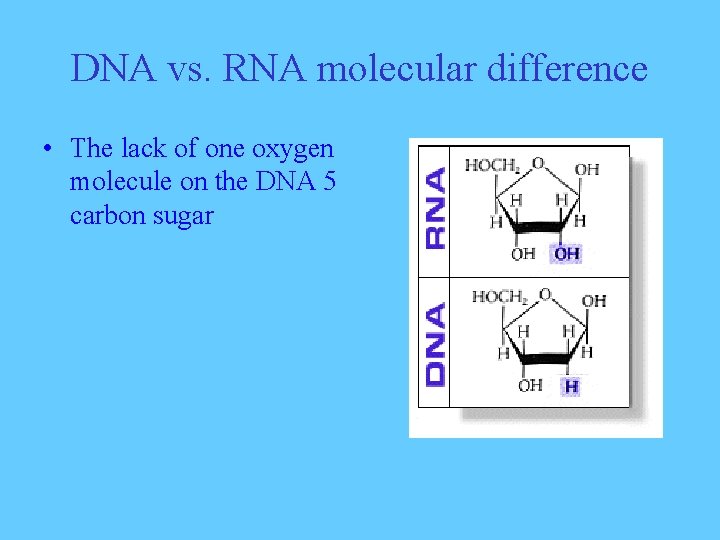
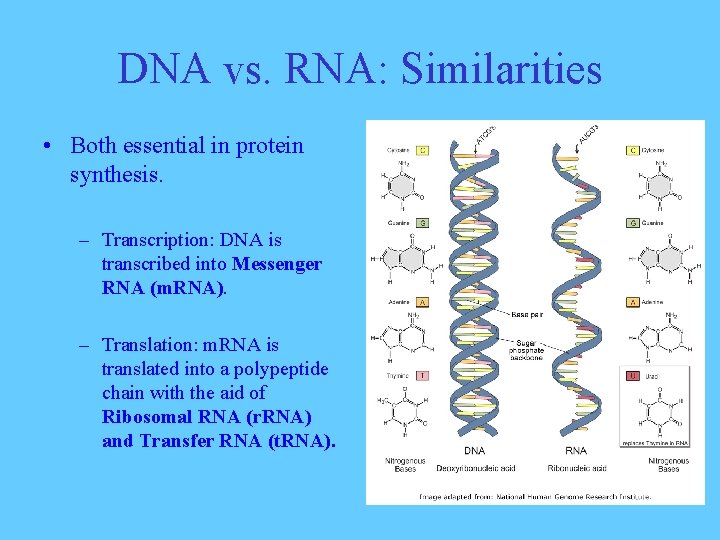
DNA vs. RNA: differences • DNA (deoxyribose nucleic acid) and RNA (ribose nucleic acid) are both nucleotide polymers. These molecules are very similar but there are some distinct differences between them. • Both molecules are helical: – DNA is a double helix – RNA is a single helix. • DNA bases: – Adenine (A), Thymine (T), Cytosine (C) & Guanine (G) • RNA bases: – A, G and C but T is replaced with Uracil (U) • DNA has one less oxygen on the 5 carbon sugar than RNA; thus the difference in their names. Deoxyribose simply refers to a ribose sugar lacking an oxygen molecule.
DNA vs. RNA molecular difference • The lack of one oxygen molecule on the DNA 5 carbon sugar
RNA types • 1. Ribosomal RNA (r. RNA): make up ribosomes • 2. Transfer RNA (t. RNA): transport amino acids to ribosomes • 3. Messenger RNA (m. RNA): copied from DNA, conveys information from chromosomes to ribosomes
DNA vs. RNA: Similarities • Both essential in protein synthesis. – Transcription: DNA is transcribed into Messenger RNA (m. RNA). – Translation: m. RNA is translated into a polypeptide chain with the aid of Ribosomal RNA (r. RNA) and Transfer RNA (t. RNA).
Transcription Essentials • Transcription occurs in nucleus. • Transcription: production of m. RNA copy of the DNA gene. – Think of DNA as instructions to build hardware (proteins), unfortunately, these instructions are in another language and incomprehensible to the workers that will eventually assemble the hardware. This is where m. RNA will come into the picture - to provide new instructions that will be used by the workers.
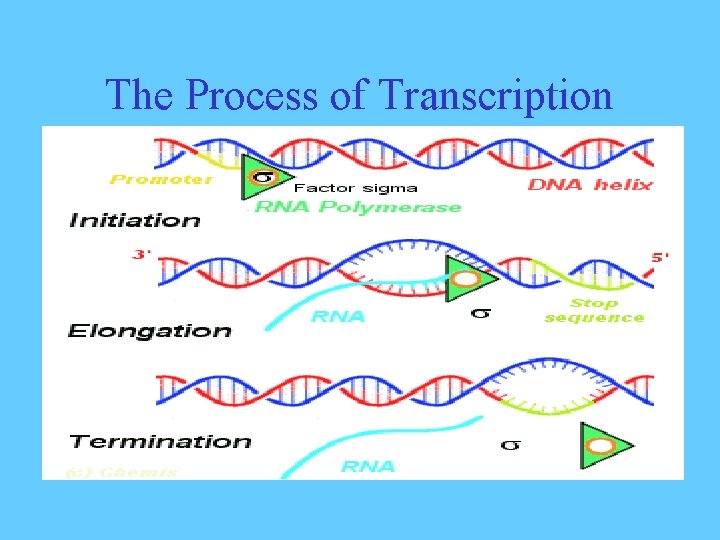
Steps of Transcription 1. Initiation: DNA is unzipped and the enzyme RNA polymerase runs along the template strand of the DNA. – The template strand of DNA can be identified by finding the promoter region: nucleotide sequence T A C at the 3’ end (If the strand is written backwards it may look like C A T at the 3’ end). This identifies that strand as the template and the other strand, the information strand, will not be used in this transcription (this does not mean, however, that it may not be used in future transcription processes).
Steps of Transcription 2. Elongation: As the RNA polymerase runs along the DNA template strand it will add the complementary RNA nucleotides to the DNA nucleotides. – This means that G will be paired with C, and visa versa, and A (DNA) will be paired with U (RNA - rather than T in DNA replication) and T (DNA) paired with A (RNA).
Steps of Transcription 3. Termination: Transcription continues until RNA polymerase reaches a DNA region called the termination signal: nucleotide sequence that marks the end of a gene. • When the single helix m. RNA strand is complete, RNA polymerase releases the DNA andnew RNA molecule. The DNA will re-zip into the double helix.
The Process of Transcription
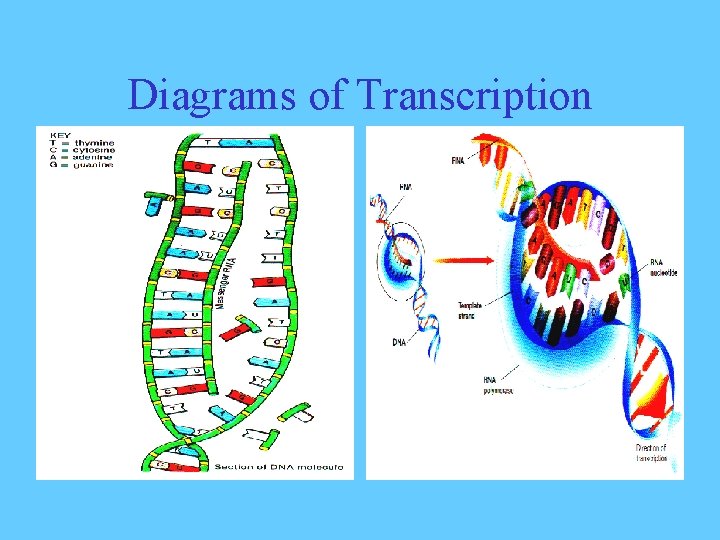
Diagrams of Transcription
Processing the Products of Transcription • In eukaryotes, once the m. RNA is transcribed it will then be processed. – A cap and tail will be added to the ends of the m. RNA strand. – The strand will be spliced. • The introns (non-coding regions) will be removed • The exons (coding regions) will be spliced together – The completed m. RNA strand has groups of three nucleotides known as codons (for example, A U G is the codon in m. RNA that was transcribed from T A C). These groups of three will code for a particular amino acid in translation (A U G will code for the start amino acid, methionine, in translation).
Translation From RNA to Protein
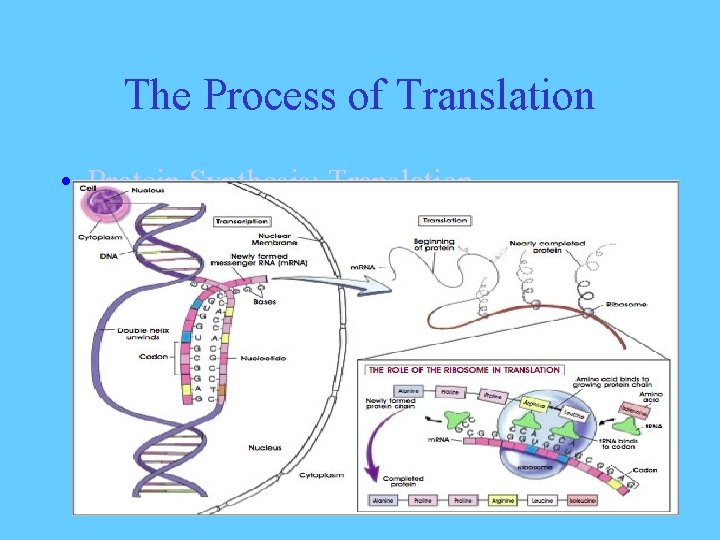
The Process of Translation • Protein Synthesis: Translation
Translation • Translation occurs when the m. RNA strand moves out of the nucleus and into the cytoplasm to a ribosome. – At this point m. RNA, r. RNA and t. RNA all come together. • The r. RNA consists of two parts, the large ribosomal unit and the small ribosomal unit. • On the large ribosomal unit are two sites- the A site and the P site. These will be the sites of polypeptide synthesis and elongation. – The r. RNA is like the factory of translation and t. RNA is the worker.
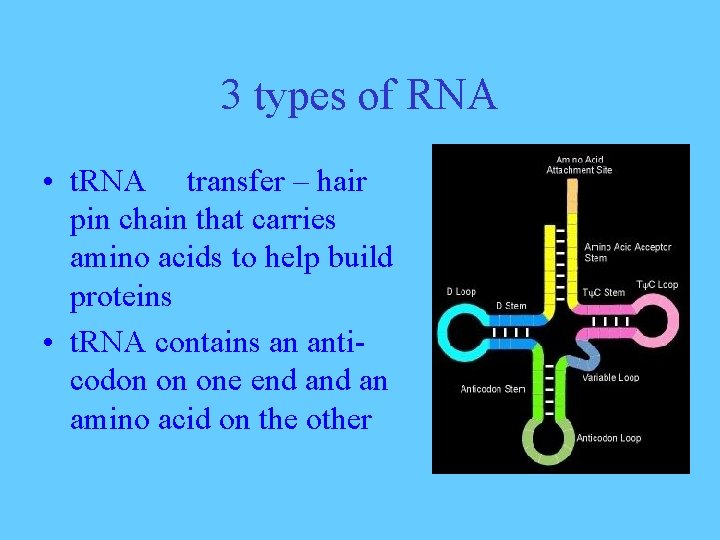
Terminology for Translation The t. RNA molecules have an amino acid attachment site and carries an anticodon. • Anticodon: the 3 nucleotide sequence on t-RNA which the ribosome must fit against m-RNA to ensure that the correct amino acid is placed in the growing protein during translation. • The t. RNA will pick up the appropriate amino acid in the cytoplasm that is coded for by the m. RNA codon that its anticodon matches. – A lock and key process.
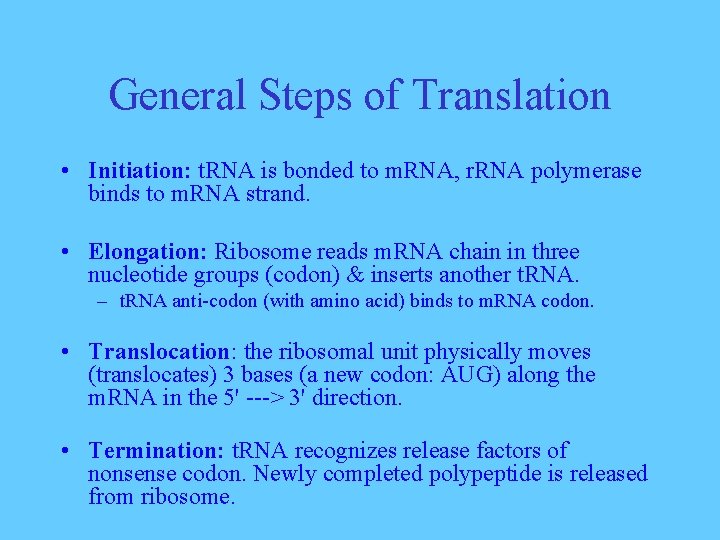
General Steps of Translation • Initiation: t. RNA is bonded to m. RNA, r. RNA polymerase binds to m. RNA strand. • Elongation: Ribosome reads m. RNA chain in three nucleotide groups (codon) & inserts another t. RNA. – t. RNA anti-codon (with amino acid) binds to m. RNA codon. • Translocation: the ribosomal unit physically moves (translocates) 3 bases (a new codon: AUG) along the m. RNA in the 5' ---> 3' direction. • Termination: t. RNA recognizes release factors of nonsense codon. Newly completed polypeptide is released from ribosome.
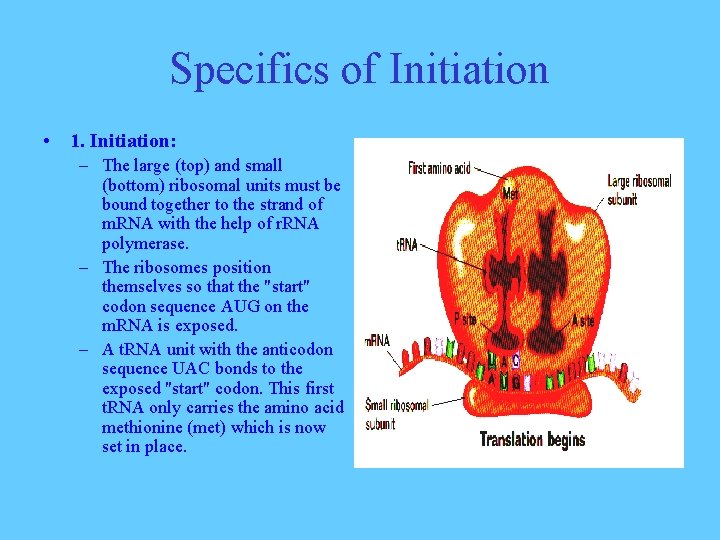
Specifics of Initiation • 1. Initiation: – The large (top) and small (bottom) ribosomal units must be bound together to the strand of m. RNA with the help of r. RNA polymerase. – The ribosomes position themselves so that the "start" codon sequence AUG on the m. RNA is exposed. – A t. RNA unit with the anticodon sequence UAC bonds to the exposed "start" codon. This first t. RNA only carries the amino acid methionine (met) which is now set in place.
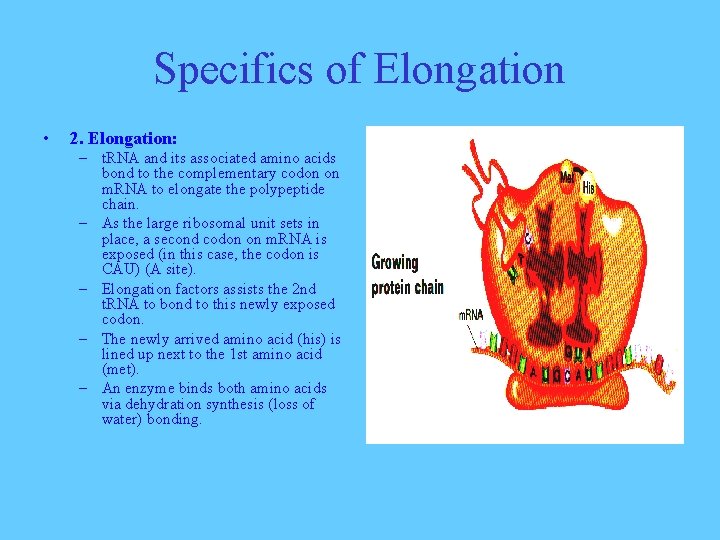
Specifics of Elongation • 2. Elongation: – t. RNA and its associated amino acids bond to the complementary codon on m. RNA to elongate the polypeptide chain. – As the large ribosomal unit sets in place, a second codon on m. RNA is exposed (in this case, the codon is CAU) (A site). – Elongation factors assists the 2 nd t. RNA to bond to this newly exposed codon. – The newly arrived amino acid (his) is lined up next to the 1 st amino acid (met). – An enzyme binds both amino acids via dehydration synthesis (loss of water) bonding.
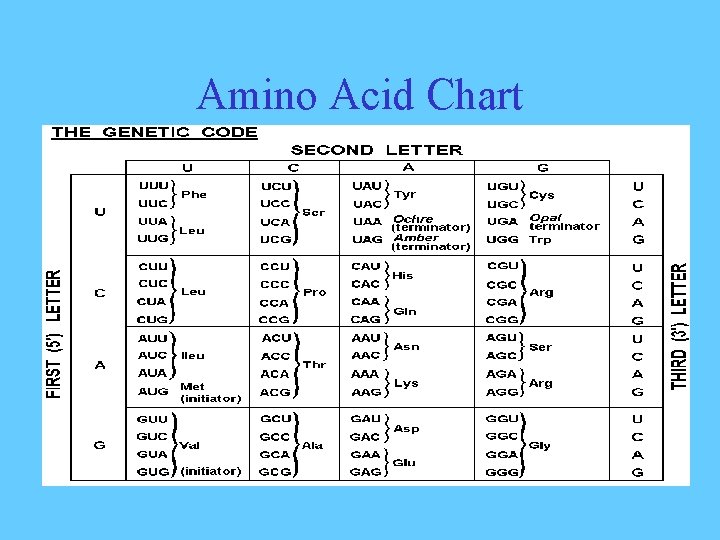
Amino Acid Chart
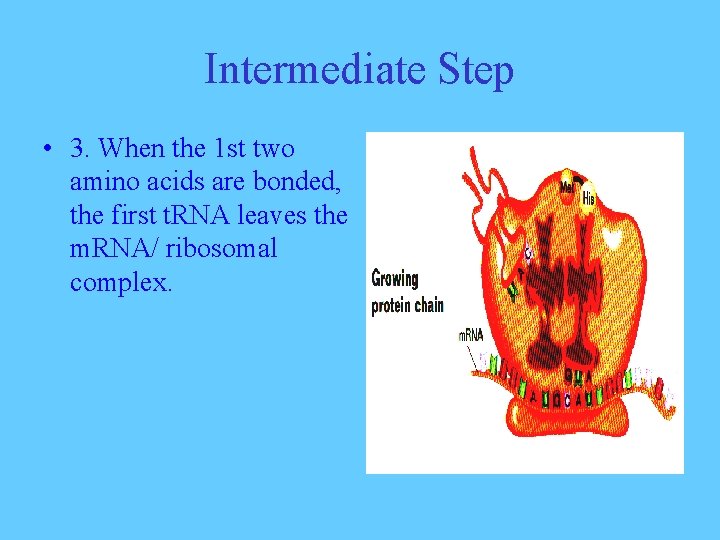
Intermediate Step • 3. When the 1 st two amino acids are bonded, the first t. RNA leaves the m. RNA/ ribosomal complex.
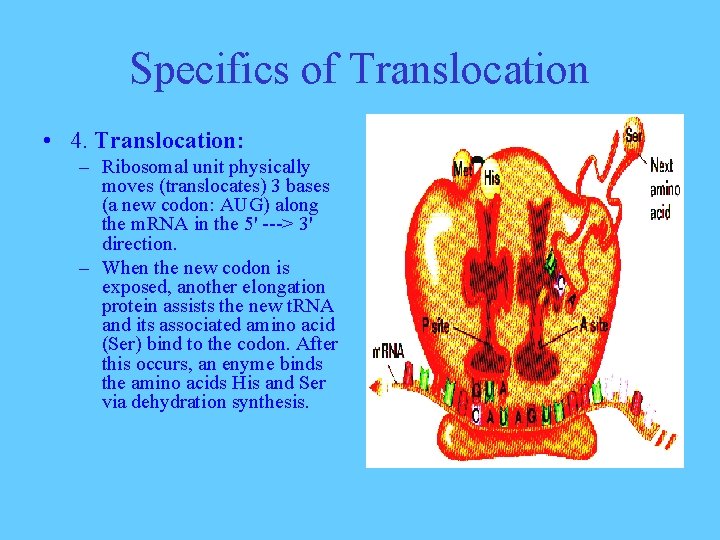
Specifics of Translocation • 4. Translocation: – Ribosomal unit physically moves (translocates) 3 bases (a new codon: AUG) along the m. RNA in the 5' ---> 3' direction. – When the new codon is exposed, another elongation protein assists the new t. RNA and its associated amino acid (Ser) bind to the codon. After this occurs, an enyme binds the amino acids His and Ser via dehydration synthesis.
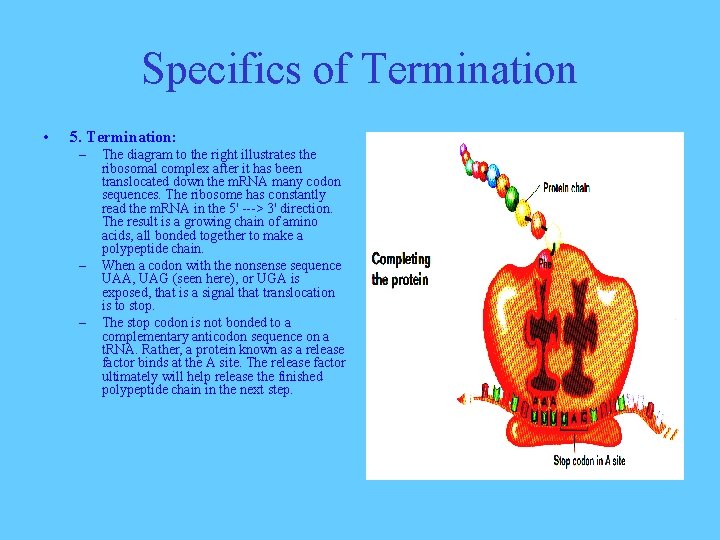
Specifics of Termination • 5. Termination: – – – The diagram to the right illustrates the ribosomal complex after it has been translocated down the m. RNA many codon sequences. The ribosome has constantly read the m. RNA in the 5' ---> 3' direction. The result is a growing chain of amino acids, all bonded together to make a polypeptide chain. When a codon with the nonsense sequence UAA, UAG (seen here), or UGA is exposed, that is a signal that translocation is to stop. The stop codon is not bonded to a complementary anticodon sequence on a t. RNA. Rather, a protein known as a release factor binds at the A site. The release factor ultimately will help release the finished polypeptide chain in the next step.
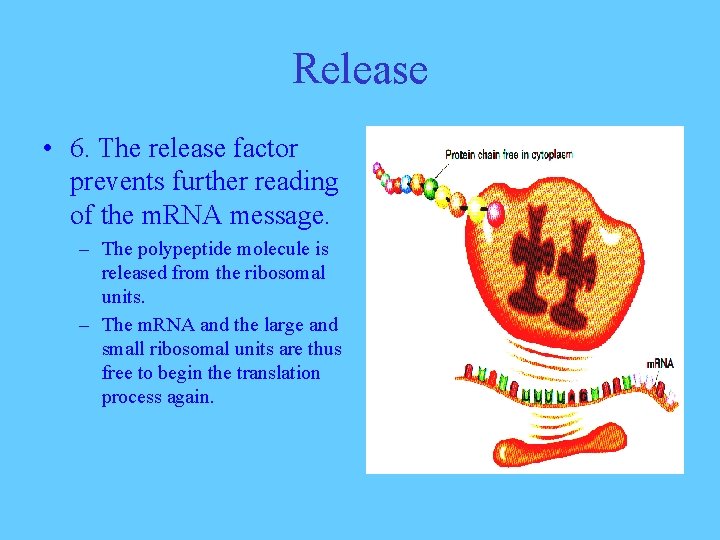
Release • 6. The release factor prevents further reading of the m. RNA message. – The polypeptide molecule is released from the ribosomal units. – The m. RNA and the large and small ribosomal units are thus free to begin the translation process again.
Protein Synthesis
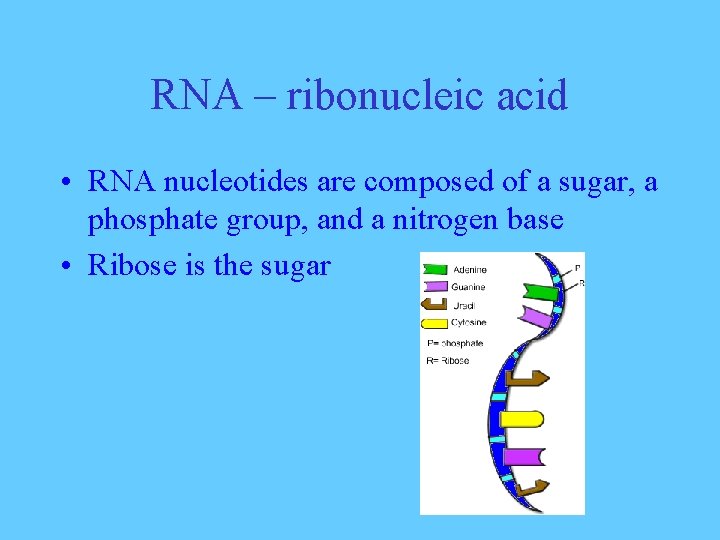
RNA – ribonucleic acid • RNA nucleotides are composed of a sugar, a phosphate group, and a nitrogen base • Ribose is the sugar
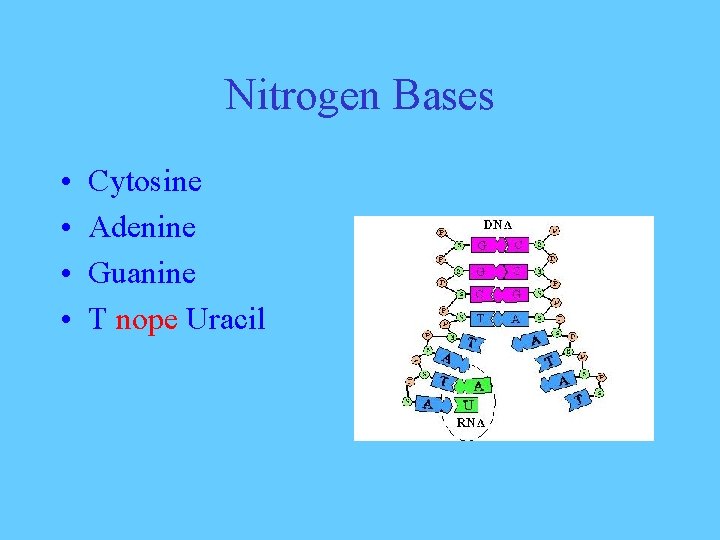
Nitrogen Bases • • Cytosine Adenine Guanine T nope Uracil
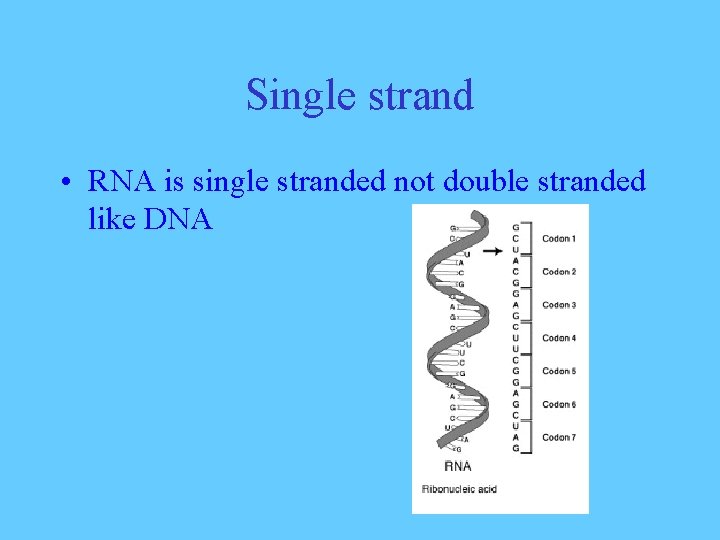
Single strand • RNA is single stranded not double stranded like DNA
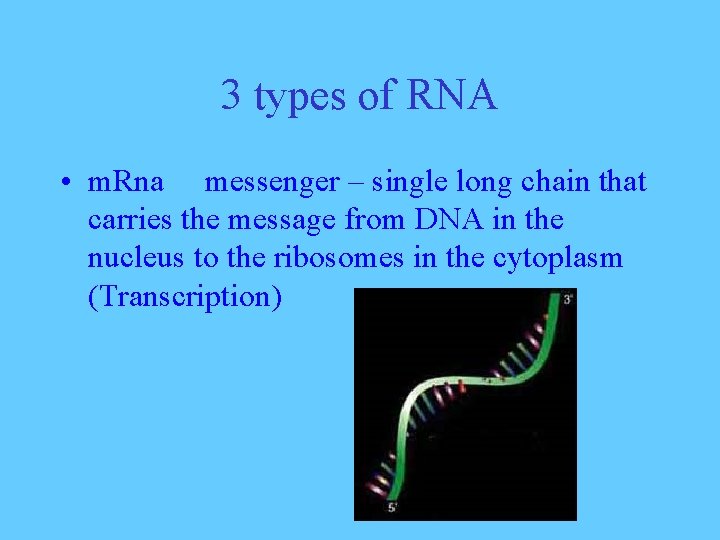
3 types of RNA • m. Rna messenger – single long chain that carries the message from DNA in the nucleus to the ribosomes in the cytoplasm (Transcription)
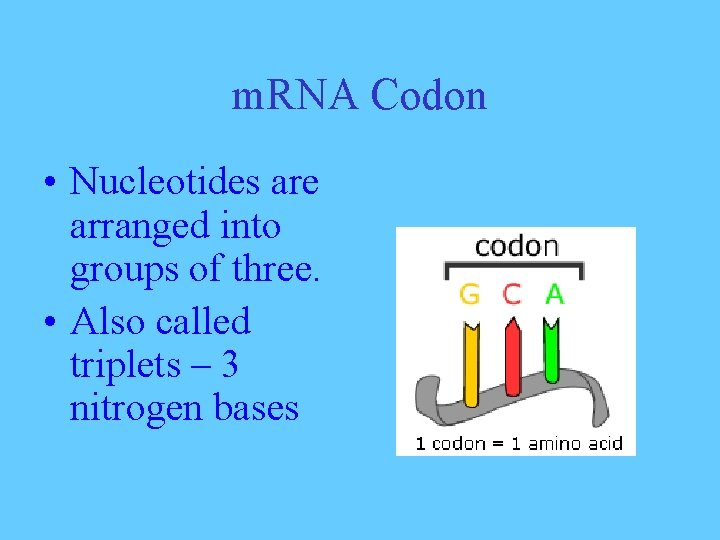
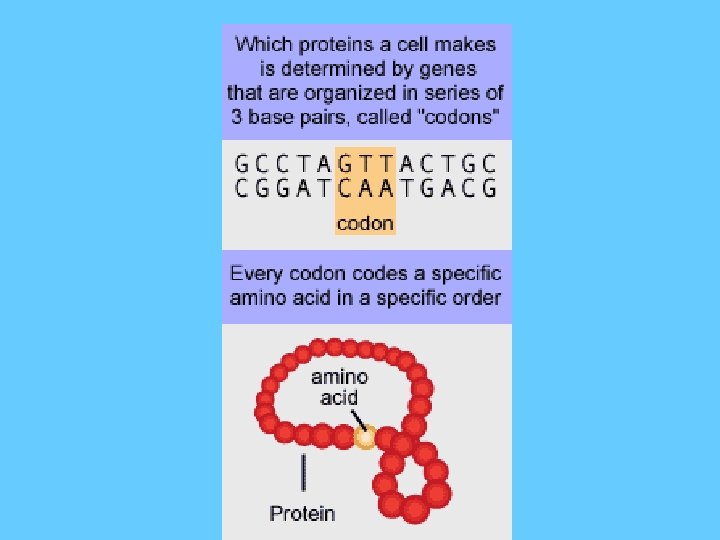
m. RNA Codon • Nucleotides are arranged into groups of three. • Also called triplets – 3 nitrogen bases
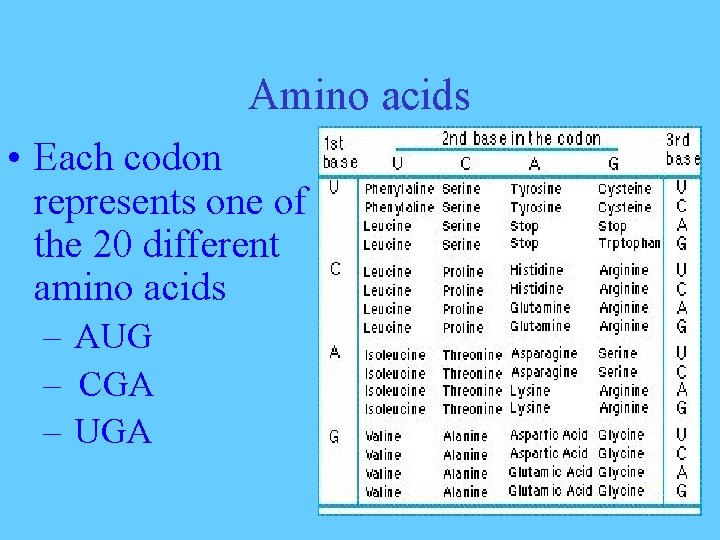
Amino acids • Each codon represents one of the 20 different amino acids – AUG – CGA – UGA
3 types of RNA • t. RNA transfer – hair pin chain that carries amino acids to help build proteins • t. RNA contains an anticodon on one end an amino acid on the other
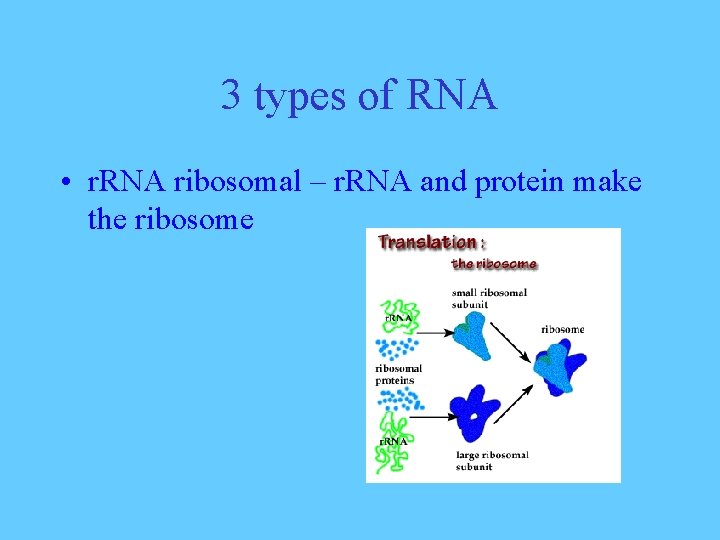
3 types of RNA • r. RNA ribosomal – r. RNA and protein make the ribosome
Problem • DNA is in the nucleus…… • Proteins are made on the ribosomes in the cytoplasm…… • How does the information get from the DNA in the nucleus to the ribosomes in the cytoplasm?
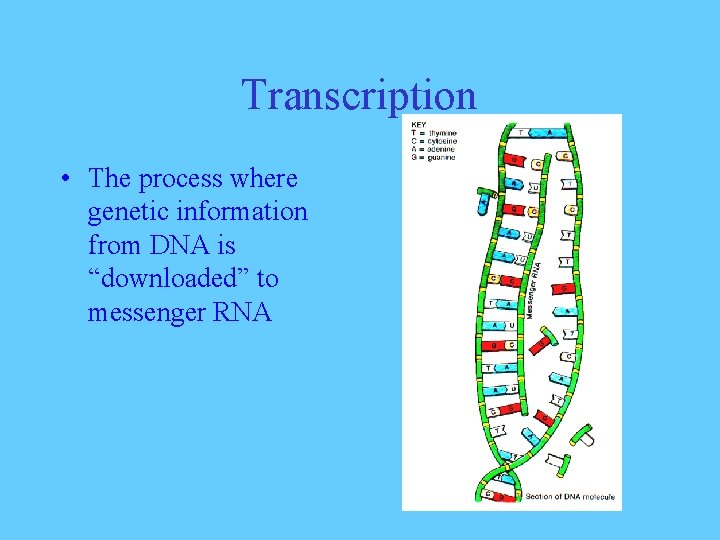
Transcription • The process where genetic information from DNA is “downloaded” to messenger RNA
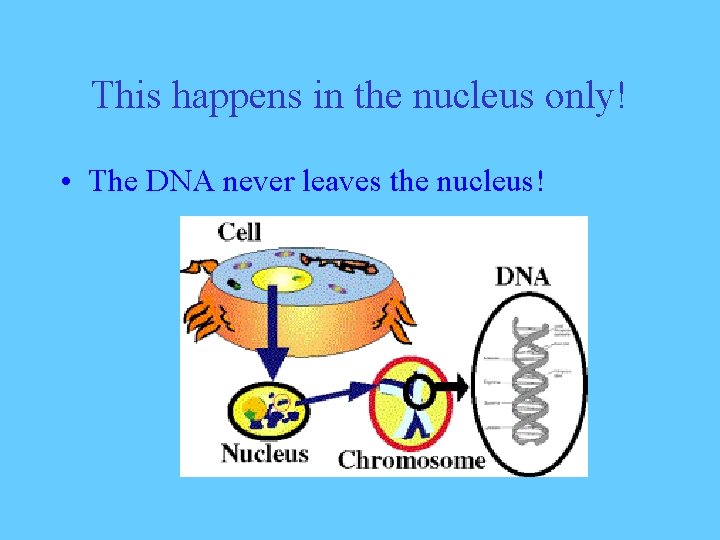
This happens in the nucleus only! • The DNA never leaves the nucleus!
Transcription • Works just like DNA replication, but produces only one strand of m. RNA • The DNA is unzipped by the enzyme “Helicase” • RNA Polymerase reads the DNA and pairs complimentary RNA nucleotides to the RNA strand • The m. RNA leaves the nucleus • DNA zips back up
Transcription cont. • The strand of m. RNA is complimentary because it is constructed from the DNA nucleotide sequence! • Remember: Uracil replaces Thymine in the m. RNA sequence
Translation • The process of making a protein from the m. RNA code……. . • The m. RNA leaves the nucleus and goes to the ribosome • The m. RNA goes through the ribosome and is read by the ribosome • The ribosome recognizes a codon and send a message to the t. RNA
Translation • t. RNA carries an amino acid that is floating in the cytoplasm over to the ribosome • The t. RNA anti-codon binds to the m. RNA codon while linking the amino acids together………. • Thus creating a polypeptide, amino acid chain (protein)
Make a protein • At the ribosomes, the t. RNA gives the amino acid away to build protein • Then goes back into the cytoplasm to look for a free amino acid and repeats • The ribosome keeps reading the m. RNA taking the amino acids from t. RNA and sticking them together to make a protein chain • This all happens very quickly!