
The mole Particles of matter are so small




- Slides: 19
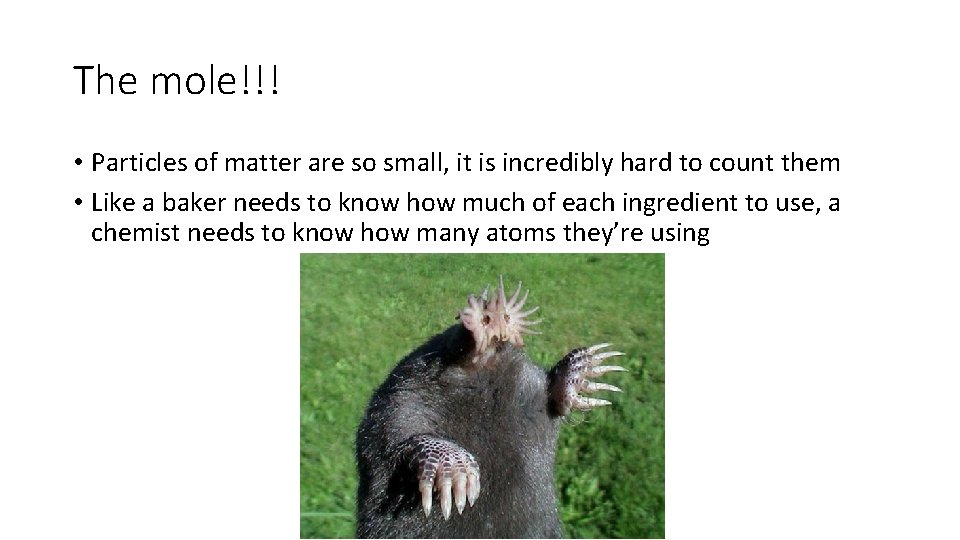
The mole!!! • Particles of matter are so small, it is incredibly hard to count them • Like a baker needs to know how much of each ingredient to use, a chemist needs to know how many atoms they’re using
The mole • However, reactions aren’t dictated by the mass of a substance, or its volume, or anything else • It is dictated solely by the number of particles in the reaction • So we can’t measure out grams, or cups, or m. L. We need to know the number of particles we are using
The mole • A mole is a counting unit • 1 dozen = 12 things • 1 score = 20 things • 1 gross = 144 things • 1 ream = 500 things • 1 mole = 6. 022 x 1023 things/mol = 602, 214, 129, 000, 000 things/mol • Avogadro’s Number
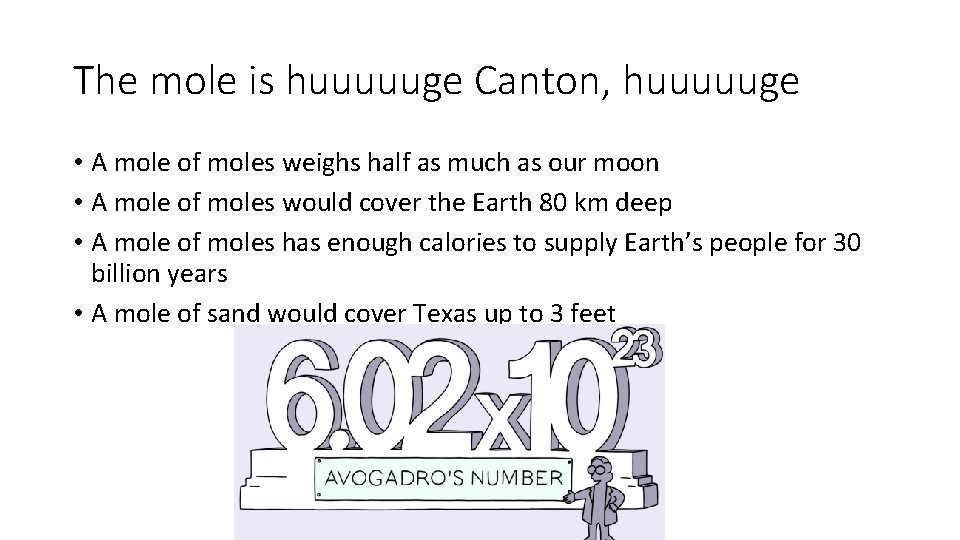
The mole is huuuuuge Canton, huuuuuge • A mole of moles weighs half as much as our moon • A mole of moles would cover the Earth 80 km deep • A mole of moles has enough calories to supply Earth’s people for 30 billion years • A mole of sand would cover Texas up to 3 feet
What is a mole? • A) a blind furry animal that feels with its face • B) a brown mark on your body • C) an important chemistry concept • D) All of these
The answer is D!! • Even though moles are cute and fuzzy, we’re going to focus on the chemistry bit
The mole • Determined from the number of atoms in a 12 g sample of C-12 • Currently being redefined, but the number won’t change too much
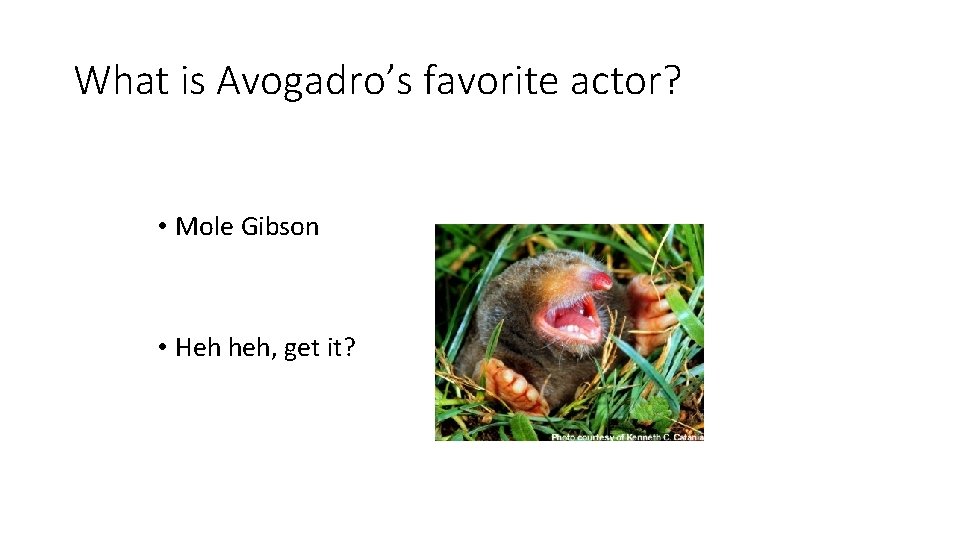
What is Avogadro’s favorite actor? • Mole Gibson • Heh heh, get it?
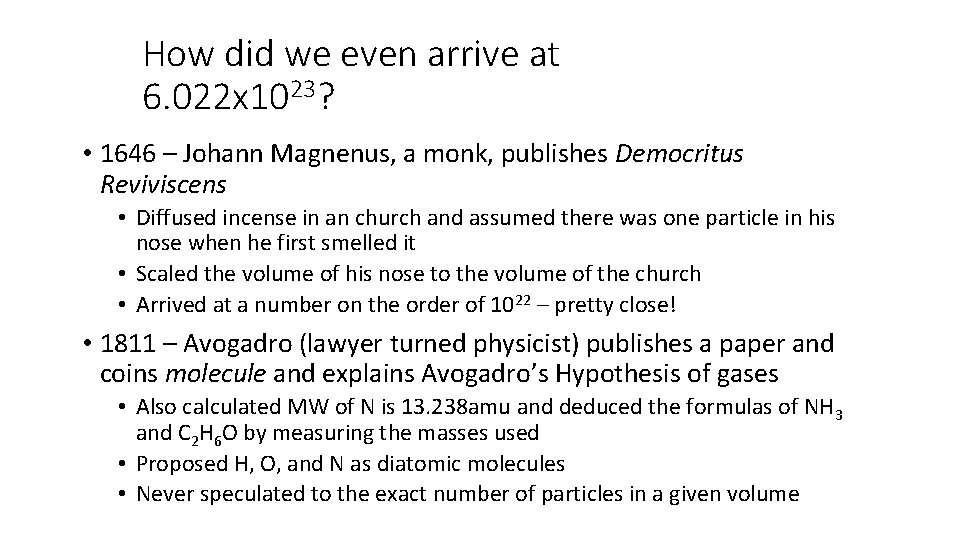
How did we even arrive at 6. 022 x 1023? • 1646 – Johann Magnenus, a monk, publishes Democritus Reviviscens • Diffused incense in an church and assumed there was one particle in his nose when he first smelled it • Scaled the volume of his nose to the volume of the church • Arrived at a number on the order of 1022 – pretty close! • 1811 – Avogadro (lawyer turned physicist) publishes a paper and coins molecule and explains Avogadro’s Hypothesis of gases • Also calculated MW of N is 13. 238 amu and deduced the formulas of NH 3 and C 2 H 6 O by measuring the masses used • Proposed H, O, and N as diatomic molecules • Never speculated to the exact number of particles in a given volume
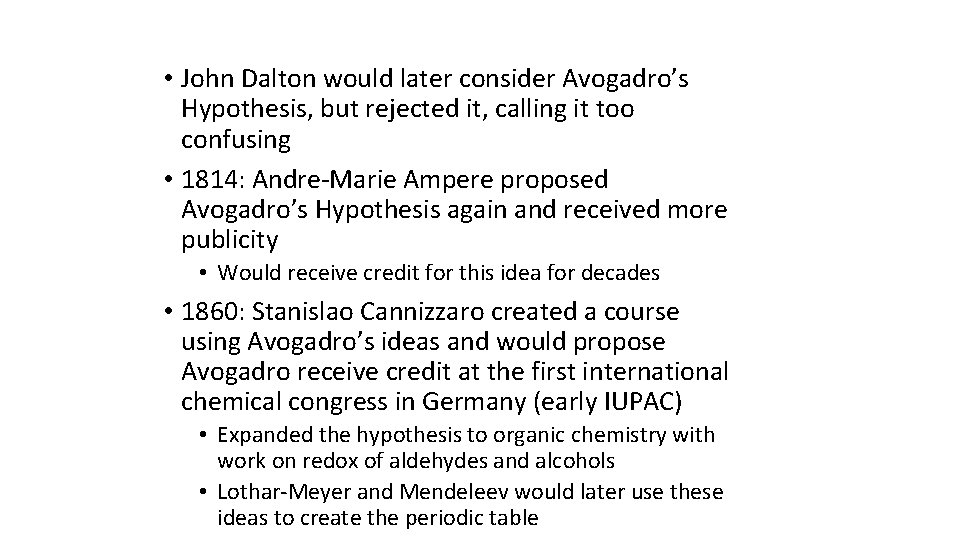
• John Dalton would later consider Avogadro’s Hypothesis, but rejected it, calling it too confusing • 1814: Andre-Marie Ampere proposed Avogadro’s Hypothesis again and received more publicity • Would receive credit for this idea for decades • 1860: Stanislao Cannizzaro created a course using Avogadro’s ideas and would propose Avogadro receive credit at the first international chemical congress in Germany (early IUPAC) • Expanded the hypothesis to organic chemistry with work on redox of aldehydes and alcohols • Lothar-Meyer and Mendeleev would later use these ideas to create the periodic table
• 1865: Johann Josef Loschmidt studies the size of gas molecules and refines a mole to be 4. 10 x 1022. • Inspired by work on the kinetic motion of gases in the 1700 s by Bernoulli • Used his studies to deduce a cross-sectional area of a gas • Using Boltzmann’s constant k (relates energy to temperature), the universal gas constant R can be deduced • k = R/n where n is the number of moles • Now the Ideal Gas Law becomes PV=n. RT
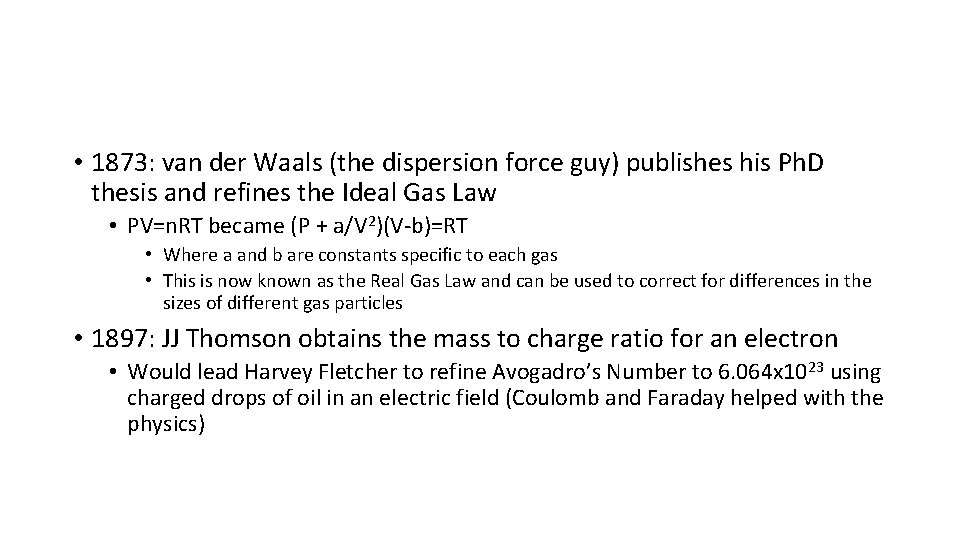
• 1873: van der Waals (the dispersion force guy) publishes his Ph. D thesis and refines the Ideal Gas Law • PV=n. RT became (P + a/V 2)(V-b)=RT • Where a and b are constants specific to each gas • This is now known as the Real Gas Law and can be used to correct for differences in the sizes of different gas particles • 1897: JJ Thomson obtains the mass to charge ratio for an electron • Would lead Harvey Fletcher to refine Avogadro’s Number to 6. 064 x 1023 using charged drops of oil in an electric field (Coulomb and Faraday helped with the physics)
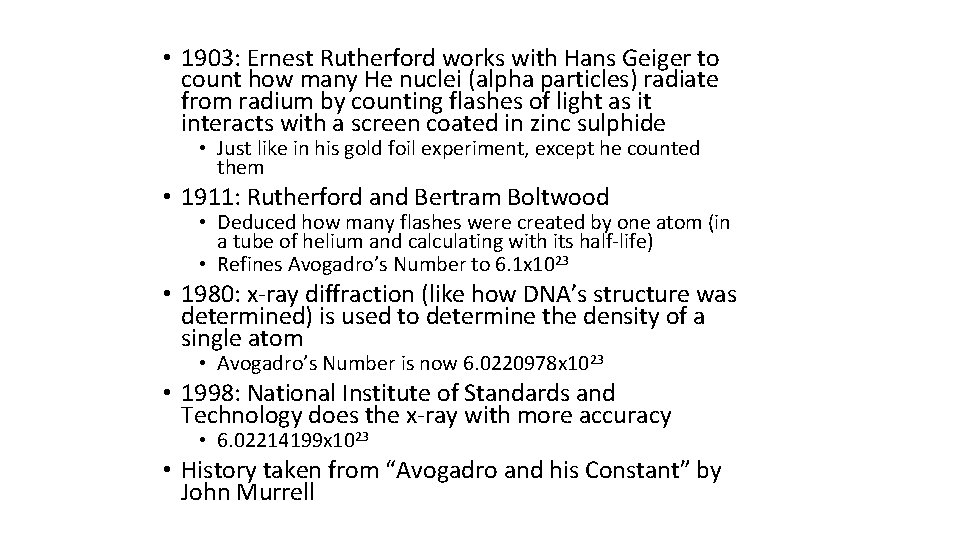
• 1903: Ernest Rutherford works with Hans Geiger to count how many He nuclei (alpha particles) radiate from radium by counting flashes of light as it interacts with a screen coated in zinc sulphide • Just like in his gold foil experiment, except he counted them • 1911: Rutherford and Bertram Boltwood • Deduced how many flashes were created by one atom (in a tube of helium and calculating with its half-life) • Refines Avogadro’s Number to 6. 1 x 10²³ • 1980: x-ray diffraction (like how DNA’s structure was determined) is used to determine the density of a single atom • Avogadro’s Number is now 6. 0220978 x 1023 • 1998: National Institute of Standards and Technology does the x-ray with more accuracy • 6. 02214199 x 1023 • History taken from “Avogadro and his Constant” by John Murrell
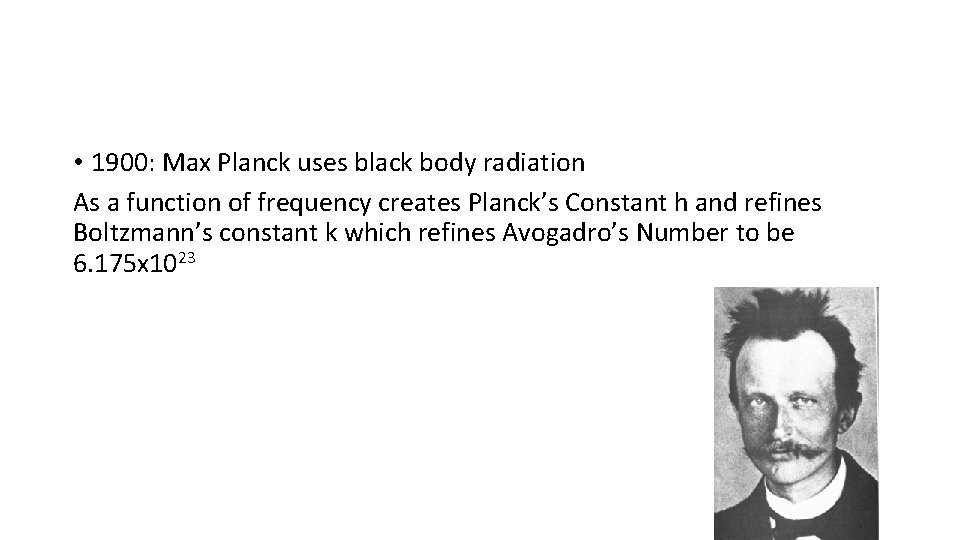
• 1900: Max Planck uses black body radiation As a function of frequency creates Planck’s Constant h and refines Boltzmann’s constant k which refines Avogadro’s Number to be 6. 175 x 1023
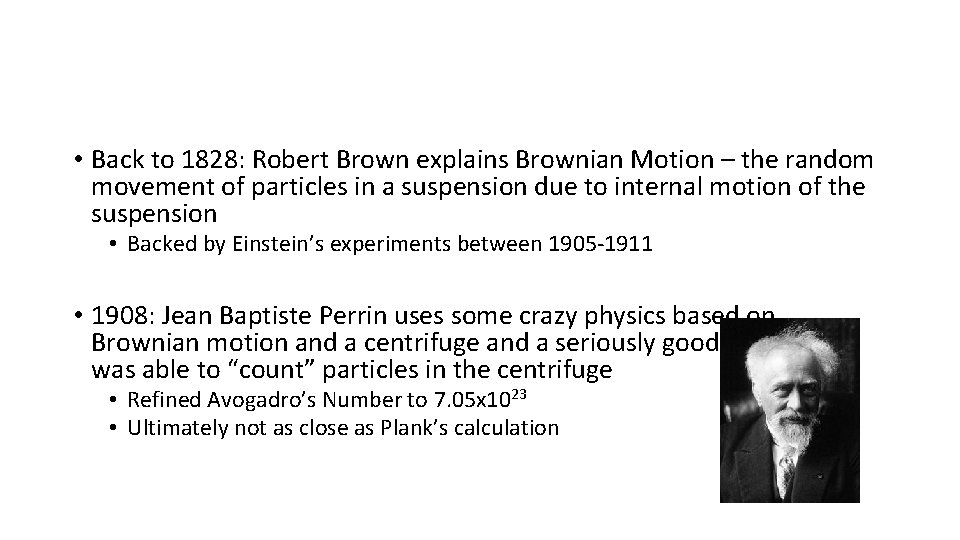
• Back to 1828: Robert Brown explains Brownian Motion – the random movement of particles in a suspension due to internal motion of the suspension • Backed by Einstein’s experiments between 1905 -1911 • 1908: Jean Baptiste Perrin uses some crazy physics based on Brownian motion and a centrifuge and a seriously good microscope was able to “count” particles in the centrifuge • Refined Avogadro’s Number to 7. 05 x 1023 • Ultimately not as close as Plank’s calculation
• 1990 s-today: The International Avogadro Coordination (Avogadro Project) is formed to assist in redefining a kilogram as a universal constant based on math rather than the current “kilogram” – Le Grand K • Work backwards from Avogadro’s number and Plank’s constant h • 2011 -2017 Using 1 kg polished spheres of silicon they measure the dimensions of the sphere and use the width of silicon’s crystal structure to count the number of atoms in the sphere • 6. 02214(082)x 1023
• 2017: Avogadro Project has announced due dates for researchers to finalize their calculations • 2018: Researchers will convene to finalize their results for the • • • Mole Planck’s Constant Kilogram Ampere Kelvin • More reading: https: //en. wikipedia. org/wiki/Proposed_redefinition_of_SI_base_uni ts