
The Mole Not the type of mole we


- Slides: 45
The Mole
Not the type of mole we are talking about
Measuring Matter • You often measure the amount of something by one of three different methods: 1. Count 2. Mass 3. Volume
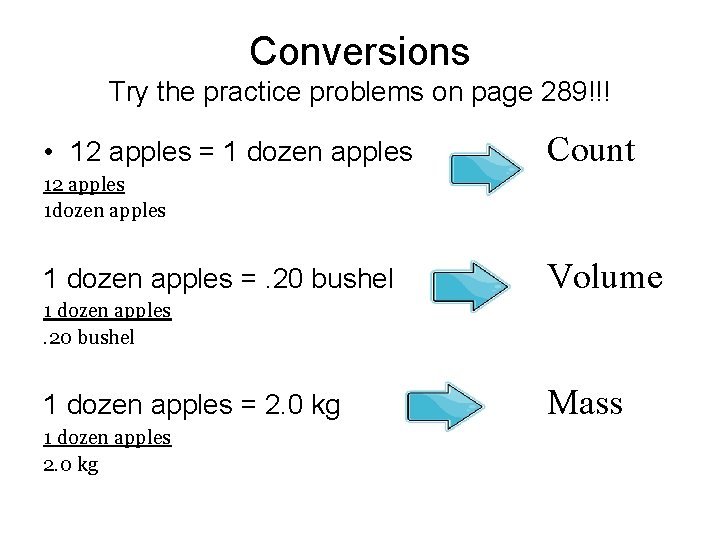
Conversions Try the practice problems on page 289!!! • 12 apples = 1 dozen apples Count 12 apples 1 dozen apples 1 dozen apples =. 20 bushel Volume 1 dozen apples. 20 bushel 1 dozen apples = 2. 0 kg 1 dozen apples 2. 0 kg Mass
The Mole Q: how long would it take to spend a mole of $1 coins if they were being spent at a rate of 1 billion per second?
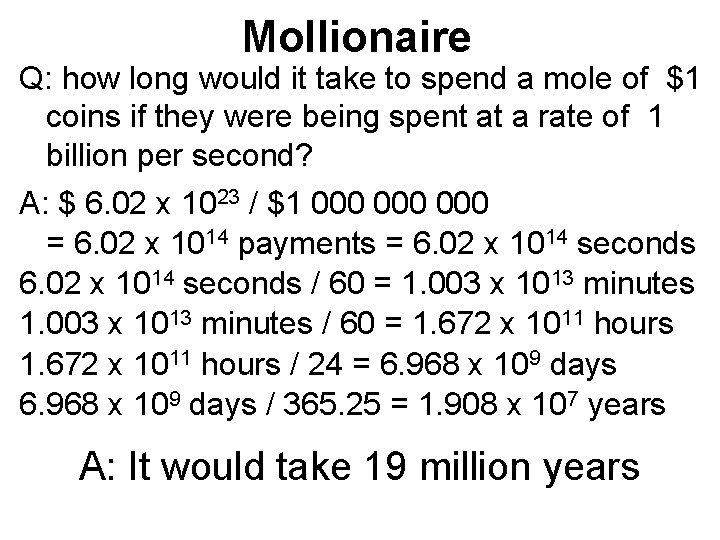
Mollionaire Q: how long would it take to spend a mole of $1 coins if they were being spent at a rate of 1 billion per second? A: $ 6. 02 x 1023 / $1 000 000 = 6. 02 x 1014 payments = 6. 02 x 1014 seconds / 60 = 1. 003 x 1013 minutes / 60 = 1. 672 x 1011 hours / 24 = 6. 968 x 109 days / 365. 25 = 1. 908 x 107 years A: It would take 19 million years
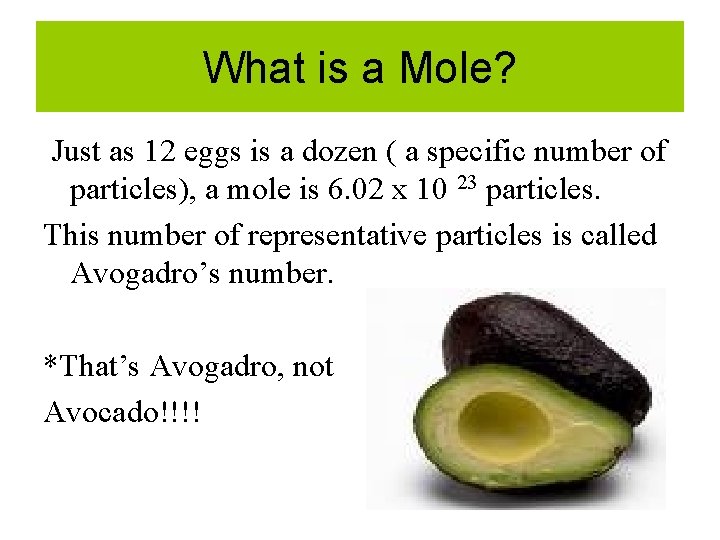
What is a Mole? Just as 12 eggs is a dozen ( a specific number of particles), a mole is 6. 02 x 10 23 particles. This number of representative particles is called Avogadro’s number. *That’s Avogadro, not Avocado!!!!
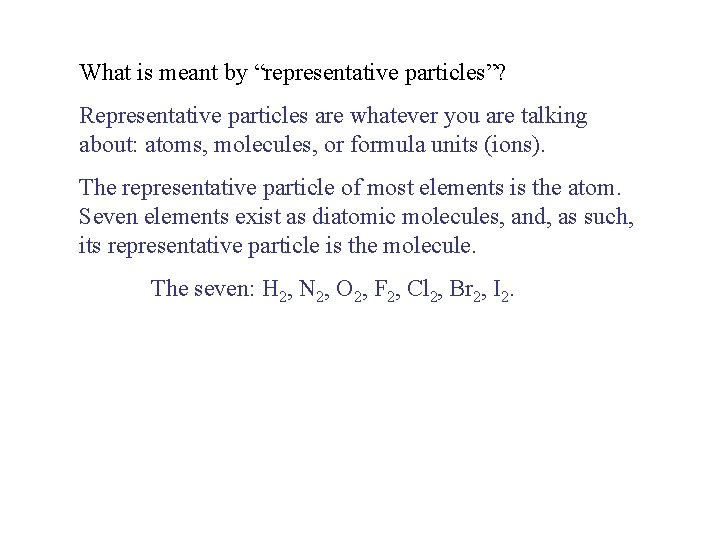
What is meant by “representative particles”? Representative particles are whatever you are talking about: atoms, molecules, or formula units (ions). The representative particle of most elements is the atom. Seven elements exist as diatomic molecules, and, as such, its representative particle is the molecule. The seven: H 2, N 2, O 2, F 2, Cl 2, Br 2, I 2.
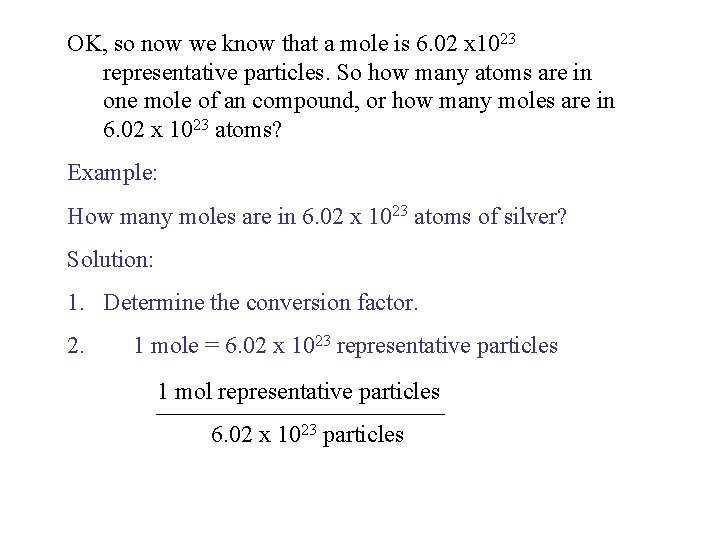
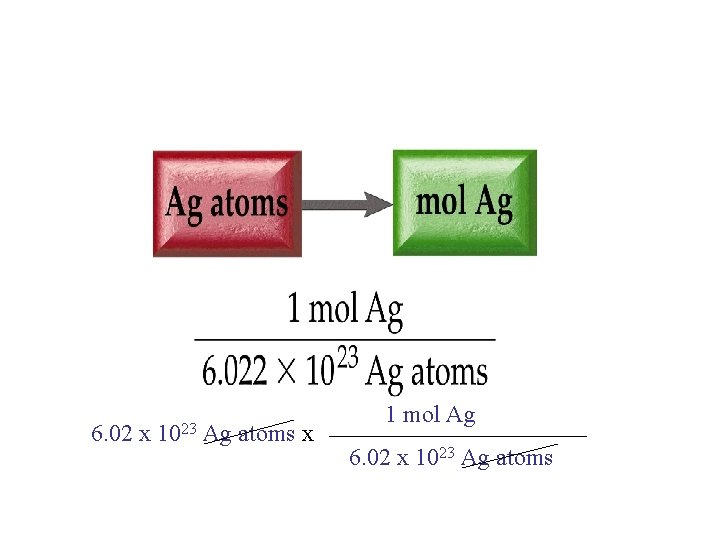
OK, so now we know that a mole is 6. 02 x 1023 representative particles. So how many atoms are in one mole of an compound, or how many moles are in 6. 02 x 1023 atoms? Example: How many moles are in 6. 02 x 1023 atoms of silver? Solution: 1. Determine the conversion factor. 2. 1 mole = 6. 02 x 1023 representative particles 1 mol representative particles 6. 02 x 1023 particles
6. 02 x 1023 Ag atoms x 1 mol Ag 6. 02 x 1023 Ag atoms
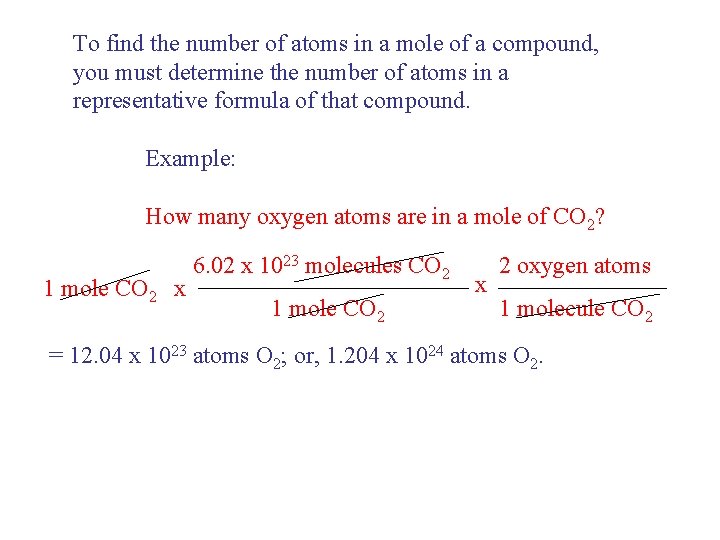
To find the number of atoms in a mole of a compound, you must determine the number of atoms in a representative formula of that compound. Example: How many oxygen atoms are in a mole of CO 2? 1 mole CO 2 x 6. 02 x 1023 molecules CO 2 1 mole CO 2 x 2 oxygen atoms 1 molecule CO 2 = 12. 04 x 1023 atoms O 2; or, 1. 204 x 1024 atoms O 2.
Converting Number of Particles to Moles • Look on Page 290 and 291 • Try the practice problems!!!! How many representative Particles are in one mole? ?
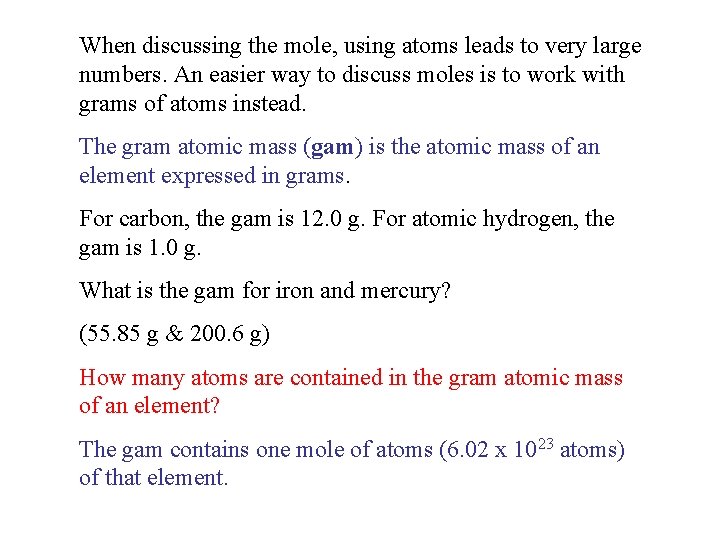
When discussing the mole, using atoms leads to very large numbers. An easier way to discuss moles is to work with grams of atoms instead. The gram atomic mass (gam) is the atomic mass of an element expressed in grams. For carbon, the gam is 12. 0 g. For atomic hydrogen, the gam is 1. 0 g. What is the gam for iron and mercury? (55. 85 g & 200. 6 g) How many atoms are contained in the gram atomic mass of an element? The gam contains one mole of atoms (6. 02 x 1023 atoms) of that element.
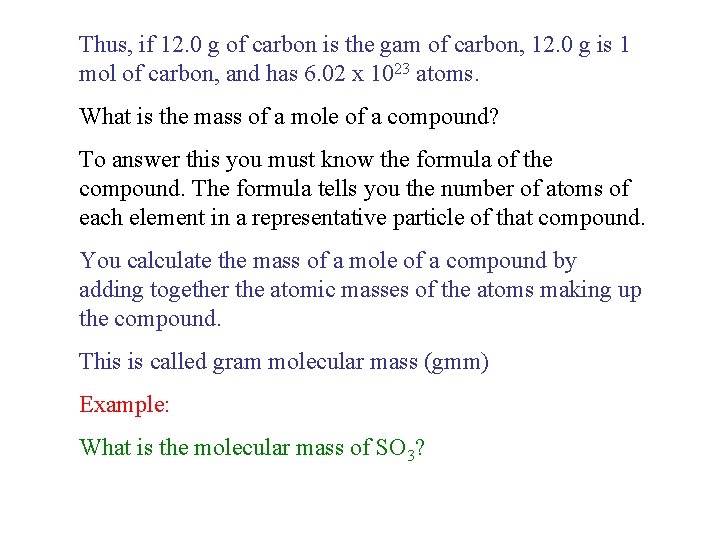
Thus, if 12. 0 g of carbon is the gam of carbon, 12. 0 g is 1 mol of carbon, and has 6. 02 x 1023 atoms. What is the mass of a mole of a compound? To answer this you must know the formula of the compound. The formula tells you the number of atoms of each element in a representative particle of that compound. You calculate the mass of a mole of a compound by adding together the atomic masses of the atoms making up the compound. This is called gram molecular mass (gmm) Example: What is the molecular mass of SO 3?
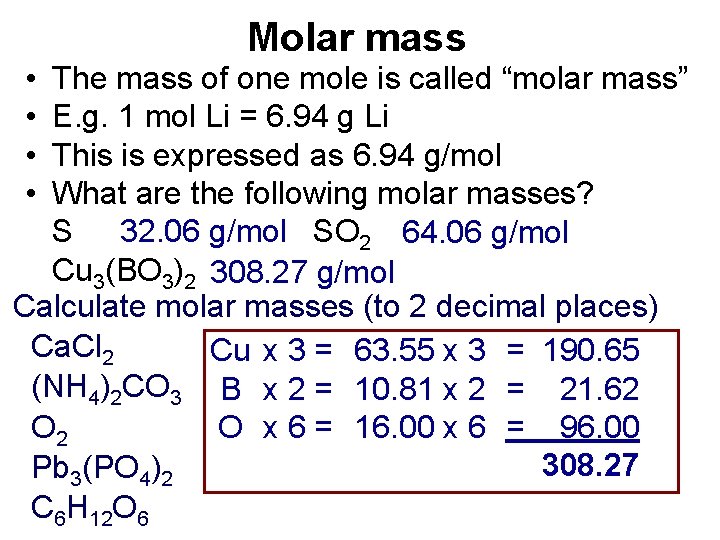
• • Molar mass The mass of one mole is called “molar mass” E. g. 1 mol Li = 6. 94 g Li This is expressed as 6. 94 g/mol What are the following molar masses? S 32. 06 g/mol SO 2 64. 06 g/mol Cu 3(BO 3)2 308. 27 g/mol Calculate molar masses (to 2 decimal places) Ca. Cl 2 Cu x 3 = 63. 55 x 3 = 190. 65 (NH 4)2 CO 3 B x 2 = 10. 81 x 2 = 21. 62 O x 6 = 16. 00 x 6 = 96. 00 308. 27 Pb 3(PO 4)2 C 6 H 12 O 6
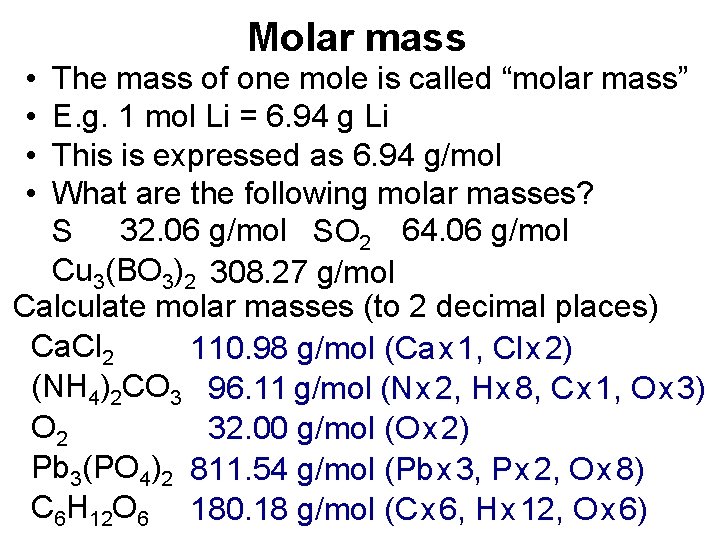
• • Molar mass The mass of one mole is called “molar mass” E. g. 1 mol Li = 6. 94 g Li This is expressed as 6. 94 g/mol What are the following molar masses? S 32. 06 g/mol SO 2 64. 06 g/mol Cu 3(BO 3)2 308. 27 g/mol Calculate molar masses (to 2 decimal places) Ca. Cl 2 110. 98 g/mol (Ca x 1, Cl x 2) (NH 4)2 CO 3 96. 11 g/mol (N x 2, H x 8, C x 1, O x 3) O 2 32. 00 g/mol (O x 2) Pb 3(PO 4)2 811. 54 g/mol (Pb x 3, P x 2, O x 8) C 6 H 12 O 6 180. 18 g/mol (C x 6, H x 12, O x 6)
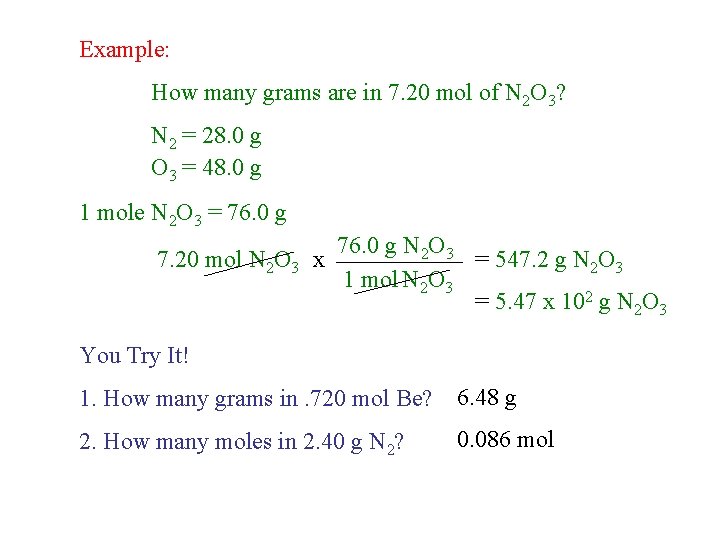
Example: How many grams are in 7. 20 mol of N 2 O 3? N 2 = 28. 0 g O 3 = 48. 0 g 1 mole N 2 O 3 = 76. 0 g 7. 20 mol N 2 O 3 x 76. 0 g N 2 O 3 = 547. 2 g N 2 O 3 1 mol N 2 O 3 = 5. 47 x 102 g N 2 O 3 You Try It! 1. How many grams in. 720 mol Be? 6. 48 g 2. How many moles in 2. 40 g N 2? 0. 086 mol
Easy peasy!! Now let’s see if the fog has lifted….
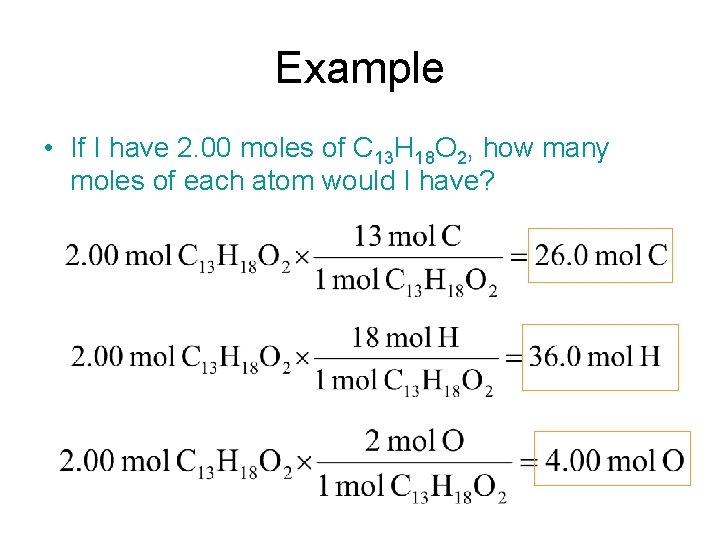
Example • If I have 2. 00 moles of C 13 H 18 O 2, how many moles of each atom would I have?
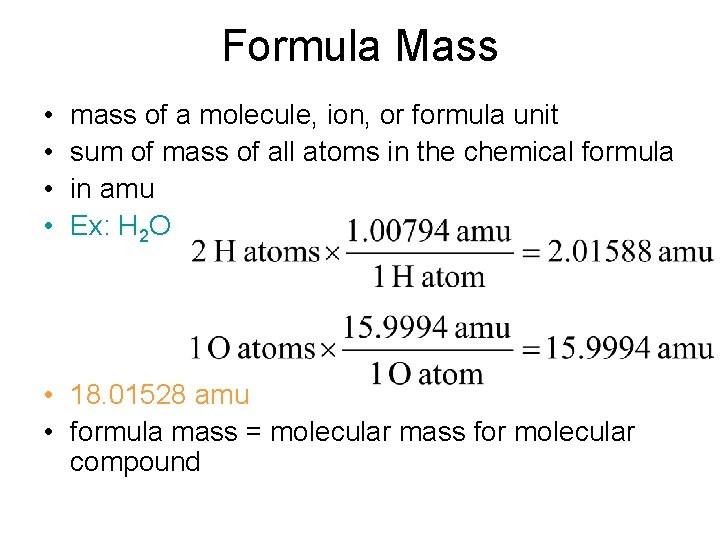
Formula Mass • • mass of a molecule, ion, or formula unit sum of mass of all atoms in the chemical formula in amu Ex: H 2 O • 18. 01528 amu • formula mass = molecular mass for molecular compound
Example • Find formula mass of potassium chlorate. • KCl. O 3 • 1(39. 0983) + 1(35. 4527) + 3(15. 9994) • 122. 549 amu
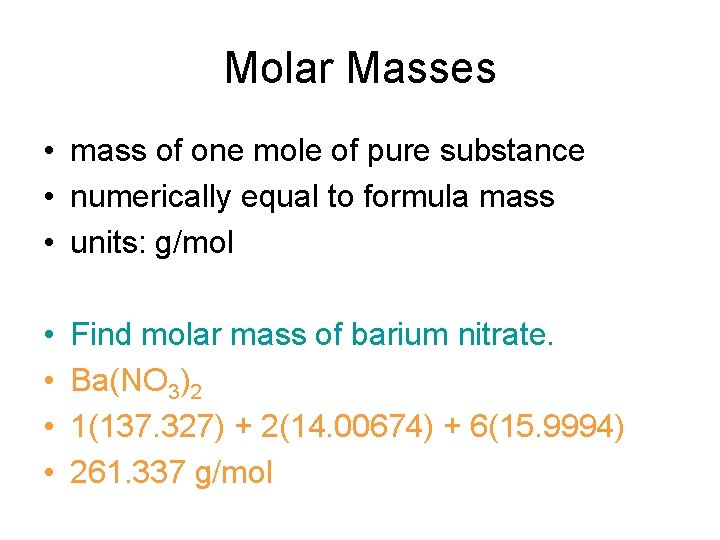
Molar Masses • mass of one mole of pure substance • numerically equal to formula mass • units: g/mol • • Find molar mass of barium nitrate. Ba(NO 3)2 1(137. 327) + 2(14. 00674) + 6(15. 9994) 261. 337 g/mol
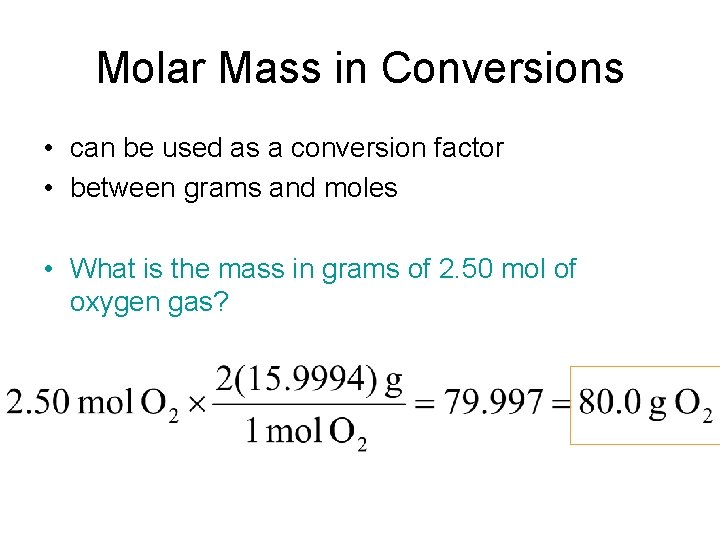
Molar Mass in Conversions • can be used as a conversion factor • between grams and moles • What is the mass in grams of 2. 50 mol of oxygen gas?
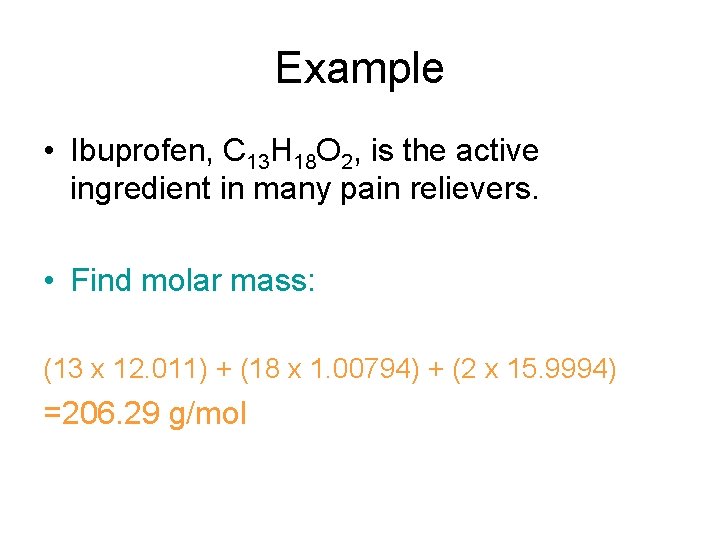
Example • Ibuprofen, C 13 H 18 O 2, is the active ingredient in many pain relievers. • Find molar mass: (13 x 12. 011) + (18 x 1. 00794) + (2 x 15. 9994) =206. 29 g/mol
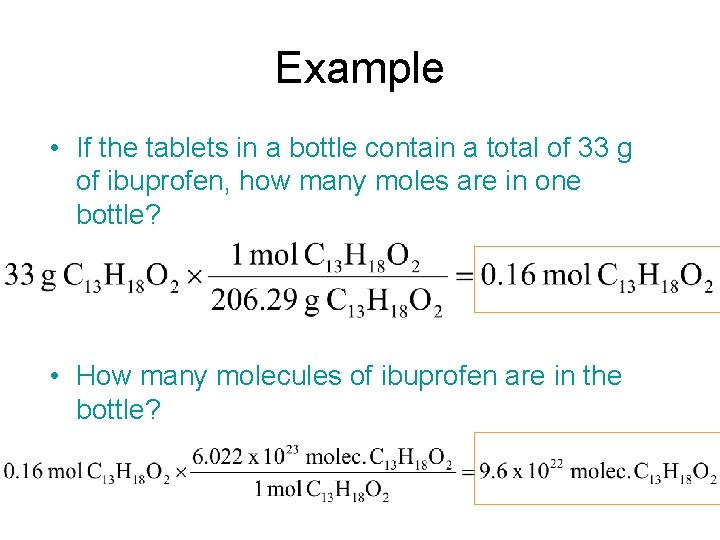
Example • If the tablets in a bottle contain a total of 33 g of ibuprofen, how many moles are in one bottle? • How many molecules of ibuprofen are in the bottle?
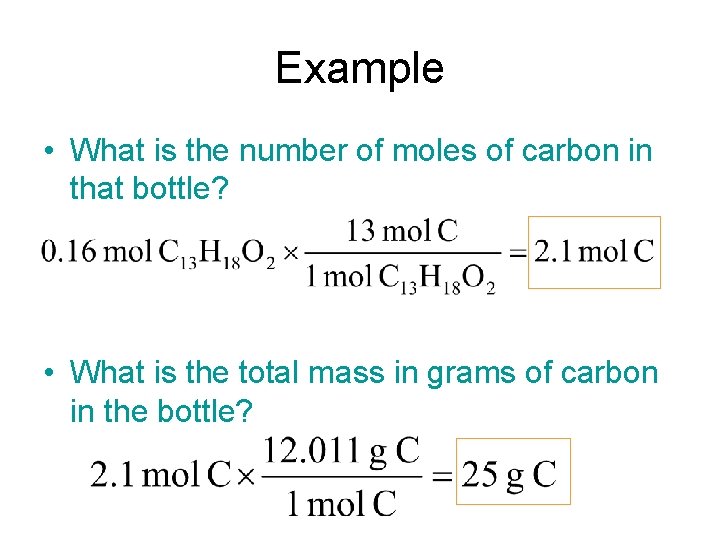
Example • What is the number of moles of carbon in that bottle? • What is the total mass in grams of carbon in the bottle?
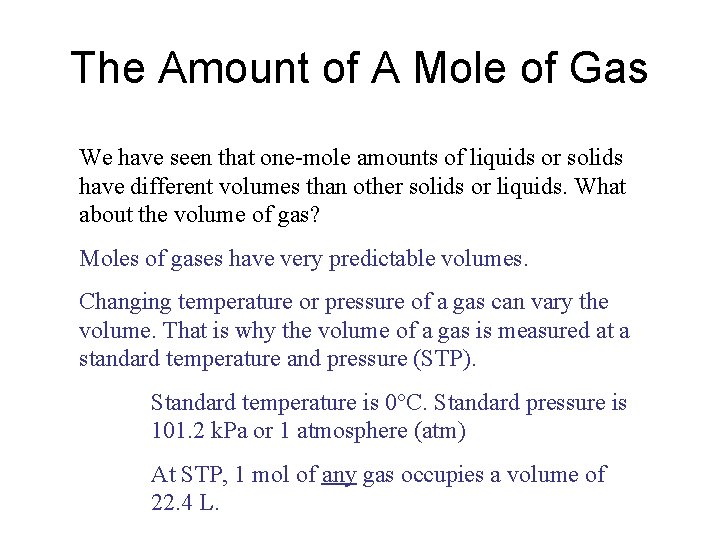
The Amount of A Mole of Gas We have seen that one-mole amounts of liquids or solids have different volumes than other solids or liquids. What about the volume of gas? Moles of gases have very predictable volumes. Changing temperature or pressure of a gas can vary the volume. That is why the volume of a gas is measured at a standard temperature and pressure (STP). Standard temperature is 0°C. Standard pressure is 101. 2 k. Pa or 1 atmosphere (atm) At STP, 1 mol of any gas occupies a volume of 22. 4 L.
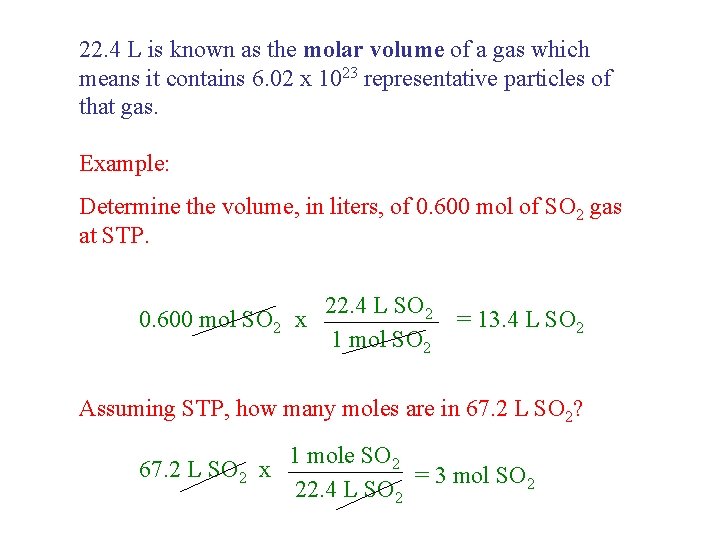
22. 4 L is known as the molar volume of a gas which means it contains 6. 02 x 1023 representative particles of that gas. Example: Determine the volume, in liters, of 0. 600 mol of SO 2 gas at STP. 0. 600 mol SO 2 x 22. 4 L SO 2 1 mol SO 2 = 13. 4 L SO 2 Assuming STP, how many moles are in 67. 2 L SO 2? 1 mole SO 2 67. 2 L SO 2 x = 3 mol SO 2 22. 4 L SO 2
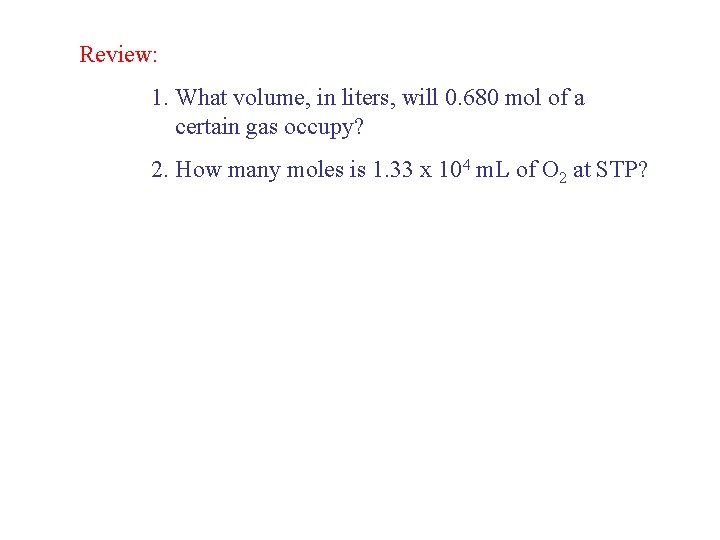
Review: 1. What volume, in liters, will 0. 680 mol of a certain gas occupy? 2. How many moles is 1. 33 x 104 m. L of O 2 at STP?
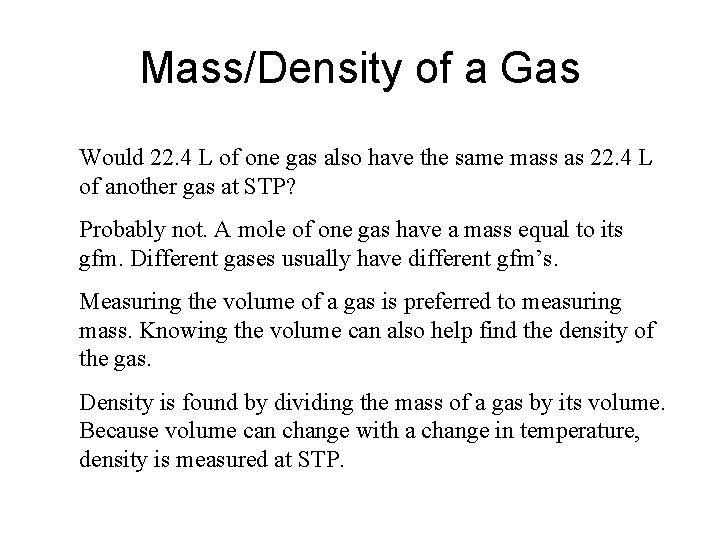
Mass/Density of a Gas Would 22. 4 L of one gas also have the same mass as 22. 4 L of another gas at STP? Probably not. A mole of one gas have a mass equal to its gfm. Different gases usually have different gfm’s. Measuring the volume of a gas is preferred to measuring mass. Knowing the volume can also help find the density of the gas. Density is found by dividing the mass of a gas by its volume. Because volume can change with a change in temperature, density is measured at STP.
molar mass g/mol Density (at STP) = = molar volume 22. 4 L/mol = g L Example: What is the density of oxygen gas at STP? (in grams per liter. ) molar mass = 32 g/mol = 1. 43 g/L D= molar volume 22. 4 L/mol
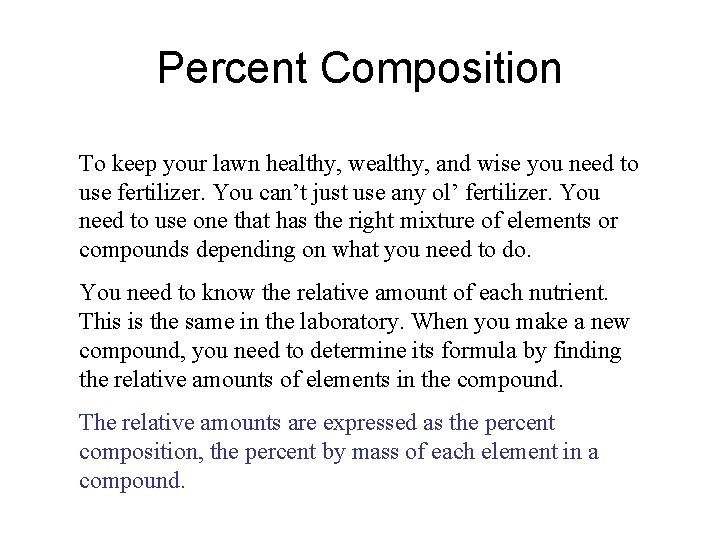
Percent Composition To keep your lawn healthy, wealthy, and wise you need to use fertilizer. You can’t just use any ol’ fertilizer. You need to use one that has the right mixture of elements or compounds depending on what you need to do. You need to know the relative amount of each nutrient. This is the same in the laboratory. When you make a new compound, you need to determine its formula by finding the relative amounts of elements in the compound. The relative amounts are expressed as the percent composition, the percent by mass of each element in a compound.
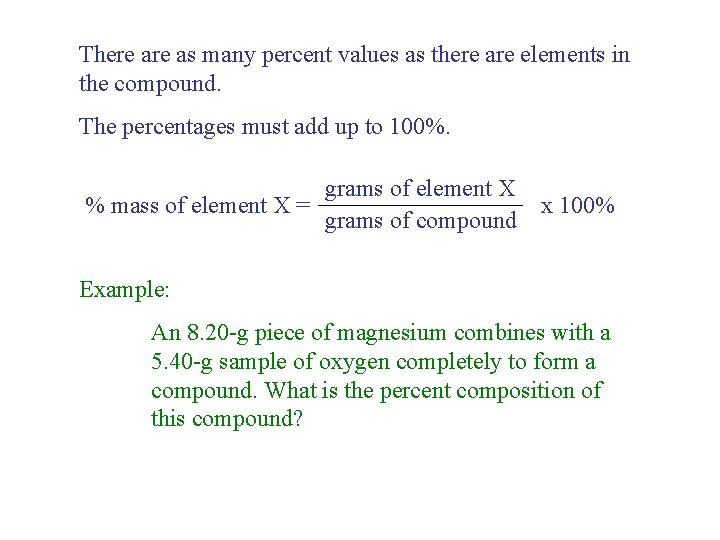
There as many percent values as there are elements in the compound. The percentages must add up to 100%. grams of element X % mass of element X = grams of compound x 100% Example: An 8. 20 -g piece of magnesium combines with a 5. 40 -g sample of oxygen completely to form a compound. What is the percent composition of this compound?
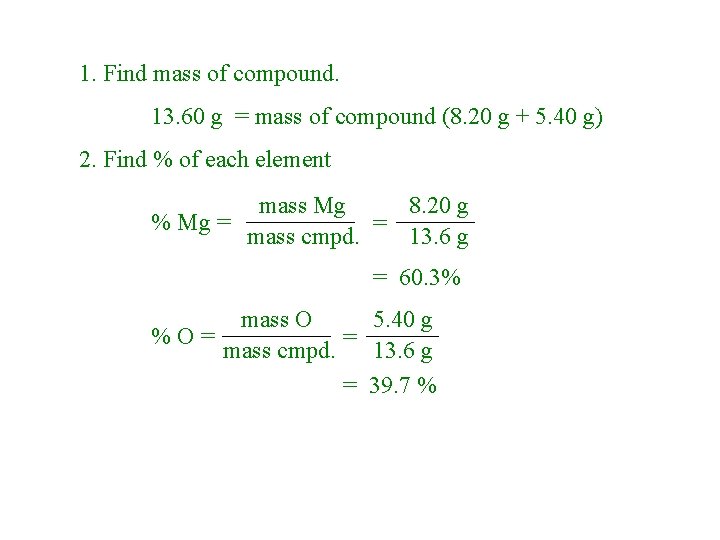
1. Find mass of compound. 13. 60 g = mass of compound (8. 20 g + 5. 40 g) 2. Find % of each element mass Mg 8. 20 g % Mg = = mass cmpd. 13. 6 g = 60. 3% mass O 5. 40 g %O= = mass cmpd. 13. 6 g = 39. 7 %
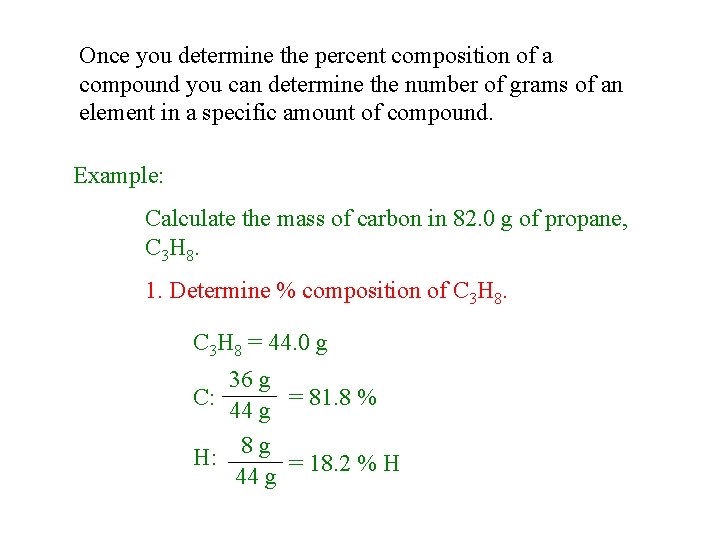
Once you determine the percent composition of a compound you can determine the number of grams of an element in a specific amount of compound. Example: Calculate the mass of carbon in 82. 0 g of propane, C 3 H 8. 1. Determine % composition of C 3 H 8 = 44. 0 g 36 g = 81. 8 % C: 44 g H: 8 g = 18. 2 % H 44 g
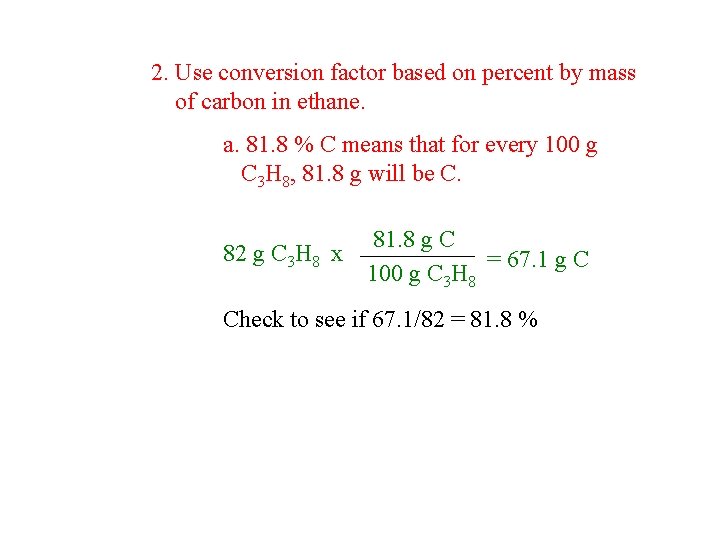
2. Use conversion factor based on percent by mass of carbon in ethane. a. 81. 8 % C means that for every 100 g C 3 H 8, 81. 8 g will be C. 82 g C 3 H 8 x 81. 8 g C = 67. 1 g C 100 g C 3 H 8 Check to see if 67. 1/82 = 81. 8 %
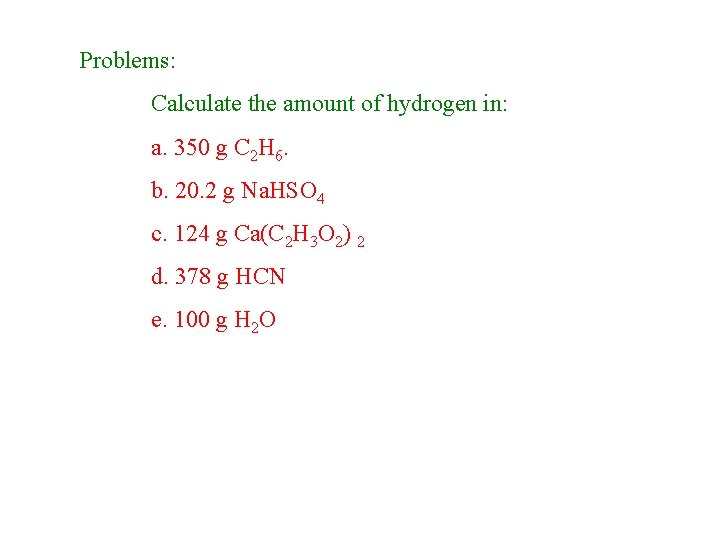
Problems: Calculate the amount of hydrogen in: a. 350 g C 2 H 6. b. 20. 2 g Na. HSO 4 c. 124 g Ca(C 2 H 3 O 2) 2 d. 378 g HCN e. 100 g H 2 O
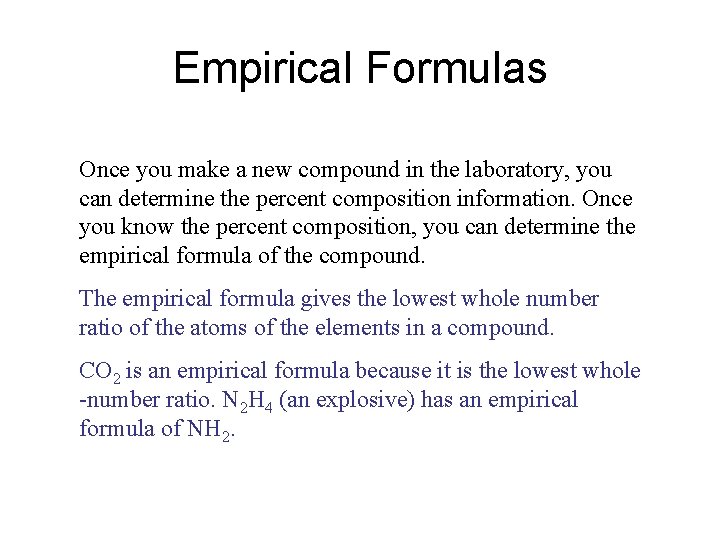
Empirical Formulas Once you make a new compound in the laboratory, you can determine the percent composition information. Once you know the percent composition, you can determine the empirical formula of the compound. The empirical formula gives the lowest whole number ratio of the atoms of the elements in a compound. CO 2 is an empirical formula because it is the lowest whole -number ratio. N 2 H 4 (an explosive) has an empirical formula of NH 2.
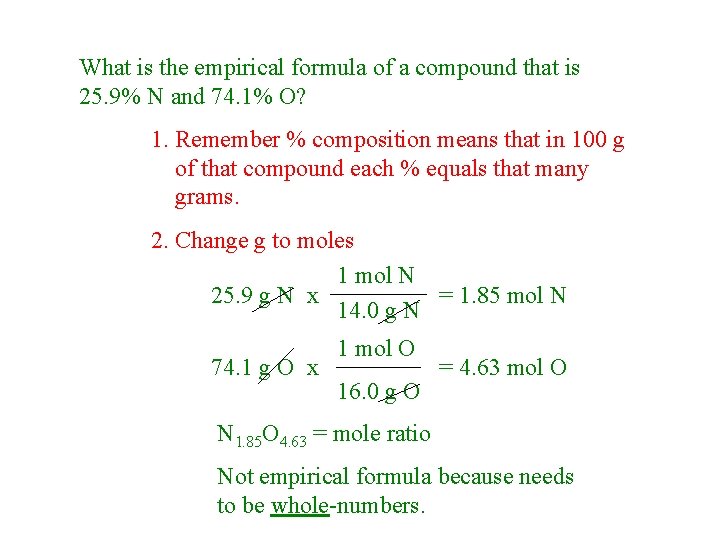
What is the empirical formula of a compound that is 25. 9% N and 74. 1% O? 1. Remember % composition means that in 100 g of that compound each % equals that many grams. 2. Change g to moles 1 mol N 25. 9 g N x = 1. 85 mol N 14. 0 g N 74. 1 g O x 1 mol O 16. 0 g O = 4. 63 mol O N 1. 85 O 4. 63 = mole ratio Not empirical formula because needs to be whole-numbers.
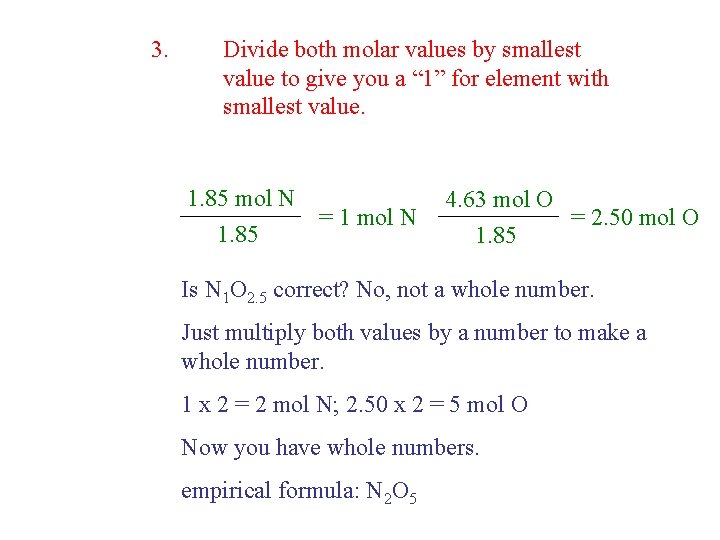
3. Divide both molar values by smallest value to give you a “ 1” for element with smallest value. 1. 85 mol N 1. 85 = 1 mol N 4. 63 mol O 1. 85 = 2. 50 mol O Is N 1 O 2. 5 correct? No, not a whole number. Just multiply both values by a number to make a whole number. 1 x 2 = 2 mol N; 2. 50 x 2 = 5 mol O Now you have whole numbers. empirical formula: N 2 O 5
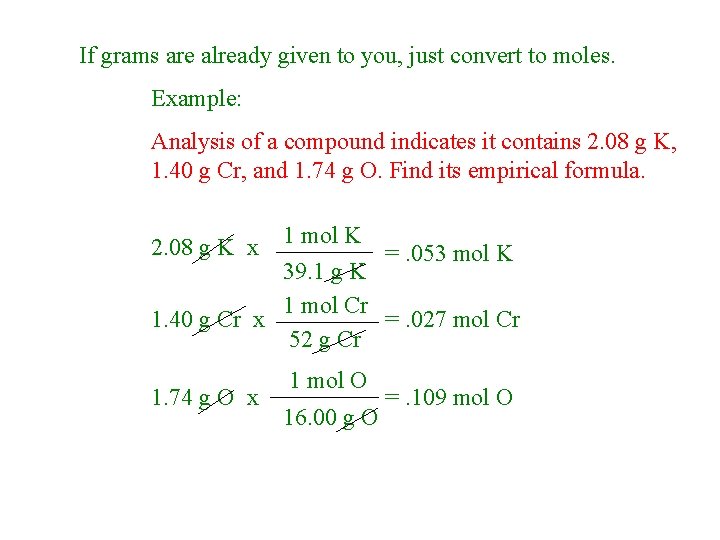
If grams are already given to you, just convert to moles. Example: Analysis of a compound indicates it contains 2. 08 g K, 1. 40 g Cr, and 1. 74 g O. Find its empirical formula. 2. 08 g K x 1 mol K =. 053 mol K 39. 1 g K 1 mol Cr 1. 40 g Cr x =. 027 mol Cr 52 g Cr 1. 74 g O x 1 mol O 16. 00 g O =. 109 mol O
Then divide by smallest mole number to get mole ratio. Multiply if you need to.
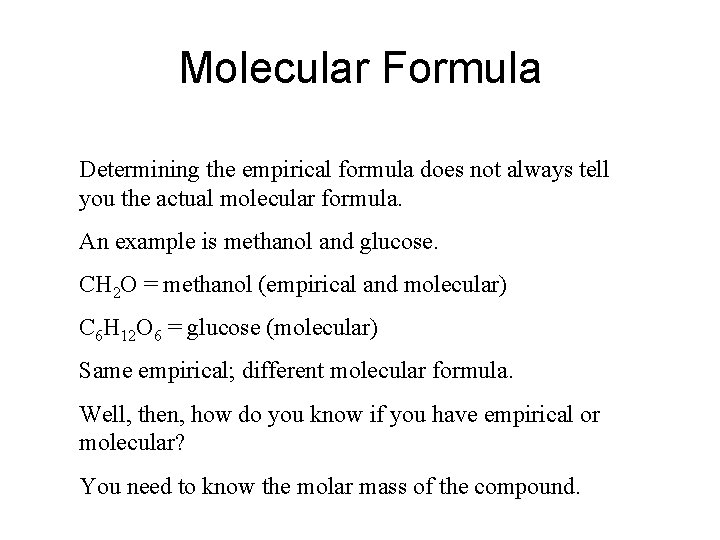
Molecular Formula Determining the empirical formula does not always tell you the actual molecular formula. An example is methanol and glucose. CH 2 O = methanol (empirical and molecular) C 6 H 12 O 6 = glucose (molecular) Same empirical; different molecular formula. Well, then, how do you know if you have empirical or molecular? You need to know the molar mass of the compound.
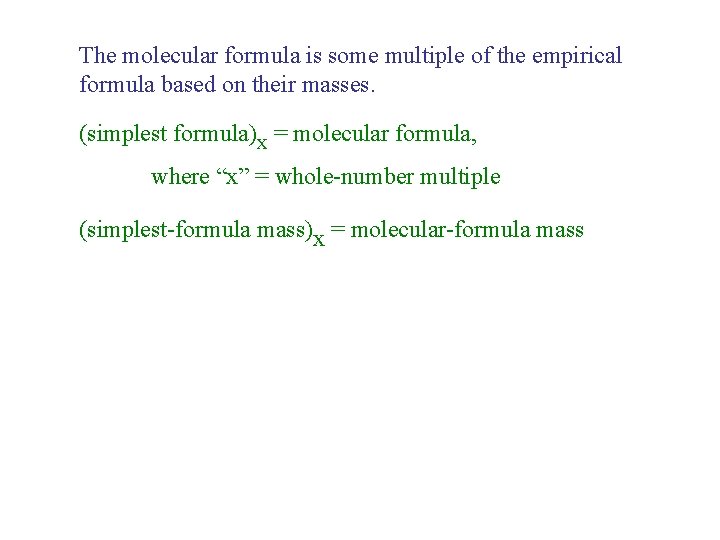
The molecular formula is some multiple of the empirical formula based on their masses. (simplest formula)x = molecular formula, where “x” = whole-number multiple (simplest-formula mass)x = molecular-formula mass
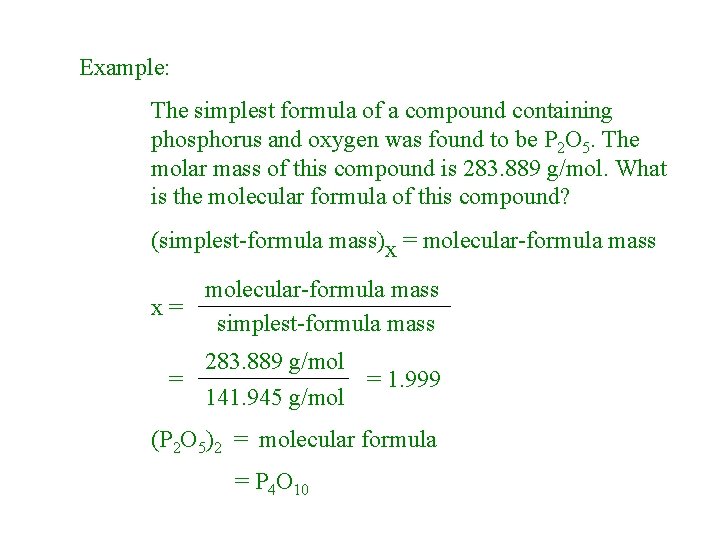
Example: The simplest formula of a compound containing phosphorus and oxygen was found to be P 2 O 5. The molar mass of this compound is 283. 889 g/mol. What is the molecular formula of this compound? (simplest-formula mass)x = molecular-formula mass x= simplest-formula mass = 283. 889 g/mol 141. 945 g/mol = 1. 999 (P 2 O 5)2 = molecular formula = P 4 O 10