
The Mole 23 6 02 X 10 Table
The Mole 23 6. 02 X 10
Table of Contents • • The Molar Mass Percent Composition Formulas Slides 3 - 8 Slides 9 - 23 Slides 24 – 27 Slides 28 - 36
The Mole C. 8. A DEFINE AND USE THE CONCEPT OF A MOLE
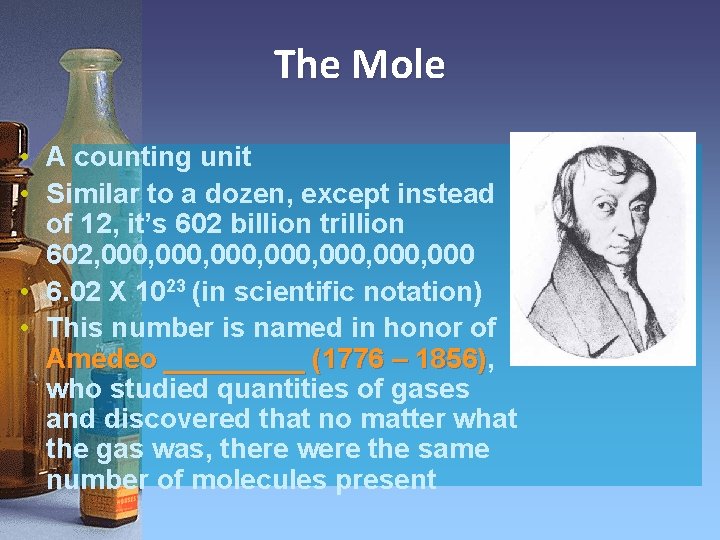
The Mole • A counting unit • Similar to a dozen, except instead of 12, it’s 602 billion trillion 602, 000, 000, 000 • 6. 02 X 1023 (in scientific notation) • This number is named in honor of Amedeo _____ (1776 – 1856), 1856) who studied quantities of gases and discovered that no matter what the gas was, there were the same number of molecules present
The Mole • 1 dozen cookies = 12 cookies • 1 mole of cookies = 6. 02 X 1023 cookies • 1 dozen cars = 12 cars • 1 mole of cars = 6. 02 X 1023 cars • 1 dozen Al atoms = 12 Al atoms • 1 mole of Al atoms = 6. 02 X 1023 atoms Note that the NUMBER is always the same, but the MASS is very different! Mole is abbreviated mol (gee, that’s a lot quicker to write, huh? )
Check your knowledge Suppose we invented a new collection unit called a rapp. One rapp contains 8 objects. 1. How many paper clips in 1 rapp? a) 1 b) 4 c) 8 2. How many oranges in 2. 0 rapp? a) 4 b) 8 c) 16 3. How many rapps contain 40 gummy bears? a) 5 b) 10 c) 20
A Mole of Particles Contains 6. 02 x 1023 particles 1 mole C = 6. 02 x 1023 C atoms 1 mole H 2 O = 6. 02 x 1023 H 2 O molecules 1 mole Na. Cl = 6. 02 x 1023 Na. Cl “molecules” (technically, ionics are compounds not molecules so they are called formula units) 6. 02 x 1023 Na+ ions and 6. 02 x 1023 Cl– ions
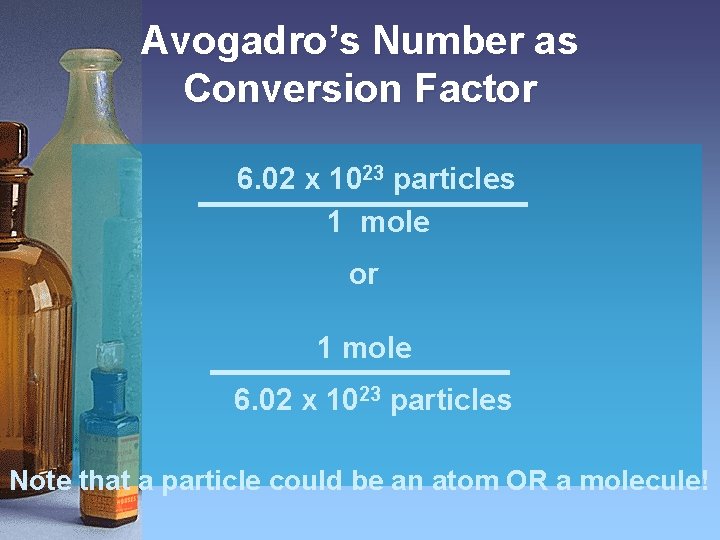
Avogadro’s Number as Conversion Factor 6. 02 x 1023 particles 1 mole or 1 mole 6. 02 x 1023 particles Note that a particle could be an atom OR a molecule!
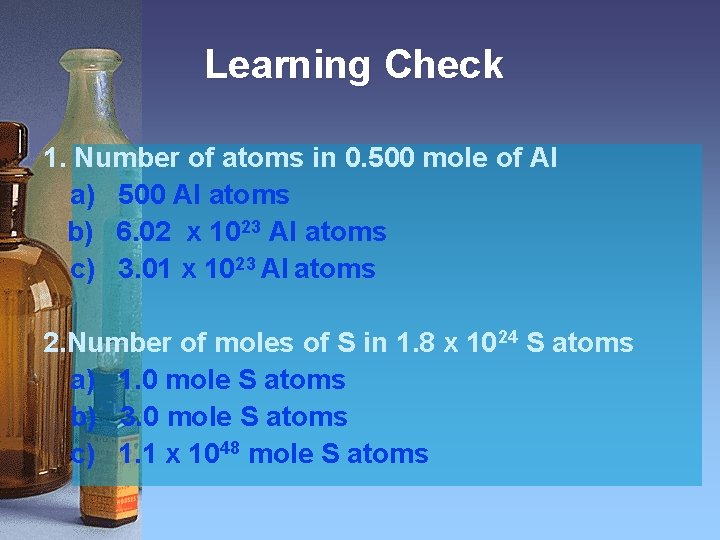
Learning Check 1. Number of atoms in 0. 500 mole of Al a) 500 Al atoms b) 6. 02 x 1023 Al atoms c) 3. 01 x 1023 Al atoms 2. Number of moles of S in 1. 8 x 1024 S atoms a) 1. 0 mole S atoms b) 3. 0 mole S atoms c) 1. 1 x 1048 mole S atoms
Molar Mass
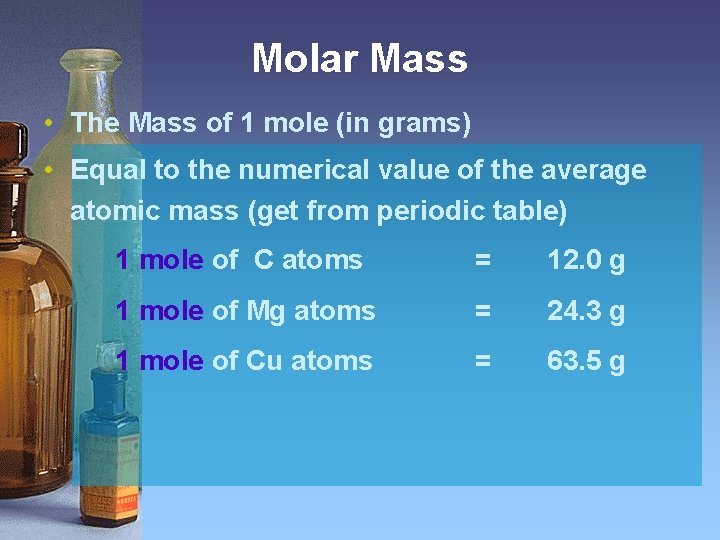
Molar Mass • The Mass of 1 mole (in grams) • Equal to the numerical value of the average atomic mass (get from periodic table) 1 mole of C atoms = 12. 0 g 1 mole of Mg atoms = 24. 3 g 1 mole of Cu atoms = 63. 5 g
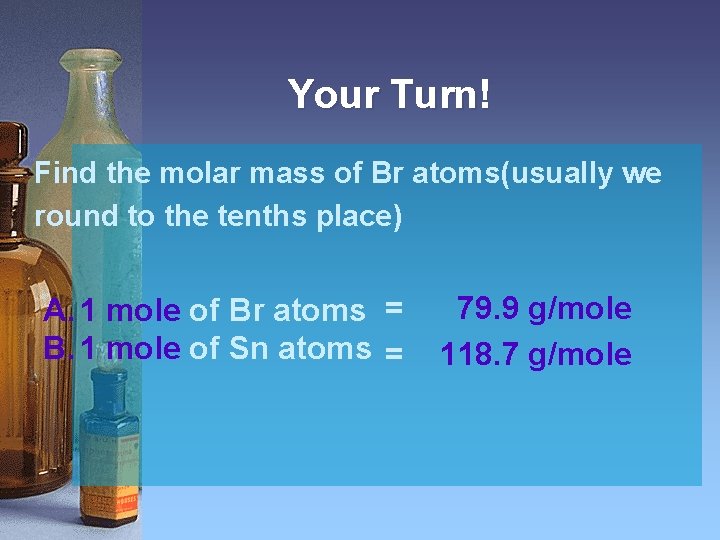
Your Turn! Find the molar mass of Br atoms(usually we round to the tenths place) A. 1 mole of Br atoms = B. 1 mole of Sn atoms = 79. 9 g/mole 118. 7 g/mole

Molar Mass of Molecules and Compounds Mass in grams of 1 mole equal numerically to the sum of the atomic masses 1 mole of Ca. Cl 2 = 110. 9 g/mol 1 mole Ca x 40. 1 g/mol = 40. 1 g/mol + 2 moles Cl x 35. 5 g/mol 1 mole of N 2 O 4 = 96. 0 g/mol = 70. 8 g/mol Ca. Cl 2
Find! A. Molar Mass of K 2 O = ? Grams/mole B. Molar Mass of antacid Al(OH)3 = ? Grams/mole
Real life Connection Prozac, C 17 H 18 F 3 NO, is a widely used antidepressant that inhibits the uptake of serotonin by the brain. Find its molar mass.
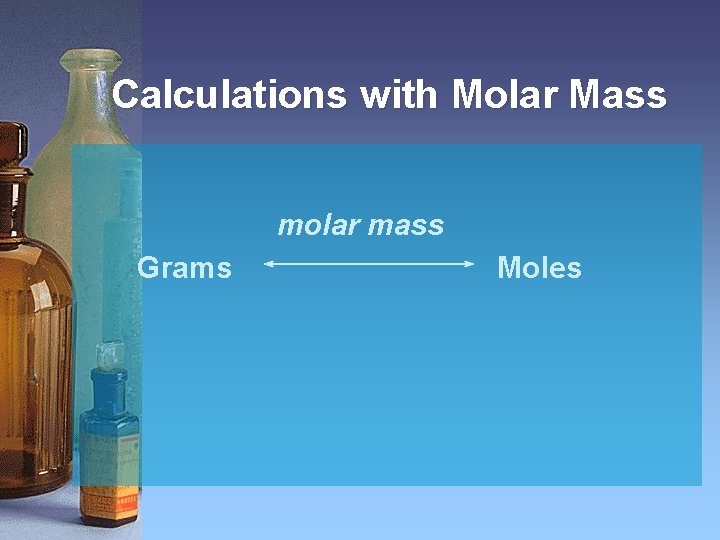
Calculations with Molar Mass molar mass Grams Moles
Converting Moles and Grams Aluminum is often used for the structure of light-weight bicycle frames. How many grams of Al are in 3. 00 moles of Al? 3. 00 moles Al ? g Al
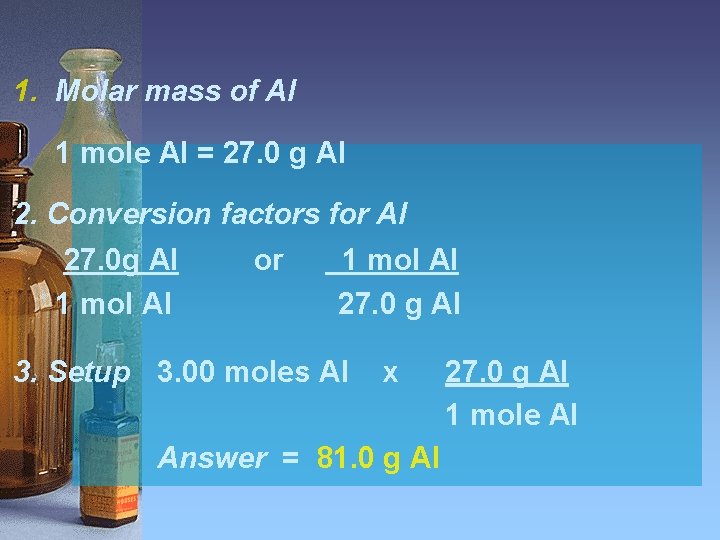
1. Molar mass of Al 1 mole Al = 27. 0 g Al 2. Conversion factors for Al 27. 0 g Al 1 mol Al or 1 mol Al 27. 0 g Al 3. Setup 3. 00 moles Al x Answer = 81. 0 g Al 27. 0 g Al 1 mole Al
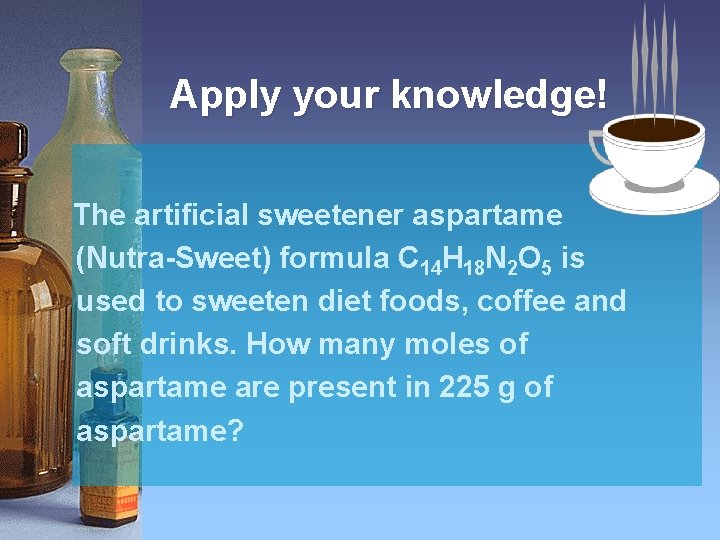
Apply your knowledge! The artificial sweetener aspartame (Nutra-Sweet) formula C 14 H 18 N 2 O 5 is used to sweeten diet foods, coffee and soft drinks. How many moles of aspartame are present in 225 g of aspartame?
Atoms, Molecules and Grams C. 8. B USE THE MOLE CONCEPT TO CALCULATE THE NUMBER OF ATOMS, IONS, OR MOLECULES IN A SAMPLE OF . MATERIAL
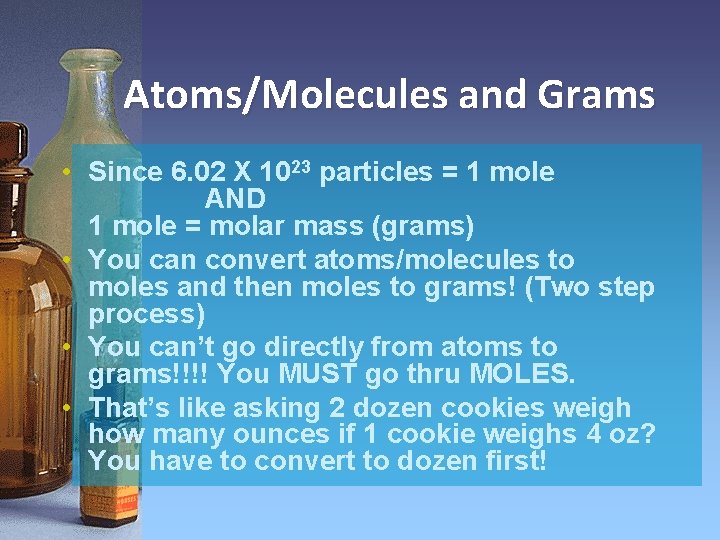
Atoms/Molecules and Grams • Since 6. 02 X 1023 particles = 1 mole AND 1 mole = molar mass (grams) • You can convert atoms/molecules to moles and then moles to grams! (Two step process) • You can’t go directly from atoms to grams!!!! You MUST go thru MOLES. • That’s like asking 2 dozen cookies weigh how many ounces if 1 cookie weighs 4 oz? You have to convert to dozen first!
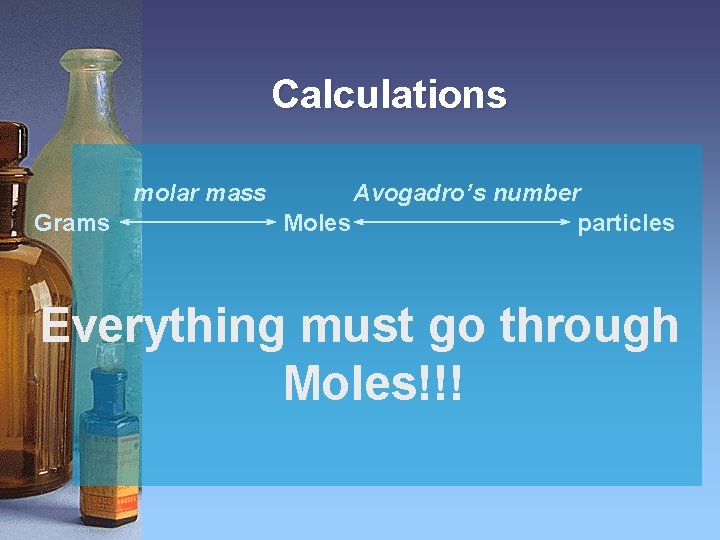
Calculations molar mass Grams Avogadro’s number Moles particles Everything must go through Moles!!!
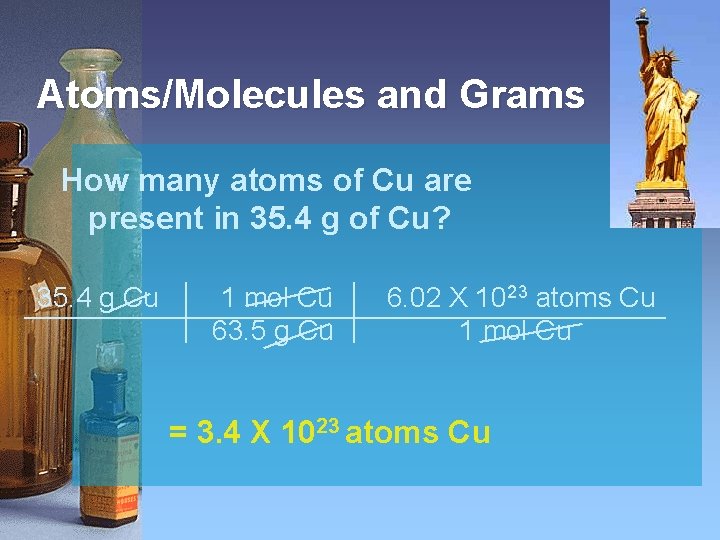
Atoms/Molecules and Grams How many atoms of Cu are present in 35. 4 g of Cu? 35. 4 g Cu 1 mol Cu 63. 5 g Cu 6. 02 X 1023 atoms Cu 1 mol Cu = 3. 4 X 10²³ atoms Cu
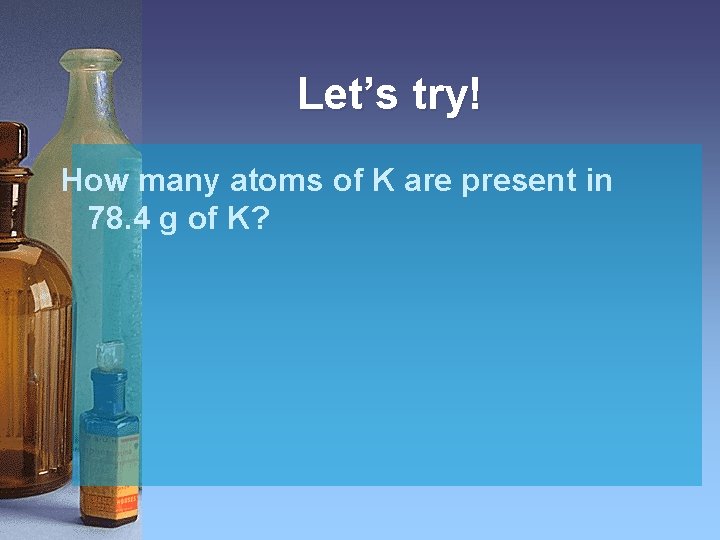
Let’s try! How many atoms of K are present in 78. 4 g of K?
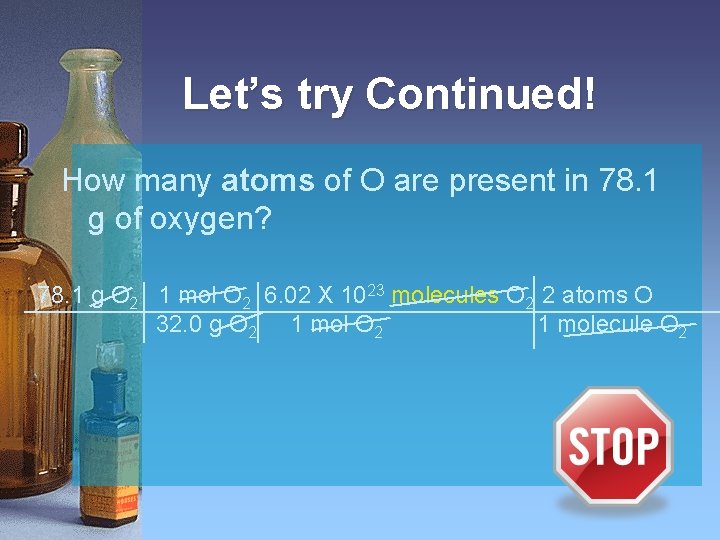
Let’s try Continued! How many atoms of O are present in 78. 1 g of oxygen? 78. 1 g O 2 1 mol O 2 6. 02 X 1023 molecules O 2 2 atoms O 32. 0 g O 2 1 molecule O 2
Percent Composition C. 8. C Calculate percent composition and empirical and molecular formulas.
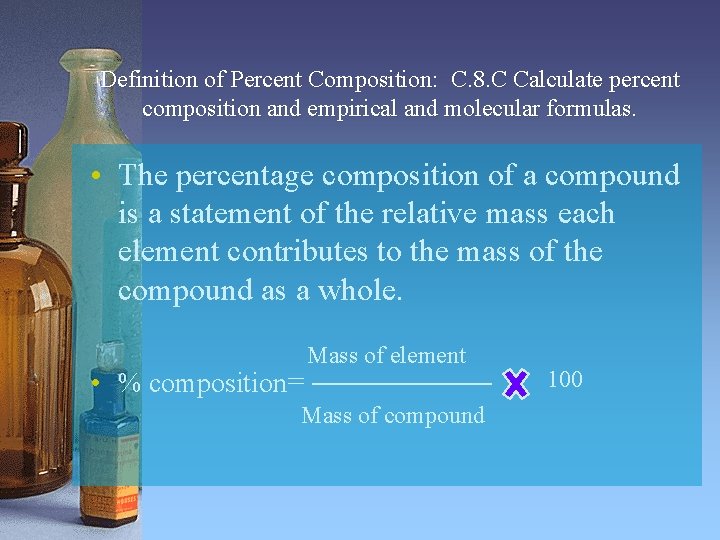
Definition of Percent Composition: C. 8. C Calculate percent composition and empirical and molecular formulas. • The percentage composition of a compound is a statement of the relative mass each element contributes to the mass of the compound as a whole. • % composition= Mass of element Mass of compound 100
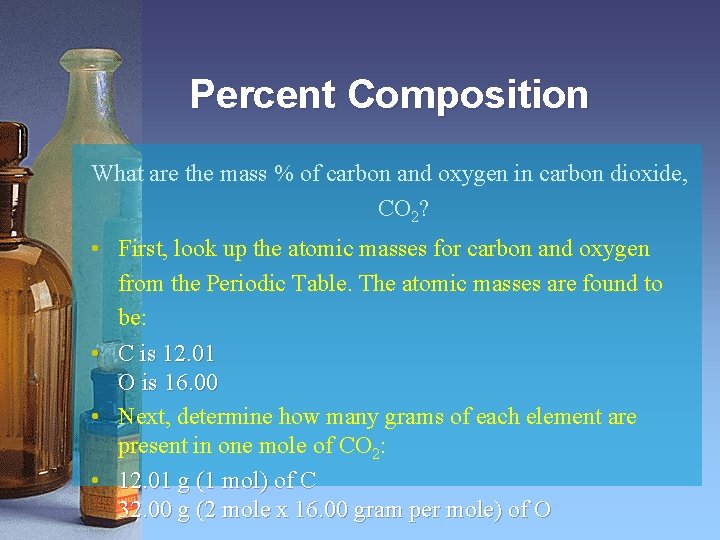
Percent Composition What are the mass % of carbon and oxygen in carbon dioxide, CO 2? • First, look up the atomic masses for carbon and oxygen from the Periodic Table. The atomic masses are found to be: • C is 12. 01 O is 16. 00 • Next, determine how many grams of each element are present in one mole of CO 2: • 12. 01 g (1 mol) of C 32. 00 g (2 mole x 16. 00 gram per mole) of O
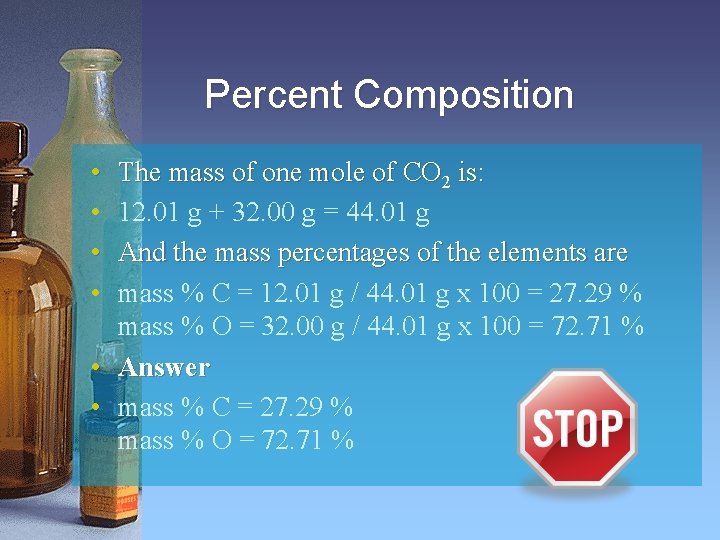
Percent Composition • • The mass of one mole of CO 2 is: 12. 01 g + 32. 00 g = 44. 01 g And the mass percentages of the elements are mass % C = 12. 01 g / 44. 01 g x 100 = 27. 29 % mass % O = 32. 00 g / 44. 01 g x 100 = 72. 71 % • Answer • mass % C = 27. 29 % mass % O = 72. 71 %
Formulas Empirical Ionic Molecular
Formulas C. 8. C CALCULATE PERCENT COMPOSITION AND EMPIRICAL AND MOLECULAR FORMULAS
Chemical Formulas of Compounds • Formulas give the relative numbers of atoms or moles of each element in a formula unit - always a whole number ratio (the law of definite proportions). NO 2 2 atoms of O for every 1 atom of N 1 mole of NO 2 : 2 moles of O atoms to every 1 mole of N atoms • If we know or can determine the relative number of moles of each element in a compound, we can determine a formula for the compound.
Types of Formulas • Empirical Formula The formula of a compound that expresses the smallest whole number ratio of the atoms present. Ionic formula are always empirical formula • Molecular Formula The formula that states the actual number of each kind of atom found in one molecule of the compound.
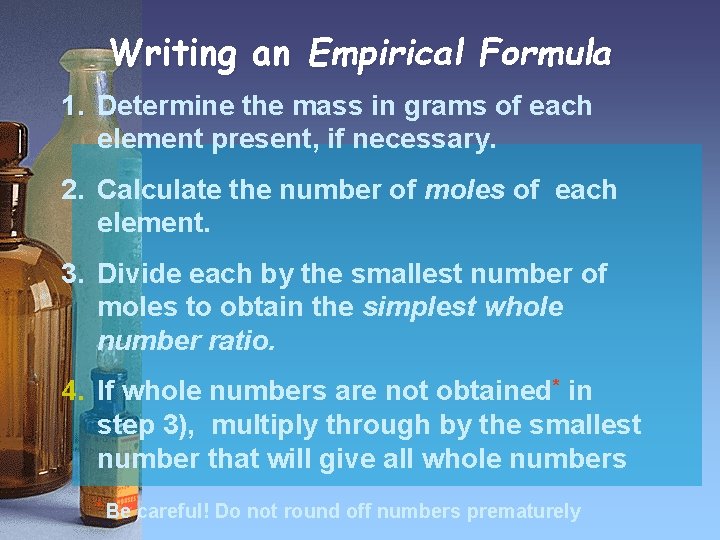
Writing an Empirical Formula 1. Determine the mass in grams of each element present, if necessary. 2. Calculate the number of moles of each element. 3. Divide each by the smallest number of moles to obtain the simplest whole number ratio. 4. If whole numbers are not obtained* in step 3), multiply through by the smallest number that will give all whole numbers * Be careful! Do not round off numbers prematurely
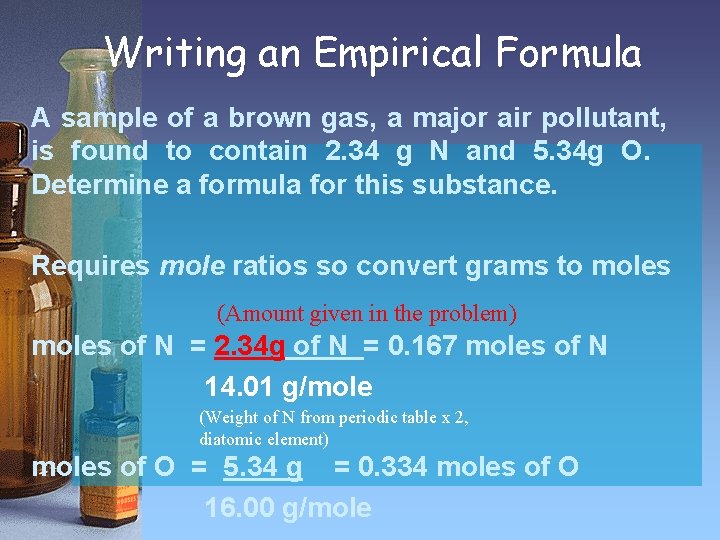
Writing an Empirical Formula A sample of a brown gas, a major air pollutant, is found to contain 2. 34 g N and 5. 34 g O. Determine a formula for this substance. Requires mole ratios so convert grams to moles (Amount given in the problem) moles of N = 2. 34 g of N = 0. 167 moles of N 14. 01 g/mole (Weight of N from periodic table x 2, diatomic element) moles of O = 5. 34 g = 0. 334 moles of O 16. 00 g/mole
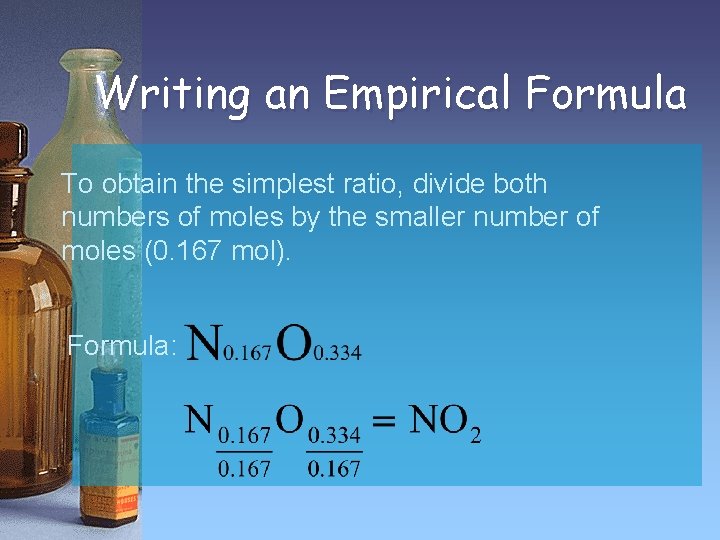
Writing an Empirical Formula To obtain the simplest ratio, divide both numbers of moles by the smaller number of moles (0. 167 mol). Formula:
Molecular Formula • Definition: a chemical formula based on analysis and molecular weight
Molecular Formula • What is the molecular formula of a substance that has an empirical formula of Ag. CO 2 and a formula mass of 304? • The formula mass of the empirical unit, Ag. CO 2, is 152. If we divide the formula mass 304 by 152, we get 2. Therefore, the molecular formula must be 2 times the empirical formula, or Ag 2 C 2 O 4.
Empirical Formula from % Composition A substance has the following composition by mass: 60. 80 % Na ; 28. 60 % B ; 10. 60 % H What is the empirical formula of the substance? Consider a sample size of 100 grams This will contain 28. 60 grams of B and 10. 60 grams H Determine the number of moles of each Determine the simplest whole number ratio
Stoichiometry C. 8. E Perform stoichiometric calculations, including determination of mass relationships between reactants and products, calculation of limiting reagents, and percent yield
Table of Contents • Slides 39 - 50 Stoichiometry • Slides 51 - 57 Limiting Reagent • Slides 58 - 62 Percent Yield
Definition of Stoichiometry is: Calculations of quantities of substances involved in chemical reactions
What you need to know 1. How to balance an equation. 2. How to find molecular masses. 3. How to set up conversions.
Steps for solving mass-mass problems 1. Write and balance the chemical equation. 2. Set up the mole equivalency using the balanced equation. 3. Find the molecular mass for the Given and for the substance Asked For. 4. Set up the conversion T-bar.
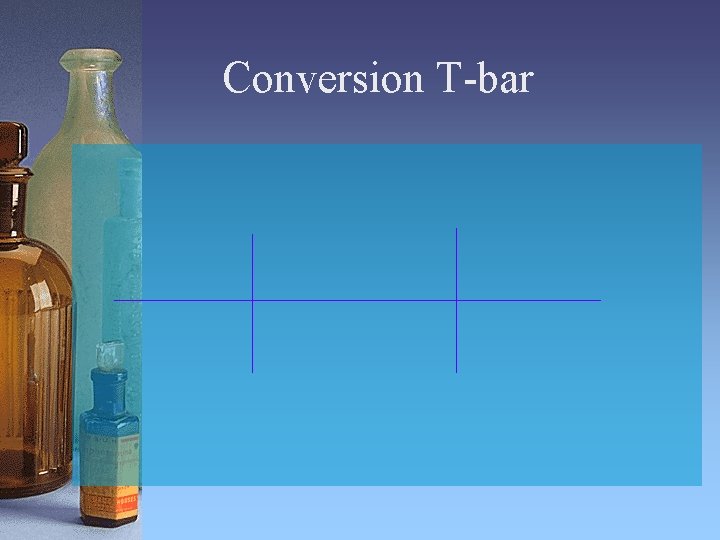
Conversion T-bar
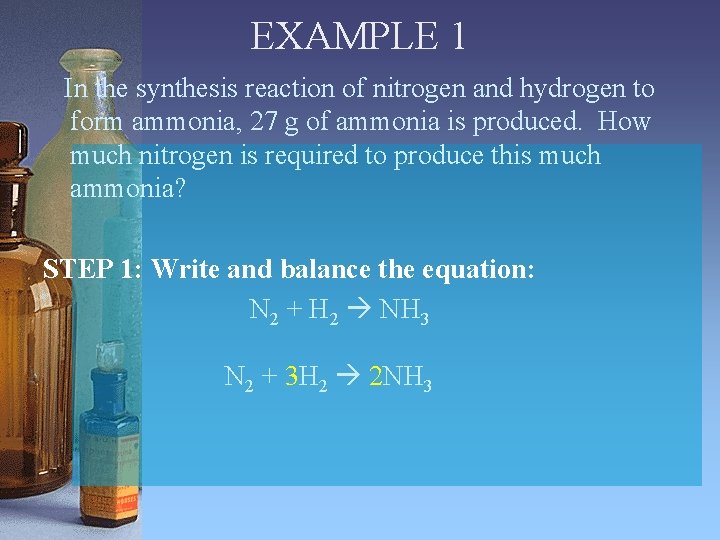
EXAMPLE 1 In the synthesis reaction of nitrogen and hydrogen to form ammonia, 27 g of ammonia is produced. How much nitrogen is required to produce this much ammonia? STEP 1: Write and balance the equation: N 2 + H 2 NH 3 N 2 + 3 H 2 2 NH 3
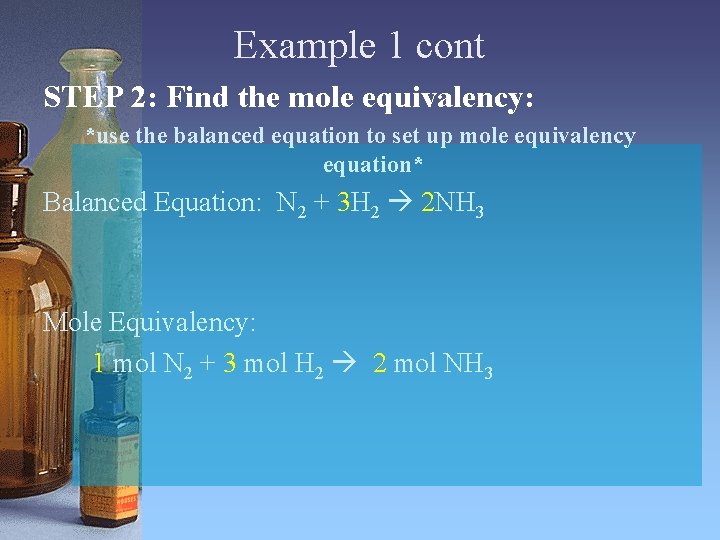
Example 1 cont STEP 2: Find the mole equivalency: *use the balanced equation to set up mole equivalency equation* Balanced Equation: N 2 + 3 H 2 2 NH 3 Mole Equivalency: 1 mol N 2 + 3 mol H 2 2 mol NH 3
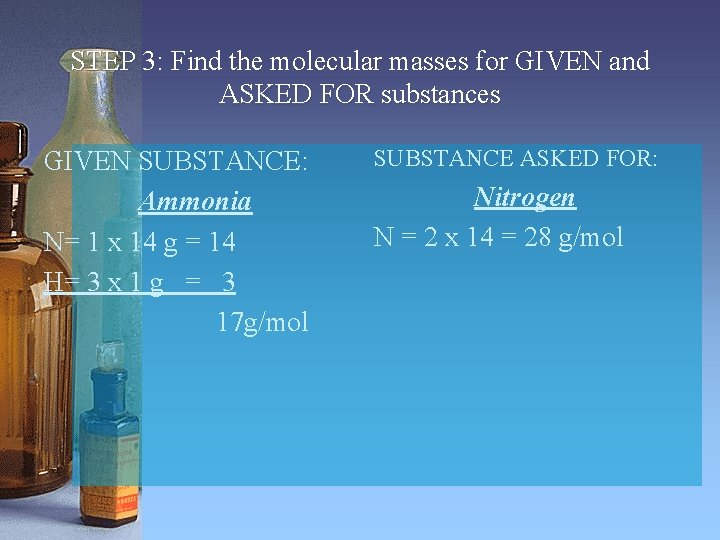
STEP 3: Find the molecular masses for GIVEN and ASKED FOR substances GIVEN SUBSTANCE: Ammonia N= 1 x 14 g = 14 H= 3 x 1 g = 3 17 g/mol SUBSTANCE ASKED FOR: Nitrogen N = 2 x 14 = 28 g/mol
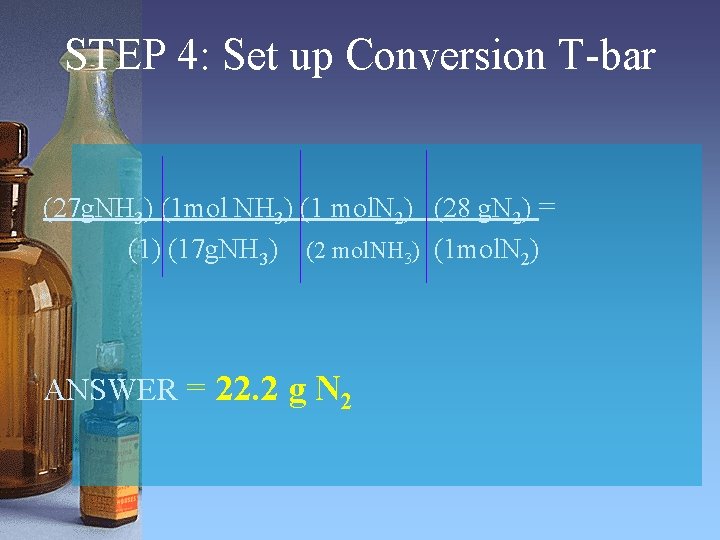
STEP 4: Set up Conversion T-bar (27 g. NH 3) (1 mol NH 3) (1 mol. N 2) (28 g. N 2) = (1) (17 g. NH 3) (2 mol. NH 3) (1 mol. N 2) ANSWER = 22. 2 g N 2
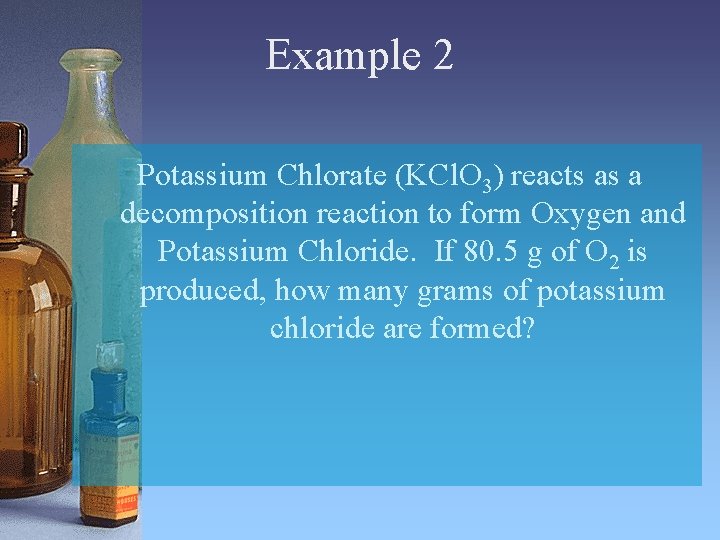
Example 2 Potassium Chlorate (KCl. O 3) reacts as a decomposition reaction to form Oxygen and Potassium Chloride. If 80. 5 g of O 2 is produced, how many grams of potassium chloride are formed?
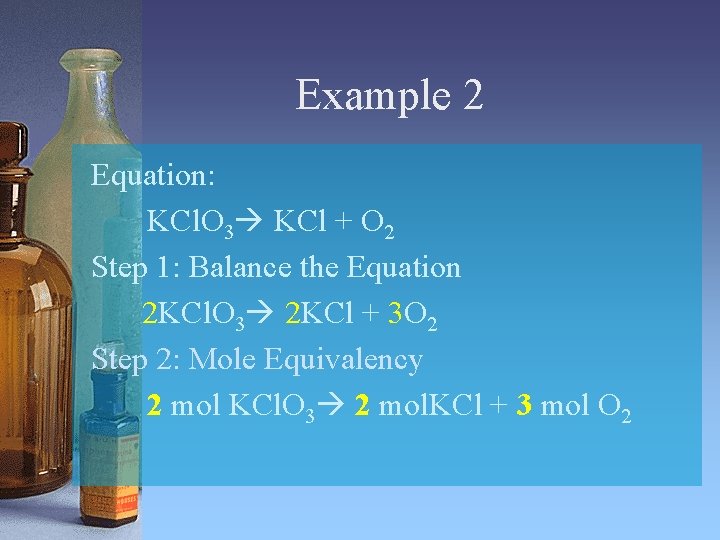
Example 2 Equation: KCl. O 3 KCl + O 2 Step 1: Balance the Equation 2 KCl. O 3 2 KCl + 3 O 2 Step 2: Mole Equivalency 2 mol KCl. O 3 2 mol. KCl + 3 mol O 2
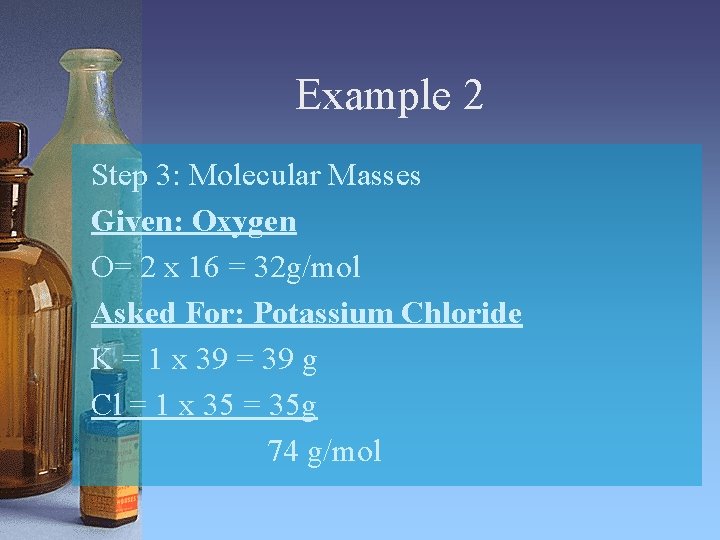
Example 2 Step 3: Molecular Masses Given: Oxygen O= 2 x 16 = 32 g/mol Asked For: Potassium Chloride K = 1 x 39 = 39 g Cl = 1 x 35 = 35 g 74 g/mol
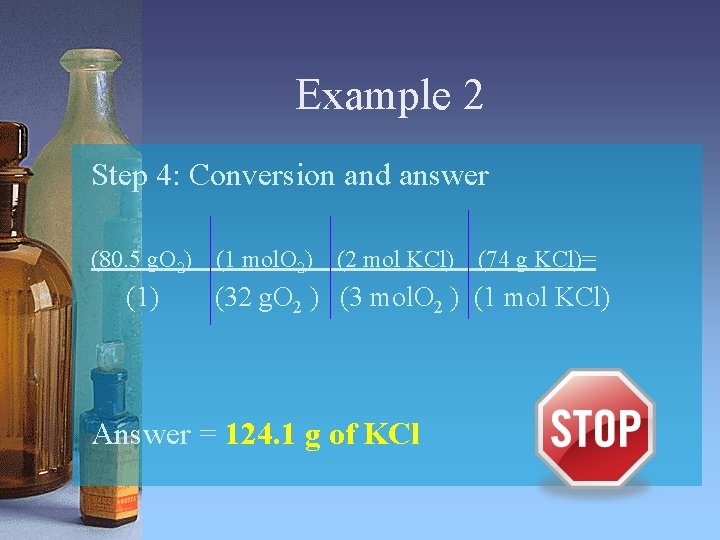
Example 2 Step 4: Conversion and answer (80. 5 g. O 2) (1 mol. O 2) (2 mol KCl) (74 g KCl)= (32 g. O 2 ) (3 mol. O 2 ) (1 mol KCl) Answer = 124. 1 g of KCl
Limiting Reagents C. 8. E Perform stoichiometric calculations, including determination of mass relationships between reactants and products, calculation of limiting reagents, and percent yield
What is limiting reagent? • Limiting reagent is the reactant that is consumed completely in a chemical reaction.
Calculate • How many grams of CO 2 are formed if 10. 0 g of carbon are burned in 20. 0 dm 3 of oxygen? (Assume STP)
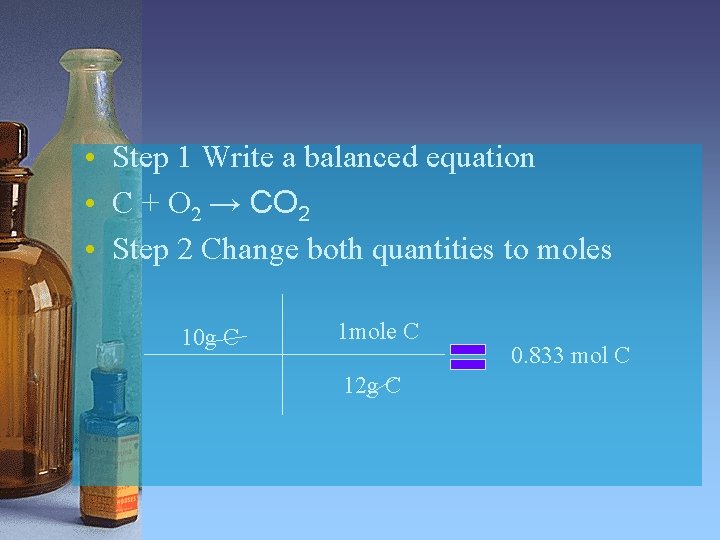
• Step 1 Write a balanced equation • C + O 2 → CO 2 • Step 2 Change both quantities to moles 10 g C 1 mole C 12 g C 0. 833 mol C
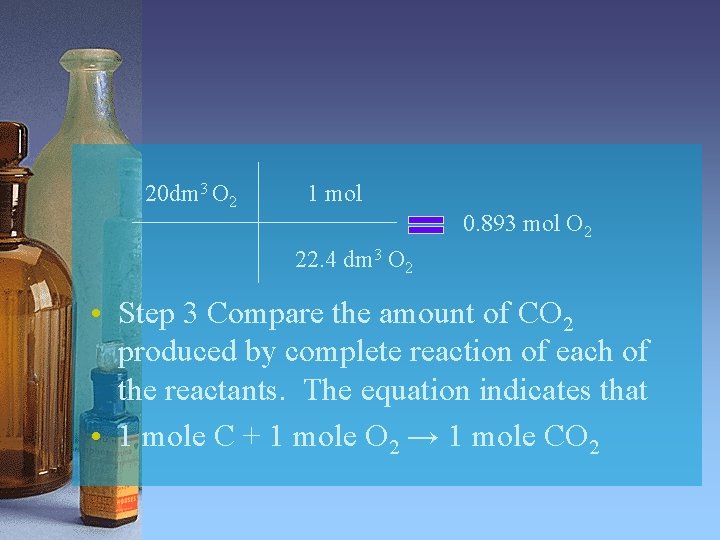
20 dm 3 O 2 1 mol 0. 893 mol O 2 22. 4 dm 3 O 2 • Step 3 Compare the amount of CO 2 produced by complete reaction of each of the reactants. The equation indicates that • 1 mole C + 1 mole O 2 → 1 mole CO 2
• Therefore, 0. 833 mol C would produce 0. 833 mol CO 2 and 0. 893 mol O 2 would produce 0. 893 mol CO 2. Because carbon would produce fewer moles of carbon dioxide, the carbon limits the reaction. Some oxygen (0. 060 mole) is left unreacted. We call carbon the limiting reactant.
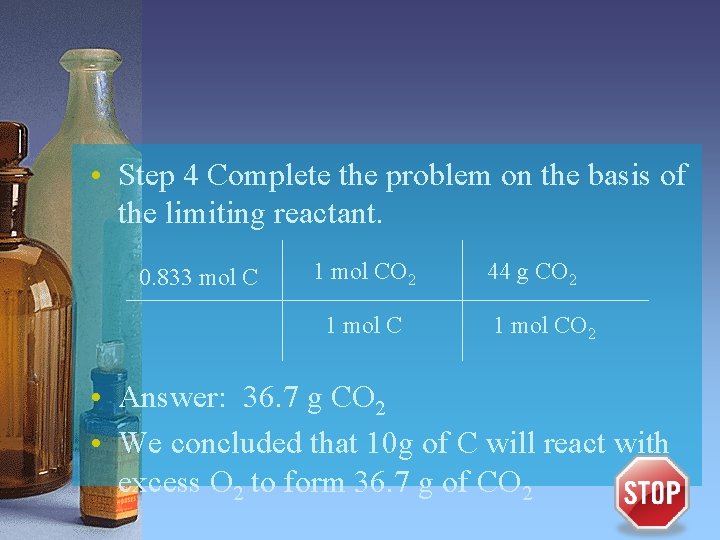
• Step 4 Complete the problem on the basis of the limiting reactant. 0. 833 mol C 1 mol CO 2 1 mol C 44 g CO 2 1 mol CO 2 • Answer: 36. 7 g CO 2 • We concluded that 10 g of C will react with excess O 2 to form 36. 7 g of CO 2
Percent Yield C. 8. E Perform stoichiometric calculations, including determination of mass relationships between reactants and products, calculation of limiting reagents, and percent yield
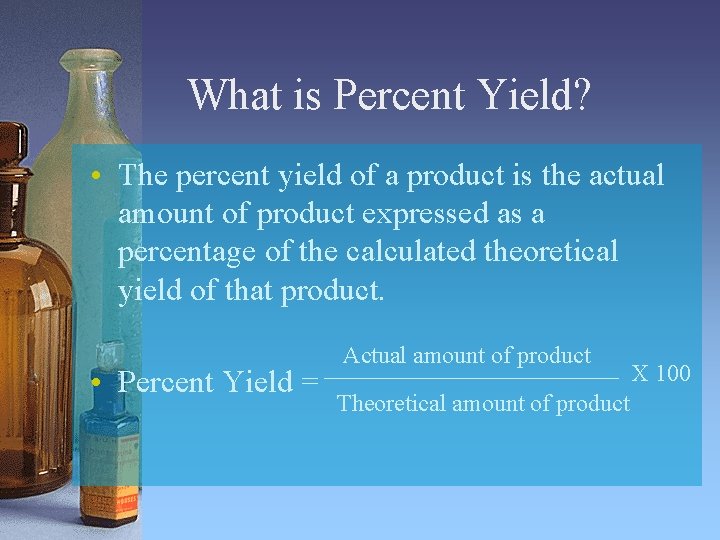
What is Percent Yield? • The percent yield of a product is the actual amount of product expressed as a percentage of the calculated theoretical yield of that product. • Percent Yield = Actual amount of product Theoretical amount of product X 100
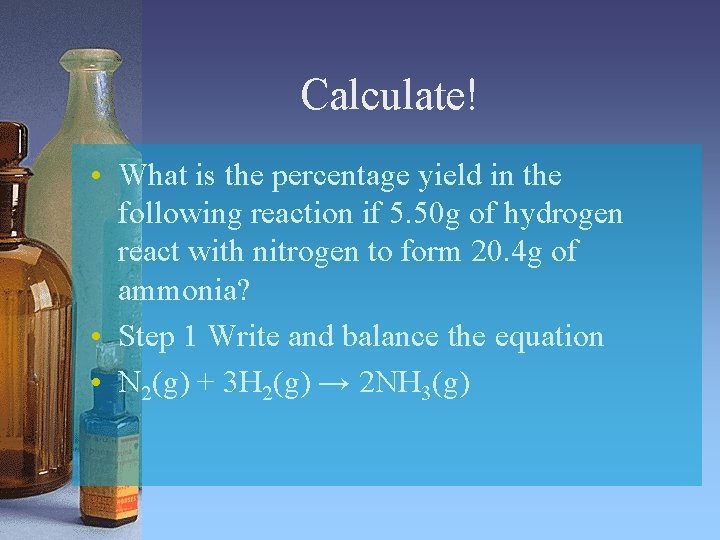
Calculate! • What is the percentage yield in the following reaction if 5. 50 g of hydrogen react with nitrogen to form 20. 4 g of ammonia? • Step 1 Write and balance the equation • N 2(g) + 3 H 2(g) → 2 NH 3(g)
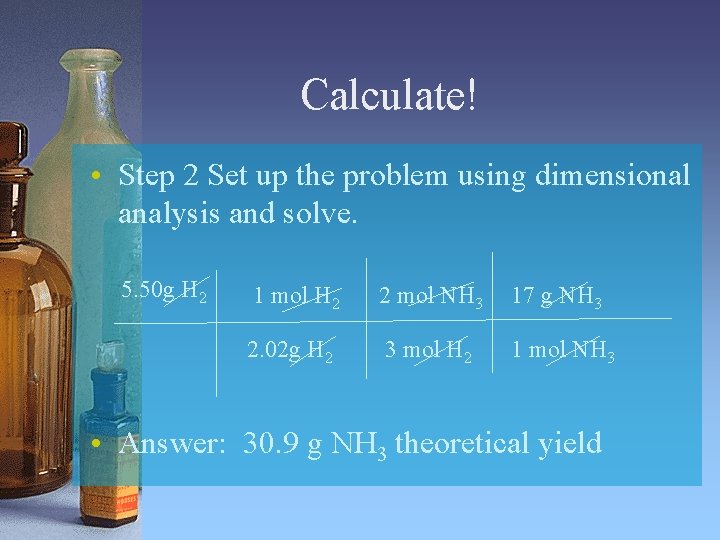
Calculate! • Step 2 Set up the problem using dimensional analysis and solve. 5. 50 g H 2 1 mol H 2 2 mol NH 3 17 g NH 3 2. 02 g H 2 3 mol H 2 1 mol NH 3 • Answer: 30. 9 g NH 3 theoretical yield
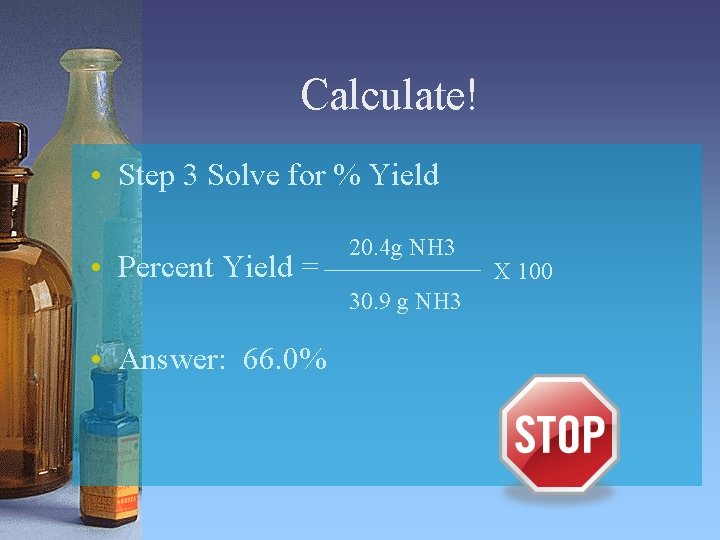
Calculate! • Step 3 Solve for % Yield • Percent Yield = 20. 4 g NH 3 30. 9 g NH 3 • Answer: 66. 0% X 100
- Slides: 65