
The MOGUL Project MODULAR COGNITION FRAMEWORK PART 4
- Slides: 17
The MOGUL Project MODULAR COGNITION FRAMEWORK PART 4 (MCF) THE AFFECTIVE SYSTEM
This third introductory presentation provides a basic guide to the way the affective system influences every aspect of our behaviour
Appraisal � Most if not all cognitive representations are affected by the mind’s assessment of their current value. � Values may be NEGATIVE or POSITIVE � Their negative or positive value can also vary in intensity.
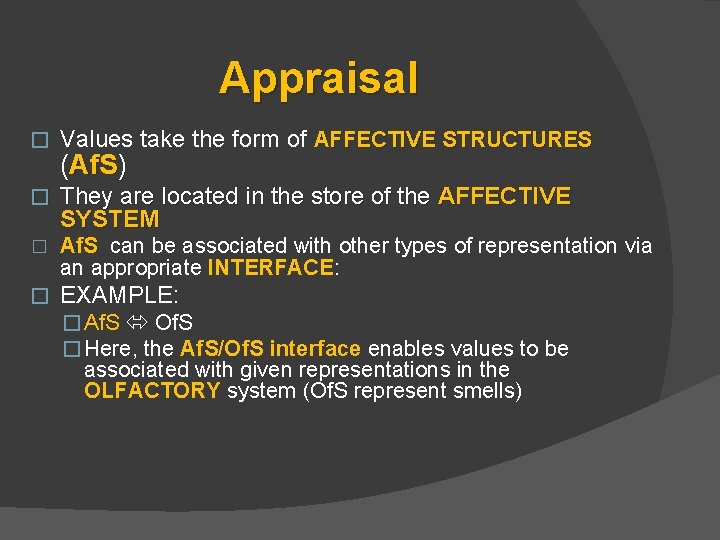
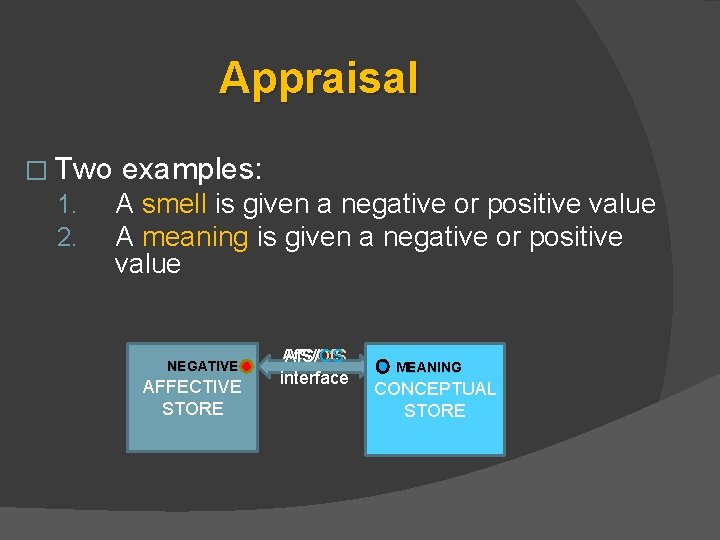
Appraisal � Values take the form of AFFECTIVE STRUCTURES � They are located in the store of the AFFECTIVE SYSTEM � Af. S can be associated with other types of representation via an appropriate INTERFACE: � EXAMPLE: (Af. S) � Af. S Of. S � Here, the Af. S/Of. S interface enables values to be associated with given representations in the OLFACTORY system (Of. S represent smells)
Appraisal � Two examples: 1. A smell is given a negative or positive value 2. A meaning is given a negative or positive value NEGATIVE AFFECTIVE STORE Af. S/Of. S Af. S/CS interface SMELL MEANING CONCEPTUAL OLFACTORY STORE
Emotion Af. S � The Affective System is also where our basic inborn (‘primitive’) emotions are stored and processed (Anger, Fear, Happiness, Surprise etc. ) � Here, Af. S are strongly associated, from birth, with various sensory perceptual systems as well as the motor system giving rise to the complex physical effects of a given emotion
Emotion Af. S � The Basic Emotion (Anger, Fear, Happiness, Surprise etc. ) are probably combinations of smaller component structures including positive or negative values � More complex emotions like Envy, Shame, Guilt and Embarrassment are formed via particular associations between the affective and the conceptual system (Af. S and CS)
The extensive reach of Af. S Emotions always figure in our most basic level of awareness (as they do with other species) due to the typically high activation levels of associated sensory perceptual structures � We are also able to become fully conscious of, and reflect upon emotional experiences thanks to associations with conceptual structures � Due to the extensive reach of the affective system, affect always accompanies cognitive activities whether or not we have full awareness and understanding about what precisely is causing it. � Appraisal and even emotions may be active without any awareness being present and this can make our decisions and assessments very biased without our realising it. �
A network of affective associations are spread over the system as a whole: Affect and Cognition are continually and intimately interconnected
Affect and Activation Levels � Affect has a direct impact on a representation's current level of activation For example, a representation with a relative LOW resting level of activation can get a BOOST if associated with given Af. S � This has the effect of increasing its current value � This boost will give the representation in question a sudden competitive advantage that it otherwise would not have. �
Flexible Responses to Changes in the Situation � � � Imagine a situation at a party where you are talking to someone and paying very little attention to the other people in the room However, as you are chatting away, you notice out of the corner of your eye someone who you suddenly recognise as a very good friend of yours. S/he immediately attracts your attention and you interrupt your conversation and turn away to greet the newcomer What causes this shift? The higher value already associated with the newly perceived person relative to the person you have been talking to. The higher valued person triggers a shift in attentional focus.
Flexible Responses to Changes in the Situation (value adjustment) � Now imagine a situation where you are talking to someone with who you both share the ability to speak two languages fluently, i. e. Spanish and Turkish � You are in Madrid and currently discussing plans for the afternoon, in Spanish. � A Turkish friend suddenly joins you and you know her Spanish is not nearly so good as yours.
Flexible Responses to Changes in the Situation (value adjustment) You immediately switch to Turkish, � What causes the shift? � The language associated with the newcomer now increases in value and its activation level is boosted accordingly. � As a result the language you have been using up to then, Spanish, declines in value relative to Turkish. This readjustment, along with other structures reflecting the altered context, triggers the codeswitch. �
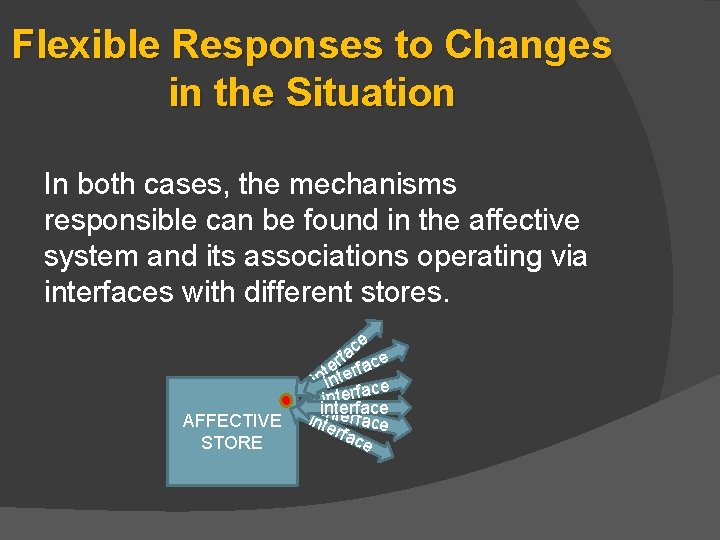
Flexible Responses to Changes in the Situation In both cases, the mechanisms responsible can be found in the affective system and its associations operating via interfaces with different stores. AFFECTIVE STORE ce a rf face e t ininter e c interface te intin erfarface ce
Affect and the growth of knowledge When new representations are created, they generally acquire a LOW resting level � What happens to them later basically depends on how frequently they are activated. � However, positive values associated with the type of knowledge in question (e. g. a language, local geography) will contribute to the increase in the resting levels of activation � By the same token, negative values will inhibit the frequency effect associated with growth. �
Summary This presentation has covered: 1. A basic introduction to the affective system 2. Appraisal and emotion 3. The ways in which affective structures enable a flexible response to ongoing situations. 4. Their role in boosting or inhibiting the growth of knowledge.
The End LEFT CLICK TO RETURN TO THE BEGINNING OF THE PRESENTATION Part 4 will cover the special way in which “input” processing is explained. OR press Esc