
The Modern and Postmodern Periods 1901 Present Historical
- Slides: 17
The Modern and Postmodern Periods 1901 - Present
Historical Background • Points to be aware of: • Progress in science and technology was helping to make life easier and the world more comprehensible • Advances in communication and transportation brought the world closer together • WWI – (1914 -1918) about 8. 5 million soldiers died from wounds or diseases • WWII – (1939 -1945) estimations vary between 35 -60 million casualties
The Edwardian Age (1901 -1910) • Rigid class distinctions lingered past the Victorian age • Rapid technological and social changes quickly undermined the customs and assumptions of the Victorian Age • Changes included – electricity, the right for women to vote • By 1910 with the crowning of King George V – the nineteenth century life was fading into memory
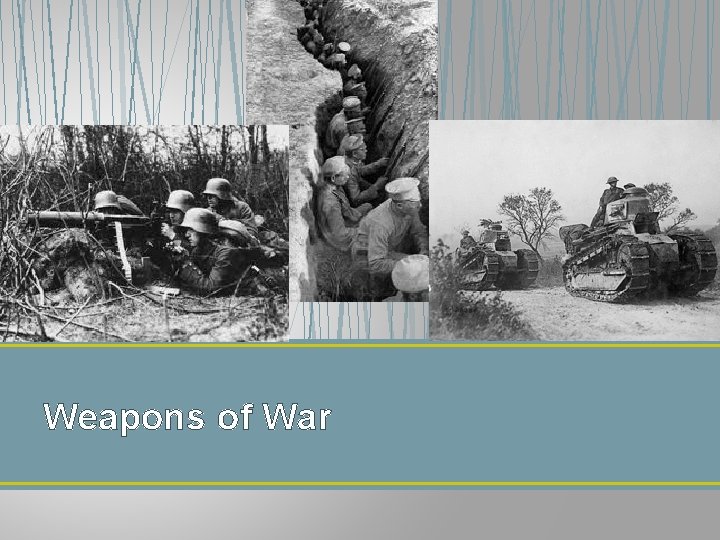
WWI • 1914 long-standing tensions between European nations erupted • It was ignited by the assassination of Austria-Hungary’s archduke Francis Ferdinand • Germany invaded Belgium and England France joined together to stop the aggression • They began the war optimistically, but soon were overcome with the realities of this new war • Poison Gas • Massive Artillery • Trench Warfare
WWI cont. • Russia broke out in its own civil war during WWI • The Czar was overthrown and the first Communist state was created – The Soviet Union • An armistice was signed on November 11, 1918 • Monarchies were destroyed by then – imperial Germany, and the Austro-Hungarian empire • An uneasy peace followed the armistice as a result of the harsh conditions of the Treaty of Versailles.
Weapons of War
Between Wars • The young generation following WWI was known as the “lost generation” – they were disillusioned and struggled due to a lack of purpose • They masked their unease with the pursuit of pleasure • Fast Cars • Wild Jazz • Giddy Fads • Women finally won the right to vote in 1918 (Age 30) • 1928 – they lowered the voting age to 21 – same as men
Political Developments in Europe • Adolf Hitler began to aggressively expand to Germany’s borders • Germany invaded Poland on September 1, 1939 • It was this action that made clear the fact that Hitler would only be stopped through violent intervention
WWII • • Second global war more destructive than the first Hitler attempted to eradicate the Jews – killing about 6 million Germany invaded Russia Fighting raged from Europe to North Africa, from the mountains of Burma and China to the Hawaiian Islands Massive bombing raids turned London, Dresden, and Tokyo into infernos France fell to Germany in 1940 and England had to bear the brunt of German attacks 1941 – two powerful allies joined England – The United States and The Soviet Union August 1945 – Hiroshima and Nagasaki brought the war to a brutal and abrupt end.
The End of an Empire • 1922 – Ireland won its independence from Britain • After WWII, the British Empire suffered further dramatic losses • Colonies around the world were striving for independence from British rule – ethnic, racial and border conflicts led to bloodshed in these former colonies • An iron curtain divided Eastern and Western Europe • The United States and the Soviet Union dominated the world
Modern England
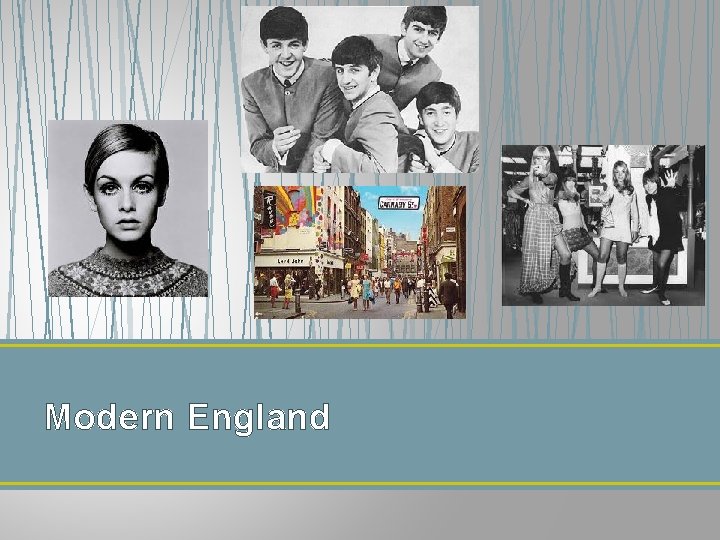
British Society • By the 1960 s – Britons had put most of their troubles behind them • However – despite leading fashion changes like rock-and -roll music, fads, and trends, major industries like textiles, steel, and shipbuilding suffered • British society was also changing • Britain’s multiracial population exploded. It includes Caribbean islanders, Indians, Bangladeshis, Pakistanis, and Africans • Discrimination often caused riots
Contemporary Britain • Margaret Thatcher was a Conservative and was the first female Prime Minister in England • Came to power in 1979 and had a hands-off approach to the economy • The country did not benefit from “Thatcherism” and she resigned in 1990 • Britain had to adjust to a rapidly changing world • Prospect for peace have increased between Ireland England, but there is still potential for violence • Wales and Scotland voted to set up their own parliamentary system – so a modern question becomes – what is the purpose of the monarchy? • Even in trial – Briton has always turned to its past for a sense of pride and comfort
Modernism and Postmodernism Literature • Modernism has a commitment to creating new forms and is perhaps the most important artistic movement of the 20 th century • Modernists often present experiences in fragments, rather than as a coherent whole • Postmodern refers to 1965 - present – characterized by the phrase “continuance and completion”
Modernism and Poetry • Modernism in poetry developed with the Imagist movement, founded about 1912 • Imagists stressed the use of precise visual images and unadorned, concise language • William Butler Yeats is considered one of the greatest literary figures • His work spans several literary generations • T. S. Eliot – an American who moved to London was a Modernist poet • He uses a collage effect of “voices” which is very similar to the Cubist collages that Picasso painted after 1910
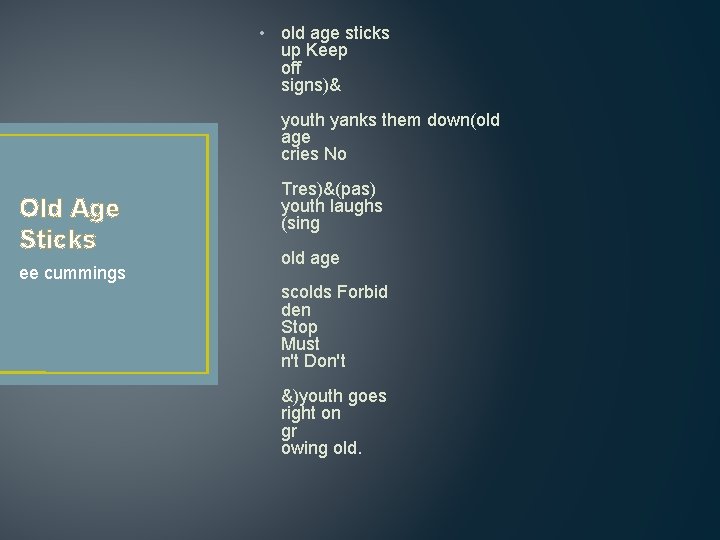
• old age sticks up Keep off signs)& youth yanks them down(old age cries No Old Age Sticks ee cummings Tres)&(pas) youth laughs (sing old age scolds Forbid den Stop Must n't Don't &)youth goes right on gr owing old.
REVIEW Literary Text Types • • • Epic Poetry Lyric Poetry Drama Romanticism Social Commentary Realism Naturalism Modernism Post Modernism