
The Modern American Short Story A Brief Introduction
The Modern American Short Story A Brief Introduction Blue American Literature Textbook p. 740 -1
The Short Story • One of the most popular genres among American authors • Authors in the U. S. began to portray plots and characters that mirrored real life. • Modernist writers began experimenting with new ways of capturing the complexity of human life.
Literary Mavericks • Sherwood Anderson, Ernest Hemingway, F. Scott Fitzgerald, Henry James, and Katherine Anne Porter energized the short story in the early 1900 s • “to at last go out of myself, truly into others I met constantly in the streets of the city, in the office where I then worked, and still others remembered out of my childhood in an American small town. ” -Anderson
Stream of Consciousness • Many authors of the early 1900 s were influenced by the new psychological theories of the time • Sigmund Freud: sought unconscious causes for people’s behaviour. • Stream of consciousness: coined by William James in 1890, believed thought was a constant stream flowing through the minds without clear logic or order.

Stream of Consciousness continued • James Joyce, Virginia Woolf, William Falkner, and Katherine Anne Porter • Defining elements: -first-person POV -a lack of conventional sentence structure or grammar -”free associations” that flow through a character’s mind and link distinctly separate events -interior monologues
The Interior World • Modernists reacted against formulaic, plotdriven stories that dominated the early 1900 s • Instead they strove for the “artful approach to the significant moment. ” –Frank O’Connor • Anton Chekhov: Russian writer, master of realistic detail and understatement • Used “slice of life” anecdotes • Lack obvious external conflicts, action-packed events, and clear climaxes; instead, the drama rages inside the characters’ minds
The Interior World continued • Anti-heroes: conflicted characters engulfed by indecision • Language: -subtle and poetic -Must infer what is being left unsaid: “It is no longer necessary to describe; it is enough to suggest. ” –H. E. Bates
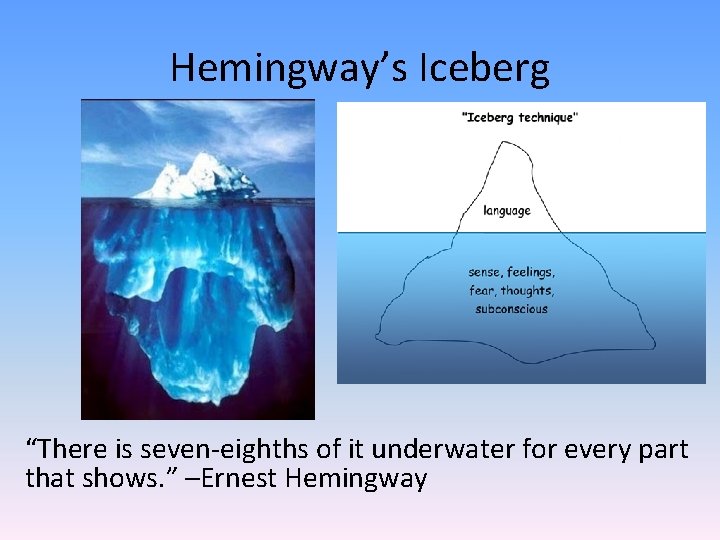
Hemingway’s Iceberg “There is seven-eighths of it underwater for every part that shows. ” –Ernest Hemingway

Features of the Modern Short Story • • Unspectacular, or everyday, settings Themes of instability and loss Plots without a clear climax or resolution Understatement Irony Stream of consciousness Anti-heroes
- Slides: 9