
The Mobile Commerce Quest for ValueAdded Products Services
The Mobile Commerce Quest for Value-Added Products & Services Pirkko Walden IAMSR/Abo Akademi University pirkko. walden@abo. fi EUNITE 2001, December 2001 1
MOBILE COMMERCE • Key Success Factors Ø Customer ownership [key for banking, brokerage; others only if value-added for producers & customers; customers kept only through value added and best business practice] Ø Personalisation Ø Localisation Ø Ubiquity Ø Timeliness Ø Convenience Ø Pricing EUNITE 2001, December 2001 2
MOBILE COMMERCE • M-commerce, products & services Ø Services: intangible, no ownership defined Ø Products: tangible, ownership defined Ø Digital products: intangible, ownership defined Ø Digital services: intangible, no ownership defined Ø Digital products & services: intangible, ownership is defined Ø Digital services & products: intangible, ownership is not defined EUNITE 2001, December 2001 3
MOBILE COMMERCE • Conceptual framework, customer perspective Ø Flexibility, products & services available anywhere, at any time and anyhow Ø Value-adding, products & services should improve productivity, be adaptive to localisation, be sensitive to customer personalisation Ø A mobile technology basis, should use innovative and distinguishing features of mobile technology EUNITE 2001, December 2001 4
MOBILE COMMERCE • Conceptual framework, producer perspective Ø Modularity, products & services to be built from a core of generic modules; should support flexibility Ø Layers, products & services should be built in layers to add attributes, characteristics; should support valueadding Ø Bundling, products & services built through a bundling of modular products and service; use the mobile technology basis EUNITE 2001, December 2001 5
MOBILE COMMERCE • Conceptual framework, management perspective Ø Value/cost ratios, products & services should show good/very good value for cost in benchmarking Ø Production, logistics, marketing and advertising, value chain activities, products & services should have innovative features through mobile technology when benchmarked Ø Business model, products & services should use innovative & distinguishing features of business EUNITE 2001, December 2001 6
MOBILE COMMERCE • M-commerce, products & services [Kontinen] Ø M-commerce: multimodal, mobility Ø Var A: mobile client, standard services, separate voice Ø Var B: + services, aware of client location Ø Var C: + moving services, aware of own location Ø Var D: + services, aware of other clients in vicinity EUNITE 2001, December 2001 7
MOBILE COMMERCE • M-commerce, products & services [Keen] Ø M-commerce: freedom of choice the key issue Ø Follows: knowledge mobilisation among producers, users, management, employees and in peer-to-peer Ø Proposal: b-to-b is going to be the first breakthrough, wireless support for employees the second Ø Value networks (? ): a better metaphor will be dynamic value entities, which change shape with the context EUNITE 2001, December 2001 8
MOBILE COMMERCE • M-commerce, products & services Ø Our proposal: probably not single (”killer”) entities Ø Then follows: synergistic combinations, which can be simplified over time Ø And thus: key features can be given to individual products & services Ø Possible variations: (i) b-to-b, (ii) b-to-c, (iii) b-toemployee, (iv) peer-to-peer EUNITE 2001, December 2001 9
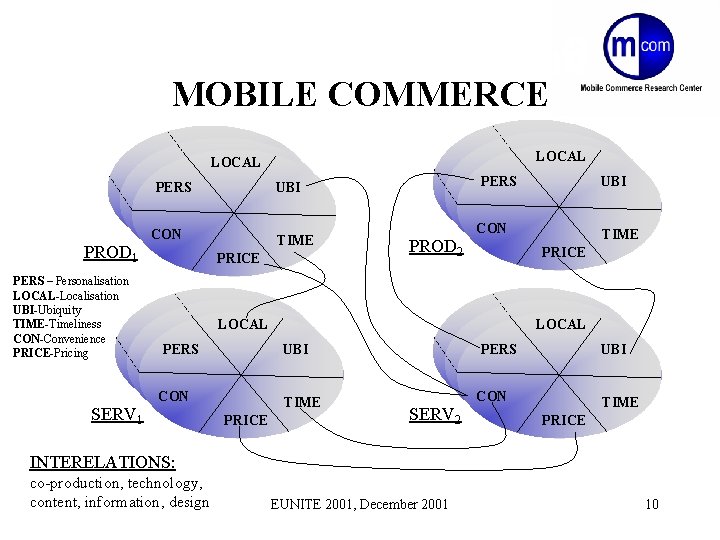
MOBILE COMMERCE LOCAL PERS PROD 1 PERS – Personalisation LOCAL-Localisation UBI-Ubiquity TIME-Timeliness CON-Convenience PRICE-Pricing SERV 1 PERS UBI CON TIME PRICE PROD 2 CON LOCAL UBI CON TIME PRICE LOCAL PERS UBI PERS SERV 2 UBI CON TIME PRICE INTERELATIONS: co-production, technology, content, information, design EUNITE 2001, December 2001 10
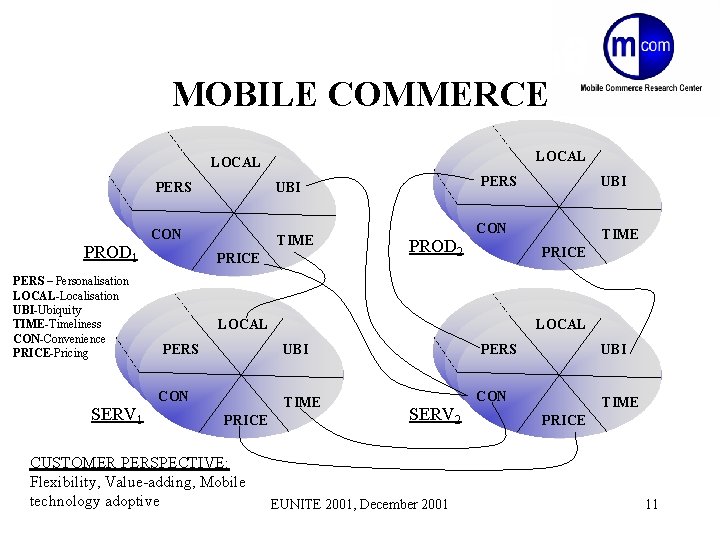
MOBILE COMMERCE LOCAL PERS PROD 1 PERS – Personalisation LOCAL-Localisation UBI-Ubiquity TIME-Timeliness CON-Convenience PRICE-Pricing SERV 1 PERS UBI CON TIME PRICE PROD 2 CON LOCAL UBI CON TIME PRICE CUSTOMER PERSPECTIVE: Flexibility, Value-adding, Mobile technology adoptive TIME PRICE LOCAL PERS UBI PERS SERV 2 EUNITE 2001, December 2001 UBI CON TIME PRICE 11
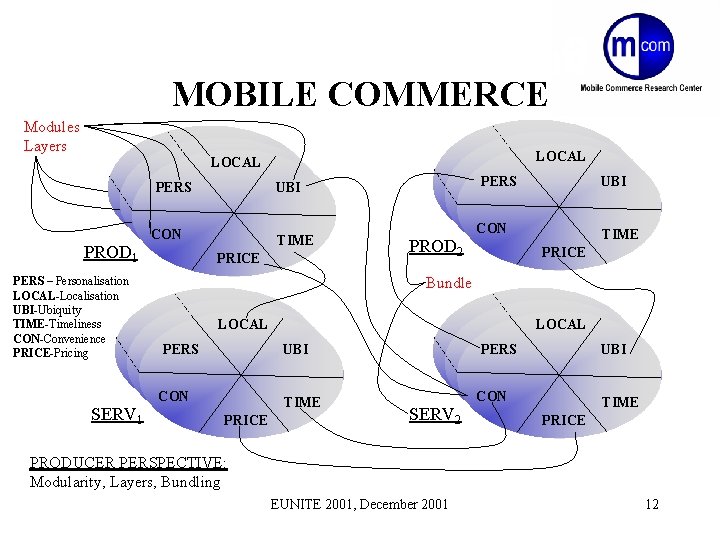
MOBILE COMMERCE Modules Layers LOCAL PERS PROD 1 PERS – Personalisation LOCAL-Localisation UBI-Ubiquity TIME-Timeliness CON-Convenience PRICE-Pricing SERV 1 PERS UBI CON TIME PRICE PROD 2 UBI CON TIME PRICE Bundle LOCAL PERS LOCAL UBI CON TIME PRICE PERS SERV 2 UBI CON TIME PRICE PRODUCER PERSPECTIVE: Modularity, Layers, Bundling EUNITE 2001, December 2001 12
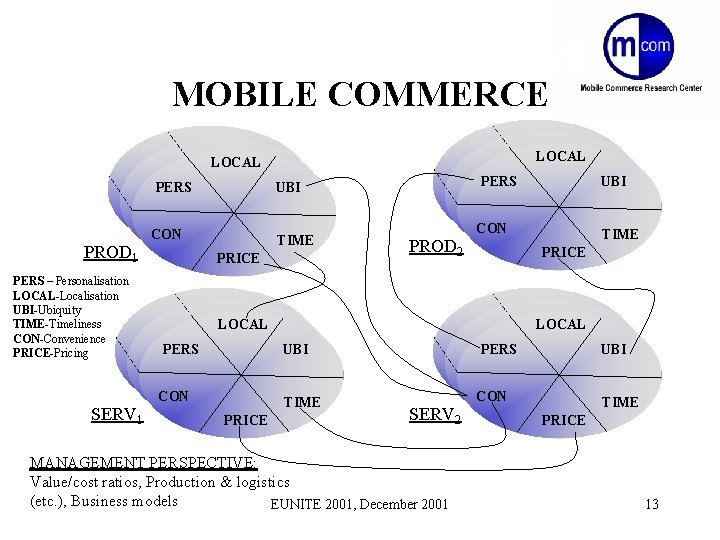
MOBILE COMMERCE LOCAL PERS PROD 1 PERS – Personalisation LOCAL-Localisation UBI-Ubiquity TIME-Timeliness CON-Convenience PRICE-Pricing SERV 1 PERS UBI CON TIME PRICE PROD 2 CON LOCAL UBI CON TIME PRICE LOCAL PERS UBI PERS SERV 2 MANAGEMENT PERSPECTIVE: Value/cost ratios, Production & logistics (etc. ), Business models EUNITE 2001, December 2001 UBI CON TIME PRICE 13
MOBILE COMMERCE • M-commerce, killer applications Ø Killer cocktail: a mix in which components cannot be identified Ø Killer pizza: a mix in which components can be distinguished Ø Killer bouquet: the aggregate > the sum of parts Ø Killer soup: the more ingredients, the better it gets; operator needed for stirring Ø Killer fondue: as for the soup, no operator needed EUNITE 2001, December 2001 14
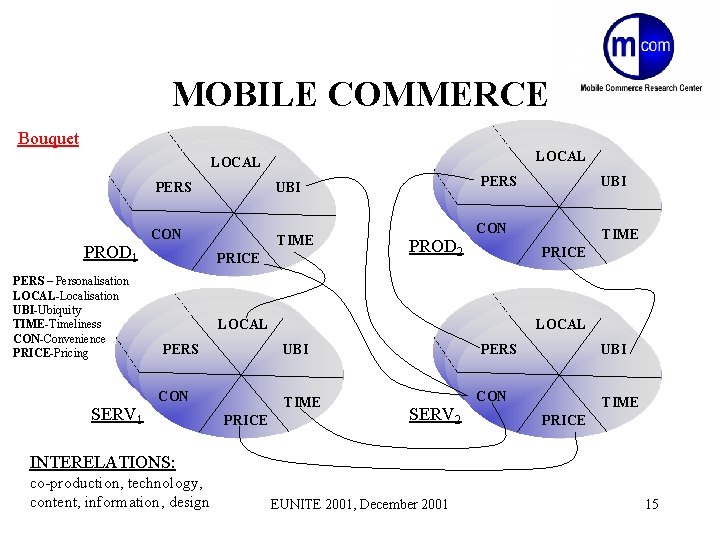
MOBILE COMMERCE Bouquet LOCAL PERS PROD 1 PERS – Personalisation LOCAL-Localisation UBI-Ubiquity TIME-Timeliness CON-Convenience PRICE-Pricing SERV 1 PERS UBI CON TIME PRICE PROD 2 CON LOCAL UBI CON TIME PRICE LOCAL PERS UBI PERS SERV 2 UBI CON TIME PRICE INTERELATIONS: co-production, technology, content, information, design EUNITE 2001, December 2001 15
MOBILE ICT BUSINESS • Key principles: Ø Embedding processes in software brings the internal operations and capabilites of the company forward into the customer relationship interface. Ø In a sense, this concentrates the business into the software; it transforms organisational value chain activities spread across locations and time zones to capabilities at hand, now and anywhere. Ø It transforms business by enabling personalisation, localisation, ubiquity, timeliness, convenience and neew pricing models EUNITE 2001, December 2001 16
MOBILE ICT BUSINESS Ø Embedding processes in software is win-win for customer and provider. Ø Out-tasking – getting rid of a process – is win-win. Ø In-sourcing – using advanced know how developed by somebody else – is win-win. Ø Company wins by interacting with a best practice e. Process capability. Ø Customer wins as service is being handled by a bestpractice provider. Ø The provider wins by + revenue and + market EUNITE 2001, December 2001 17
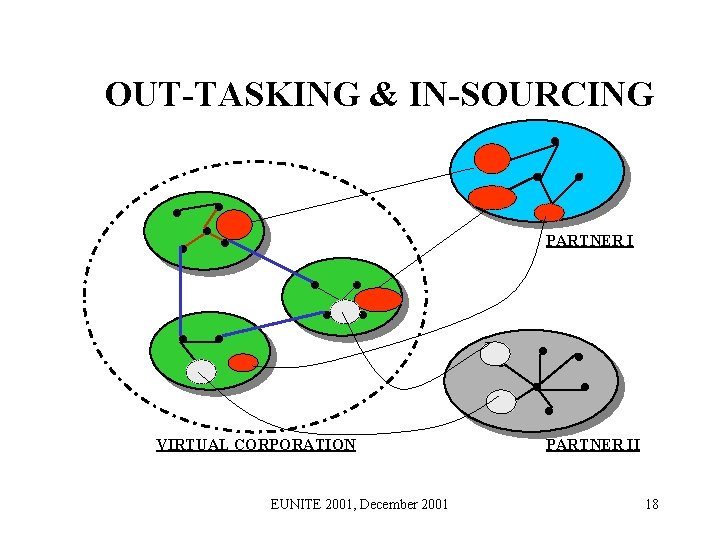
OUT-TASKING & IN-SOURCING PARTNER I VIRTUAL CORPORATION EUNITE 2001, December 2001 PARTNER II 18
MOBILE ICT BUSINESS • Building scale @ speed [Keen]. Ø Business design and organizational structuring are constrained by geography, physical location, workflows, time and the links with capital investment demands. Ø e. Process companies can get access to world-class capabilities in months rather than years. A first-rate technology platform and a solid base of repeat customers more and more capabilties at less and less capital cost. EUNITE 2001, December 2001 19
MOBILE ICT BUSINESS • e. Process strategies [Keen]. Ø e. Process edge over traditional companies: information-rich relationships with customers and organizational flexibility through in-sourcing; out-tasking simplifies operations and improves service. Ø Build in-house capabilities: these form the operational basis for the company: Ø Enable people with knowledge and access to work effectively Ø Support knowledge work with high-touch and –texture interfaces Ø Embed company rules into software interfaces Ø Build internal systems that provide high-value functionality Ø e. Process techniques to decide where and how to focus in-house capabilities EUNITE 2001, December 2001 20
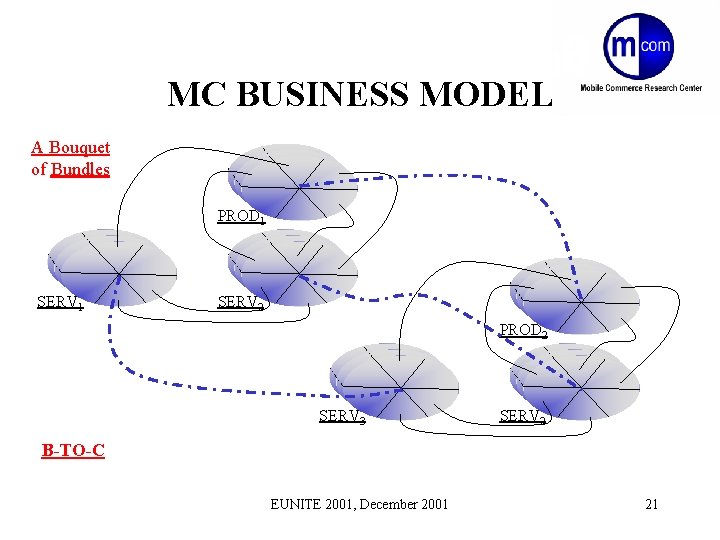
MC BUSINESS MODEL A Bouquet of Bundles PROD 1 SERV 2 PROD 2 SERV 3 SERV 2 B-TO-C EUNITE 2001, December 2001 21
MC BUSINESS MODEL • B-to-C 1. Bundles are combinations of products & services 2. A bouquet can be built from (i) bundles or (ii) from combinations of individual products & services. 3. A bouquet is built to offer 1. Flexibility – availability anywhere, at any time and anyhow 2. Value-added – will improve productivity, will be adaptive to localisation, will be sensitive to customer personalisation 3. Mobile technology adoption- will use innovative and distinguishing features of mobile technology to enhance flexibility and value-added EUNITE 2001, December 2001 22
MC BUSINESS MODEL • B-to-B 1. The same bouquets or bundles are used as in the B-to-C model 2. The customer is a business. 3. A bouquet is built to offer 1. Flexibility – availability anywhere, at any time and anyhow 2. Value-added – in production, logistics, marketing & advertising: value chain activities for bringing m-commerce products & services to the markets 3. Mobile technology adoption- will induce (i) business process reengineering, (ii) multimodality, (iii) out-tasking, (iv) in-sourcing, (v) new logistical solutions EUNITE 2001, December 2001 23
MC BUSINESS MODEL • B-to-B [cont. ] Ø Bouquets are Ø adapted to customers and made ubiquitous with layers, Ø adapted to localisation, personalisation and timeliness through modules Ø built for customer convenience with variations of the mobile technology and the use of a choice of platforms (smart phones, WAP, communicators, PDA, digi. TV, WLAN etc. ) Ø Structured and built for flexibility and value-added Ø The bouquet structure of m-commerce products & services supports the out-tasking and in-sourcing business models [cf. next slide] EUNITE 2001, December 2001 24
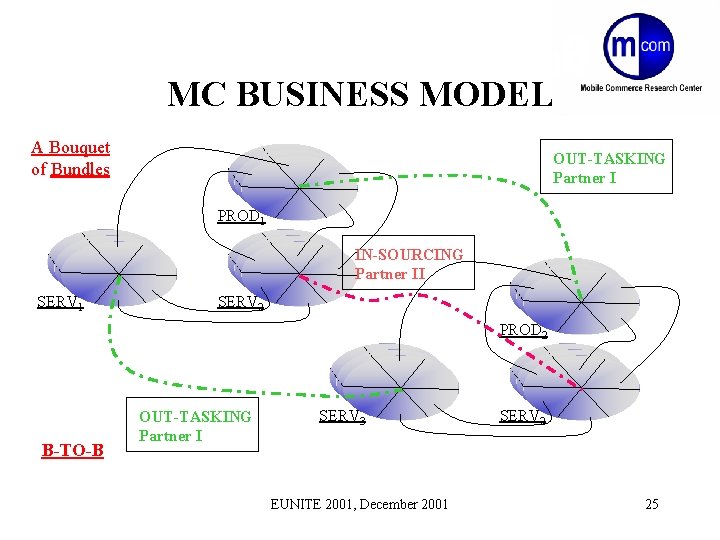
MC BUSINESS MODEL A Bouquet of Bundles OUT-TASKING Partner I PROD 1 IN-SOURCING Partner II SERV 1 SERV 2 PROD 2 B-TO-B OUT-TASKING Partner I SERV 3 EUNITE 2001, December 2001 SERV 2 25
MC BUSINESS MODEL • B-to-B [cont. ] Ø Partners I and II work on Ø Product entities and Ø Service entities in a bouquet Ø Modules forming products & services Ø Layers, which are included in products & services Ø Bundling products & services Ø Logistics Ø Marketing and advertising Ø Management, and maybe even Ø Planning EUNITE 2001, December 2001 26
MC BUSINESS MODEL • B-to-B [cont. ] Ø The mobile commerce business model may have side effects on consortium and business partners in traditional business Ø The mobile technology used/enhanced/improved/developed to serve mc business models may traditional solutions in Ø Production Ø Logistics Ø Marketing and advertising Ø Management, and maybe even Ø Planning Ø Thus, m-commerce may introduce competitive advantages also in tradional industry EUNITE 2001, December 2001 27
MC BUSINESS MODEL • B-to-Employee Ø Both B-to-C and B-to-B solutions may be adapted to B-to-E Ø Involves (i) an adaptation of modules to fit the corporate intranet and corporate standard mobile solutions, (ii) the choice and adaptation of layers to fit employee work context and tasks, and (iii) the building of company-specific bundles or bouquets Ø These B-to-E solutions can be offered by (i) the producer of mcommerce products & services to its own employees, (ii) the outtasking and/or in-sourcing partners to their own employees, (iii) other business partners in traditional business, (iv) through licensing to any corporate customers or by (v) licensing partners to any corporation EUNITE 2001, December 2001 28
MC BUSINESS MODEL • B-to-Employee [cont. ] Ø The B-to-E solutions may have some interesting consequences Ø Employees (E) will/can work with and understand the m-commerce products and services Ø E gain the same value-added in their own work as B or C partners Ø Knowledge mobilisation among E Ø Out-tasking and in-sourcing may become possible between and within teams working in the same organisation Ø Freedom of choice to work wireless anywhere, anytime and anyhow while moving Ø Corporate structure will be simplified, virtual, adaptive, flexible, fast in reaction and knowledge based EUNITE 2001, December 2001 29
MC BUSINESS MODEL • Peer-to-Peer Ø Principle: B-to-C products & servicces move out of the control of B to become P-to-P distributed (and loved by the network operators, which will gain in cash flow) Ø B can control Bouquets or Bundles, and (i) allow or (ii) not allow P -to-P distribution; this can be controlled through proprietary software or possibly encryption Ø B may be interested in allowing P-to-P distribution in order to create a market; could include some mechanism to collect a (small) fee per user/customer/usage time unit/volume, etc. Ø If in-sourcing & out-tasking is used there may be restrictions on the use of modules, layers and bundles EUNITE 2001, December 2001 30
MC BUSINESS MODEL • Peer-to-Peer [cont. ] Ø Products & services may be modified for P-to-P usage by Ø Deleting or modifying modules Ø Controlling the use of layers Ø Adapting or tailoring bundles Ø P-to-P can be used to create Clubs, User Groups, Virtual Tribes – groups sharing in modification and application solutions EUNITE 2001, December 2001 31
MOBILE COMMERCE • M-commerce vs. e-commerce Ø Overall: focus on the following issues as compared to ecommerce Ø Changes in fundamentals Ø Significant changes in technology Ø Modifications of products & services Ø Mobile enhancements of e-commerce products & services Ø Business models Ø Pricing EUNITE 2001, December 2001 32
- Slides: 32