
The MMUTCD New Compliance Dates Sign Retroreflectivity Street


- Slides: 50
The MMUTCD New Compliance Dates Sign Retroreflectivity Street Name Signs Private Roads Traffic and Safety, MDOT
MMUTCD Adoption Date For Michigan a new manual had to be in place by January 15, 2012 Ø Manual addresses: Ø l l Ø Unique items in MVC Unique items in Michigan Effective December 1, 2011
Old Compliance Dates Ø Compliance dates are for those “Big Ticket” items Ø 67 Phase-in Target Compliance Dates for Devices, includes: l l l Dates established by previous final rules (3) Dates established in 2005 MMUTCD (52) New compliance items in 2011 MMUTCD (12)
Items with No Specific Compliance Date Ø New or reconstructed devices installed shall be in compliance with State MUTCD Ø Federal-aid projects require devices to be in conformance to MUTCD Ø Upgrade non-compliant devices as part of systematic upgrade
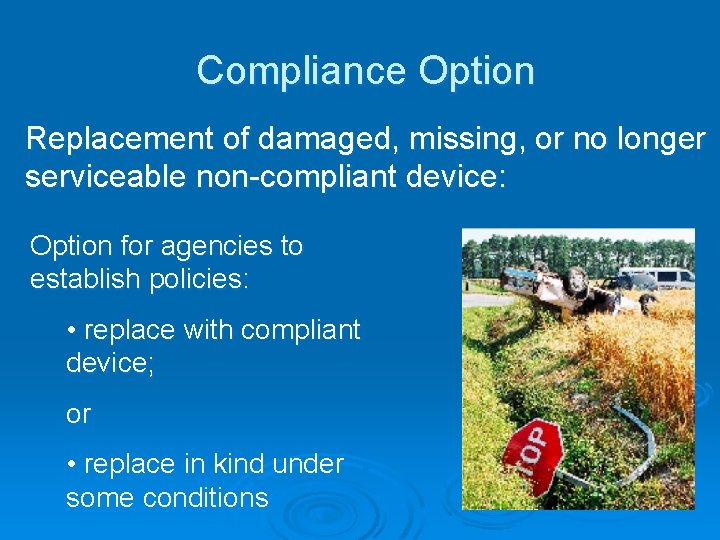
Compliance Option Replacement of damaged, missing, or no longer serviceable non-compliant device: Option for agencies to establish policies: • replace with compliant device; or • replace in kind under some conditions
New Compliance Dates Ø Compliance dates are for those “Big Ticket” items Ø 12 Phase-in Target Compliance Dates for Devices, includes: l l l Dates established by previous final rules (3) Dates established in 2005 MMUTCD (1) New compliance items in 2011 MMUTCD (8)
Part 2 Signs
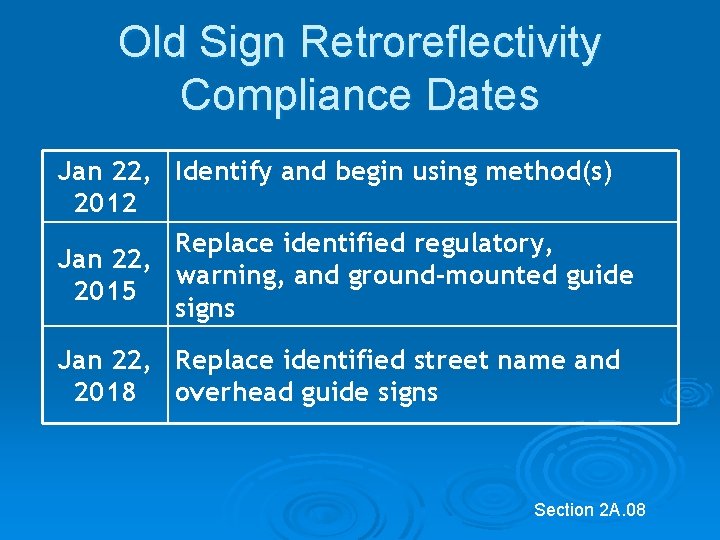
Old Sign Retroreflectivity Compliance Dates Jan 22, Identify and begin using method(s) 2012 Replace identified regulatory, Jan 22, warning, and ground-mounted guide 2015 signs Jan 22, Replace identified street name and 2018 overhead guide signs Section 2 A. 08
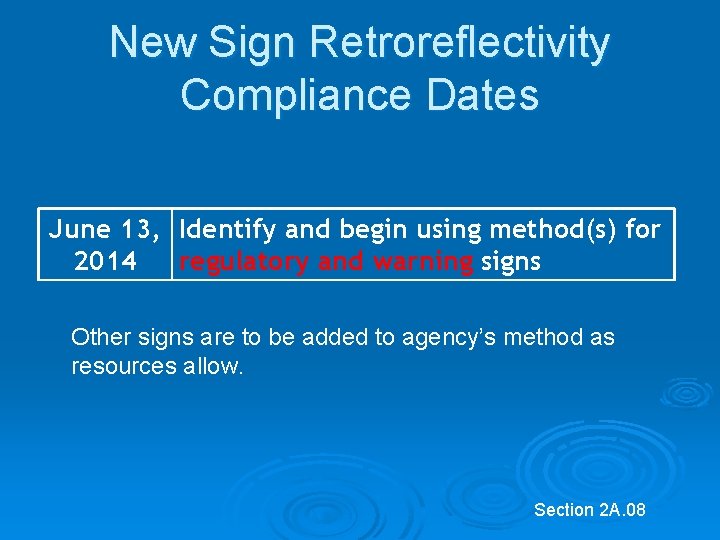
New Sign Retroreflectivity Compliance Dates June 13, Identify and begin using method(s) for 2014 regulatory and warning signs Other signs are to be added to agency’s method as resources allow. Section 2 A. 08
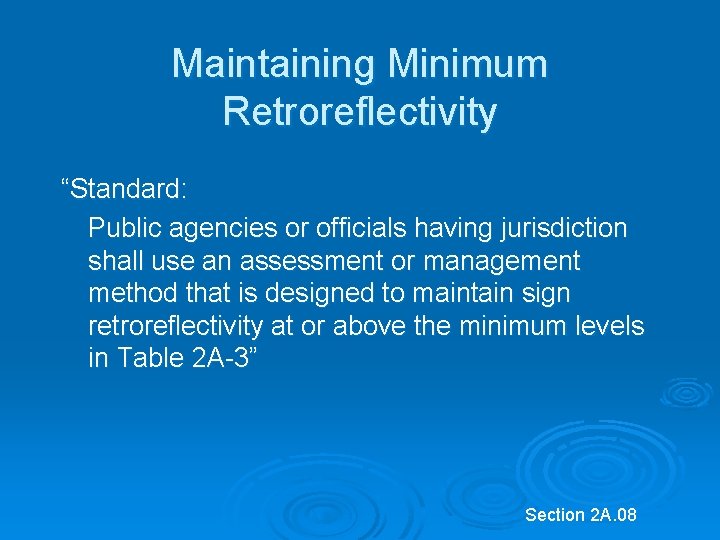
Maintaining Minimum Retroreflectivity “Standard: Public agencies or officials having jurisdiction shall use an assessment or management method that is designed to maintain sign retroreflectivity at or above the minimum levels in Table 2 A-3” Section 2 A. 08
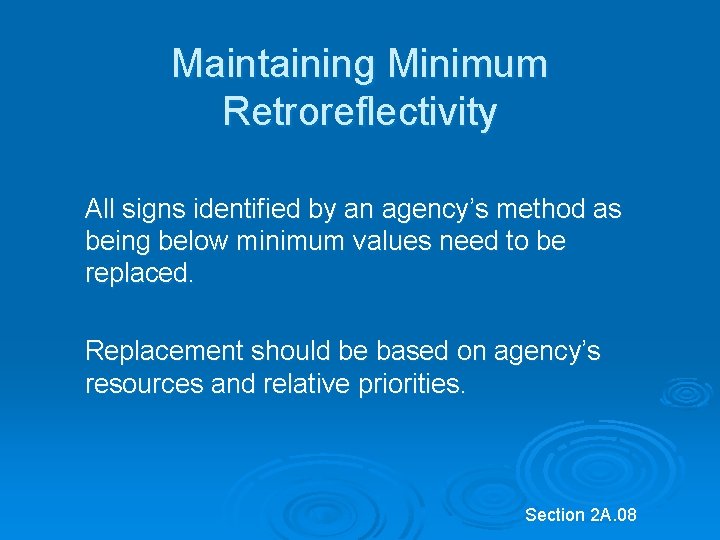
Maintaining Minimum Retroreflectivity All signs identified by an agency’s method as being below minimum values need to be replaced. Replacement should be based on agency’s resources and relative priorities. Section 2 A. 08
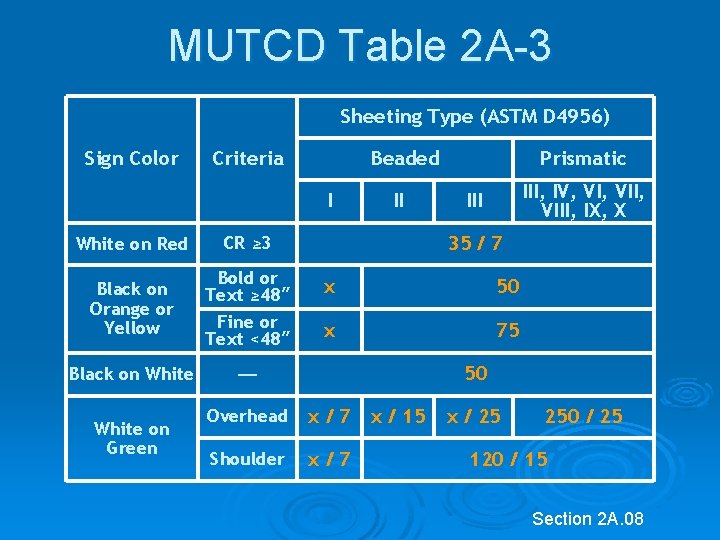
MUTCD Table 2 A-3 Sheeting Type (ASTM D 4956) Sign Color Beaded Criteria I White on Red CR ≥ 3 Black on Orange or Yellow Bold or Text ≥ 48” Fine or Text <48” Black on White on Green II Prismatic III, IV, VII, VIII, IX, X III 35 / 7 x 50 x 75 50 Overhead x/7 Shoulder x/7 x / 15 x / 25 250 / 25 120 / 15 Section 2 A. 08
Sign Maintenance Methods Ø Visual Nighttime Inspection Ø Measured Sign Retroreflectivity Ø Expected Sign Life Ø Blanket replacement Ø Control signs Ø Any combination of above Ø Other methods based on engineering studies Section 2 A. 08
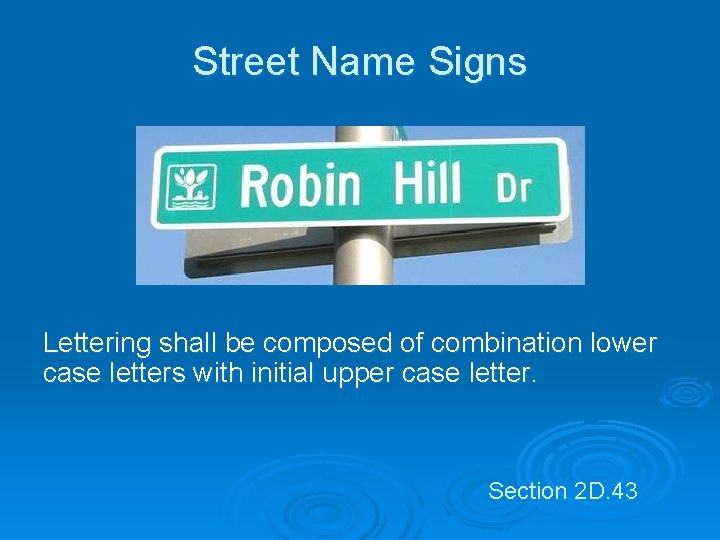
Maintaining Minimum Retroreflectivity FAQs Do I have to replace my street name signs that have all capital letters? Yes, when they are reached the end of their useful service life with the combination lower case letters with initial upper case letter. Section 2 A. 08
Maintaining Minimum Retroreflectivity FAQs Do I have to develop an inventory to be in compliance with the MMUTCD? No, although a documented inventory, in particular computerized, is very useful. Section 2 A. 08
Maintaining Minimum Retroreflectivity FAQs Do I have to submit documentation annually to FHWA for approval? No, FHWA does not require documentation. Section 2 A. 08
Maintaining Minimum Retroreflectivity FAQs Can the warranty of a sign be used to determine its service life? The warranty period is a good start but is often less than the service life. Section 2 A. 08
Maintaining Minimum Retroreflectivity FAQs Does blanket replacement relieve me of sign maintenance between cycles? No, there are other maintenance requirements such as replacing knockdowns or trimming vegetation that is still required. Section 2 A. 08
Maintaining Minimum Retroreflectivity FAQs Can we inspect signs during the day to avoid overtime costs? No, not if your agency is using the nighttime visual inspection method listed in the MMUTCD. Section 2 A. 08
Maintaining Minimum Retroreflectivity FAQs Do I need a 60 year old for nighttime inspection? There are 3 different visual nighttime inspections that can be used. Only the consistent parameters requires an inspector to be at least 60 years of age. Section 2 A. 08
Lateral Offset Ø Sign supports within the clear zone for roads with posted speed limit of 50 mph or higher shall be crashworthy (NCHRP Report 350) unless shielded with a longitudinal barrier or crash cushion Ø Compliance date of August 15, 2015 Section 2 A. 19
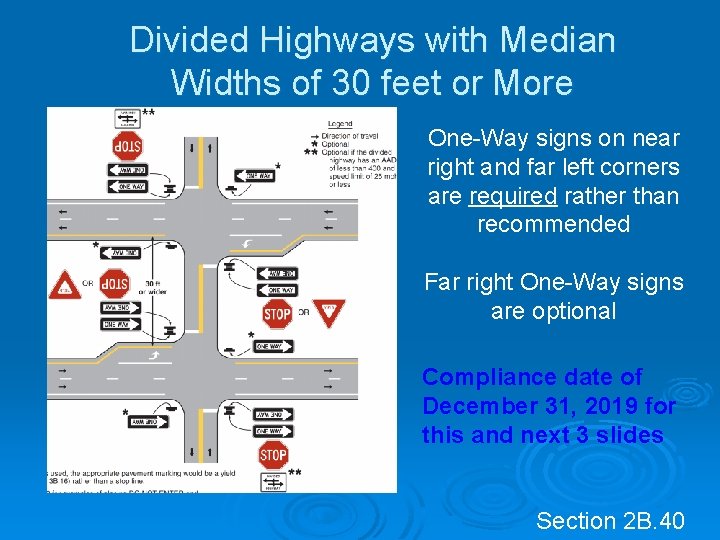
Divided Highways with Median Widths of 30 feet or More One-Way signs on near right and far left corners are required rather than recommended Far right One-Way signs are optional Compliance date of December 31, 2019 for this and next 3 slides Section 2 B. 40
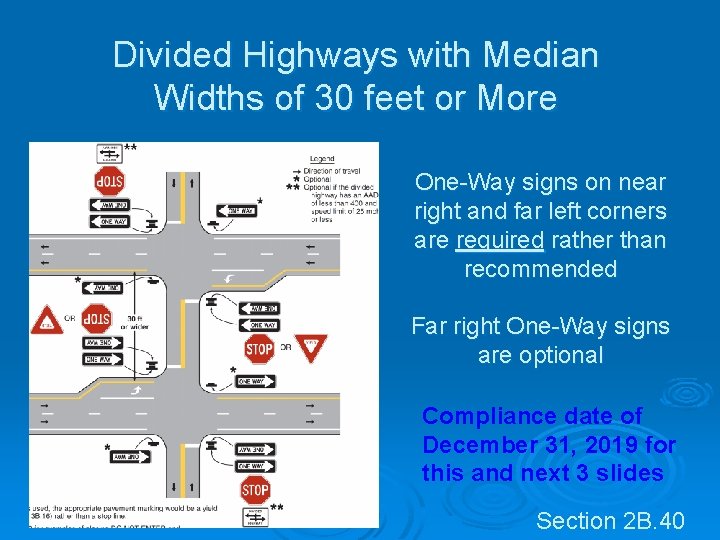
Divided Highways with Median Widths of 30 feet or More One-Way signs on near right and far left corners are required rather than recommended Far right One-Way signs are optional Compliance date of December 31, 2019 for this and next 3 slides Section 2 B. 40
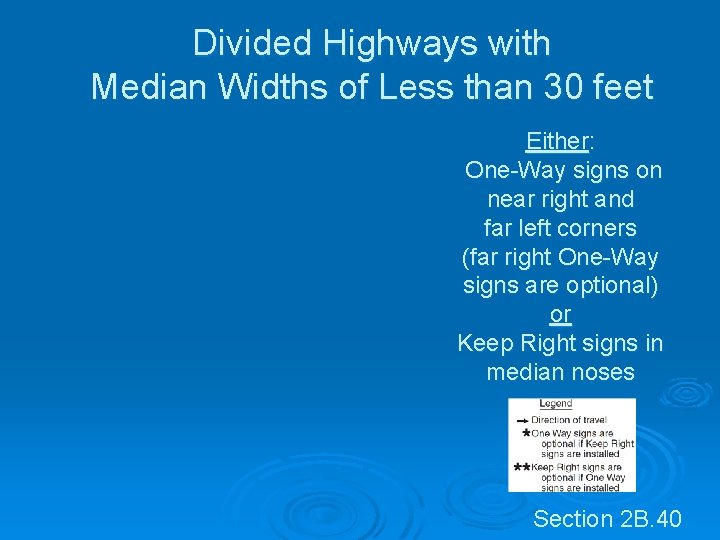
Divided Highways with Median Widths of Less than 30 feet Either: One-Way signs on near right and far left corners (far right One-Way signs are optional) or Keep Right signs in median noses Section 2 B. 40
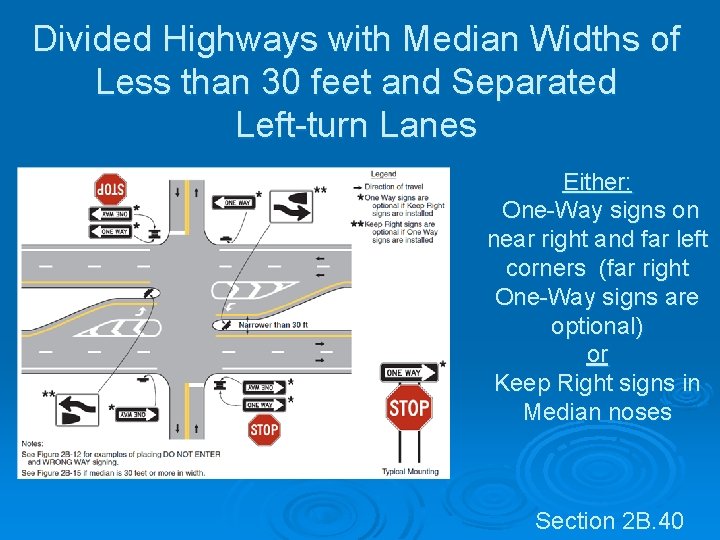
Divided Highways with Median Widths of Less than 30 feet and Separated Left-turn Lanes Either: One-Way signs on near right and far left corners (far right One-Way signs are optional) or Keep Right signs in Median noses Section 2 B. 40
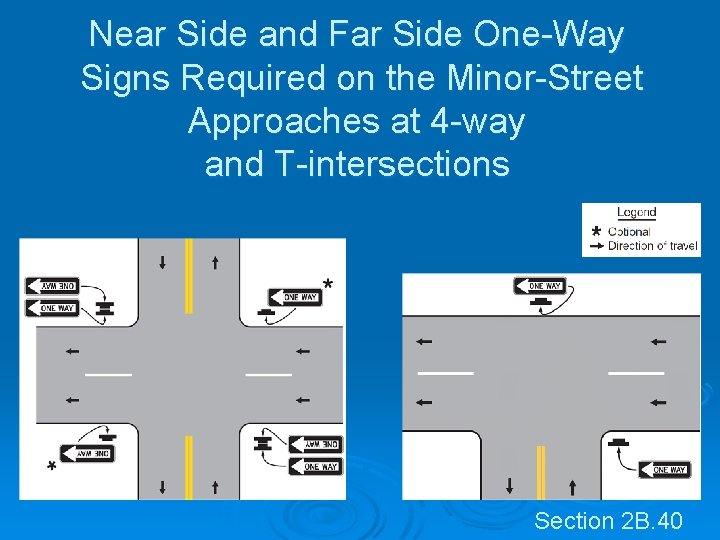
Near Side and Far Side One-Way Signs Required on the Minor-Street Approaches at 4 -way and T-intersections Section 2 B. 40
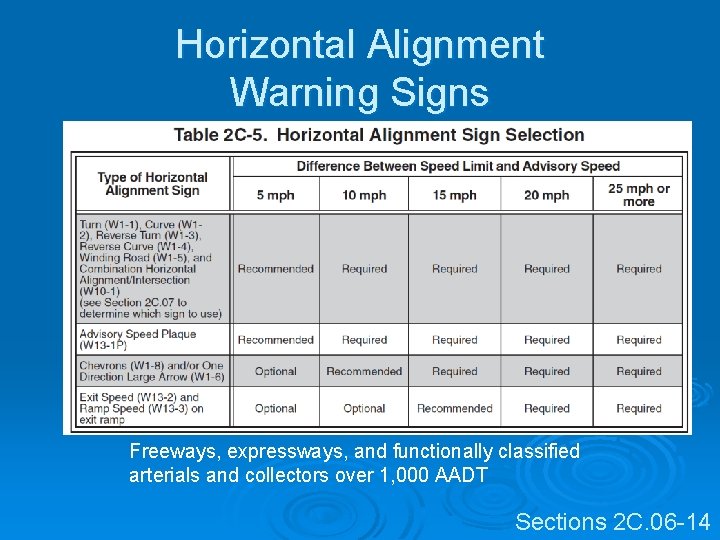
Horizontal Alignment Warning Signs Freeways, expressways, and functionally classified arterials and collectors over 1, 000 AADT Sections 2 C. 06 -14
New Criteria for the Determination of Advisory Speeds Support: Among the established engineering practices that are appropriate for the determination of the recommended advisory speed for a horizontal curve are the following: A. An accelerometer that provides a direct determination of side friction factors B. A design speed equation C. A traditional ball-bank indicator using the following criteria: 16 degrees of ball-bank for speeds of 20 mph or less 14 degrees of ball-bank for speeds of 25 to 30 mph 12 degrees of ball-bank for speeds of 35 mph and higher Sections 2 C. 06 -14
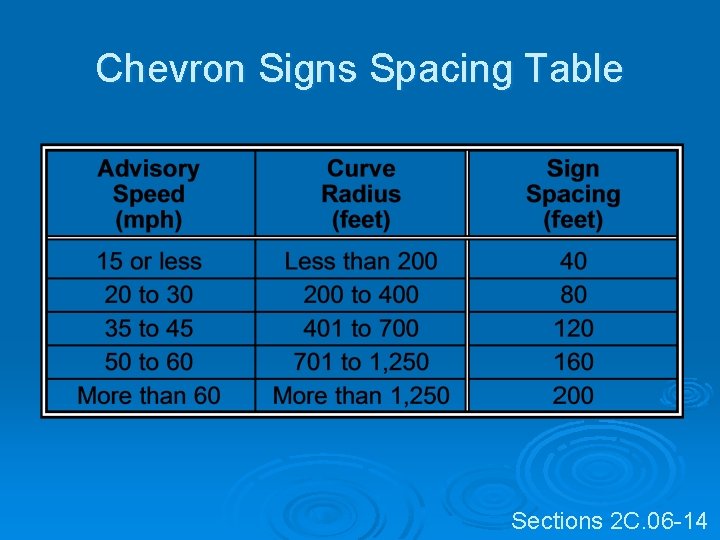
Chevron Signs Spacing Table Sections 2 C. 06 -14
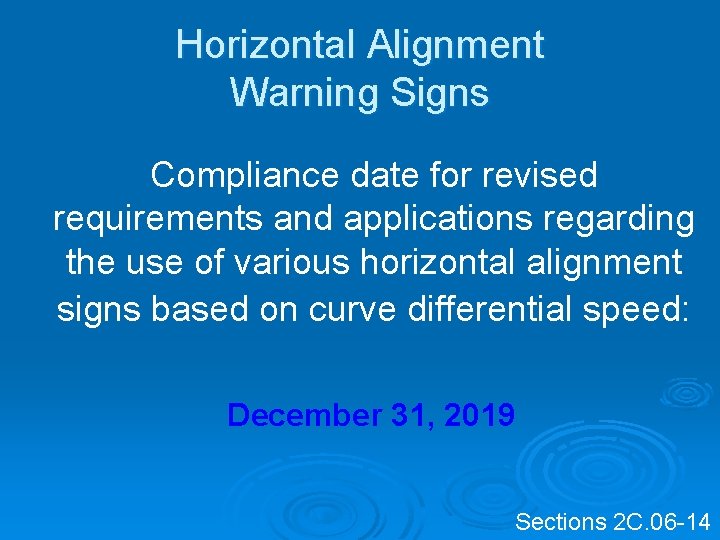
Horizontal Alignment Warning Signs Compliance date for revised requirements and applications regarding the use of various horizontal alignment signs based on curve differential speed: December 31, 2019 Sections 2 C. 06 -14
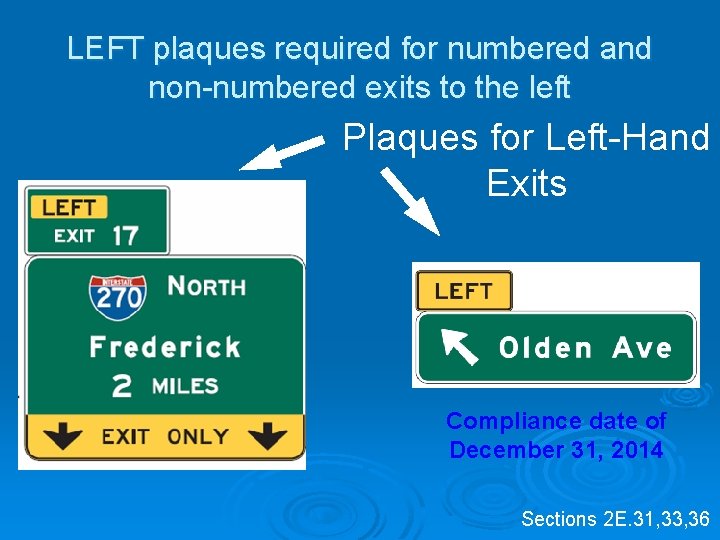
LEFT plaques required for numbered and non-numbered exits to the left Plaques for Left-Hand Exits Compliance date of December 31, 2014 Sections 2 E. 31, 33, 36
Part 4 Highway Traffic Signals
Yellow Change Intervals and Red Clearance Intervals Durations shall be determined using engineering practices Ø Use of red clearance – changed from option to guidance, when indicated by application of engineering practices Ø Compliance date of December 31, 2014 when timing adjustments are made to the individual intersection and/or corridor, whichever occurs first Section 4 D. 26
Pedestrian Clearance Time Ped Change Interval (flashing DW): - shall not extend into the red clearance interval - shall be followed by min. 3 sec. buffer interval Compliance date of December 31, 2014 when timing adjustments are made to the individual intersection and/or corridor, whichever occurs first Section 4 E. 06
Part 6 Temporary Traffic Control
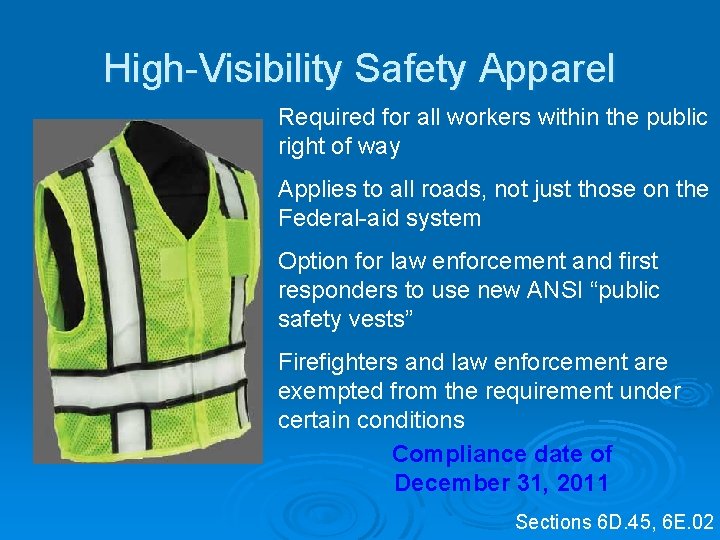
High-Visibility Safety Apparel Required for all workers within the public right of way Applies to all roads, not just those on the Federal-aid system Option for law enforcement and first responders to use new ANSI “public safety vests” Firefighters and law enforcement are exempted from the requirement under certain conditions Compliance date of December 31, 2011 Sections 6 D. 45, 6 E. 02
Part 7 Traffic Control For School Areas
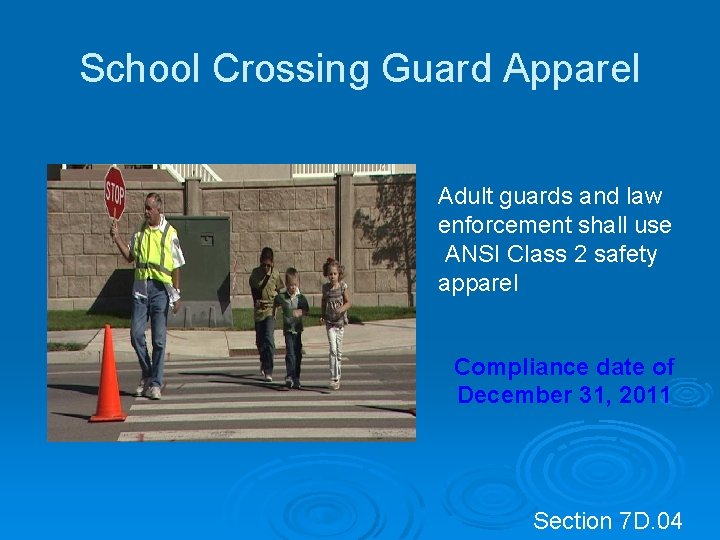
School Crossing Guard Apparel Adult guards and law enforcement shall use ANSI Class 2 safety apparel Compliance date of December 31, 2011 Section 7 D. 04
Part 8 Traffic Control for Railroad and Light Rail Transit Grade Crossings
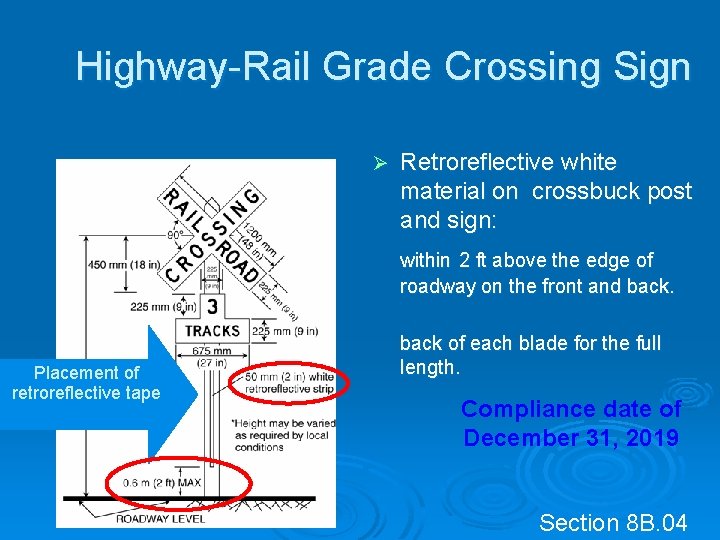
Highway-Rail Grade Crossing Sign Ø Retroreflective white material on crossbuck post and sign: within 2 ft above the edge of roadway on the front and back. Placement of retroreflective tape back of each blade for the full length. Compliance date of December 31, 2019 Section 8 B. 04
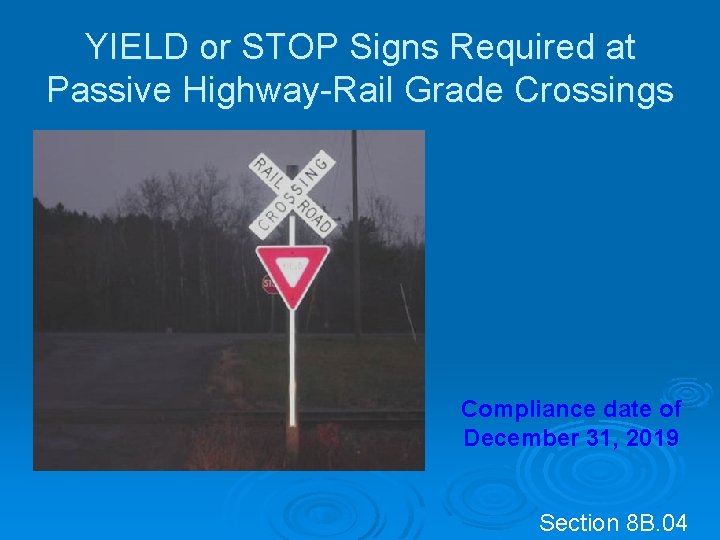
YIELD or STOP Signs Required at Passive Highway-Rail Grade Crossings Compliance date of December 31, 2019 Section 8 B. 04
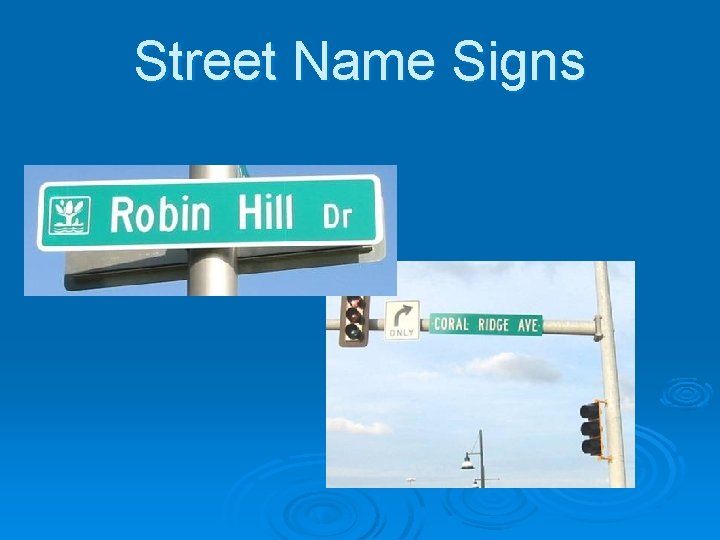
Street Name Signs
Street Name Signs Lettering shall be composed of combination lower case letters with initial upper case letter. Section 2 D. 43
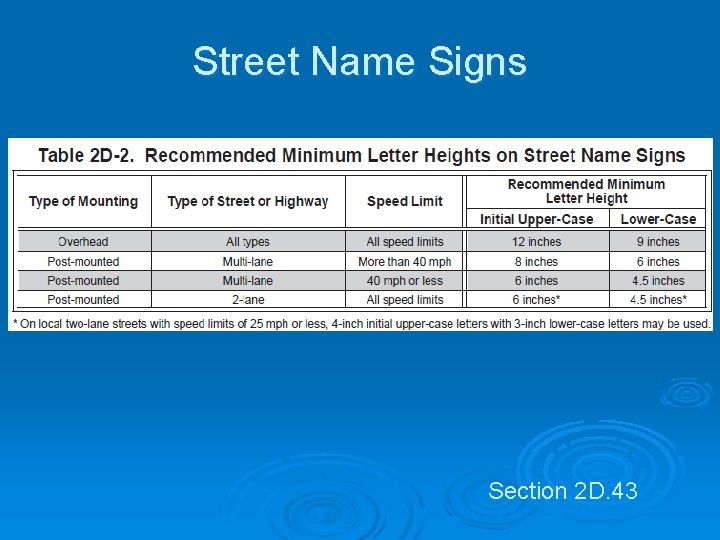
Street Name Signs Section 2 D. 43
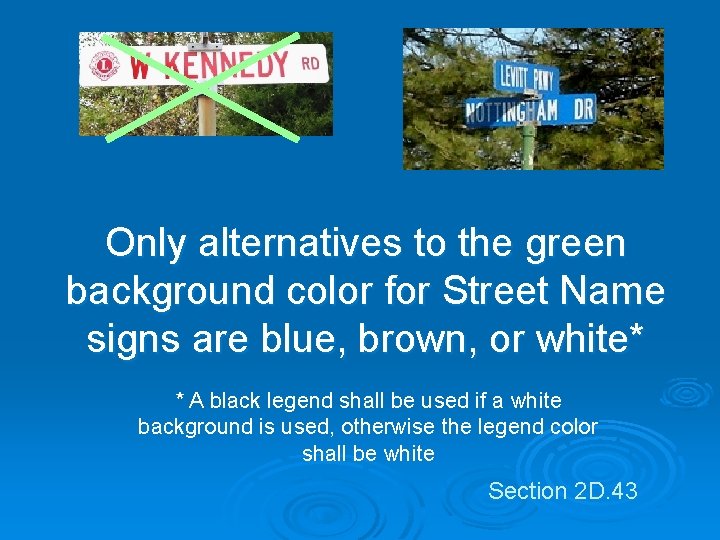
Only alternatives to the green background color for Street Name signs are blue, brown, or white* * A black legend shall be used if a white background is used, otherwise the legend color shall be white Section 2 D. 43
Private Roads
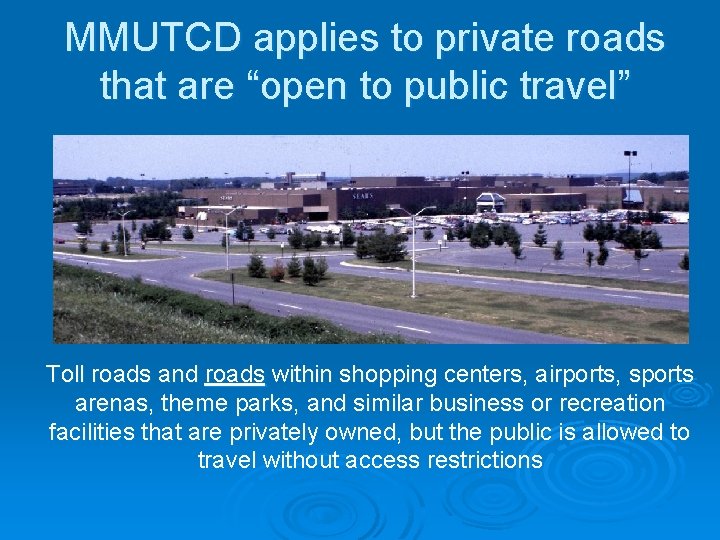
MMUTCD applies to private roads that are “open to public travel” Toll roads and roads within shopping centers, airports, sports arenas, theme parks, and similar business or recreation facilities that are privately owned, but the public is allowed to travel without access restrictions
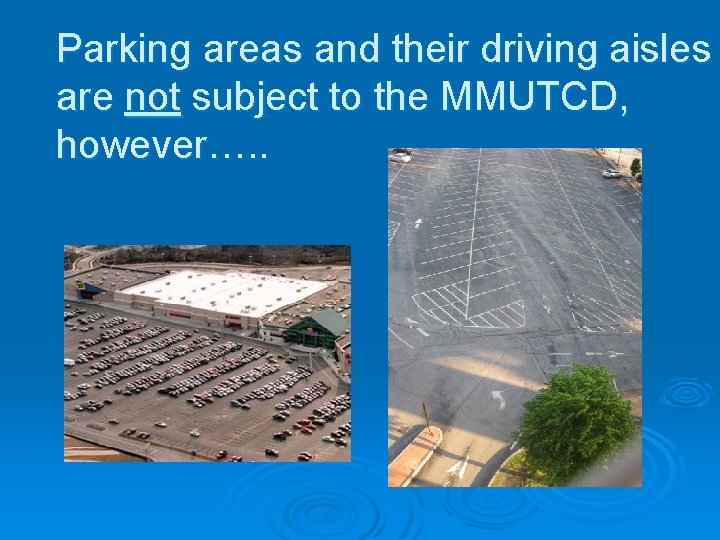
Parking areas and their driving aisles are not subject to the MMUTCD, however…. .
Please take note! Ø The Effective date of the MMUTCD is December 1, 2011. Ø The Michigan Manual on Uniform Traffic Control Devices is the document for all Michigan road agencies to follow.
Where to Find the MMUTCD Ø Download the 2011 MMUTCD l http: //mdotwas 1. mdot. state. mi. us/public/tands /Details_Web/mmutcdcompleteinteractive. pdf Ø Order the 2011 MMUTCD l l l 1 -517 -322 -1676 #60 MMUTCD - $143. 99 #61 Part 6 - free