
The MJO signal in tropical cyclone activity A
- Slides: 21
The MJO signal in tropical cyclone activity A study using a genesis potential index Suzana J. Camargo Lamont-Doherty Earth Observatory, Columbia University, Palisades, NY Matthew C. Wheeler Centre for Australian Weather and Climate Research, Melbourne, Australia Adam H. Sobel Columbia University, New York, NY
The convective phase of the MJO brings increased TC activity in many basins. By what mechanism does this occur? We examine this using an empirical genesis potential index. To the extent that the GP index captures the MJO signal in TC activity, it gives us an objective way to compare quantitatively the influence of different environmental factors (humidity, wind shear etc. ) all of which are modulated by the MJO.
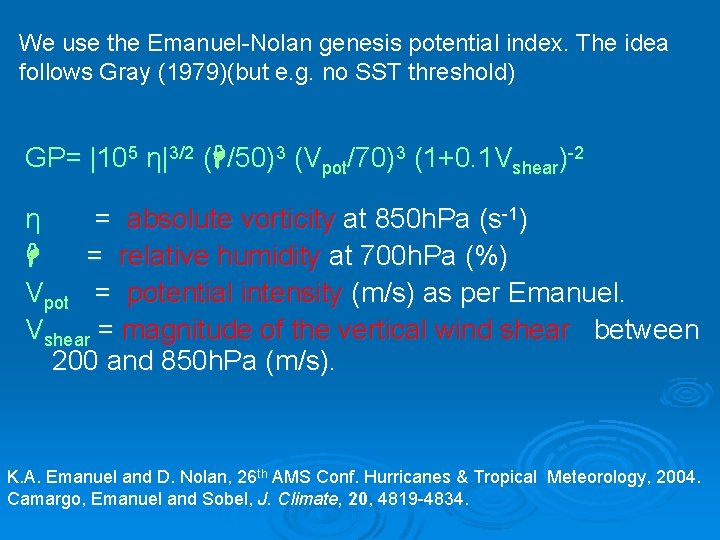
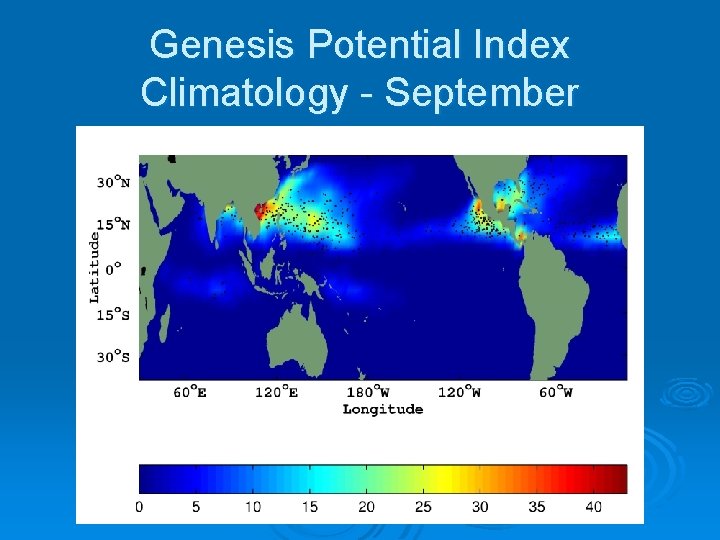
We use the Emanuel-Nolan genesis potential index. The idea follows Gray (1979)(but e. g. no SST threshold) GP= |105 η|3/2 (H/50)3 (Vpot/70)3 (1+0. 1 Vshear)-2 η = absolute vorticity at 850 h. Pa (s-1) H = relative humidity at 700 h. Pa (%) Vpot = potential intensity (m/s) as per Emanuel. Vshear = magnitude of the vertical wind shear between 200 and 850 h. Pa (m/s). K. A. Emanuel and D. Nolan, 26 th AMS Conf. Hurricanes & Tropical Meteorology, 2004. Camargo, Emanuel and Sobel, J. Climate, 20, 4819 -4834.
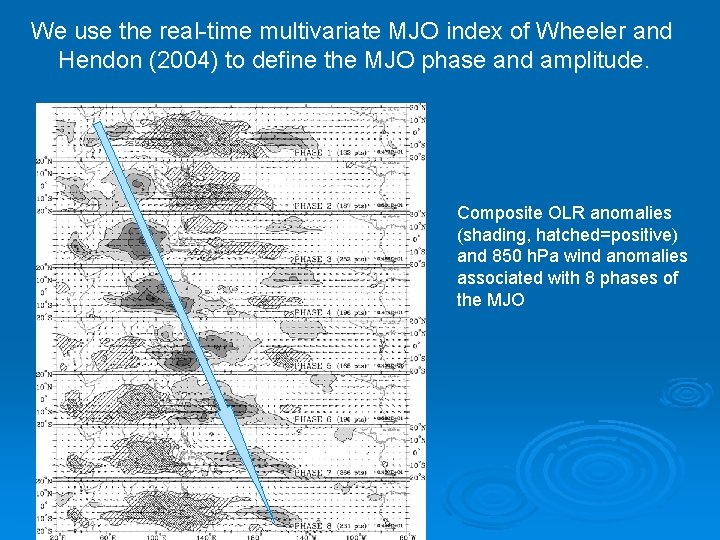
We use the real-time multivariate MJO index of Wheeler and Hendon (2004) to define the MJO phase and amplitude. Composite OLR anomalies (shading, hatched=positive) and 850 h. Pa wind anomalies associated with 8 phases of the MJO
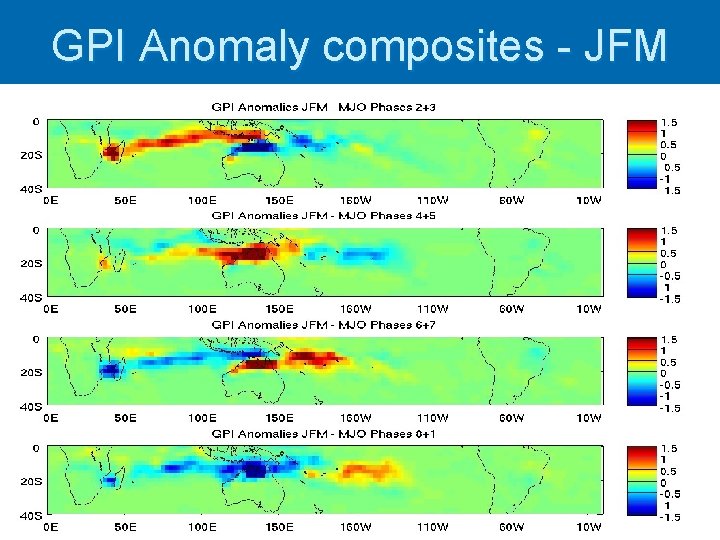
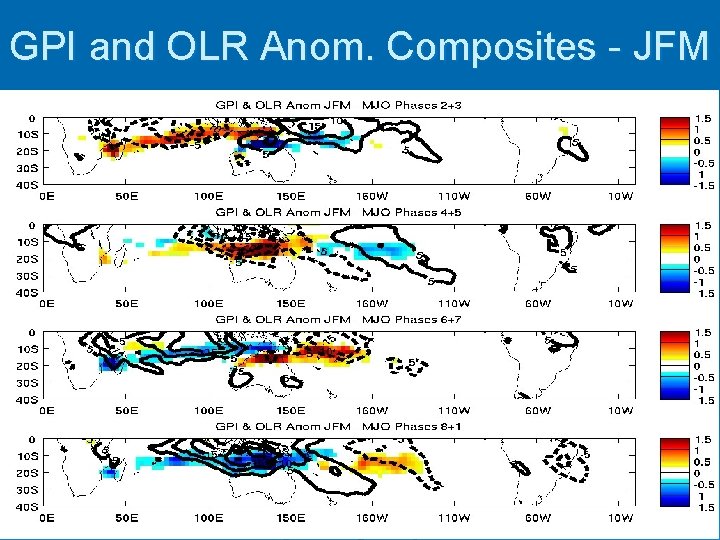
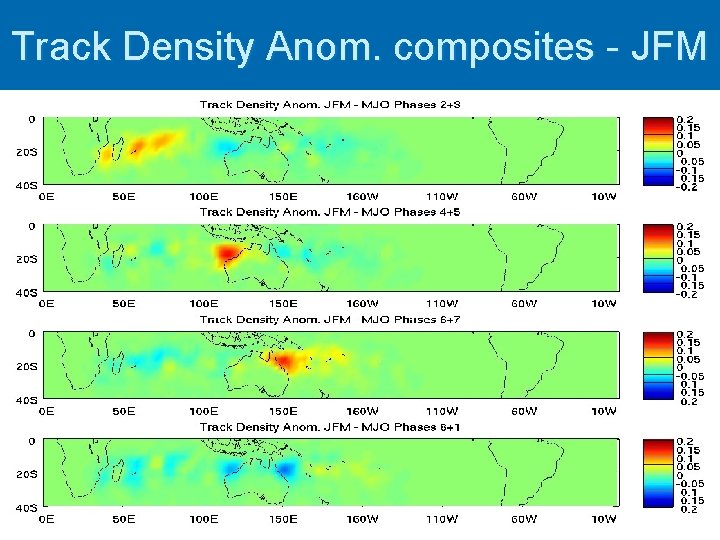
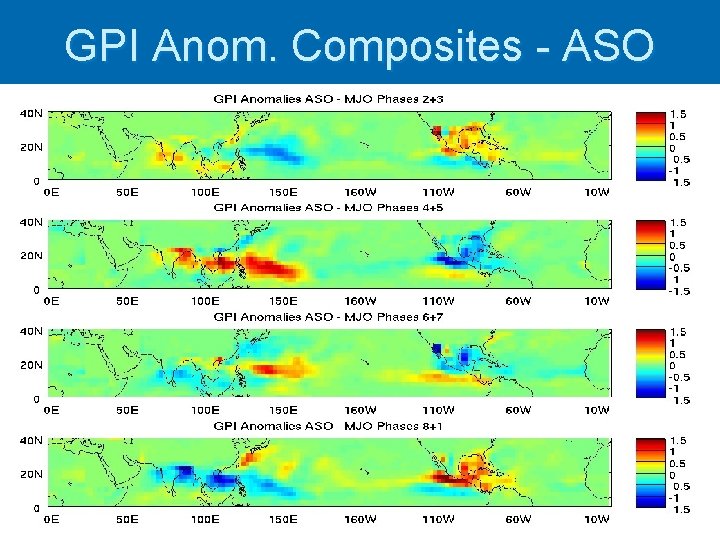
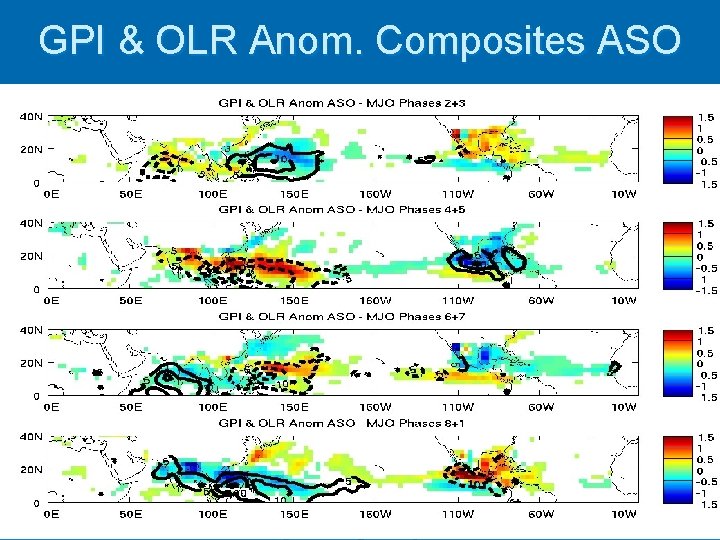
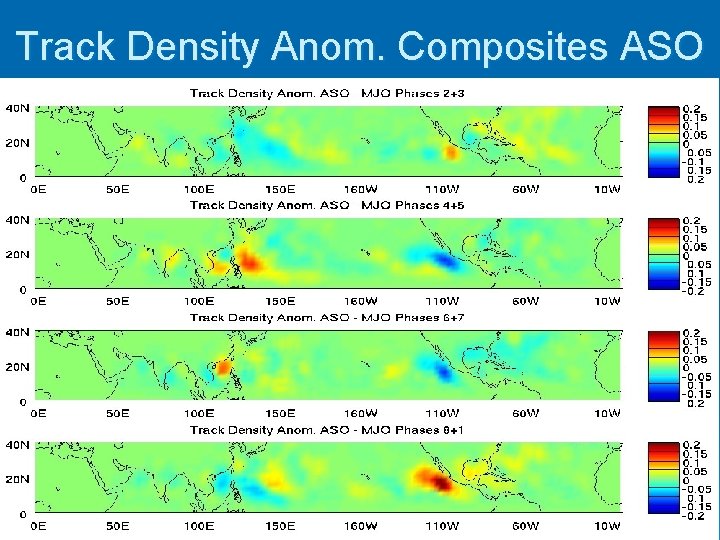
We compute MJO anomaly composites for the GPI (computed from NCEP Reanalysis data – similar results from ECMWF) and for observed TC genesis density and track density (computed from best track data sets).
GPI Anomaly composites - JFM
GPI and OLR Anom. Composites - JFM
Track Density Anom. composites - JFM
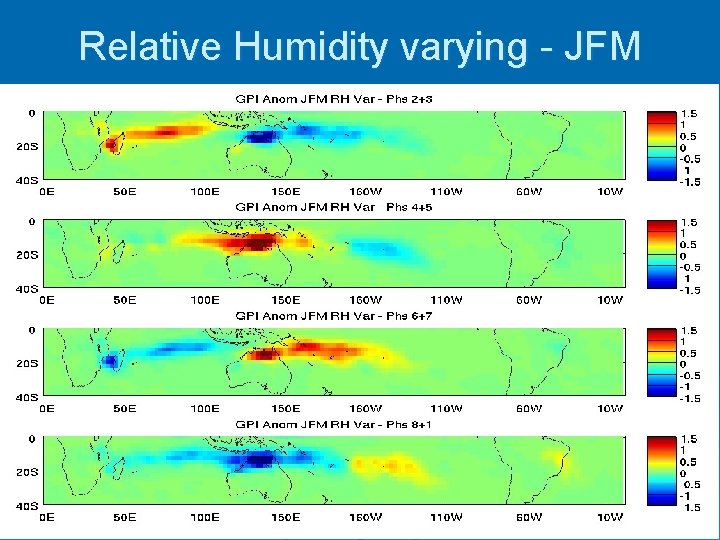
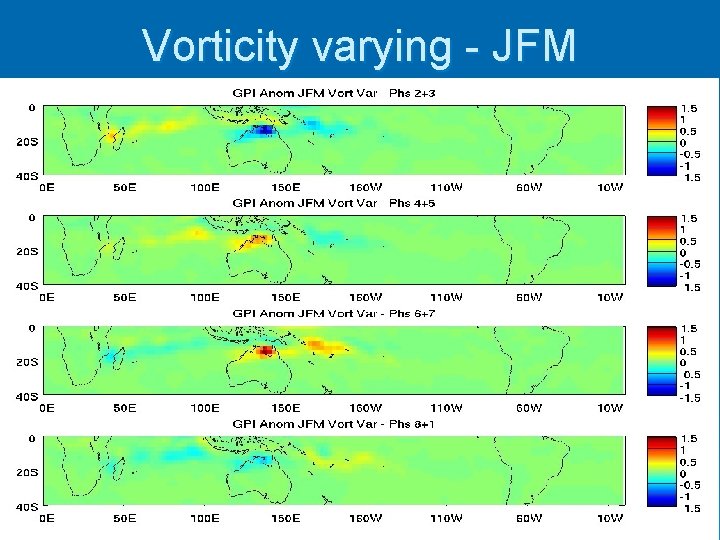
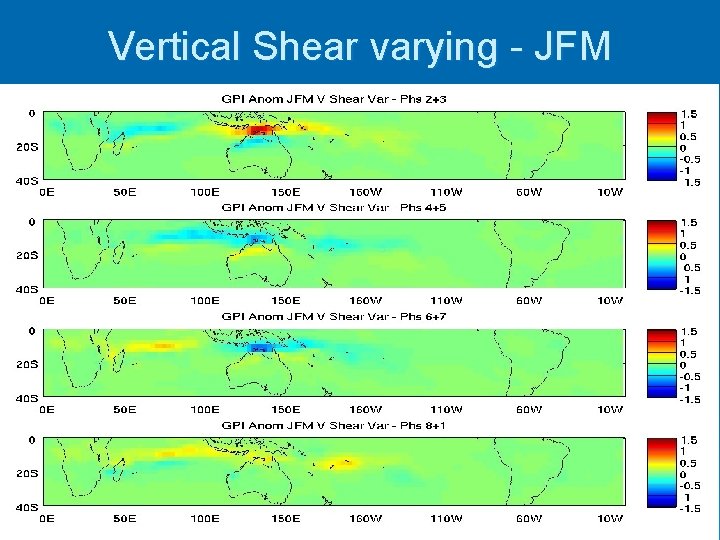
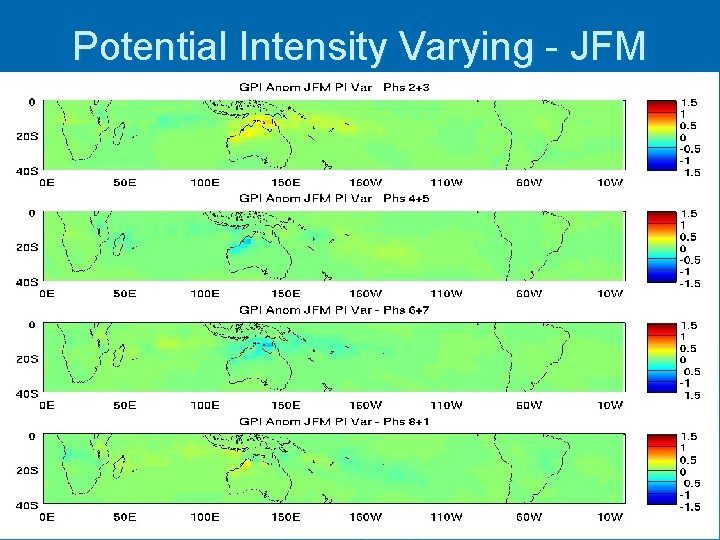
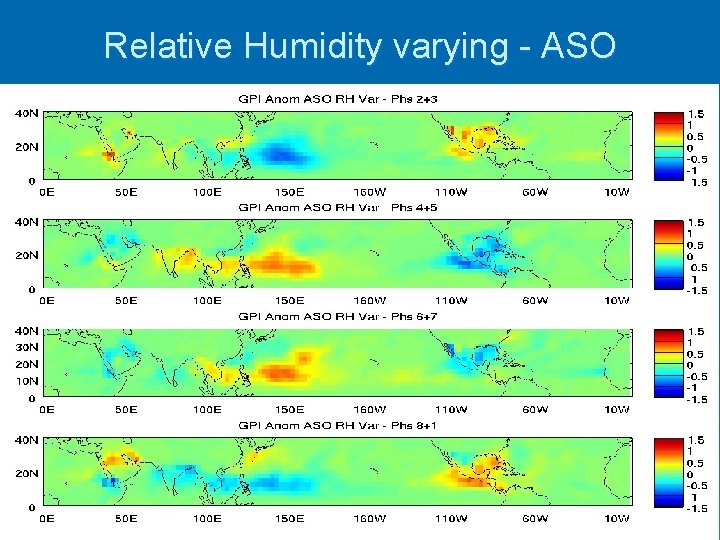
Having shown that the GPI captures the MJO signal in TC activity, we use it to assess which factor is most important in producing that signal – potential intensity, low-level absolute vorticity, vertical wind shear, or midlevel relative humidity? We do this by constructing a new GPI in which 3 of 4 factors are set to climatology and the 4 th is allowed to fluctuate. We do this for all 4 factors. This gives us a set of anomalies in each individual factor which is weighted appropriately to compare its influence on TC activity to that of the others.
Relative Humidity varying - JFM
Vorticity varying - JFM
Vertical Shear varying - JFM
Potential Intensity Varying - JFM
Relative Humidity varying - ASO
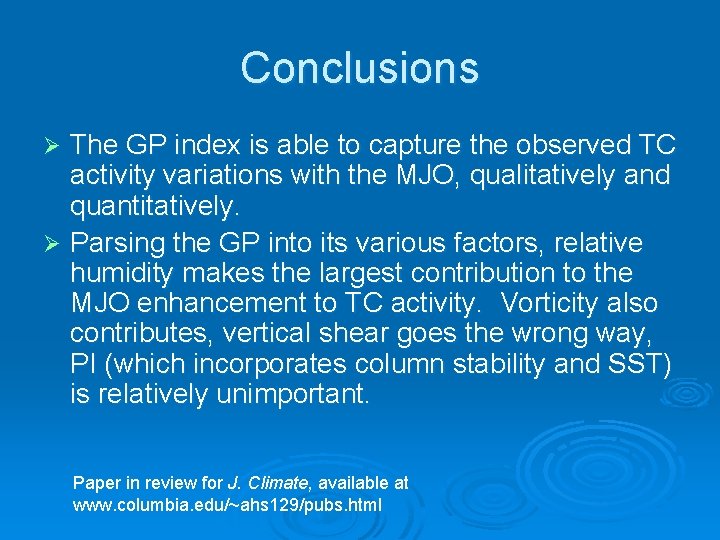
Conclusions The GP index is able to capture the observed TC activity variations with the MJO, qualitatively and quantitatively. Ø Parsing the GP into its various factors, relative humidity makes the largest contribution to the MJO enhancement to TC activity. Vorticity also contributes, vertical shear goes the wrong way, PI (which incorporates column stability and SST) is relatively unimportant. Ø Paper in review for J. Climate, available at www. columbia. edu/~ahs 129/pubs. html
GPI Anom. Composites - ASO
GPI & OLR Anom. Composites ASO
Track Density Anom. Composites ASO
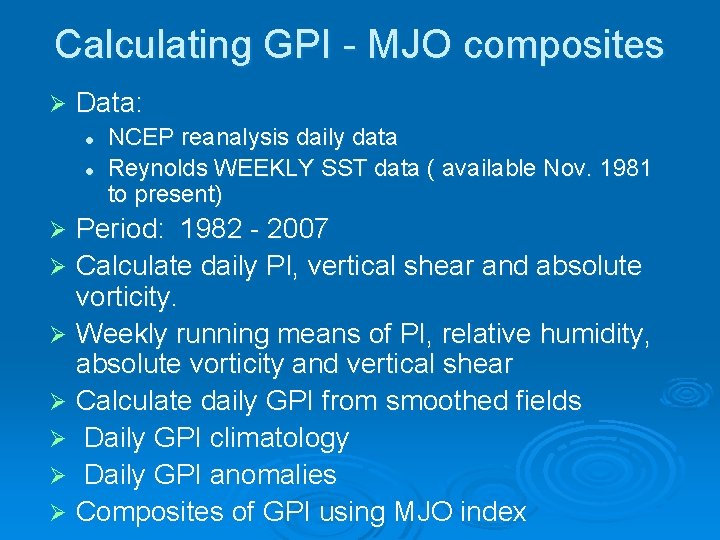
Calculating GPI - MJO composites Ø Data: l l NCEP reanalysis daily data Reynolds WEEKLY SST data ( available Nov. 1981 to present) Period: 1982 - 2007 Ø Calculate daily PI, vertical shear and absolute vorticity. Ø Weekly running means of PI, relative humidity, absolute vorticity and vertical shear Ø Calculate daily GPI from smoothed fields Ø Daily GPI climatology Ø Daily GPI anomalies Ø Composites of GPI using MJO index Ø
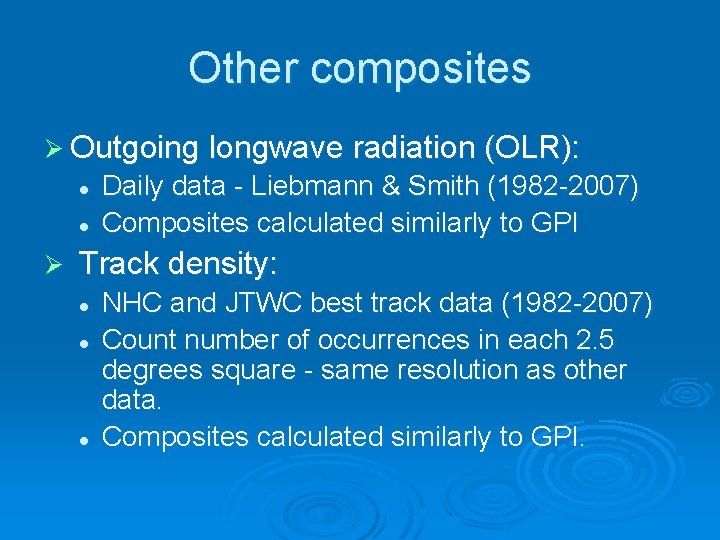
Other composites Ø Outgoing longwave radiation (OLR): l l Ø Daily data - Liebmann & Smith (1982 -2007) Composites calculated similarly to GPI Track density: l l l NHC and JTWC best track data (1982 -2007) Count number of occurrences in each 2. 5 degrees square - same resolution as other data. Composites calculated similarly to GPI.
Genesis Potential Index Climatology - September