
The Mitra Bridge international study Mitra Clip procedure
The “Mitra. Bridge” international study Mitra. Clip procedure as a bridge therapy for heart transplantation Cosmo Godino, MD San Raffaele Hospital, Milan, Italy
Potential conflicts of interest Speaker's name : Cosmo Godino ☑ I do not have any potential conflict of interest to declare
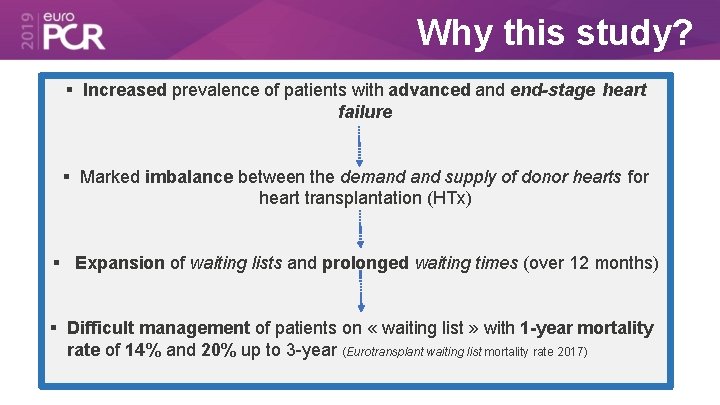
Why this study? Increased prevalence of patients with advanced and end-stage heart failure Marked imbalance between the demand supply of donor hearts for heart transplantation (HTx) Expansion of waiting lists and prolonged waiting times (over 12 months) Difficult management of patients on « waiting list » with 1 -year mortality rate of 14% and 20% up to 3 -year (Eurotransplant waiting list mortality rate 2017)
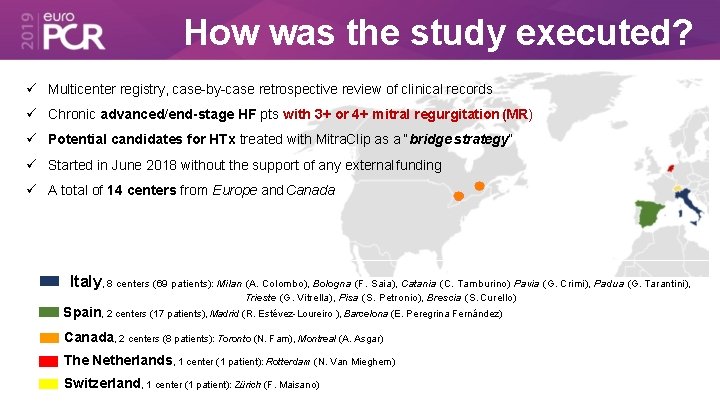
How was the study executed? Multicenter registry, case-by-case retrospective review of clinical records Chronic advanced/end-stage HF pts with 3+ or 4+ mitral regurgitation (MR) Potential candidates for HTx treated with Mitra. Clip as a “bridge strategy” Started in June 2018 without the support of any external funding A total of 14 centers from Europe and Canada Italy, 8 centers (69 patients): Milan (A. Colombo), Bologna (F. Saia), Catania (C. Tamburino) Pavia (G. Crimi), Padua (G. Tarantini), Trieste (G. Vitrella), Pisa (S. Petronio), Brescia (S. Curello) Spain, 2 centers (17 patients), Madrid (R. Estévez-Loureiro ), Barcelona (E. Peregrina Fernández) Canada, 2 centers (8 patients): Toronto (N. Fam), Montreal (A. Asgar) The Netherlands, 1 center (1 patient): Rotterdam (N. Van Mieghem) Switzerland, 1 center (1 patient): Zürich (F. Maisano)
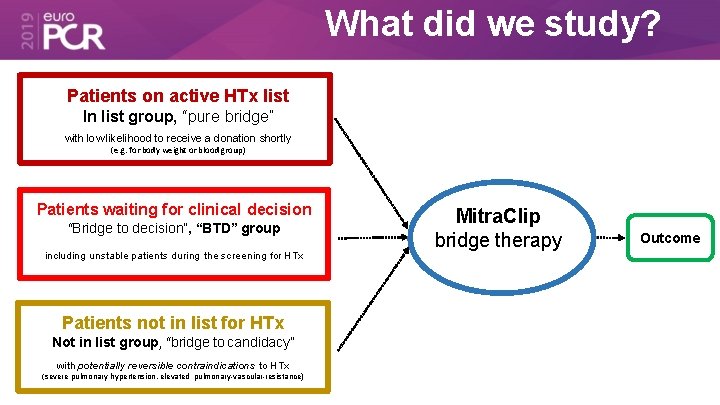
What did we study? Patients on active HTx list In list group, “pure bridge” with low likelihood to receive a donation shortly (e. g. for body weight or blood group) Patients waiting for clinical decision “Bridge to decision”, “BTD” group including unstable patients during the screening for HTx Patients not in list for HTx Not in list group, “bridge to candidacy” with potentially reversible contraindications to HTx (severe pulmonary hypertension, elevated pulmonary-vascular-resistance) Mitra. Clip bridge therapy Outcome
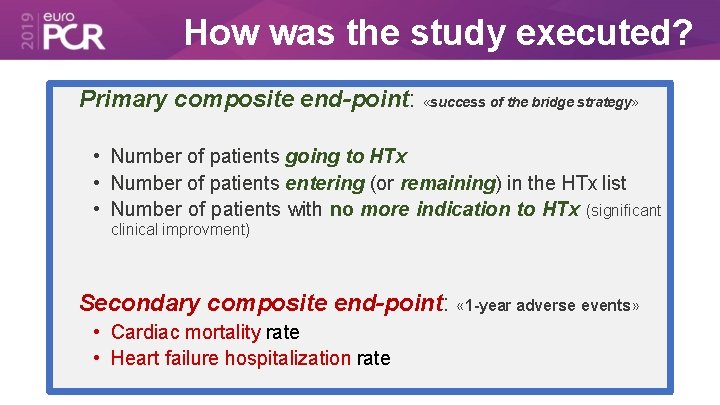
How was the study executed? Primary composite end-point: «success of the bridge strategy» • Number of patients going to HTx • Number of patients entering (or remaining) in the HTx list • Number of patients with no more indication to HTx (significant clinical improvment) Secondary composite end-point: « 1 -year adverse events» • Cardiac mortality rate • Heart failure hospitalization rate
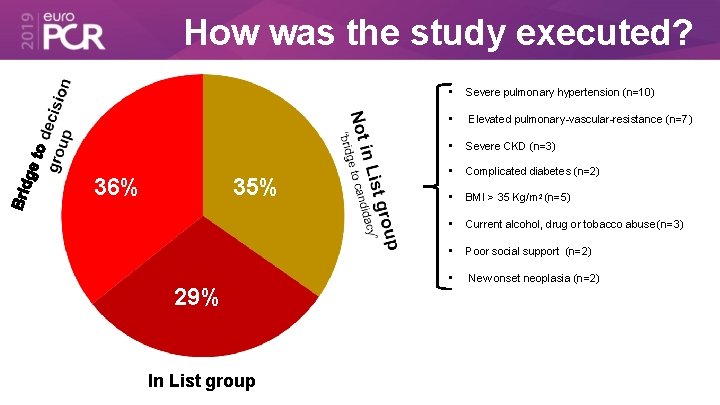
How was the study executed? 36% 35% 29% In List group • Severe pulmonary hypertension (n=10) • Elevated pulmonary-vascular-resistance (n=7) • Severe CKD (n=3) • Complicated diabetes (n=2) • BMI > 35 Kg/m 2 (n=5) • Current alcohol, drug or tobacco abuse (n=3) • Poor social support (n=2) • New onset neoplasia (n=2)
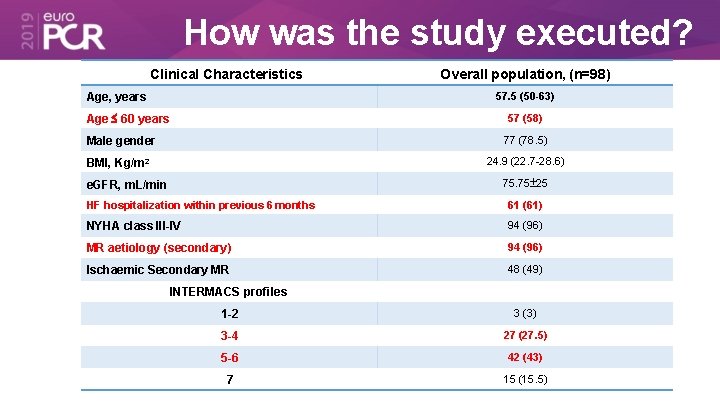
How was the study executed? Clinical Characteristics Overall population, (n=98) 57. 5 (50 -63) Age, years Age 60 years 57 (58) Male gender 77 (78. 5) BMI, Kg/m 2 24. 9 (22. 7 -28. 6) 75. 75 25 e. GFR, m. L/min HF hospitalization within previous 6 months 61 (61) NYHA class III-IV 94 (96) MR aetiology (secondary) 94 (96) Ischaemic Secondary MR 48 (49) INTERMACS profiles 1 -2 3 (3) 3 -4 27 (27. 5) 5 -6 42 (43) 7 15 (15. 5)
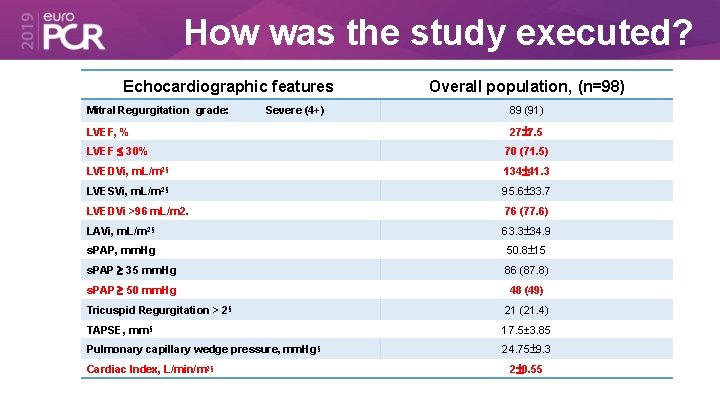
How was the study executed? Echocardiographic features Mitral Regurgitation grade: Severe (4+) LVEF, % Overall population, (n=98) 89 (91) 27 7. 5 LVEF 30% 70 (71. 5) LVEDVi, m. L/m 2§ 134 41. 3 LVESVi, m. L/m 2§ 95. 6 33. 7 LVEDVi >96 m. L/m 2. 76 (77. 6) LAVi, m. L/m 2§ 63. 3 34. 9 s. PAP, mm. Hg 50. 8 15 s. PAP 35 mm. Hg 86 (87. 8) s. PAP 50 mm. Hg 48 (49) Tricuspid Regurgitation > 2§ 21 (21. 4) TAPSE, mm§ 17. 5± 3. 85 Pulmonary capillary wedge pressure, mm. Hg§ 24. 75 9. 3 Cardiac Index, L/min/m 2§ 2 0. 55
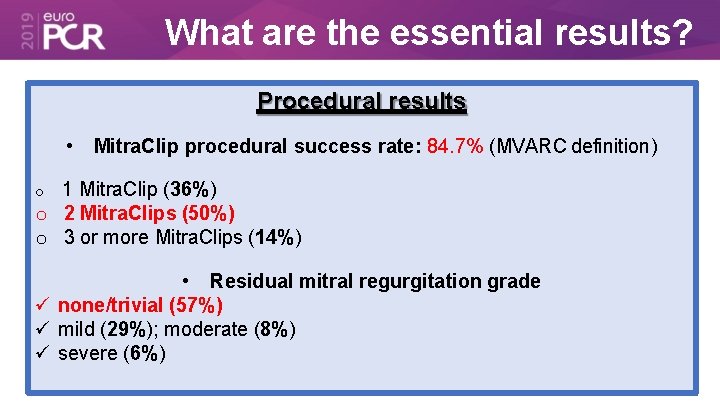
What are the essential results? Procedural results • Mitra. Clip procedural success rate: 84. 7% (MVARC definition) 1 Mitra. Clip (36%) o 2 Mitra. Clips (50%) o 3 or more Mitra. Clips (14%) o • Residual mitral regurgitation grade none/trivial (57%) mild (29%); moderate (8%) severe (6%)
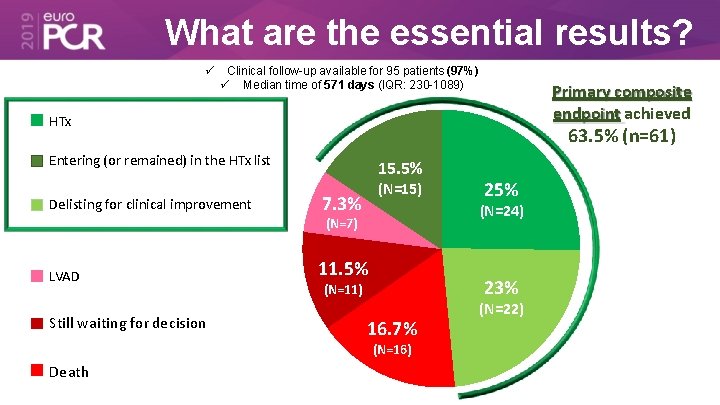
What are the essential results? Clinical follow-up available for 95 patients (97%) Median time of 571 days (IQR: 230 -1089) Primary composite endpoint achieved HTx 63. 5% (n=61) Entering (or remained) in the HTx list Delisting for clinical improvement 15. 5% (N=15) 7. 3% (N=24) (N=7) LVAD Still waiting for decision 11. 5% 23% (N=11) 16. 7% (N=16) Death 25% (N=22)
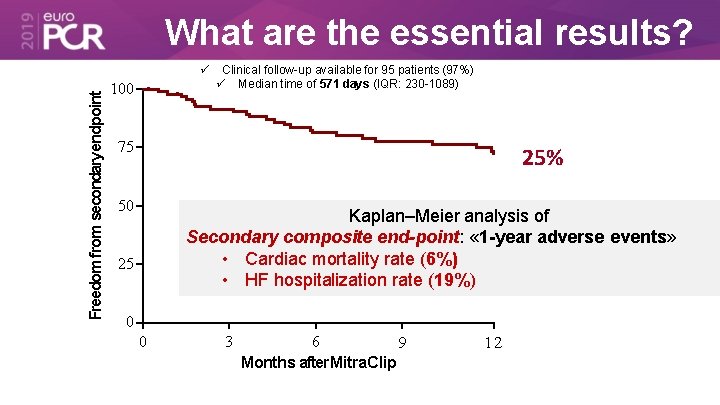
What are the essential results? Freedom from secondaryendpoint 100 Clinical follow-up available for 95 patients (97%) Median time of 571 days (IQR: 230 -1089) 75 25% 50 Kaplan–Meier analysis of Secondary composite end-point: « 1 -year adverse events» • Cardiac mortality rate (6%) • HF hospitalization rate (19%) 25 0 0 3 6 9 Months after Mitra. Clip 12
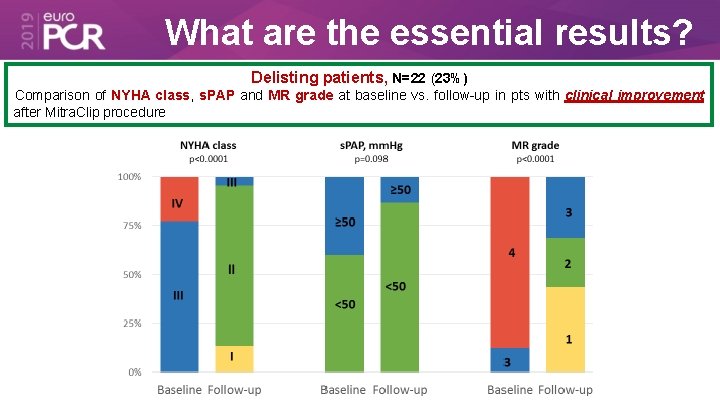
What are the essential results? Delisting patients, N=22 (23%) Comparison of NYHA class, s. PAP and MR grade at baseline vs. follow-up in pts with clinical improvement after Mitra. Clip procedure
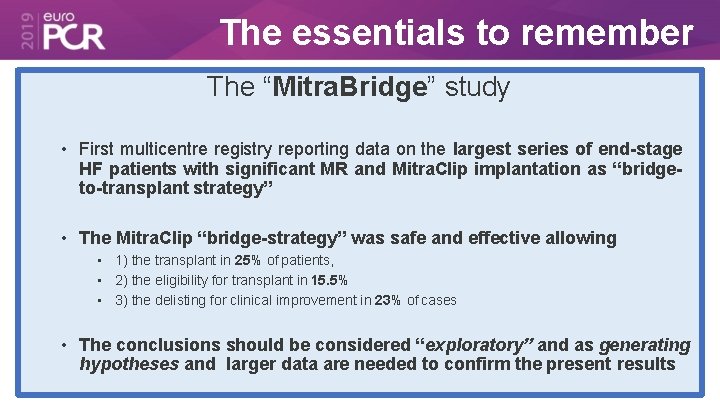
The essentials to remember The “Mitra. Bridge” study • First multicentre registry reporting data on the largest series of end-stage HF patients with significant MR and Mitra. Clip implantation as “bridgeto-transplant strategy” • The Mitra. Clip “bridge-strategy” was safe and effective allowing • 1) the transplant in 25% of patients, • 2) the eligibility for transplant in 15. 5% • 3) the delisting for clinical improvement in 23% of cases • The conclusions should be considered “exploratory” and as generating hypotheses and larger data are needed to confirm the present results

m By and Foe you PCRonline. com
- Slides: 15