
The Minnesota Noxious Weed Law and Lists 2017
- Slides: 73
The Minnesota Noxious Weed Law and Lists 2017 Prepared by Anthony Cortilet Minnesota Department of Agriculture Noxious and Invasive Weed Program
MN Department of Agriculture Noxious and Invasive Weed Unit Website www. mda. state. mn. us/weedcontrol
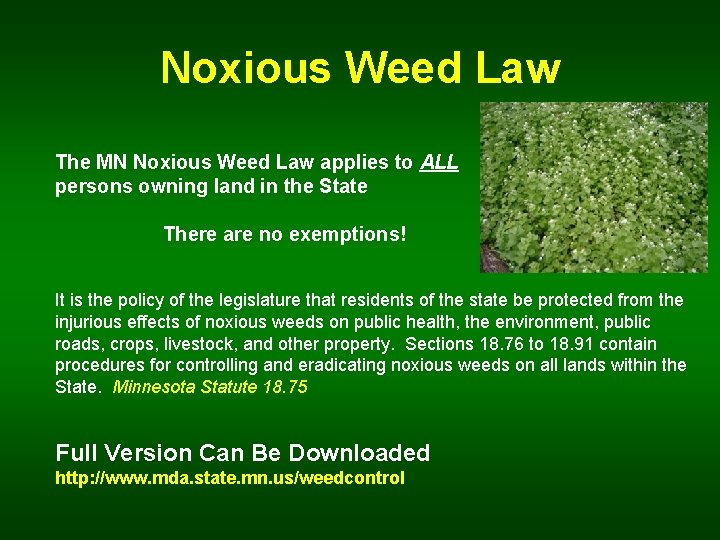
Noxious Weed Law The MN Noxious Weed Law applies to ALL persons owning land in the State There are no exemptions! It is the policy of the legislature that residents of the state be protected from the injurious effects of noxious weeds on public health, the environment, public roads, crops, livestock, and other property. Sections 18. 76 to 18. 91 contain procedures for controlling and eradicating noxious weeds on all lands within the State. Minnesota Statute 18. 75 Full Version Can Be Downloaded http: //www. mda. state. mn. us/weedcontrol
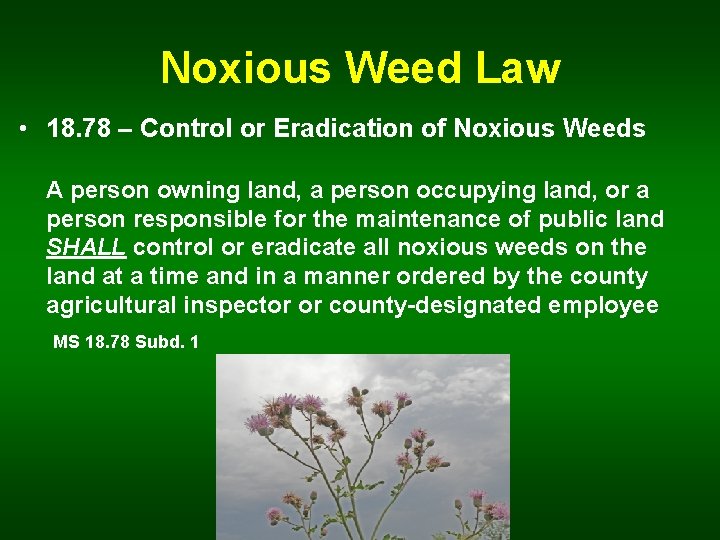
Noxious Weed Law • 18. 78 – Control or Eradication of Noxious Weeds A person owning land, a person occupying land, or a person responsible for the maintenance of public land SHALL control or eradicate all noxious weeds on the land at a time and in a manner ordered by the county agricultural inspector or county-designated employee MS 18. 78 Subd. 1
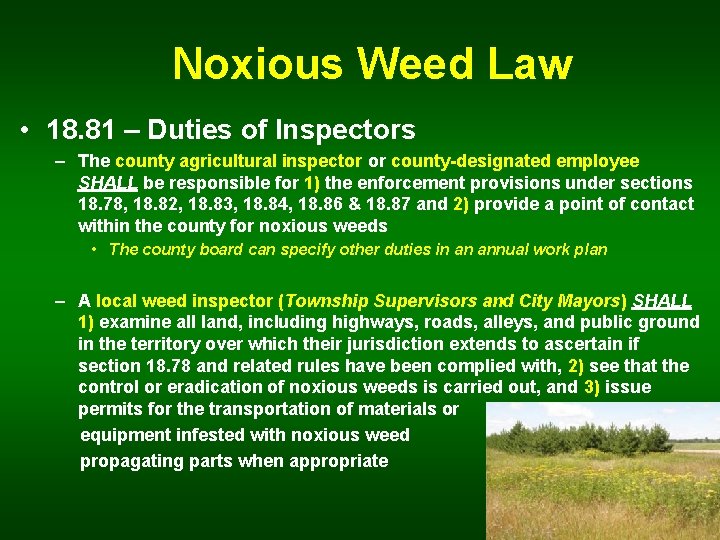
Noxious Weed Law • 18. 81 – Duties of Inspectors – The county agricultural inspector or county-designated employee SHALL be responsible for 1) the enforcement provisions under sections 18. 78, 18. 82, 18. 83, 18. 84, 18. 86 & 18. 87 and 2) provide a point of contact within the county for noxious weeds • The county board can specify other duties in an annual work plan – A local weed inspector (Township Supervisors and City Mayors) SHALL 1) examine all land, including highways, roads, alleys, and public ground in the territory over which their jurisdiction extends to ascertain if section 18. 78 and related rules have been complied with, 2) see that the control or eradication of noxious weeds is carried out, and 3) issue permits for the transportation of materials or equipment infested with noxious weed propagating parts when appropriate
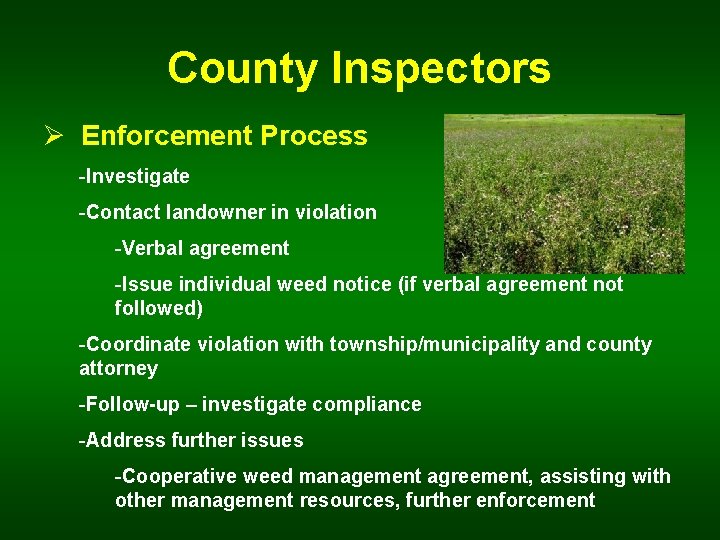
County Inspectors Ø Enforcement Process -Investigate -Contact landowner in violation -Verbal agreement -Issue individual weed notice (if verbal agreement not followed) -Coordinate violation with township/municipality and county attorney -Follow-up – investigate compliance -Address further issues -Cooperative weed management agreement, assisting with other management resources, further enforcement
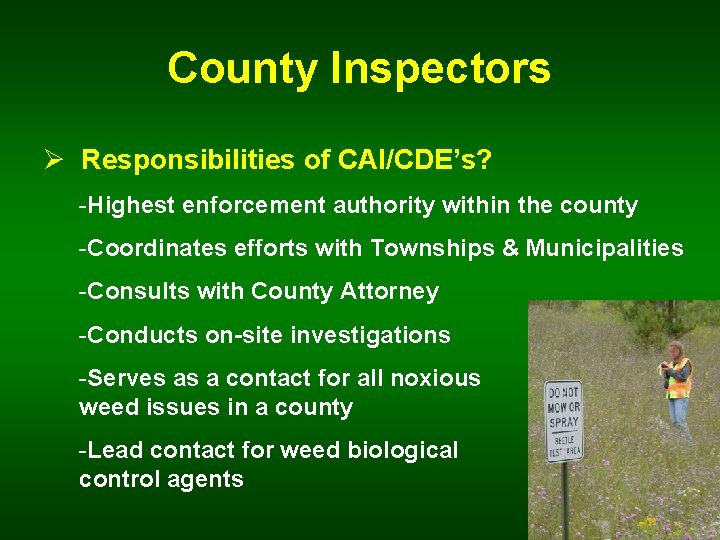
County Inspectors Ø Responsibilities of CAI/CDE’s? -Highest enforcement authority within the county -Coordinates efforts with Townships & Municipalities -Consults with County Attorney -Conducts on-site investigations -Serves as a contact for all noxious weed issues in a county -Lead contact for weed biological control agents
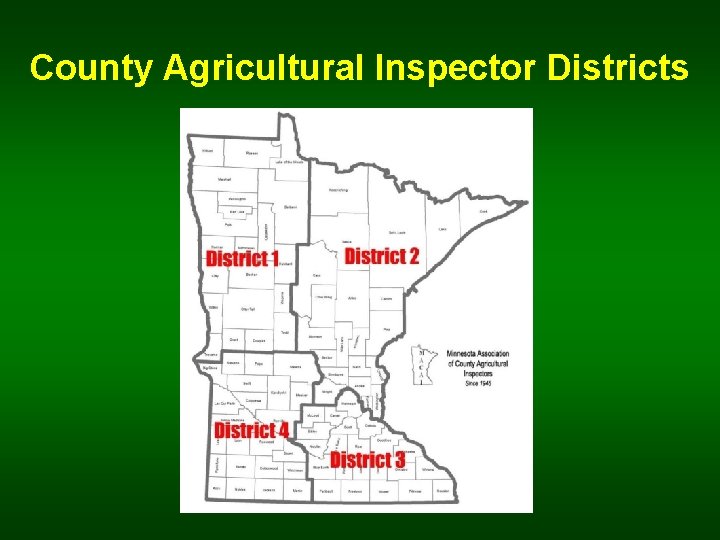
County Agricultural Inspector Districts
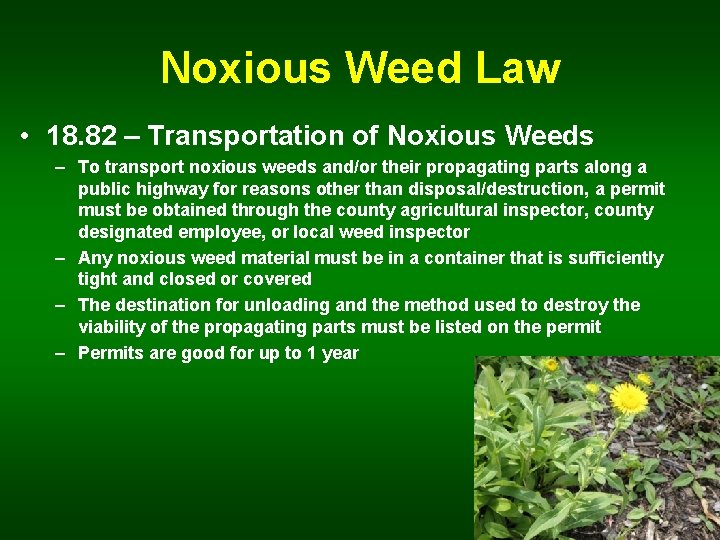
Noxious Weed Law • 18. 82 – Transportation of Noxious Weeds – To transport noxious weeds and/or their propagating parts along a public highway for reasons other than disposal/destruction, a permit must be obtained through the county agricultural inspector, county designated employee, or local weed inspector – Any noxious weed material must be in a container that is sufficiently tight and closed or covered – The destination for unloading and the method used to destroy the viability of the propagating parts must be listed on the permit – Permits are good for up to 1 year
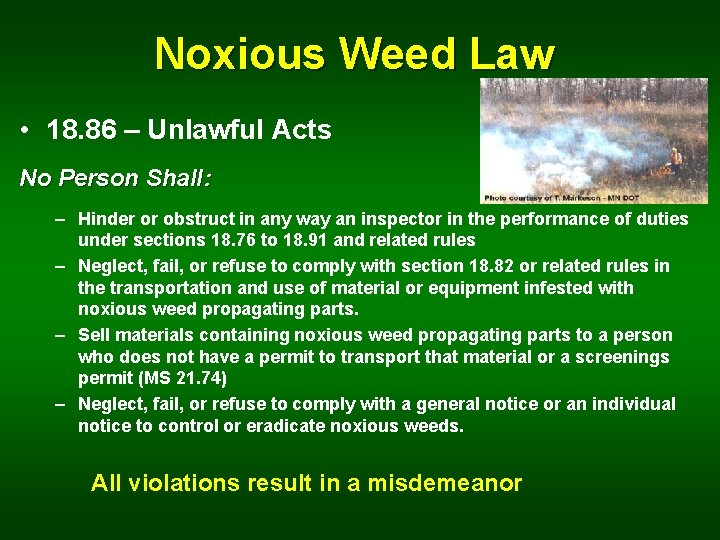
Noxious Weed Law • 18. 86 – Unlawful Acts No Person Shall: – Hinder or obstruct in any way an inspector in the performance of duties under sections 18. 76 to 18. 91 and related rules – Neglect, fail, or refuse to comply with section 18. 82 or related rules in the transportation and use of material or equipment infested with noxious weed propagating parts. – Sell materials containing noxious weed propagating parts to a person who does not have a permit to transport that material or a screenings permit (MS 21. 74) – Neglect, fail, or refuse to comply with a general notice or an individual notice to control or eradicate noxious weeds. All violations result in a misdemeanor
Noxious Weed Law • 18. 88 – Noxious Weed Program Funding – Subd. 1 – County – The county board SHALL pay, from the general revenue or other fund for the county, the expenses for the county agricultural inspector or county-designated employee, for noxious weed control or eradication on all land owned by the county or on land for which the county is responsible for its maintenance and the expenses of the appeal committee – Subd. 2 – Municipality – The municipality SHALL pay, from the general revenue or other fund for the municipality, the necessary expenses of the local weed inspector in the performance of duties required for noxious weed control or eradication on all land owned by the municipality or on land for which the municipality is responsible for its maintenance
Noxious Weed Law • 18. 91 – Noxious Weed Advisory Committee; Membership – Subd. 1 - This committee will assist the Commissioner of Agriculture by evaluating plant species for invasiveness, difficulty of control, costs of control, possible benefits from these species, and amount of injury caused by them. – Subd. 2 – Membership • Representative outlined in this subdivision will serve on the committee.
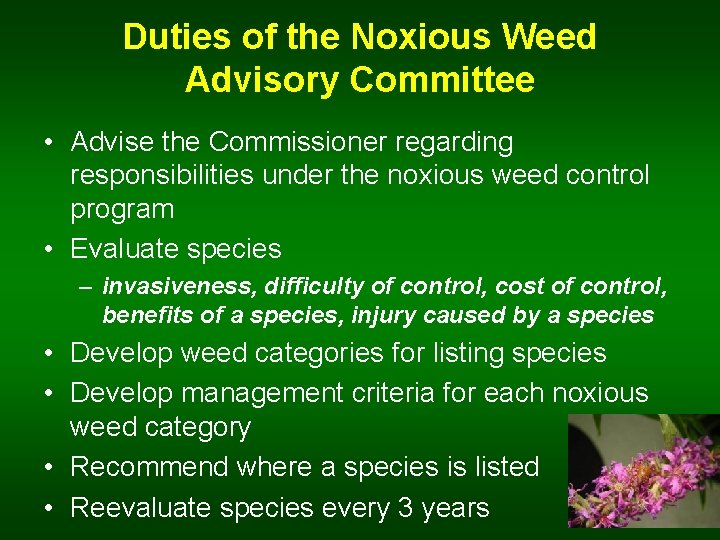
Duties of the Noxious Weed Advisory Committee • Advise the Commissioner regarding responsibilities under the noxious weed control program • Evaluate species – invasiveness, difficulty of control, cost of control, benefits of a species, injury caused by a species • Develop weed categories for listing species • Develop management criteria for each noxious weed category • Recommend where a species is listed • Reevaluate species every 3 years
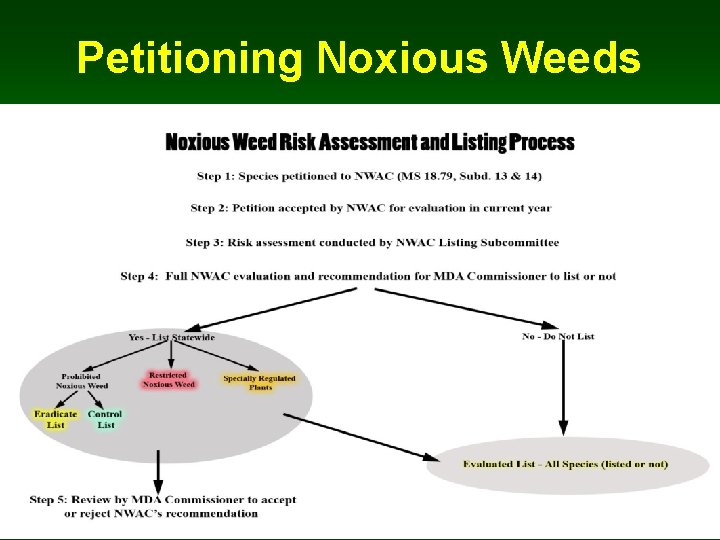
Petitioning Noxious Weeds
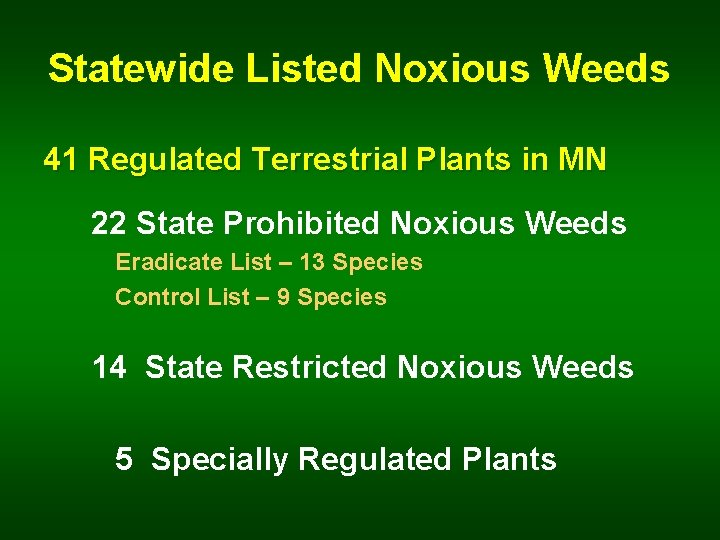
Statewide Listed Noxious Weeds 41 Regulated Terrestrial Plants in MN 22 State Prohibited Noxious Weeds Eradicate List – 13 Species Control List – 9 Species 14 State Restricted Noxious Weeds 5 Specially Regulated Plants
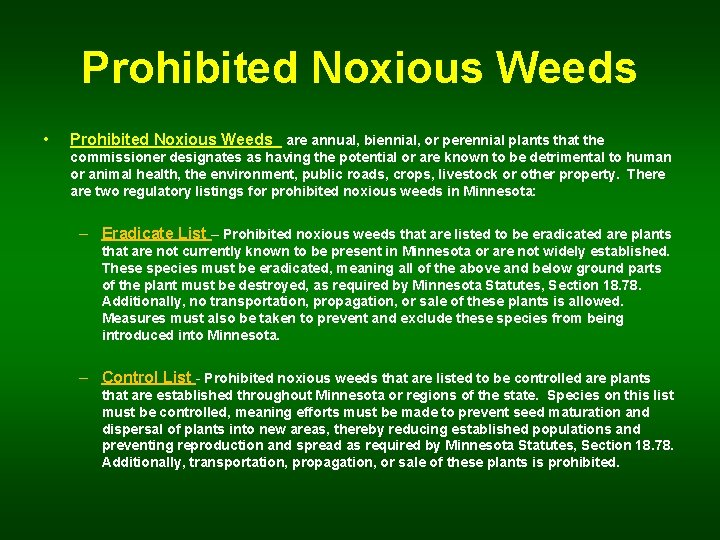
Prohibited Noxious Weeds • Prohibited Noxious Weeds are annual, biennial, or perennial plants that the commissioner designates as having the potential or are known to be detrimental to human or animal health, the environment, public roads, crops, livestock or other property. There are two regulatory listings for prohibited noxious weeds in Minnesota: – Eradicate List – Prohibited noxious weeds that are listed to be eradicated are plants that are not currently known to be present in Minnesota or are not widely established. These species must be eradicated, meaning all of the above and below ground parts of the plant must be destroyed, as required by Minnesota Statutes, Section 18. 78. Additionally, no transportation, propagation, or sale of these plants is allowed. Measures must also be taken to prevent and exclude these species from being introduced into Minnesota. – Control List - Prohibited noxious weeds that are listed to be controlled are plants that are established throughout Minnesota or regions of the state. Species on this list must be controlled, meaning efforts must be made to prevent seed maturation and dispersal of plants into new areas, thereby reducing established populations and preventing reproduction and spread as required by Minnesota Statutes, Section 18. 78. Additionally, transportation, propagation, or sale of these plants is prohibited.
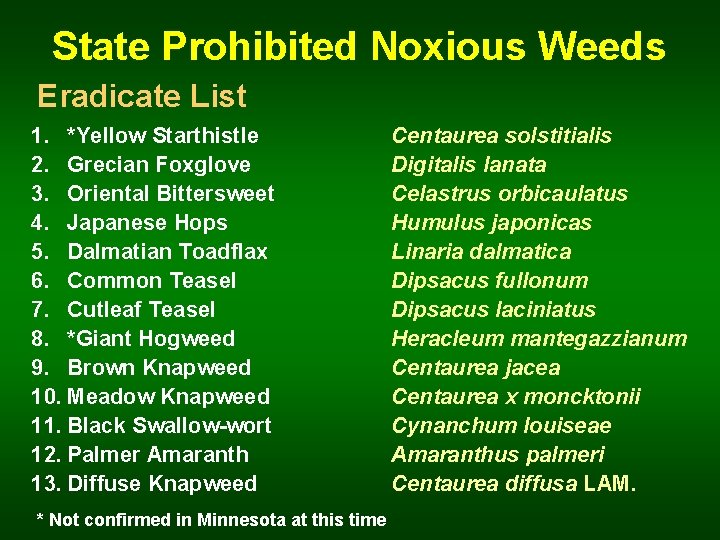
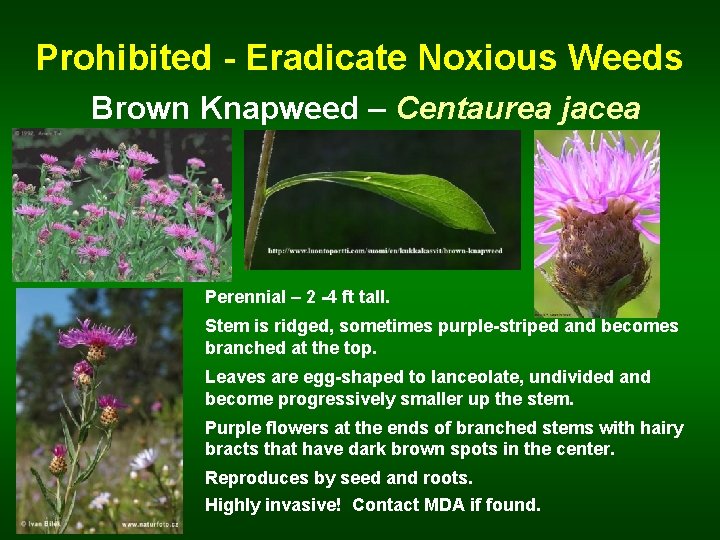
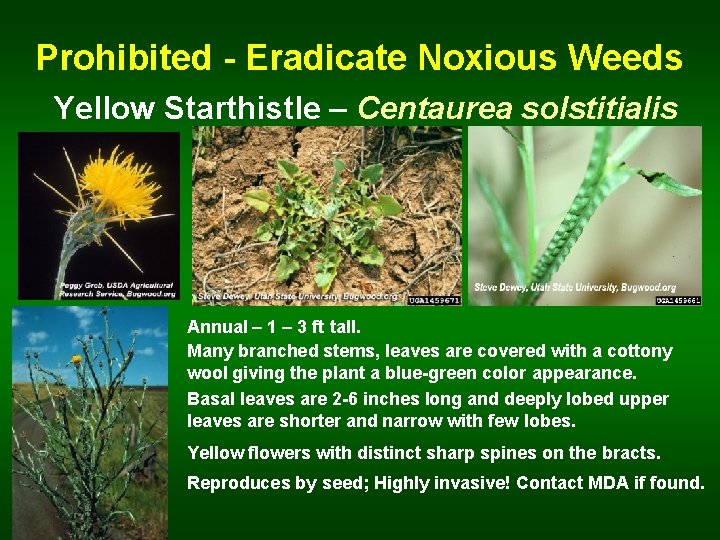
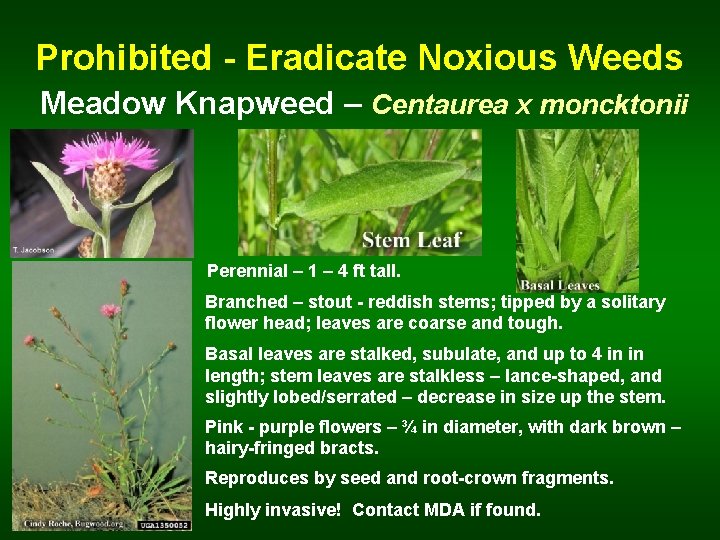
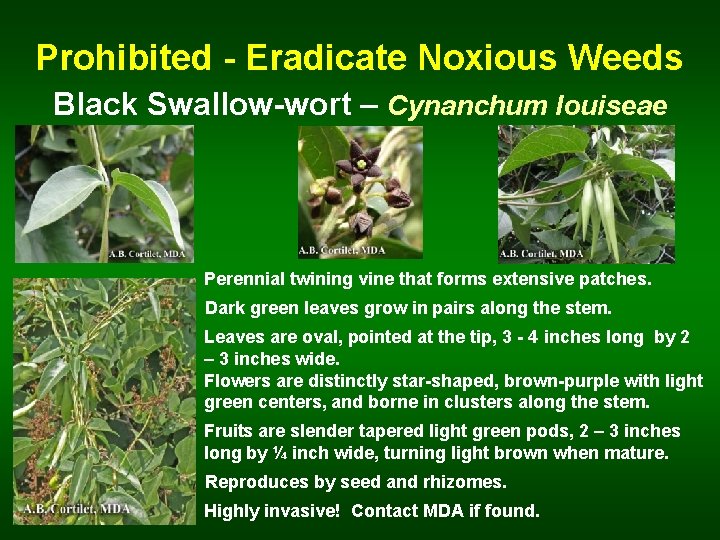
State Prohibited Noxious Weeds Eradicate List 1. *Yellow Starthistle 2. Grecian Foxglove 3. Oriental Bittersweet 4. Japanese Hops 5. Dalmatian Toadflax 6. Common Teasel 7. Cutleaf Teasel 8. *Giant Hogweed 9. Brown Knapweed 10. Meadow Knapweed 11. Black Swallow-wort 12. Palmer Amaranth 13. Diffuse Knapweed * Not confirmed in Minnesota at this time Centaurea solstitialis Digitalis lanata Celastrus orbicaulatus Humulus japonicas Linaria dalmatica Dipsacus fullonum Dipsacus laciniatus Heracleum mantegazzianum Centaurea jacea Centaurea x moncktonii Cynanchum louiseae Amaranthus palmeri Centaurea diffusa LAM.
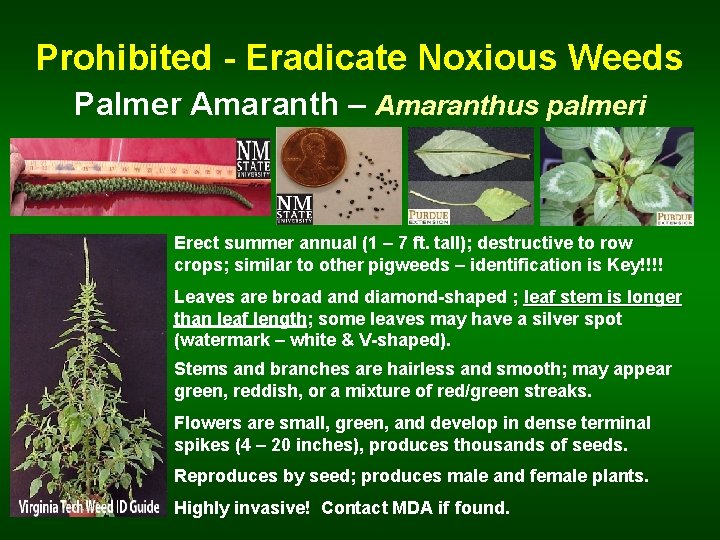
Prohibited - Eradicate Noxious Weeds Palmer Amaranth – Amaranthus palmeri Erect summer annual (1 – 7 ft. tall); destructive to row crops; similar to other pigweeds – identification is Key!!!! Leaves are broad and diamond-shaped ; leaf stem is longer than leaf length; some leaves may have a silver spot than leaf length (watermark – white & V-shaped). Stems and branches are hairless and smooth; may appear green, reddish, or a mixture of red/green streaks. Flowers are small, green, and develop in dense terminal spikes (4 – 20 inches), produces thousands of seeds. Reproduces by seed; produces male and female plants. Highly invasive! Contact MDA if found.
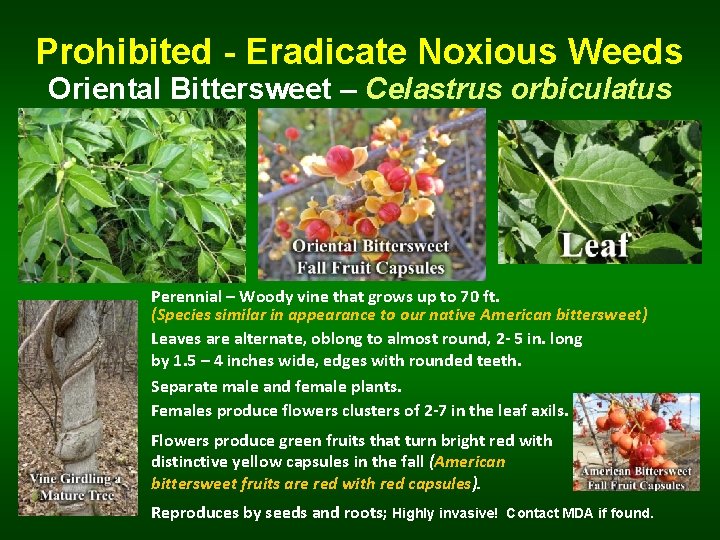
Prohibited - Eradicate Noxious Weeds Oriental Bittersweet – Celastrus orbiculatus Perennial – Woody vine that grows up to 70 ft. (Species similar in appearance to our native American bittersweet) Leaves are alternate, oblong to almost round, 2 - 5 in. long by 1. 5 – 4 inches wide, edges with rounded teeth. Separate male and female plants. Females produce flowers clusters of 2 -7 in the leaf axils. Flowers produce green fruits that turn bright red with distinctive yellow capsules in the fall (American bittersweet fruits are red with red capsules). Reproduces by seeds and roots; Highly invasive! Contact MDA if found.
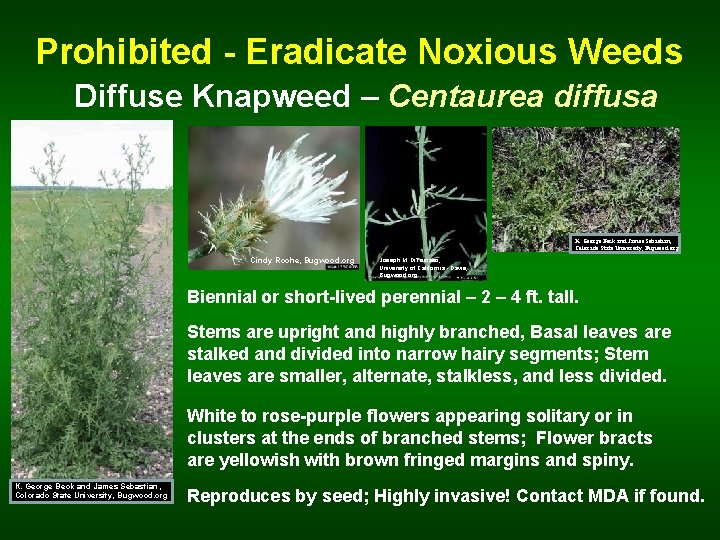
Prohibited - Eradicate Noxious Weeds Diffuse Knapweed – Centaurea diffusa K. George Beck and James Sebastian, Colorado State University, Bugwood. org Cindy Roche, Bugwood. org Joseph M. Di. Tomaso, University of California - Davis, Bugwood. org Biennial or short-lived perennial – 2 – 4 ft. tall. Stems are upright and highly branched, Basal leaves are stalked and divided into narrow hairy segments; Stem leaves are smaller, alternate, stalkless, and less divided. White to rose-purple flowers appearing solitary or in clusters at the ends of branched stems; Flower bracts are yellowish with brown fringed margins and spiny. K. George Beck and James Sebastian, Colorado State University, Bugwood. org Reproduces by seed; Highly invasive! Contact MDA if found.
Prohibited - Eradicate Noxious Weeds Brown Knapweed – Centaurea jacea Perennial – 2 -4 ft tall. Stem is ridged, sometimes purple-striped and becomes branched at the top. Leaves are egg-shaped to lanceolate, undivided and become progressively smaller up the stem. Purple flowers at the ends of branched stems with hairy bracts that have dark brown spots in the center. Reproduces by seed and roots. Highly invasive! Contact MDA if found.
Prohibited - Eradicate Noxious Weeds Yellow Starthistle – Centaurea solstitialis Annual – 1 – 3 ft tall. Many branched stems, leaves are covered with a cottony wool giving the plant a blue-green color appearance. Basal leaves are 2 -6 inches long and deeply lobed upper leaves are shorter and narrow with few lobes. Yellow flowers with distinct sharp spines on the bracts. Reproduces by seed; Highly invasive! Contact MDA if found.
Prohibited - Eradicate Noxious Weeds Meadow Knapweed – Centaurea x moncktonii Perennial – 1 – 4 ft tall. Branched – stout - reddish stems; tipped by a solitary flower head; leaves are coarse and tough. Basal leaves are stalked, subulate, and up to 4 in in length; stem leaves are stalkless – lance-shaped, and slightly lobed/serrated – decrease in size up the stem. Pink - purple flowers – ¾ in diameter, with dark brown – hairy-fringed bracts. Reproduces by seed and root-crown fragments. Highly invasive! Contact MDA if found.
Prohibited - Eradicate Noxious Weeds Black Swallow-wort – Cynanchum louiseae Perennial twining vine that forms extensive patches. Dark green leaves grow in pairs along the stem. Leaves are oval, pointed at the tip, 3 - 4 inches long by 2 – 3 inches wide. Flowers are distinctly star-shaped, brown-purple with light green centers, and borne in clusters along the stem. Fruits are slender tapered light green pods, 2 – 3 inches long by ¼ inch wide, turning light brown when mature. Reproduces by seed and rhizomes. Highly invasive! Contact MDA if found.
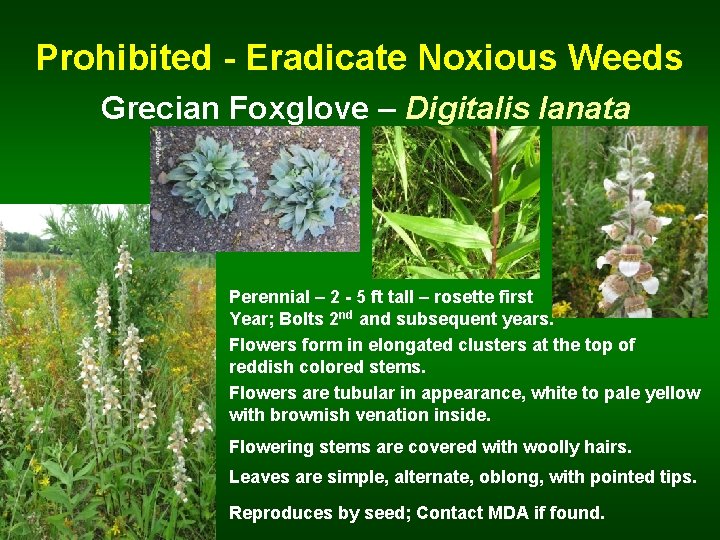
Prohibited - Eradicate Noxious Weeds Grecian Foxglove – Digitalis lanata Perennial – 2 - 5 ft tall – rosette first Year; Bolts 2 nd and subsequent years. Flowers form in elongated clusters at the top of reddish colored stems. Flowers are tubular in appearance, white to pale yellow with brownish venation inside. Flowering stems are covered with woolly hairs. Leaves are simple, alternate, oblong, with pointed tips. Reproduces by seed; Contact MDA if found.
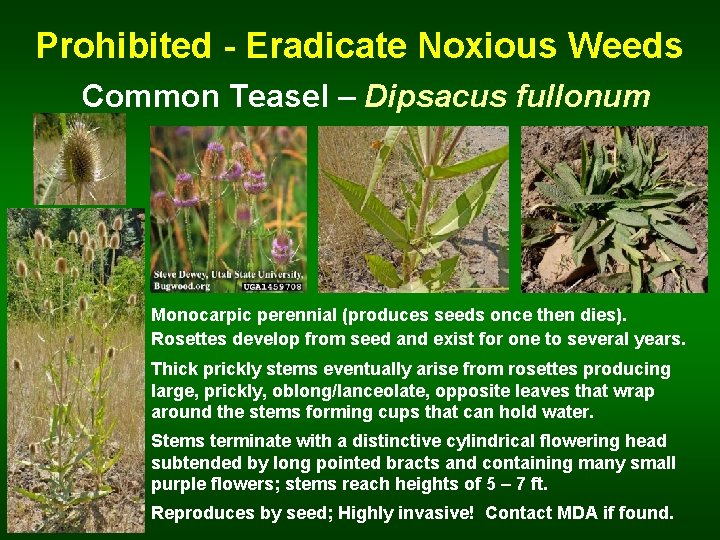
Prohibited - Eradicate Noxious Weeds Common Teasel – Dipsacus fullonum Monocarpic perennial (produces seeds once then dies). Rosettes develop from seed and exist for one to several years. Thick prickly stems eventually arise from rosettes producing large, prickly, oblong/lanceolate, opposite leaves that wrap around the stems forming cups that can hold water. Stems terminate with a distinctive cylindrical flowering head subtended by long pointed bracts and containing many small purple flowers; stems reach heights of 5 – 7 ft. Reproduces by seed; Highly invasive! Contact MDA if found.
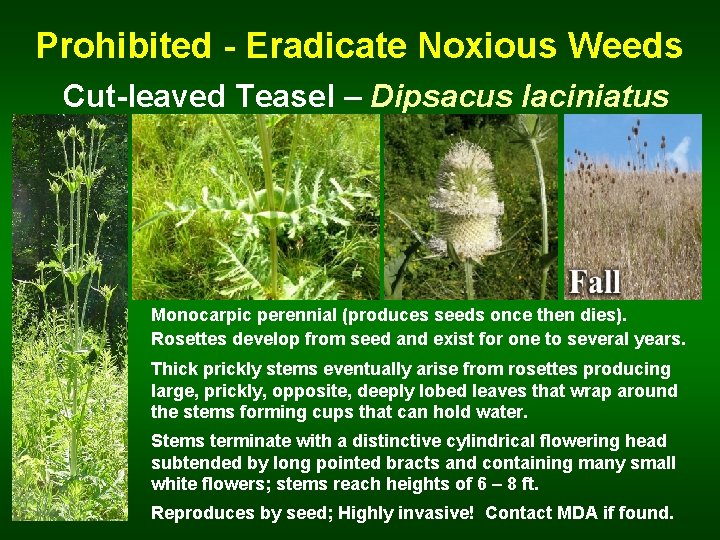
Prohibited - Eradicate Noxious Weeds Cut-leaved Teasel – Dipsacus laciniatus Monocarpic perennial (produces seeds once then dies). Rosettes develop from seed and exist for one to several years. Thick prickly stems eventually arise from rosettes producing large, prickly, opposite, deeply lobed leaves that wrap around the stems forming cups that can hold water. Stems terminate with a distinctive cylindrical flowering head subtended by long pointed bracts and containing many small white flowers; stems reach heights of 6 – 8 ft. Reproduces by seed; Highly invasive! Contact MDA if found.
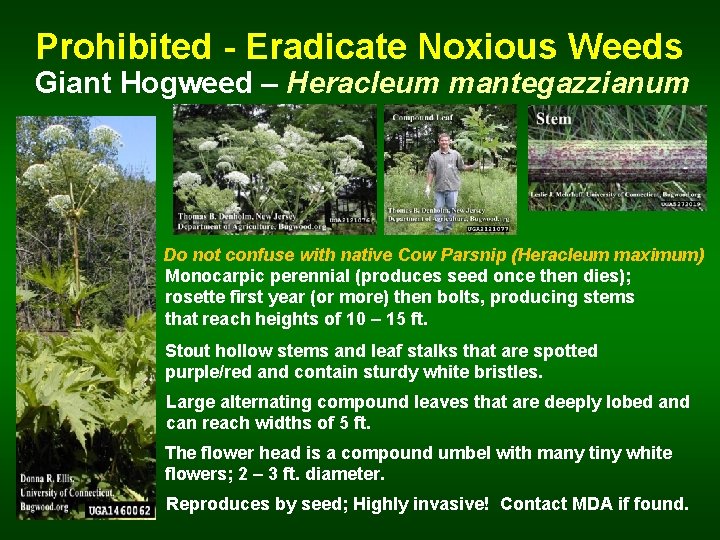
Prohibited - Eradicate Noxious Weeds Giant Hogweed – Heracleum mantegazzianum Do not confuse with native Cow Parsnip (Heracleum maximum) Monocarpic perennial (produces seed once then dies); rosette first year (or more) then bolts, producing stems that reach heights of 10 – 15 ft. Stout hollow stems and leaf stalks that are spotted purple/red and contain sturdy white bristles. Large alternating compound leaves that are deeply lobed and can reach widths of 5 ft. The flower head is a compound umbel with many tiny white flowers; 2 – 3 ft. diameter. Reproduces by seed; Highly invasive! Contact MDA if found.
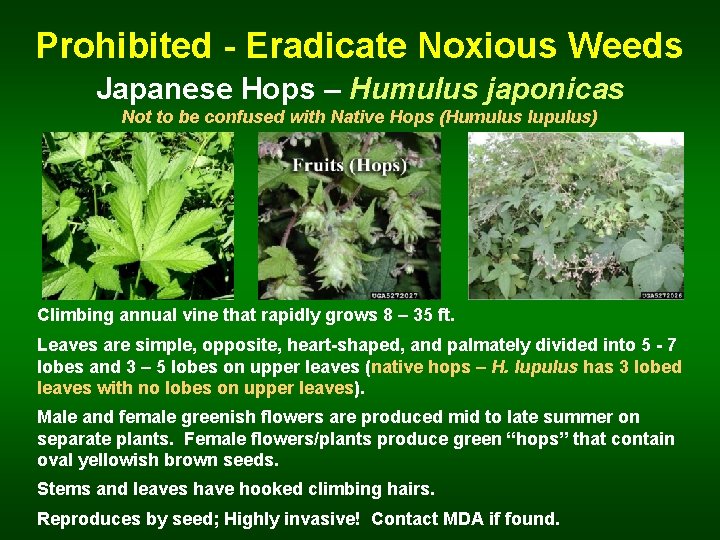
Prohibited - Eradicate Noxious Weeds Japanese Hops – Humulus japonicas Not to be confused with Native Hops (Humulus lupulus) Climbing annual vine that rapidly grows 8 – 35 ft. Leaves are simple, opposite, heart-shaped, and palmately divided into 5 - 7 lobes and 3 – 5 lobes on upper leaves (native hops – H. lupulus has 3 lobed leaves with no lobes on upper leaves). Male and female greenish flowers are produced mid to late summer on separate plants. Female flowers/plants produce green “hops” that contain oval yellowish brown seeds. Stems and leaves have hooked climbing hairs. Reproduces by seed; Highly invasive! Contact MDA if found.
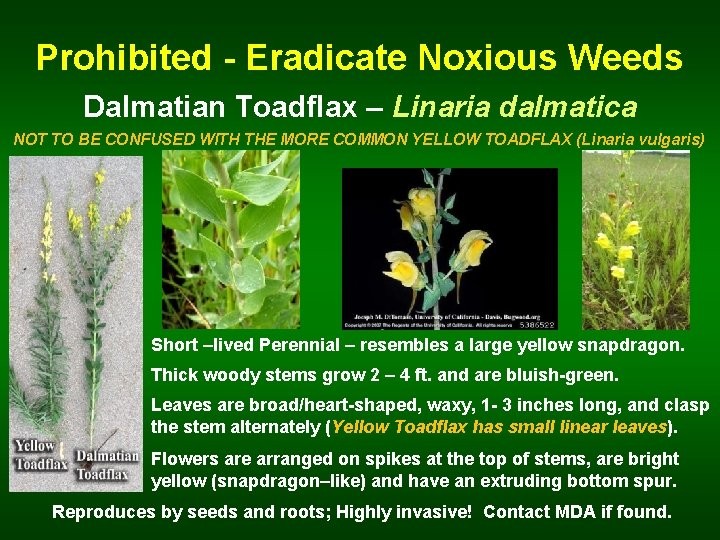
Prohibited - Eradicate Noxious Weeds Dalmatian Toadflax – Linaria dalmatica NOT TO BE CONFUSED WITH THE MORE COMMON YELLOW TOADFLAX (Linaria vulgaris) Short –lived Perennial – resembles a large yellow snapdragon. Thick woody stems grow 2 – 4 ft. and are bluish-green. Leaves are broad/heart-shaped, waxy, 1 - 3 inches long, and clasp the stem alternately (Yellow Toadflax has small linear leaves). Flowers are arranged on spikes at the top of stems, are bright yellow (snapdragon–like) and have an extruding bottom spur. Reproduces by seeds and roots; Highly invasive! Contact MDA if found.
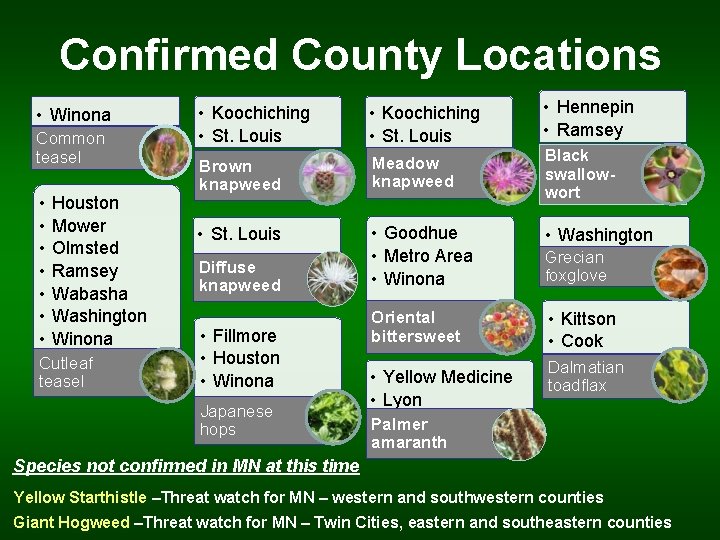
Confirmed County Locations • Winona Common teasel • • Houston Mower Olmsted Ramsey Wabasha Washington Winona Cutleaf teasel • Koochiching • St. Louis • Hennepin • Ramsey Brown knapweed Meadow knapweed Black swallowwort • St. Louis • Goodhue • Metro Area • Winona • Washington Grecian foxglove Oriental bittersweet • Kittson • Cook Diffuse knapweed • Fillmore • Houston • Winona Japanese hops • Yellow Medicine • Lyon Dalmatian toadflax Palmer amaranth Species not confirmed in MN at this time Yellow Starthistle –Threat watch for MN – western and southwestern counties Giant Hogweed –Threat watch for MN – Twin Cities, eastern and southeastern counties
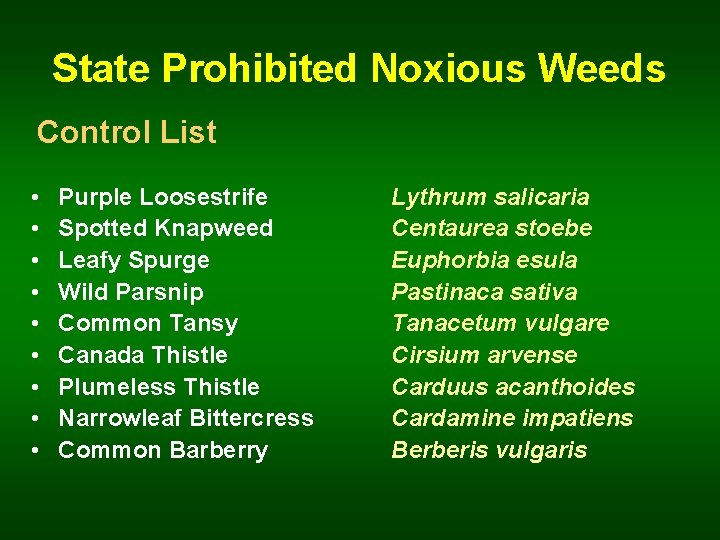
State Prohibited Noxious Weeds Control List • • • Purple Loosestrife Spotted Knapweed Leafy Spurge Wild Parsnip Common Tansy Canada Thistle Plumeless Thistle Narrowleaf Bittercress Common Barberry Lythrum salicaria Centaurea stoebe Euphorbia esula Pastinaca sativa Tanacetum vulgare Cirsium arvense Carduus acanthoides Cardamine impatiens Berberis vulgaris
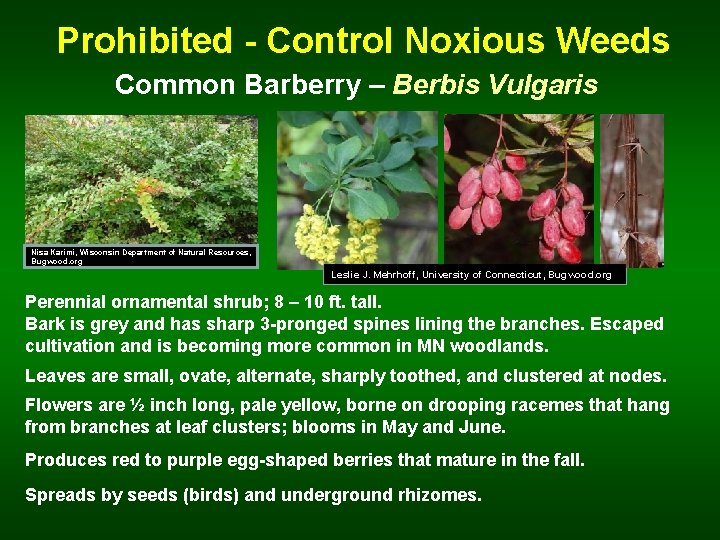
Prohibited - Control Noxious Weeds Common Barberry – Berbis Vulgaris Nisa Karimi, Wisconsin Department of Natural Resources, Bugwood. org Leslie J. Mehrhoff, University of Connecticut, Bugwood. org Perennial ornamental shrub; 8 – 10 ft. tall. Bark is grey and has sharp 3 -pronged spines lining the branches. Escaped cultivation and is becoming more common in MN woodlands. Leaves are small, ovate, alternate, sharply toothed, and clustered at nodes. Flowers are ½ inch long, pale yellow, borne on drooping racemes that hang from branches at leaf clusters; blooms in May and June. Produces red to purple egg-shaped berries that mature in the fall. Spreads by seeds (birds) and underground rhizomes.
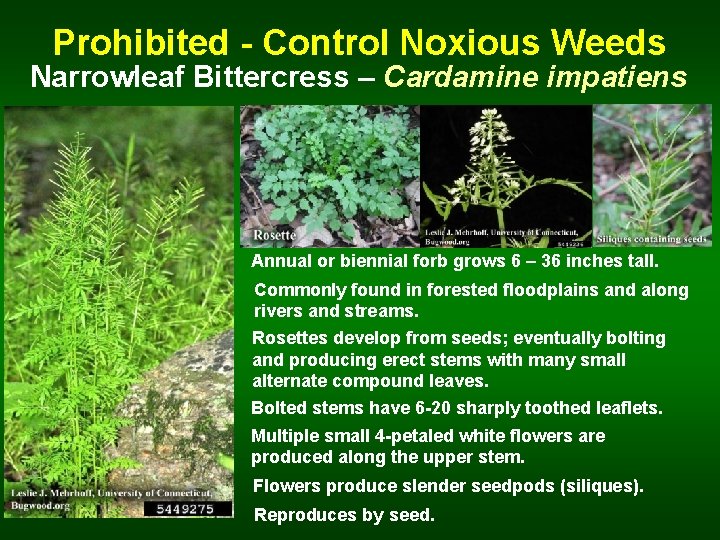
Prohibited - Control Noxious Weeds Narrowleaf Bittercress – Cardamine impatiens Annual or biennial forb grows 6 – 36 inches tall. Commonly found in forested floodplains and along rivers and streams. Rosettes develop from seeds; eventually bolting and producing erect stems with many small alternate compound leaves. Bolted stems have 6 -20 sharply toothed leaflets. Multiple small 4 -petaled white flowers are produced along the upper stem. Flowers produce slender seedpods (siliques). Reproduces by seed.
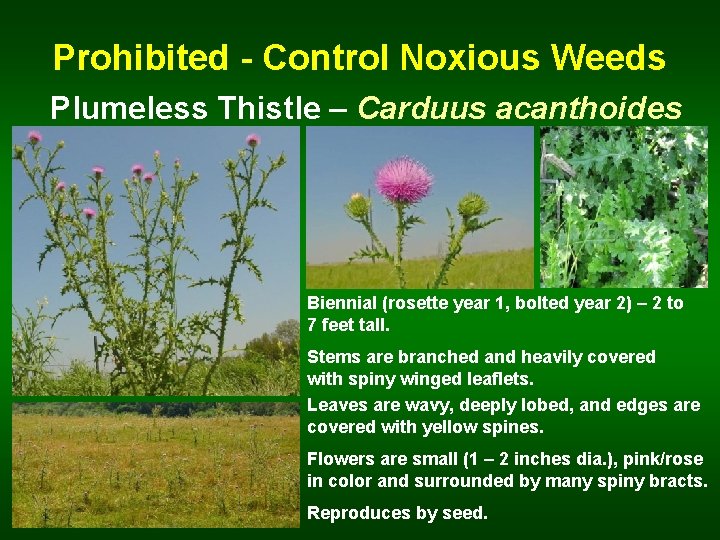
Prohibited - Control Noxious Weeds Plumeless Thistle – Carduus acanthoides Biennial (rosette year 1, bolted year 2) – 2 to 7 feet tall. Stems are branched and heavily covered with spiny winged leaflets. Leaves are wavy, deeply lobed, and edges are covered with yellow spines. Flowers are small (1 – 2 inches dia. ), pink/rose in color and surrounded by many spiny bracts. Reproduces by seed.
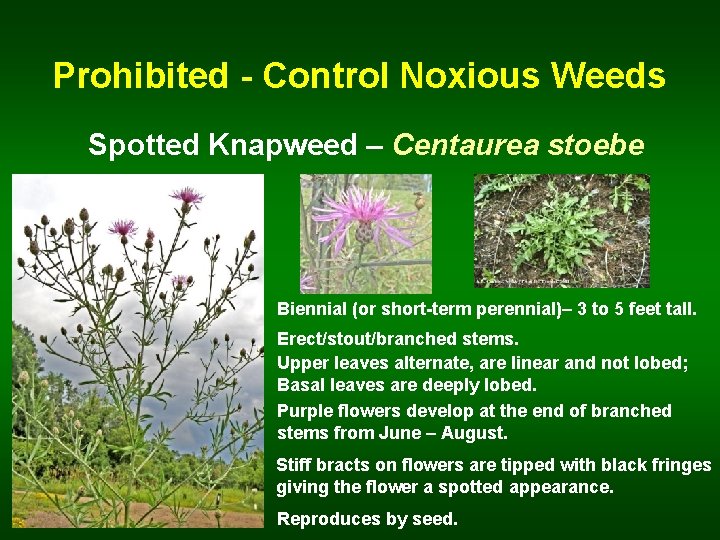
Prohibited - Control Noxious Weeds Spotted Knapweed – Centaurea stoebe Biennial (or short-term perennial)– 3 to 5 feet tall. Erect/stout/branched stems. Upper leaves alternate, are linear and not lobed; Basal leaves are deeply lobed. Purple flowers develop at the end of branched stems from June – August. Stiff bracts on flowers are tipped with black fringes giving the flower a spotted appearance. Reproduces by seed.
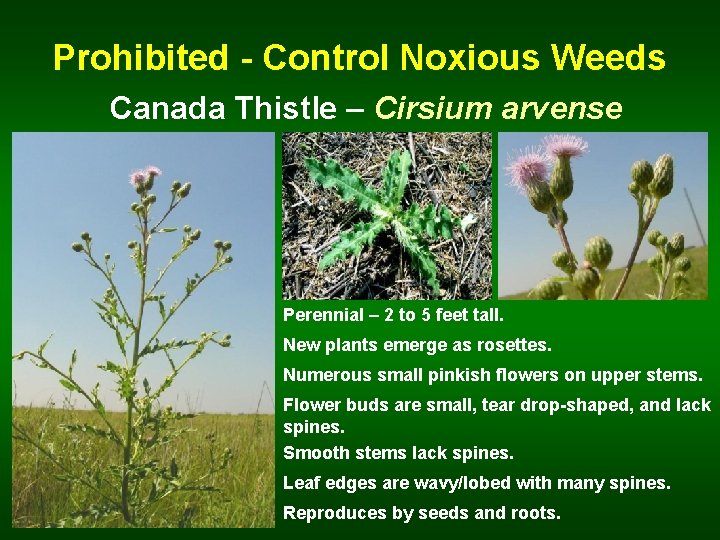
Prohibited - Control Noxious Weeds Canada Thistle – Cirsium arvense Perennial – 2 to 5 feet tall. New plants emerge as rosettes. Numerous small pinkish flowers on upper stems. Flower buds are small, tear drop-shaped, and lack spines. Smooth stems lack spines. Leaf edges are wavy/lobed with many spines. Reproduces by seeds and roots.
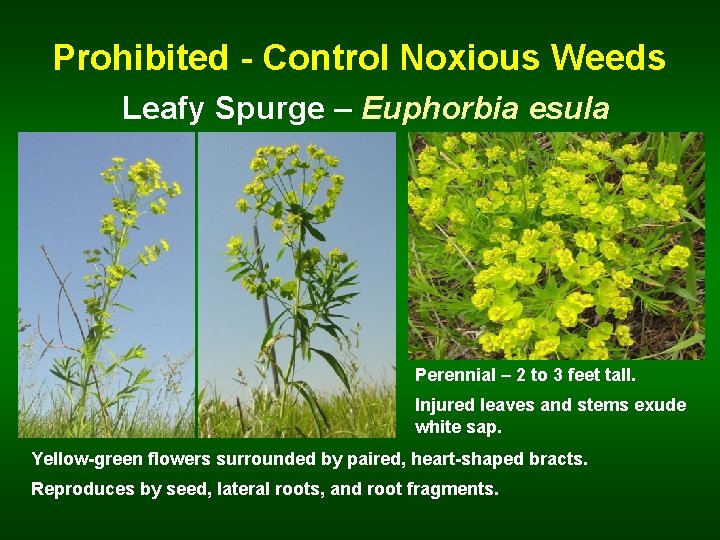
Prohibited - Control Noxious Weeds Leafy Spurge – Euphorbia esula Perennial – 2 to 3 feet tall. Injured leaves and stems exude white sap. Yellow-green flowers surrounded by paired, heart-shaped bracts. Reproduces by seed, lateral roots, and root fragments.
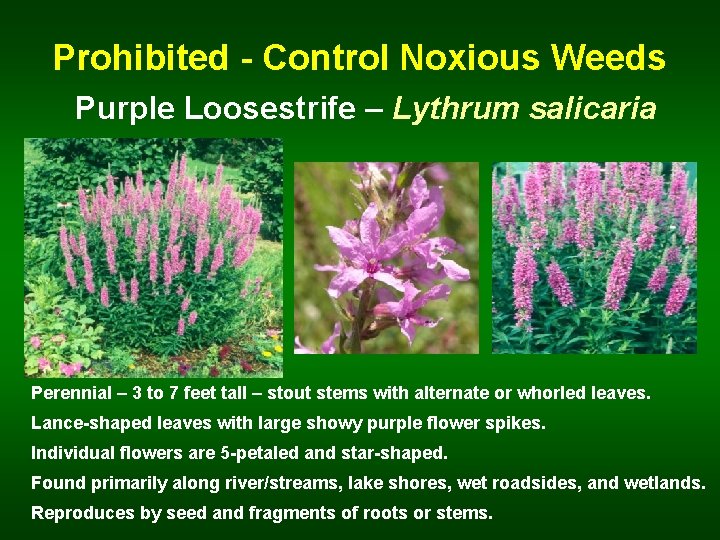
Prohibited - Control Noxious Weeds Purple Loosestrife – Lythrum salicaria Perennial – 3 to 7 feet tall – stout stems with alternate or whorled leaves. Lance-shaped leaves with large showy purple flower spikes. Individual flowers are 5 -petaled and star-shaped. Found primarily along river/streams, lake shores, wet roadsides, and wetlands. Reproduces by seed and fragments of roots or stems.
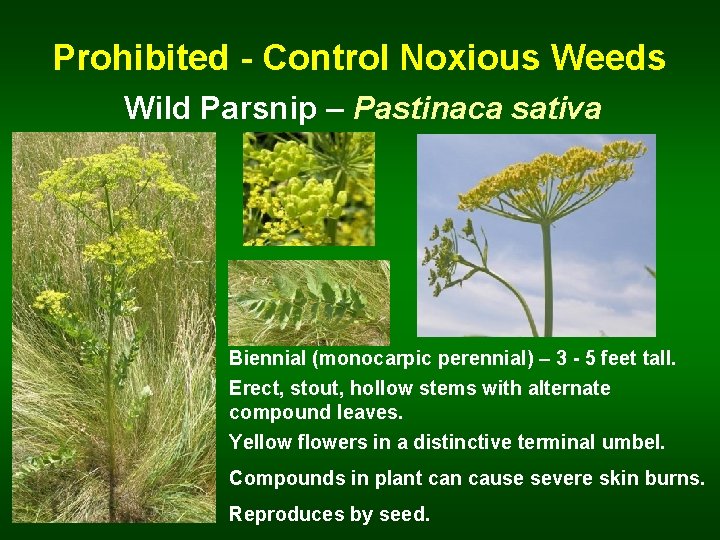
Prohibited - Control Noxious Weeds Wild Parsnip – Pastinaca sativa Biennial (monocarpic perennial) – 3 - 5 feet tall. Erect, stout, hollow stems with alternate compound leaves. Yellow flowers in a distinctive terminal umbel. Compounds in plant can cause severe skin burns. Reproduces by seed.
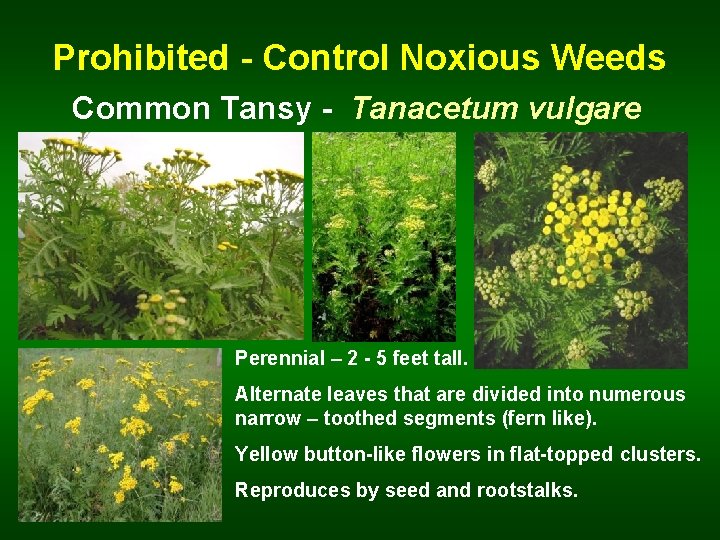
Prohibited - Control Noxious Weeds Common Tansy - Tanacetum vulgare Perennial – 2 - 5 feet tall. Alternate leaves that are divided into numerous narrow – toothed segments (fern like). Yellow button-like flowers in flat-topped clusters. Reproduces by seed and rootstalks.
State Restricted Noxious Weeds are plants that are widely distributed in Minnesota and are detrimental to human or animal health, the environment, public roads, crops, livestock or other property, but whose only feasible means of control is to prevent their spread by prohibiting the importation, sale, and transportation of their propagating parts in the state except as allowed by Minnesota Statutes, Section 18. 82. Plants designated as Restricted Noxious Weeds may be reclassified if effective means of control are developed.
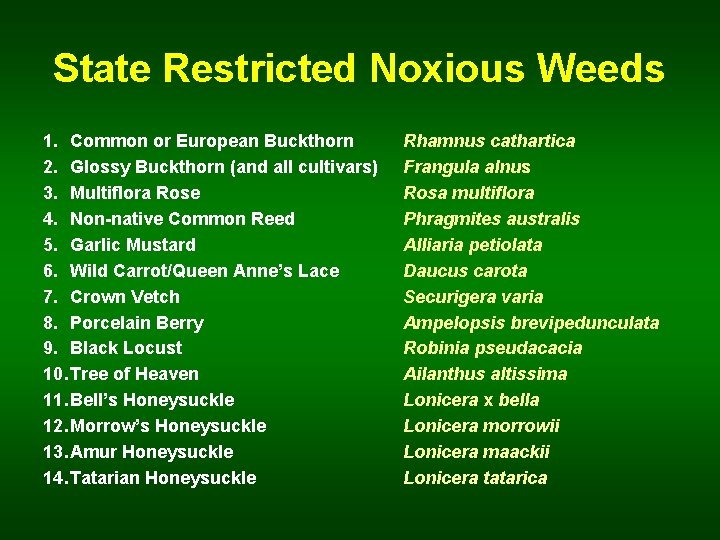
State Restricted Noxious Weeds 1. Common or European Buckthorn 2. Glossy Buckthorn (and all cultivars) 3. Multiflora Rose 4. Non-native Common Reed 5. Garlic Mustard 6. Wild Carrot/Queen Anne’s Lace 7. Crown Vetch 8. Porcelain Berry 9. Black Locust 10. Tree of Heaven 11. Bell’s Honeysuckle 12. Morrow’s Honeysuckle 13. Amur Honeysuckle 14. Tatarian Honeysuckle Rhamnus cathartica Frangula alnus Rosa multiflora Phragmites australis Alliaria petiolata Daucus carota Securigera varia Ampelopsis brevipedunculata Robinia pseudacacia Ailanthus altissima Lonicera x bella Lonicera morrowii Lonicera maackii Lonicera tatarica
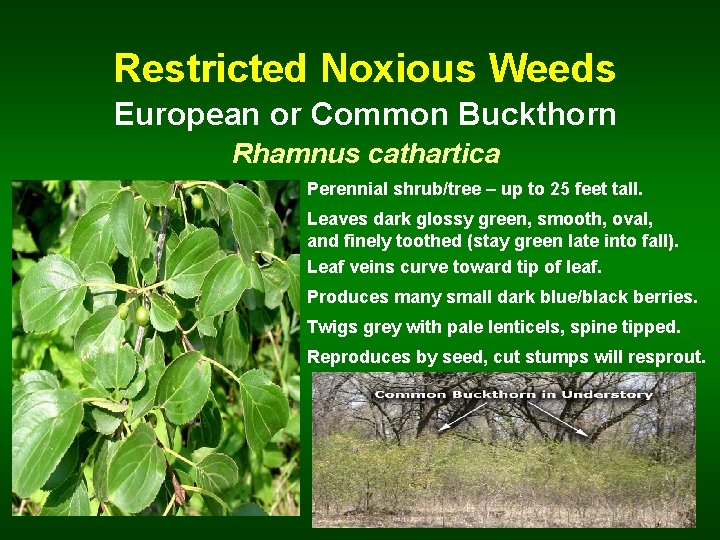
Restricted Noxious Weeds European or Common Buckthorn Rhamnus cathartica Perennial shrub/tree – up to 25 feet tall. Leaves dark glossy green, smooth, oval, and finely toothed (stay green late into fall). Leaf veins curve toward tip of leaf. Produces many small dark blue/black berries. Twigs grey with pale lenticels, spine tipped. Reproduces by seed, cut stumps will resprout.
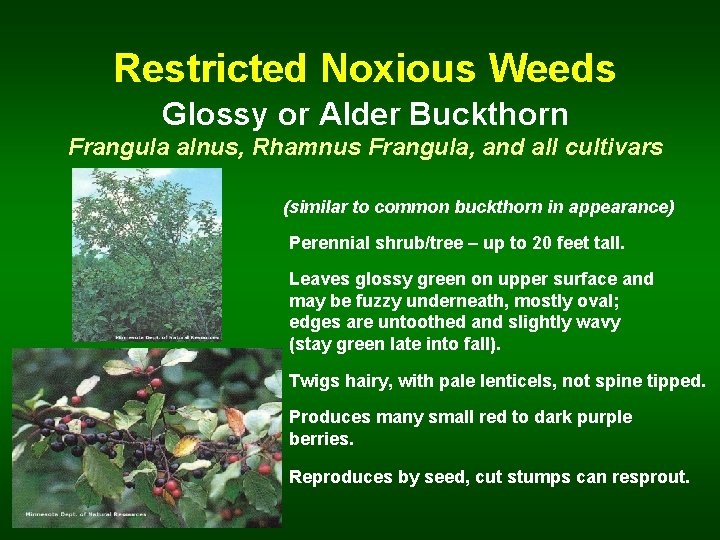
Restricted Noxious Weeds Glossy or Alder Buckthorn Frangula alnus, Rhamnus Frangula, and all cultivars (similar to common buckthorn in appearance) Perennial shrub/tree – up to 20 feet tall. Leaves glossy green on upper surface and may be fuzzy underneath, mostly oval; edges are untoothed and slightly wavy (stay green late into fall). Twigs hairy, with pale lenticels, not spine tipped. Produces many small red to dark purple berries. Reproduces by seed, cut stumps can resprout.
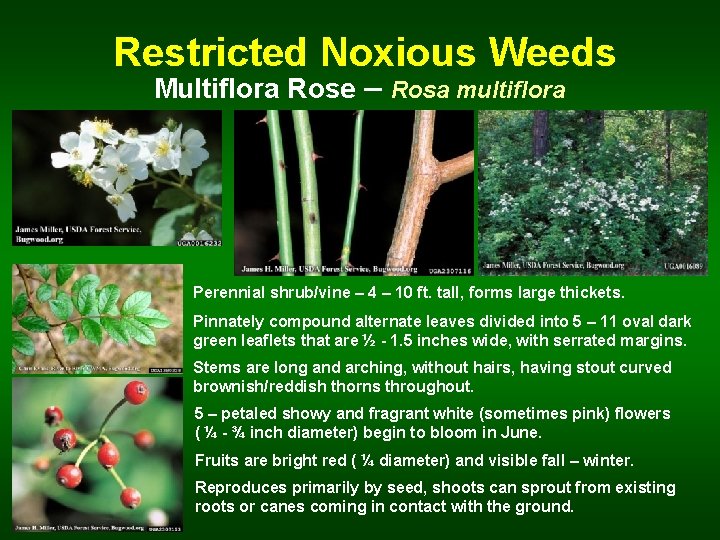
Restricted Noxious Weeds Multiflora Rose – Rosa multiflora Perennial shrub/vine – 4 – 10 ft. tall, forms large thickets. Pinnately compound alternate leaves divided into 5 – 11 oval dark green leaflets that are ½ - 1. 5 inches wide, with serrated margins. Stems are long and arching, without hairs, having stout curved brownish/reddish thorns throughout. 5 – petaled showy and fragrant white (sometimes pink) flowers ( ¼ - ¾ inch diameter) begin to bloom in June. Fruits are bright red ( ¼ diameter) and visible fall – winter. Reproduces primarily by seed, shoots can sprout from existing roots or canes coming in contact with the ground.
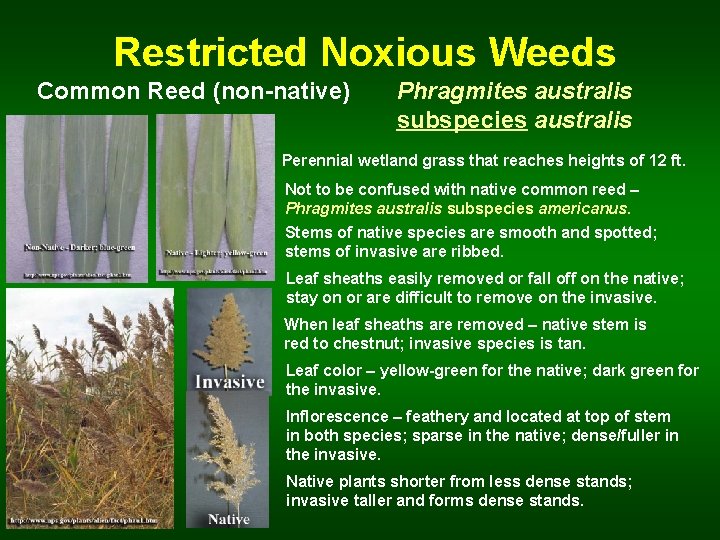
Restricted Noxious Weeds Common Reed (non-native) Phragmites australis subspecies australis Perennial wetland grass that reaches heights of 12 ft. Not to be confused with native common reed – Phragmites australis subspecies americanus. Stems of native species are smooth and spotted; stems of invasive are ribbed. Leaf sheaths easily removed or fall off on the native; stay on or are difficult to remove on the invasive. When leaf sheaths are removed – native stem is red to chestnut; invasive species is tan. Leaf color – yellow-green for the native; dark green for the invasive. Inflorescence – feathery and located at top of stem in both species; sparse in the native; dense/fuller in the invasive. Native plants shorter from less dense stands; invasive taller and forms dense stands.
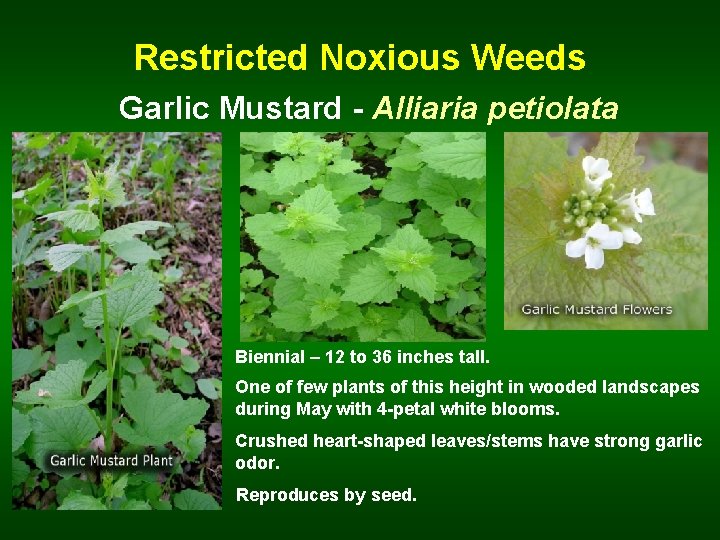
Restricted Noxious Weeds Garlic Mustard - Alliaria petiolata Biennial – 12 to 36 inches tall. One of few plants of this height in wooded landscapes during May with 4 -petal white blooms. Crushed heart-shaped leaves/stems have strong garlic odor. Reproduces by seed.
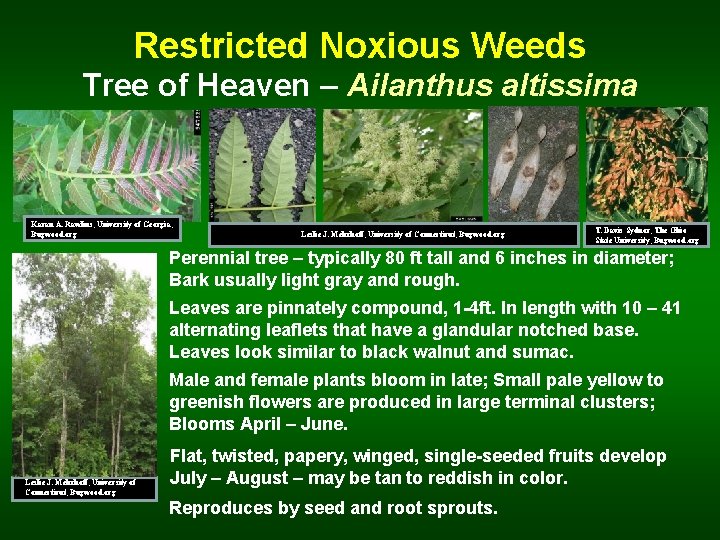
Restricted Noxious Weeds Tree of Heaven – Ailanthus altissima Karan A. Rawlins, University of Georgia, Bugwood. org Leslie J. Mehrhoff, University of Connecticut, Bugwood. org T. Davis Sydnor, The Ohio State University, Bugwood. org Perennial tree – typically 80 ft tall and 6 inches in diameter; Bark usually light gray and rough. Leaves are pinnately compound, 1 -4 ft. In length with 10 – 41 alternating leaflets that have a glandular notched base. Leaves look similar to black walnut and sumac. Male and female plants bloom in late; Small pale yellow to greenish flowers are produced in large terminal clusters; Blooms April – June. Leslie J. Mehrhoff, University of Connecticut, Bugwood. org Flat, twisted, papery, winged, single-seeded fruits develop July – August – may be tan to reddish in color. Reproduces by seed and root sprouts.
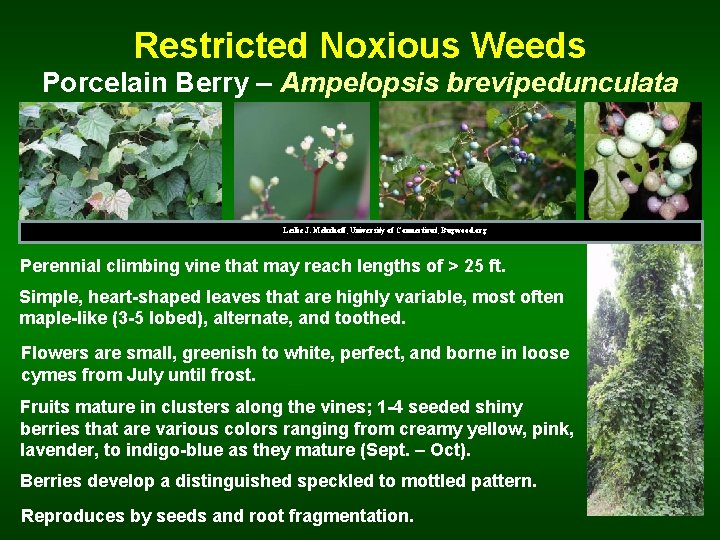
Restricted Noxious Weeds Porcelain Berry – Ampelopsis brevipedunculata Leslie J. Mehrhoff, University of Connecticut, Bugwood. org Perennial climbing vine that may reach lengths of > 25 ft. Simple, heart-shaped leaves that are highly variable, most often maple-like (3 -5 lobed), alternate, and toothed. Flowers are small, greenish to white, perfect, and borne in loose cymes from July until frost. Fruits mature in clusters along the vines; 1 -4 seeded shiny berries that are various colors ranging from creamy yellow, pink, lavender, to indigo-blue as they mature (Sept. – Oct). Berries develop a distinguished speckled to mottled pattern. Reproduces by seeds and root fragmentation.
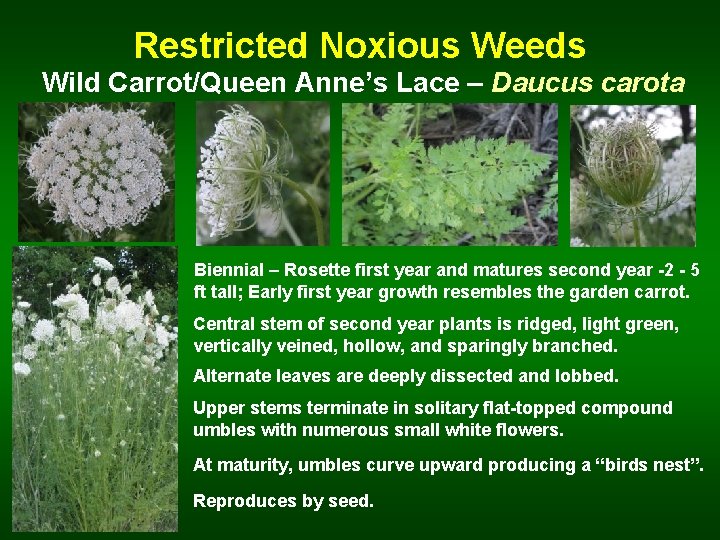
Restricted Noxious Weeds Wild Carrot/Queen Anne’s Lace – Daucus carota Biennial – Rosette first year and matures second year -2 - 5 ft tall; Early first year growth resembles the garden carrot. Central stem of second year plants is ridged, light green, vertically veined, hollow, and sparingly branched. Alternate leaves are deeply dissected and lobbed. Upper stems terminate in solitary flat-topped compound umbles with numerous small white flowers. At maturity, umbles curve upward producing a “birds nest”. Reproduces by seed.
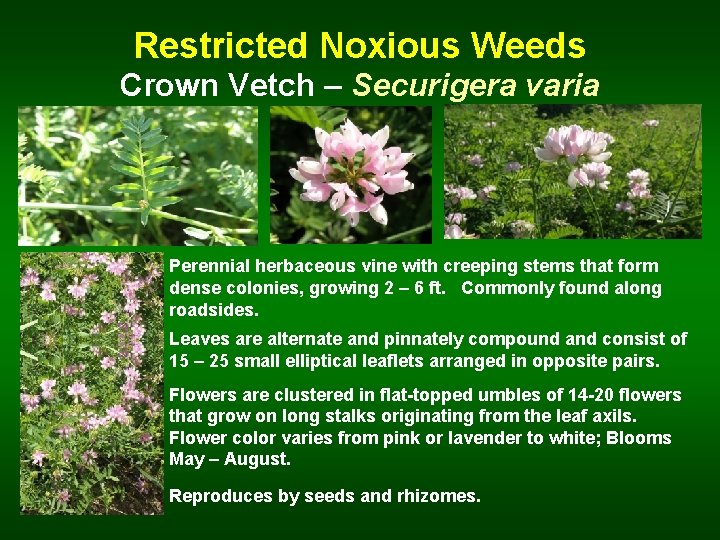
Restricted Noxious Weeds Crown Vetch – Securigera varia Perennial herbaceous vine with creeping stems that form dense colonies, growing 2 – 6 ft. Commonly found along roadsides. Leaves are alternate and pinnately compound and consist of 15 – 25 small elliptical leaflets arranged in opposite pairs. Flowers are clustered in flat-topped umbles of 14 -20 flowers that grow on long stalks originating from the leaf axils. Flower color varies from pink or lavender to white; Blooms May – August. Reproduces by seeds and rhizomes.
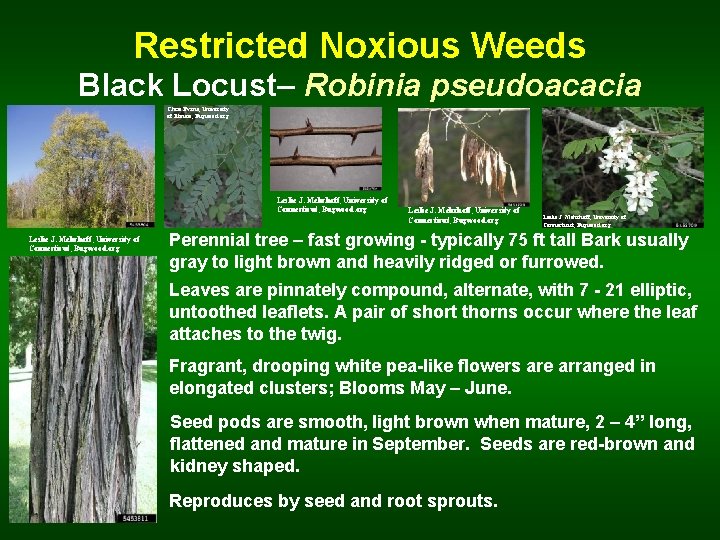
Restricted Noxious Weeds Black Locust– Robinia pseudoacacia Chris Evans, University of Illinois, Bugwood. org Leslie J. Mehrhoff, University of Connecticut, Bugwood. org Perennial tree – fast growing - typically 75 ft tall Bark usually gray to light brown and heavily ridged or furrowed. Leaves are pinnately compound, alternate, with 7 - 21 elliptic, untoothed leaflets. A pair of short thorns occur where the leaf attaches to the twig. Fragrant, drooping white pea-like flowers are arranged in elongated clusters; Blooms May – June. Seed pods are smooth, light brown when mature, 2 – 4” long, flattened and mature in September. Seeds are red-brown and kidney shaped. Reproduces by seed and root sprouts.
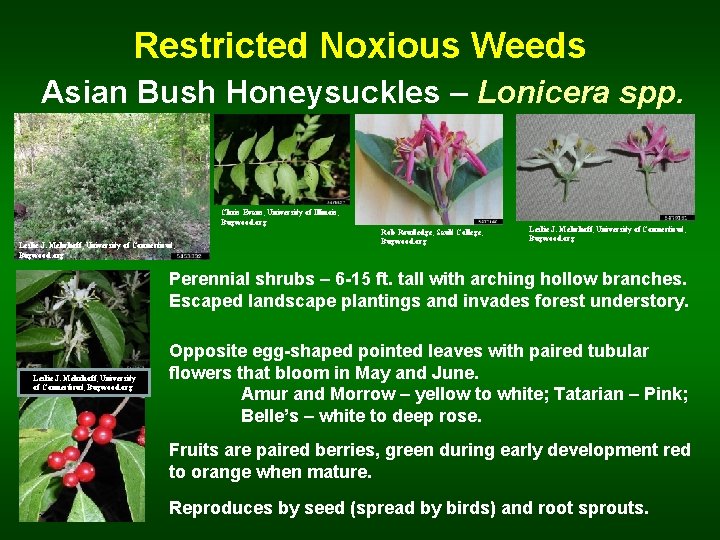
Restricted Noxious Weeds Asian Bush Honeysuckles – Lonicera spp. Chris Evans, University of Illinois, Bugwood. org Leslie J. Mehrhoff, University of Connecticut, Bugwood. org Rob Routledge, Sault College, Bugwood. org Leslie J. Mehrhoff, University of Connecticut, Bugwood. org Perennial shrubs – 6 -15 ft. tall with arching hollow branches. Escaped landscape plantings and invades forest understory. Leslie J. Mehrhoff, University of Connecticut, Bugwood. org Opposite egg-shaped pointed leaves with paired tubular flowers that bloom in May and June. Amur and Morrow – yellow to white; Tatarian – Pink; Belle’s – white to deep rose. Fruits are paired berries, green during early development red to orange when mature. Reproduces by seed (spread by birds) and root sprouts.
State Specially Regulated Plants are plants that may be native species or have demonstrated economic value, but also have the potential to cause harm in non-controlled environments. Plants designated as specially regulated have been determined to pose ecological, economical, or human or animal health concerns. Plant specific management plans and or rules that define the use and management requirements for these plants will be developed by the Minnesota Department of Agriculture for each plant designated as specially regulated. Measures must also be taken to minimize the potential for harm caused by these plants. • Poison Ivy - Toxicodendron radicans & T. rydbergii Must be eradicated for public safety along rights-of-ways, trails, public accesses, business properties open to the public or on any lands where public access for business or commerce is granted. Must also be eradicated along property boarders when neighboring landowners request.
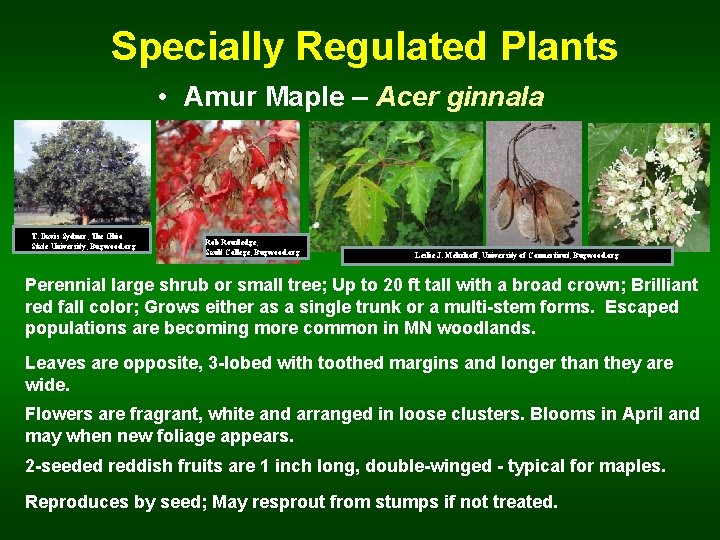
State Specially Regulated Plants • Japanese Knotweed - Polygonum cuspidatum • Giant Knotweed - Polygonum sachalinense Any person, corporation, business or other retail entity distributing Japanese and/or giant knotweeds for sale within the state, must have information directly affixed to the plant or container packaging that it is being sold with, indicating that it is unadvisable to plant this species within 100 feet of a water body or its designated flood plain as defined by Minnesota Statute 103 F. 111, Subdivision 4. • Amur Maple - Acer ginnala Sellers shall affix a label that advises buyers to only plant Amur maple and its cultivars in landscapes where the seedlings will be controlled by mowing or other means. Amur maple should be planted at least 100 yards from natural areas.
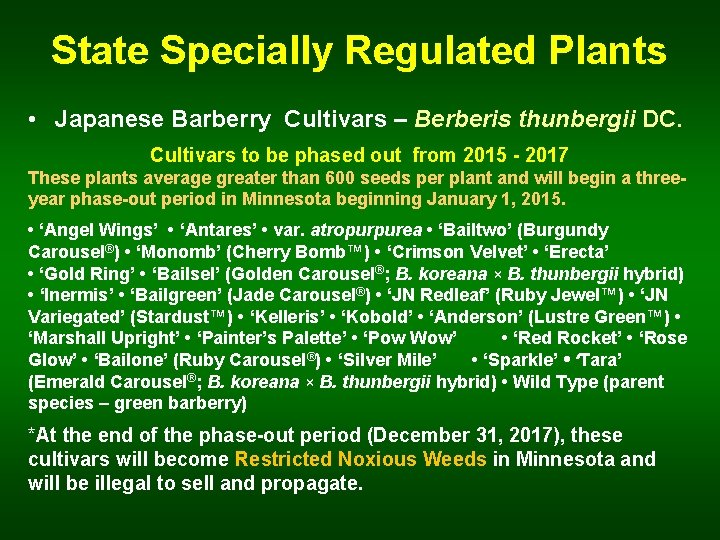
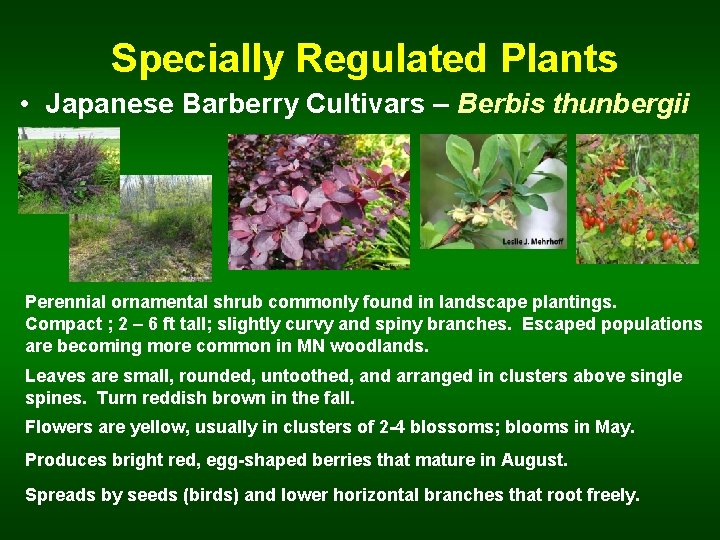
State Specially Regulated Plants • Japanese Barberry Cultivars – Berberis thunbergii DC. Cultivars to be phased out from 2015 - 2017 These plants average greater than 600 seeds per plant and will begin a threeyear phase-out period in Minnesota beginning January 1, 2015. • ‘Angel Wings’ • ‘Antares’ • var. atropurpurea • ‘Bailtwo’ (Burgundy Carousel®) • ‘Monomb’ (Cherry Bomb™) • ‘Crimson Velvet’ • ‘Erecta’ • ‘Gold Ring’ • ‘Bailsel’ (Golden Carousel®; B. koreana × B. thunbergii hybrid) • ‘Inermis’ • ‘Bailgreen’ (Jade Carousel®) • ‘JN Redleaf’ (Ruby Jewel™) • ‘JN Variegated’ (Stardust™) • ‘Kelleris’ • ‘Kobold’ • ‘Anderson’ (Lustre Green™) • ‘Marshall Upright’ • ‘Painter’s Palette’ • ‘Pow Wow’ • ‘Red Rocket’ • ‘Rose Glow’ • ‘Bailone’ (Ruby Carousel®) • ‘Silver Mile’ • ‘Sparkle’ • ‘Tara’ (Emerald Carousel®; B. koreana × B. thunbergii hybrid) • Wild Type (parent species – green barberry) *At the end of the phase-out period (December 31, 2017), these cultivars will become Restricted Noxious Weeds in Minnesota and will be illegal to sell and propagate.
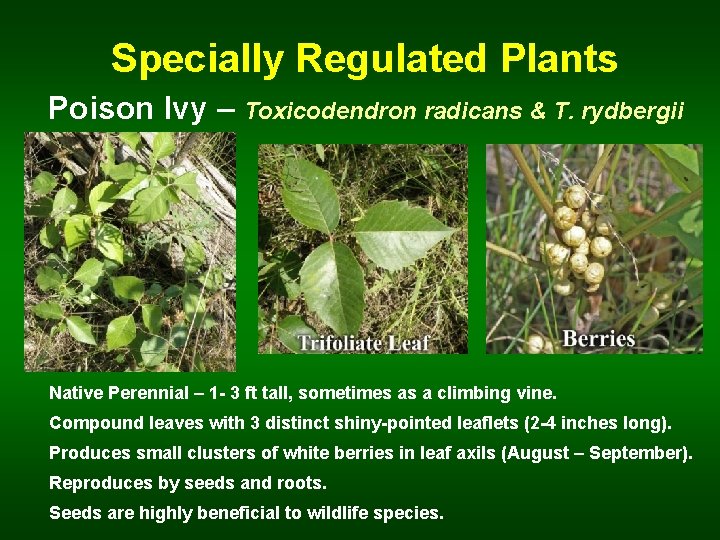
Specially Regulated Plants Poison Ivy – Toxicodendron radicans & T. rydbergii Native Perennial – 1 - 3 ft tall, sometimes as a climbing vine. Compound leaves with 3 distinct shiny-pointed leaflets (2 -4 inches long). Produces small clusters of white berries in leaf axils (August – September). Reproduces by seeds and roots. Seeds are highly beneficial to wildlife species.
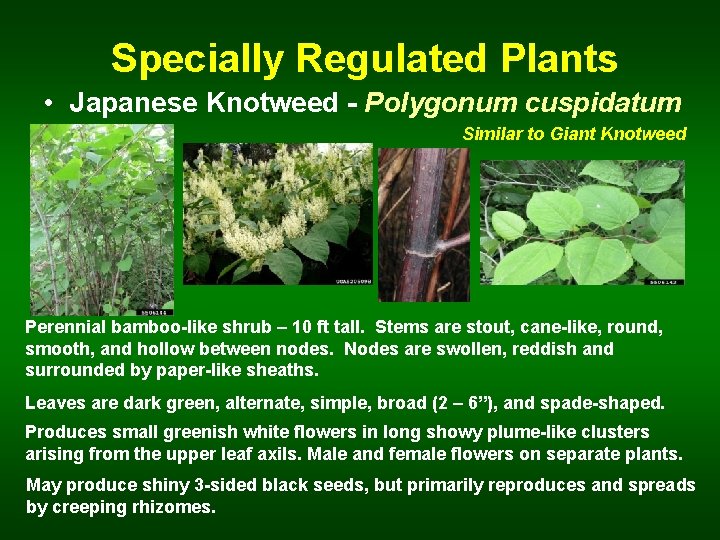
Specially Regulated Plants • Japanese Knotweed - Polygonum cuspidatum Similar to Giant Knotweed Perennial bamboo-like shrub – 10 ft tall. Stems are stout, cane-like, round, smooth, and hollow between nodes. Nodes are swollen, reddish and surrounded by paper-like sheaths. Leaves are dark green, alternate, simple, broad (2 – 6”), and spade-shaped. Produces small greenish white flowers in long showy plume-like clusters arising from the upper leaf axils. Male and female flowers on separate plants. May produce shiny 3 -sided black seeds, but primarily reproduces and spreads by creeping rhizomes.
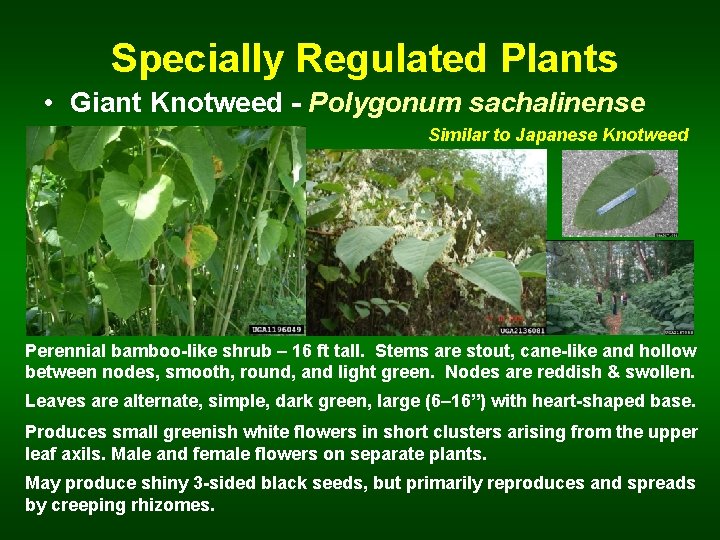
Specially Regulated Plants • Giant Knotweed - Polygonum sachalinense Similar to Japanese Knotweed Perennial bamboo-like shrub – 16 ft tall. Stems are stout, cane-like and hollow between nodes, smooth, round, and light green. Nodes are reddish & swollen. Leaves are alternate, simple, dark green, large (6– 16”) with heart-shaped base. Produces small greenish white flowers in short clusters arising from the upper leaf axils. Male and female flowers on separate plants. May produce shiny 3 -sided black seeds, but primarily reproduces and spreads by creeping rhizomes.
Specially Regulated Plants • Japanese Barberry Cultivars – Berbis thunbergii Perennial ornamental shrub commonly found in landscape plantings. Compact ; 2 – 6 ft tall; slightly curvy and spiny branches. Escaped populations are becoming more common in MN woodlands. Leaves are small, rounded, untoothed, and arranged in clusters above single spines. Turn reddish brown in the fall. Flowers are yellow, usually in clusters of 2 -4 blossoms; blooms in May. Produces bright red, egg-shaped berries that mature in August. Spreads by seeds (birds) and lower horizontal branches that root freely.
Specially Regulated Plants • Amur Maple – Acer ginnala T. Davis Sydnor, The Ohio State University, Bugwood. org Rob Routledge, Sault College, Bugwood. org Leslie J. Mehrhoff, University of Connecticut, Bugwood. org Perennial large shrub or small tree; Up to 20 ft tall with a broad crown; Brilliant red fall color; Grows either as a single trunk or a multi-stem forms. Escaped populations are becoming more common in MN woodlands. Leaves are opposite, 3 -lobed with toothed margins and longer than they are wide. Flowers are fragrant, white and arranged in loose clusters. Blooms in April and may when new foliage appears. 2 -seeded reddish fruits are 1 inch long, double-winged - typical for maples. Reproduces by seed; May resprout from stumps if not treated.
County Noxious Weeds are plants that are designated by individual county boards to be prohibited within the county’s jurisdiction and must be approved by the Commissioner of Agriculture, in consultation with the Noxious Weed Advisory Committee. Each county board must submit newly proposed County Noxious Weeds to the Minnesota Department of Agriculture for review. Approved County Noxious Weeds shall also be posted with the county’s general weed notice prior to May 15 th each year. Counties are solely responsible for developing County Noxious Weed lists and their enforcement.
Weed Management Basics • There is a weed for every occasion • There is a weed species that is adapted to your management, no matter what it is
Weed Management Basics • Therefore, repeated use of the same management will result in a few species that are out of control • Goal should be to get as many species as possible • Using diversified weed management strategies
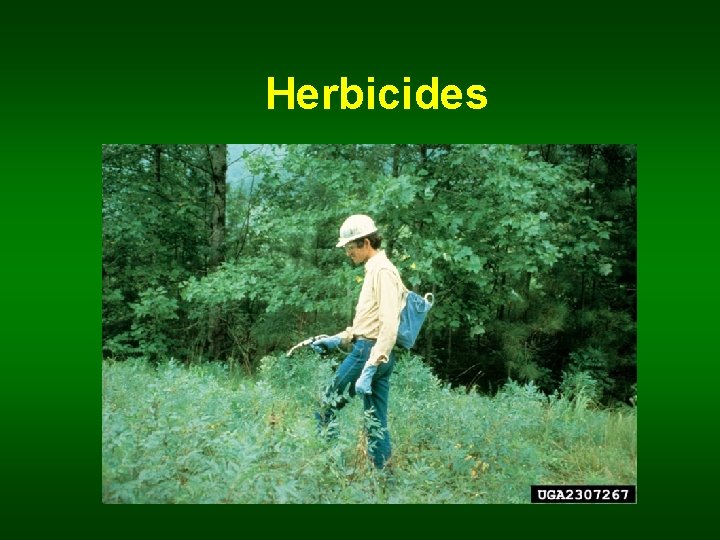
Herbicides
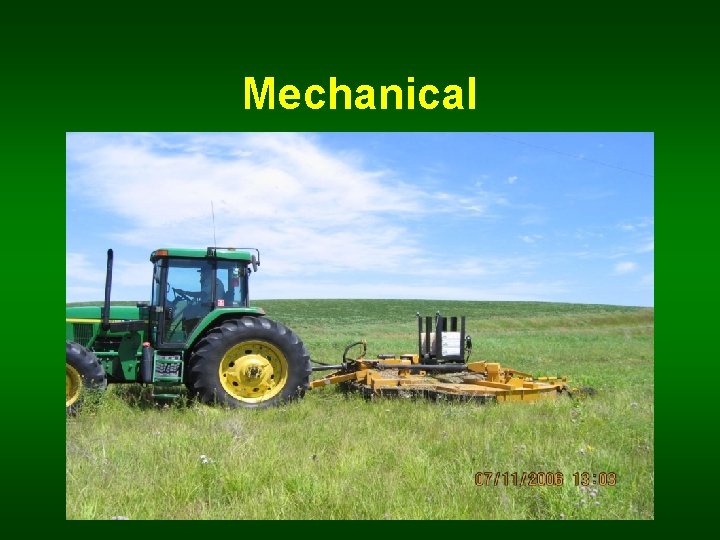
Mechanical
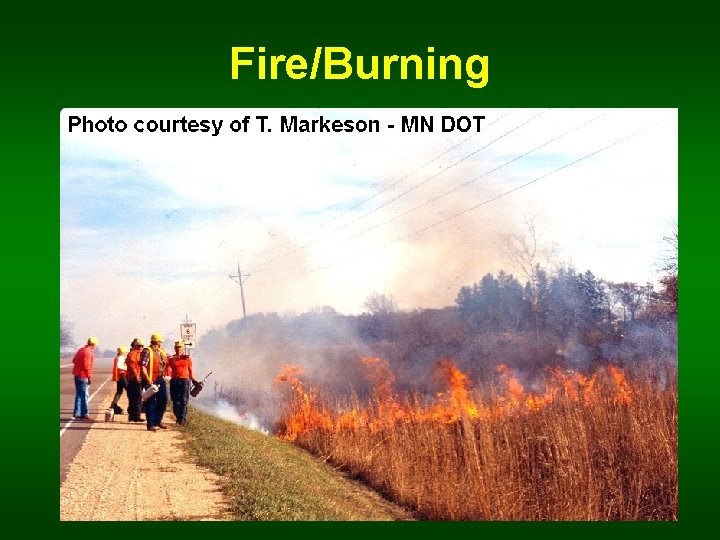
Fire/Burning
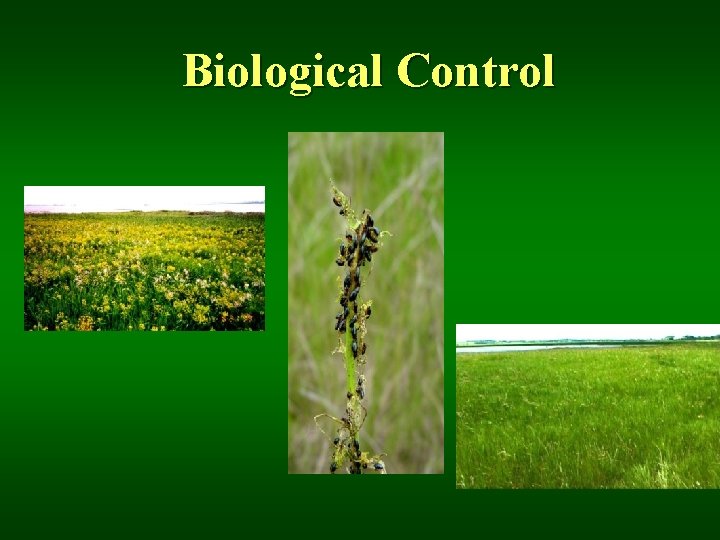
Biological Control
Impact of Seed Bank on Weed Management • Level of inputs required to control weeds directly related to seed bank size • Seed production by weeds needs to be considered in management decisions • What is an acceptable level of seed production?
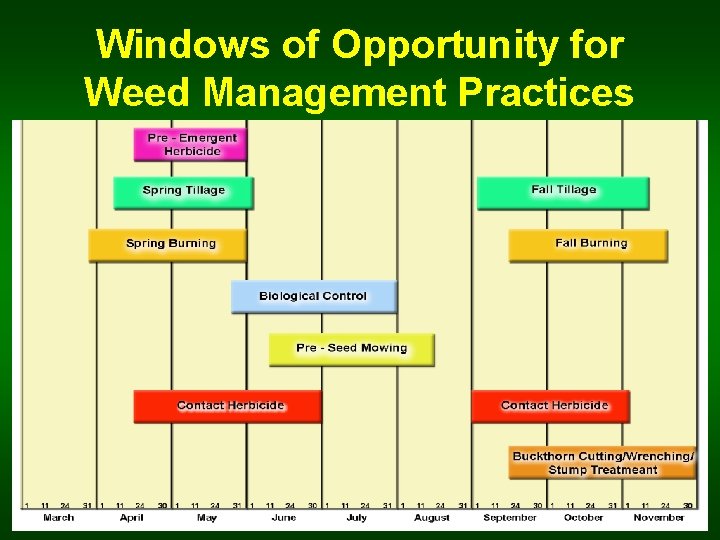
Windows of Opportunity for Weed Management Practices
Ø Everyone has weeds! • The key is to work on managing them • Efficient Communication among the CAI/ County-designated employee, township, or municipal inspectors can easily solve problems
More Information? 1) 2) 3) Contact Your Local County Agricultural Inspector or County Designated Employee U of M Weed Science Extension - Dr. Roger Becker (612) 625 -5753 Minnesota Department of Agriculture Cliff Watrin - Supervisor - Anthony Cortilet (Weed Law) - Monika Chandler (Early Detection) (651) 201 -6531 (651) 201 -6538 (651) 201 -6537 4) Minnesota Department of Transportation - Dave Hansen (651) 366 -3632 5) Minnesota Department of Natural Resources Laura Van Riper (DNR Invasive Species) (651) 259 -5090