
The Minitube Group Dr Monika Esch In 1970

The Minitube Group Dr. Monika Esch

In 1970, Foundation of Minitüb
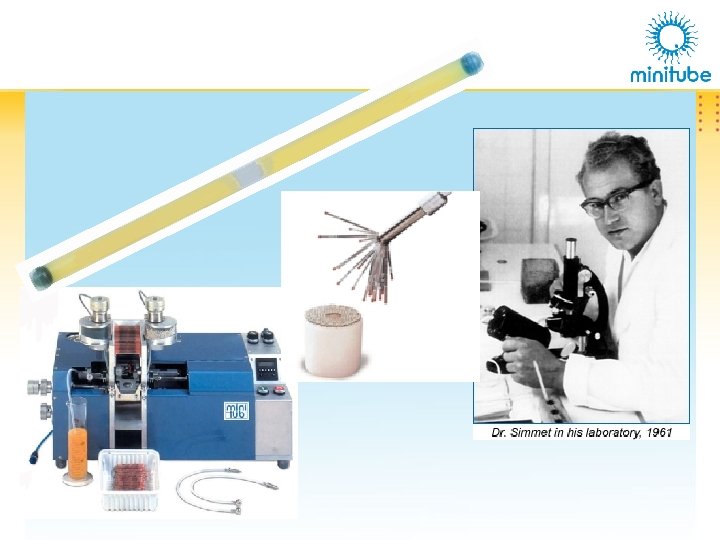

Headquarters Germany Minitüb in Tiefenbach
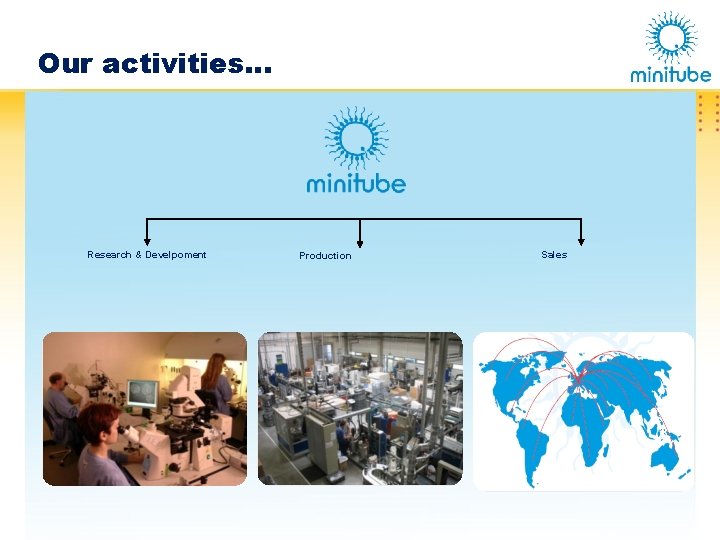
Our activities… Research & Develpoment Production Sales
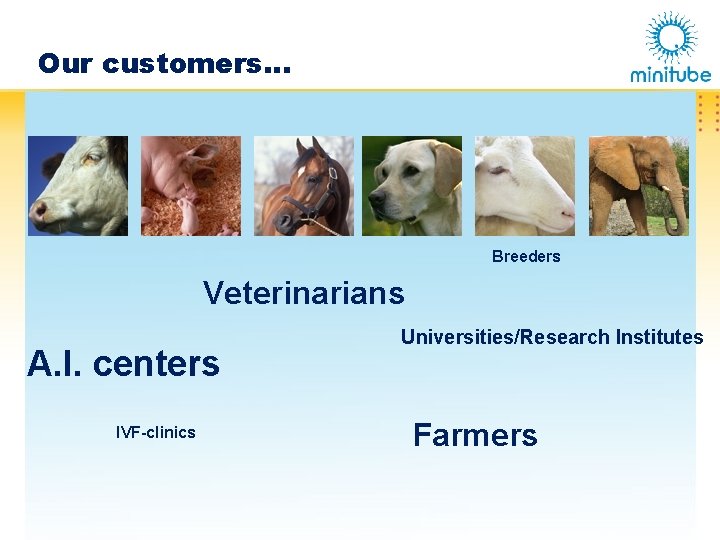
Our customers… Breeders Veterinarians A. I. centers IVF-clinics Universities/Research Institutes Farmers
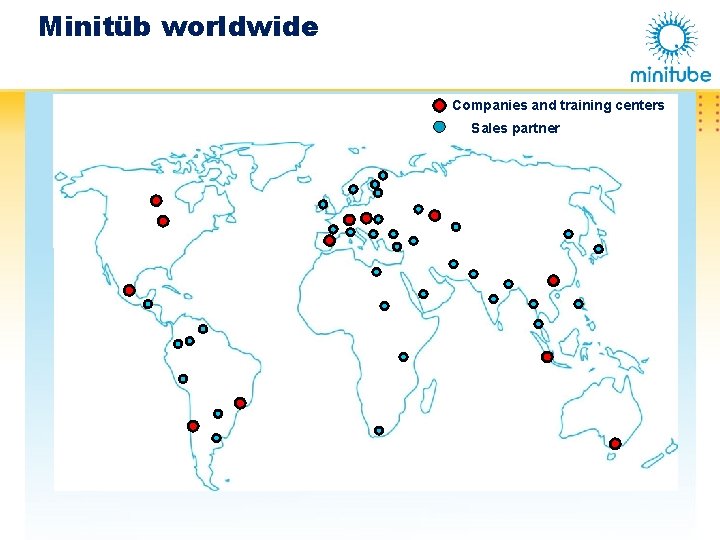
Minitüb worldwide Companies and training centers Sales partner

International Center for Biotechnology 2004
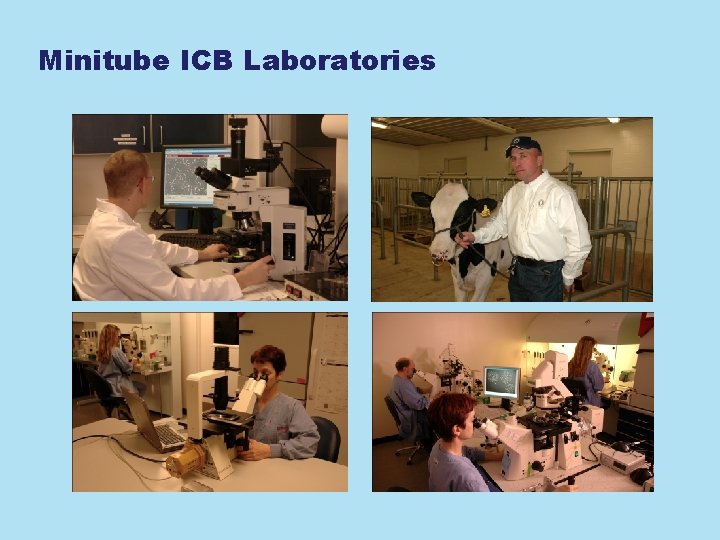
Minitube ICB Laboratories

Research Cooperations University for Veterinary Medicine Hannover, Centre for Reproduction University of Munich, Institute for Molecular Animal Production Federal University of Rio Grande do Sul University of Vienna, Institute for Reproduction University of Murcia, Department of Reproduction

Canine Artificial Insemination
Canine Artificial Insemination • The artificial insemination of dogs is not a new concept. The first reported insemination of a bitch is dated back to 1780. • Reduces the risk of infection which can occur with natural mating. Also the risk of infections such as Canine Flu during transport is eliminated.
Canine Artificial Insemination • High success rate: - use of semen evaluated for fertility - improved by addition of extenders - because of the accurate timing of insemination. • No need for stud or female dog transport and stressful displacements • Fertilization even when: - the male or the female dog have physical disorders - psychological or cognitive disorders (inexperience, low sexual drive, hierarchy, trauma, fear, etc. ) • One ejaculate can be split into multiple semen doses for AI • Reduce number of males for breeding programs
Canine Artificial Insemination • Evaluate the semen for the following parameters: - Volume - Appearance (consistency/colour) - p. H value - Semen concentration - Total sperm cell count in the ejaculate - Motility of sperm cells - Number of morphologically abnormal sperm cells
Daily Sperm Production vs. Daily Sperm Output • Overuse of male dog? Collect once a day, but not every day -> every other day for months is o. k. !!
Semen collection and semen preservation If possible always try natural mating first Results with good breeding management: § Natural mating 95 -100%* § Fresh/chilled semen 70 -90% § Frozen semen 65 -90% *depending on the breed AI is indicated: • when male and female dogs are located in distant locations • vaginal anomaly exists
Semen collection and semen preservation § Indications for semen collection: } Diagnostic purposes: » Older males (> 12 years of age) » Males that have not been used for breeding for several years » Males that have a history of infertile breedings or small litter sizes » Males with abnormal preputial discharge, hematuria, hemospermia or other evidence of prostatic disease
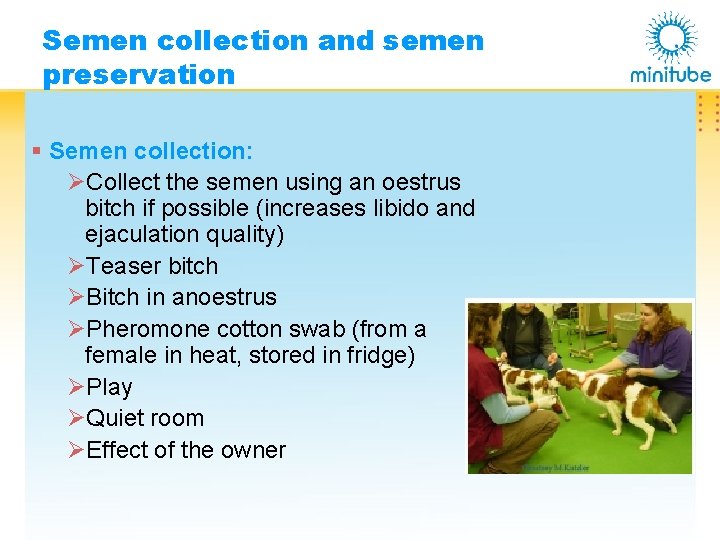
Semen collection and semen preservation § Semen collection: ØCollect the semen using an oestrus bitch if possible (increases libido and ejaculation quality) ØTeaser bitch ØBitch in anoestrus ØPheromone cotton swab (from a female in heat, stored in fridge) ØPlay ØQuiet room ØEffect of the owner
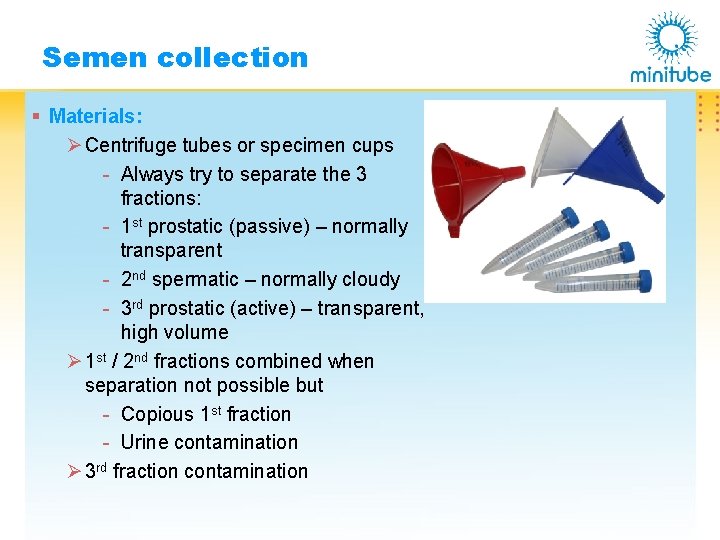
Semen collection § Materials: Ø Centrifuge tubes or specimen cups - Always try to separate the 3 fractions: - 1 st prostatic (passive) – normally transparent - 2 nd spermatic – normally cloudy - 3 rd prostatic (active) – transparent, high volume Ø 1 st / 2 nd fractions combined when separation not possible but - Copious 1 st fraction - Urine contamination Ø 3 rd fraction contamination
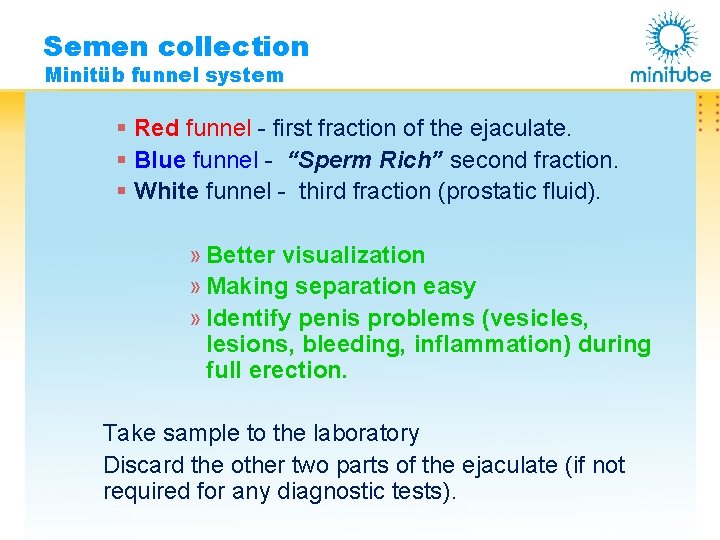
Semen collection Minitüb funnel system § Red funnel - first fraction of the ejaculate. § Blue funnel - “Sperm Rich” second fraction. § White funnel - third fraction (prostatic fluid). » Better visualization » Making separation easy » Identify penis problems (vesicles, lesions, bleeding, inflammation) during full erection. Take sample to the laboratory Discard the other two parts of the ejaculate (if not required for any diagnostic tests).
Semen evaluation • Volume - Depends on prostatic fraction § 3 to 30 ml or more § If a low volume is collected: } Make sure that you have taken the entirely of the 2 nd fraction of ejaculate - Colour § Normal: opaque, cloudy / milky - p. H § Normal 6. 5 to 7. 0 - Density § Very good § Good § Fair § Poor 750 – 1. 000 Mio sperm/ml 400 – 750 Mio sperm/ml 250 – 400 Mio sperm/ml < 250 Mio sperm/ml
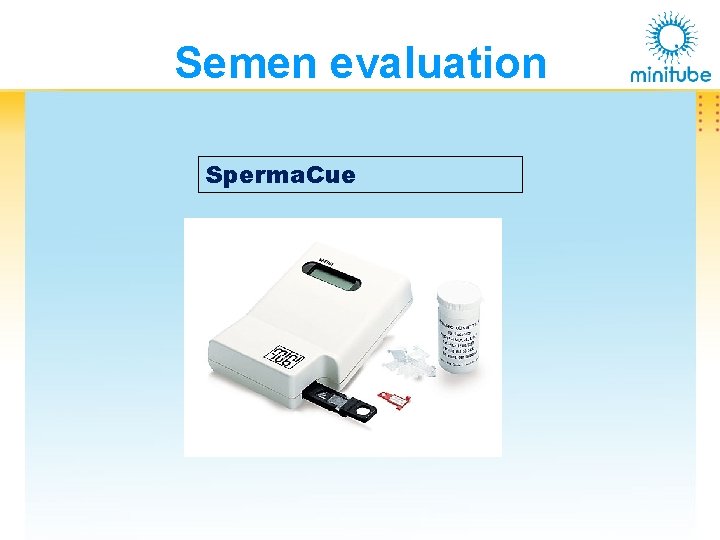
Semen evaluation Sperma. Cue
Semen evaluation • Total spermatozoa in ejaculate - Volume x sperm concentration/ml Average: 1, 25 billion / ejaculate Range: 300 million – 2 billion Variable because: § Age § Breed § Size of testes - Minimum insemination dose: § 100 million normal motile spermatozoa per dose
Semen preservation objectives Objectives: - Conserve semen at: § approx. 5 degrees C for a few days § or at -196 degrees for … years - Conservation Medium should: § Maintain osmolarity and p. H, prevent oxydative stress § Provide energy substrates
Semen preservation Spermicidal Substances: - Many disposable syringes and insemination pipettes - Disposable gloves - Many lubricants - Detergents and disinfectants - Water and air - Seminal gel
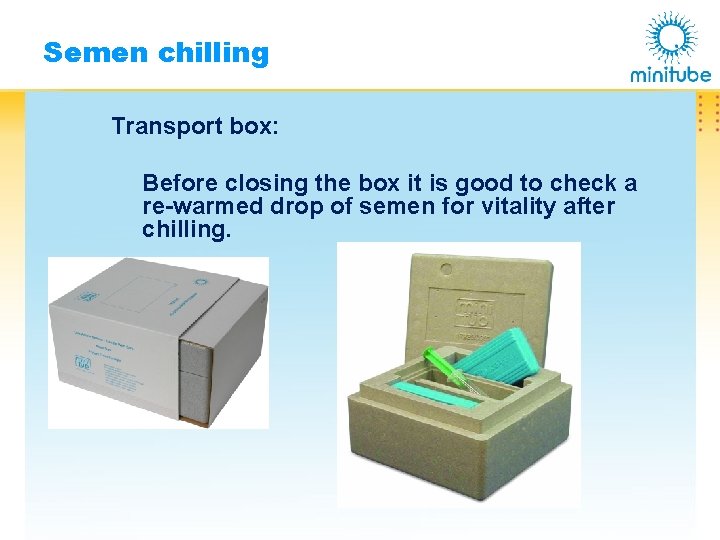
Semen chilling Transport box: Before closing the box it is good to check a re-warmed drop of semen for vitality after chilling.
Semen chilling Method of use Ø Do a trial storage before shipping Ø Important criteria: § Bitch management § Do not shock or harm sperm § Correct cooling rates § Correct temperature during storage Ø Close and seal the shipping box, making sure that some extra extender is included in the package as well as the insemination instructions and eventually syringe and insemination pipettes if the semen is to be send to a breeder.
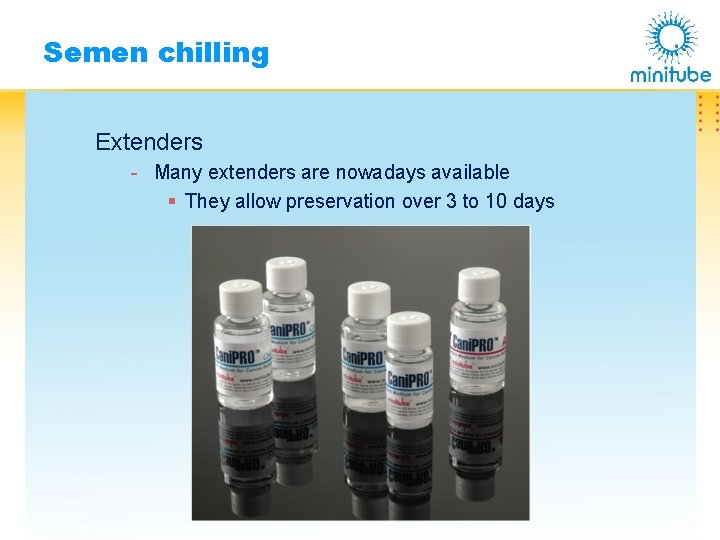
Semen chilling Extenders - Many extenders are nowadays available § They allow preservation over 3 to 10 days
Semen freezing § Indications } Cryopreservation: » Allows stud dog owners to preserve valuable genetic material for future breeding » Allows for breeding when the male is dead or no longer fertile » Allows for breeding to a male that is unavailable for breeding » Allows for international exchange over long distances or when quarantine exists
Semen freezing Whelping rates: - Results after AI with frozen-thawed semen are highly variable and depend on: § Method used § Site of deposition § Number of inseminations and inseminated sperm § Semen quality, handling ….
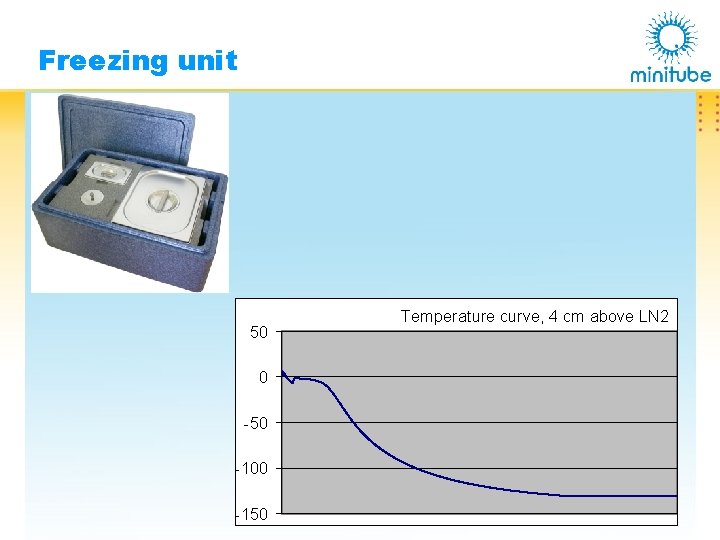
Freezing unit 50 0 -50 -100 -150 Temperature curve, 4 cm above LN 2
Breeding management - Mono-oestrus: one cycle per season? ? ? - Seasonal but: § Mean inter-oestrous interval 7 months } No real correlation with season } Highly variable between breeds } High variations in the same breed } High variations in the same animal § Keyword about canine cycle: VARIABILITY
Breeding management Canine oestrous cycle Relations between sexual behaviour and cycle: Pro-oestrous: average 9 days (2 -27 days) Oestrous: average 9 days (3 -21 days)
Breeding management - Should begin 3 -5 days after first bleedings: § Vaginal smears § Vaginoscopy § Progesterone assays } Best to inseminate with fresh semen or mate twice at 48 h interval from 5 -7 ng/ml } Best to inseminate with frozen semen or poor quality semen twice at 24 h interval from 9 -10 ng/ml Poor breeding management is the main cause of infertility in the bitch

Progesterone measurement e. Pro. Check measures Progesterone automatically Serum sample necessary
Breeding management Vaginal smears § Easy and cheap } Cotton swab into the vagina } Scraping the mucosa } Rolling the swab on the slide } Diff-Quick and/or Harris-Schorr § No possibility to predict ovulation or the time peak fertility The use of vaginal smears improve results of breeding management from 40% up to 60 -65% of success rate
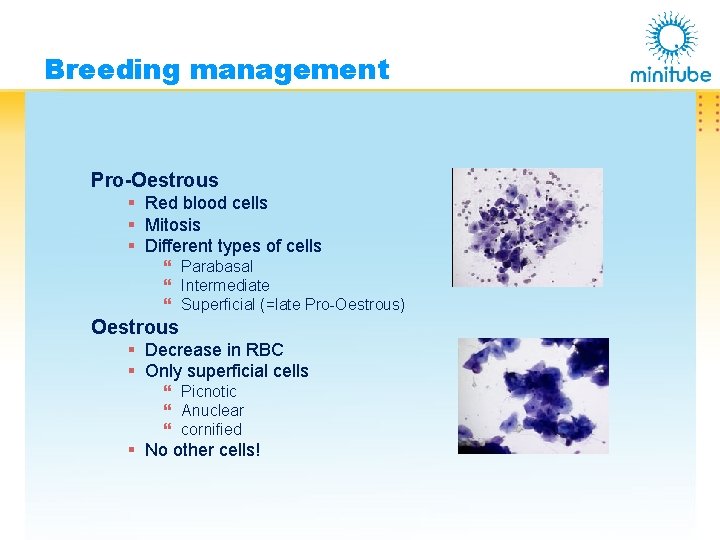
Breeding management Pro-Oestrous § Red blood cells § Mitosis § Different types of cells } Parabasal } Intermediate } Superficial (=late Pro-Oestrous) Oestrous § Decrease in RBC § Only superficial cells } Picnotic } Anuclear } cornified § No other cells!
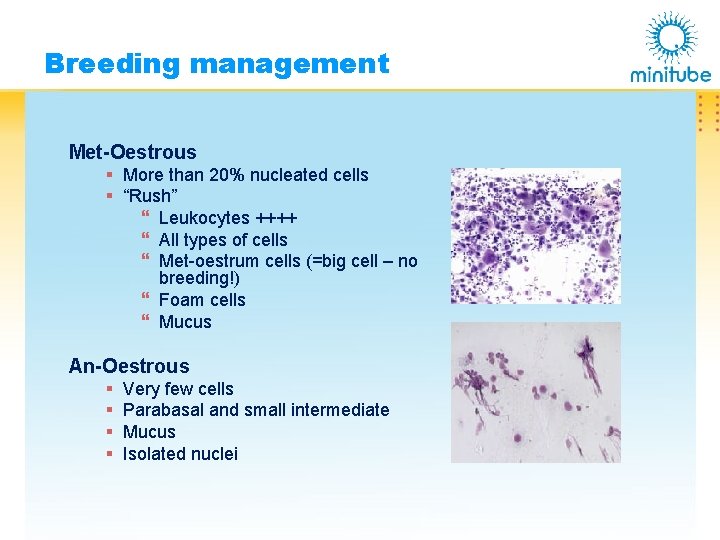
Breeding management Met-Oestrous § More than 20% nucleated cells § “Rush” } Leukocytes ++++ } All types of cells } Met-oestrum cells (=big cell – no breeding!) } Foam cells } Mucus An-Oestrous § § Very few cells Parabasal and small intermediate Mucus Isolated nuclei
Breeding management vaginal endoscopy Allows for an improvement of breeding management results from 60 -65% to 80 -90% Ø However: experience is needed Still a large window for the period of insemination Progesterone essay is needed in conjunction with these 2 techniques to optimise results
Artificial Insemination Volumes: Depending on the semen quality at the time of insemination, perform either: • Vaginal insemination with a MAVIC catheter using the chilled semen and extra extender at room temperature to ideally reach the following total volumes: o 2 -5 cc for bitches <10 kg o 5 -10 cc for bitches between 11 and 19 kg o Up to 20 cc for bitches > 20 kg Note: These volumes simulate the volumes produced during natural mating. At time of insemination first inject the extended semen, then flush with the extra volume of extender mimicking the events happening during the tie. • TCI or surgical insemination using 1 – 3 cc of extended semen depending on the size of the bitch.
Artificial Insemination - Vaginal: § Pipette § MAVIC - Surgical: § Laparotomy } } General anesthesia Incision 4 -6 cm linea alba Locate the uterus Bring the uterus extra-abdominally
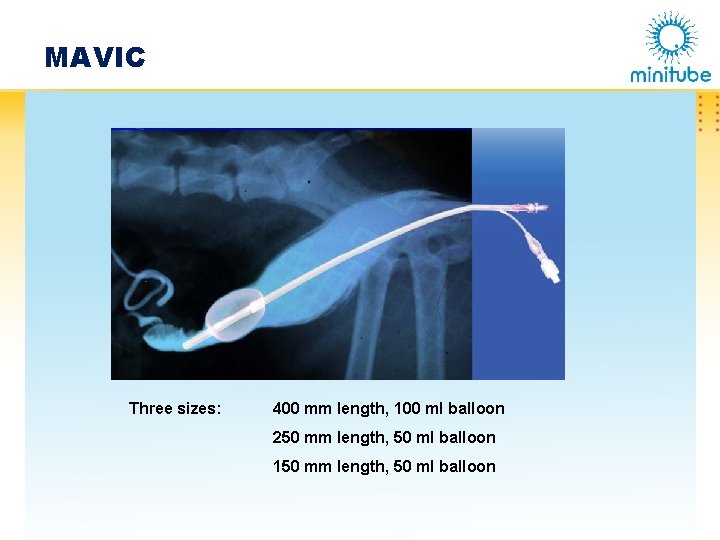
MAVIC Three sizes: 400 mm length, 100 ml balloon 250 mm length, 50 ml balloon 150 mm length, 50 ml balloon
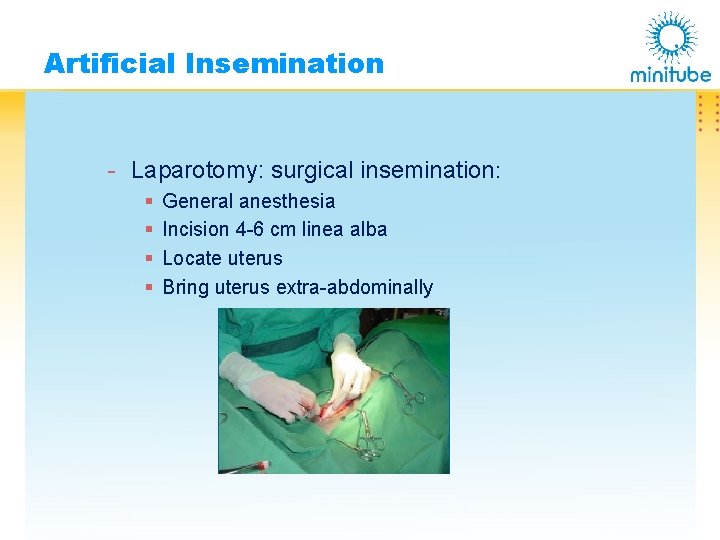
Artificial Insemination - Laparotomy: surgical insemination: § § General anesthesia Incision 4 -6 cm linea alba Locate uterus Bring uterus extra-abdominally
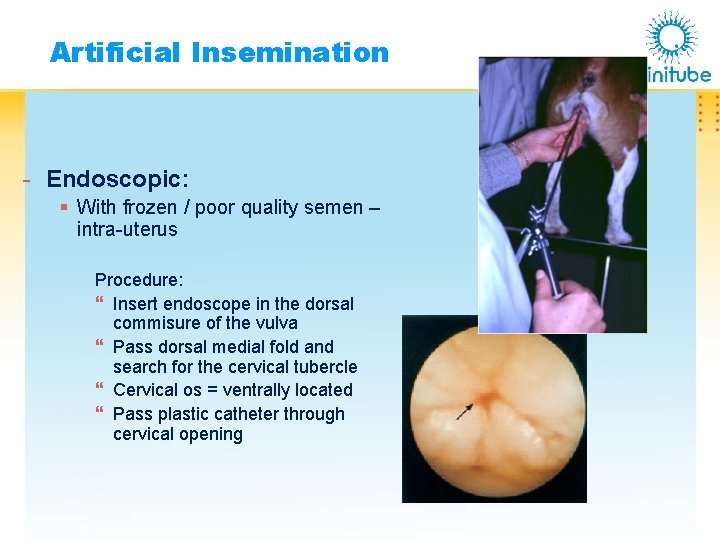
Artificial Insemination - Endoscopic: § With frozen / poor quality semen – intra-uterus Procedure: } Insert endoscope in the dorsal commisure of the vulva } Pass dorsal medial fold and search for the cervical tubercle } Cervical os = ventrally located } Pass plastic catheter through cervical opening
Thank you very much
- Slides: 45