
The Millennial Development Goals by Eli Feriante The
The Millennial Development Goals by Eli Feriante
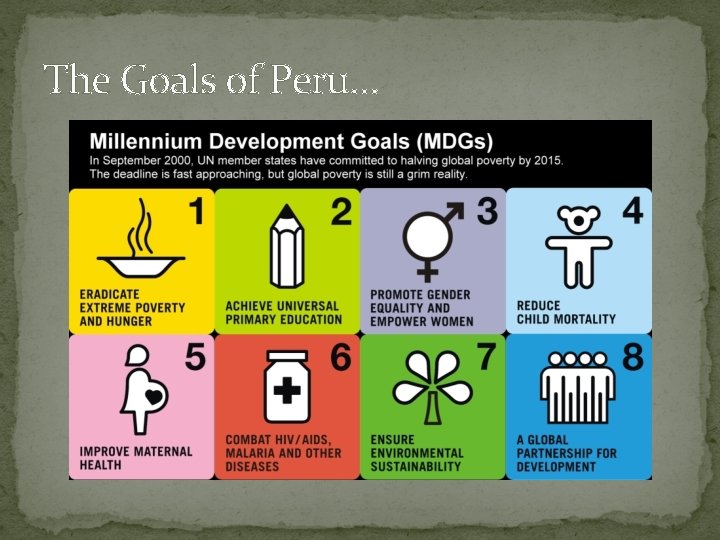
The Goals of Peru…
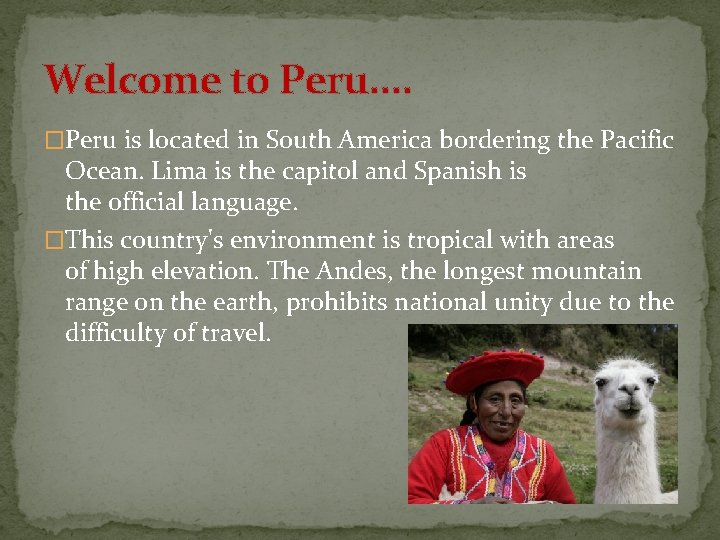
Welcome to Peru. . �Peru is located in South America bordering the Pacific Ocean. Lima is the capitol and Spanish is the official language. �This country's environment is tropical with areas of high elevation. The Andes, the longest mountain range on the earth, prohibits national unity due to the difficulty of travel.
1) Eradicate extreme poverty and hunger �In regards to those who’s income is under $1 a day, that proportion will be cut by 50% between 1990 and 2015. �There are hopes to produce enough jobs for women and young people. �The employment rates are increasing. �Malnutrition rates are deceasing. �The plan is to reduce hunger by 50% by 2015.
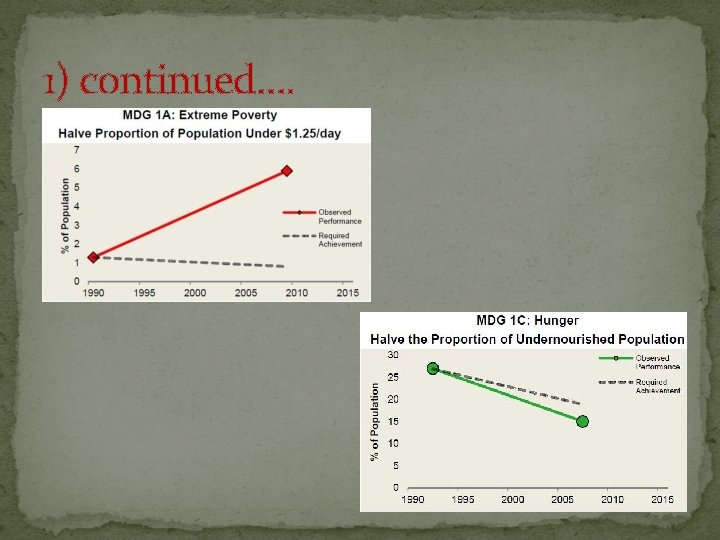
1) continued….
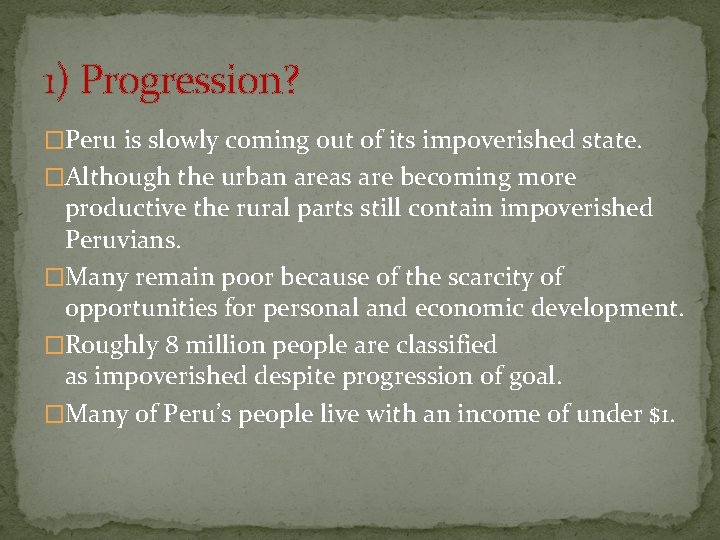
1) Progression? �Peru is slowly coming out of its impoverished state. �Although the urban areas are becoming more productive the rural parts still contain impoverished Peruvians. �Many remain poor because of the scarcity of opportunities for personal and economic development. �Roughly 8 million people are classified as impoverished despite progression of goal. �Many of Peru’s people live with an income of under $1.
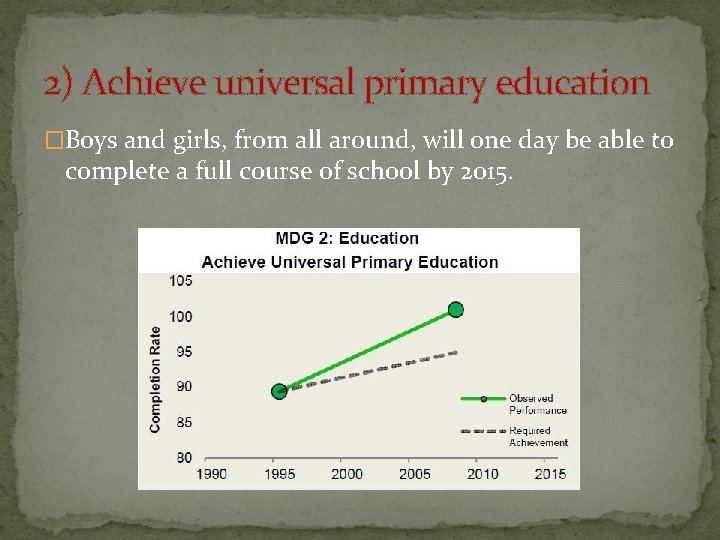
2) Achieve universal primary education �Boys and girls, from all around, will one day be able to complete a full course of school by 2015.
2) Progression? �Peru is making great strides in providing education to its people. �Efforts are being made to propose that tw 0 languages are to be taught in certain schools, especially Quechua, the language of the ancient Indians. �Scholastic achievement is forecasted to improve in Quechua and Spanish between 54% and 67%.
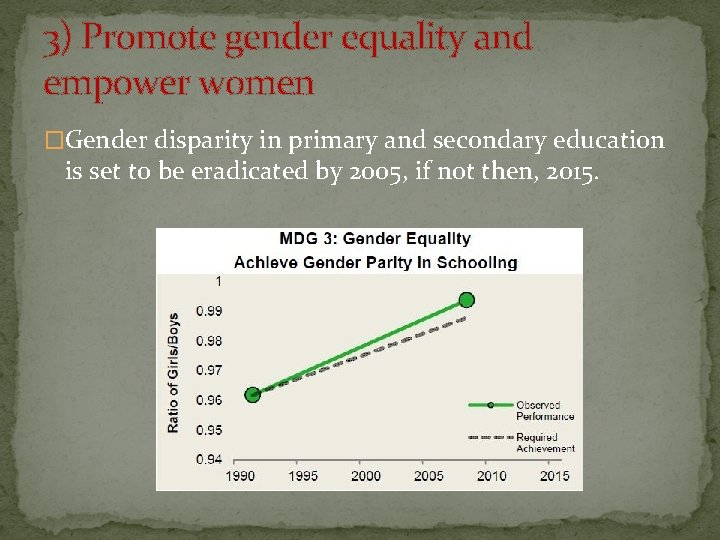
3) Promote gender equality and empower women �Gender disparity in primary and secondary education is set to be eradicated by 2005, if not then, 2015.
3) Progression? �Influence government authorities at the local, regional and national level to design policies and strategies to tackle gender inequity. �Those you are more educated will more likely obtain jobs that will diminish poverty. �Also, educational people can reduce child mortality rates and teen pregnancy. Maternal health will increase.
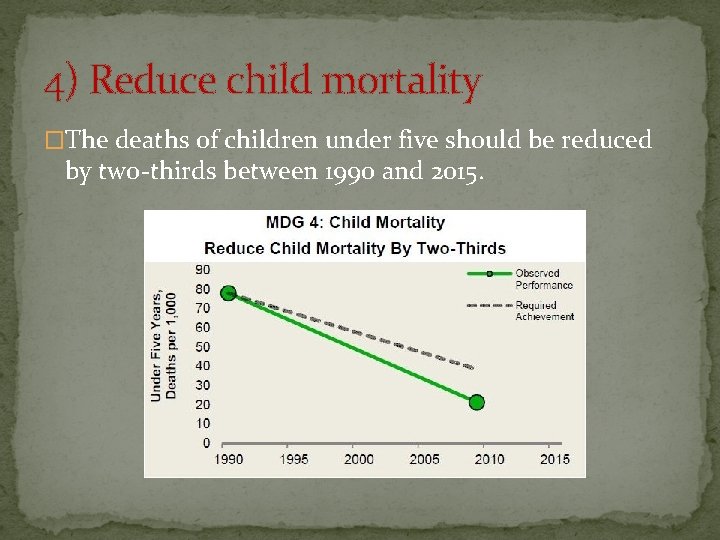
4) Reduce child mortality �The deaths of children under five should be reduced by two-thirds between 1990 and 2015.
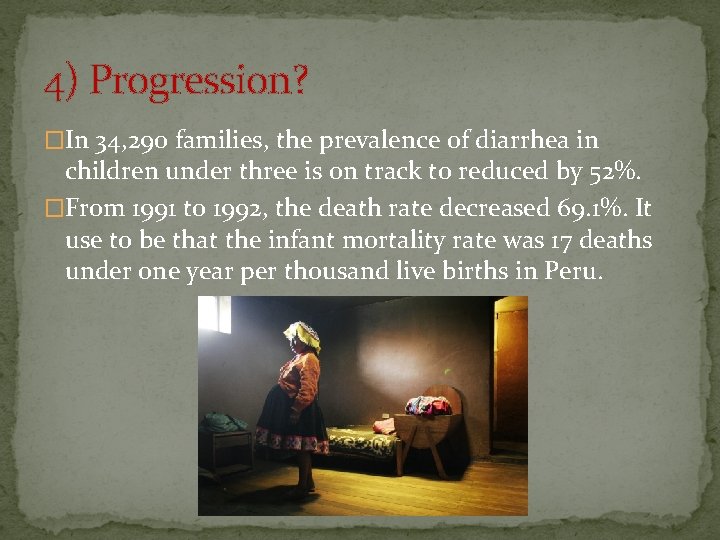
4) Progression? �In 34, 290 families, the prevalence of diarrhea in children under three is on track to reduced by 52%. �From 1991 to 1992, the death rate decreased 69. 1%. It use to be that the infant mortality rate was 17 deaths under one year per thousand live births in Peru.
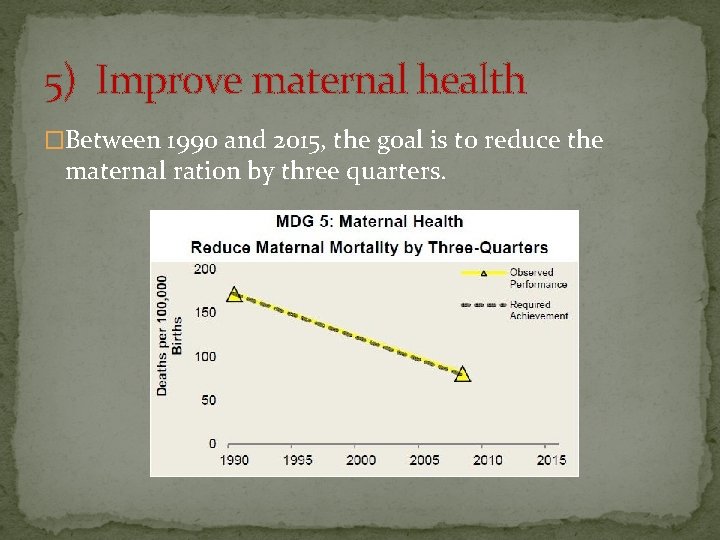
5) Improve maternal health �Between 1990 and 2015, the goal is to reduce the maternal ration by three quarters.
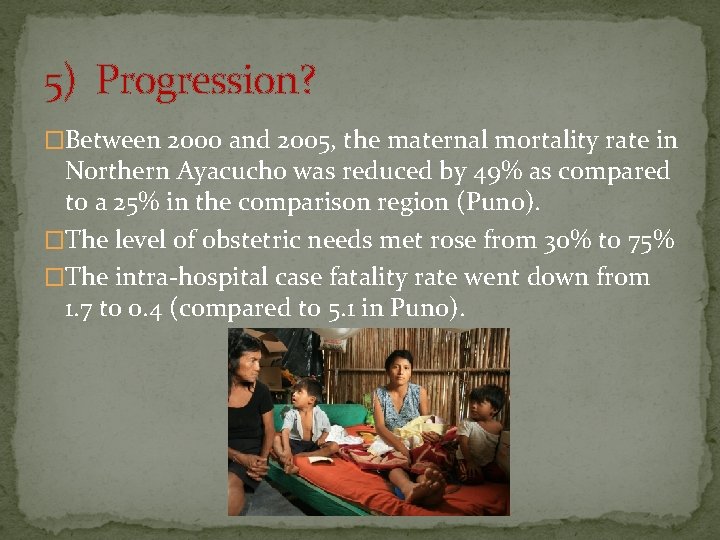
5) Progression? �Between 2000 and 2005, the maternal mortality rate in Northern Ayacucho was reduced by 49% as compared to a 25% in the comparison region (Puno). �The level of obstetric needs met rose from 30% to 75% �The intra-hospital case fatality rate went down from 1. 7 to 0. 4 (compared to 5. 1 in Puno).
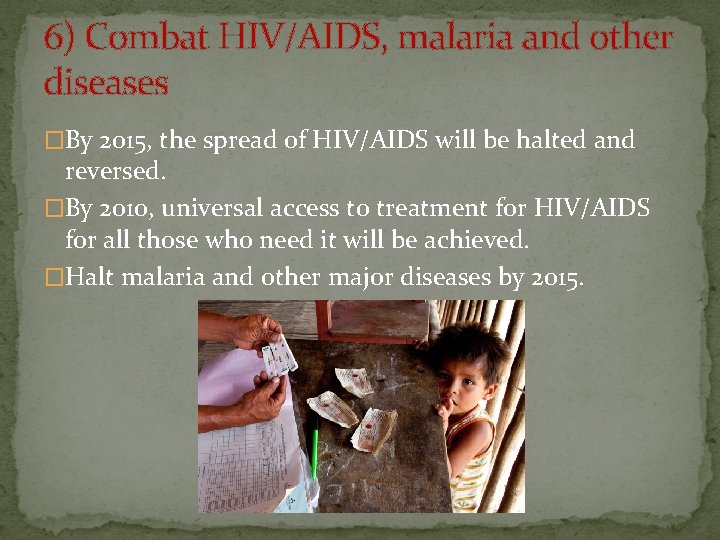
6) Combat HIV/AIDS, malaria and other diseases �By 2015, the spread of HIV/AIDS will be halted and reversed. �By 2010, universal access to treatment for HIV/AIDS for all those who need it will be achieved. �Halt malaria and other major diseases by 2015.
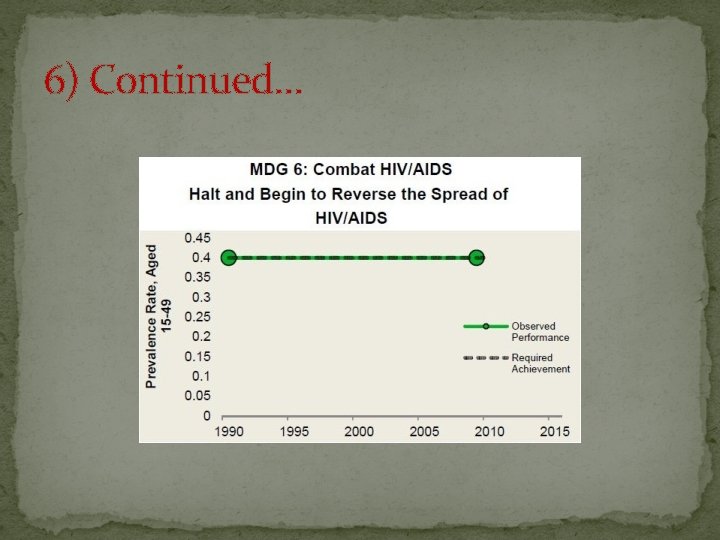
6) Continued…
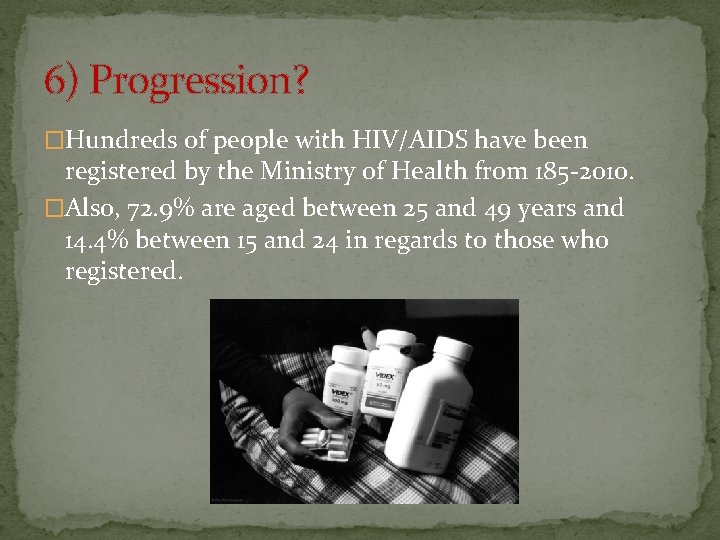
6) Progression? �Hundreds of people with HIV/AIDS have been registered by the Ministry of Health from 185 -2010. �Also, 72. 9% are aged between 25 and 49 years and 14. 4% between 15 and 24 in regards to those who registered.
7) Ensure environmental sustainability �Principles of sustainable development, country polices, and programs will reverse the loss of environmental resources. �By 2010, there will be a significant reduction of biodiversity loss. �By 2015, the proportion of people without sustainable access to safe drinking water and basic sanitation will be cut by 50% �By 2020, the goal is to have achieved a significant improvement in the lives of at least 100 million slum dwellers.
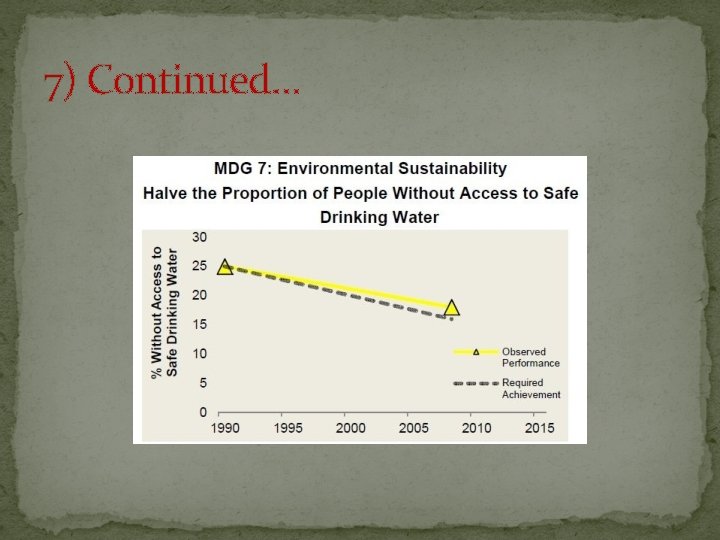
7) Continued…
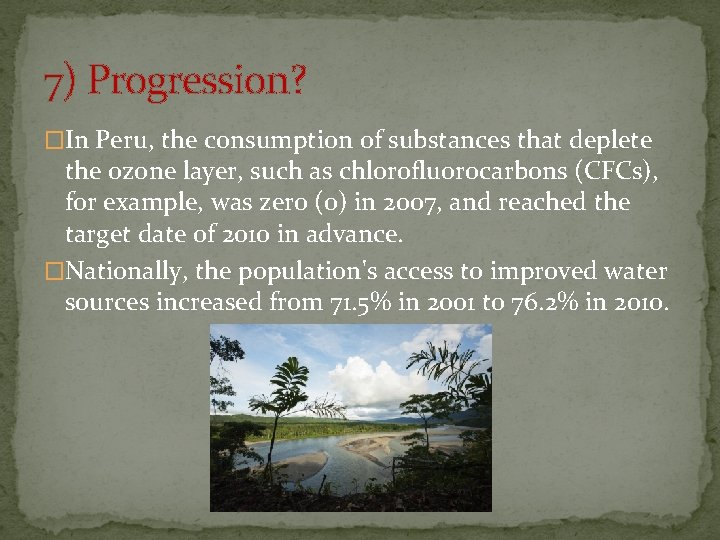
7) Progression? �In Peru, the consumption of substances that deplete the ozone layer, such as chlorofluorocarbons (CFCs), for example, was zero (0) in 2007, and reached the target date of 2010 in advance. �Nationally, the population's access to improved water sources increased from 71. 5% in 2001 to 76. 2% in 2010.
8) Develop a global partnership for development �Develop a non-discriminatory trading and financial system. �Address the special needs of landlocked countries and small island developing States. �Create national and international measures that deal with debt problems of developing countries
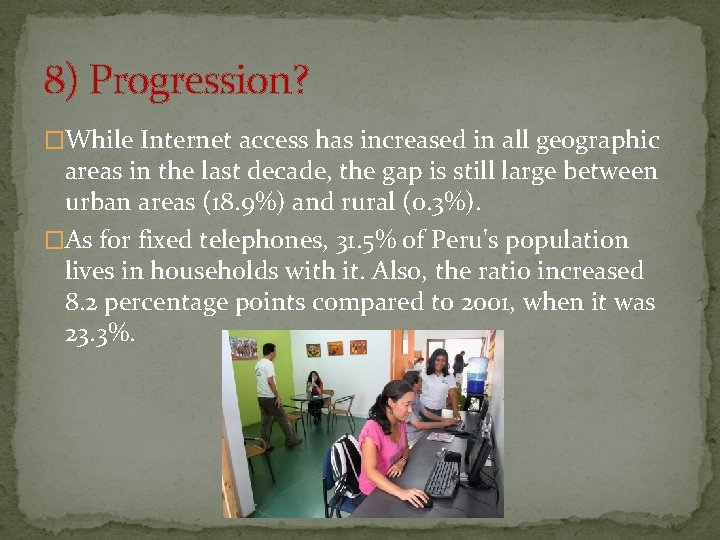
8) Progression? �While Internet access has increased in all geographic areas in the last decade, the gap is still large between urban areas (18. 9%) and rural (0. 3%). �As for fixed telephones, 31. 5% of Peru's population lives in households with it. Also, the ratio increased 8. 2 percentage points compared to 2001, when it was 23. 3%.
Wrap-Up �Peru is on its way to becoming a 2. 0 world country due to increasing job opportunities, better education, environmental concern, reduction of diseases and child mortality rates, and maternal as well as gender equality. �However, Peru is partially a 1. 0 world because it is still working its way out poverty, poor quality of education, inequality, and lack of technological infrastructure. These factors are prohibiting its potential in becoming a strong country.
Works Cited Information: �http: //mdgs. un. org/unsd/mdg/host. aspx? Content=in dicators/officiallist. htm �http: //www. care. org. pe/pdfs/CARE%20 PERU%20%20 the%20 MDGs. pdf �http: //www. pe. undp. org/content/peru/es/home/ �http: //theperuviancountry. weebly. com/ Charts and Pictures: �http: //www. cgdev. org/page/mdg-progress-indexgauging-country-level-achievements �http: //www. google. com
- Slides: 24