
The Milky Way Deep Space and Beyond Hierarchy
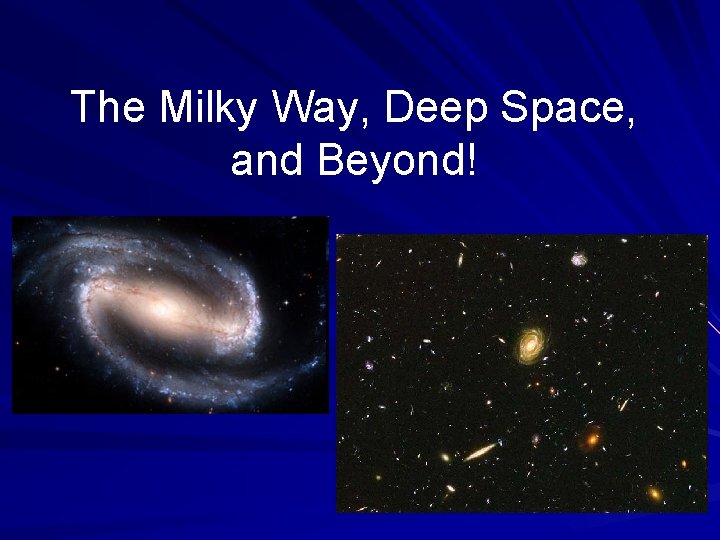
The Milky Way, Deep Space, and Beyond!
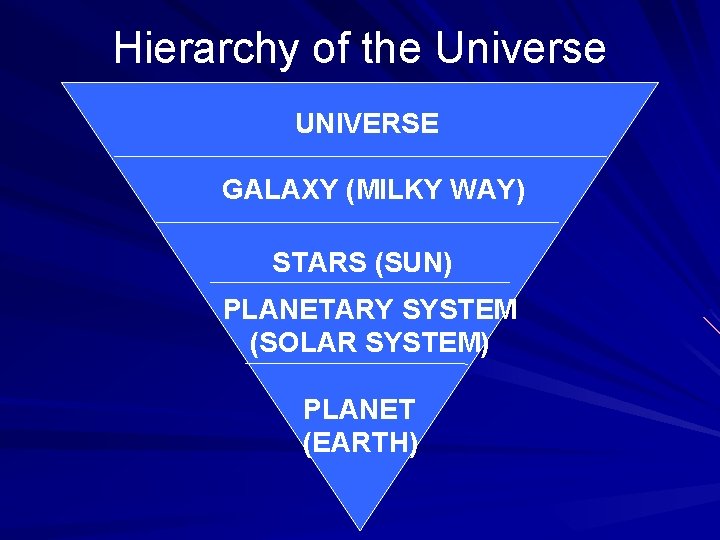
Hierarchy of the Universe UNIVERSE GALAXY (MILKY WAY) STARS (SUN) PLANETARY SYSTEM (SOLAR SYSTEM) PLANET (EARTH)
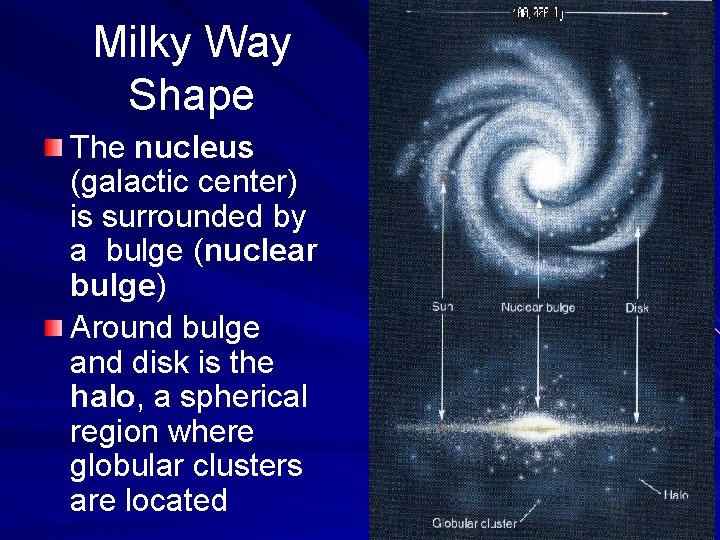
Milky Way Shape The nucleus (galactic center) is surrounded by a bulge (nuclear bulge) Around bulge and disk is the halo, a spherical region where globular clusters are located
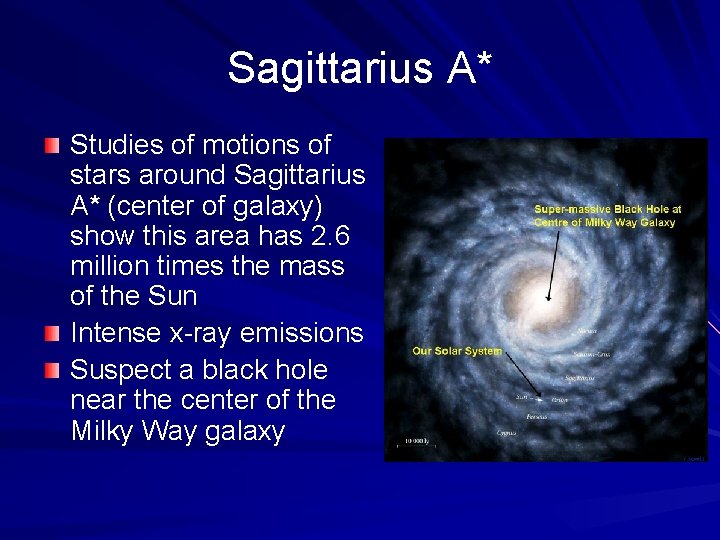
Sagittarius A* Studies of motions of stars around Sagittarius A* (center of galaxy) show this area has 2. 6 million times the mass of the Sun Intense x-ray emissions Suspect a black hole near the center of the Milky Way galaxy
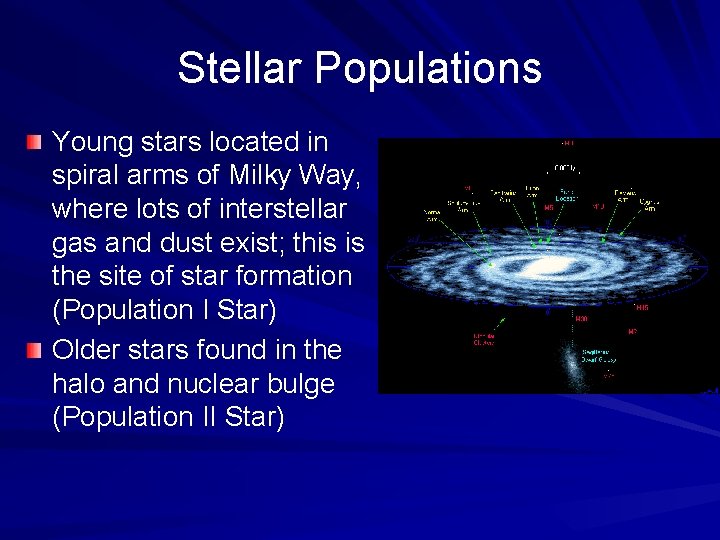
Stellar Populations Young stars located in spiral arms of Milky Way, where lots of interstellar gas and dust exist; this is the site of star formation (Population I Star) Older stars found in the halo and nuclear bulge (Population II Star)
Discovering other Galaxies… Astronomers aware of galaxies outside the Milky Way long before they knew what the objects were Disagreed about the nature of these objects 1924 Edwin Hubble able to measure the distance to some of these objects and determined them to be outside our galaxy
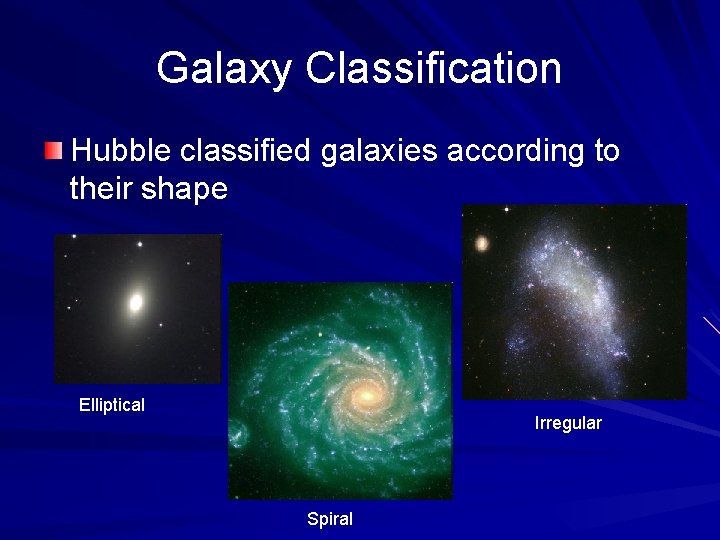
Galaxy Classification Hubble classified galaxies according to their shape Elliptical Irregular Spiral
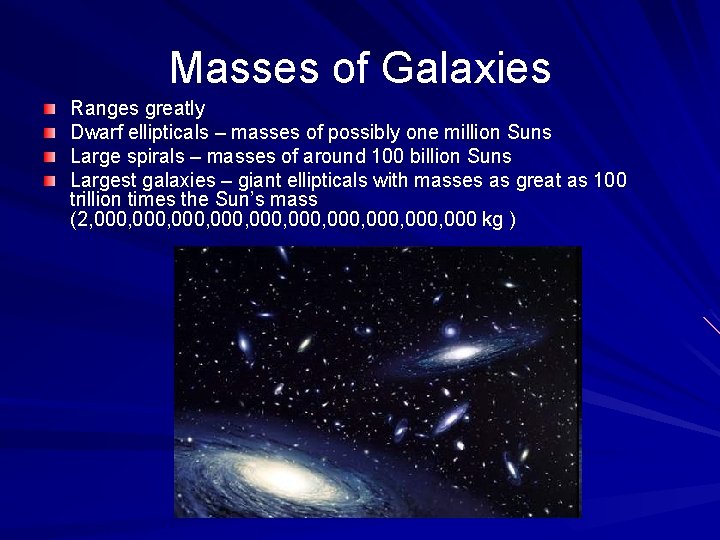
Masses of Galaxies Ranges greatly Dwarf ellipticals – masses of possibly one million Suns Large spirals – masses of around 100 billion Suns Largest galaxies – giant ellipticals with masses as great as 100 trillion times the Sun’s mass (2, 000, 000, 000 kg )
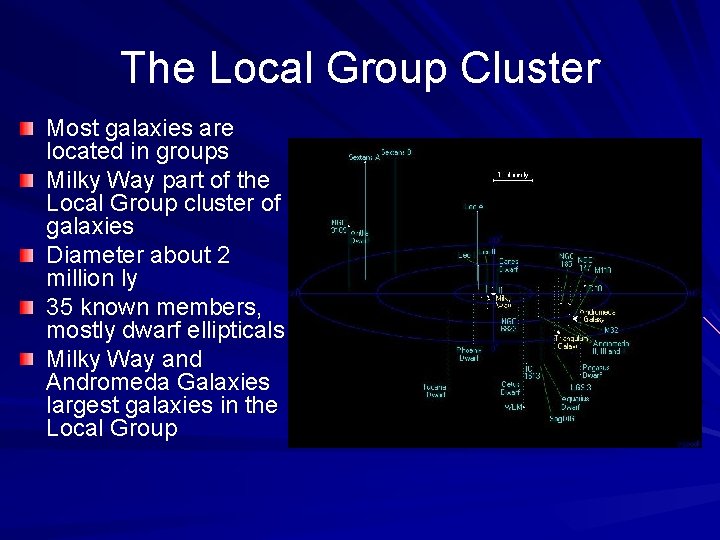
The Local Group Cluster Most galaxies are located in groups Milky Way part of the Local Group cluster of galaxies Diameter about 2 million ly 35 known members, mostly dwarf ellipticals Milky Way and Andromeda Galaxies largest galaxies in the Local Group
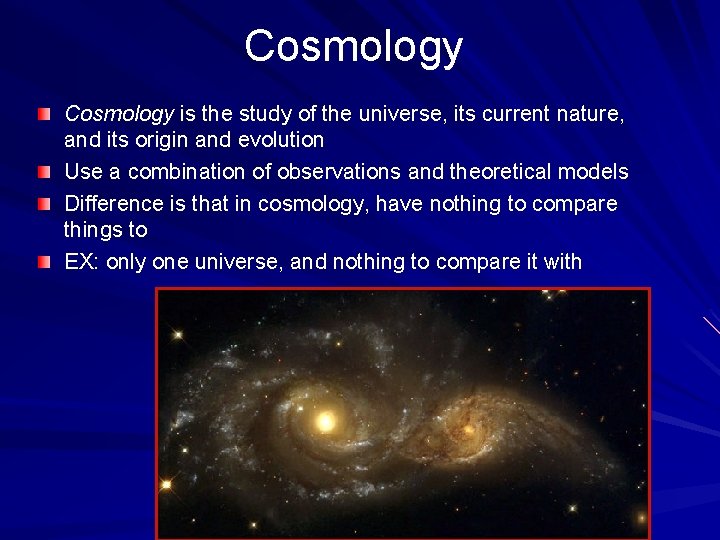
Cosmology is the study of the universe, its current nature, and its origin and evolution Use a combination of observations and theoretical models Difference is that in cosmology, have nothing to compare things to EX: only one universe, and nothing to compare it with
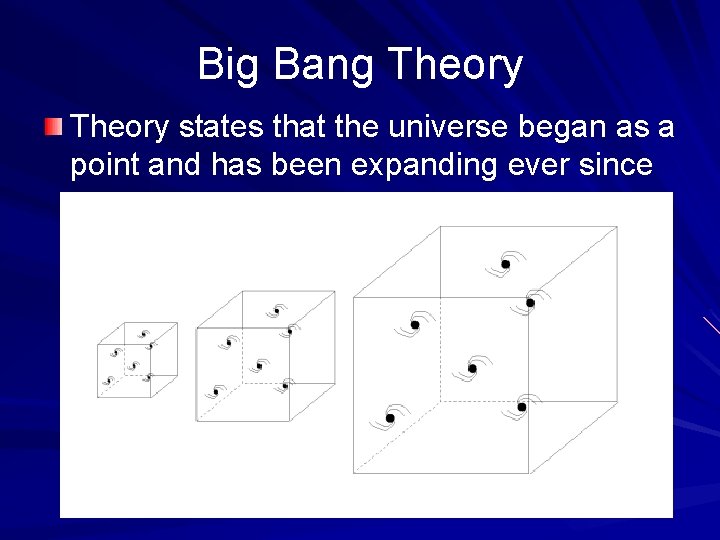
Big Bang Theory states that the universe began as a point and has been expanding ever since
Misconceptions about the Big Bang Theory 1. The Big Bang was an explosion 2. The Big Bang Theory is an explanation for how the universe was created. 3. There is no evidence for the Big Bang Theory
Misconceptions about the Big Bang 1. The Big Bang was an explosion. -Originally known as the “primeval atom” theory Technically, there was no “bang” Technically, galaxies are not moving away from each other Reality: space expands – When there is more space between galaxies, they “move” away from each other – Analogy: dots on an expanding balloon
Misconceptions about the Big Bang Theory 2. The Big Bang Theory is an explanation for how the universe was created. Big Bang Theory explains how the Universe first started but leaves many unanswered questions Time, Space and Matter were created in the Big Bang – Before the bang, there were no time, no space and no matter – Physics has not solved the question “What’s before the Big Bang”
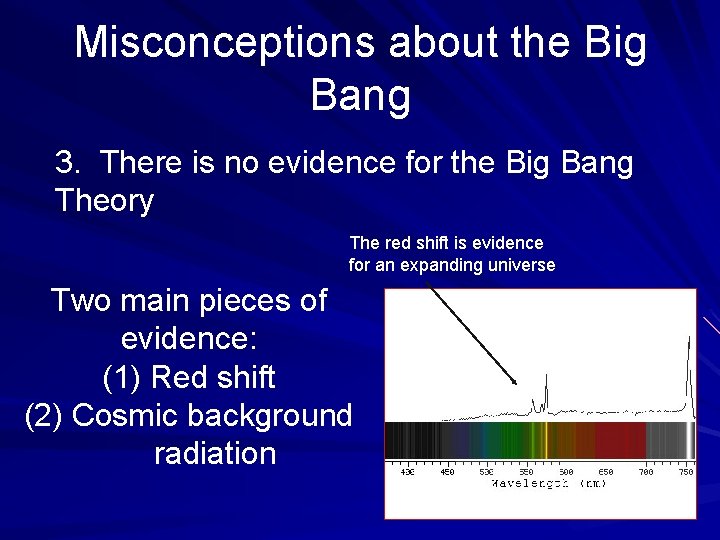
Misconceptions about the Big Bang 3. There is no evidence for the Big Bang Theory The red shift is evidence for an expanding universe Two main pieces of evidence: (1) Red shift (2) Cosmic background radiation
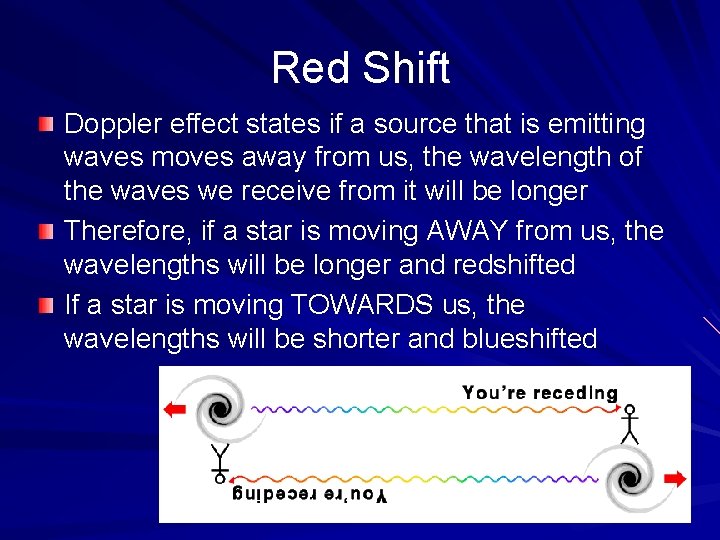
Red Shift Doppler effect states if a source that is emitting waves moves away from us, the wavelength of the waves we receive from it will be longer Therefore, if a star is moving AWAY from us, the wavelengths will be longer and redshifted If a star is moving TOWARDS us, the wavelengths will be shorter and blueshifted
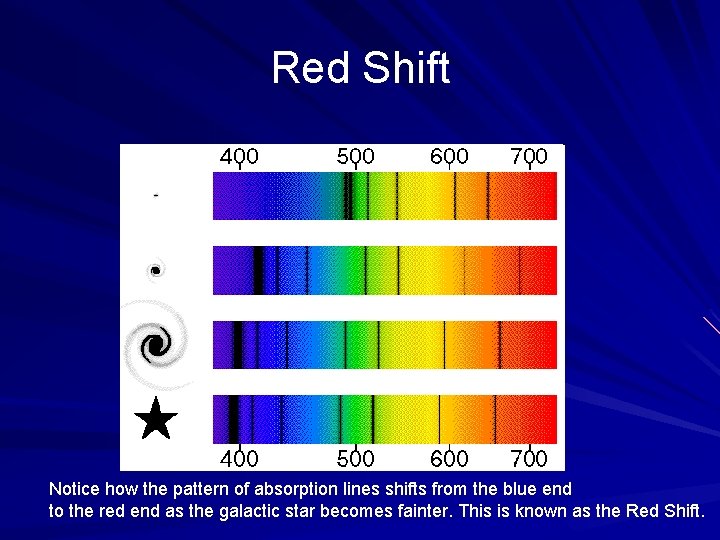
Red Shift Notice how the pattern of absorption lines shifts from the blue end to the red end as the galactic star becomes fainter. This is known as the Red Shift.
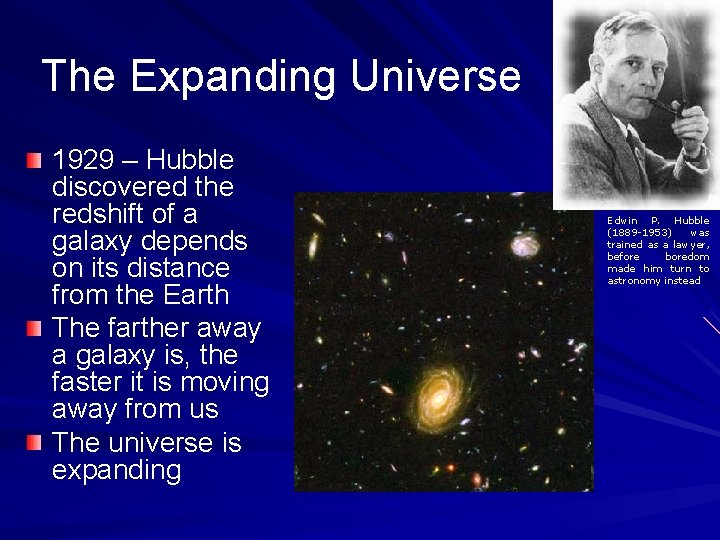
The Expanding Universe 1929 – Hubble discovered the redshift of a galaxy depends on its distance from the Earth The farther away a galaxy is, the faster it is moving away from us The universe is expanding Edwin P. Hubble (1889 -1953) was trained as a lawyer, before boredom made him turn to astronomy instead
Cosmic Background Radiation 2 nd piece of evidence in support of Big Bang Theory If all matter was compressed into a small space, that means that in addition to being very dense, it was also very hot These high temperatures would have filled the universe with radiation and this radiation should still be present today Energy of the radiation should have cooled down today into longer wavelengths and lower frequencies
Cosmic Background Radiation Background radiation was discovered in 1964 by Arno Penzias and Robert Wilson, who later won the Nobel Prize for this discovery Corresponds to a temperature of just 2. 7 Kelvin ( -270 C) Identified as the radiation left over from the Big Bang event
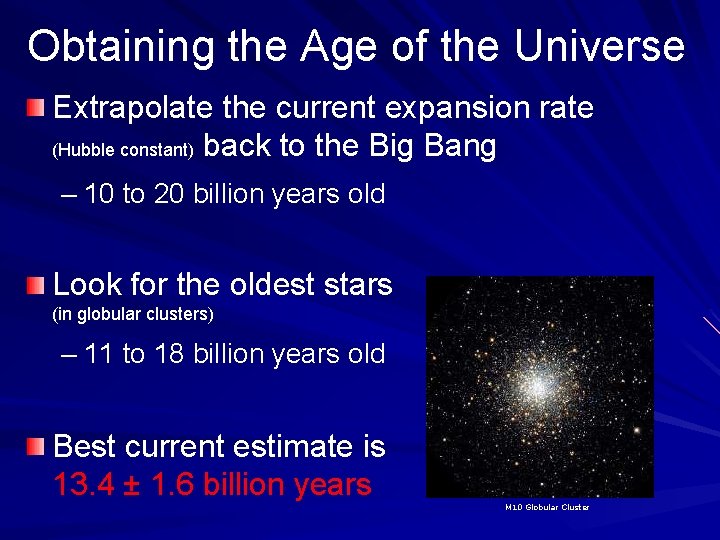
Obtaining the Age of the Universe Extrapolate the current expansion rate (Hubble constant) back to the Big Bang – 10 to 20 billion years old Look for the oldest stars (in globular clusters) – 11 to 18 billion years old Best current estimate is 13. 4 ± 1. 6 billion years M 10 Globular Cluster
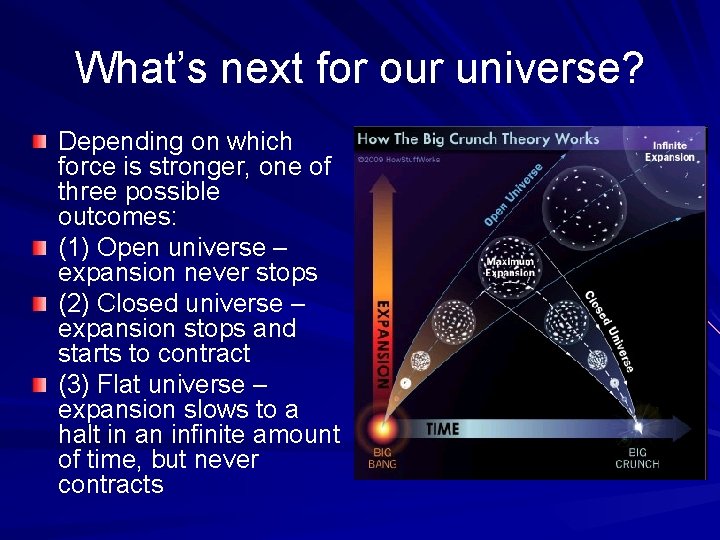
What’s next for our universe? Depending on which force is stronger, one of three possible outcomes: (1) Open universe – expansion never stops (2) Closed universe – expansion stops and starts to contract (3) Flat universe – expansion slows to a halt in an infinite amount of time, but never contracts
- Slides: 22