
The Military Uniform and Appearance Standards Lesson Overview
- Slides: 26
The Military Uniform and Appearance Standards
Lesson Overview Ø Uniform wear and history Ø Uniform wear, restrictions, and standards Ø Uniforms used within special teams Ø Cadet appearance and grooming standards Ø Military pay grades and rank insignia Chapter 1, Lesson 2
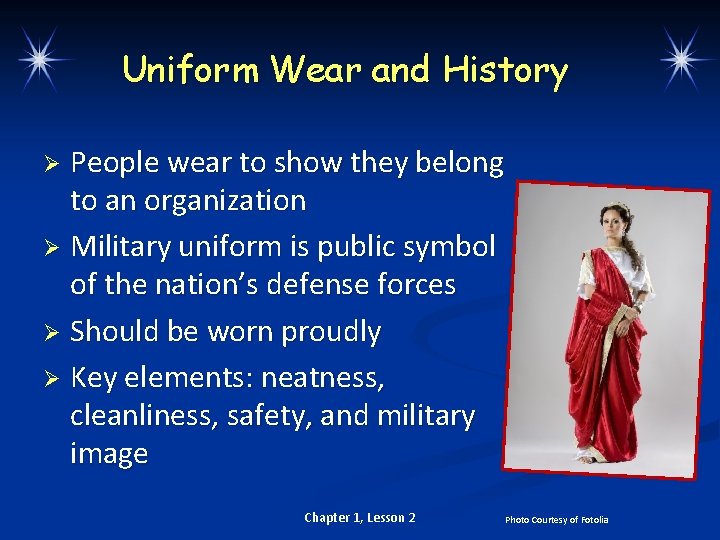
Uniform Wear and History People wear to show they belong to an organization Ø Military uniform is public symbol of the nation’s defense forces Ø Should be worn proudly Ø Key elements: neatness, cleanliness, safety, and military image Ø Chapter 1, Lesson 2 Photo Courtesy of Fotolia
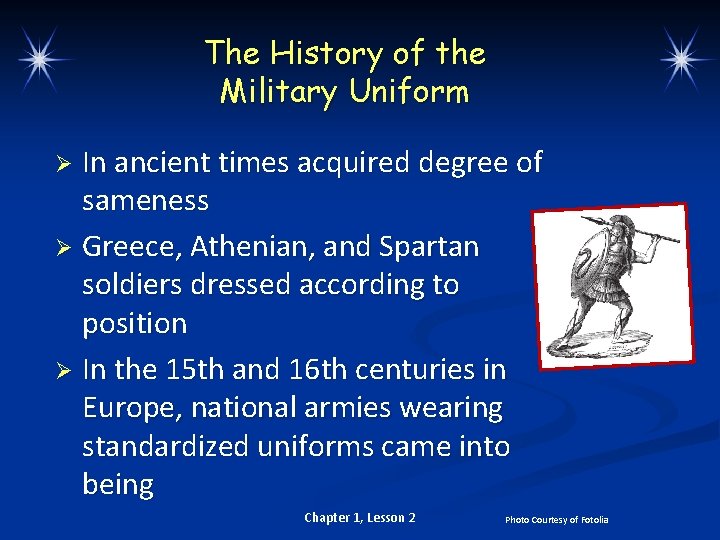
The History of the Military Uniform In ancient times acquired degree of sameness Ø Greece, Athenian, and Spartan soldiers dressed according to position Ø In the 15 th and 16 th centuries in Europe, national armies wearing standardized uniforms came into being Ø Chapter 1, Lesson 2 Photo Courtesy of Fotolia
Uniform Wear, Restrictions, and Standards Ø Ø Cadets generally wear same uniform as parent military service Restrictions for military personnel Ø Barred from engaging in political activity in uniform Ø Prohibited from publicly supporting a candidate Ø Requires absolute obedience to elected leaders Chapter 1, Lesson 2 Photo Courtesy of Fotolia
Uniform Wear, Restrictions, and Standards, cont. As citizens, military are encouraged to vote Ø Federal law forbids military in uniform from participating in public demonstrations Ø No item of JROTC uniform may be worn by groups that sponsor JROTC programs Ø Chapter 1, Lesson 2
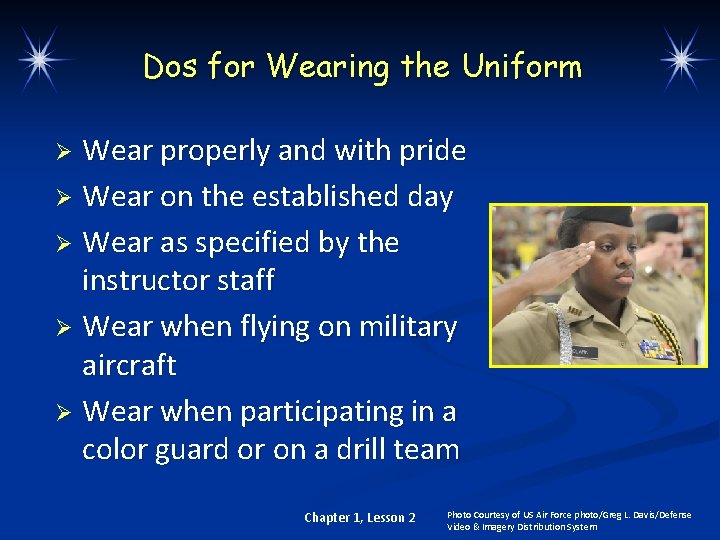
Dos for Wearing the Uniform Wear properly and with pride Ø Wear on the established day Ø Wear as specified by the instructor staff Ø Wear when flying on military aircraft Ø Wear when participating in a color guard or on a drill team Ø Chapter 1, Lesson 2 Photo Courtesy of US Air Force photo/Greg L. Davis/Defense Video & Imagery Distribution System
Dos for Wearing the Uniform, cont. Ø Ø Ø Keep your shoes polished and shined Wear shoes appropriate for the activity Ensure that badges, insignia, belt buckles, and other metallic devices are clean Keep ribbons clean Wear the distinctive uniform required Chapter 1, Lesson 2
Don’ts for Wearing the Uniform Ø Ø Do not wear with other clothing Do not lend your uniform to anyone who is not a JROTC member Do not allow articles to be visible Unless required in uniform: Ø Do not wear earphones or headphones Ø Do not carry pagers or cell phones Chapter 1, Lesson 2 Photo Courtesy of Fotolia
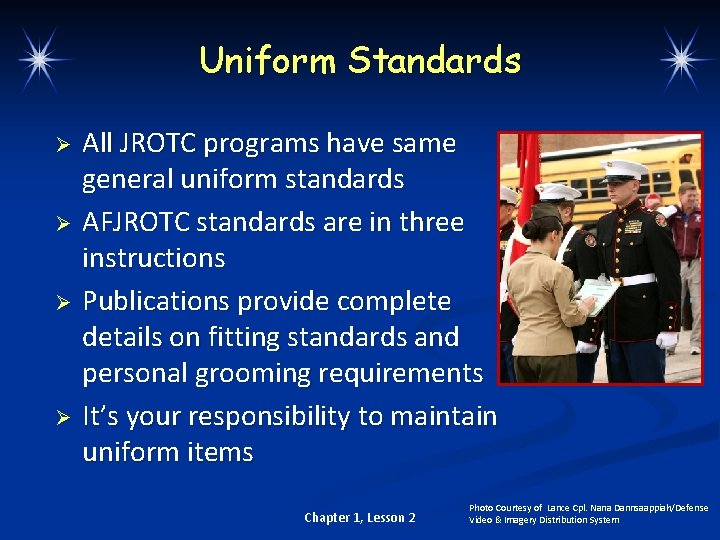
Uniform Standards Ø Ø All JROTC programs have same general uniform standards AFJROTC standards are in three instructions Publications provide complete details on fitting standards and personal grooming requirements It’s your responsibility to maintain uniform items Chapter 1, Lesson 2 Photo Courtesy of Lance Cpl. Nana Dannsaappiah/Defense Video & Imagery Distribution System
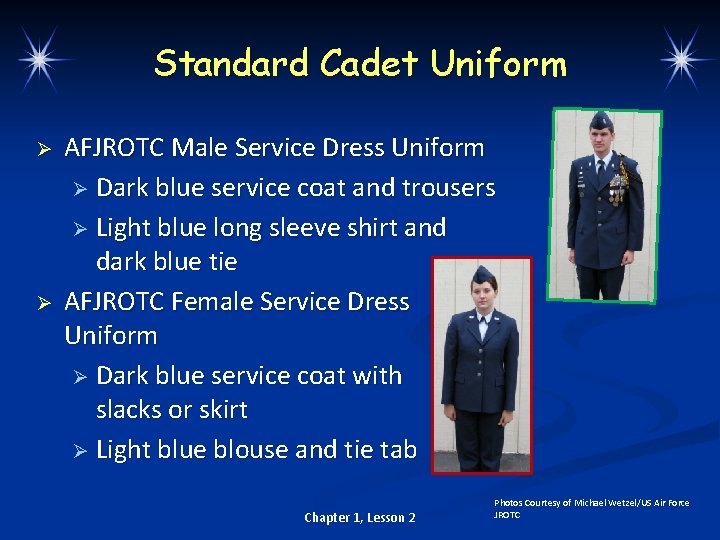
Standard Cadet Uniform Ø Ø AFJROTC Male Service Dress Uniform Ø Dark blue service coat and trousers Ø Light blue long sleeve shirt and dark blue tie AFJROTC Female Service Dress Uniform Ø Dark blue service coat with slacks or skirt Ø Light blue blouse and tie tab Chapter 1, Lesson 2 Photos Courtesy of Michael Wetzel/US Air Force JROTC
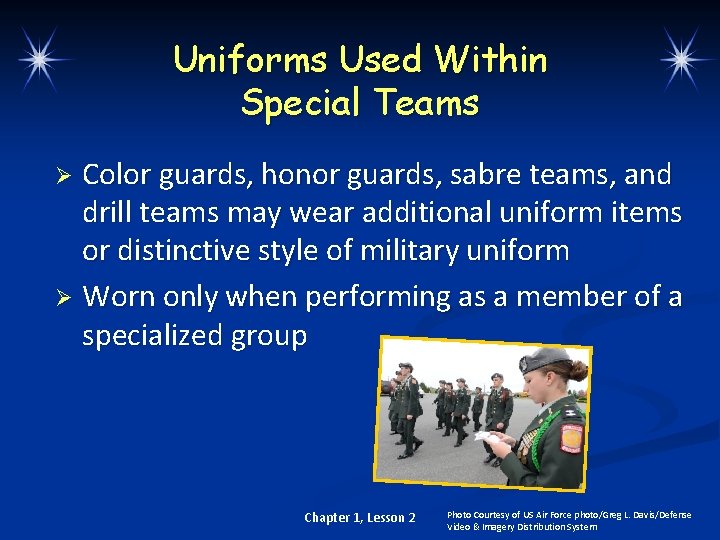
Uniforms Used Within Special Teams Color guards, honor guards, sabre teams, and drill teams may wear additional uniform items or distinctive style of military uniform Ø Worn only when performing as a member of a specialized group Ø Chapter 1, Lesson 2 Photo Courtesy of US Air Force photo/Greg L. Davis/Defense Video & Imagery Distribution System
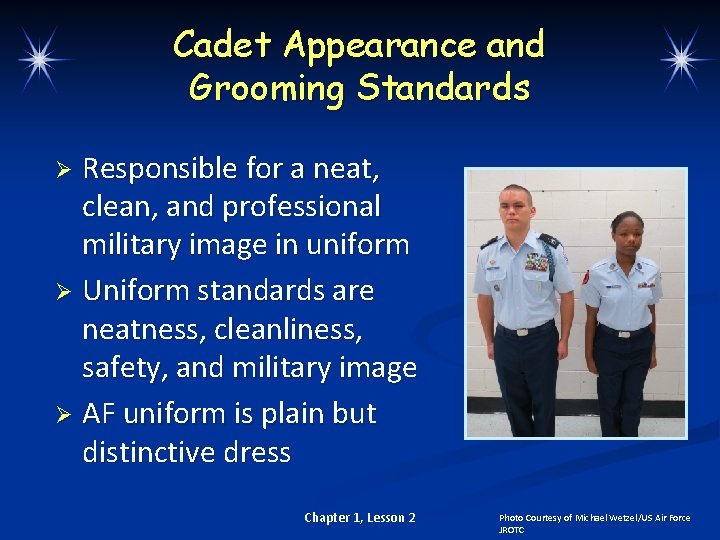
Cadet Appearance and Grooming Standards Responsible for a neat, clean, and professional military image in uniform Ø Uniform standards are neatness, cleanliness, safety, and military image Ø AF uniform is plain but distinctive dress Ø Chapter 1, Lesson 2 Photo Courtesy of Michael Wetzel/US Air Force JROTC
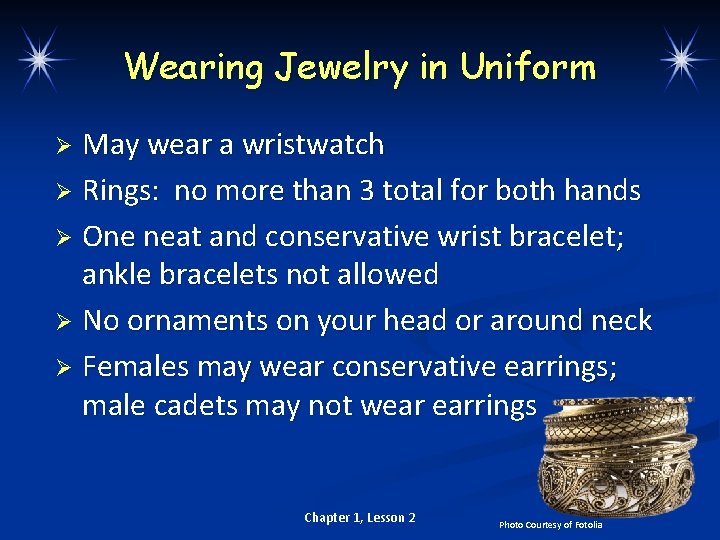
Wearing Jewelry in Uniform May wear a wristwatch Ø Rings: no more than 3 total for both hands Ø One neat and conservative wrist bracelet; ankle bracelets not allowed Ø No ornaments on your head or around neck Ø Females may wear conservative earrings; male cadets may not wear earrings Ø Chapter 1, Lesson 2 Photo Courtesy of Fotolia
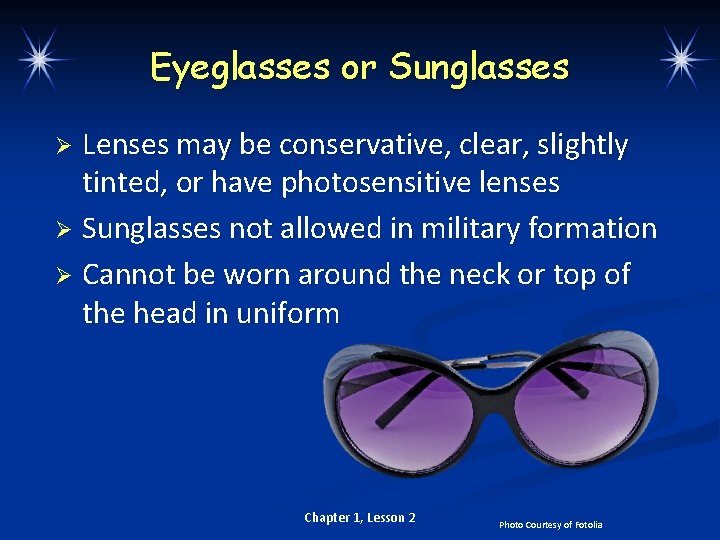
Eyeglasses or Sunglasses Lenses may be conservative, clear, slightly tinted, or have photosensitive lenses Ø Sunglasses not allowed in military formation Ø Cannot be worn around the neck or top of the head in uniform Ø Chapter 1, Lesson 2 Photo Courtesy of Fotolia
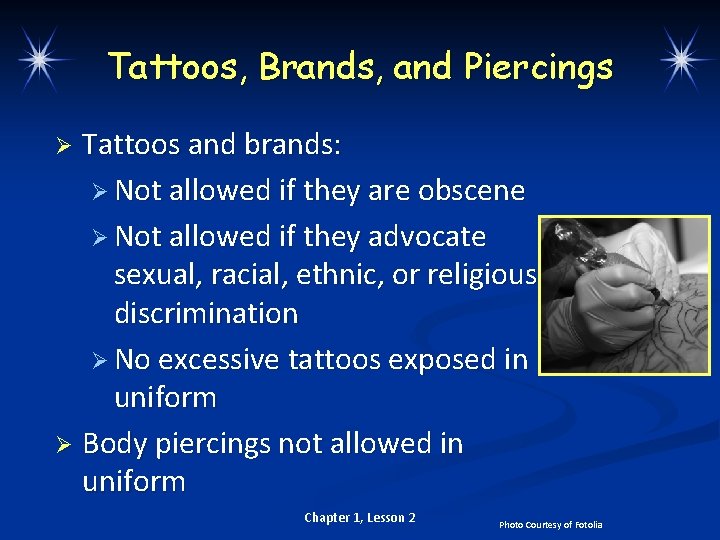
Tattoos, Brands, and Piercings Tattoos and brands: Ø Not allowed if they are obscene Ø Not allowed if they advocate sexual, racial, ethnic, or religious discrimination Ø No excessive tattoos exposed in uniform Ø Body piercings not allowed in uniform Ø Chapter 1, Lesson 2 Photo Courtesy of Fotolia
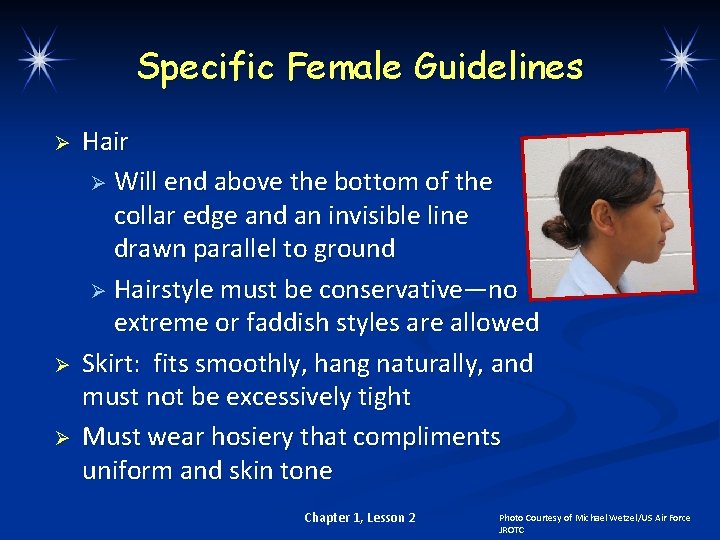
Specific Female Guidelines Ø Ø Ø Hair Ø Will end above the bottom of the collar edge and an invisible line drawn parallel to ground Ø Hairstyle must be conservative—no extreme or faddish styles are allowed Skirt: fits smoothly, hang naturally, and must not be excessively tight Must wear hosiery that compliments uniform and skin tone Chapter 1, Lesson 2 Photo Courtesy of Michael Wetzel/US Air Force JROTC
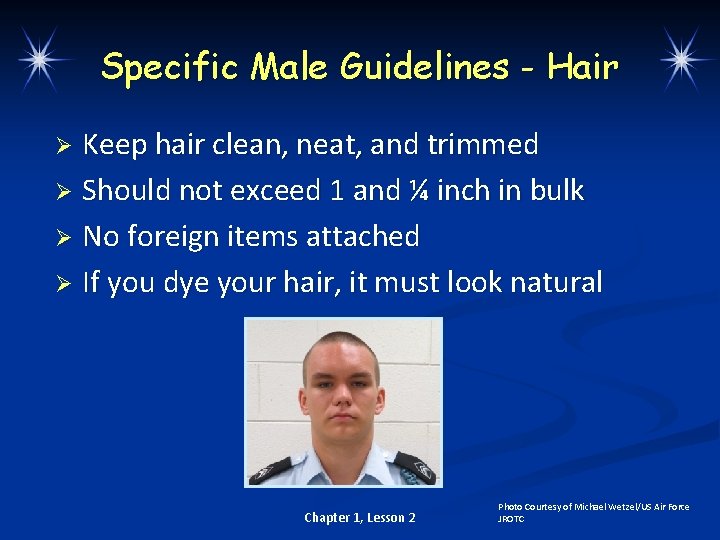
Specific Male Guidelines - Hair Keep hair clean, neat, and trimmed Ø Should not exceed 1 and ¼ inch in bulk Ø No foreign items attached Ø If you dye your hair, it must look natural Ø Chapter 1, Lesson 2 Photo Courtesy of Michael Wetzel/US Air Force JROTC
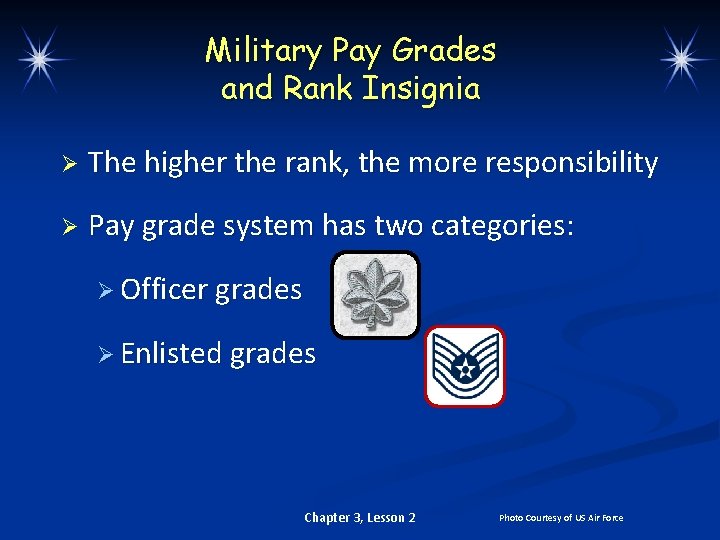
Military Pay Grades and Rank Insignia Ø The higher the rank, the more responsibility Ø Pay grade system has two categories: Ø Officer grades Ø Enlisted grades Chapter 3, Lesson 2 Photo Courtesy of US Air Force
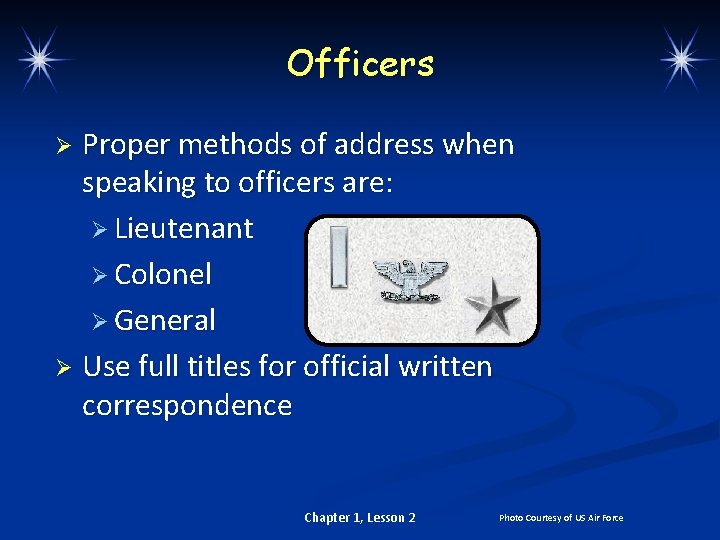
Officers Proper methods of address when speaking to officers are: Ø Lieutenant Ø Colonel Ø General Ø Use full titles for official written correspondence Ø Chapter 1, Lesson 2 Photo Courtesy of US Air Force
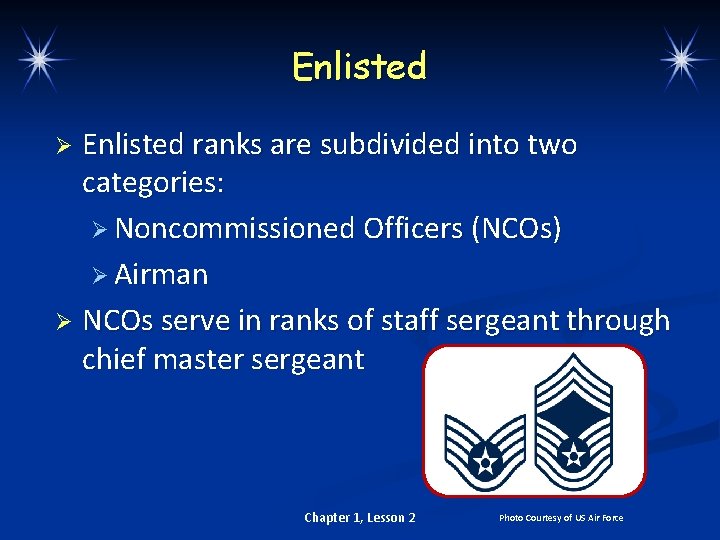
Enlisted ranks are subdivided into two categories: Ø Noncommissioned Officers (NCOs) Ø Airman Ø NCOs serve in ranks of staff sergeant through chief master sergeant Ø Chapter 1, Lesson 2 Photo Courtesy of US Air Force
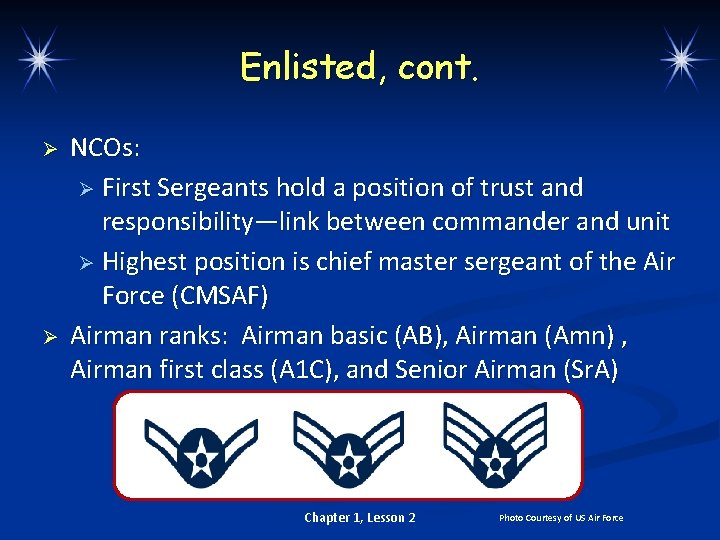
Enlisted, cont. Ø Ø NCOs: Ø First Sergeants hold a position of trust and responsibility—link between commander and unit Ø Highest position is chief master sergeant of the Air Force (CMSAF) Airman ranks: Airman basic (AB), Airman (Amn) , Airman first class (A 1 C), and Senior Airman (Sr. A) Chapter 1, Lesson 2 Photo Courtesy of US Air Force
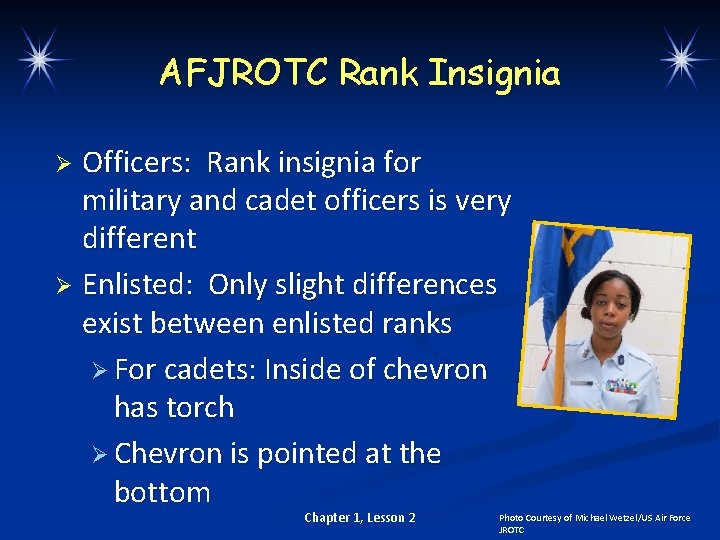
AFJROTC Rank Insignia Officers: Rank insignia for military and cadet officers is very different Ø Enlisted: Only slight differences exist between enlisted ranks Ø For cadets: Inside of chevron has torch Ø Chevron is pointed at the bottom Ø Chapter 1, Lesson 2 Photo Courtesy of Michael Wetzel/US Air Force JROTC
Ribbons Ensure proper order based on the AFJROTC ribbon chart Ø Lowest ribbon worn at the lowest left position Ø Highest ribbon worn at the top right Ø Chapter 1, Lesson 2
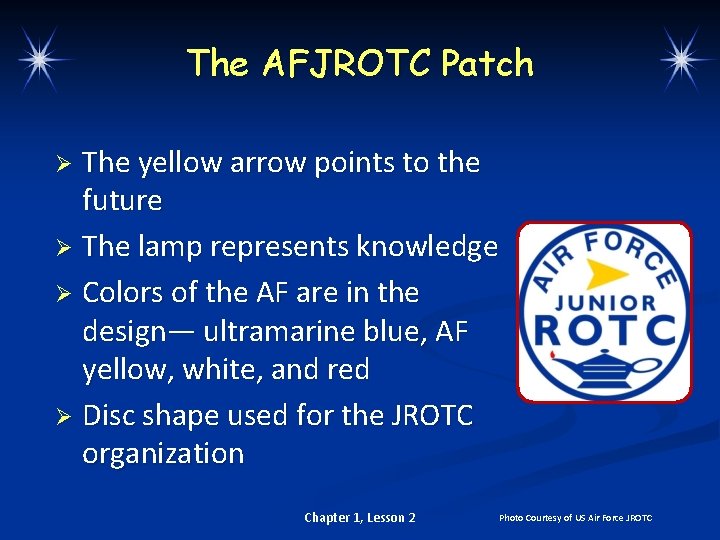
The AFJROTC Patch The yellow arrow points to the future Ø The lamp represents knowledge Ø Colors of the AF are in the design— ultramarine blue, AF yellow, white, and red Ø Disc shape used for the JROTC organization Ø Chapter 1, Lesson 2 Photo Courtesy of US Air Force JROTC
Summary Ø Uniform wear and history Ø Uniform wear, restrictions, and standards Ø Uniforms used within special teams Ø Cadet appearance and grooming standards Ø Military pay grades and rank insignia Chapter 1, Lesson 2