
The Migratory Bird Treaty Act For Federal Agencies
The Migratory Bird Treaty Act For Federal Agencies Eric L. Kershner October 2018 U. S. Fish and Wildlife Service Migratory Bird Program Conserving America’s Birds
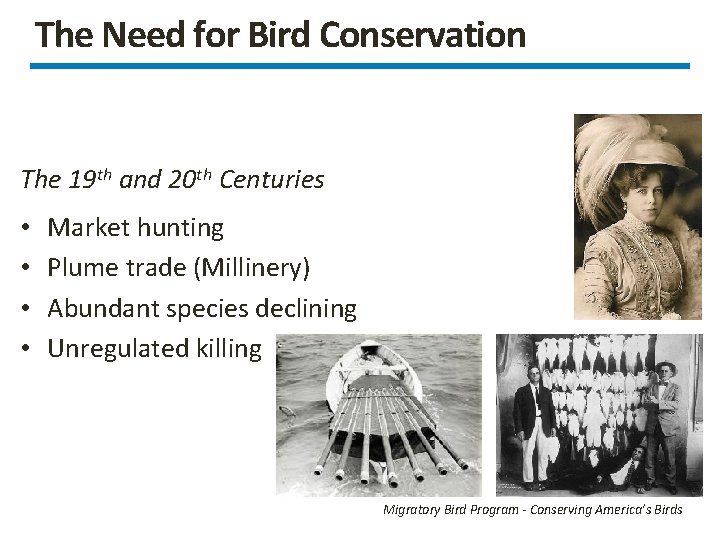
The Need for Bird Conservation The 19 th and 20 th Centuries • • Market hunting Plume trade (Millinery) Abundant species declining Unregulated killing Migratory Bird Program - Conserving America’s Birds
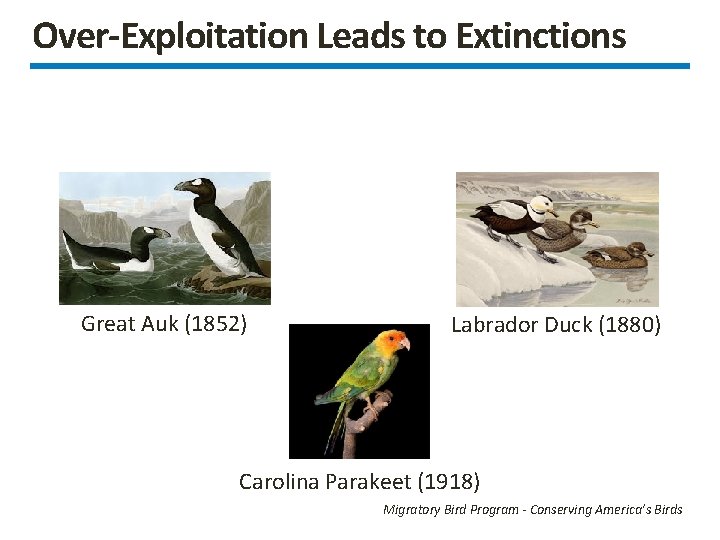
Over-Exploitation Leads to Extinctions Great Auk (1852) Labrador Duck (1880) Carolina Parakeet (1918) Migratory Bird Program - Conserving America’s Birds
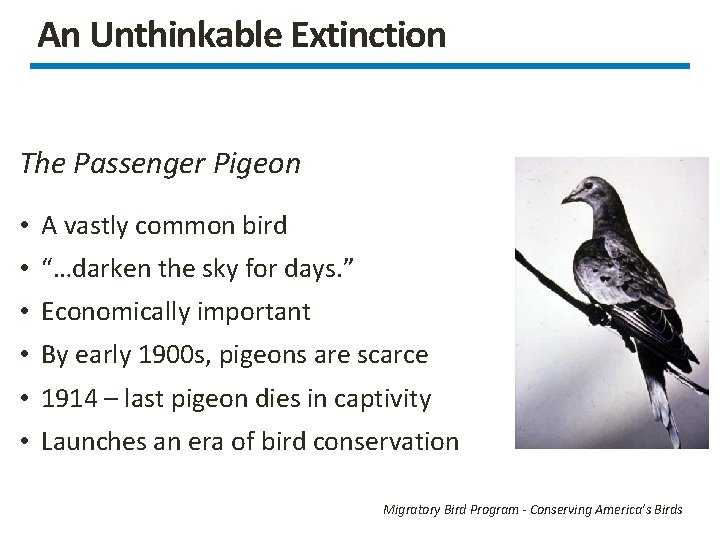
An Unthinkable Extinction The Passenger Pigeon • A vastly common bird • “…darken the sky for days. ” • Economically important • By early 1900 s, pigeons are scarce • 1914 – last pigeon dies in captivity • Launches an era of bird conservation Migratory Bird Program - Conserving America’s Birds
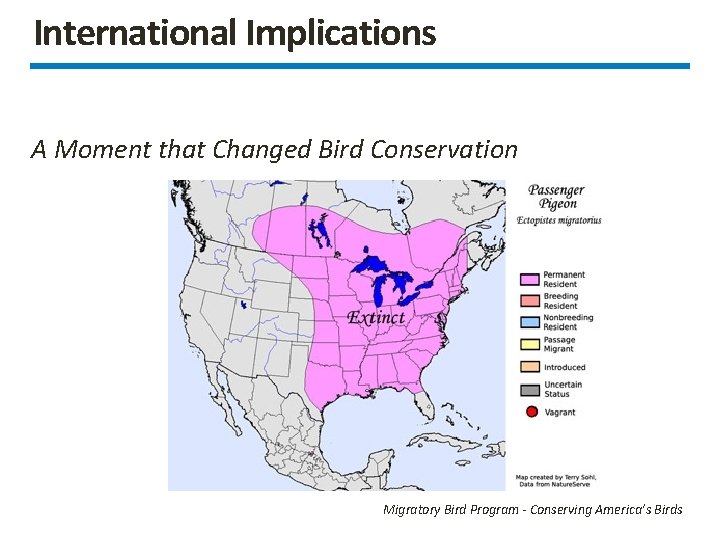
International Implications A Moment that Changed Bird Conservation Migratory Bird Program - Conserving America’s Birds
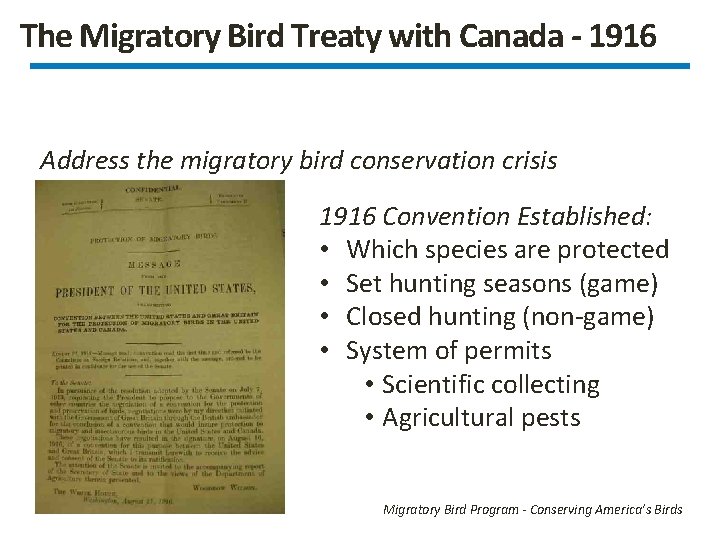
The Migratory Bird Treaty with Canada - 1916 Address the migratory bird conservation crisis 1916 Convention Established: • Which species are protected • Set hunting seasons (game) • Closed hunting (non-game) • System of permits • Scientific collecting • Agricultural pests Migratory Bird Program - Conserving America’s Birds
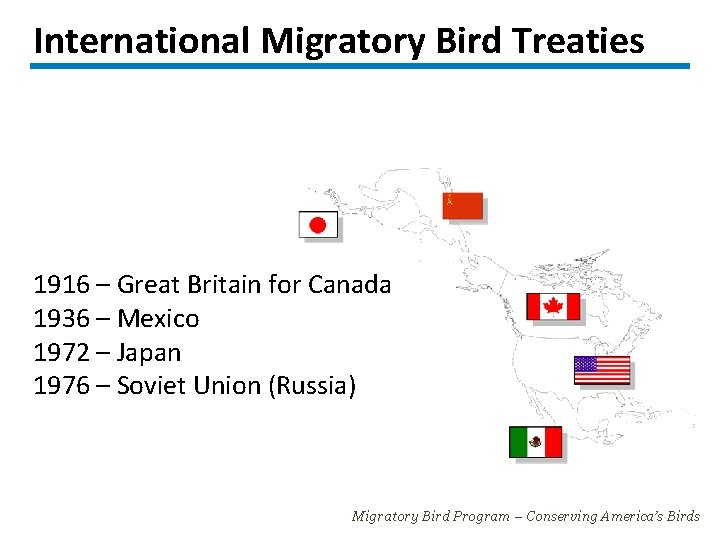
International Migratory Bird Treaties 1916 – Great Britain for Canada 1936 – Mexico 1972 – Japan 1976 – Soviet Union (Russia) Migratory Bird Program – Conserving America’s Birds
The Migratory Bird Treaty Act - 1918 A Tool for the Conservation of Migratory Birds U. S. Congress enacted the MBTA using the constitution’s Treaty Power as authorization Enacted to implement the 1916 treaty with Canada and the three subsequent treaties: Mexico (1936), Japan (1972), and Russia (1976) Migratory Bird Program – Conserving America’s Birds
The Migratory Bird Treaty Act -1918 What does it say? PROHIBITS taking “at any time, by any means or in any manner…any migratory bird, [or] any part, nest, or egg of any such bird” unless authorized by the Secretary of the Interior ALLOWS permits for the taking of migratory birds that are “compatible with the terms” and “carry out the purposes” of the migratory bird conventions Migratory Bird Program – Conserving America’s Birds
Birds Protected by MBTA ~ 1, 026 species (1, 088 pending 2018 proposed rule) Species are protected under MBTA if they are: • Native to some portion of the U. S. and its territories - and • Belong to a family, group, or species named in one of the four international treaties They are protected regardless of whether the species actually migrates or not – resident species are covered Migratory Bird Program – Conserving America’s Birds
MBTA and Incidental Take A historical review • Under previous interpretations, the killing of 1 bird is a violation and can be enforced • Enforcement discretion depends on whether a project elected to follow recommended best practices or not • Courts have been split on whether incidental take is prohibited under the MBTA • The courts inconsistently apply the provisions of the MBTA, utilizing different and often contradictory methods Migratory Bird Program - Conserving America’s Birds
2017 Department of Interior M-Opinion A new interpretation of MBTA and Incidental take • Inconsistent court decisions led to legal uncertainty for lawful actions whose purpose is not to take birds • The December 2017 M-Opinion replaces the January 2017 M-Opinion on the same subject • The M-Opinion concludes MBTA does not prohibit activities that result in the incidental/unintentional take of migratory birds Migratory Bird Program - Conserving America’s Birds
2017 Department of Interior M-Opinion A new interpretation of MBTA and Incidental take • Clarifies “take” to include pursue, hunt, shoot, wound, kill, trap, capture, or collect or attempt any of these actions, with the intent of taking migratory birds, nests or eggs • There is a distinction between the intent to kill a bird and knowing a bird will die – If killing a bird is NOT the intent of the action – it is not prohibited, regardless of whether you know birds might die as a result • M-Opinion directs the actions of the bureaus within DOI but does not change any statutory or regulatory requirements implemented by federal agencies Migratory Bird Program - Conserving America’s Birds
Current MBTA Prohibitions Purposeful vs Incidental Purposeful Take – Prohibited Under MBTA • Take that is the purpose of the action • Generally, permits are available for these actions Incidental Take – Not Prohibited Under MBTA • Take that directly results from, but is not the purpose of an activity Migratory Bird Program - Conserving America’s Birds
Scenario 1 Do I need a permit? Action: I need to change a light on my tower There is a nest on my tower 10 feet above the light that I need to change Do I need a permit? NO – you may change the light on the tower without a permit, abandonment of the nest is incidental Use voluntary best practices to reduce disturbance Migratory Bird Program - Conserving America’s Birds
Scenario 2 Do I need a permit? Action: There is a Osprey nest on my tower. The adults are aggressive to people near the tower. I want to remove the nest for human safety Do I need a permit? YES – removing the nest for human safety is a purposeful action USFWS will issue a permit to remove the nest Migratory Bird Program - Conserving America’s Birds
Scenario 3 Do I need a permit? Action: I want to determine whether a nest on my tower is active using a drone Do I need a permit? NO – you may use a drone to assess tower components or nest status without a permit Use voluntary best practices to reduce disturbance Migratory Bird Program - Conserving America’s Birds
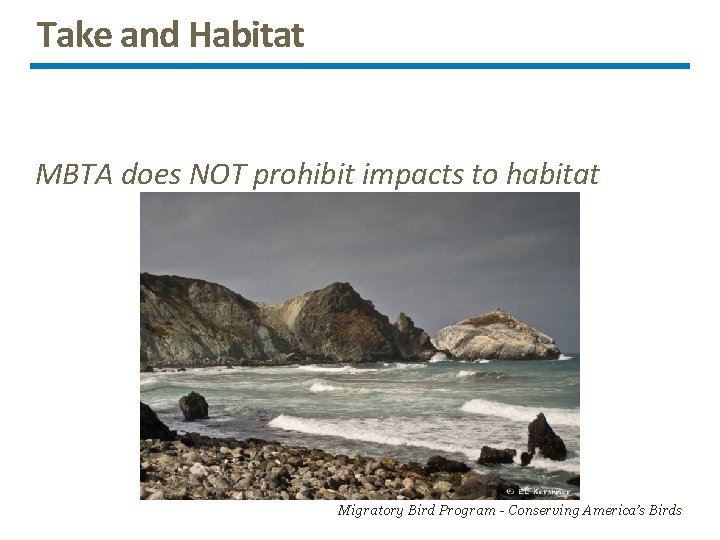
Take and Habitat MBTA does NOT prohibit impacts to habitat Migratory Bird Program - Conserving America’s Birds
Implementing the MBTA Technical Assistance • The Service is mandated to conserve migratory birds • Continue to authorize purposeful take via permits • Depredation permits – BASH, Human Health • Continue to work with all partners that seek to reduce impacts on migratory birds • Develop and recommend voluntary best practices Migratory Bird Program - Conserving America’s Birds
Nest Destruction Memo Good Samaritan Policy • Intended to allow conservation outcomes without regulatory burden • Any person/entity can, without a permit: 1. Temporarily possess and transport any sick, injured, orphaned bird 2. Temporarily possess any egg or chick in imminent danger of incidental take 3. Relocate any active nest in imminent danger of incidental take (when species appropriate) And transport these items to a vet or rehab facility Migratory Bird Program - Conserving America’s Birds
Additional Considerations Its not all about the MBTA • Compliance w/ Eagle Act and ESA still required • NEPA still applies to all federal actions • Executive Order 13186 remains in effect Migratory Bird Program - Conserving America’s Birds
National Environmental Policy Act Addressing impacts to the human environment • Requires Federal Agencies to evaluate action-related impacts to the human environment, including birds • Questions to consider • How does the action impact migratory birds and their habitats? • Can impacts be reduced with best practices? Migratory Bird Program - Conserving America’s Birds
Executive Order 13186 Federal Agency responsibilities to protect migratory birds • The M-Opinion does not directly affect how federal agencies manage incidental take • The EO was not designed to implement the MBTA per se • Intended to govern federal efforts to conserve migratory birds more broadly (treaties) • Federal agencies should continue to comply with the EO • Implement MOUs, including applying conservation measures to bird and habitat impacts Migratory Bird Program - Conserving America’s Birds
Summary • Evaluate all federal actions with NEPA • Reduce impacts to birds and their habitat through voluntary conservation measures • Follow the Executive Order and associated MOUs • When faced with incidental take – use tools such as Good Samaritan policy, when appropriate • Seek authorizing permits for Purposeful Take actions Migratory Bird Program - Conserving America’s Birds
- Slides: 24