
The Middle East Objectives Identify the geography of

The Middle East Objectives: • Identify the geography of the Middle East • Evaluate the changes and conflicts in the countries of the Middle East • Analyze the conflict between the Israelis and the Palestinians
The Middle East Review • EARLY CIVILIZATIONS: • RELIGIONS: • DIVERSITY: • CLIMATE & NATURAL RESOURCES: • INSTABILITY/CONFLICTS:

The Middle East Review • Early Civilizations: - Crossroads of Civilization - connected Africa, Asia, Europe - major trade route on land sea - The Fertile Crescent - Silt, fertile soil - The Nile River -“Gift of the Nile” (Egypt) - Created civilizations in Africa - Tigres & Euphrates (Iran & Iraq) - Civilization developed around it.
• Religions: - Home to the Semitic religions - Islam, Judaism, Christianity Diversity: - Many cultures, traditional, modern - 30 different languages - Political systems (dictators, democracy, monarchs) Resources: – – – Lacks natural resources Lacks arable land (farm land) Technology--- irrigation Most valuable resource OIL Uneven distribution of wealth
• Instability/conflicts: -Religious -western vs. traditional -secular/non secular -territory
Facts about Arabs Who is an Arab? “Arab” is a cultural and linguistic term. It refers to those who speak Arabic as their first language. Arabs are united by culture and by history. Arabs are not a race. Some have blue eyes and red hair; others are dark skinned; most are somewhere in between. Most Arabs are Muslims but there also millions of Christian Arabs and thousands of Jewish Arabs, just as there are Muslim, Christian, and Jewish Americans.
What is the Arab World? The Arab World consists of 22 countries in the Middle East and North Africa: Algeria, Bahrain, the Comoros Islands, Djibouti, Egypt, Iraq, Jordan, Kuwait, Libya, Morocco, Mauritania, Oman, Palestine, Qatar, Saudi Arabia, Somalia, Sudan, Syria, Tunisia, the United Arab Emirates, and Yemen. Iran and Turkey are not Arab countries and their primary languages are Farsi and Turkish respectively. Arab countries have a rich diversity of ethnic, linguistic, and religious communities. These include Kurds, Armenians, Berbers and others. There are over 200 million Arabs.
What is the Muslim World? There an estimated 1. 2 billion Muslims in the world. The Organization of Islamic Countries has 55 member states. The ten countries with the largest Muslim population are: Indonesia (170. 3 million), Pakistan (136 million), Bangladesh (106 million), India (103 million), Turkey (62. 4 million), Iran (60. 7 million), Egypt (53. 7 million), Nigeria (47. 7 million), and China (37. 1 million). Of these countries only Egypt is an Arab country. Most Arabs are Muslims, but most Muslims are not Arabs.
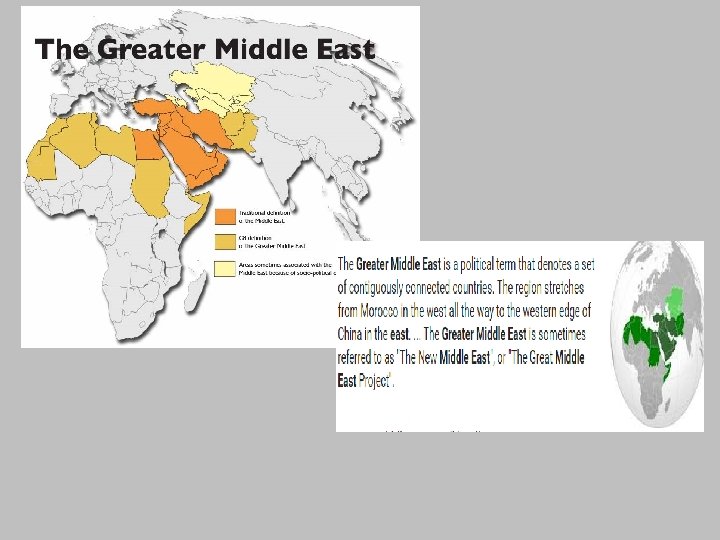
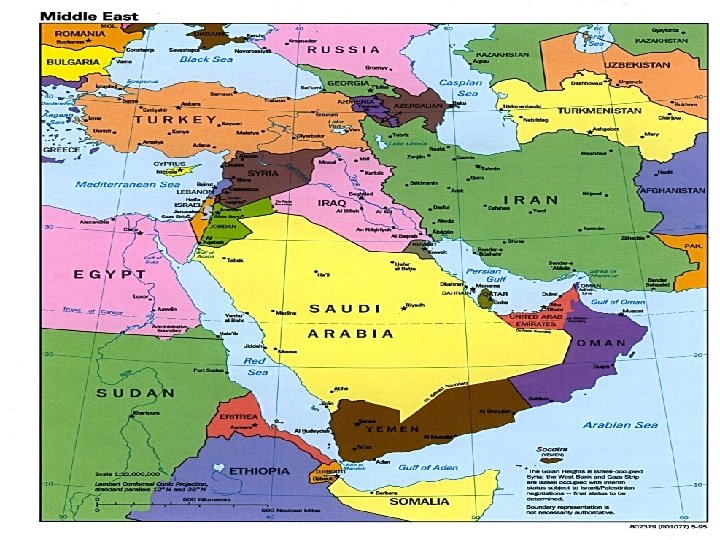
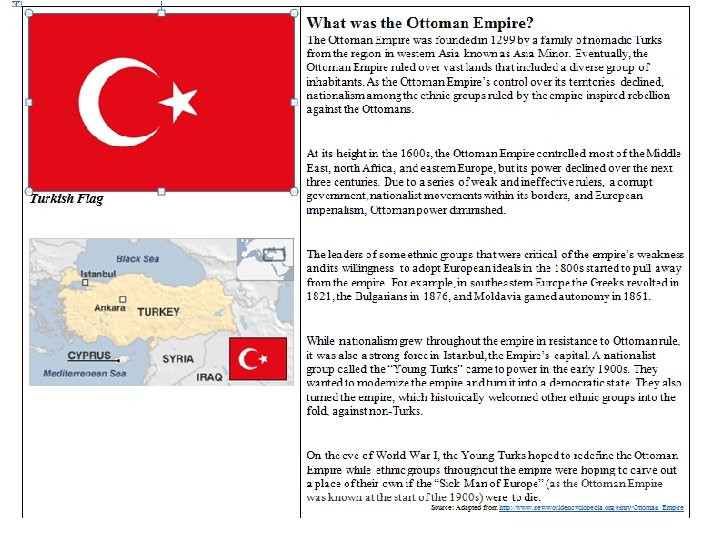
What is the Middle East? The Middle East is a loose term, not always used to describe the same territory. It usually includes the Arab countries from Egypt east to the Persian Gulf, plus Israel and Iran. Turkey is sometimes considered part of the Middle East, sometimes part of Europe. Afghanistan, Pakistan, India, and Bangladesh are usually described as South Asia.
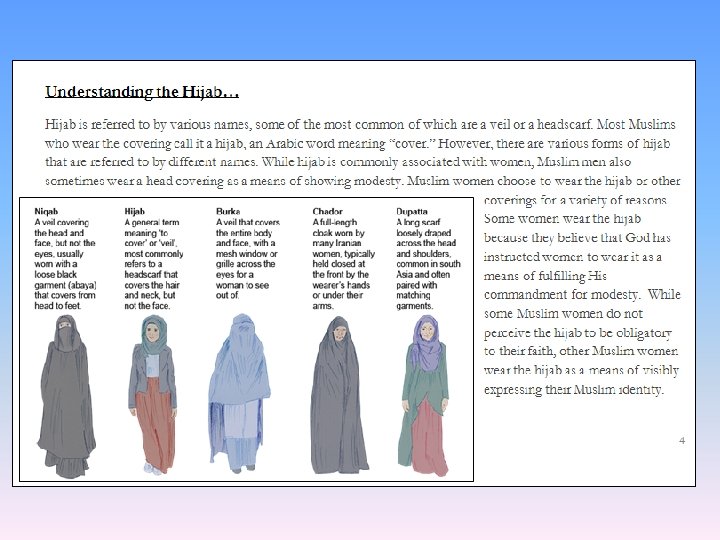
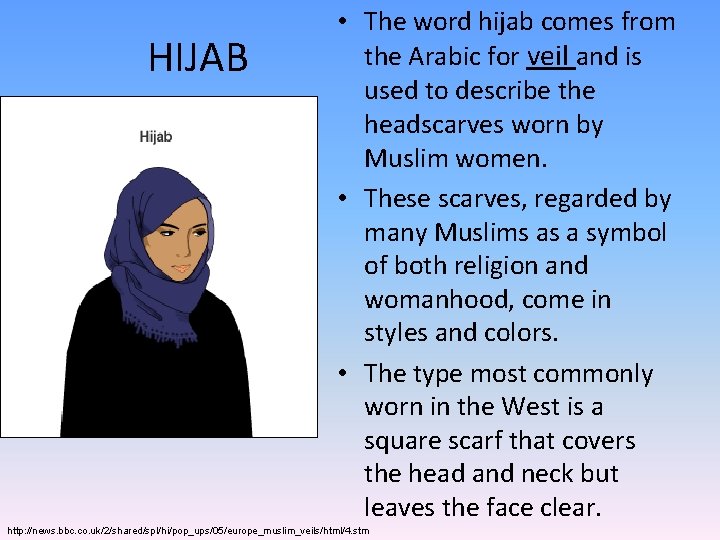
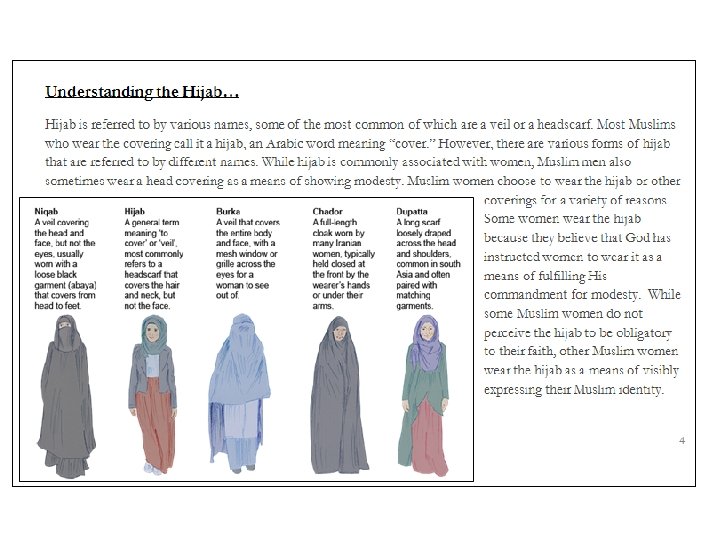
HIJAB • The word hijab comes from the Arabic for veil and is used to describe the headscarves worn by Muslim women. • These scarves, regarded by many Muslims as a symbol of both religion and womanhood, come in styles and colors. • The type most commonly worn in the West is a square scarf that covers the head and neck but leaves the face clear. http: //news. bbc. co. uk/2/shared/spl/hi/pop_ups/05/europe_muslim_veils/html/4. stm
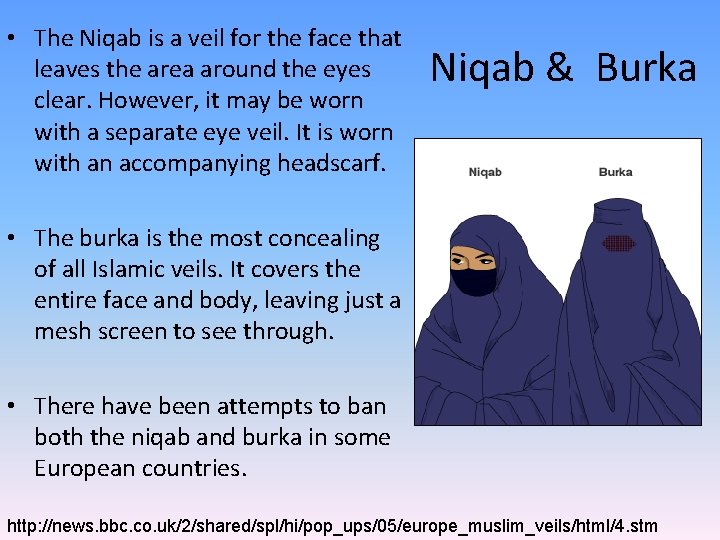
• The Niqab is a veil for the face that leaves the area around the eyes clear. However, it may be worn with a separate eye veil. It is worn with an accompanying headscarf. Niqab & Burka • The burka is the most concealing of all Islamic veils. It covers the entire face and body, leaving just a mesh screen to see through. • There have been attempts to ban both the niqab and burka in some European countries. http: //news. bbc. co. uk/2/shared/spl/hi/pop_ups/05/europe_muslim_veils/html/4. stm
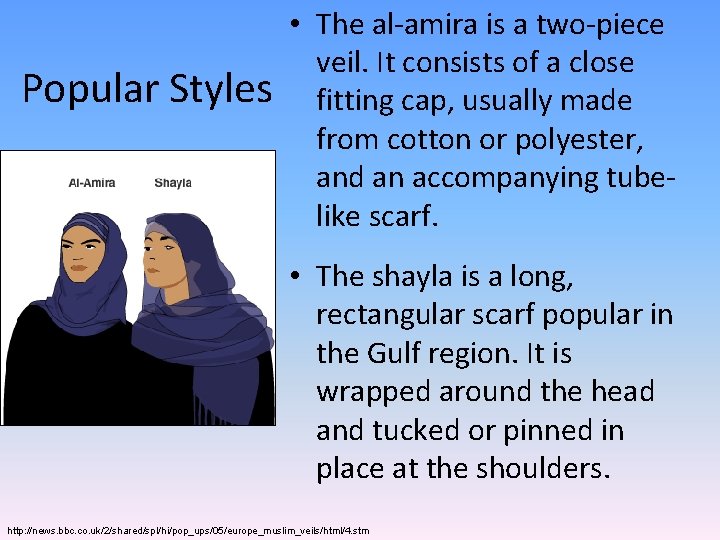
Popular Styles • The al-amira is a two-piece veil. It consists of a close fitting cap, usually made from cotton or polyester, and an accompanying tubelike scarf. • The shayla is a long, rectangular scarf popular in the Gulf region. It is wrapped around the head and tucked or pinned in place at the shoulders. http: //news. bbc. co. uk/2/shared/spl/hi/pop_ups/05/europe_muslim_veils/html/4. stm
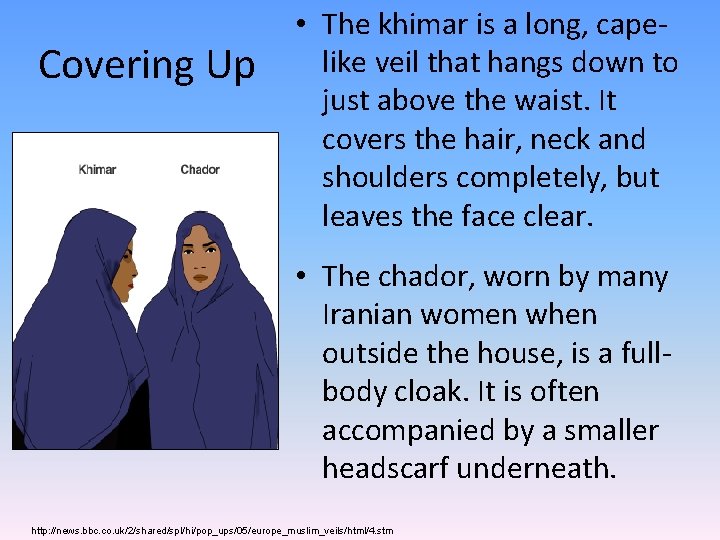
Covering Up • The khimar is a long, capelike veil that hangs down to just above the waist. It covers the hair, neck and shoulders completely, but leaves the face clear. • The chador, worn by many Iranian women when outside the house, is a fullbody cloak. It is often accompanied by a smaller headscarf underneath. http: //news. bbc. co. uk/2/shared/spl/hi/pop_ups/05/europe_muslim_veils/html/4. stm
What is the Middle East? The Middle East is a loose term, not always used to describe the same territory. It usually includes the Arab countries from Egypt east to the Persian Gulf, plus Israel and Iran. Turkey is sometimes considered part of the Middle East, sometimes part of Europe. Afghanistan, Pakistan, India, and Bangladesh are usually described as South Asia.
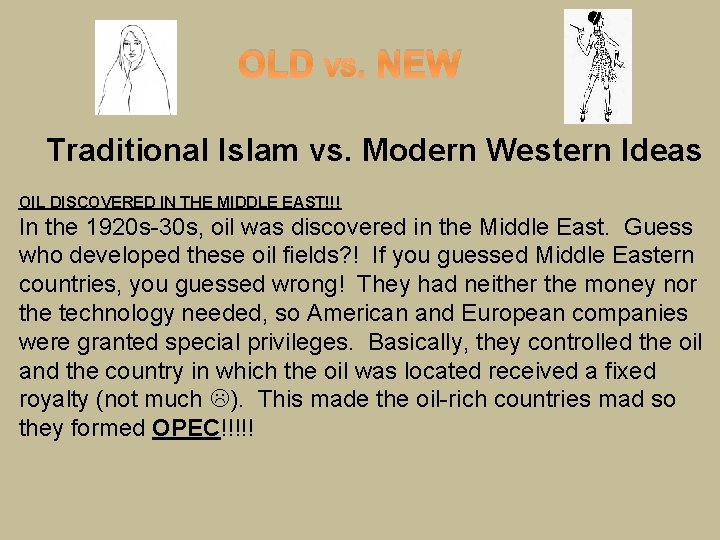
OLD VS. NEW Traditional Islam vs. Modern Western Ideas OIL DISCOVERED IN THE MIDDLE EAST!!! In the 1920 s-30 s, oil was discovered in the Middle East. Guess who developed these oil fields? ! If you guessed Middle Eastern countries, you guessed wrong! They had neither the money nor the technology needed, so American and European companies were granted special privileges. Basically, they controlled the oil and the country in which the oil was located received a fixed royalty (not much ). This made the oil-rich countries mad so they formed OPEC!!!!!
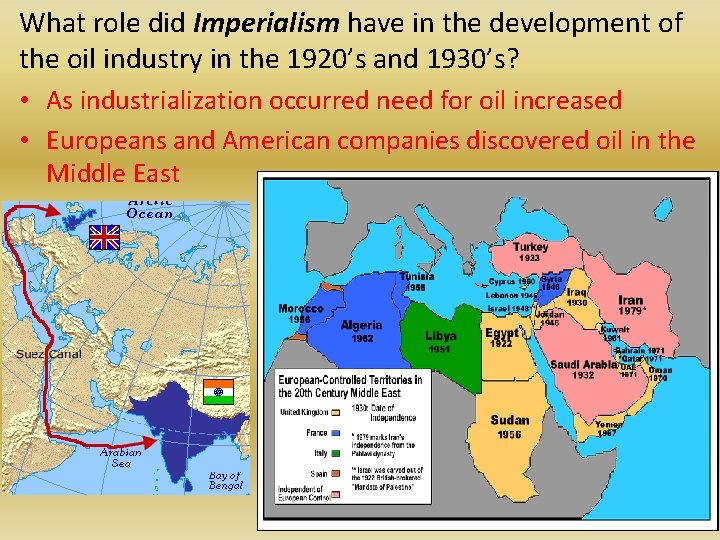
What role did Imperialism have in the development of the oil industry in the 1920’s and 1930’s? • As industrialization occurred need for oil increased • Europeans and American companies discovered oil in the Middle East
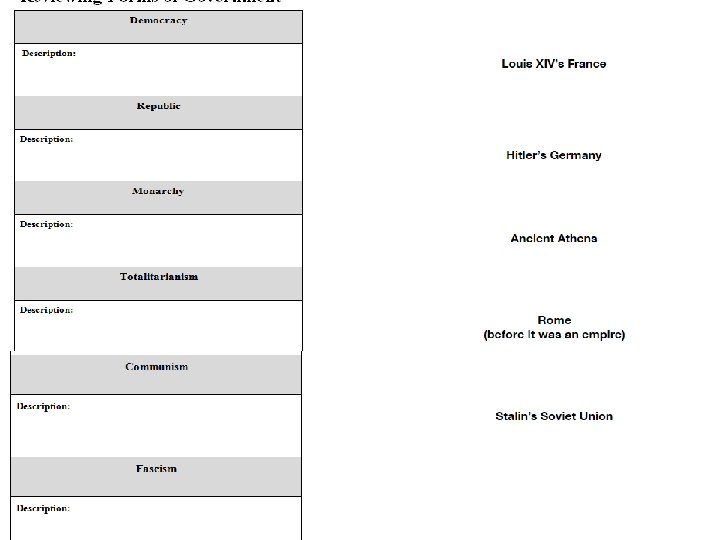
The Conflict over Oil An offshoot of the Industrial Revolution and the Age of Imperialism is the global dependence on oil or petroleum. Developed countries are especially dependent because of high-levels of industry, transportation, etc. This means that whoever controls the oil enjoys a fair amount of political, economic, and even social power. Much of the world's oil supply lies in the Middle East. In the first half of the 20 th century, Middle Eastern nations had the oil but did not have a way to procure, refine, and distribute it. Foreign governments, such as, Europe and the United States, provided the necessary elements and these oil-producing nations grew rich. In the 1970's, it was decided that more wealth and power could be had if the foreign influence was removed. Foreign nations would still have to purchase the oil, but could no longer cut costs by providing the needed infrastructure to produce the oil. Therefore, OPEC was established. The Organization of Petroleum Exporting Countries was formed to further control the oil and reduce foreign influence. The oil-producing nations, like Saudi Arabia, experienced a rise in their standard of living. Also, the nations of OPEC, which included some African and Latin American countries, used oil as a political weapon. -Regentsprep. org
What does OPEC mean? • Organization of Petroleum Exporting Countries Who created OPEC and when? • Iran, Kuwait, Iraq, Saudi Arabia and Venezuela 1960’s What was the goal of OPEC? • Control oil industry by setting levels and prices How does the development of OPEC show nationalism? • Countries united together to control resources REVIEW: How did Imperialism lead to Nationalism in the region of the Middle East?

The Middle East has been a crossroads for people of Africa, Asia, and Europe since ancient times. This fact has led to an enormous diversity of peoples, belief systems, and cultures. These differences have sometimes led to conflict. The discovery of oil in the region brought power to some Middle Eastern nations. Oil is a vital part of the global economy. Oil resources, however, are not evenly distributed across the region. As a result, Middle Eastern countries have gone to war over oil-rich lands. Dependence on oil is one reason why countries around the world take an active interest in conflicts in the Middle East. RELIGIOUS & ETHNIC DIFFERENCES Muslims, Christians, and Jews Different sects within religions More than 30 languages Religious, racial, and cultural prejudices Desire for a united Arab state NATURAL RESOURCES GOVERNMENTS ISLAMIC TRADITION Largest oil fields in the world Democracy in Israel & Turkey Oil-rich nations gain wealth, political & economic power Rule by royal family in Jordan & Saudi Arabia Laws of Islam influence government, society, and personal life Limited water supply Single-party dictators in Iraq & Arguments over Syria dams and water rights Anti-Western feelings 1990 s revival of Islamic traditions
WHERE THERE’S OIL, THERE’S WEALTH!!! Wealth from the oil industry brought a more materialistic lifestyle to many Middle Eastern countries. Some leaders began to modernize and westernize their countries with the oil profits. Technology, urbanization, and women’s roles were lifestyle changes that resulted. This made some people in the Middle East very unhappy! The conflict between traditional Muslim values and new ideas and lifestyles gave way to Islamic Fundamentalism. Which geographic feature has been most responsible for the population distribution in the Middle East? A. abundance of oil deposits B. location of water C. presence of high plateaus D. availability of natural harbors
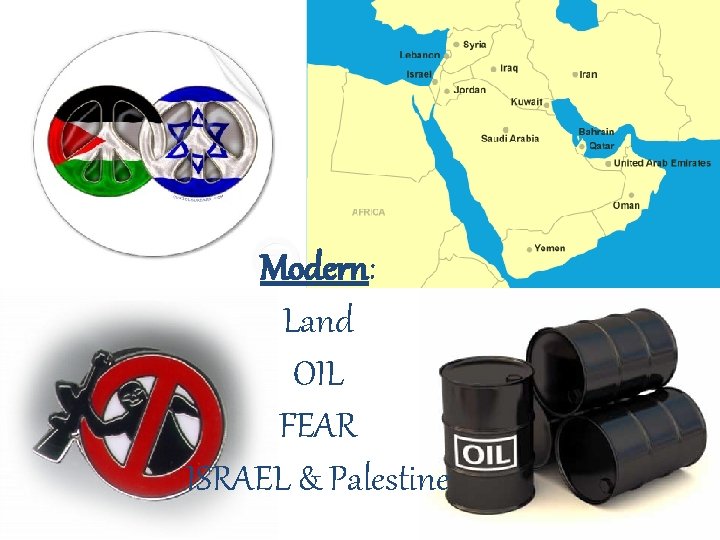
Modern: Land OIL FEAR ISRAEL & Palestine
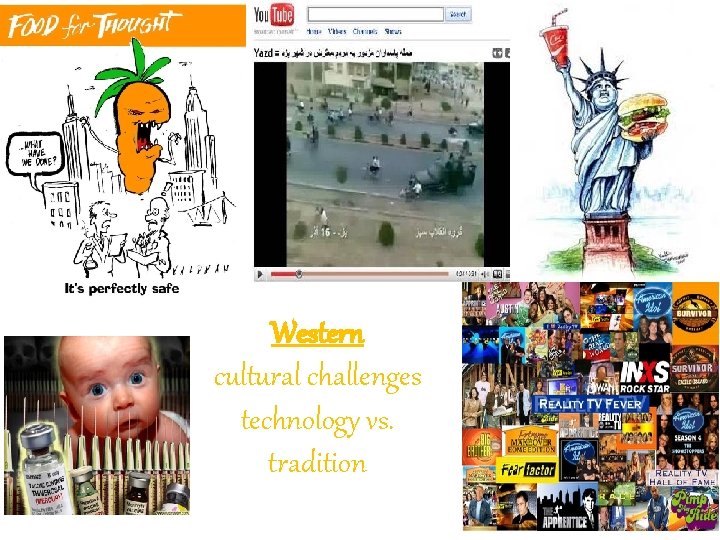
Western cultural challenges technology vs. tradition
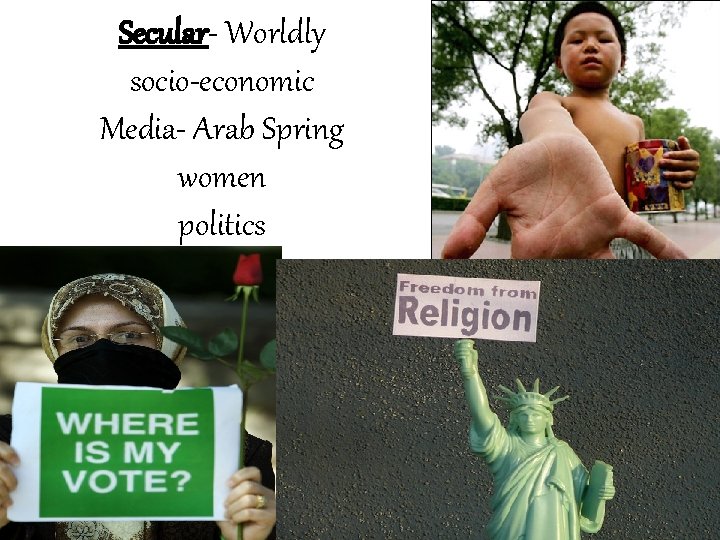
Secular- Worldly socio-economic Media- Arab Spring women politics
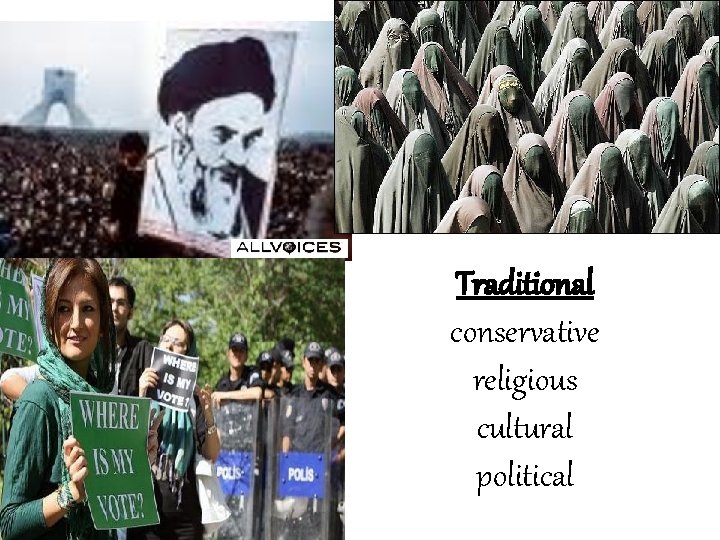
Traditional conservative religious cultural political
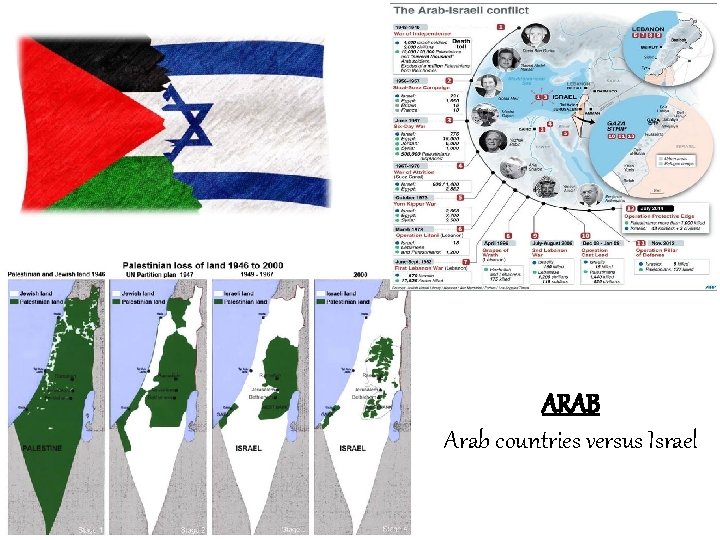
ARAB Arab countries versus Israel
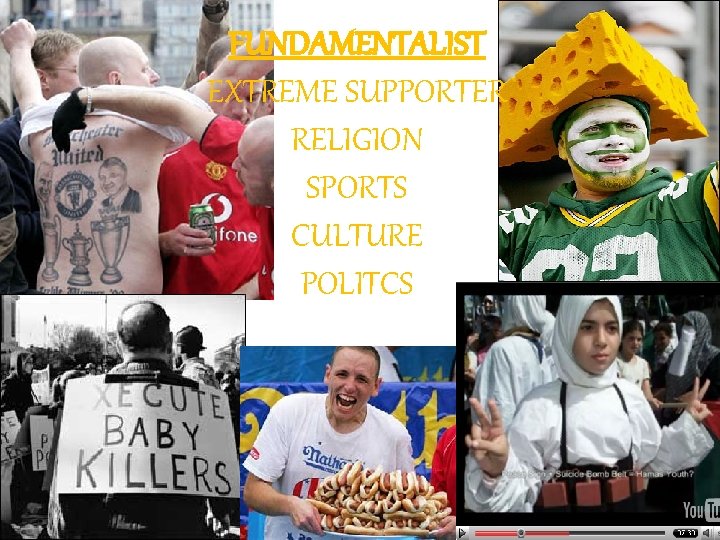
FUNDAMENTALIST EXTREME SUPPORTER RELIGION SPORTS CULTURE POLITCS
Essential question: • How can Imperialism lead to Nationalism?
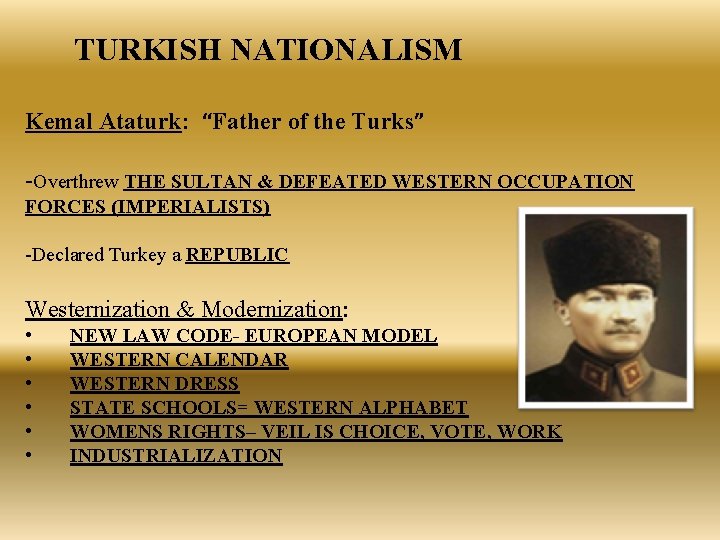
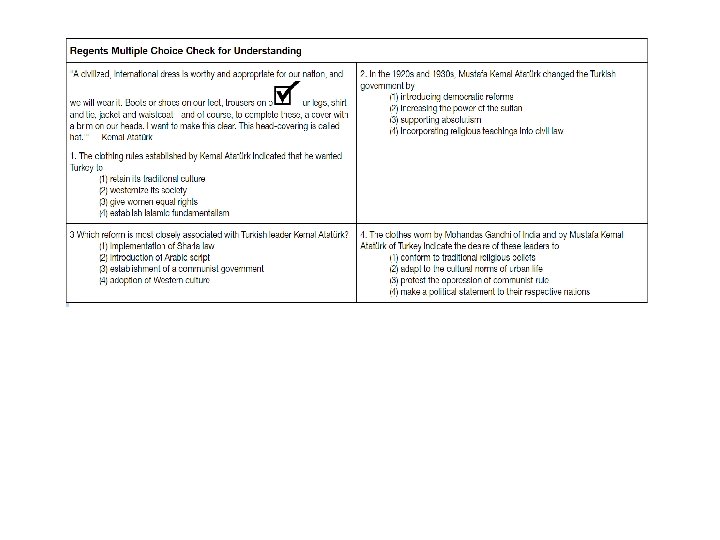
TURKISH NATIONALISM Kemal Ataturk: “Father of the Turks” -Overthrew THE SULTAN & DEFEATED WESTERN OCCUPATION FORCES (IMPERIALISTS) -Declared Turkey a REPUBLIC Westernization & Modernization: • • • NEW LAW CODE- EUROPEAN MODEL WESTERN CALENDAR WESTERN DRESS STATE SCHOOLS= WESTERN ALPHABET WOMENS RIGHTS– VEIL IS CHOICE, VOTE, WORK INDUSTRIALIZATION
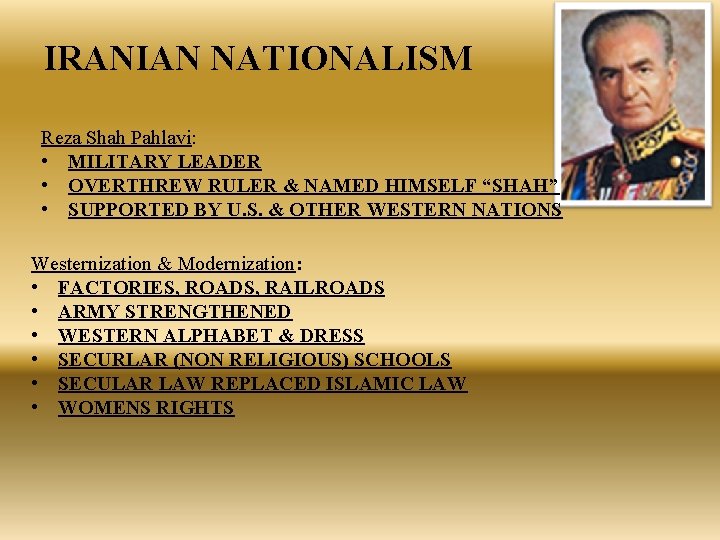
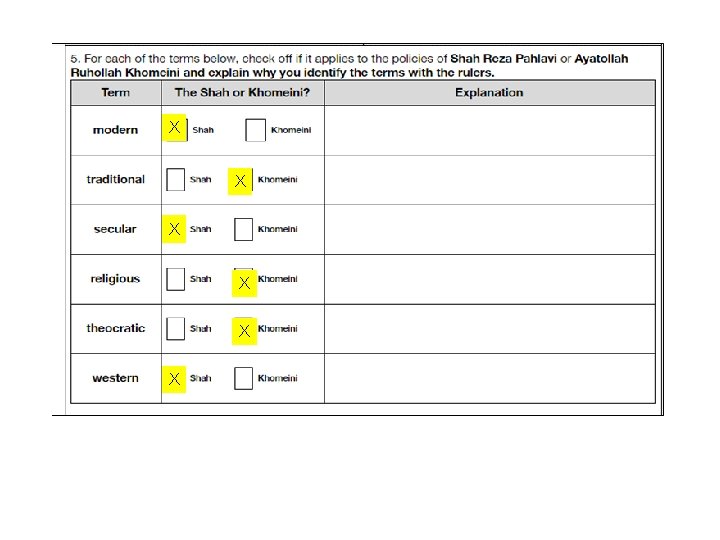
IRANIAN NATIONALISM Reza Shah Pahlavi: • MILITARY LEADER • OVERTHREW RULER & NAMED HIMSELF “SHAH” • SUPPORTED BY U. S. & OTHER WESTERN NATIONS Westernization & Modernization: • FACTORIES, ROADS, RAILROADS • ARMY STRENGTHENED • WESTERN ALPHABET & DRESS • SECURLAR (NON RELIGIOUS) SCHOOLS • SECULAR LAW REPLACED ISLAMIC LAW • WOMENS RIGHTS
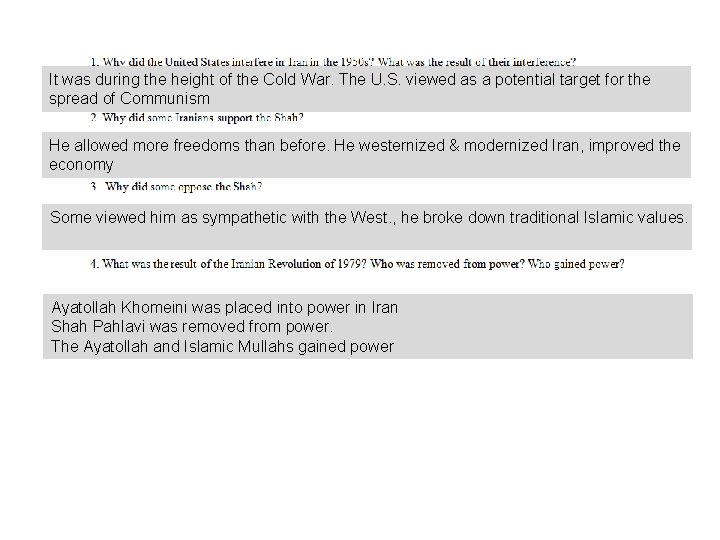
It was during the height of the Cold War. The U. S. viewed as a potential target for the spread of Communism He allowed more freedoms than before. He westernized & modernized Iran, improved the economy Some viewed him as sympathetic with the West. , he broke down traditional Islamic values. Ayatollah Khomeini was placed into power in Iran Shah Pahlavi was removed from power. The Ayatollah and Islamic Mullahs gained power
X X X
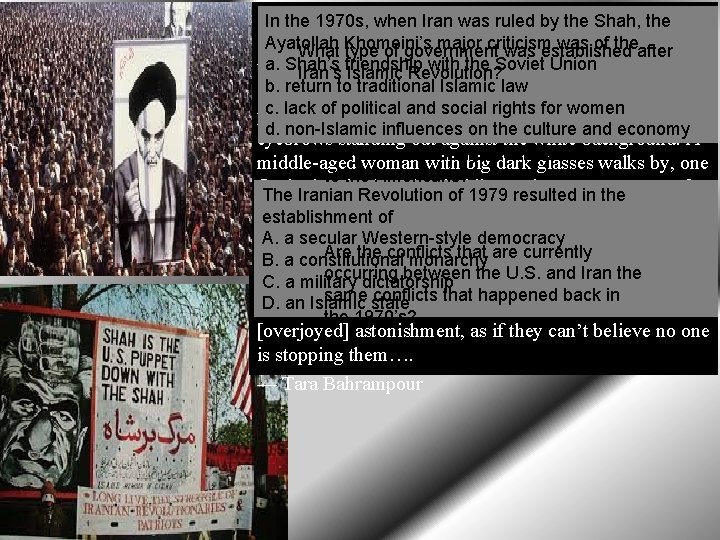
…A river of people flowing downbythe In the 1970 s, when is Iran was ruled theboulevard. Shah, the Ayatollah Khomeini’s major criticism was of theafter Some are very with, the separate from the What typereligious, of government wasmen established a. Shah’s with the Soviet Union [robes]. women andfriendship the women covered in chadors Iran’s Islamic Revolution? b. return to traditional Islamic Some are not. Two young menlaw in jeans carry a large c. lackofof. Khomeini, political and social rights turban for women poster with his black and black d. non-Islamic influences on the culture and economy eyebrows standing out against the white background. A Whywoman were sowith many hostile walks by, one middle-aged bigpeople dark glasses to the Americans? fist in the air, Revolution the other holding cigarette. A group of The Iranian of 1979 aresulted in the college studentsoflink arms and shout “Marg bar Shah!” establishment —Death to the Shah!—and democracy they have the same sort of A. a secular Western-style Are that conflicts that are currently glad the shoe salesman had on the day B. a expression constitutional monarchy occurring between the U. S. and the C. asked a military dictatorship he Mama if she was American. But. Iran these people same conflicts that happened back in D. an Islamic statelook—a kind of exhilarated also have another the 1970’s? [overjoyed] astonishment, as if they can’t believe no one is stopping them…. — Tara Bahrampour

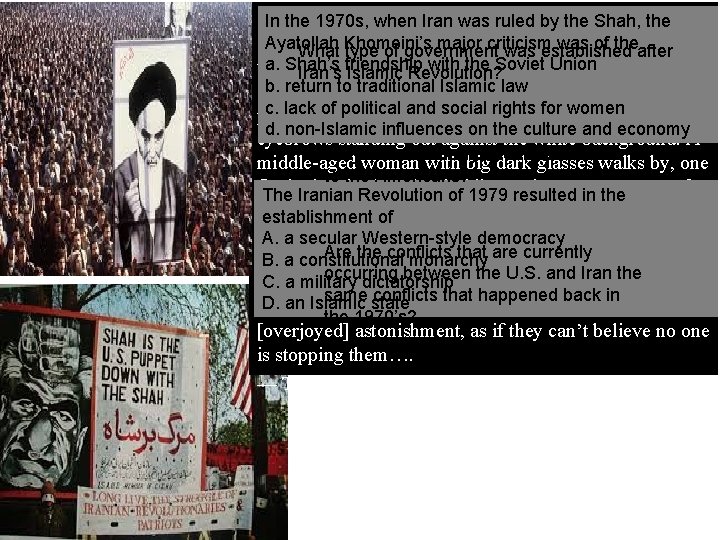
…A river of people flowing downbythe In the 1970 s, when is Iran was ruled theboulevard. Shah, the Ayatollah Khomeini’s major criticism was of theafter Some are very with, the separate from the What typereligious, of government wasmen established a. Shah’s with the Soviet Union [robes]. women andfriendship the women covered in chadors Iran’s Islamic Revolution? b. return to traditional Islamic Some are not. Two young menlaw in jeans carry a large c. lackofof. Khomeini, political and social rights turban for women poster with his black and black d. non-Islamic influences on the culture and economy eyebrows standing out against the white background. A Whywoman were sowith many hostile walks by, one middle-aged bigpeople dark glasses to the Americans? fist in the air, Revolution the other holding cigarette. A group of The Iranian of 1979 aresulted in the college studentsoflink arms and shout “Marg bar Shah!” establishment —Death to the Shah!—and democracy they have the same sort of A. a secular Western-style Are that conflicts that are currently glad the shoe salesman had on the day B. a expression constitutional monarchy occurring between the U. S. and the C. asked a military dictatorship he Mama if she was American. But. Iran these people same conflicts that happened back in D. an Islamic statelook—a kind of exhilarated also have another the 1970’s? [overjoyed] astonishment, as if they can’t believe no one is stopping them…. — Tara Bahrampour
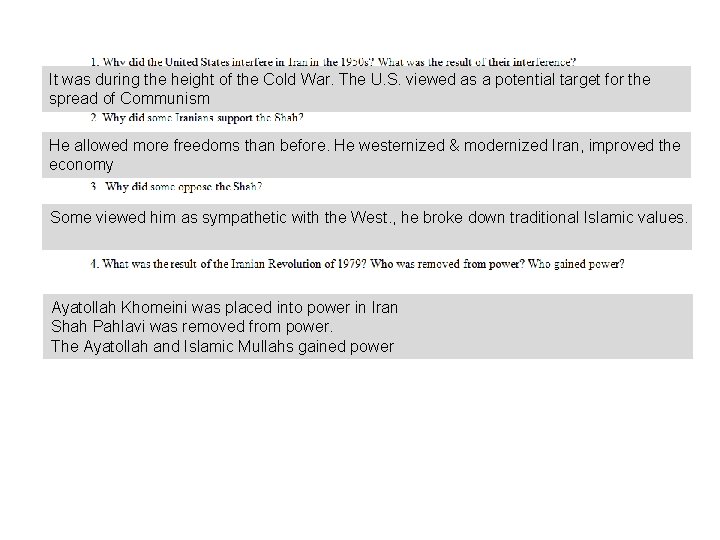
It was during the height of the Cold War. The U. S. viewed as a potential target for the spread of Communism He allowed more freedoms than before. He westernized & modernized Iran, improved the economy Some viewed him as sympathetic with the West. , he broke down traditional Islamic values. Ayatollah Khomeini was placed into power in Iran Shah Pahlavi was removed from power. The Ayatollah and Islamic Mullahs gained power
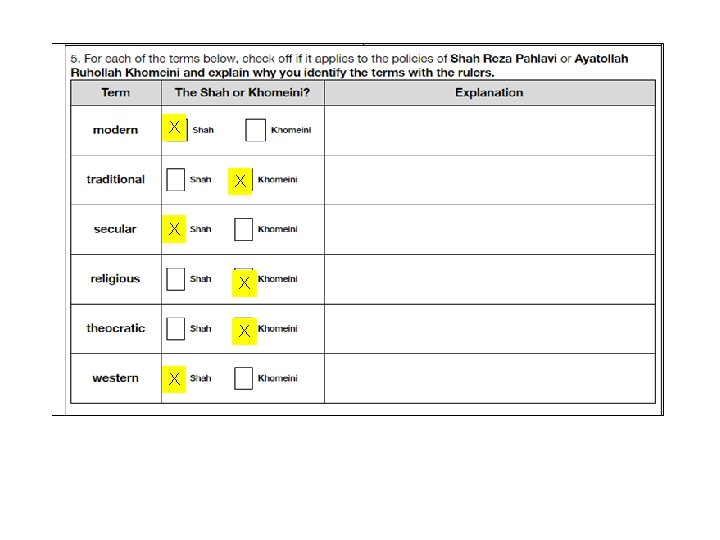
X X X
Pan-Arabism and Zionism in the Middle East • Following the withdrawal of European imperialism from the Middle East, a variety of nationalistic groups sprung up demanding sovereignty (independence) for their nations. • Arab nationalism was present in Algeria, Lebanon, Syria, Iraq, Jordon, Egypt, Saudi Arabia, and Turkey. • A call for Pan-Arabism (Arab nationalism) was made by Egyptian leader Gamal Abdel Nasser, who had the desire to unite all the nations of the Arab world. • The Pan-Arabic movement flourished for a short period when the Arab world was contesting the presence of the Jewish state of Israel, but has since decayed as Islamic countries squabbled amongst themselves over territory and oil.
Goal/Essential question: • How can secular and religious ideas co-exist? TARGET • I can examine how Zionism lead to the creation of the State of Israel and to the Arab-Israeli conflicts.
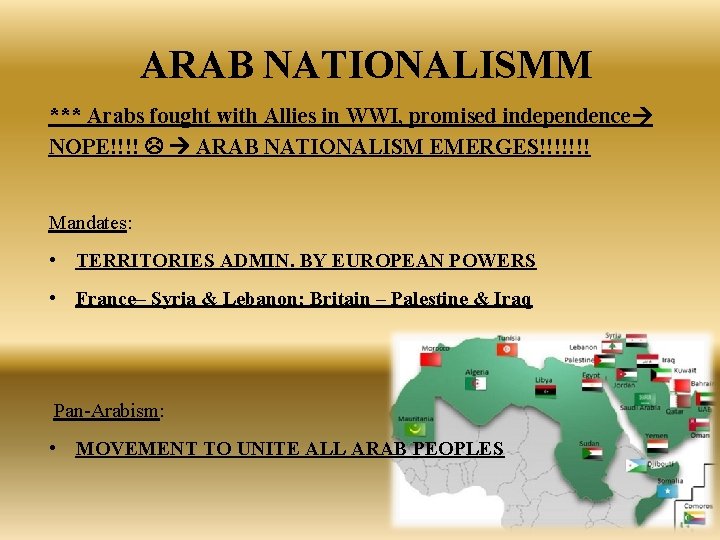
ARAB NATIONALISMM *** Arabs fought with Allies in WWI, promised independence NOPE!!!! ARAB NATIONALISM EMERGES!!!!!!! Mandates: • TERRITORIES ADMIN. BY EUROPEAN POWERS • France– Syria & Lebanon; Britain – Palestine & Iraq Pan-Arabism: • MOVEMENT TO UNITE ALL ARAB PEOPLES

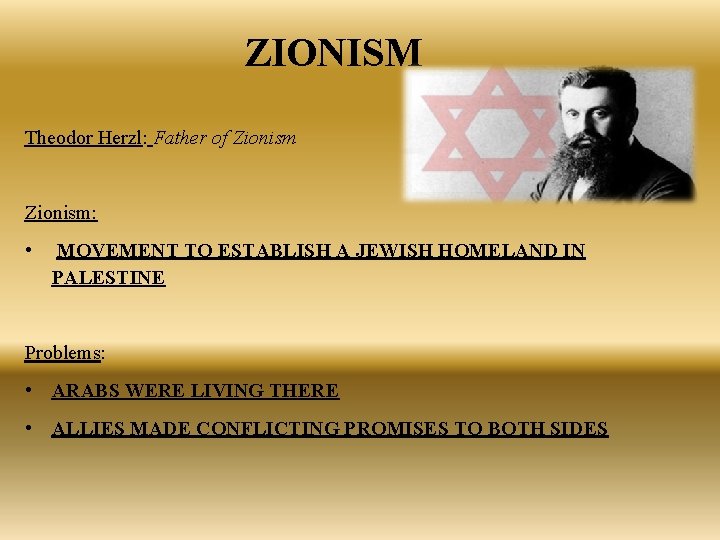
ZIONISM Theodor Herzl: Father of Zionism: • MOVEMENT TO ESTABLISH A JEWISH HOMELAND IN PALESTINE Problems: • ARABS WERE LIVING THERE • ALLIES MADE CONFLICTING PROMISES TO BOTH SIDES

Pan-Arabism and Zionism in the Middle East • Zionism, founded by Theodor Herzl, is defined as the nationalistic movement of Jewish people and their desire to establish their own nation in the Holy Land. • After World War II, the nation of Israel, led by Prime Minister David Ben-Gurion, was formed making Zionism a successful nationalistic movement. • Since then, nationalism has played a role in the turbulent Middle East. Arab nationalistic movements will be in direct conflict with each other and with Israel up to the present-day.
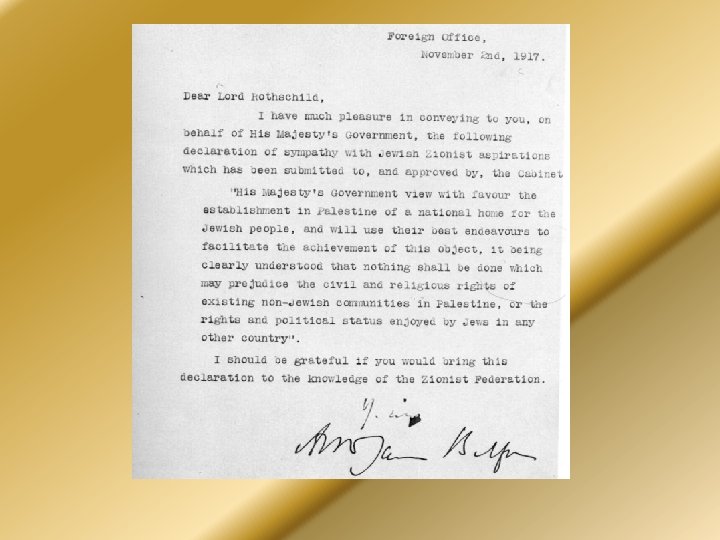
Anti-Semitism led to Zionism: MOVEMENT TO CREATE A JEWISH HOMELAND IN PALESTINE 1917—Balfour Declaration: “The British government supports the establishment of…” ** Packet p. 16 PROMOTED HOMELAND IN PALESTINE, BUT PROTECT RIGHTS OF NON-JEWISH
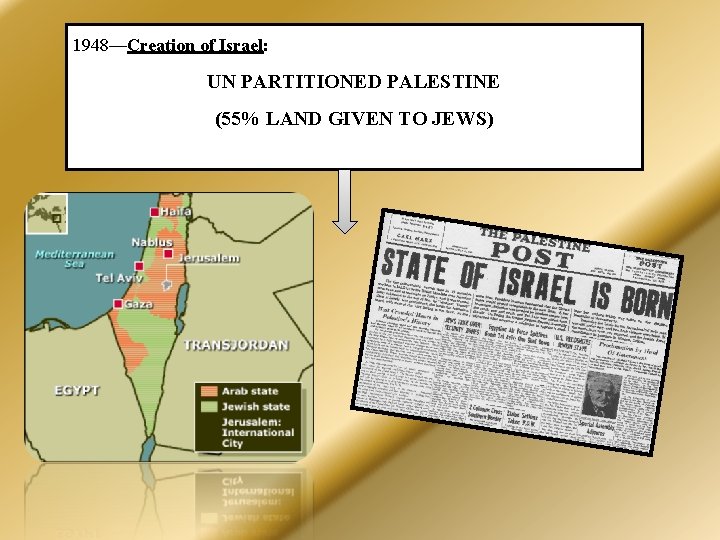
1948—Creation of Israel: UN PARTITIONED PALESTINE (55% LAND GIVEN TO JEWS)
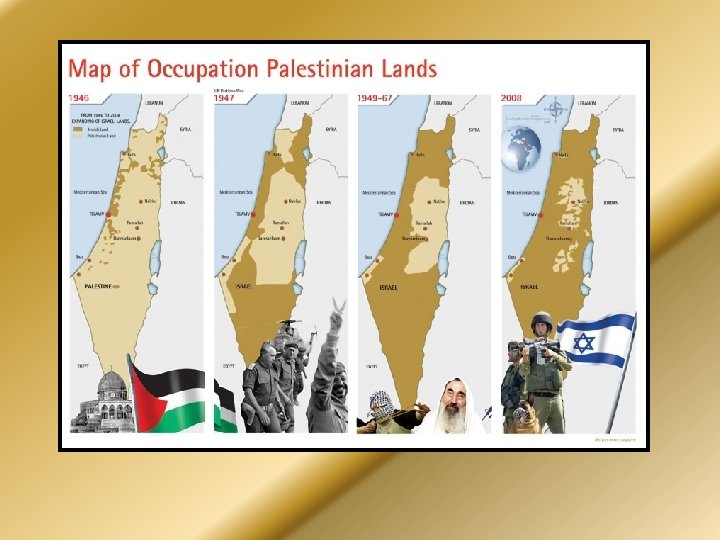
Reaction— 1948 -73 Wars: ARAB-ISRAELI WARS Why? FELT THAT ARAB/PALESTINIANS HAD RIGHT TO THE LAND THEY OCCUPIED; FIGHT WESTERN INFLUENCE Who? Egypt, Iraq, Jordan, Saudi Arabia and Syria o Israel gets strong military, economic and political support from o US & WESTERN NATIONS o Israel wins these conflicts and nearly doubles its territory
The Palestinian Liberation Organization (PLO): Why? o 700, 000 Arab refugees displaced into camps o Extreme POVERTY-- ANGER! o They want THEIR OWN HOMELAND Who? YASIR ARAFAT was the leader of the PLO How? Use TERROR and guerilla warfare against Israelis Israeli’s respond with MILITARY Increased discrimination and seizure of land Intifada: Palestinian Uprising boycotts, demonstrations, attacks on Israeli soldiers
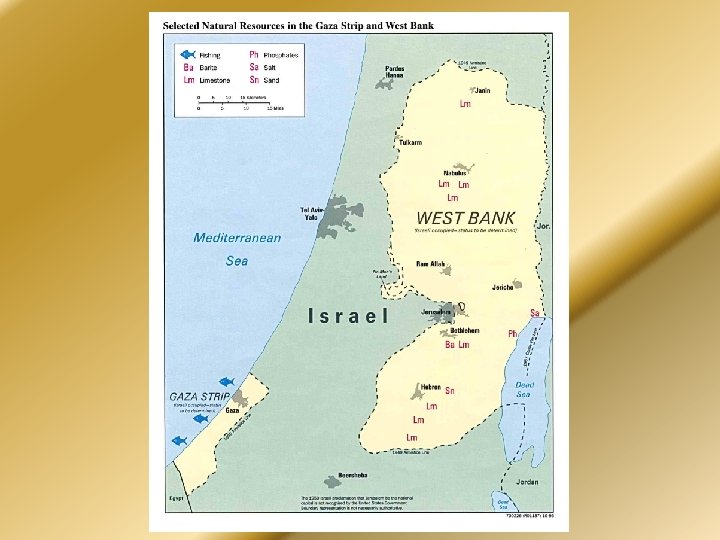
PEACE NEGOTIATIONS: Camp David Accords— 1979 o Ends war between EGYPT and ISRAEL o Egyptian president ANWAR SADAT becomes first Arab leader to visit and recognize the Jewish state (he was assassinated by Muslim extremists ) Oslo Agreement— 1993: o Israel agreed to GRANT PALESTINIANS SELF-RULE IN GAZA STRIP & WEST BANK. o This was not achieved and Israeli leader Yitzhak Rabin was assassinated by Jewish extremist. Road Map— 2003: o Internationally devised peace plan that seeks 2 SEPARATE PEACEFUL STATES o August 2005, Israelis evacuate the GAZA STRIP o o Peace still being negotiated Tensions still high between Palestinians and Israelis
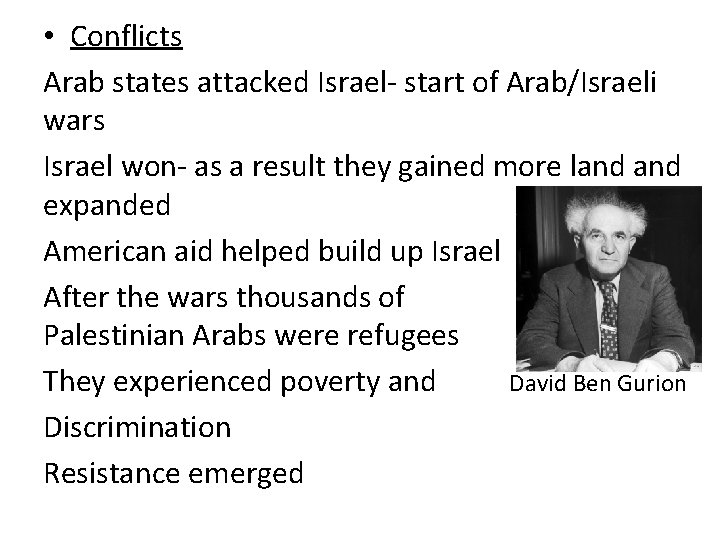
• Conflicts Arab states attacked Israel- start of Arab/Israeli wars Israel won- as a result they gained more land expanded American aid helped build up Israel After the wars thousands of Palestinian Arabs were refugees They experienced poverty and David Ben Gurion Discrimination Resistance emerged
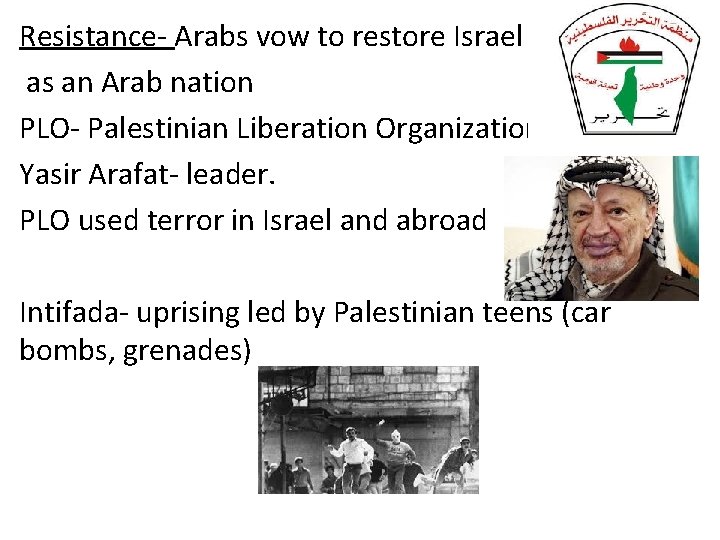
Resistance- Arabs vow to restore Israel as an Arab nation PLO- Palestinian Liberation Organization Yasir Arafat- leader. PLO used terror in Israel and abroad Intifada- uprising led by Palestinian teens (car bombs, grenades)

- Slides: 66