
The Middle East is a region or area


- Slides: 27
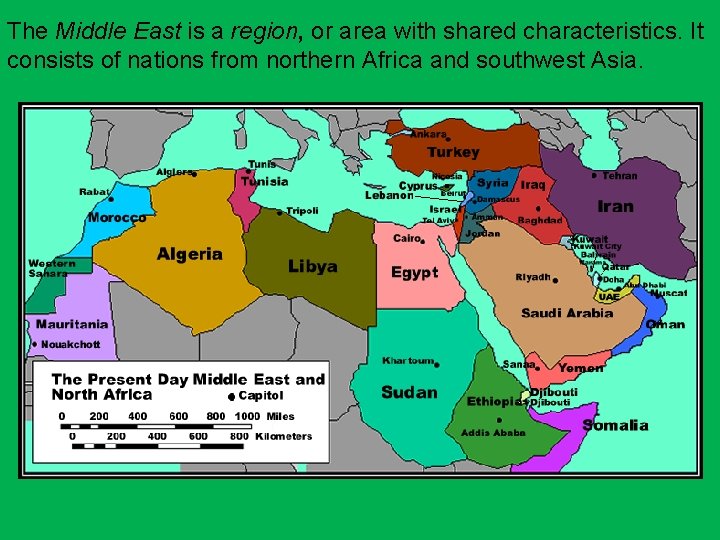
The Middle East is a region, or area with shared characteristics. It consists of nations from northern Africa and southwest Asia.
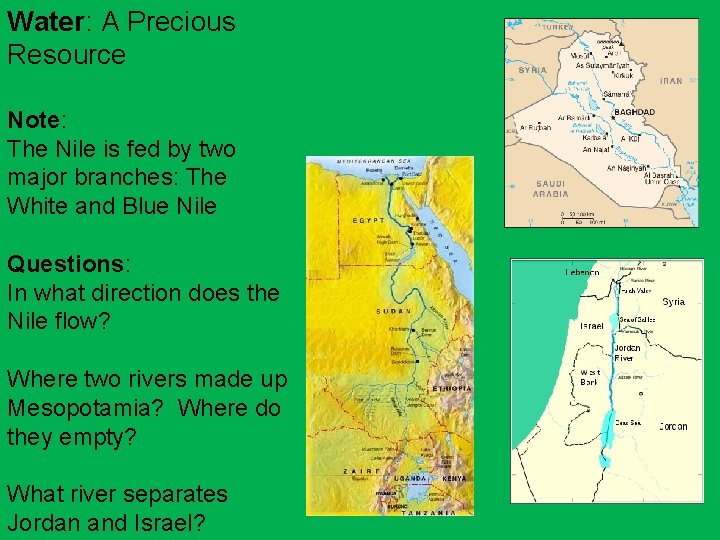
Water: A Precious Resource Note: The Nile is fed by two major branches: The White and Blue Nile Questions: In what direction does the Nile flow? Where two rivers made up Mesopotamia? Where do they empty? What river separates Jordan and Israel?
Map of the Persian Gulf The nations of Kuwait, Bahrain, U. A. E. Qatar and Oman have benefited from a combination of a lot of oil and small populations.
OPEC – Organization of Petroleum Exporting Countries OPEC is a cartel, or an organization that controls the supply and demand of a product. OPEC Members Algeria Indonesia Iran Iraq Kuwait Libya Nigeria Qatar Saudi Arabia United Arab Emirates Venezuela Pipeline to Refinery in Bahrain
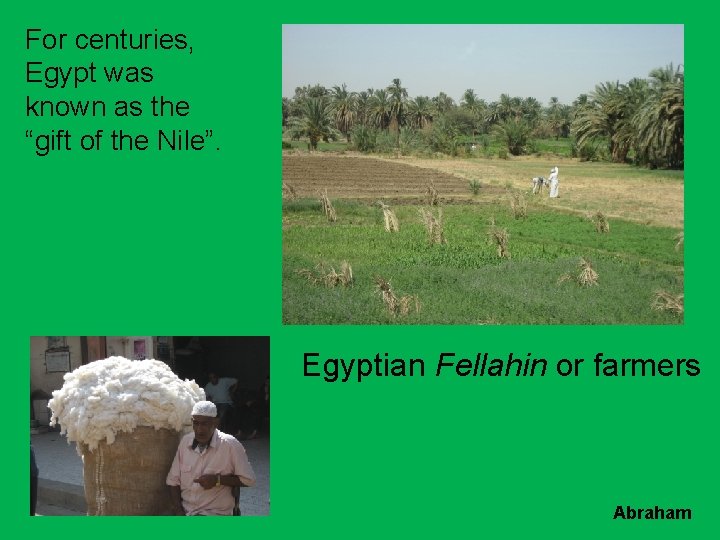
For centuries, Egypt was known as the “gift of the Nile”. Egyptian Fellahin or farmers Abraham
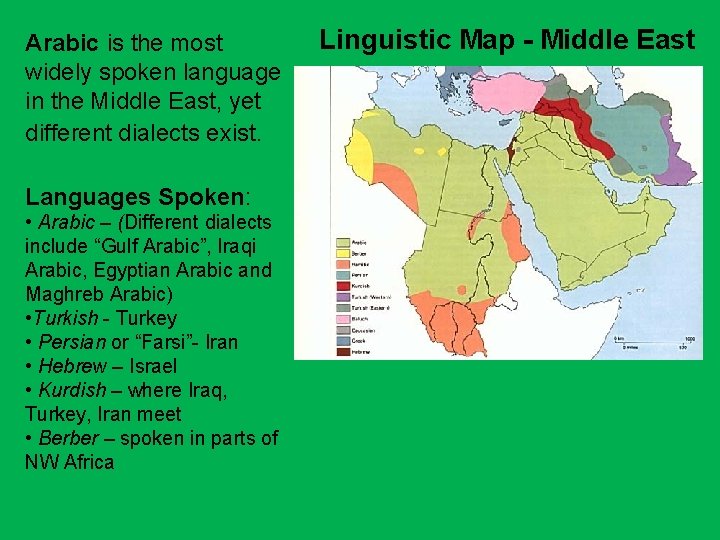
Arabic is the most widely spoken language in the Middle East, yet different dialects exist. Languages Spoken: • Arabic – (Different dialects include “Gulf Arabic”, Iraqi Arabic, Egyptian Arabic and Maghreb Arabic) • Turkish - Turkey • Persian or “Farsi”- Iran • Hebrew – Israel • Kurdish – where Iraq, Turkey, Iran meet • Berber – spoken in parts of NW Africa Linguistic Map - Middle East
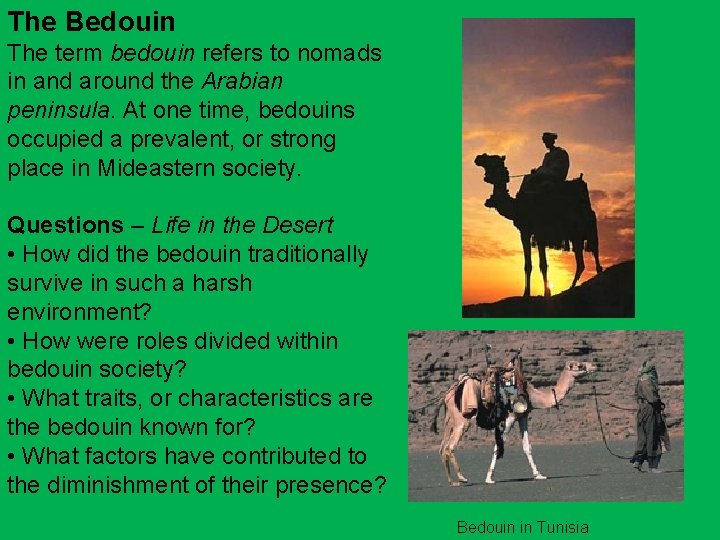
The Bedouin The term bedouin refers to nomads in and around the Arabian peninsula. At one time, bedouins occupied a prevalent, or strong place in Mideastern society. Questions – Life in the Desert • How did the bedouin traditionally survive in such a harsh environment? • How were roles divided within bedouin society? • What traits, or characteristics are the bedouin known for? • What factors have contributed to the diminishment of their presence? Bedouin in Tunisia
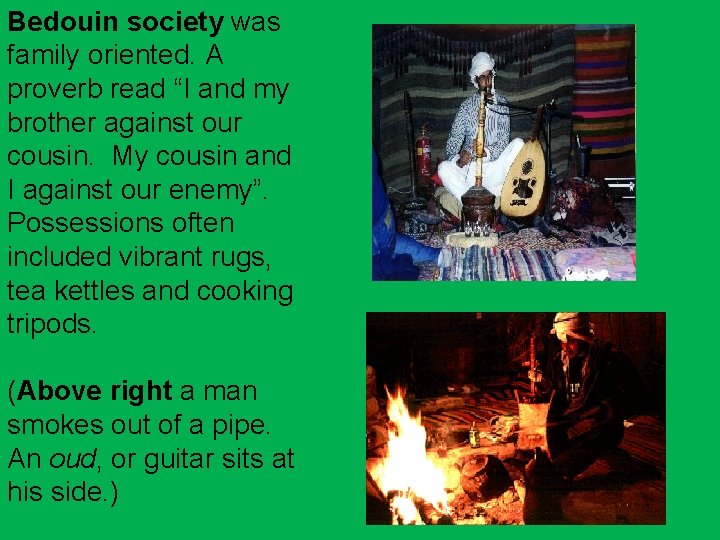
Bedouin society was family oriented. A proverb read “I and my brother against our cousin. My cousin and I against our enemy”. Possessions often included vibrant rugs, tea kettles and cooking tripods. (Above right a man smokes out of a pipe. An oud, or guitar sits at his side. )
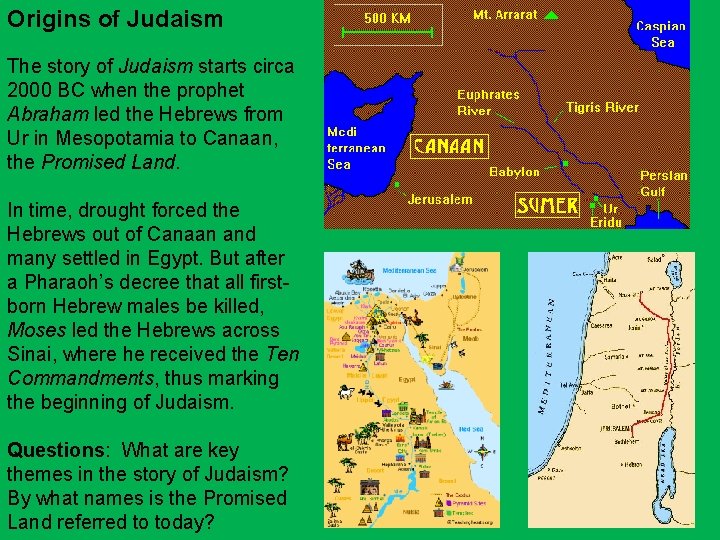
Origins of Judaism The story of Judaism starts circa 2000 BC when the prophet Abraham led the Hebrews from Ur in Mesopotamia to Canaan, the Promised Land. In time, drought forced the Hebrews out of Canaan and many settled in Egypt. But after a Pharaoh’s decree that all firstborn Hebrew males be killed, Moses led the Hebrews across Sinai, where he received the Ten Commandments, thus marking the beginning of Judaism. Questions: What are key themes in the story of Judaism? By what names is the Promised Land referred to today?
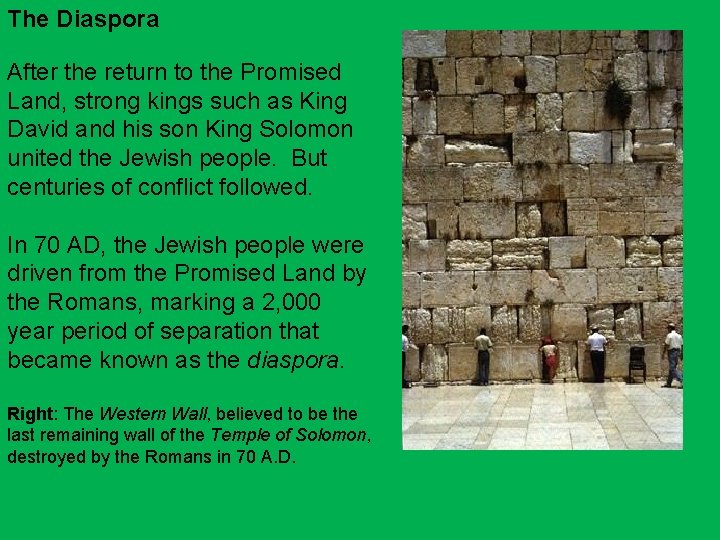
The Diaspora After the return to the Promised Land, strong kings such as King David and his son King Solomon united the Jewish people. But centuries of conflict followed. In 70 AD, the Jewish people were driven from the Promised Land by the Romans, marking a 2, 000 year period of separation that became known as the diaspora. Right: The Western Wall, believed to be the last remaining wall of the Temple of Solomon, destroyed by the Romans in 70 A. D.
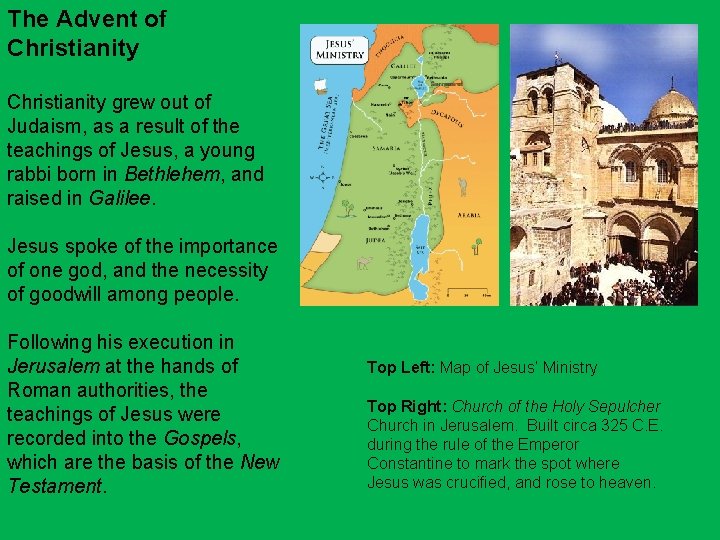
The Advent of Christianity grew out of Judaism, as a result of the teachings of Jesus, a young rabbi born in Bethlehem, and raised in Galilee. Jesus spoke of the importance of one god, and the necessity of goodwill among people. Following his execution in Jerusalem at the hands of Roman authorities, the teachings of Jesus were recorded into the Gospels, which are the basis of the New Testament. Top Left: Map of Jesus’ Ministry Top Right: Church of the Holy Sepulcher Church in Jerusalem. Built circa 325 C. E. during the rule of the Emperor Constantine to mark the spot where Jesus was crucified, and rose to heaven.
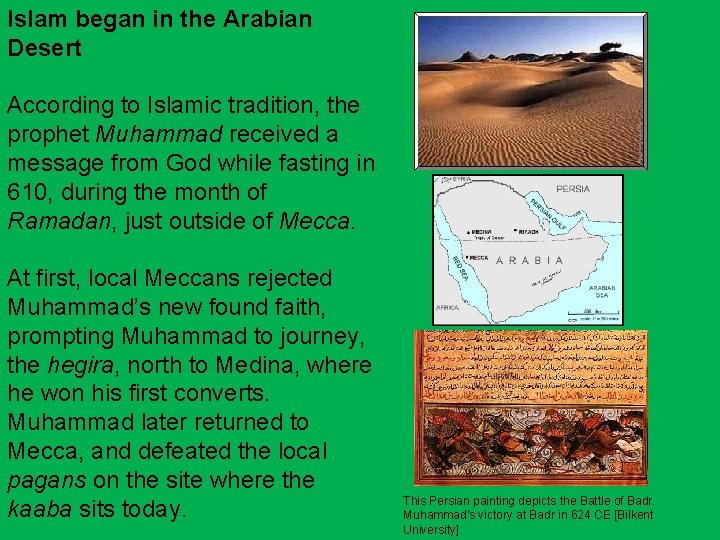
Islam began in the Arabian Desert According to Islamic tradition, the prophet Muhammad received a message from God while fasting in 610, during the month of Ramadan, just outside of Mecca. At first, local Meccans rejected Muhammad’s new found faith, prompting Muhammad to journey, the hegira, north to Medina, where he won his first converts. Muhammad later returned to Mecca, and defeated the local pagans on the site where the kaaba sits today. This Persian painting depicts the Battle of Badr. Muhammad's victory at Badr in 624 CE [Bilkent University]
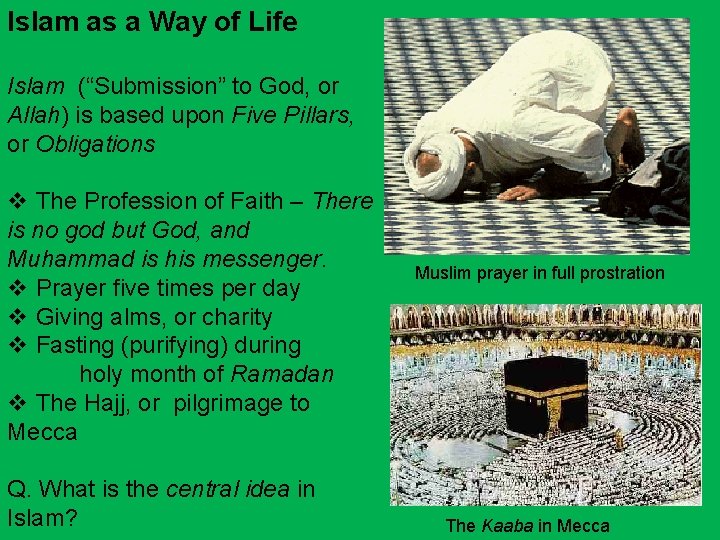
Islam as a Way of Life Islam (“Submission” to God, or Allah) is based upon Five Pillars, or Obligations v The Profession of Faith – There is no god but God, and Muhammad is his messenger. v Prayer five times per day v Giving alms, or charity v Fasting (purifying) during holy month of Ramadan v The Hajj, or pilgrimage to Mecca Q. What is the central idea in Islam? Muslim prayer in full prostration The Kaaba in Mecca
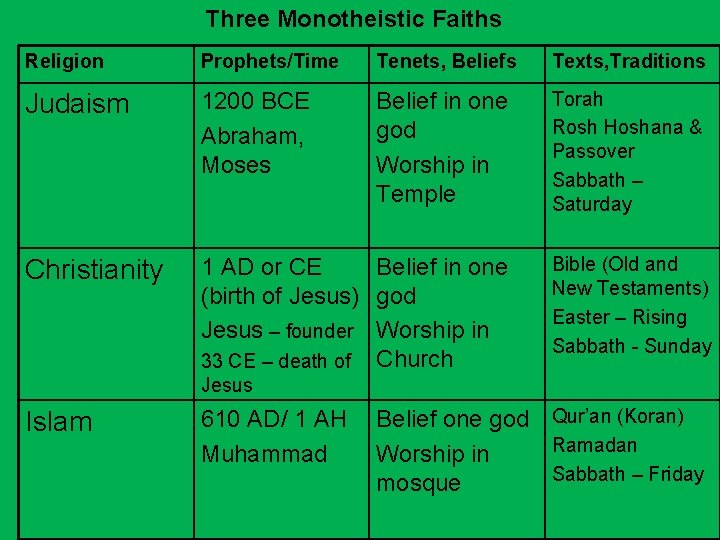
Three Monotheistic Faiths Religion Prophets/Time Tenets, Beliefs Texts, Traditions Judaism 1200 BCE Abraham, Moses Belief in one god Worship in Temple Torah Rosh Hoshana & Passover Sabbath – Saturday Christianity 1 AD or CE Belief in one (birth of Jesus) god Jesus – founder Worship in 33 CE – death of Church Bible (Old and New Testaments) Easter – Rising Sabbath - Sunday Jesus Islam 610 AD/ 1 AH Muhammad Belief one god Qur’an (Koran) Ramadan Worship in Sabbath – Friday mosque
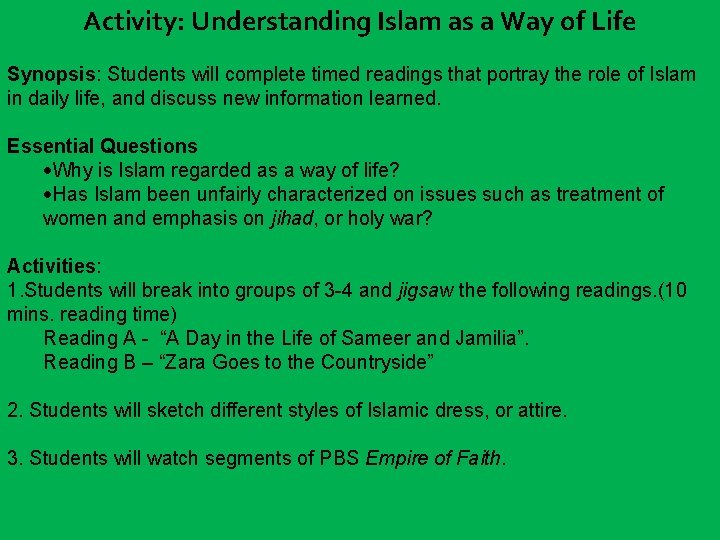
Activity: Understanding Islam as a Way of Life Synopsis: Students will complete timed readings that portray the role of Islam in daily life, and discuss new information learned. Essential Questions Why is Islam regarded as a way of life? Has Islam been unfairly characterized on issues such as treatment of women and emphasis on jihad, or holy war? Activities: 1. Students will break into groups of 3 -4 and jigsaw the following readings. (10 mins. reading time) Reading A - “A Day in the Life of Sameer and Jamilia”. Reading B – “Zara Goes to the Countryside” 2. Students will sketch different styles of Islamic dress, or attire. 3. Students will watch segments of PBS Empire of Faith.
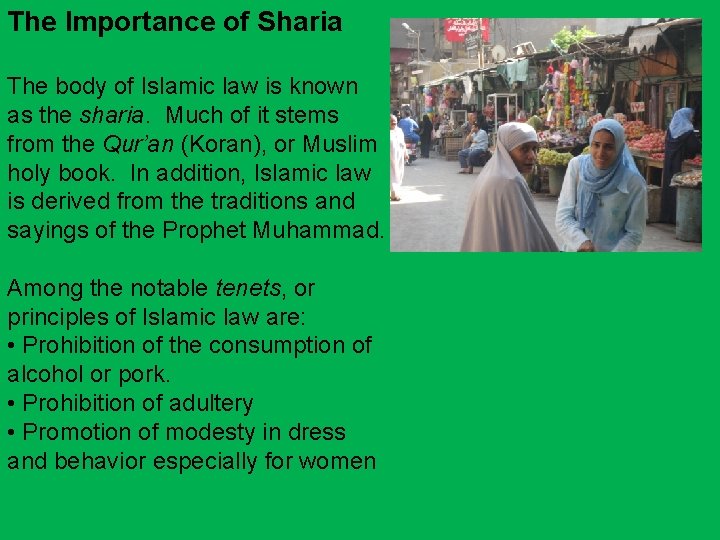
The Importance of Sharia The body of Islamic law is known as the sharia. Much of it stems from the Qur’an (Koran), or Muslim holy book. In addition, Islamic law is derived from the traditions and sayings of the Prophet Muhammad. Among the notable tenets, or principles of Islamic law are: • Prohibition of the consumption of alcohol or pork. • Prohibition of adultery • Promotion of modesty in dress and behavior especially for women
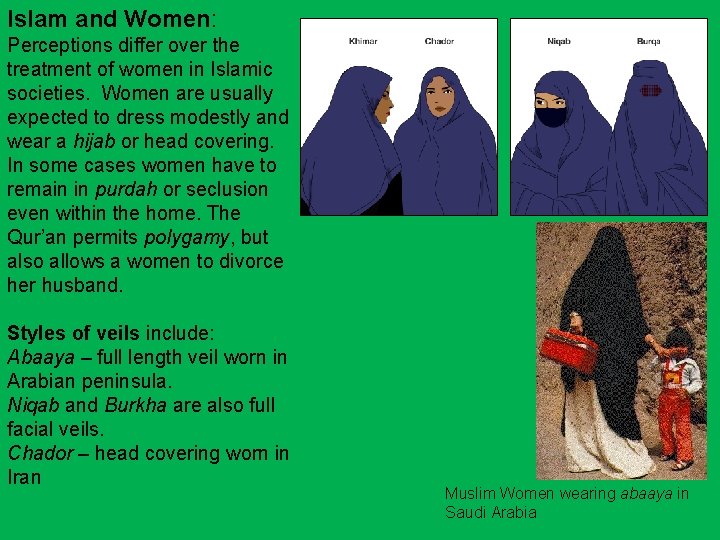
Islam and Women: Perceptions differ over the treatment of women in Islamic societies. Women are usually expected to dress modestly and wear a hijab or head covering. In some cases women have to remain in purdah or seclusion even within the home. The Qur’an permits polygamy, but also allows a women to divorce her husband. Styles of veils include: Abaaya – full length veil worn in Arabian peninsula. Niqab and Burkha are also full facial veils. Chador – head covering worn in Iran Muslim Women wearing abaaya in Saudi Arabia
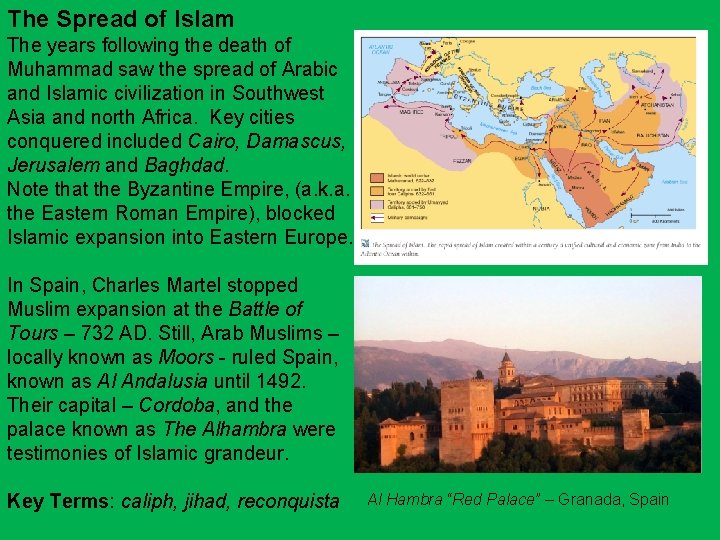
The Spread of Islam The years following the death of Muhammad saw the spread of Arabic and Islamic civilization in Southwest Asia and north Africa. Key cities conquered included Cairo, Damascus, Jerusalem and Baghdad. Note that the Byzantine Empire, (a. k. a. the Eastern Roman Empire), blocked Islamic expansion into Eastern Europe. In Spain, Charles Martel stopped Muslim expansion at the Battle of Tours – 732 AD. Still, Arab Muslims – locally known as Moors - ruled Spain, known as Al Andalusia until 1492. Their capital – Cordoba, and the palace known as The Alhambra were testimonies of Islamic grandeur. Key Terms: caliph, jihad, reconquista Al Hambra “Red Palace” – Granada, Spain
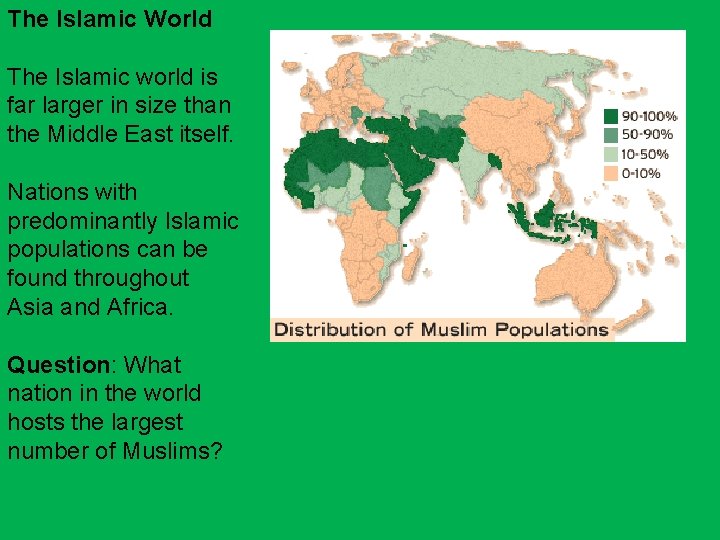
The Islamic World The Islamic world is far larger in size than the Middle East itself. Nations with predominantly Islamic populations can be found throughout Asia and Africa. Question: What nation in the world hosts the largest number of Muslims?
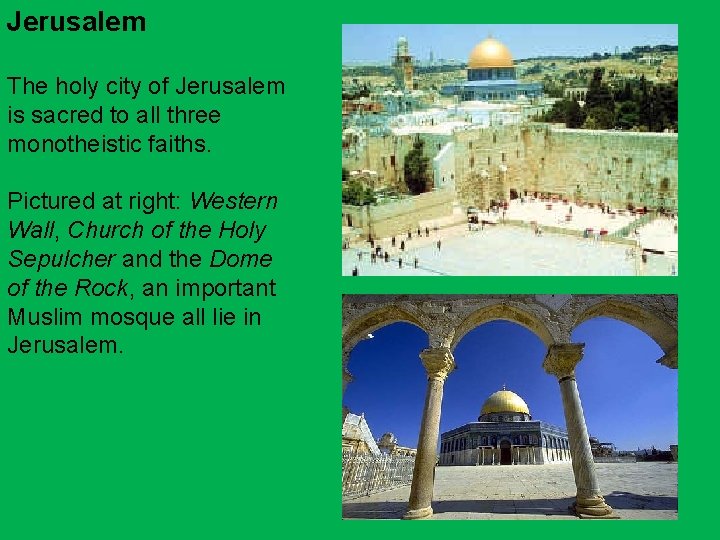
Jerusalem The holy city of Jerusalem is sacred to all three monotheistic faiths. Pictured at right: Western Wall, Church of the Holy Sepulcher and the Dome of the Rock, an important Muslim mosque all lie in Jerusalem.
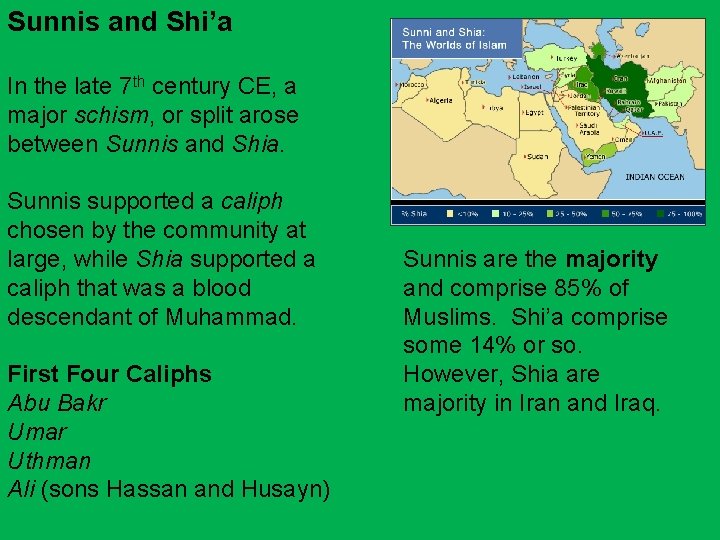
Sunnis and Shi’a In the late 7 th century CE, a major schism, or split arose between Sunnis and Shia. Sunnis supported a caliph chosen by the community at large, while Shia supported a caliph that was a blood descendant of Muhammad. First Four Caliphs Abu Bakr Umar Uthman Ali (sons Hassan and Husayn) Sunnis are the majority and comprise 85% of Muslims. Shi’a comprise some 14% or so. However, Shia are majority in Iran and Iraq.
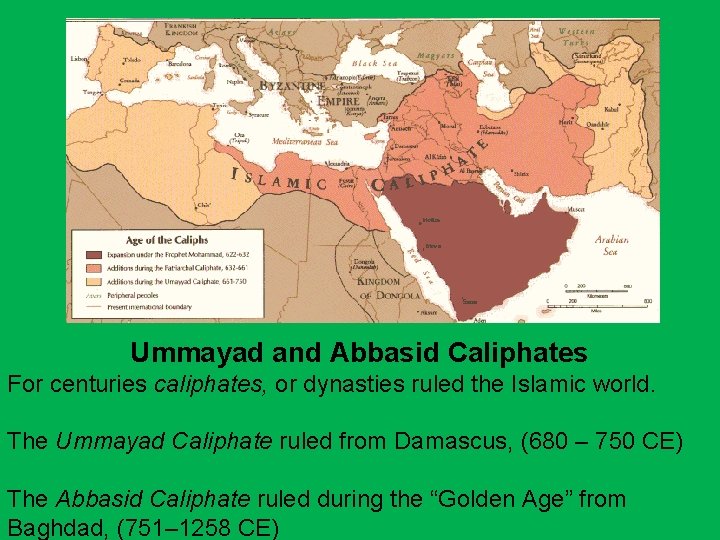
Ummayad and Abbasid Caliphates For centuries caliphates, or dynasties ruled the Islamic world. The Ummayad Caliphate ruled from Damascus, (680 – 750 CE) The Abbasid Caliphate ruled during the “Golden Age” from Baghdad, (751– 1258 CE)
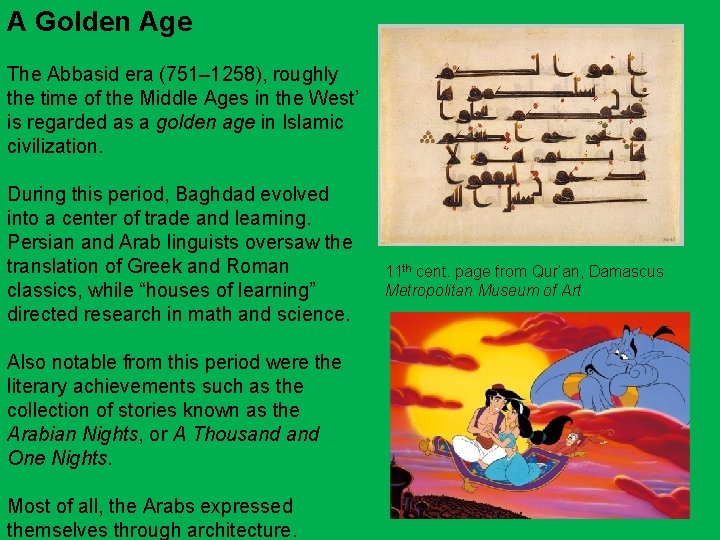
A Golden Age The Abbasid era (751– 1258), roughly the time of the Middle Ages in the West’ is regarded as a golden age in Islamic civilization. During this period, Baghdad evolved into a center of trade and learning. Persian and Arab linguists oversaw the translation of Greek and Roman classics, while “houses of learning” directed research in math and science. Also notable from this period were the literary achievements such as the collection of stories known as the Arabian Nights, or A Thousand One Nights. Most of all, the Arabs expressed themselves through architecture. 11 th cent. page from Qur’an, Damascus Metropolitan Museum of Art
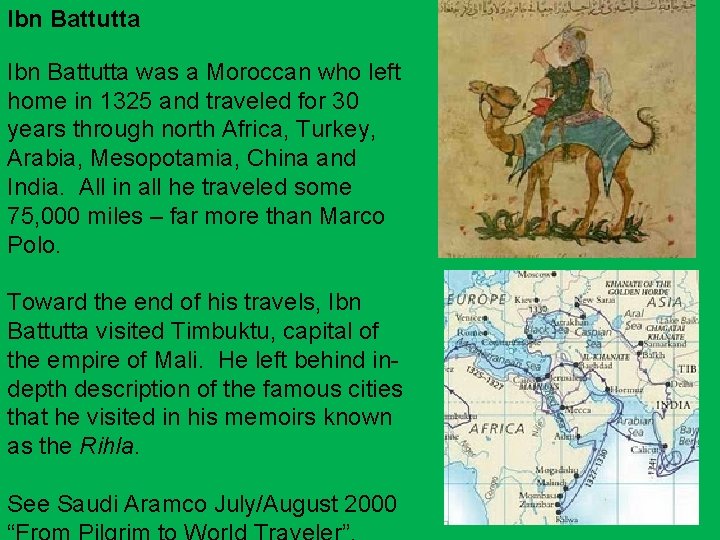
Ibn Battutta was a Moroccan who left home in 1325 and traveled for 30 years through north Africa, Turkey, Arabia, Mesopotamia, China and India. All in all he traveled some 75, 000 miles – far more than Marco Polo. Toward the end of his travels, Ibn Battutta visited Timbuktu, capital of the empire of Mali. He left behind indepth description of the famous cities that he visited in his memoirs known as the Rihla. See Saudi Aramco July/August 2000
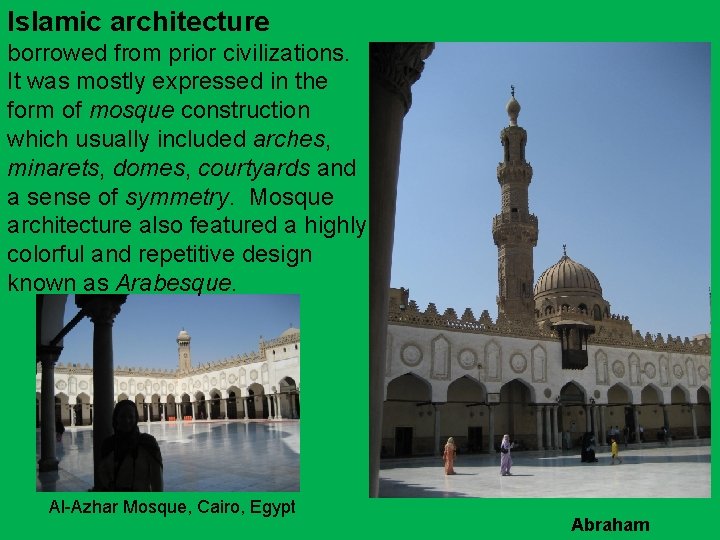
Islamic architecture borrowed from prior civilizations. It was mostly expressed in the form of mosque construction which usually included arches, minarets, domes, courtyards and a sense of symmetry. Mosque architecture also featured a highly colorful and repetitive design known as Arabesque. Al-Azhar Mosque, Cairo, Egypt Abraham
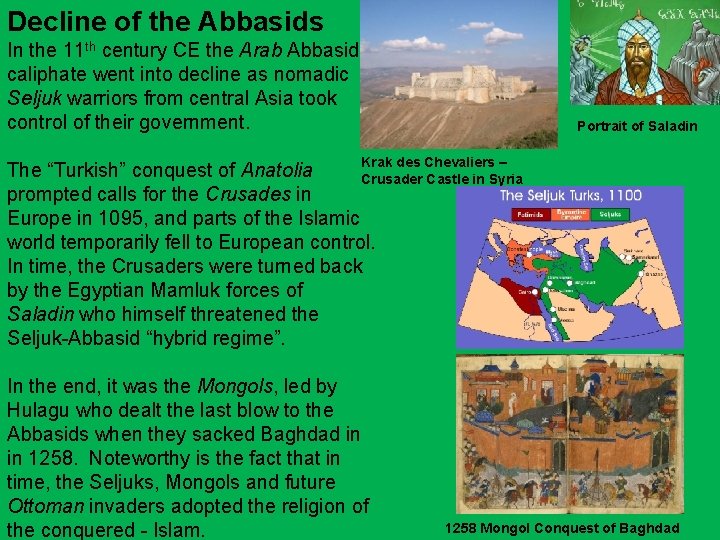
Decline of the Abbasids In the 11 th century CE the Arab Abbasid caliphate went into decline as nomadic Seljuk warriors from central Asia took control of their government. Portrait of Saladin Krak des Chevaliers – The “Turkish” conquest of Anatolia Crusader Castle in Syria prompted calls for the Crusades in Europe in 1095, and parts of the Islamic world temporarily fell to European control. In time, the Crusaders were turned back by the Egyptian Mamluk forces of Saladin who himself threatened the Seljuk-Abbasid “hybrid regime”. In the end, it was the Mongols, led by Hulagu who dealt the last blow to the Abbasids when they sacked Baghdad in in 1258. Noteworthy is the fact that in time, the Seljuks, Mongols and future Ottoman invaders adopted the religion of the conquered - Islam. 1258 Mongol Conquest of Baghdad
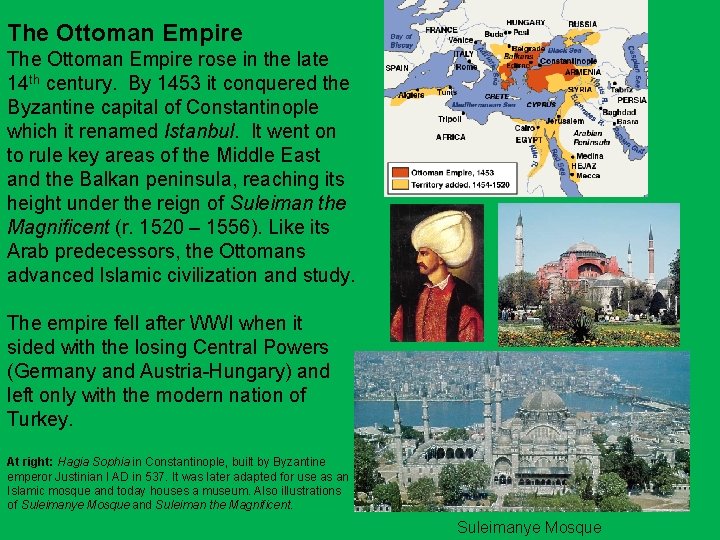
The Ottoman Empire rose in the late 14 th century. By 1453 it conquered the Byzantine capital of Constantinople which it renamed Istanbul. It went on to rule key areas of the Middle East and the Balkan peninsula, reaching its height under the reign of Suleiman the Magnificent (r. 1520 – 1556). Like its Arab predecessors, the Ottomans advanced Islamic civilization and study. The empire fell after WWI when it sided with the losing Central Powers (Germany and Austria-Hungary) and left only with the modern nation of Turkey. At right: Hagia Sophia in Constantinople, built by Byzantine emperor Justinian I AD in 537. It was later adapted for use as an Islamic mosque and today houses a museum. Also illustrations of Suleimanye Mosque and Suleiman the Magnificent. Suleimanye Mosque