
The Middle Colonies Lesson 1 Geography of the
- Slides: 30
The Middle Colonies Lesson 1: Geography of the Middle Colonies By Tyler, Kevin, Juliet, and Gabby
Plains, Hills, and Rivers • The Middle Colonies formed a region of contrasts because New Jersey and Delaware lie on the Atlantic Coastal Plain and New York and Pennsylvania stretch across the Appalachians. So they had different land lifestyles. • There was a fall line created as the rivers dropped from the hills to the coastal plain. This caused rapids and waterfalls.
Plains, Hills, and Rivers cont. • The middle colonies had beaver-filled streams, thick forests and rich farm land. • Colonist used the rivers to transport these goods. • The fall line was used to power mills and saws.
Plains, Hills, and Rivers cont. • The most important rivers in the Middle Colonies were the Delaware and the Hudson rivers. • They were large enough for ships which promoted port cities for trade. – Example: New York City
Farming the Middle Colonies • There was rich soil and a 6 to 7 month growing season that made farming easy in the middle colonies.
The Riches of the Middle Colonies • The middle colonies on the coast of piedmont • • offered good farmland which England envied. The piedmont’s forests were fulfilled with lumber and beaver. The navigable river flowed through each of these colonies and rivers tumbling down the fall line provided water power for mills.
The Middle Colonies Lesson 2: New York and New Jersey By Tyler, Kevin, Juliet, and Gabby
New Amsterdam surrenders n n In 1664, 4 English warships demanded that New Amsterdam surrender. At first Stuyvesant did not surrender, but after the colonists saw guns pointed at them they did, so Stuyvesant had no chance of winning so he surrendered.
The Duke Of York n n King Charles II gave the Dutch colony to his brother James, the Duke of York. New Netherlands became New York and New Amsterdam became New York City.
John Berkeley and George Carteret n n James gave a large part of his colony to two friends Lord John Berkeley and Sir George Carteret. They started the colony of New Jersey on land between the Hudson and the Delaware rivers.
Land For Rent n Berkeley and Carteret rented land for money in New Jersey. They offered colonists rich soil and religious freedom, soon all kinds of people were coming there to farm along New Jerseys Coastal Plain.
Farmland Along the Hudson River n n Colonists in New York and New Jersey wanted to govern themselves. The fought and won to elect and assembly, or law making body. )
John Peter Zinger n n Zinger published a weekly newspaper called “The New York Weekly journal. ” Zinger was arrested because he published a newspaper about the governor being dishonest. His defender (lawyer) was Andrew Hamilton. The trial helped to establish freedom of the press. As long as it was true, you could find fault with public officials.
“A Mixed Medley” n n n New Netherlands became New York and New Jersey. They welcomed all. People had access to: Land n Religious Freedom n And the right to govern themselves n
Chapter 9 Lesson 3 Pennsylvania and Delaware By Caroline, Victoria, Gable, Corey, and Tyler.
William Penn becomes a Quaker • William grew up in a rich, English family. • He joined a religious group called the Quakers or Society of Friends. It was founded by George • Fox. The English government disliked the Quakers. Unlike the Church of England, the Quakers said – – – you didn’t need preachers or churches and all people are equal Thou Shall not Kill = They wouldn’t serve in the army or navy
Penn’s “Holy Experiment” • In 1681 King Charles granted William Penn land • • in Pennsylvania. It was called Pennsylvania, that means “Penn’s Woods”. There were not any bodies of water on the land he was granted, so Duke of York granted him more land on a river. (Why is water important? ) This area broke away and became Delaware. • Pennsylvania offered complete religious freedom. • He said, “You shall be governed by the laws of your own making. ”
Penn Visits His Colony • On the Delaware he founded the city of Philadelphia, which means “brotherly love” in Greek. • Penn treated the Delaware people as his equal because of his beliefs. (The Delaware were Native Americans. ) • He paid them for their land.
“The Seed of a Nation” • William Penn began Pennsylvania as a “holy experiment. ” • He offered colonists freedom of religion and self-government. • He treated the Delaware as equals and kept the peace. • He hoped it would become the “seed of a nation. ”
Chapter 9 Lesson 4 The People in the Middle Colonies By Caroline, Victoria, Gable, Corey, and Tyler.
Quakers in North America n n n Many of the first colonists in New Jersey and Pennsylvania were English Quakers. They were a lot like the Puritans, idleness was a sin. In 1688, the Quakers were the first people to speak up about slavery. They did not like bringing men here against there will.
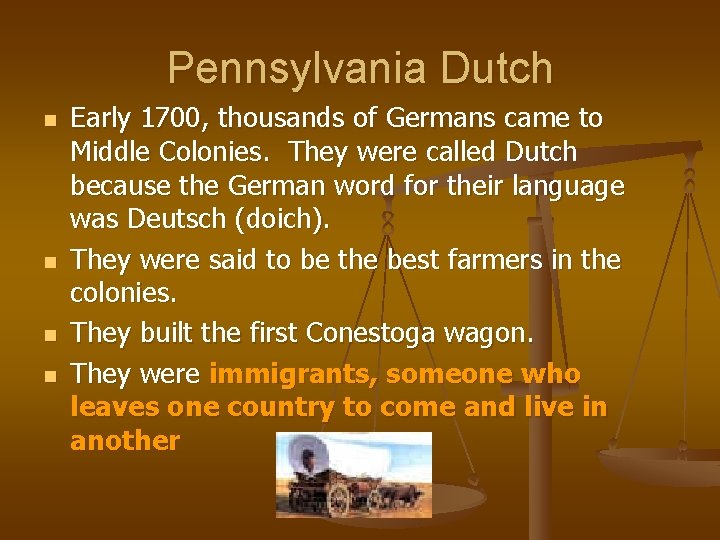
Pennsylvania Dutch n n Early 1700, thousands of Germans came to Middle Colonies. They were called Dutch because the German word for their language was Deutsch (doich). They were said to be the best farmers in the colonies. They built the first Conestoga wagon. They were immigrants, someone who leaves one country to come and live in another
Scots-Irish n n n They were called the Scots-Irish because they moved from Scotland to Ireland because they were promised land freedom of religion. In 1720, people from northern Ireland began arriving in the middle colonies. They went to the Appalachian mountain because all the good land was taken. They cleared land along the frontier, the edge of settlement.
Self-Sufficient Farm Family n n n Whether they lived in villages or on lonely farms. Most people were farmers. They were self-sufficient, able to meet almost all their needs with the farm. Most self-sufficient people grew too much grain which was sent to New York. The middle colonies were called the “bread basket of America” because of this.
The Promise of the Middle Colonies n n n 1700 the Middle Colonies grew rapidly. The Middle Colonies promised land chance of better life if people came to the colonies. Poor people from Europe could establish themselves and flourish.
Chapter 9 Lesson 5 Ben Franklin’s Philadelphia By: Corey, Tyler, Gable
Benjamin Franklin § 1 of 17 children born in Boston. (15 out of 17) § Worked at his brother’s printing press. § His brother made money while he worked so he ran away for Philadelphia. § Philadelphia was nosy and exciting to him. § It was busy all day long.
A City of Opportunity § In Philadelphia, Ben owned a print shop and published his own paper by the age of 24. § Franklin wrote the Poor Richard’s Almanac which was the best selling book in the colonies. § An almanac is a book of facts on many subjects. His taught farmers how & when to plant crops.
A City of Opportunity § Workshops lined the streets of Philadelphia. § Craftworkers made good to be sold. § The Delaware River was lined with docks built by merchants. § Ships left Philadelphia with, fur, meat, lumber, and grain. § They returned with goods, from England like, silks, lace, swords, and mouse traps.
Franklin’s Improvements on Philadelphia § Benjamin Franklin started America’s first public library in Philadelphia in 1731. Any money collected was used to buy more books for the library. § Franklin also started fire companies. § Benjamin worked for paved streets and street lights so it would be safer at night. § The largest city in the colony was Philadelphia in 1760. § Philadelphia, being the center of a farming region, grew rapidly. § Visitors enjoyed Philadelphia’s well lit streets and fine appearance.