
The Mid YIS Test The CEM at Durham






- Slides: 18
The Mid. YIS Test
The CEM at Durham University • The Centre for Evaluation and Monitoring is the largest educational research unit in a UK university. • Works with schools, colleges, education authorities and government agencies to provide high-quality information through scientifically grounded research, using evidence to guide to educational practice. • Home of a widely-used family of baseline testing systems. Assessment for Excellence
The Mid. YIS test • Mid. YIS stands for Middle Years Information System • Tests are designed to measure ability and aptitude for learning rather than achievement. • Results can be used to give an expected level of attainment in National Qualifications.
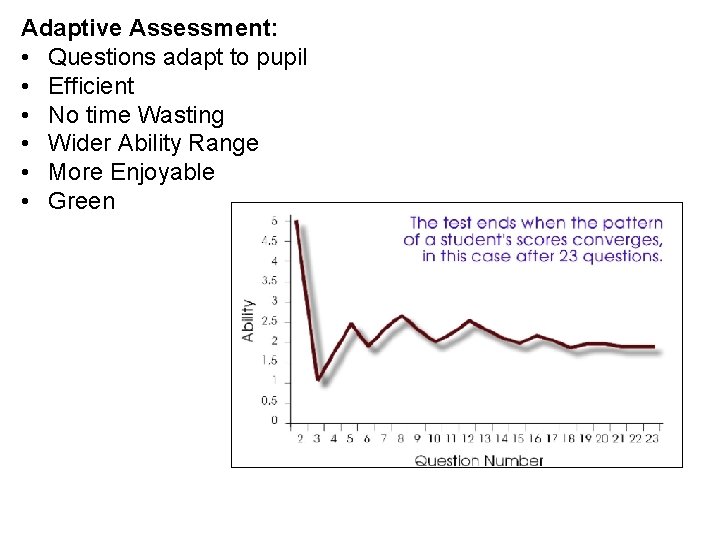
Computer Adaptive Testing • Adaptive test is based on growing bank of questions. • The adaptive nature of the test means that all pupils are challenged and receive a bespoke test suited to their ability. • Adaptive testing is considered the most efficient method of ascertaining a measure of pupils' abilities. • It offers pupils questions based on their answers to previous questions, and can therefore quickly focus in on each pupil's ability measure without requiring them to answer reams of unnecessary questions: questions that may be too easy or too hard.
Adaptive Assessment: The Systems - Computer Adaptive Assessment • Questions adapt to pupil • Efficient • No time Wasting • Wider Ability Range • More Enjoyable • Green
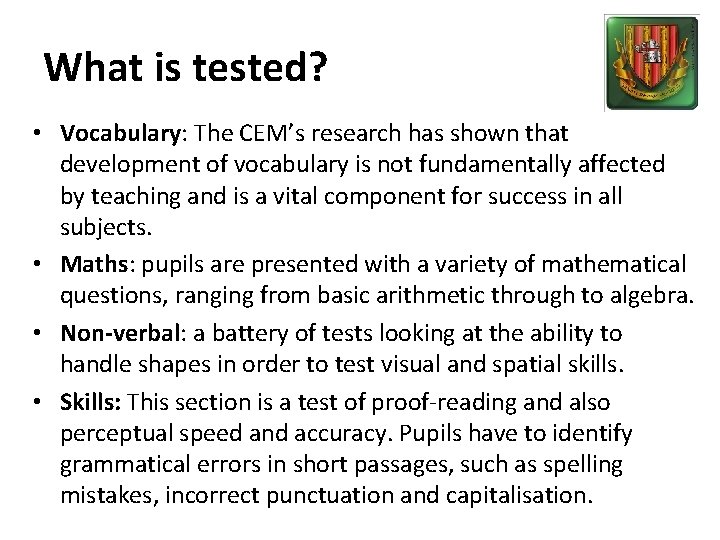
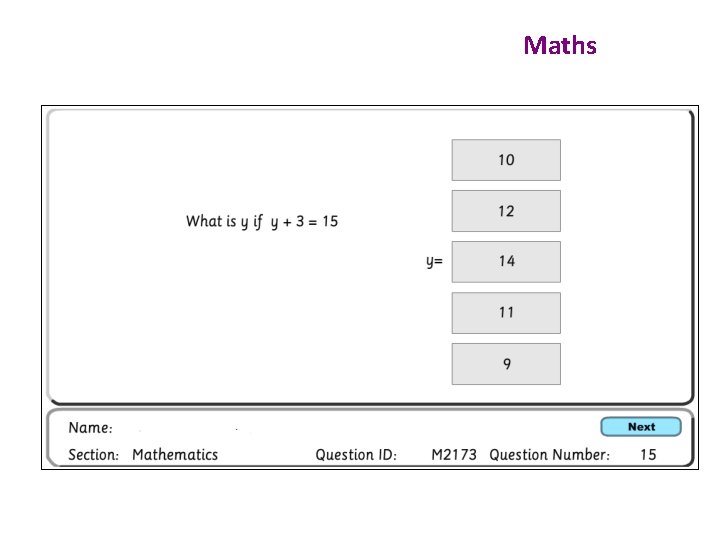
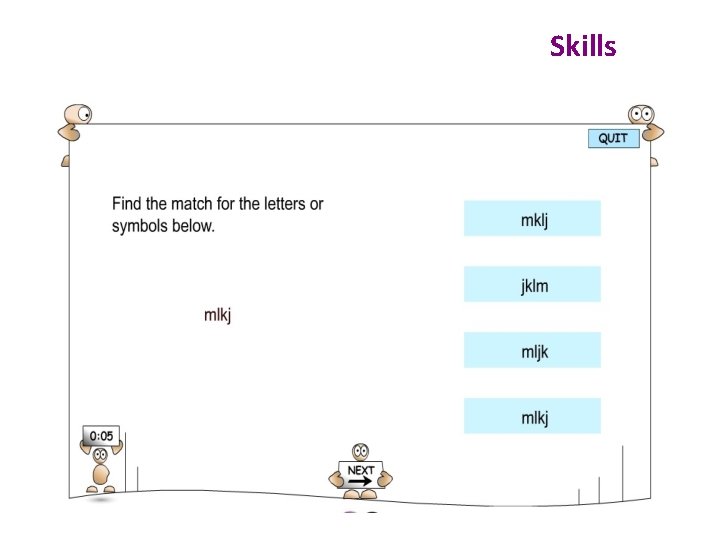
What is tested? • Vocabulary: The CEM’s research has shown that development of vocabulary is not fundamentally affected by teaching and is a vital component for success in all subjects. • Maths: pupils are presented with a variety of mathematical questions, ranging from basic arithmetic through to algebra. • Non-verbal: a battery of tests looking at the ability to handle shapes in order to test visual and spatial skills. • Skills: This section is a test of proof-reading and also perceptual speed and accuracy. Pupils have to identify grammatical errors in short passages, such as spelling mistakes, incorrect punctuation and capitalisation.
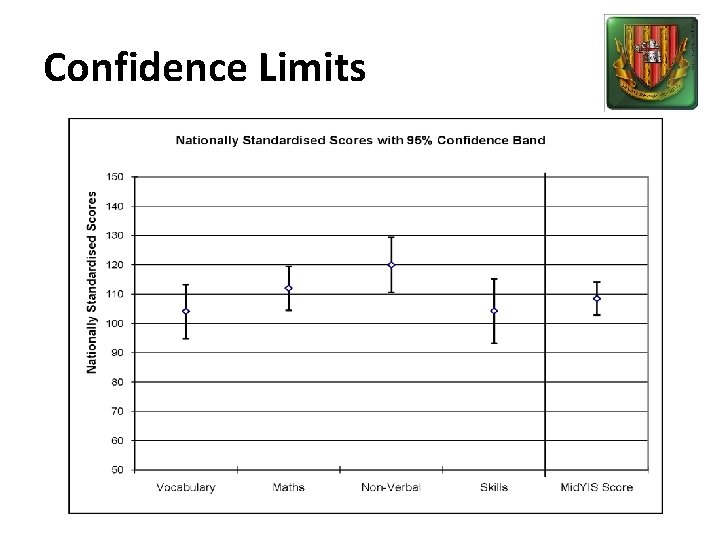
Standard Score • A pupil’s raw Mid. YIS scores are standardised against the results of everyone in the country taking part in the project to allow scores to be compared with different pupil groups or pupils in different schools. The scores can be summarised as follows: 76 -87 Well below the national average 88 -95 Below average 96 -105 Average 106 -112 Above Average 113 -124 Well above average ≥ 125 Far above average
Mid. YIS Band The score for each component and for the overall test is used to place pupils in a performance band. The scores for each band are as follows: • <90 Band D • 91 -99 Band C • 100 -109 Band B • ≥ 110 Band A
The diagram shows how the four ability bands and the nine stanines are mapped.
Confidence Limits
What is tested? • Vocabulary: The CEM’s research has shown that development of vocabulary is not fundamentally affected by teaching and is a vital component for success in all subjects. • Maths: pupils are presented with a variety of mathematical questions, ranging from basic arithmetic through to algebra. • Non-verbal: a battery of tests looking at the ability to handle shapes in order to test visual and spatial skills. • Skills: This section is a test of proof-reading and also perceptual speed and accuracy. Pupils have to identify grammatical errors in short passages, such as spelling mistakes, incorrect punctuation and capitalisation.
S 1/S 2 Baseline Assessment: Maths
S 1/S 2 Baseline Assessment: Vocabulary
S 1/S 2 Baseline Assessment: Non-verbal
S 1/S 2 Baseline Assessment: Skills
S 1/S 2 Baseline Assessment: Skills
Feedback • Feedback can be used at the pupil, class and cohort level - to guide individuals - to monitor pupil progress - to monitor subject-wide and faculty level progress • For classroom teachers, head teachers or SLT for a variety of purposes and approaches to tracking, monitoring, intervention and reporting
Further Information & Demo Test https: //www. intuproject. org/demos/CABTFamiliarisation