
The Microscopic Effect of Chemical Etching On Glass
- Slides: 1
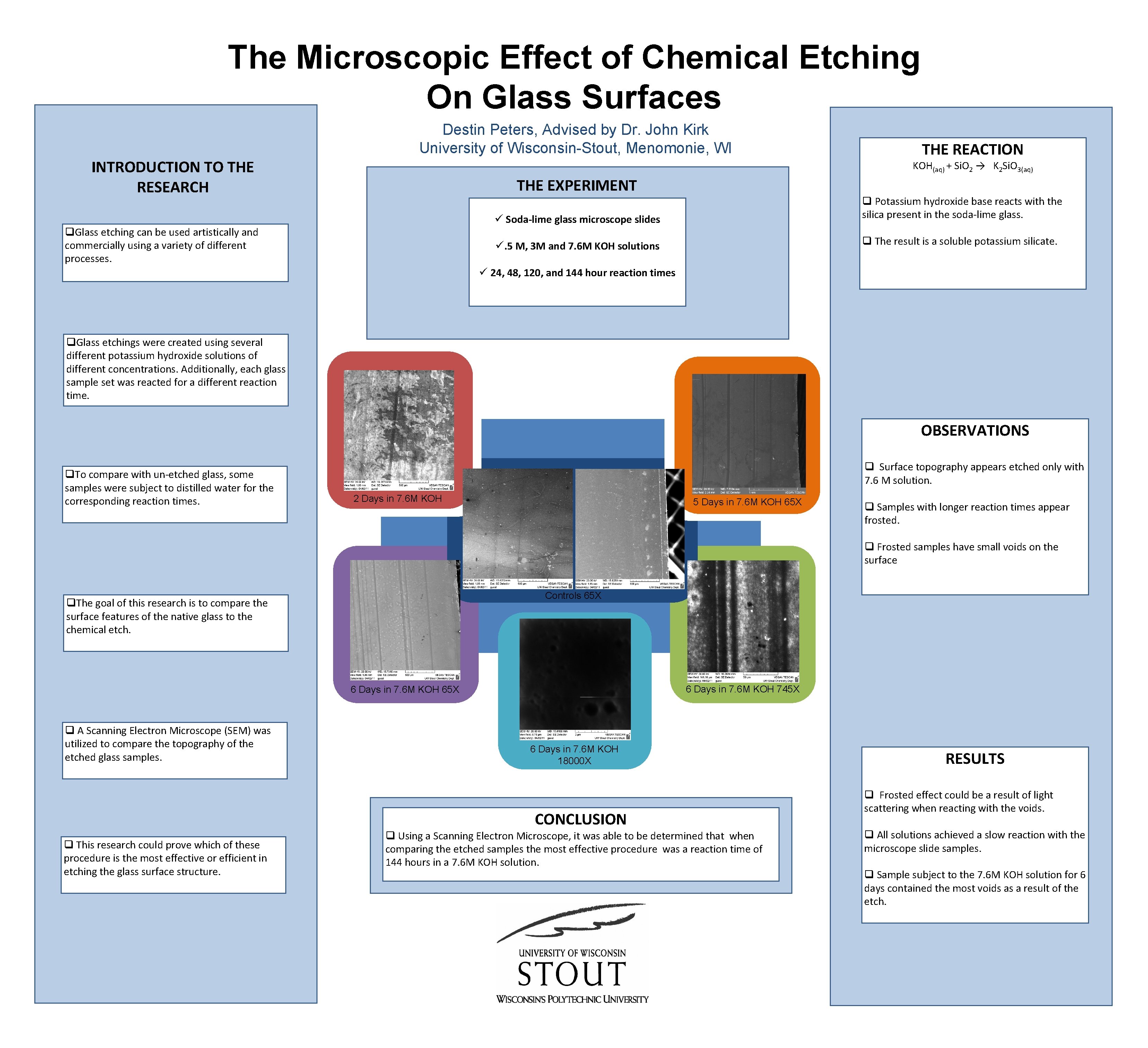
The Microscopic Effect of Chemical Etching On Glass Surfaces Destin Peters, Advised by Dr. John Kirk University of Wisconsin-Stout, Menomonie, WI INTRODUCTION TO THE RESEARCH THE REACTION KOH(aq) + Si. O 2 → K 2 Si. O 3(aq) THE EXPERIMENT q. Glass etching can be used artistically and commercially using a variety of different processes. ü Soda-lime glass microscope slides ü q Potassium hydroxide base reacts with the silica present in the soda-lime glass. ü ü. 5. 5 M, M, 3 M 3 M and 7. 6 M KOH Solutions solutions q The result is a soluble potassium silicate. ü 24, 48, 120, and 144 hour reaction times ü q. Glass etchings were created using several different potassium hydroxide solutions of different concentrations. Additionally, each glass sample set was reacted for a different reaction time. OBSERVATIONS q. To compare with un-etched glass, some samples were subject to distilled water for the corresponding reaction times. q Surface topography appears etched only with 7. 6 M solution. 2 Days in 7. 6 M KOH 5 Days in 7. 6 M KOH 65 X q Samples with longer reaction times appear frosted. q Frosted samples have small voids on the surface Controls 65 X q. The goal of this research is to compare the surface features of the native glass to the chemical etch. 6 Days in 7. 6 M KOH 745 X 6 Days in 7. 6 M KOH 65 X q A Scanning Electron Microscope (SEM) was utilized to compare the topography of the etched glass samples. 6 Days in 7. 6 M KOH 18000 X CONCLUSION q This research could prove which of these procedure is the most effective or efficient in etching the glass surface structure. q Using a Scanning Electron Microscope, it was able to be determined that when comparing the etched samples the most effective procedure was a reaction time of 144 hours in a 7. 6 M KOH solution. RESULTS q Frosted effect could be a result of light scattering when reacting with the voids. q All solutions achieved a slow reaction with the microscope slide samples. q Sample subject to the 7. 6 M KOH solution for 6 days contained the most voids as a result of the etch.