
The Micro skills of Compassion in Group work

- Slides: 52
The Micro skills of Compassion in Group work Dr Theo Gilbert, Learning and Teaching Innovation Centre, t. 1. gilbert@herts. ac. uk
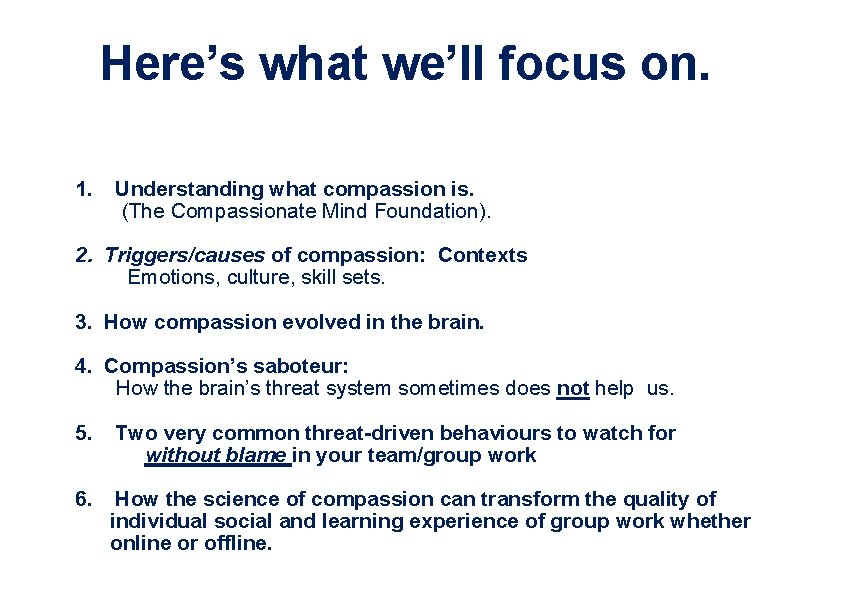
Here’s what we’ll focus on. 1. Understanding what compassion is. (The Compassionate Mind Foundation). 2. Triggers/causes of compassion: Contexts Emotions, culture, skill sets. 3. How compassion evolved in the brain. 4. Compassion’s saboteur: How the brain’s threat system sometimes does not help us. 5. Two very common threat-driven behaviours to watch for without blame in your team/group work 6. How the science of compassion can transform the quality of individual social and learning experience of group work whether online or offline.
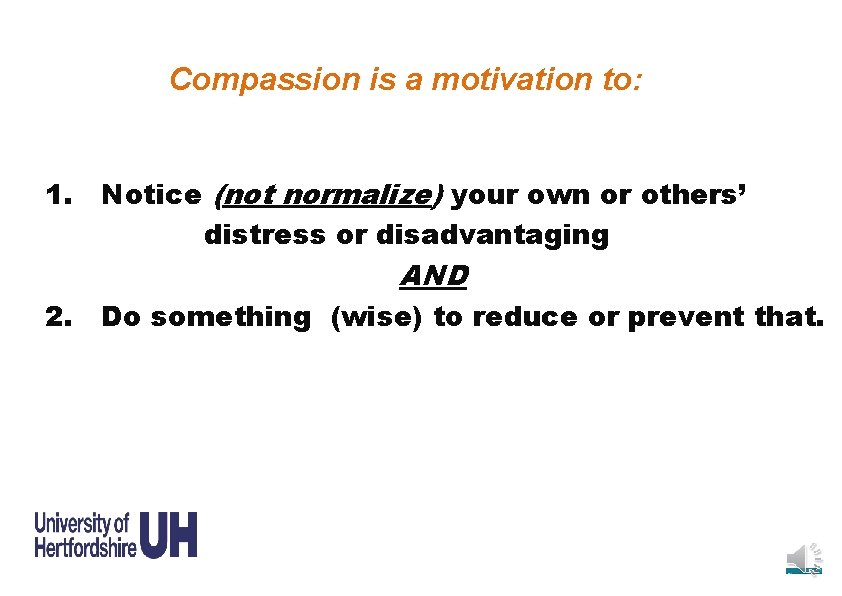
Compassion is a motivation to: 1. Notice (not normalize) your own or others’ distress or disadvantaging AND 2. Do something (wise) to reduce or prevent that.
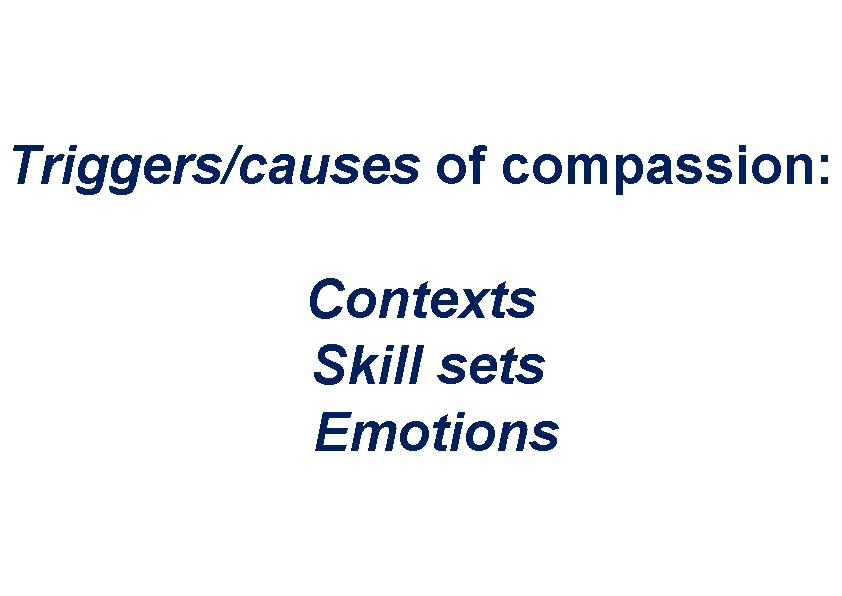
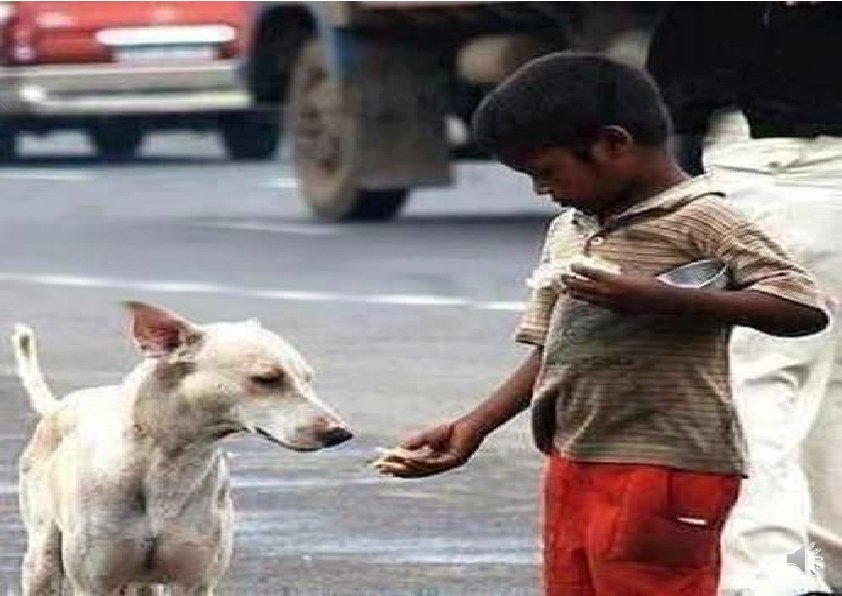
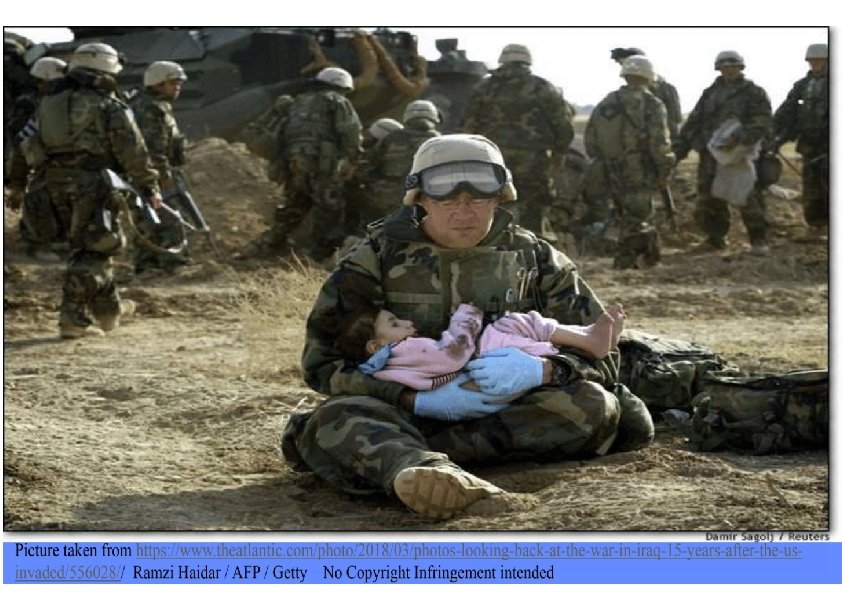
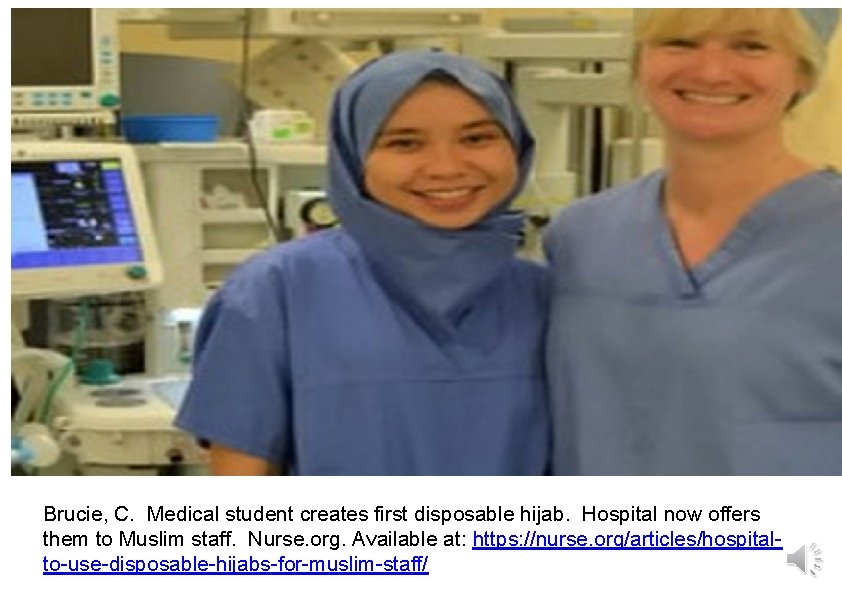
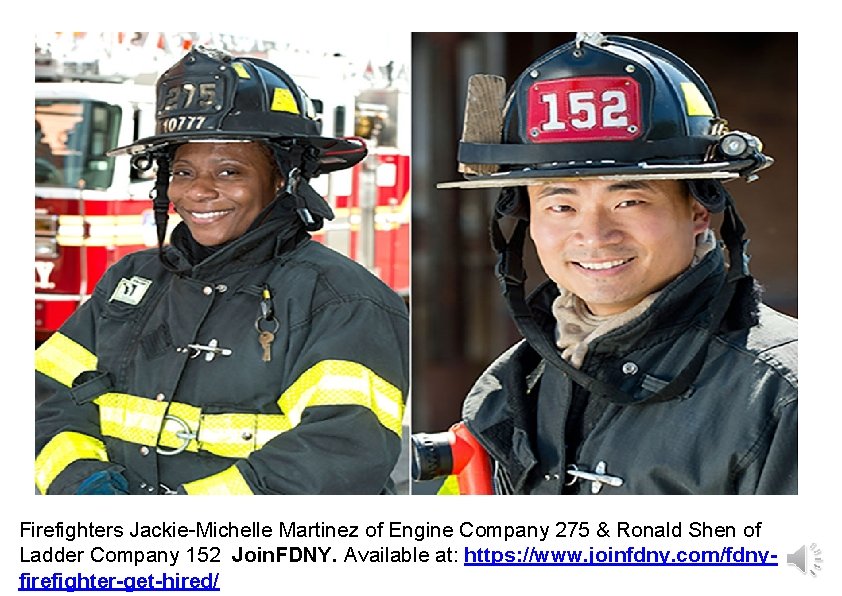
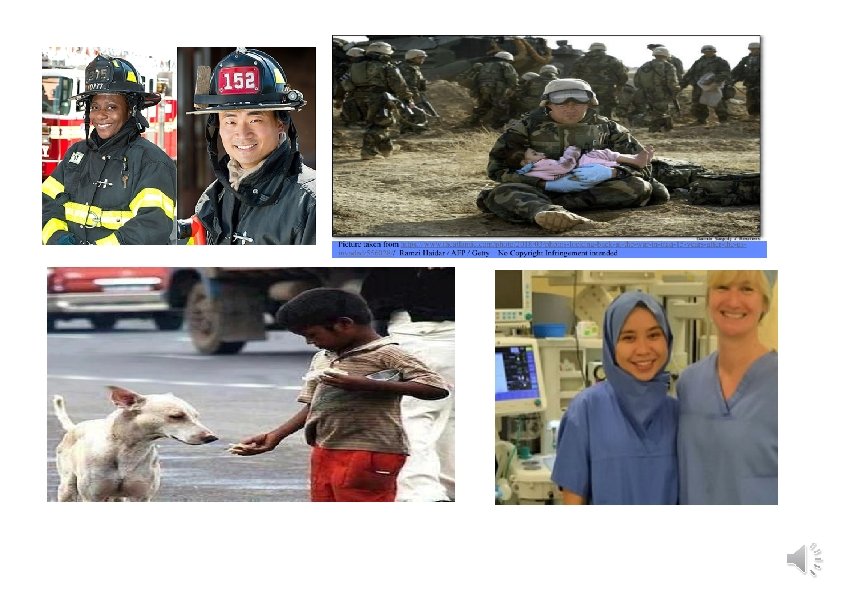
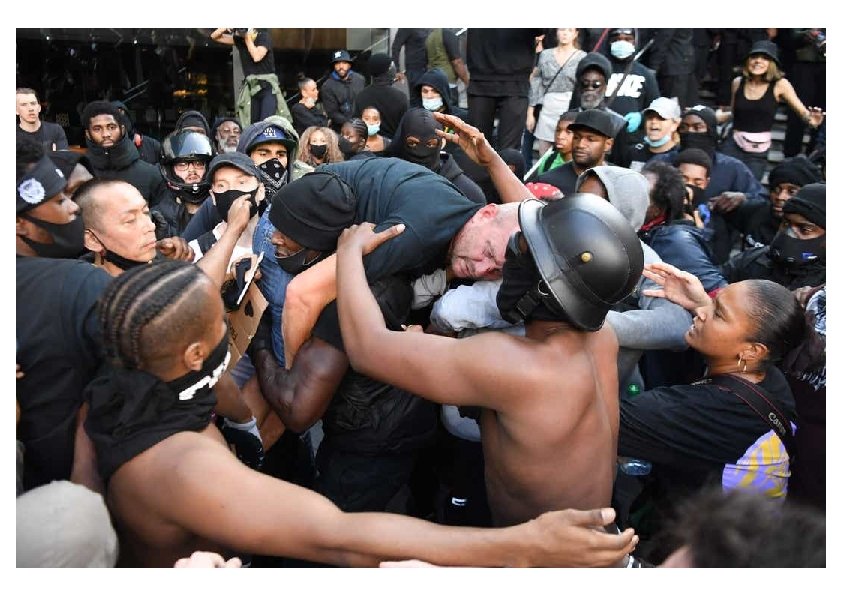
Triggers/causes of compassion: Contexts Skill sets Emotions
Brucie, C. Medical student creates first disposable hijab. Hospital now offers them to Muslim staff. Nurse. org. Available at: https: //nurse. org/articles/hospitalto-use-disposable-hijabs-for-muslim-staff/
Firefighters Jackie-Michelle Martinez of Engine Company 275 & Ronald Shen of Ladder Company 152 Join. FDNY. Available at: https: //www. joinfdny. com/fdnyfirefighter-get-hired/
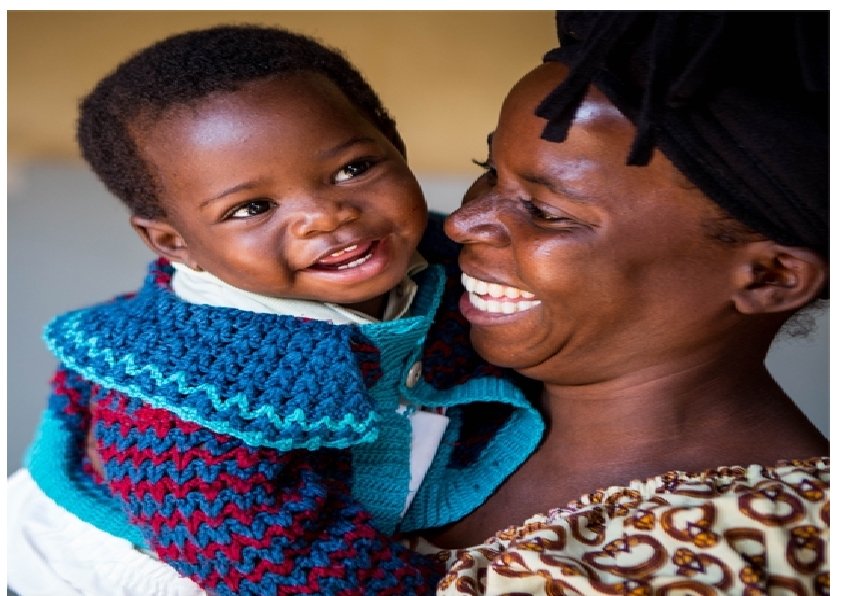
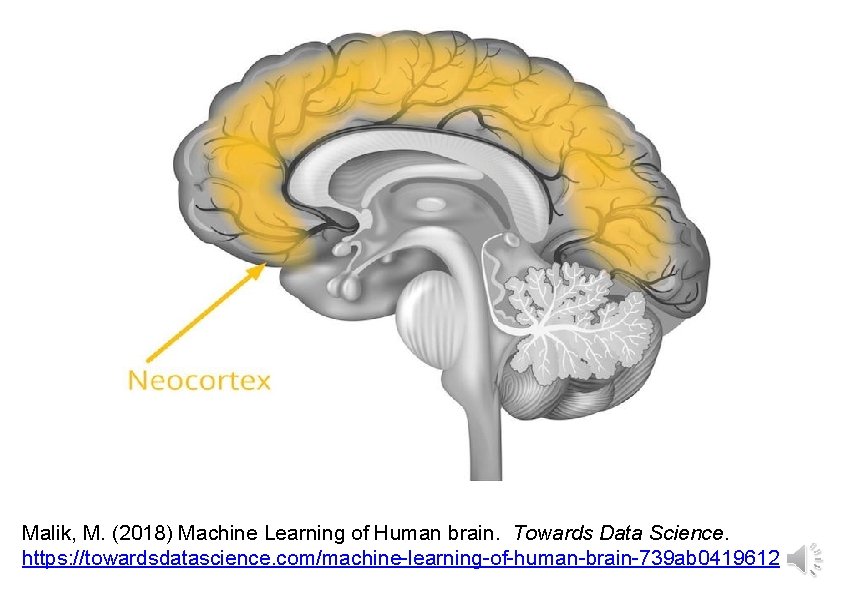
How did compassion evolve in the human brain?
Malik, M. (2018) Machine Learning of Human brain. Towards Data Science. https: //towardsdatascience. com/machine-learning-of-human-brain-739 ab 0419612
Altamira and Paleolithic Cave art of Northern Spain
The Brain’s Threat System Compassion’s saboteur: How the brain’s threat system can sometimes diminish us or even endanger our species instead of protect us.
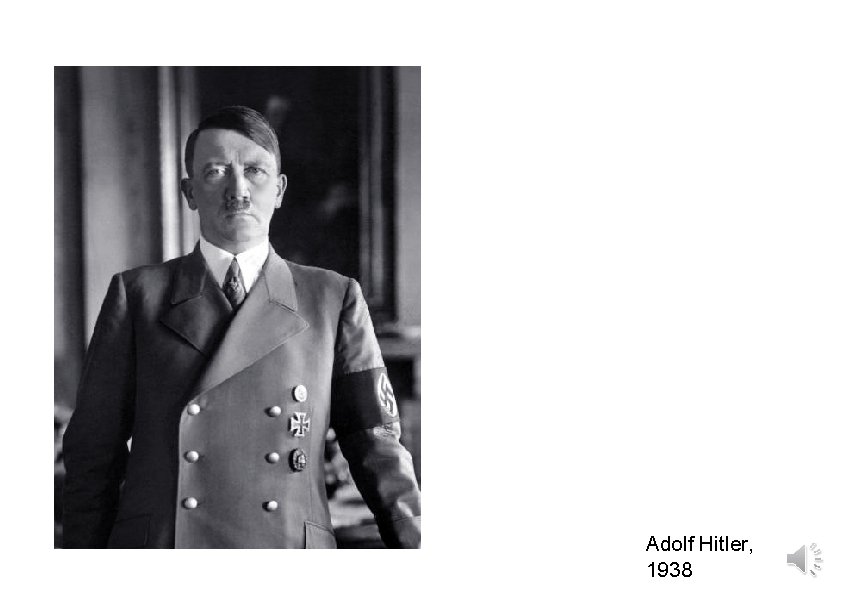
Adolf Hitler, 1938
National Union of Students’ (2009) explored why “Black students are less likely to be satisfied with their educational experience and to attain first-class degrees in comparison to their White peers” (p 4). A survey of 938 black students: “with 23 per cent describing it as ‘cliquey’… 17 per cent as ‘isolating’… 8 per cent as ‘hostile’… and respondents “often speaking of alienation and exclusion“ (p 5). “spawned from inside the classroom” “feeling left out of discussions and debates” (p 4)
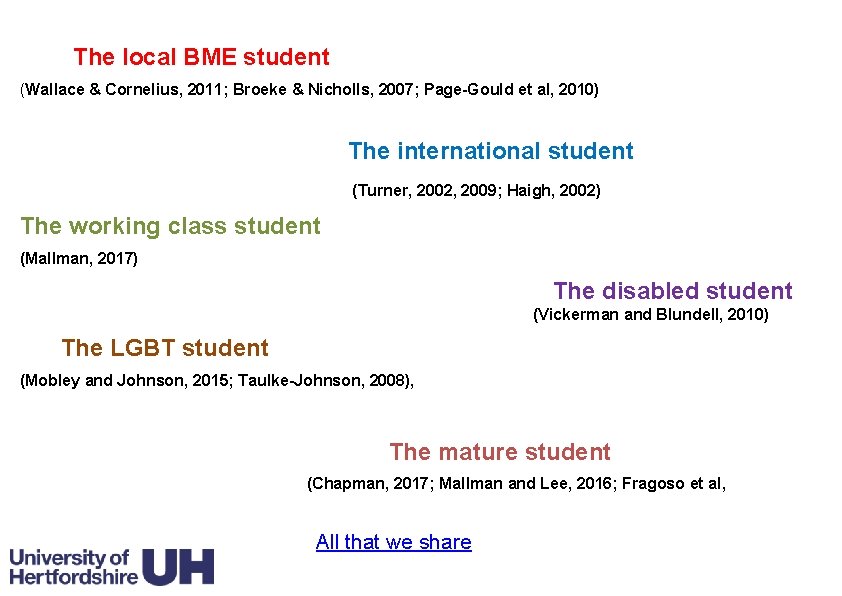
The local BME student (Wallace & Cornelius, 2011; Broeke & Nicholls, 2007; Page-Gould et al, 2010) The international student (Turner, 2002, 2009; Haigh, 2002) The working class student (Mallman, 2017) The disabled student (Vickerman and Blundell, 2010) The LGBT student (Mobley and Johnson, 2015; Taulke-Johnson, 2008), The mature student (Chapman, 2017; Mallman and Lee, 2016; Fragoso et al, All that we share
The Snowflake Generation ? Highest levels of HE student anxiety and depression in the UK (You. Gov, 2016) Highest numbers of student suicides (Office of National Statistics, 2017).
If compassion is not an emotion, what is it? Noticing distress or disadvantaging of oneself and/or others AND Doing something (smart) to reduce or prevent that.
Two Key questions to begin the module. 1. What do I do in this seminar/group work to develop my fellow students’ social and learning experiences that they most value in me? 2. What do my fellow students do in this seminar/group work to develop my social and learning experiences that I most value in them?
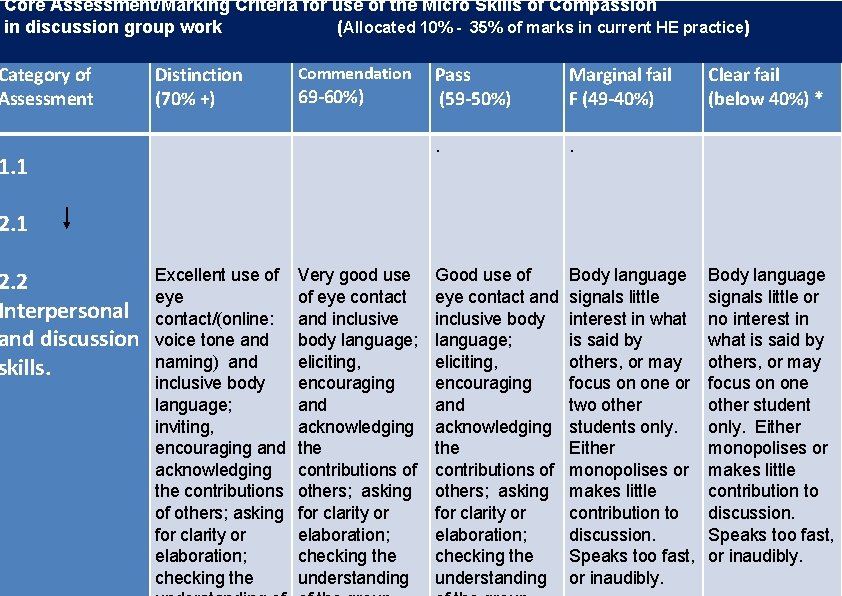
Core Assessment/Marking Criteria for use of the Micro Skills of Compassion in discussion group work ( Allocated 10% - 35% of marks in current HE practice) Category of Assessment Distinction (70% +) Commendation 69 -60%) Pass (59 -50%) Excellent use of eye contact/(online: voice tone and naming) and inclusive body language; inviting, encouraging and acknowledging the contributions of others; asking for clarity or elaboration; checking the Very good use of eye contact and inclusive body language; eliciting, encouraging and acknowledging the contributions of others; asking for clarity or elaboration; checking the understanding . . Good use of Body language eye contact and signals little inclusive body interest in what language; is said by eliciting, others, or may encouraging focus on one or and two other acknowledging students only. the Either contributions of monopolises or others; asking makes little for clarity or contribution to elaboration; discussion. checking the Speaks too fast, understanding or inaudibly. 1. 1 2. 1 2. 2 Interpersonal and discussion skills. Marginal fail F (49 -40%) Clear fail (below 40%) * Body language signals little or no interest in what is said by others, or may focus on one other student only. Either monopolises or makes little contribution to discussion. Speaks too fast, or inaudibly.
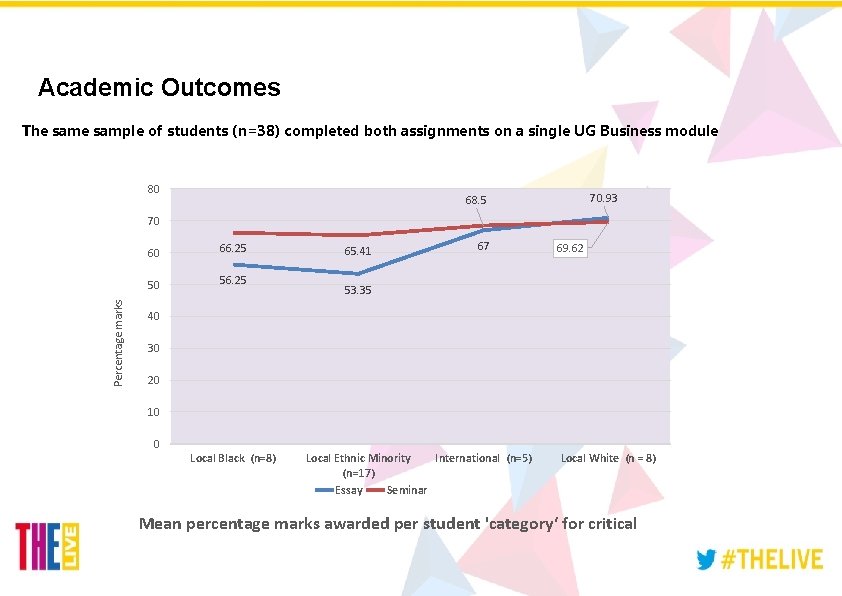
Academic Outcomes The sample of students (n=38) completed both assignments on a single UG Business module 80 70. 93 68. 5 Percentage marks 70 60 66. 25 50 56. 25 65. 41 67 69. 62 53. 35 40 30 20 10 0 Local Black (n=8) Local Ethnic Minority International (n=5) (n=17) Essay Seminar Local White (n = 8) Mean percentage marks awarded per student 'category‘ for critical thinking
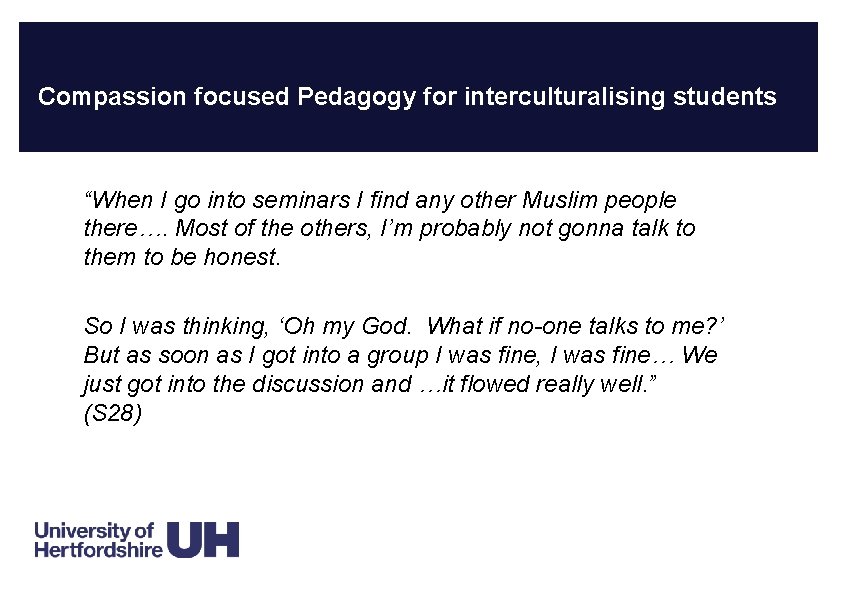
Compassion focused Pedagogy for interculturalising students “When I go into seminars I find any other Muslim people there…. Most of the others, I’m probably not gonna talk to them to be honest. So I was thinking, ‘Oh my God. What if no-one talks to me? ’ But as soon as I got into a group I was fine, I was fine… We just got into the discussion and …it flowed really well. ” (S 28)
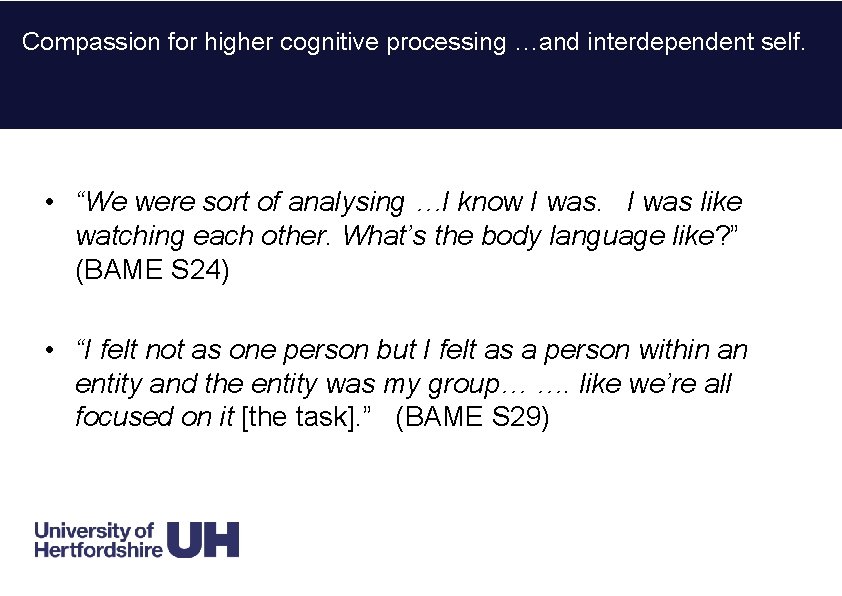
Compassion for higher cognitive processing …and interdependent self. • “We were sort of analysing …I know I was like watching each other. What’s the body language like? ” (BAME S 24) • “I felt not as one person but I felt as a person within an entity and the entity was my group… …. like we’re all focused on it [the task]. ” (BAME S 29)
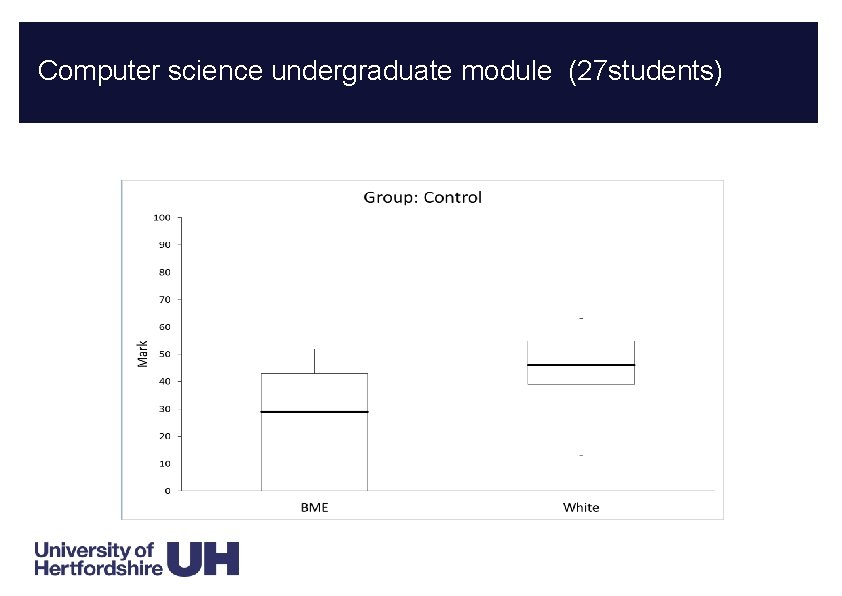
Computer science undergraduate module (27 students)
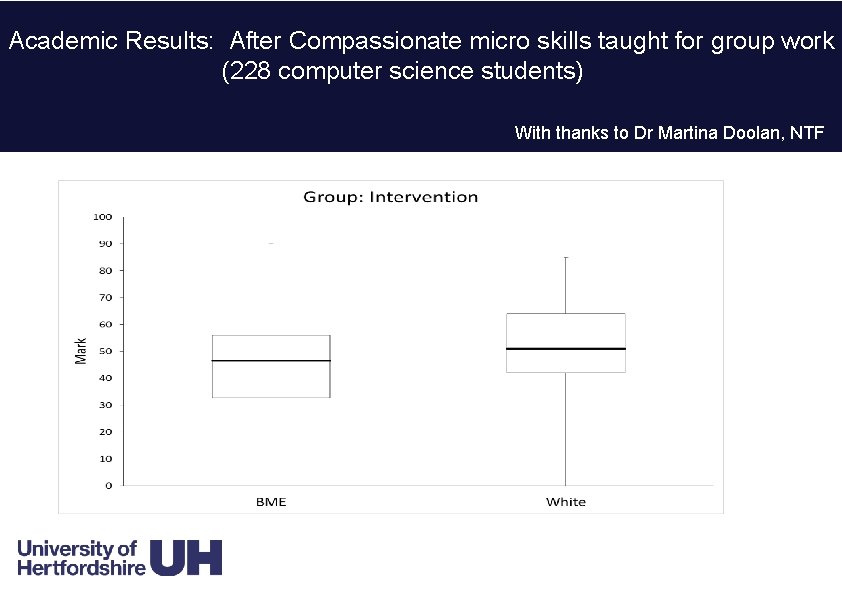
Academic Results: After Compassionate micro skills taught for group work (228 computer science students) With thanks to Dr Martina Doolan, NTF
Impact of Compassion focused Pedagogy on student outcomes • “…on their piece of work, I would listen to how they achieved this… how valued their input is. I also made sure I was showing gratitude. ” (S 185) • “…. during discussions I always made sure to leave spaces for other people. ” (S 100) • “I was worried being the oldest person and the only non-native English person… …. having ten years of working experience with people from different cultures and backgrounds, I never found it as smooth as this time. Outside of university, we’re still hanging out together. ” (S 110)
‘I’m convinced that it’s compassion …I'm closer to this group of students than to any group I've taught in years. Many of my students are saying it’s the most exciting learning experience they’ve had at university. They didn't know, they said, that learning could be like this…This is life -changing work. ’ Prof Karen Edwards, University of Exeter
‘The feedback from this session was absolutely phenomenal. I had about 30 emails from students saying how much it had affected them; how much they were more compassionate to each other. ’ Debbie Sharp, Midwifery, University of Hertfordshire ‘I showed my Business PG students the compassionate micro skills to use in their group work. They were so grateful I could have cried. ’ Norton Bertram-Smith, University of Aberdeen
The Micro skills of Compassion in Group work Taught & Credit-bearing on Degree Programmes https: //compassioninhe. wordpress. com/ Theo Gilbert t. 1. gilbert@herts. ac. uk •
https: //compassioninhe. wordpress. com You can join and link up to support from your colleagues in, so far, 60 universities through the list serve in the link above.
Compassionate Pedagogy in Virtual Reality Dr Theo Gilbert Associate Professor, Learning and Teaching School of Humanities t. 1. gilbert@herts. ac. uk Skype: theogilbert 58 Phone: 07890 296148 Andrew Marunchak Senior E-Learning Technology Developer Learning and Teaching Innovation Centre a. marunchak@herts. ac. uk
• The following slides offer some revision of the key practical strategies for enhancing the social and learning quality of student - and staff/workplace - meetings or team work.
Three kinds of eye contact in face to face group discussion
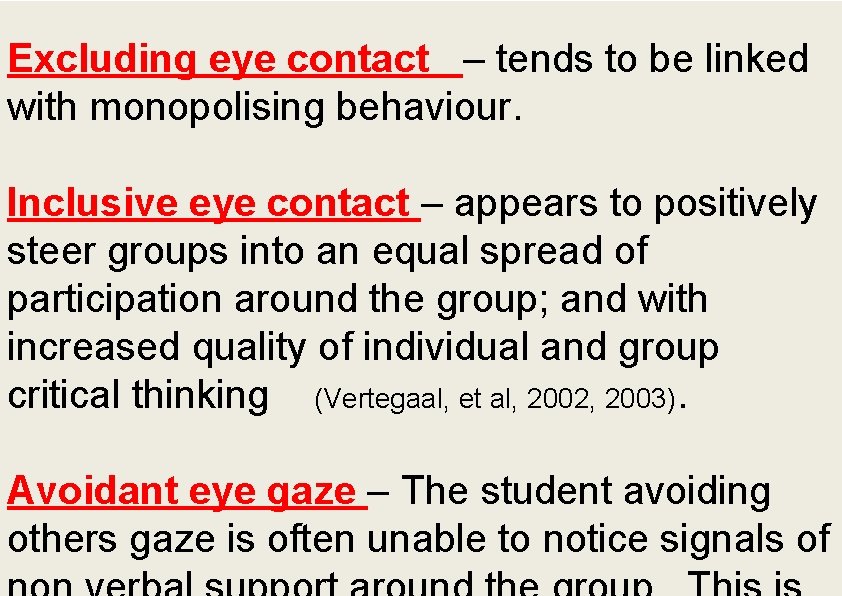
Excluding eye contact – tends to be linked with monopolising behaviour. Inclusive eye contact – appears to positively steer groups into an equal spread of participation around the group; and with increased quality of individual and group critical thinking (Vertegaal, et al, 2002, 2003). Avoidant eye gaze – The student avoiding others gaze is often unable to notice signals of
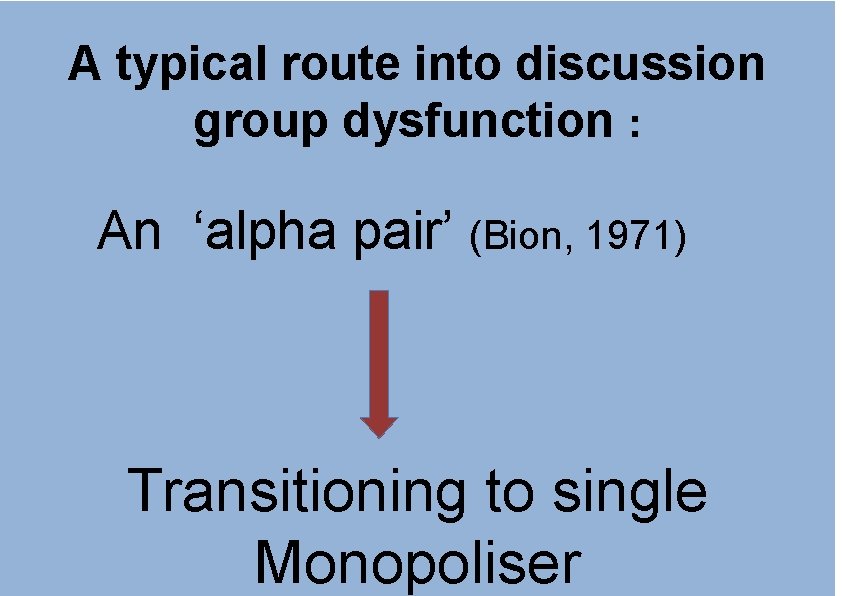
A typical route into discussion group dysfunction : An ‘alpha pair’ (Bion, 1971) Transitioning to single Monopoliser
What can students do about those who are too shy to speak?
Suggestions for students: • You could invite them by name into the discussion – ask for their opinions. “What do you think, Sara? ” • When they are pushed out of the discussion by confident speakers who like to talk over others, find another chance to invite the shyer ones back in later. • Tell them that when they speak, if they suddenly are shy and have no more to say, they can ‘pass the hot potato’. That is, they can quickly say to any other student “So what do you think, Steve? ”
S 13: And …. you realise, "Well no, we’re also responsible for making sure other people have things to say and want to talk. " S 13 PG female, second year/run of stage three, focus group transcript, p 9, lines 294297
What can you and your student colleagues do – on the spot – about students who have not read/not prepared for seminars or tutorials?
Tips for students: You are on your table with people you don’t know again this week. So…. Think of being at Wimbledon for your inclusive eye contact – as though you were speaking to a single organism, not three separate people.
An possible overview for teaching staff:
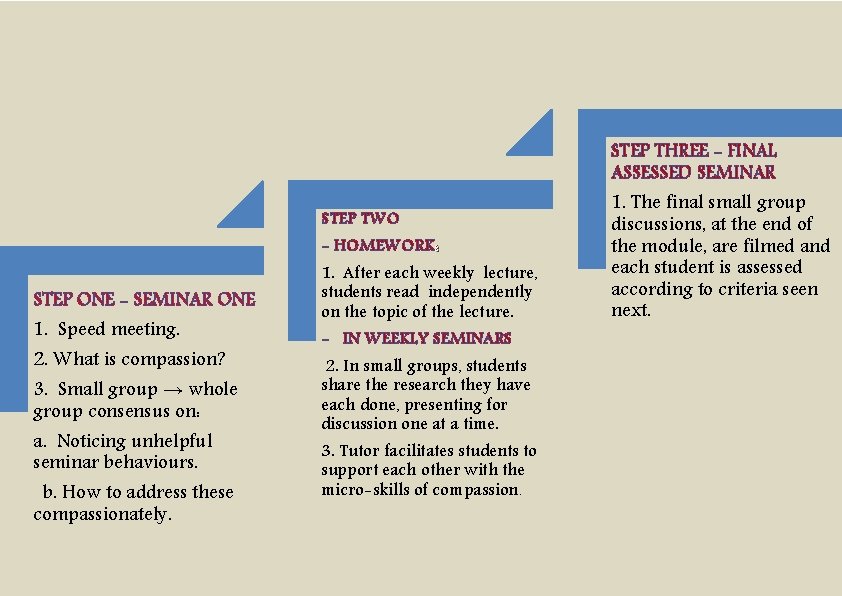
STEP TWO STEP ONE - SEMINAR ONE 1. Speed meeting. 2. What is compassion? 3. Small group → whole group consensus on: a. Noticing unhelpful seminar behaviours. b. How to address these compassionately. - HOMEWORK: 1. After each weekly lecture, students read independently on the topic of the lecture. - IN WEEKLY SEMINARS 2. In small groups, students share the research they have each done, presenting for discussion one at a time. 3. Tutor facilitates students to support each other with the micro-skills of compassion. STEP THREE - FINAL ASSESSED SEMINAR 1. The final small group discussions, at the end of the module, are filmed and each student is assessed according to criteria seen next.
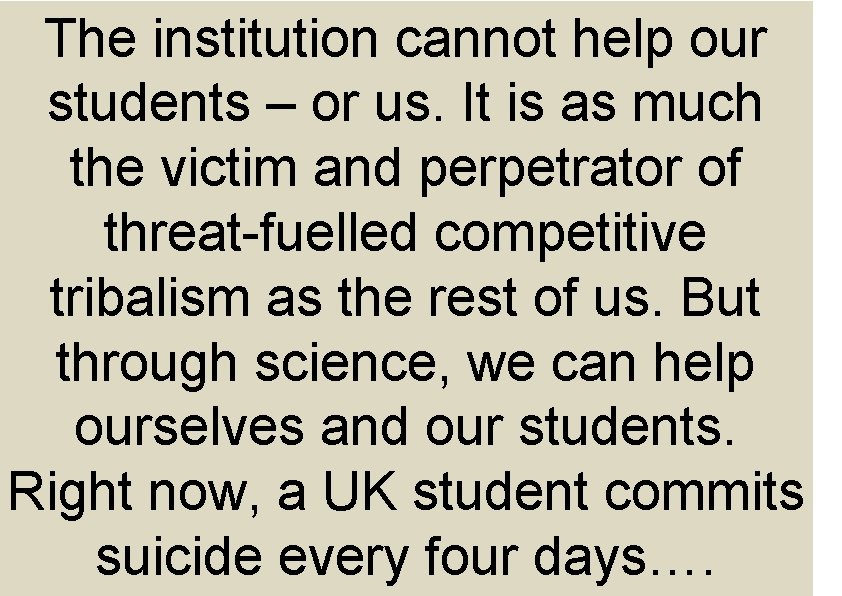
The institution cannot help our students – or us. It is as much the victim and perpetrator of threat-fuelled competitive tribalism as the rest of us. But through science, we can help ourselves and our students. Right now, a UK student commits suicide every four days….
looks like in a UK university. In P. Gibbs (Ed. ) The Pedagogy of Compassion at the Heart of Higher Education. Springer: London. Chapter 13, pp 189 -202. UH Heritage Hub. Dr Theo Gilbert’s Blog: My Research. Available at: http: //www. herts. ac. uk/heritagehub/heritage-and-historyprojects/creative-arts-andliterature/sparks-might-fly-theatrecommission/dr-theo-gilbert Doolan, M. & Gilbert, T. (2016) Student Choice: Blends of technology beyond the
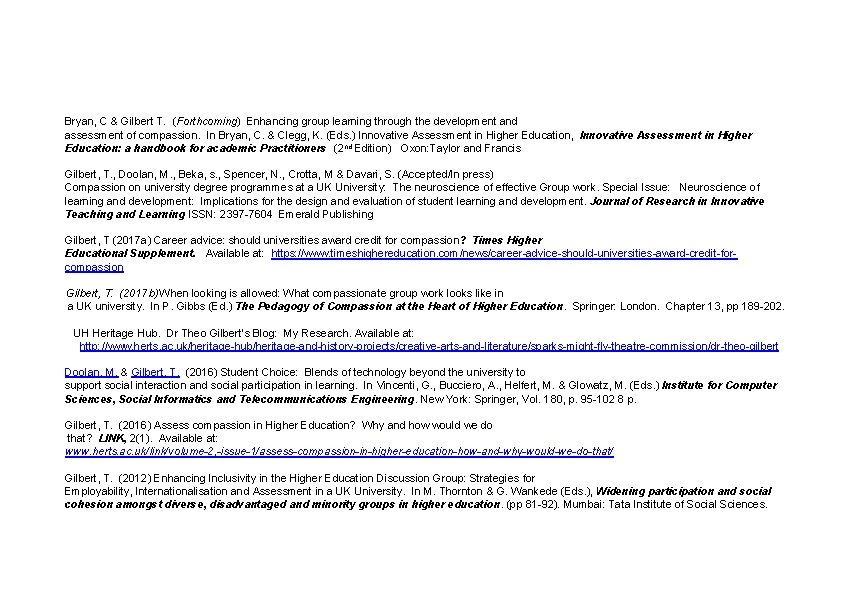
Bryan, C & Gilbert T. (Forthcoming) Enhancing group learning through the development and assessment of compassion. In Bryan, C. & Clegg, K. (Eds. ) Innovative Assessment in Higher Education, Innovative Assessment in Higher Education: a handbook for academic Practitioners (2 nd Edition) Oxon: Taylor and Francis Gilbert, T. , Doolan, M. , Beka, s. , Spencer, N. , Crotta, M & Davari, S. (Accepted/In press) Compassion on university degree programmes at a UK University: The neuroscience of effective Group work. Special Issue: Neuroscience of learning and development: Implications for the design and evaluation of student learning and development. Journal of Research in Innovative Teaching and Learning ISSN: 2397 -7604 Emerald Publishing Gilbert, T (2017 a) Career advice: should universities award credit for compassion? Times Higher Educational Supplement. Available at: https: //www. timeshighereducation. com/news/career-advice-should-universities-award-credit-forcompassion Gilbert, T. (2017 b) When looking is allowed: What compassionate group work looks like in a UK university. In P. Gibbs (Ed. ) The Pedagogy of Compassion at the Heart of Higher Education. Springer: London. Chapter 13, pp 189 -202. UH Heritage Hub. Dr Theo Gilbert’s Blog: My Research. Available at: http: //www. herts. ac. uk/heritage-hub/heritage-and-history-projects/creative-arts-and-literature/sparks-might-fly-theatre-commission/dr-theo-gilbert Doolan, M. & Gilbert, T. (2016) Student Choice: Blends of technology beyond the university to support social interaction and social participation in learning. In Vincenti, G. , Bucciero, A. , Helfert, M. & Glowatz, M. (Eds. ) Institute for Computer Sciences, Social Informatics and Telecommunications Engineering. New York: Springer, Vol. 180, p. 95 -102 8 p. Gilbert, T. (2016) Assess compassion in Higher Education? Why and how would we do that? LINK, 2(1). Available at: www. herts. ac. uk/link/volume-2, -issue-1/assess-compassion-in-higher-education-how-and-why-would-we-do-that/ Gilbert, T. (2012) Enhancing Inclusivity in the Higher Education Discussion Group: Strategies for Employability, Internationalisation and Assessment in a UK University. In M. Thornton & G. Wankede (Eds. ), Widening participation and social cohesion amongst diverse, disadvantaged and minority groups in higher education. (pp 81 -92). Mumbai: Tata Institute of Social Sciences.