
the MICE experiment Muon Ionization Cooling Experiment A
- Slides: 1
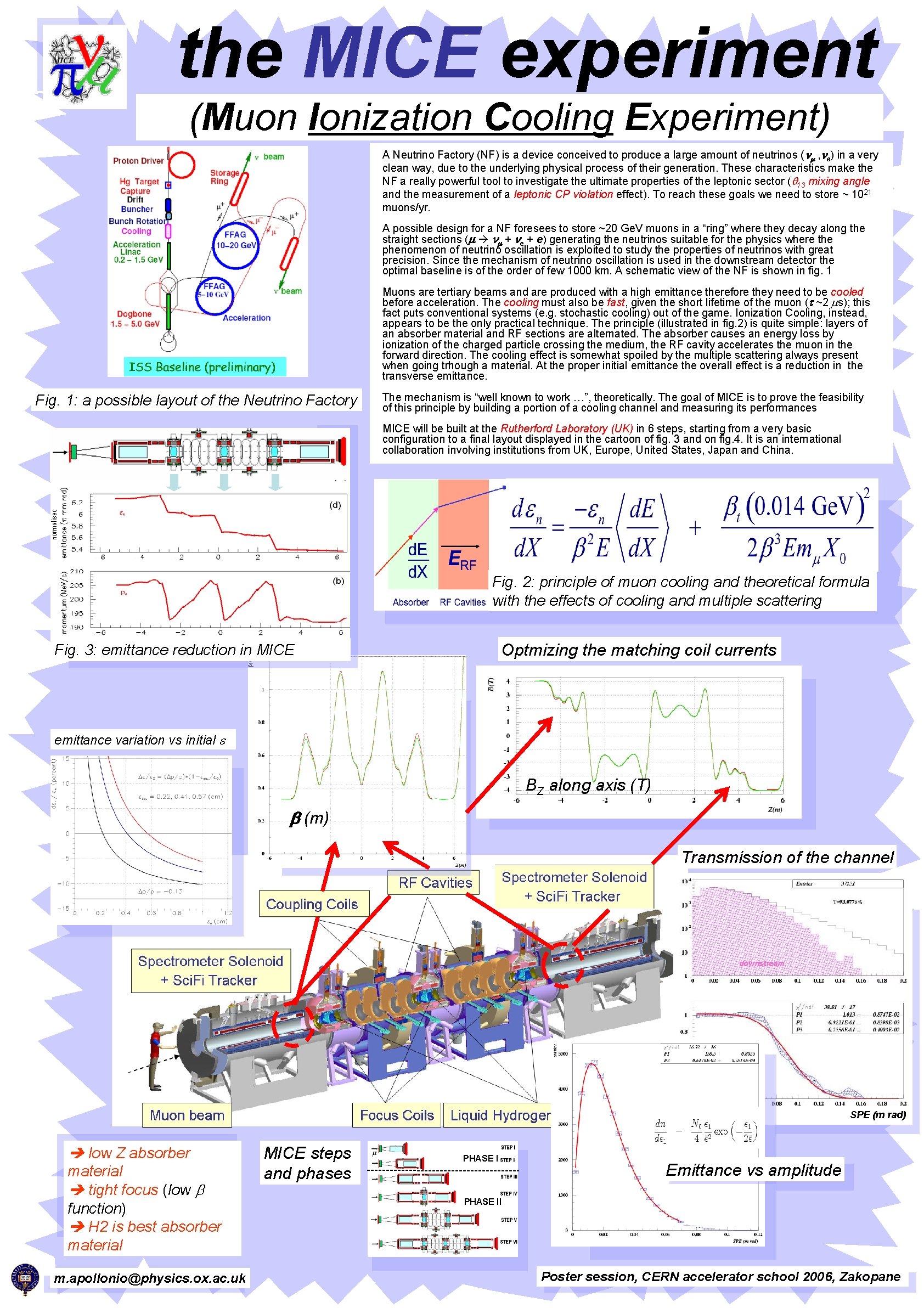
the MICE experiment (Muon Ionization Cooling Experiment) A Neutrino Factory (NF) is a device conceived to produce a large amount of neutrinos (nm , ne) in a very clean way, due to the underlying physical process of their generation. These characteristics make the NF a really powerful tool to investigate the ultimate properties of the leptonic sector (q 13 mixing angle and the measurement of a leptonic CP violation effect). To reach these goals we need to store ~ 1021 muons/yr. A possible design for a NF foresees to store ~20 Ge. V muons in a “ring” where they decay along the straight sections (m nm + ne + e) generating the neutrinos suitable for the physics where the phenomenon of neutrino oscillation is exploited to study the properties of neutrinos with great precision. Since the mechanism of neutrino oscillation is used in the downstream detector the optimal baseline is of the order of few 1000 km. A schematic view of the NF is shown in fig. 1 Muons are tertiary beams and are produced with a high emittance therefore they need to be cooled before acceleration. The cooling must also be fast, given the short lifetime of the muon (t ~2 ms); this fact puts conventional systems (e. g. stochastic cooling) out of the game. Ionization Cooling, instead, appears to be the only practical technique. The principle (illustrated in fig. 2) is quite simple: layers of an absorber material and RF sections are alternated. The absorber causes an energy loss by ionization of the charged particle crossing the medium, the RF cavity accelerates the muon in the forward direction. The cooling effect is somewhat spoiled by the multiple scattering always present when going trhough a material. At the proper initial emittance the overall effect is a reduction in the transverse emittance. Fig. 1: a possible layout of the Neutrino Factory The mechanism is “well known to work …”, theoretically. The goal of MICE is to prove the feasibility of this principle by building a portion of a cooling channel and measuring its performances MICE will be built at the Rutherford Laboratory (UK) in 6 steps, starting from a very basic configuration to a final layout displayed in the cartoon of fig. 3 and on fig. 4. It is an international collaboration involving institutions from UK, Europe, United States, Japan and China. Fig. 2: principle of muon cooling and theoretical formula with the effects of cooling and multiple scattering Optmizing the matching coil currents Fig. 3: emittance reduction in MICE emittance variation vs initial e BZ along axis (T) b (m) Transmission of the channel downstream SPE (m rad) low Z absorber material tight focus (low b function) H 2 is best absorber material m. apollonio@physics. ox. ac. uk MICE steps and phases PHASE I Emittance vs amplitude PHASE II Poster session, CERN accelerator school 2006, Zakopane