
The MGSS Technical Seminar No 4 IS SINGAPORE

- Slides: 54
The MGSS Technical Seminar No. 4 IS SINGAPORE SAFE FROM EARTHQUAKES IN SUMATRA, INDONESIA? A geotechnical investigative approach of potential effects on foundation in reclaimed areas By Dr Win Naing 28 August 2011
Geotectonic setting of Singapore assures that Singapore is situated in aseismic zone. It is located behind the back arc basin of the Sunda Mega Thrust (subduction zone) and on the continent, the Malay Peninsula. Therefore, it is safe in terms of earthquake hazards. However, whenever there was a big earthquake (Mw ≥ 8. 0) occurred either along the Sunda Mega Thrust or along Sunda Right-lateral Strike Slip Fault tremors could be felt in Singapore. People are concerned of the safety while residing in tall buildings. The MGSS Technical Seminar 4: WN 2011 2
Shakes due to earthquakes do not have destructive effects in hard rocks but it does in soft rocks and particularly in unconsolidated sediments which has low shear wave velocities. Therefore, there is a geotechnical concern that sand fills in reclaimed areas might be susceptible to earthquake shear waves. In Singapore reclaimed land forms extensive unconfined aquifers. Sand layers of varying thickness from 12 to 18 m are fully saturated and thus favouring liquefaction in foundation during the time of earthquakes. The MGSS Technical Seminar 4: WN 2011 3
CONCERN On December 4, 2010 The Straits Times senior correspondent Christopher Tan reported that “Just how vulnerable buildings in Singapore will be to tremors from major earthquakes in the region is still being investigated”. It was also reported that following the massive quakes that devastated nearby Sumatra in 2004, 2005 and 2007 two studies were commissioned two years ago. The MGSS Technical Seminar 4: WN 2011 4
One study is by the Building and Construction Authority (BCA). Nanyang Technological University (NTU) was commissioned to conduct an “earthquake vulnerability” study. This study may take another year to complete (The Straits Times, page B 6, December 4, 2010). The Housing Board (HDB) engaged the National University of Singapore (NUS) to develop “cost-effective monitoring sensors” to be mounted on HDB blocks. The sensors will enable inspections in the event of tremors but not to assess the vulnerability of buildings to tremor. The MGSS Technical Seminar 4: WN 2011 5
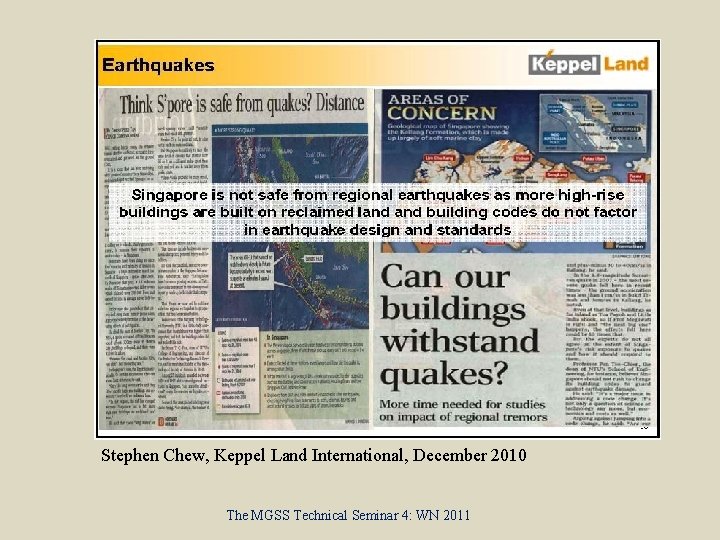
Stephen Chew, Keppel Land International, December 2010 The MGSS Technical Seminar 4: WN 2011
THE QUESTION “Whether Singapore’s construction codes may need to include provisions for tremors”. Such consideration had never occurred before since Singapore was long earthquake free. According to the Straits Times, Professor Koh Chan Ghee, NUS Centre for Hazards Research, told that “it is not uncommon for building codes to be revised, if necessary, given that a big earthquake is a low-probability but high-consequence event”. The MGSS Technical Seminar 4: WN 2011 7
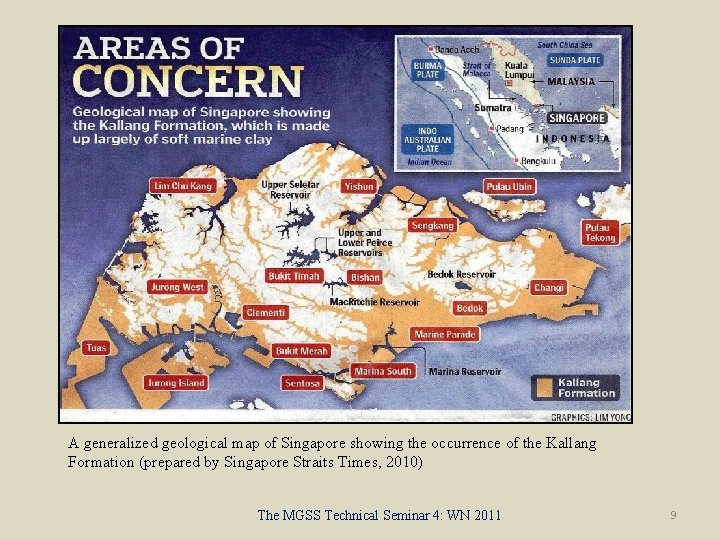
AREAS OF CONCERN Assistant Professor Kusnowidjaja Megawati of EOS said that “the real worry for Singapore is for buildings which stand on marine clay and some reclaimed land. These soil types tend to amplify lowfrequency vibrations from earthquakes hundreds of kilometers away”. Such soft soils form about a quarter of Singapore’s land particularly in the southeast. The MGSS Technical Seminar 4: WN 2011 8
A generalized geological map of Singapore showing the occurrence of the Kallang Formation (prepared by Singapore Straits Times, 2010) The MGSS Technical Seminar 4: WN 2011 9
Professor Megawati noted that in the 8. 4 magnitude Sumatran earthquake in 2007 the ground acceleration was 3. 0 cm/s 2 (0. 003 g) in Kallang (soft soil) and less than 1. 0 cm/s 2 (0. 001 g) in Bukit Timah (hard rock). It was also noted that buildings as far inland as Toa Payoh and Little India shook. Thus, effect could be much higher for “the next big one”. Recent simulations have shown that an 8. 8 -magnitude in Sumatra would create “ground acceleration of 10 cm/s 2 in Bukit Timah (hard rock) and 30 to 40 cm/s 2 in the Kallang Formation”. However, more study is required to agree on the extent of Singapore’s risk exposure to earthquakes in Sumatra. The MGSS Technical Seminar 4: WN 2011 10
RECENT EARTHQUAKES IN SUMATRA Sumatra is the regional hotspot of Southeast Asia. In 2004, Mw 9. 0 earthquake located in the Indian Ocean off the west coast of Sumatra triggered “the killer tsunami” that killed 180, 000 in Aceh. It was one of the deadliest natural disasters in recorded history. Indonesia was hardest hit followed by Sri Lanka, India and Thailand. In March 2005, northern part of Sumatra was hit by Mw 8. 7 earthquake killing 1300 people on the island of Nias. In September 2006, West Java was hit by Mw 6. 8 earthquake creating tsunami to kill 660 people. In September 2009, Padang was struck by Mw 7. 6 earthquake killing 1100 people. In 2010, Mw 7. 5 earthquake was the cause of 4 -m high tsunami that swept away homes in the Metawai Islands, off West Sumatra province. About 460 people were killed. The MGSS Technical Seminar 4: WN 2011 11
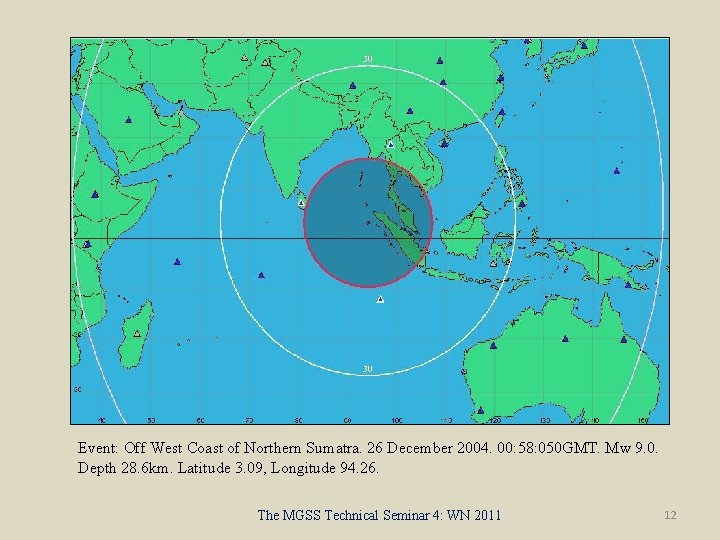
Event: Off West Coast of Northern Sumatra. 26 December 2004. 00: 58: 050 GMT. Mw 9. 0. Depth 28. 6 km. Latitude 3. 09, Longitude 94. 26. The MGSS Technical Seminar 4: WN 2011 12
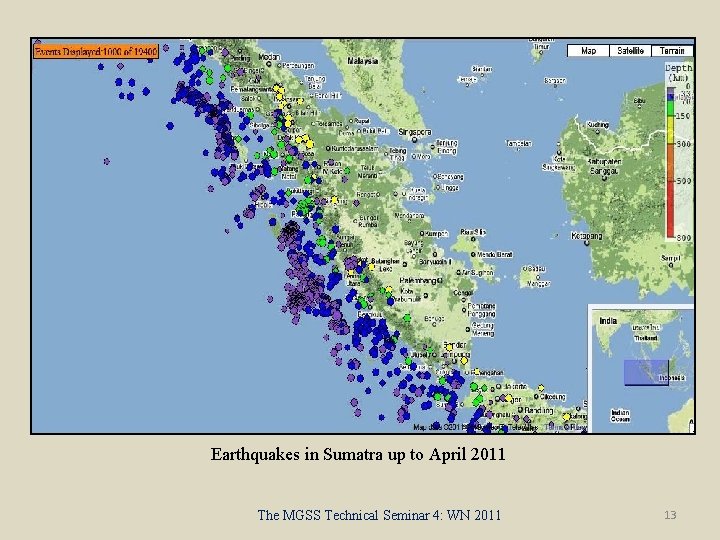
Earthquakes in Sumatra up to April 2011 The MGSS Technical Seminar 4: WN 2011 13
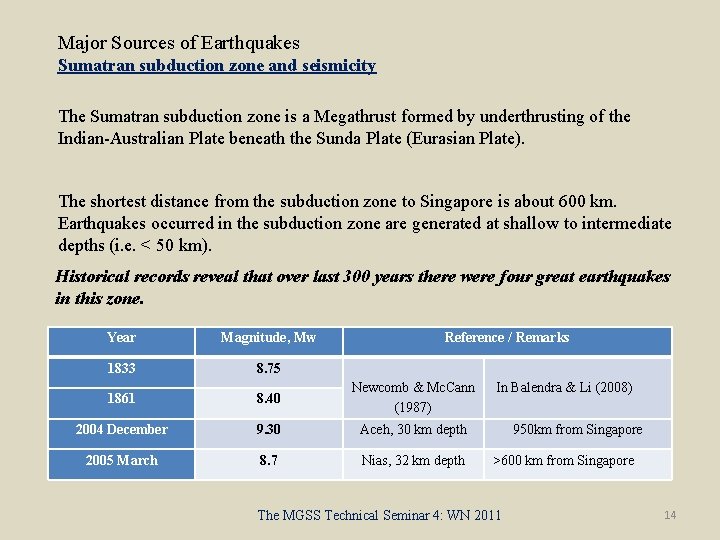
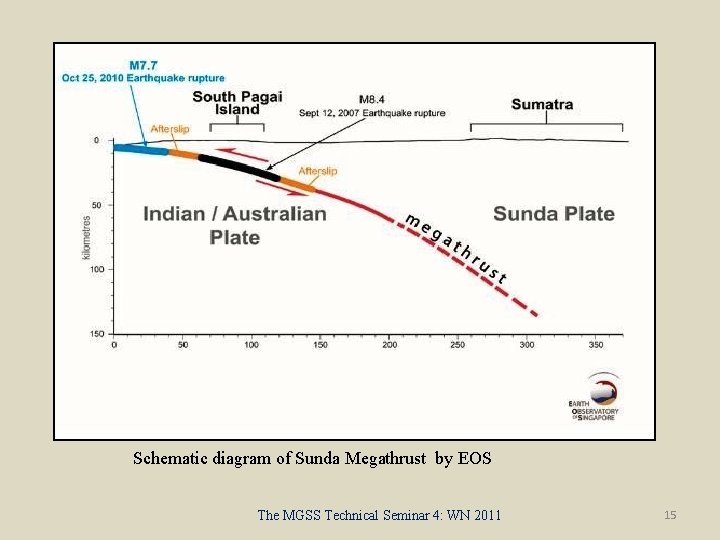
Major Sources of Earthquakes Sumatran subduction zone and seismicity The Sumatran subduction zone is a Megathrust formed by underthrusting of the Indian-Australian Plate beneath the Sunda Plate (Eurasian Plate). The shortest distance from the subduction zone to Singapore is about 600 km. Earthquakes occurred in the subduction zone are generated at shallow to intermediate depths (i. e. < 50 km). Historical records reveal that over last 300 years there were four great earthquakes in this zone. Year Magnitude, Mw Reference / Remarks 1833 8. 75 1861 8. 40 Newcomb & Mc. Cann (1987) 2004 December 9. 30 Aceh, 30 km depth 2005 March 8. 7 Nias, 32 km depth In Balendra & Li (2008) 950 km from Singapore >600 km from Singapore The MGSS Technical Seminar 4: WN 2011 14
Schematic diagram of Sunda Megathrust by EOS The MGSS Technical Seminar 4: WN 2011 15
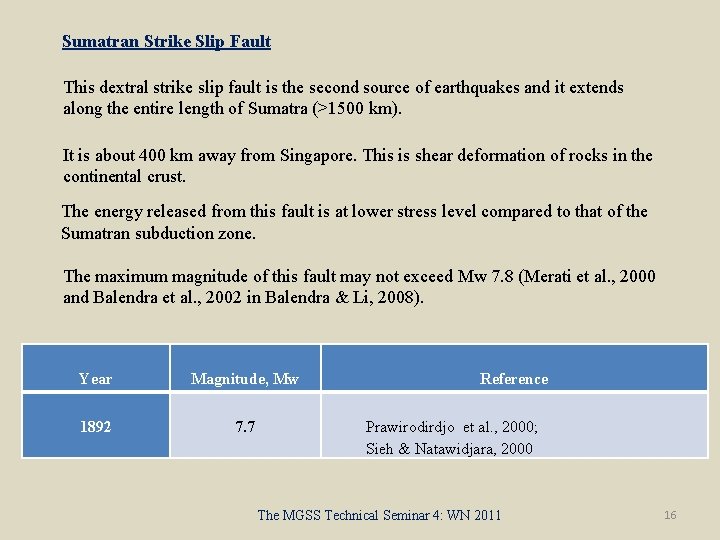
Sumatran Strike Slip Fault This dextral strike slip fault is the second source of earthquakes and it extends along the entire length of Sumatra (>1500 km). It is about 400 km away from Singapore. This is shear deformation of rocks in the continental crust. The energy released from this fault is at lower stress level compared to that of the Sumatran subduction zone. The maximum magnitude of this fault may not exceed Mw 7. 8 (Merati et al. , 2000 and Balendra et al. , 2002 in Balendra & Li, 2008). Year Magnitude, Mw 1892 7. 7 Reference Prawirodirdjo et al. , 2000; Sieh & Natawidjara, 2000 The MGSS Technical Seminar 4: WN 2011 16
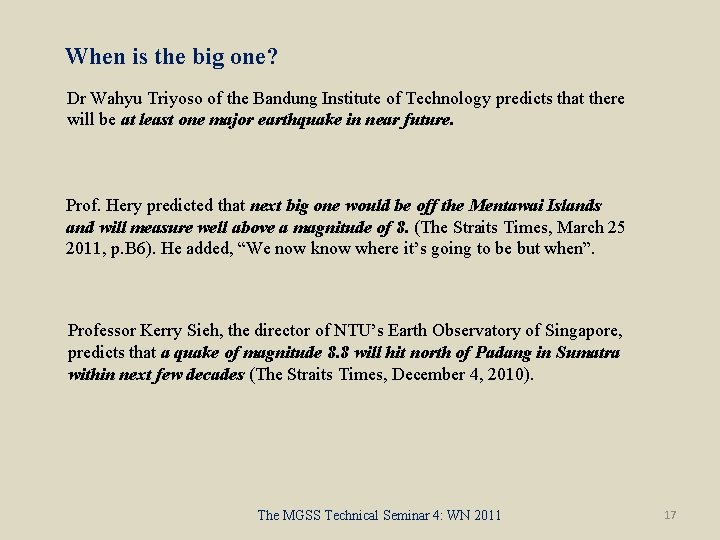
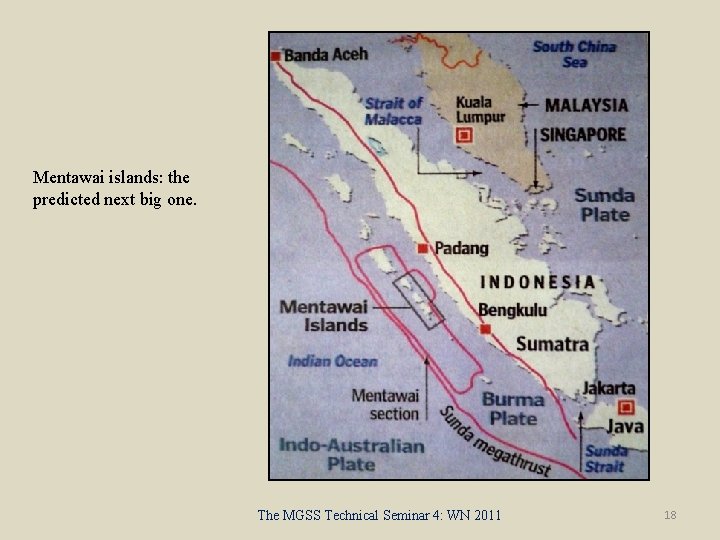
When is the big one? Dr Wahyu Triyoso of the Bandung Institute of Technology predicts that there will be at least one major earthquake in near future. Prof. Hery predicted that next big one would be off the Mentawai Islands and will measure well above a magnitude of 8. (The Straits Times, March 25 2011, p. B 6). He added, “We now know where it’s going to be but when”. Professor Kerry Sieh, the director of NTU’s Earth Observatory of Singapore, predicts that a quake of magnitude 8. 8 will hit north of Padang in Sumatra within next few decades (The Straits Times, December 4, 2010). The MGSS Technical Seminar 4: WN 2011 17
Mentawai islands: the predicted next big one. The MGSS Technical Seminar 4: WN 2011 18
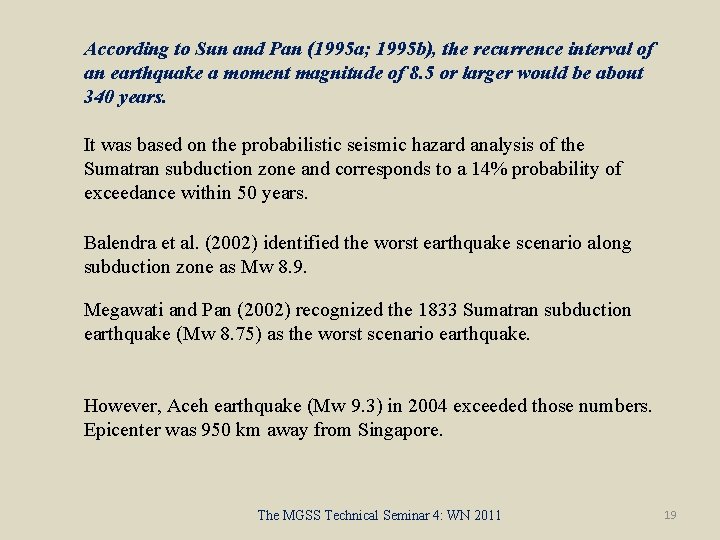
According to Sun and Pan (1995 a; 1995 b), the recurrence interval of an earthquake a moment magnitude of 8. 5 or larger would be about 340 years. It was based on the probabilistic seismic hazard analysis of the Sumatran subduction zone and corresponds to a 14% probability of exceedance within 50 years. Balendra et al. (2002) identified the worst earthquake scenario along subduction zone as Mw 8. 9. Megawati and Pan (2002) recognized the 1833 Sumatran subduction earthquake (Mw 8. 75) as the worst scenario earthquake. However, Aceh earthquake (Mw 9. 3) in 2004 exceeded those numbers. Epicenter was 950 km away from Singapore. The MGSS Technical Seminar 4: WN 2011 19
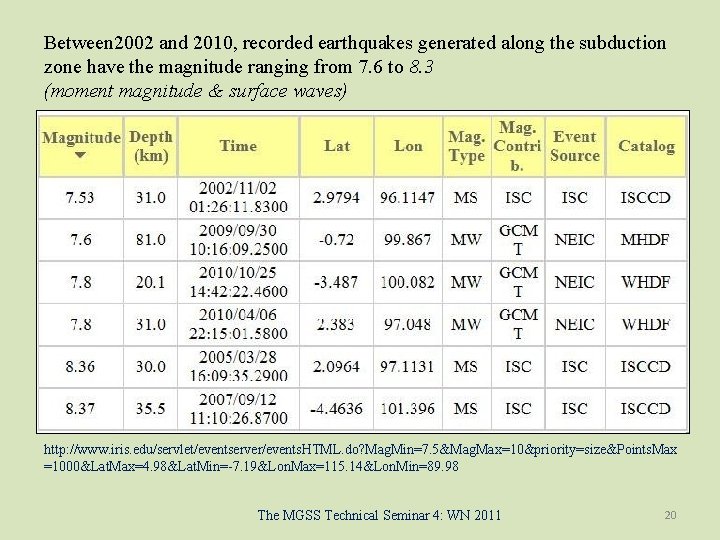
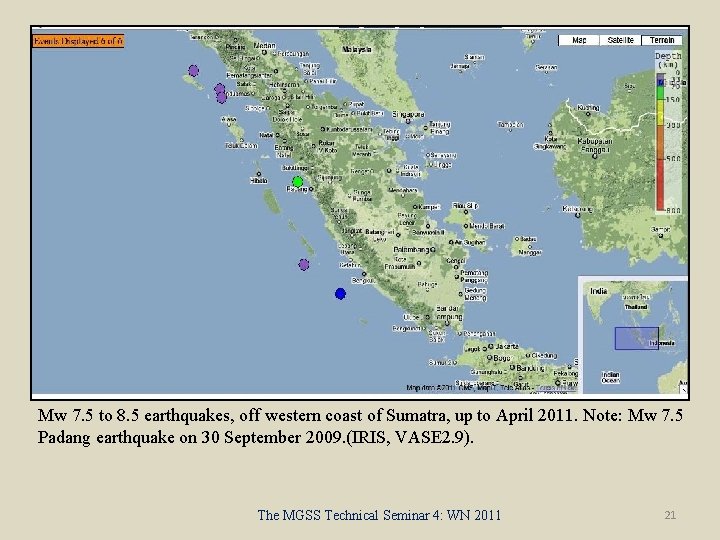
Between 2002 and 2010, recorded earthquakes generated along the subduction zone have the magnitude ranging from 7. 6 to 8. 3 (moment magnitude & surface waves) http: //www. iris. edu/servlet/eventserver/events. HTML. do? Mag. Min=7. 5&Mag. Max=10&priority=size&Points. Max =1000&Lat. Max=4. 98&Lat. Min=-7. 19&Lon. Max=115. 14&Lon. Min=89. 98 The MGSS Technical Seminar 4: WN 2011 20
Mw 7. 5 to 8. 5 earthquakes, off western coast of Sumatra, up to April 2011. Note: Mw 7. 5 Padang earthquake on 30 September 2009. (IRIS, VASE 2. 9). The MGSS Technical Seminar 4: WN 2011 21
GEOTECTNICAL ASPECT In Singapore reclaimed land forms extensive unconfined aquifers. Sand layers of varying thickness from 12 to 18 m are fully saturated and thus favouring liquefaction in foundation during the time of earthquakes. Liquefaction Soil liquefaction and related ground failures are commonly associated with large earthquakes. In common usage, liquefaction refers to the loss of strength in saturated, cohesion-less soils due to the build-up of pore water pressures during dynamic loading. The MGSS Technical Seminar 4: WN 2011 22
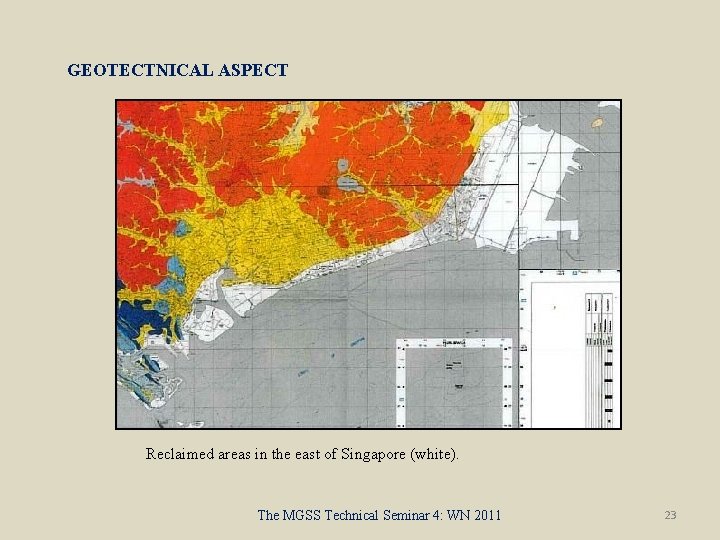
GEOTECTNICAL ASPECT Reclaimed areas in the east of Singapore (white). The MGSS Technical Seminar 4: WN 2011 23
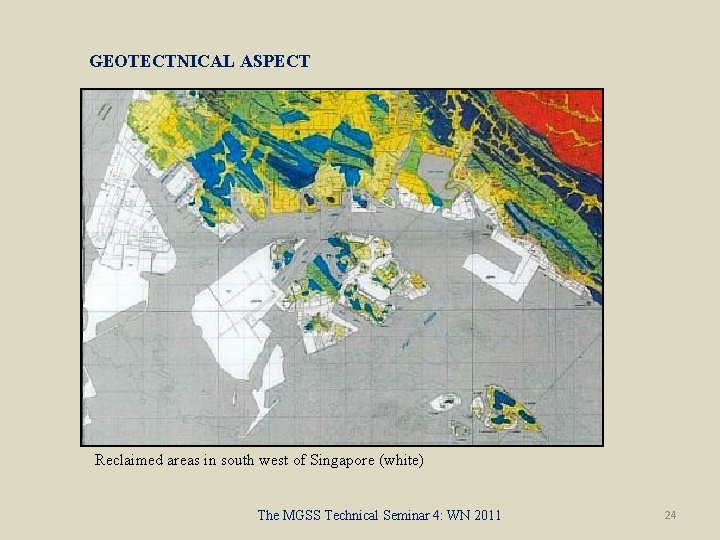
GEOTECTNICAL ASPECT Reclaimed areas in south west of Singapore (white) The MGSS Technical Seminar 4: WN 2011 24
Sladen et al. (1985) defined liquefaction as: "Liquefaction is a phenomenon wherein a mass of soil loses a large percentage of its shear resistance, when subjected to monotonic, cyclic, or shock loading, and flows in a manner resembling a liquid until the shear stresses acting on the mass are as low as the reduced shear resistance" Liquefaction Assessment Evaluating the liquefaction resistance of soils is an important step in the engineering design of new structures and the retrofit of existing structures in earthquake-prone regions. The MGSS Technical Seminar 4: WN 2011 25
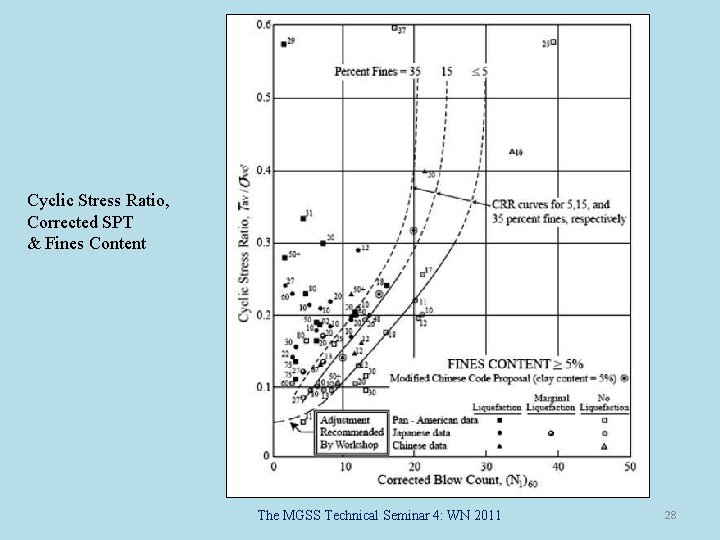
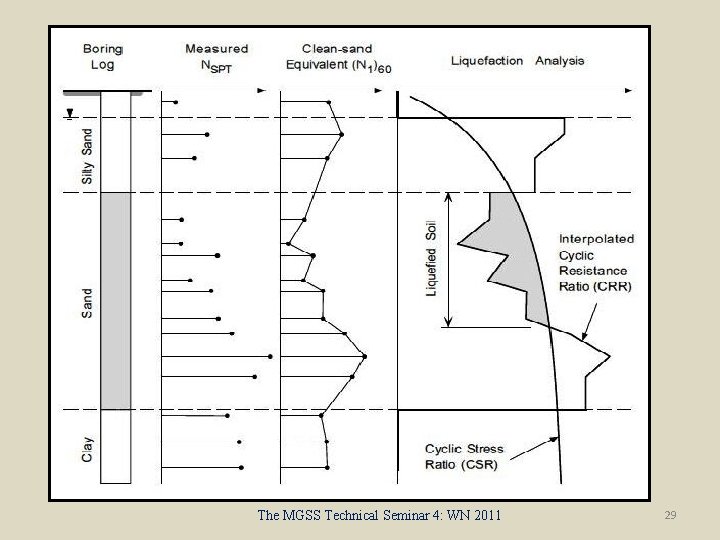
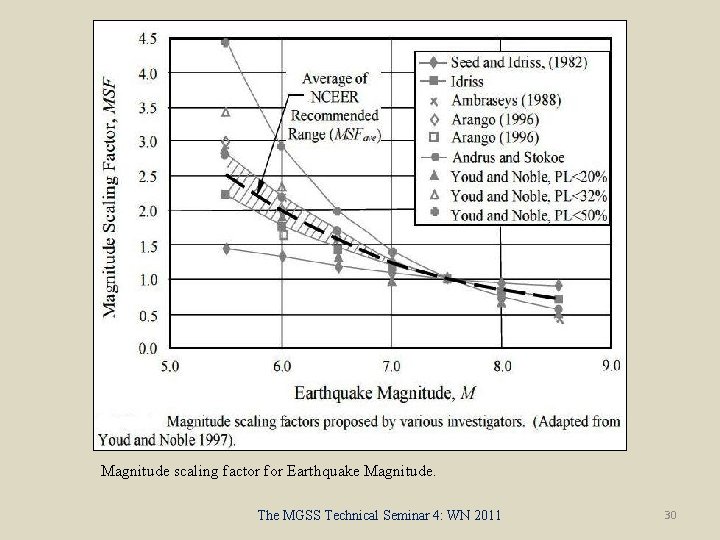
The evaluation procedure widely used throughout the world is termed the simplified procedure. This simplified procedure was originally developed by Seed and Idriss (1971) using blow counts from the Standard Penetration Test (SPT) correlated with a parameter representing the seismic loading on the soil, called the Cyclic Stress Ratio (CSR). This parameter is compared to Cyclic Resistance Ratio (CRR) of the soil and if it exceeds CRR, the soil is likely to be liquefied. A safety factor against liquefaction is defined as ratio of CRR to CSR: Safety Factor = CRR / CSR * K CRR = CRR 1 ave * MSF The MGSS Technical Seminar 4: WN 2011 26
Where: CRR 1 ave : calculated cyclic resistance ratio (average of all selected methods at a desired depth) MSF : Magnitude Scaling Factor K : overburden stress correction factor; only applied to the following analysis methods: - Vancouver Task Force Report (2007) - NCEER (1996) - Cetin et al. (2004) - Idriss & Boulanger (2004) (each of the above-mentioned methods has its own equation for calculating K , overburden stress correction factor and K : ground slope correction) The MGSS Technical Seminar 4: WN 2011 27
Cyclic Stress Ratio, Corrected SPT & Fines Content The MGSS Technical Seminar 4: WN 2011 28
The MGSS Technical Seminar 4: WN 2011 29
Magnitude scaling factor for Earthquake Magnitude. The MGSS Technical Seminar 4: WN 2011 30
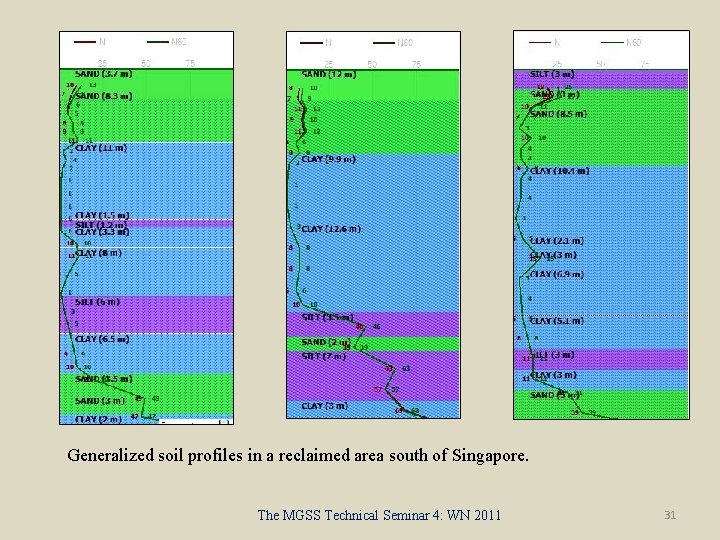
Generalized soil profiles in a reclaimed area south of Singapore. The MGSS Technical Seminar 4: WN 2011 31
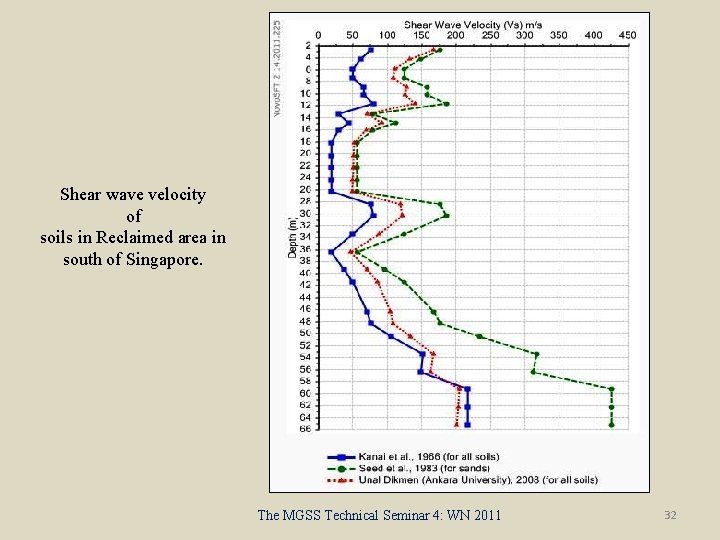
Shear wave velocity of soils in Reclaimed area in south of Singapore. The MGSS Technical Seminar 4: WN 2011 32
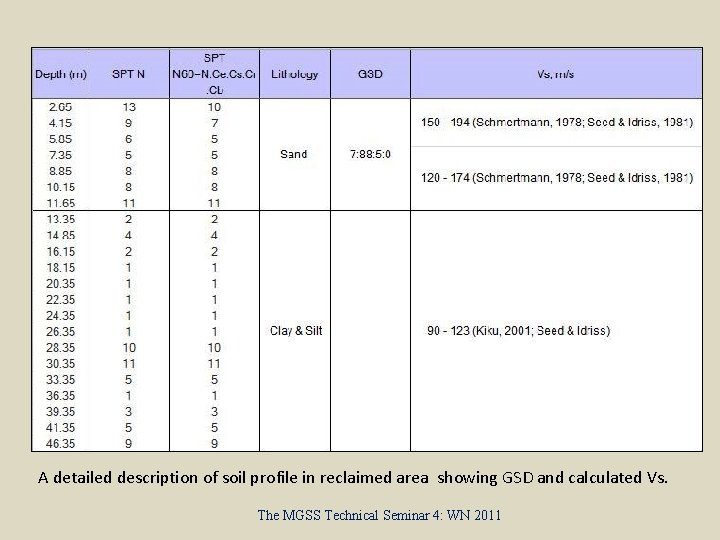
A detailed description of soil profile in reclaimed area showing GSD and calculated Vs. The MGSS Technical Seminar 4: WN 2011
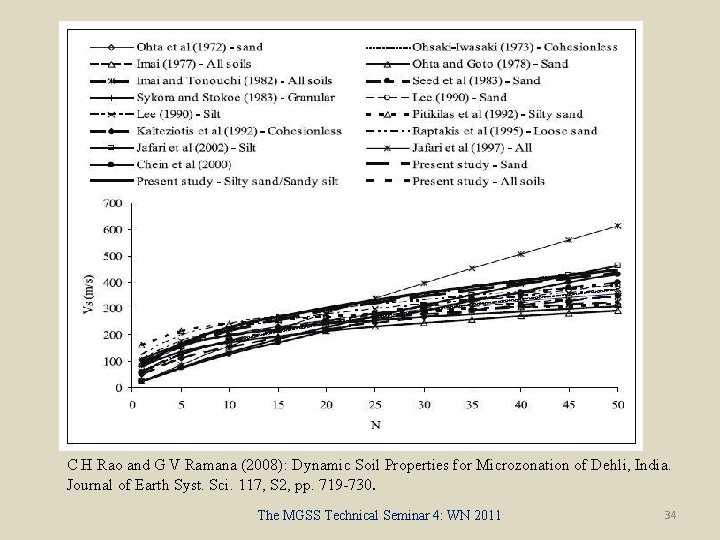
C H Rao and G V Ramana (2008): Dynamic Soil Properties for Microzonation of Dehli, India. Journal of Earth Syst. Sci. 117, S 2, pp. 719 -730. The MGSS Technical Seminar 4: WN 2011 34
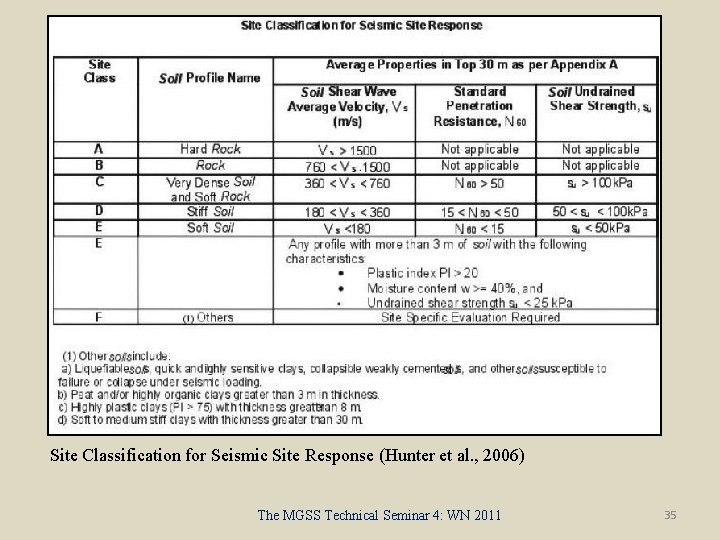
Site Classification for Seismic Site Response (Hunter et al. , 2006) The MGSS Technical Seminar 4: WN 2011 35
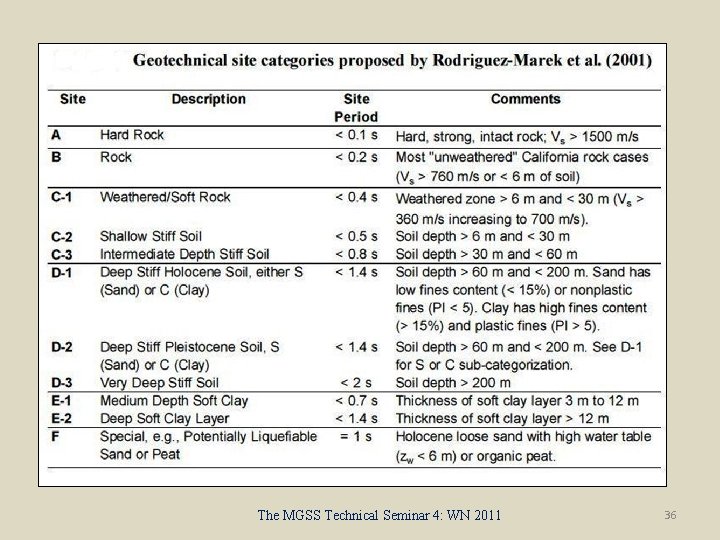
The MGSS Technical Seminar 4: WN 2011 36
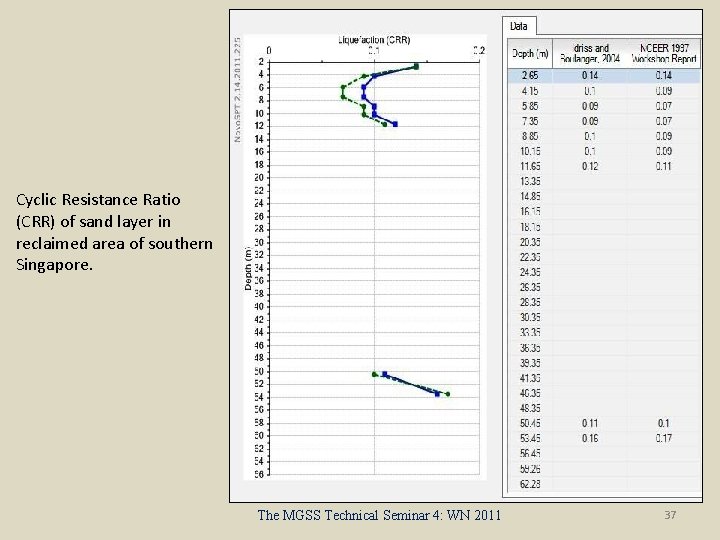
Cyclic Resistance Ratio (CRR) of sand layer in reclaimed area of southern Singapore. The MGSS Technical Seminar 4: WN 2011 37
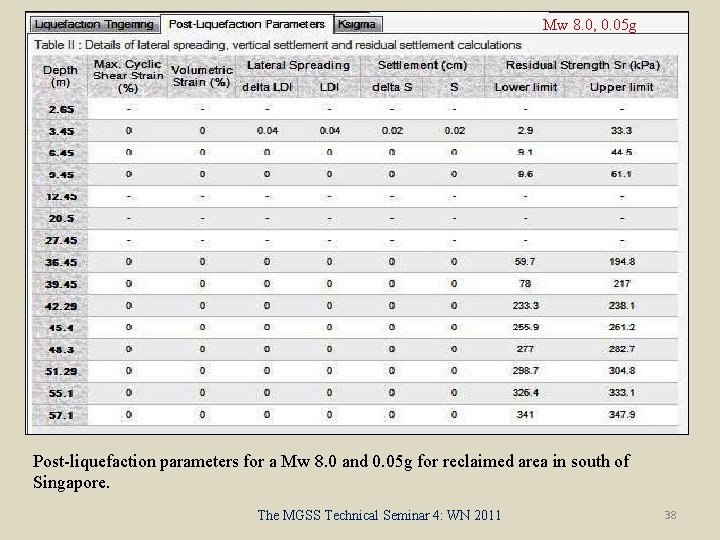
Mw 8. 0, 0. 05 g Post-liquefaction parameters for a Mw 8. 0 and 0. 05 g for reclaimed area in south of Singapore. The MGSS Technical Seminar 4: WN 2011 38
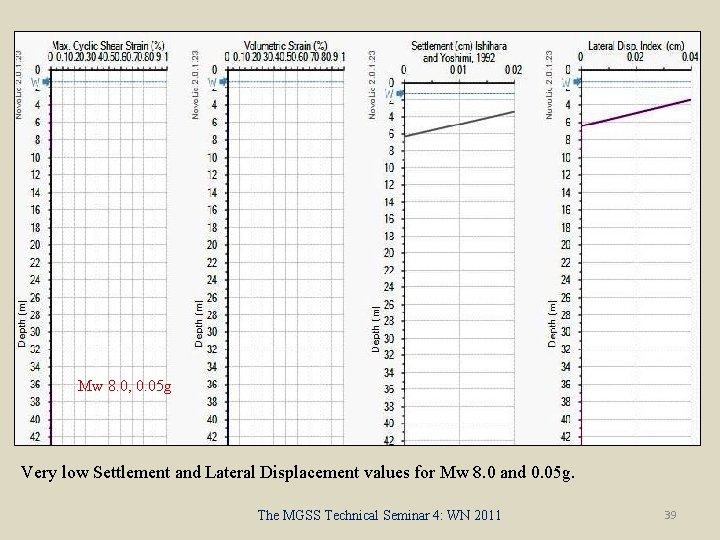
Mw 8. 0, 0. 05 g Very low Settlement and Lateral Displacement values for Mw 8. 0 and 0. 05 g. The MGSS Technical Seminar 4: WN 2011 39
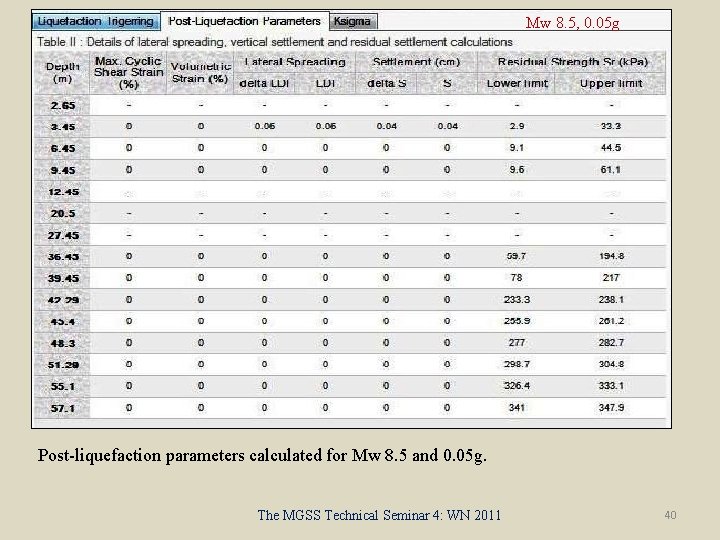
Mw 8. 5, 0. 05 g Post-liquefaction parameters calculated for Mw 8. 5 and 0. 05 g. The MGSS Technical Seminar 4: WN 2011 40
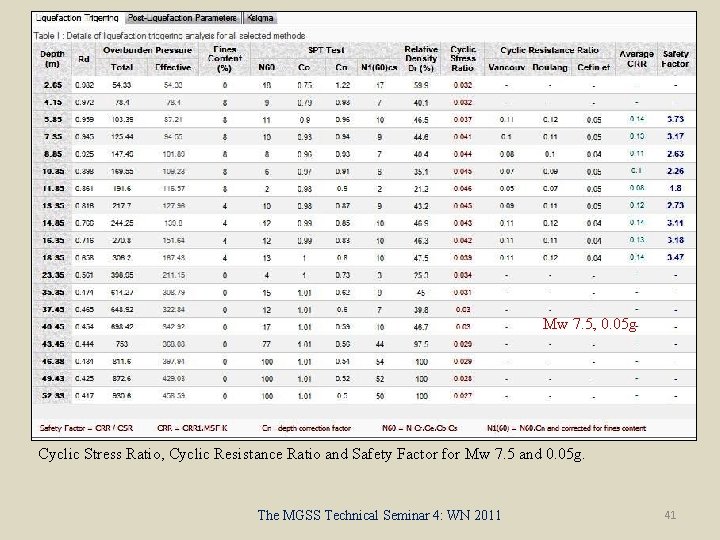
Mw 7. 5, 0. 05 g Cyclic Stress Ratio, Cyclic Resistance Ratio and Safety Factor for Mw 7. 5 and 0. 05 g. The MGSS Technical Seminar 4: WN 2011 41
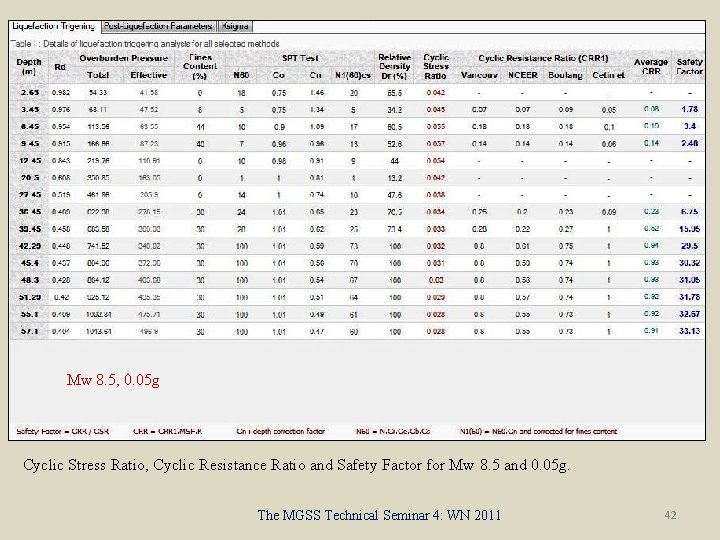
Mw 8. 5, 0. 05 g Cyclic Stress Ratio, Cyclic Resistance Ratio and Safety Factor for Mw 8. 5 and 0. 05 g. The MGSS Technical Seminar 4: WN 2011 42
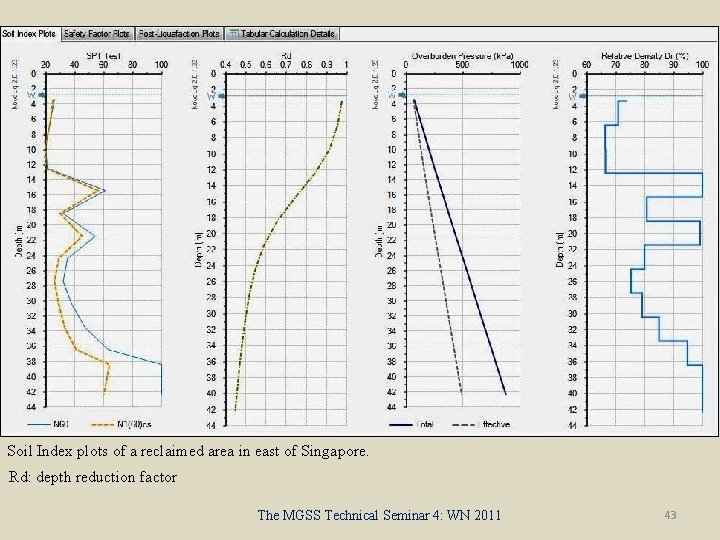
Soil Index plots of a reclaimed area in east of Singapore. Rd: depth reduction factor The MGSS Technical Seminar 4: WN 2011 43
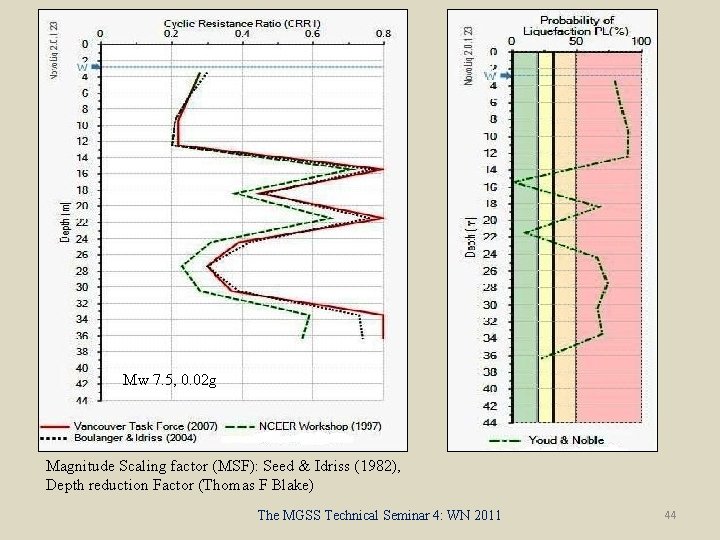
Mw 7. 5, 0. 02 g Magnitude Scaling factor (MSF): Seed & Idriss (1982), Depth reduction Factor (Thomas F Blake) The MGSS Technical Seminar 4: WN 2011 44
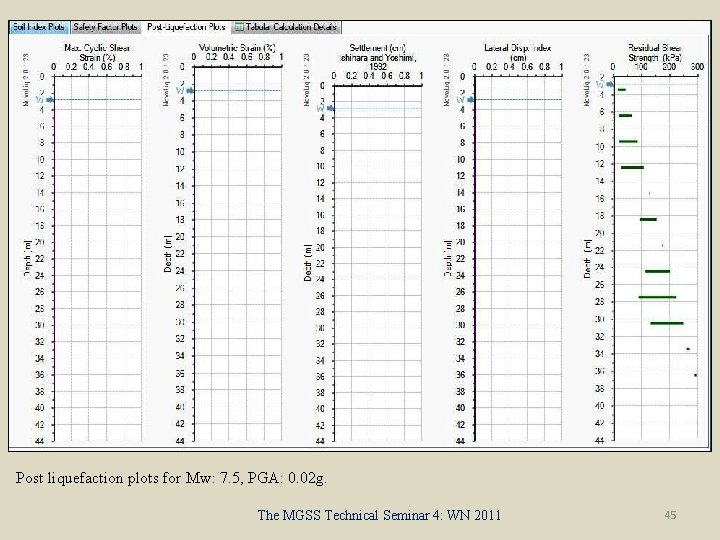
Post liquefaction plots for Mw: 7. 5, PGA: 0. 02 g. The MGSS Technical Seminar 4: WN 2011 45
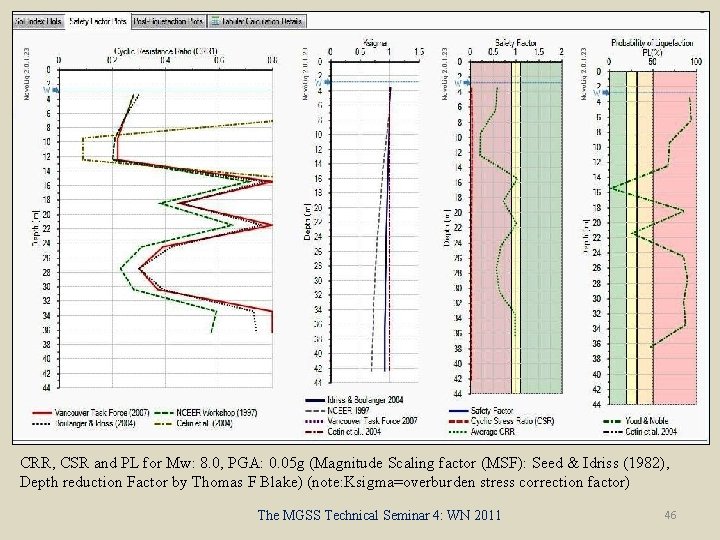
CRR, CSR and PL for Mw: 8. 0, PGA: 0. 05 g (Magnitude Scaling factor (MSF): Seed & Idriss (1982), Depth reduction Factor by Thomas F Blake) (note: Ksigma=overburden stress correction factor) The MGSS Technical Seminar 4: WN 2011 46
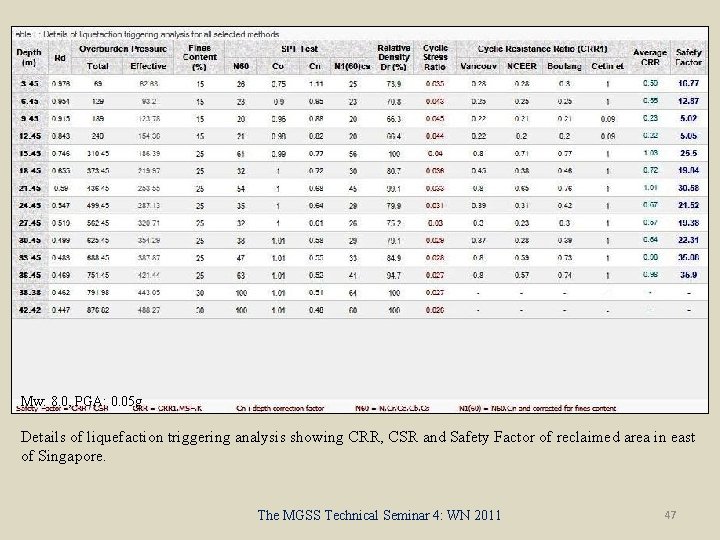
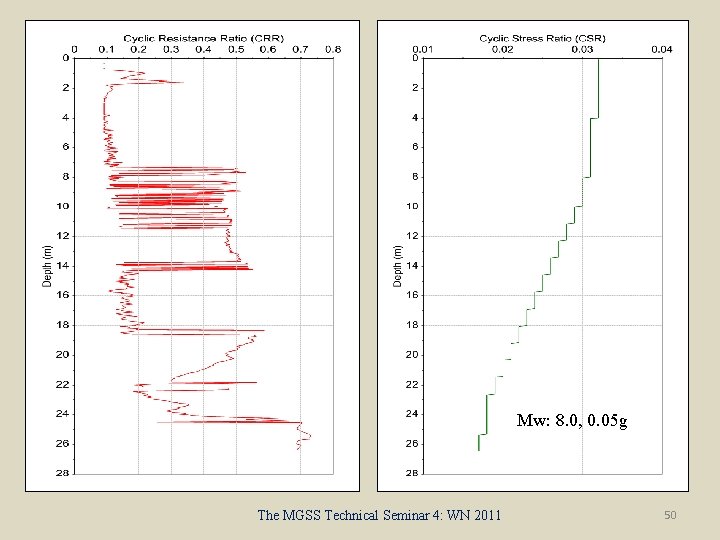
Mw: 8. 0, PGA: 0. 05 g Details of liquefaction triggering analysis showing CRR, CSR and Safety Factor of reclaimed area in east of Singapore. The MGSS Technical Seminar 4: WN 2011 47
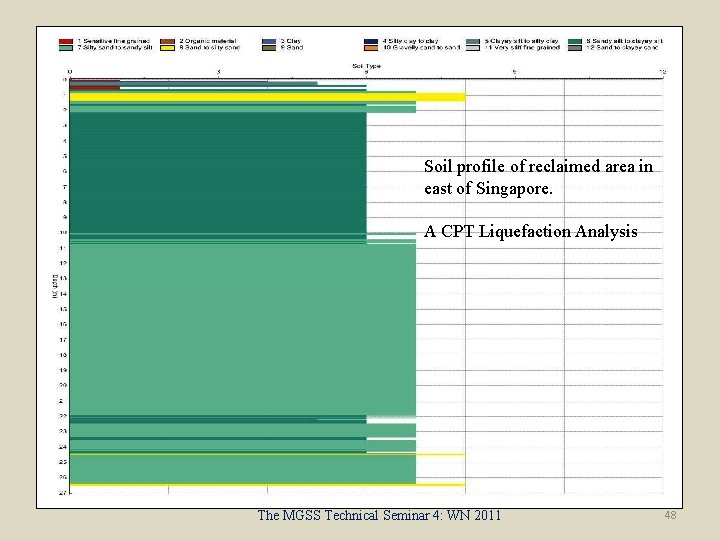
Soil profile of reclaimed area in east of Singapore. A CPT Liquefaction Analysis The MGSS Technical Seminar 4: WN 2011 48
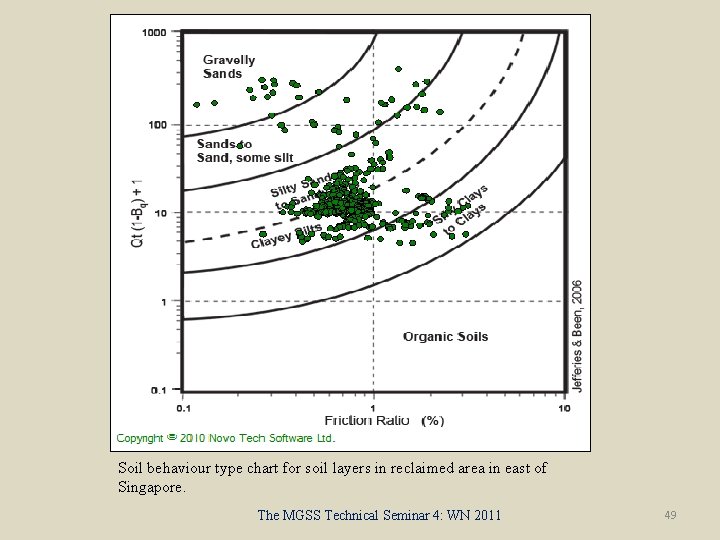
Soil behaviour type chart for soil layers in reclaimed area in east of Singapore. The MGSS Technical Seminar 4: WN 2011 49
Mw: 8. 0, 0. 05 g The MGSS Technical Seminar 4: WN 2011 50
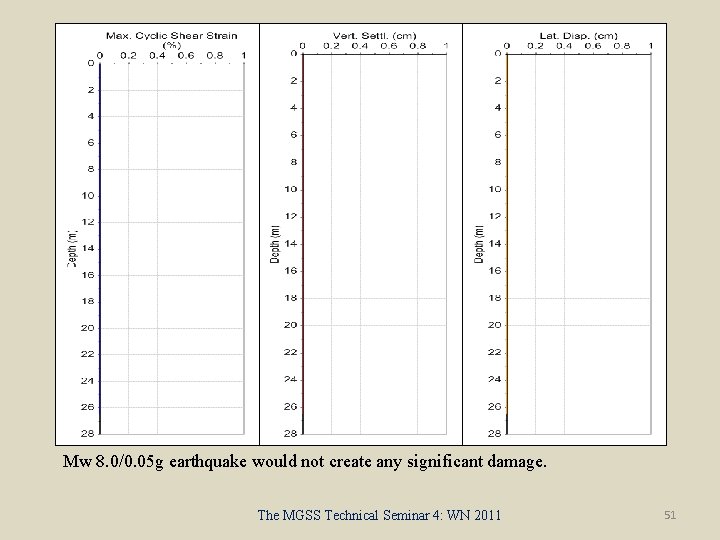
Mw 8. 0/0. 05 g earthquake would not create any significant damage. The MGSS Technical Seminar 4: WN 2011 51
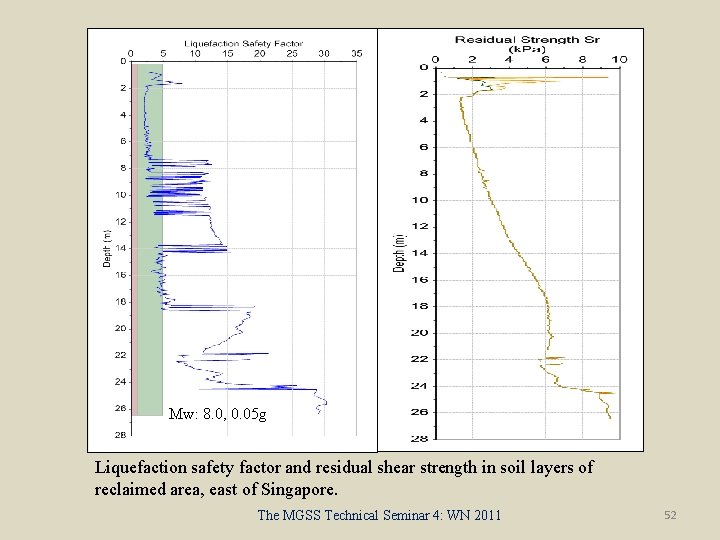
Mw: 8. 0, 0. 05 g Liquefaction safety factor and residual shear strength in soil layers of reclaimed area, east of Singapore. The MGSS Technical Seminar 4: WN 2011 52
Comments Liquefaction analysis results, particularly settlement and lateral displacement, and safety factor show that in the event of a big earthquake somewhere in Sumatra, Indonesia we may feel the tremors but our foundations in reclaimed land shouldn’t have significant damage. Therefore, this geotechnical observation supports the fact that Singapore geologically situated behind the back arc basin is tectonically safe haven. THANK YOU The MGSS Technical Seminar 4: WN 2011 53
ACKNOWLEDGEMEN T I would like to express deep gratitude to the Chairman and EC members of MGSS for taking keen interest in this technical seminar topic and encouragement. I am also indebted to www. Novotech. Software. com for providing the latest geotechnical software developed by Novo Tech Software Ltd, Canada. And, many thanks to all of you who have supported us by sparing your time for this seminar. wnaing. dr@hotmail. co. uk The MGSS Technical Seminar 4: WN 2011 54