
The Metric System The Metric System All scientific
- Slides: 24
The Metric System
The Metric System • • • All scientific measurements are made using the Metric System. It is also called the SI System (La Systeme International d’Unites) The United States is the only major country that does not use this system.
Very Easy To Use n n n There are base units and prefixes Based on 10 (10 and 100 and 1, 000) so you multiply or divide by 10 when converting It’s a decimal system… Can you think of a system we use every day that is a decimal system? ______ Hint
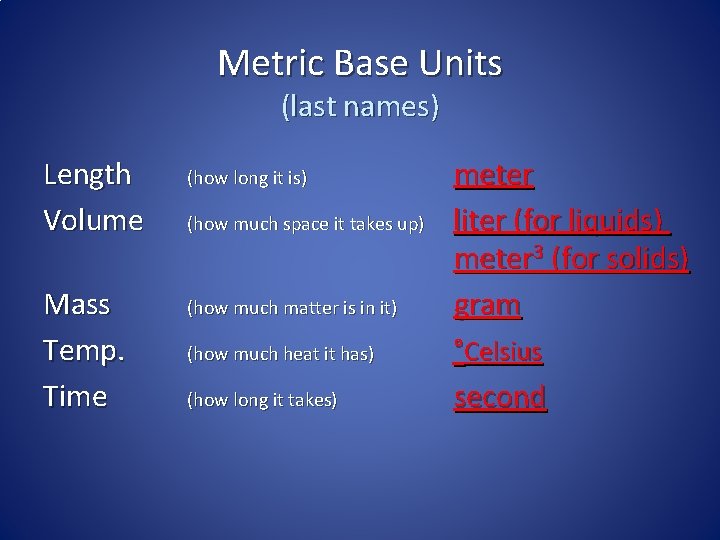
Metric Base Units (last names) Length Volume Mass Temp. Time (how long it is) (how much space it takes up) (how much matter is in it) (how much heat it has) (how long it takes) meter liter (for liquids) meter 3 (for solids) gram °Celsius second
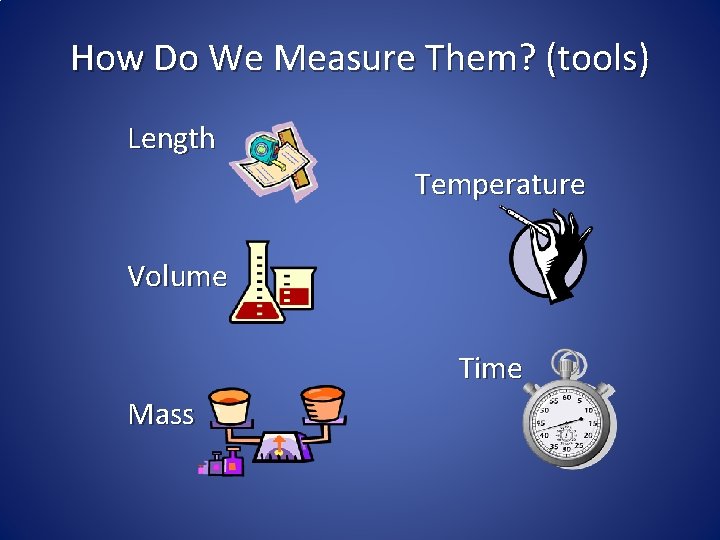
How Do We Measure Them? (tools) Length Temperature Volume Time Mass
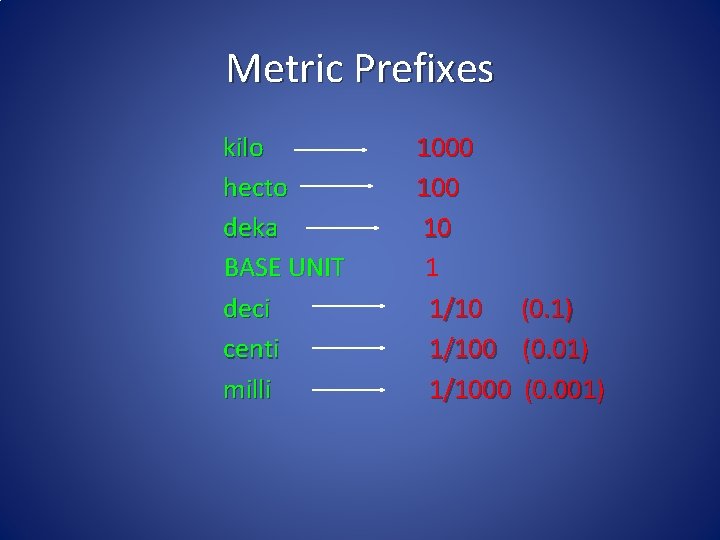
Metric Prefixes kilo hecto deka BASE UNIT deci centi milli 1000 10 1 1/10 (0. 1) 1/100 (0. 01) 1/1000 (0. 001)
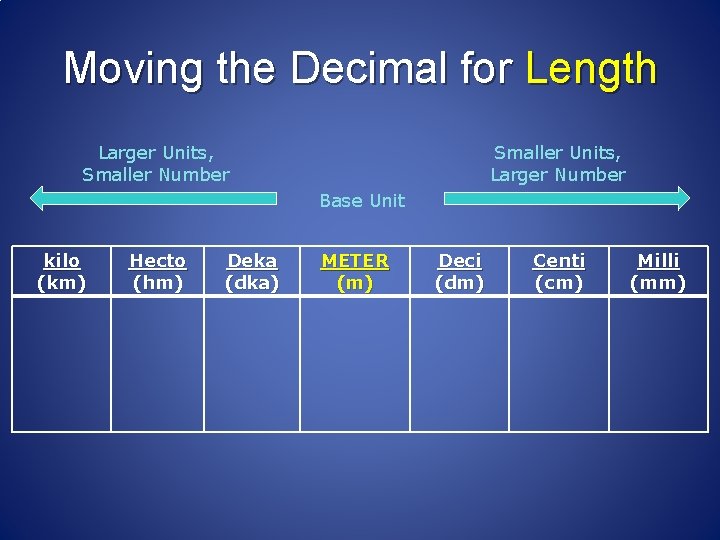
Moving the Decimal for Length Larger Units, Smaller Number Smaller Units, Larger Number Base Unit kilo (km) Hecto (hm) Deka (dka) METER (m) Deci (dm) Centi (cm) Milli (mm)
Let’s make it easier What’s a millimeter ? About the thickness of a paperclip What’s a centimeter? About the width of your pinkie finger What’s a meter? Height from the floor to the door knob
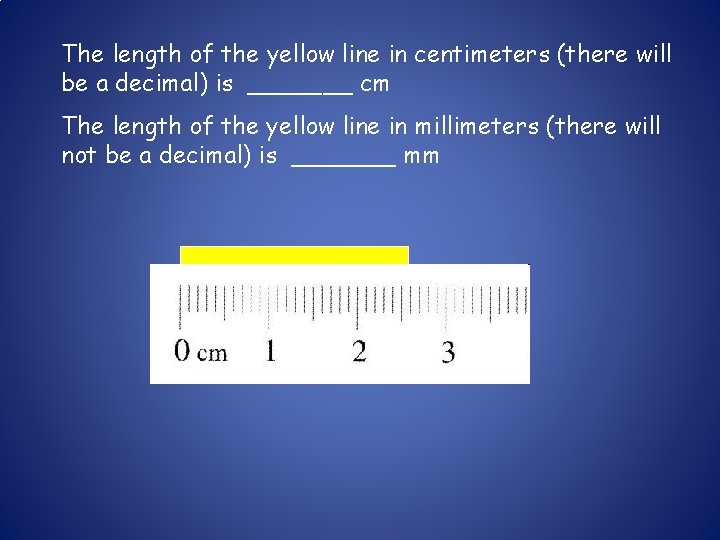
The length of the yellow line in centimeters (there will be a decimal) is _______ cm The length of the yellow line in millimeters (there will not be a decimal) is _______ mm
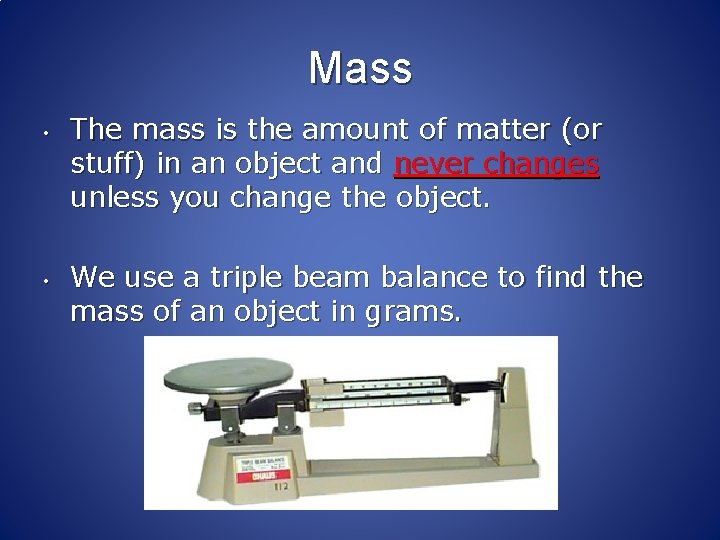
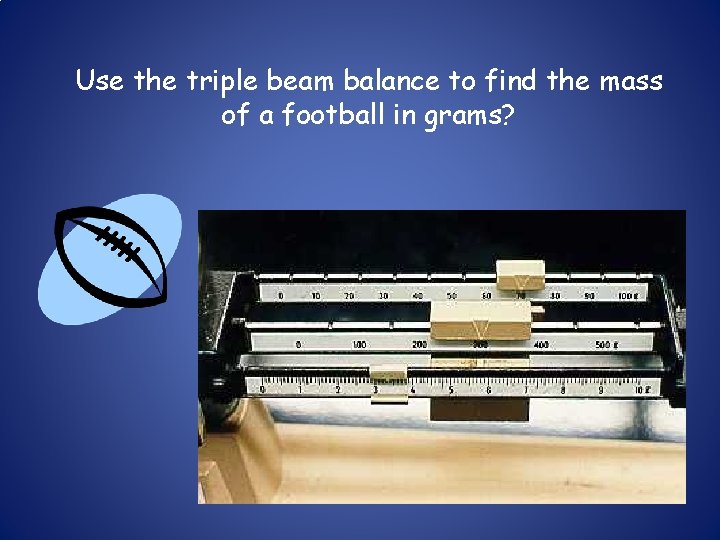
Mass • • The mass is the amount of matter (or stuff) in an object and never changes unless you change the object. We use a triple beam balance to find the mass of an object in grams.
Mass vs. Weight • • The weight of something is the amount of gravity pulling down on an object and will change if you go somewhere with more or less gravity. Mass is NOT the same as weight!
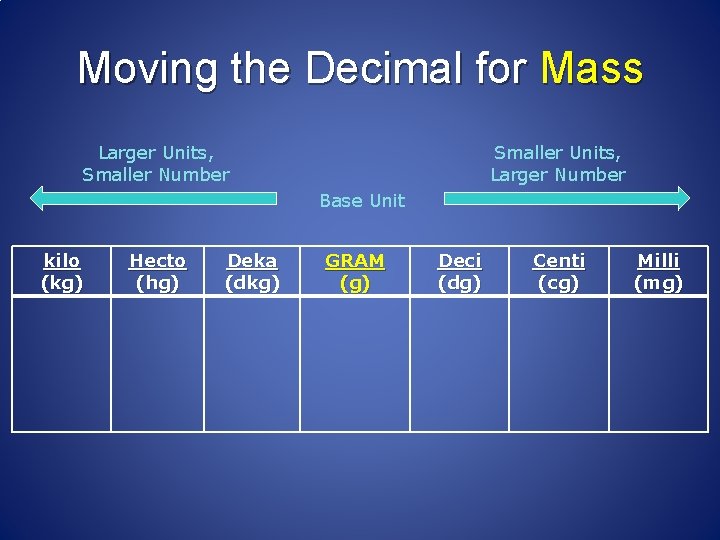
Moving the Decimal for Mass Larger Units, Smaller Number Smaller Units, Larger Number Base Unit kilo (kg) Hecto (hg) Deka (dkg) GRAM (g) Deci (dg) Centi (cg) Milli (mg)
Use the triple beam balance to find the mass of a football in grams?
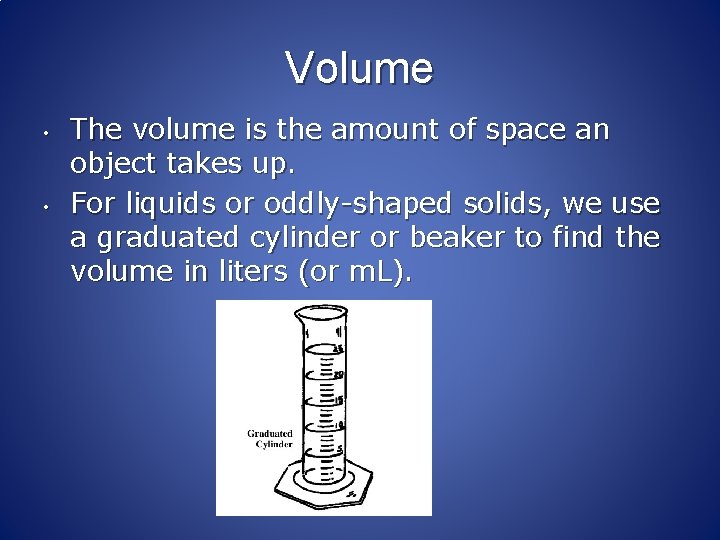
Volume • • The volume is the amount of space an object takes up. For liquids or oddly-shaped solids, we use a graduated cylinder or beaker to find the volume in liters (or m. L).
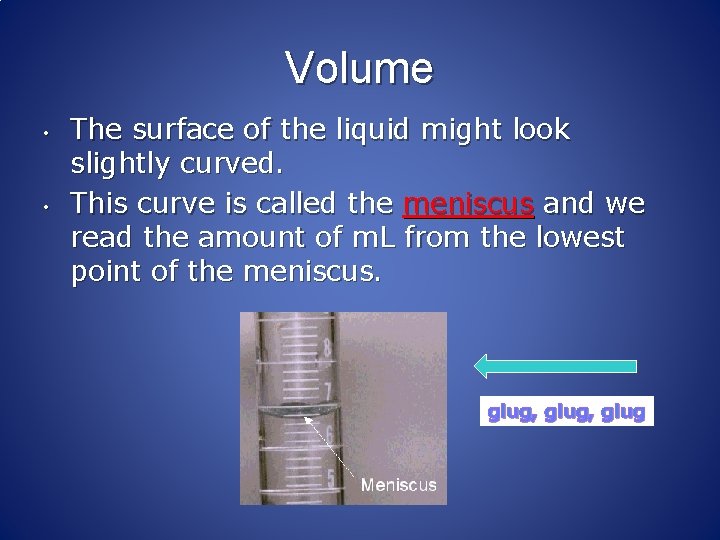
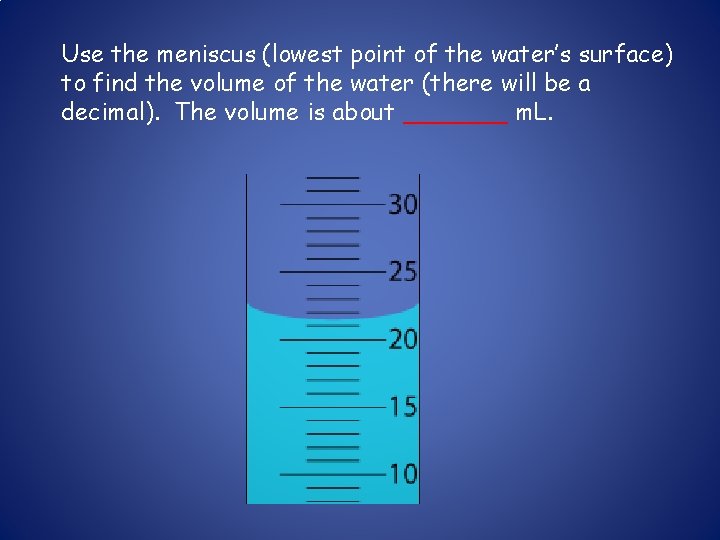
Volume • • The surface of the liquid might look slightly curved. This curve is called the meniscus and we read the amount of m. L from the lowest point of the meniscus. glug, glug
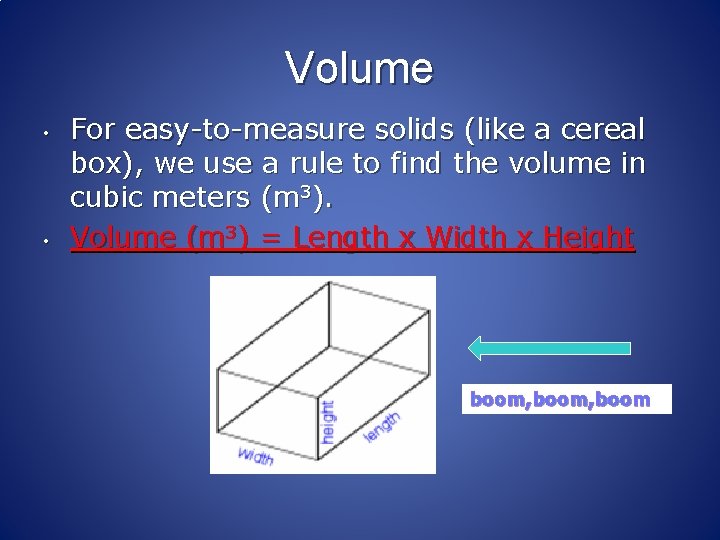
Volume • • For easy-to-measure solids (like a cereal box), we use a rule to find the volume in cubic meters (m 3). Volume (m 3) = Length x Width x Height boom, boom
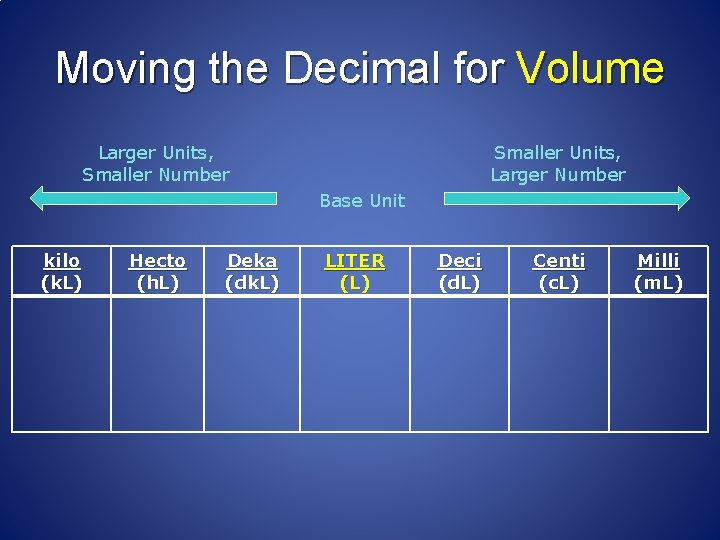
Moving the Decimal for Volume Larger Units, Smaller Number Smaller Units, Larger Number Base Unit kilo (k. L) Hecto (h. L) Deka (dk. L) LITER (L) Deci (d. L) Centi (c. L) Milli (m. L)
Use the meniscus (lowest point of the water’s surface) to find the volume of the water (there will be a decimal). The volume is about _______ m. L.
Measuring Mass and Volume • Take out a new piece of paper and do the following: • Put your name and hour in the top right hand corner • Write 1. Mass • Write 2. Volume of a liquid and then skip 5 lines • Write 3. Volume of a solid and then skip 5 lines
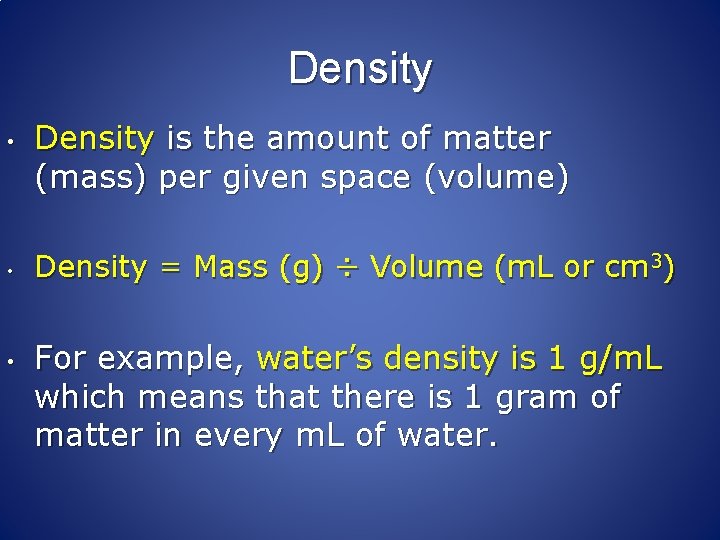
Density • • • Density is the amount of matter (mass) per given space (volume) Density = Mass (g) ÷ Volume (m. L or cm 3) For example, water’s density is 1 g/m. L which means that there is 1 gram of matter in every m. L of water.
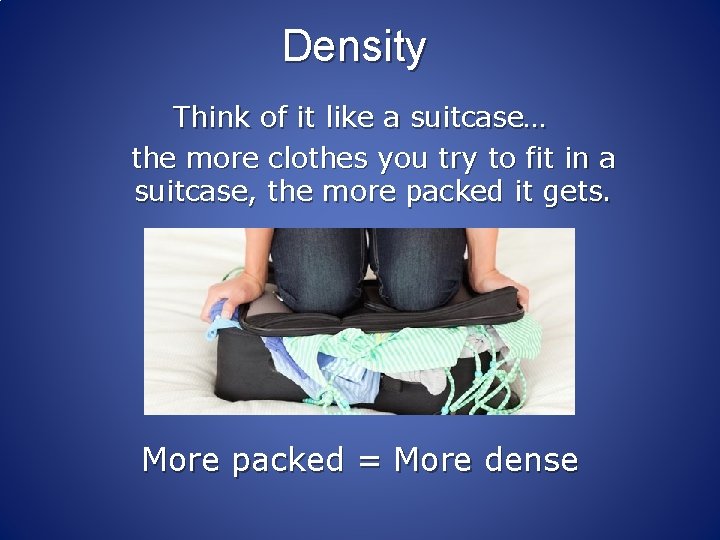
Density Think of it like a suitcase… the more clothes you try to fit in a suitcase, the more packed it gets. More packed = More dense
Density When you compare the density of two or more objects, the denser objects will sink below the less dense objects. For example, if an object has a density of 2 g/m. L … what will it do in water? What if an object has a density of 0. 2 g/m. L?
Density • • EXAMPLE OF SAME MASS (151 g): Spongebob Mac & Cheese Easter jelly beans EXAMPLE OF SAME VOLUME (5, 452 cm 3): Red Swirly bowling ball Spider Web bowling ball
Density REMEMBER: Denser objects sink below less dense objects! • Number your paper 1 – 5 • Order the following objects from least dense (#1) to most dense (#5): • Water (blue), Syrup, Oil, Rubbing (green), Oil, and Dish Soap Alcohol