
The Metric System Simple Consistent Measurement up to
- Slides: 26
The Metric System Simple & Consistent
Measurement up to 1790: Not a pretty picture! • Measurement requires standard and until 1790’s every region had own standard
Standards • “standard: something used as comparison for measuring” – standard must: • be available for everyone to check measurements • be something in nature that is same everywhere • never vary
1585 – Simon Stevin • Introduced use of decimals in Europe • Predicted universal introduction of decimal coinage, measures and weights
1670 – Gabriel Mouton • 1 st to propose decimal system of measurement based on size of earth • Earth-based standard: 1 of longitude Earth is standard available to everyone! What an idea!
Systeme International (SI) • based on metric system • invented in 1790* – Originally, earth-based standards – Volume & mass linked to length – Larger & smaller multiples of each unit related by powers of 10 *updated every few years (particularly 1960 and 1991)
1790 – French Academy of Sciences created the metric system 3 Requirements
#1 Basic Standard = Earth • unit of length is portion of Earth's circumference
#2 Internal Consistency • Units for capacity (volume or space) and mass related to unit of length
#3 Ease of Use - Calculations • Larger and smaller units created by multiplying or dividing basic units by factors of 10
Fundamental (Base) Units • Based on object/event in nature • SI system has 7 fundamental units • Probably already know 4 of them • Any guesses as to which ones you know?
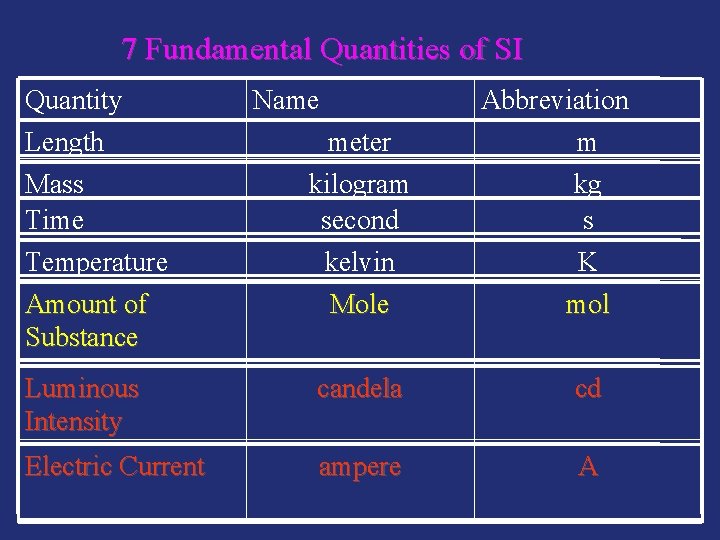
7 Fundamental Quantities of SI Quantity Length Mass Time Temperature Name meter Abbreviation m kilogram second kelvin Mole kg s K mol Luminous Intensity candela cd Electric Current ampere A Amount of Substance
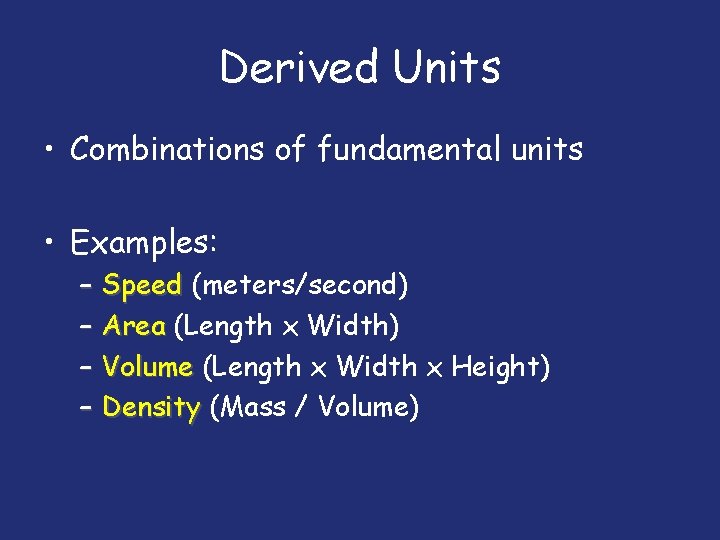
Derived Units • Combinations of fundamental units • Examples: – Speed (meters/second) – Area (Length x Width) – Volume (Length x Width x Height) – Density (Mass / Volume)
Ease of Use - Names Larger & smaller multiples of same unit named by series of prefixes relating to base unit
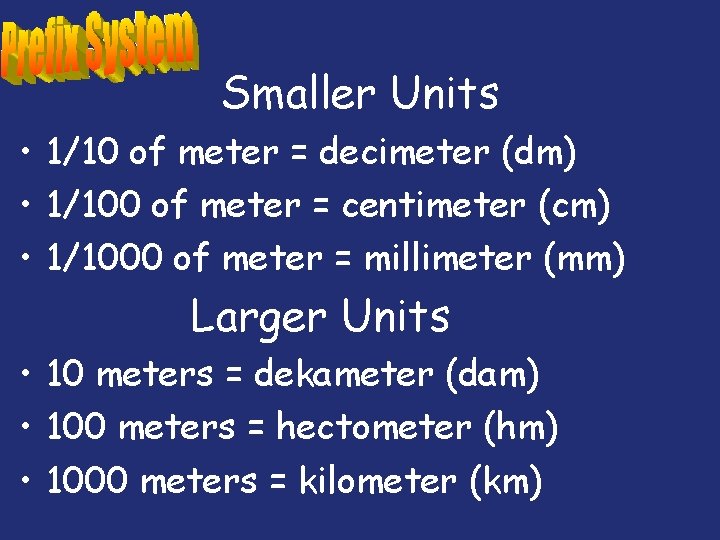
Smaller Units • 1/10 of meter = decimeter (dm) • 1/100 of meter = centimeter (cm) • 1/1000 of meter = millimeter (mm) Larger Units • 10 meters = dekameter (dam) • 100 meters = hectometer (hm) • 1000 meters = kilometer (km)
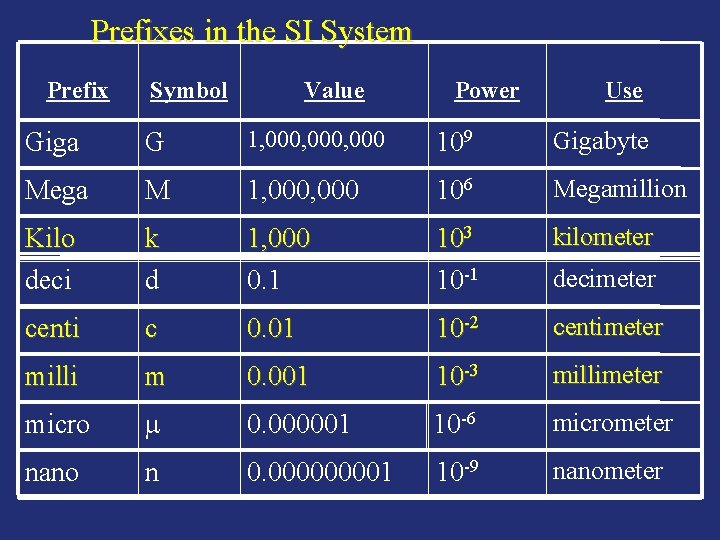
Prefixes in the SI System Prefix Symbol Value Power Use Giga G 1, 000, 000 109 Gigabyte Mega M 1, 000 106 Megamillion Kilo deci k d 1, 000 0. 1 103 10 -1 kilometer centi c 0. 01 10 -2 centimeter milli m 0. 001 10 -3 millimeter micro 0. 000001 10 -6 micrometer nano n 0. 00001 10 -9 nanometer decimeter
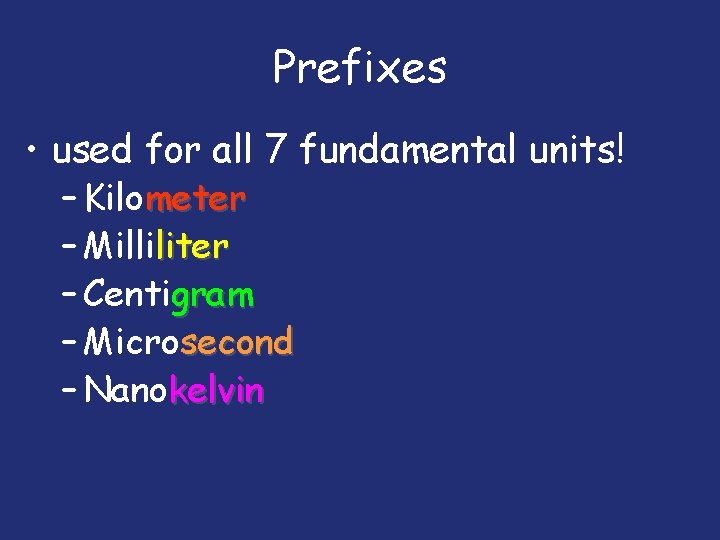
Prefixes • used for all 7 fundamental units! – Kilometer – Milliliter – Centigram – Microsecond – Nanokelvin
1790 - Jefferson • Proposed decimal-based measurement system for United States • Didn’t use prefix idea & system had too many names
1792 – U. S. Mint • Produced world’s first decimal currency (one dollar = 100 cents)
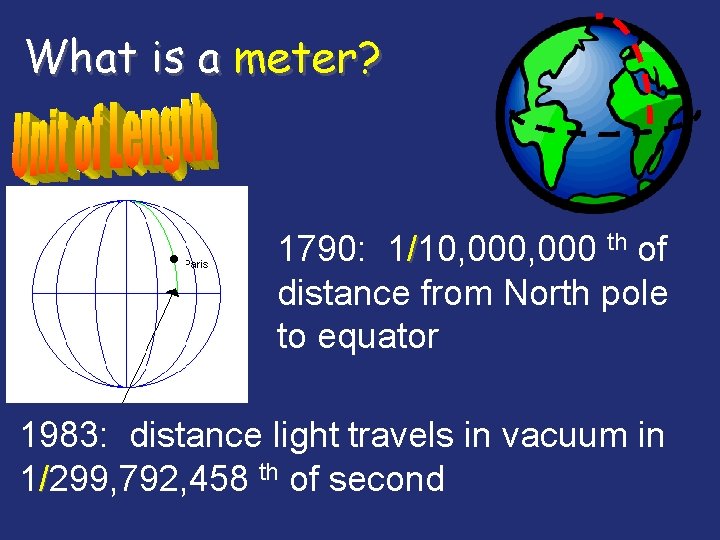
What is a meter? 1790: 1/10, 000 th of distance from North pole to equator 1983: distance light travels in vacuum in 1/299, 792, 458 th of second
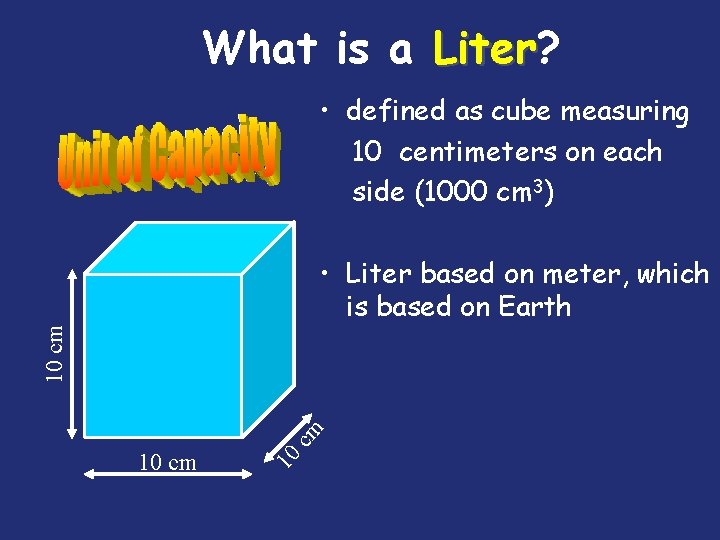
What is a Liter? Liter • defined as cube measuring 10 centimeters on each side (1000 cm 3) 10 10 cm cm 10 cm • Liter based on meter, which is based on Earth
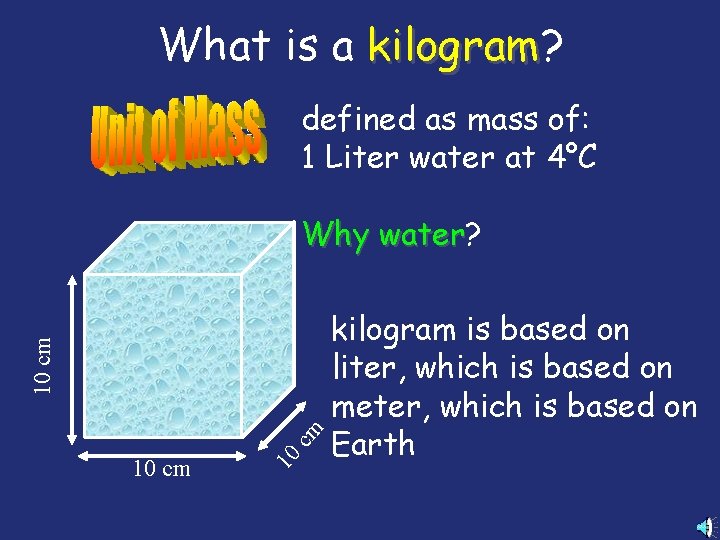
What is a kilogram? kilogram defined as mass of: 1 Liter water at 4°C 10 cm Why water? water kilogram is based on liter, which is based on meter, which is based on Earth
What is a second? second originally defined as 1/86, 400 th of average solar day Now: defined in terms of electron transitions in Cs 133
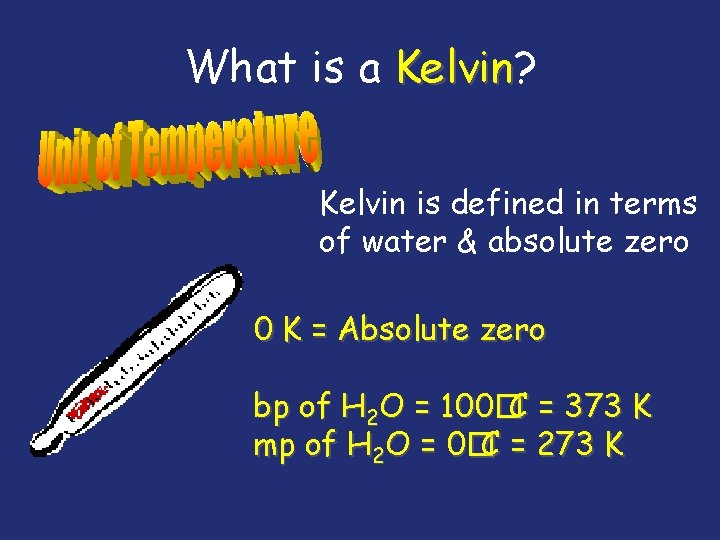
What is a Kelvin? Kelvin is defined in terms of water & absolute zero 0 K = Absolute zero bp of H 2 O = 100�C = 373 K mp of H 2 O = 0�C = 273 K
What is a mole? mole amount any substance that has as many elementary particles as number of atoms found in 0. 012 kilogram of carbon-12
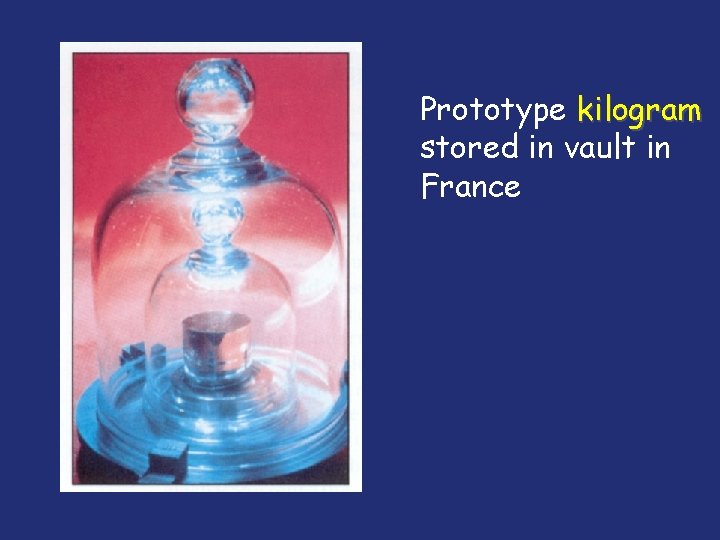
Prototype kilogram stored in vault in France