
The Metabolic Pathway of Shikimic Acid Aromatic Amino
The Metabolic Pathway of Shikimic Acid Aromatic Amino Acids Phenolic Compounds Jan Michael O. Santos Philippine Normal University College of Science Department of Physical Sciences
Outline of Discussion 1. Shikimic Acid Pathway a. b. c. d. e. Origin of Shikimic Acid Starting Material Enzymes Pathway- Mechanism Product
2. Aromatic Amino Acids a. b. c. d. e. What are the Aromatic Amino Acids Starting Material Enzymes Pathway- Mechanism Products
3. Phenolic Compounds a. b. c. d. e. What are Phenolic Compounds Starting Material Enzymes Pathway- Mechanism Products
DEFINITION OF TERMS 1. Shikimic acid or shikimate: is an important biochemical metabolite in plants and microorganisms. 2. Aromatic compound: is a hydrocarbon with alternating double bonds and single bonds between carbon atoms 3. Amino acids: are molecules containing an amine group, a carboxylic acid group and a side chain (specific)
4. Phenolic Compounds: are a large and diverse group of molecules, which includes many families of aromatic secondary metabolite in plants. 5. Enzymes: are group of molecules that serve as a catalyst with a high degree of specificity for a certain substrate or class of substrates. It can only act on one substrate or on a family of structurally similar substrates.
MAJOR ENZYMES 1. Synthase: Joints two molecules together w/o hydrolyzing a pyrophosphate bond. 2. Dehydratase: Removes water to create a double bond 3. Dehydrogenase: Removes hydrogen atom from its substrate 4. Kinase: Transfer a phosphate group from a high -energy phosphate compound such as ATP to its substrate.
SHIKIMIC ACID

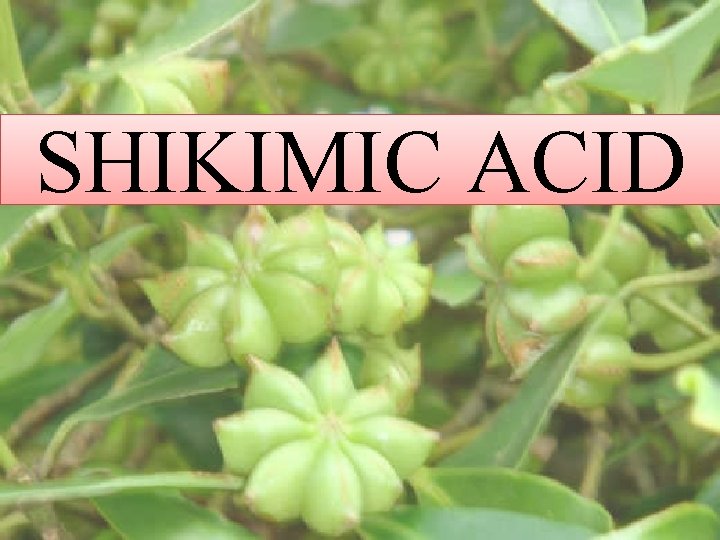
Where this came from? Shikimi Illicium anisatum
Shikimic acid is a precursor for: 1. Aromatic amino acids phenylalanine and tyrosine 2. Indole, and indole derivatives and a. a. a tryptophan 3. Alkaloids 4. Phenylpropanoids, flavonoids, tannins, and lignins.
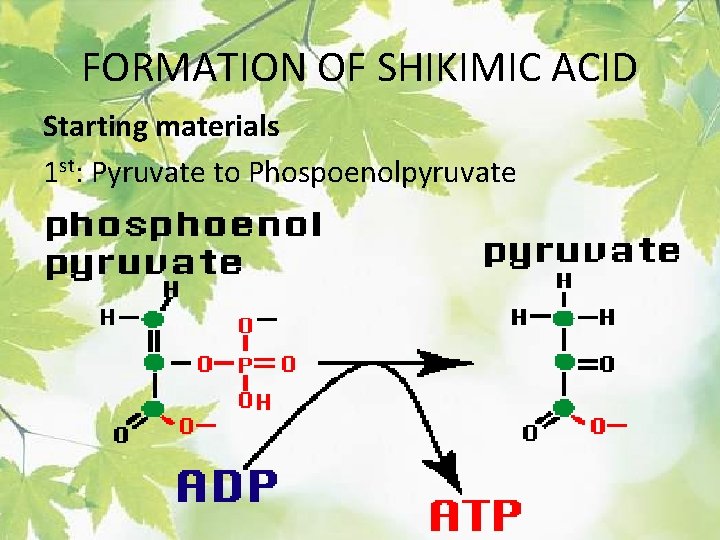
FORMATION OF SHIKIMIC ACID Starting materials 1 st: Pyruvate to Phospoenolpyruvate
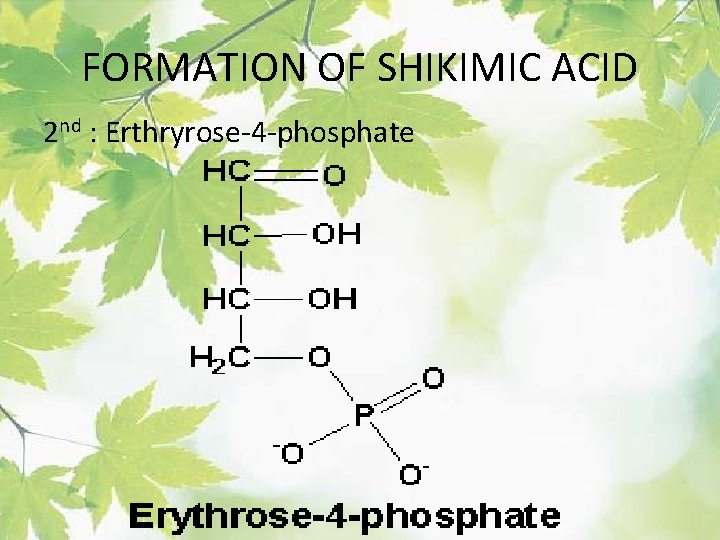
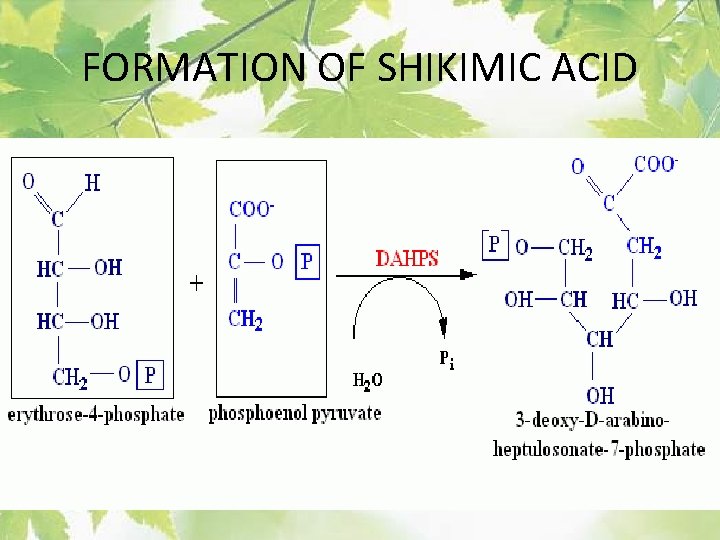
FORMATION OF SHIKIMIC ACID 2 nd : Erthryrose-4 -phosphate
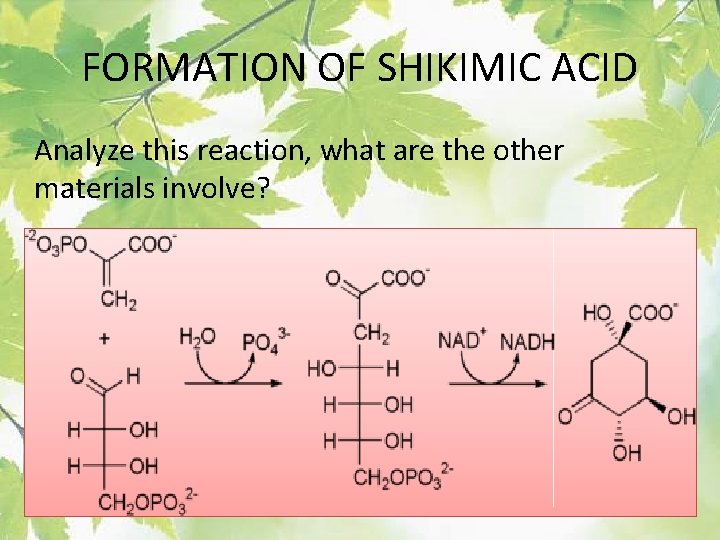
FORMATION OF SHIKIMIC ACID Analyze this reaction, what are the other materials involve?
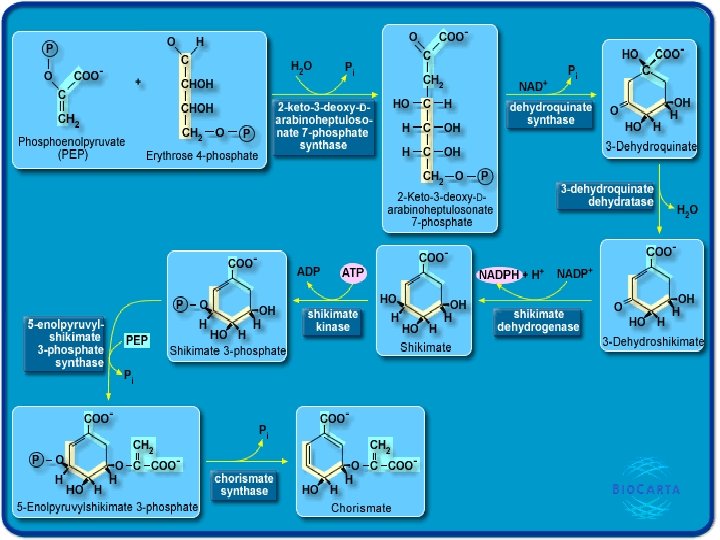
FORMATION OF SHIKIMIC ACID 3 -deoxy-D-arabinoheptulosonate 7 phosphate (DAHP) synthase is the first enzyme in a series of metabolic reactions known as the shikimate pathway. Since it is the first enzyme in the shikimate pathway, it controls the amount of carbon entering the pathway.
FORMATION OF SHIKIMIC ACID
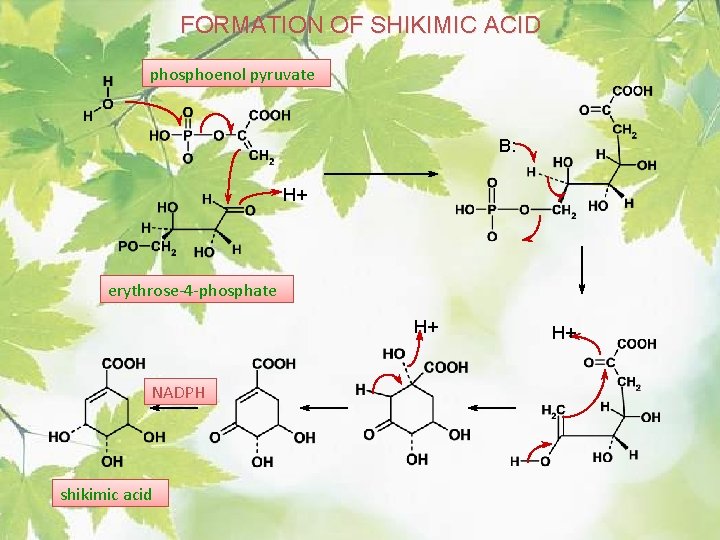
FORMATION OF SHIKIMIC ACID phosphoenol pyruvate B: H+ erythrose-4 -phosphate H+ NADPH shikimic acid H+
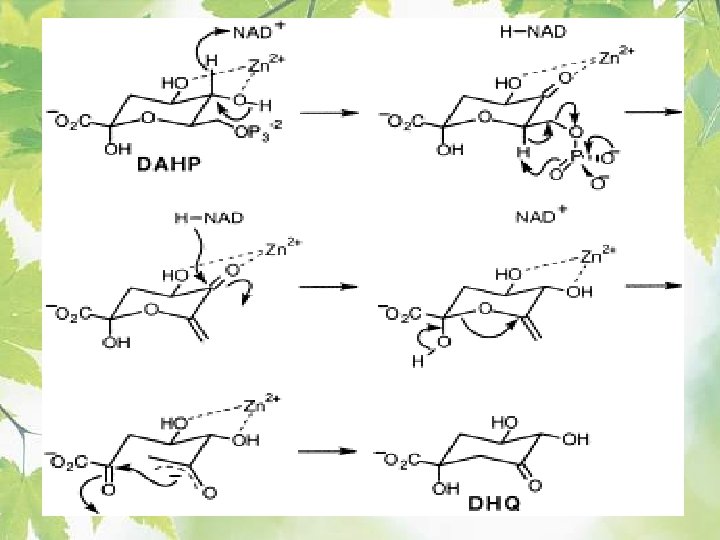
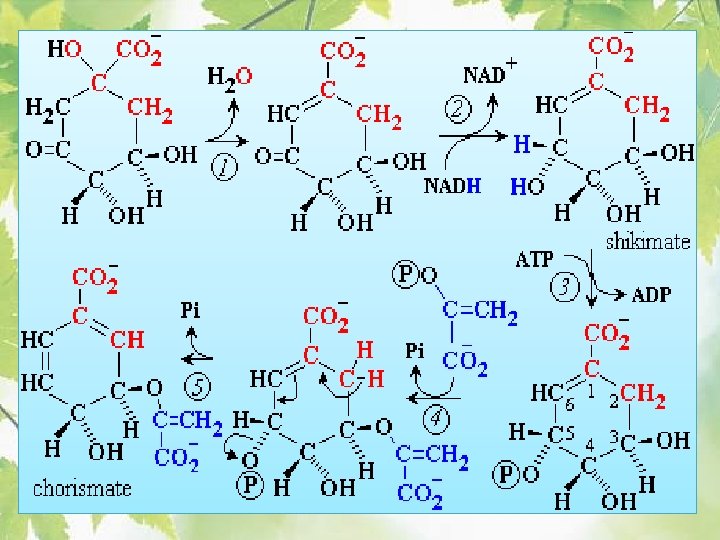
FORMATION OF SHIKIMIC ACID 3 -dehydroquinate synthase is the second enzyme of the shikimate pathway. It catalyzes the elimination of phosphate from DAHP to generate 3 -dehydroquinate (DHQ).
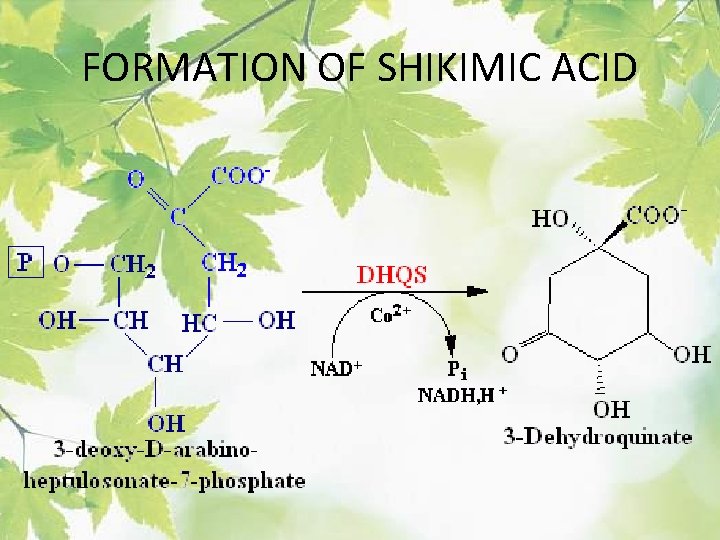
FORMATION OF SHIKIMIC ACID
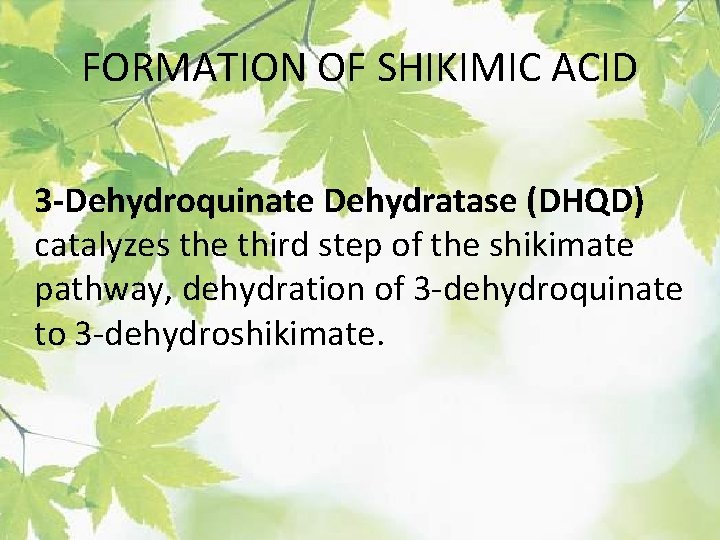
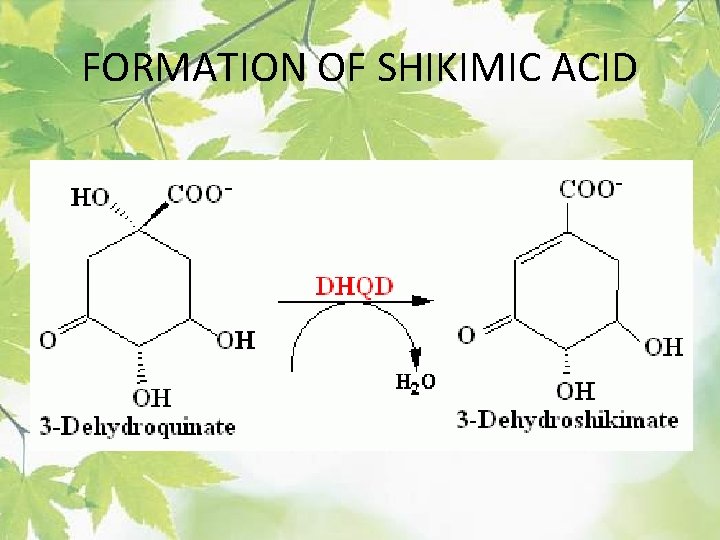
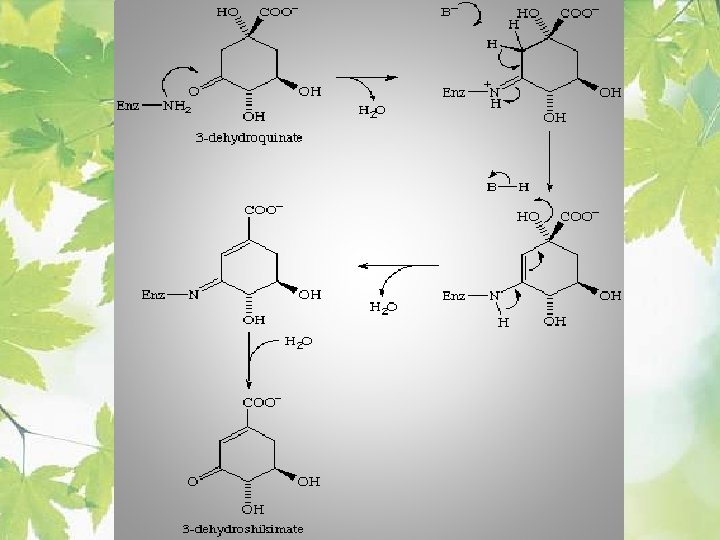
FORMATION OF SHIKIMIC ACID 3 -Dehydroquinate Dehydratase (DHQD) catalyzes the third step of the shikimate pathway, dehydration of 3 -dehydroquinate to 3 -dehydroshikimate.
FORMATION OF SHIKIMIC ACID
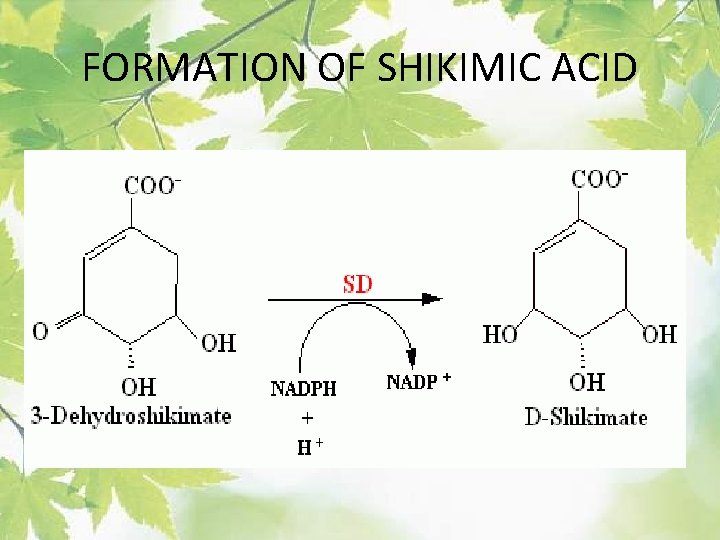
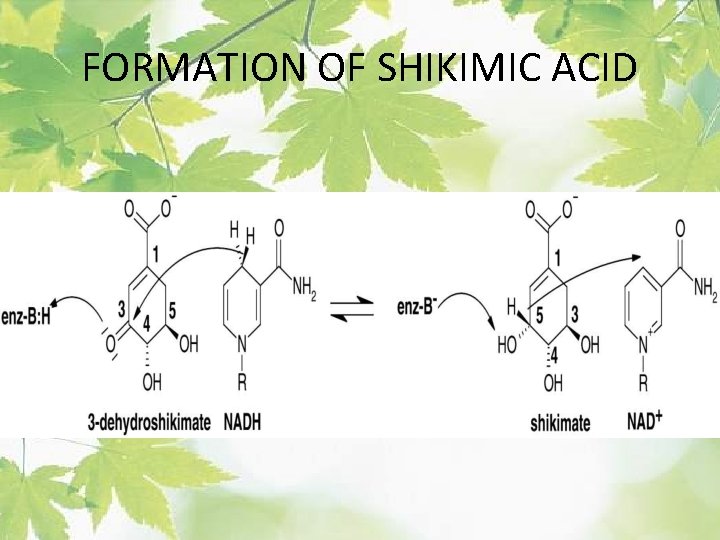
FORMATION OF SHIKIMIC ACID Shikimate-5 -Dehydrogenase (SDH) The fourth step of the shikimate pathway is the reduction of DHS to shikimate. the reaction is catalyzed by an NADP-dependent shikimate dehydrogenase (SHD)
FORMATION OF SHIKIMIC ACID
FORMATION OF SHIKIMIC ACID
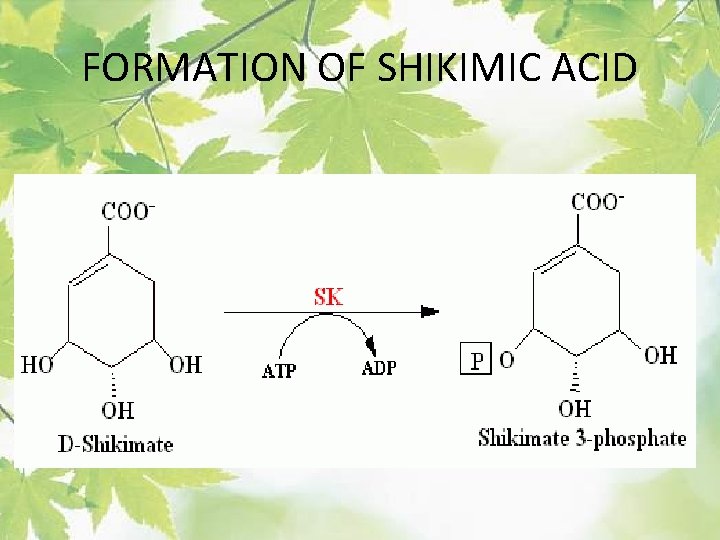
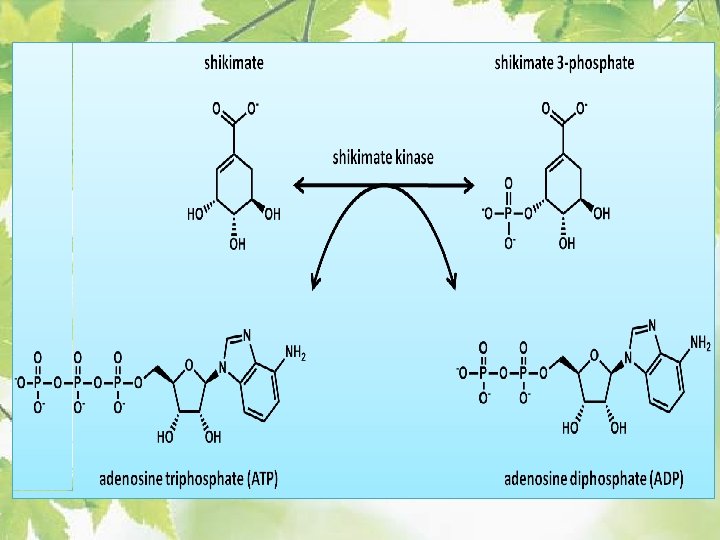
FORMATION OF SHIKIMIC ACID Shikimate Kinase (SK)- In the fifth step of the shikimate pathway, shikimate kinase catalyzes the specific phosphorylation of the 3 -hydroxyl group of D-shikimate to yield shikimate 3 -phosphate using ATP as a cosubtrate
FORMATION OF SHIKIMIC ACID
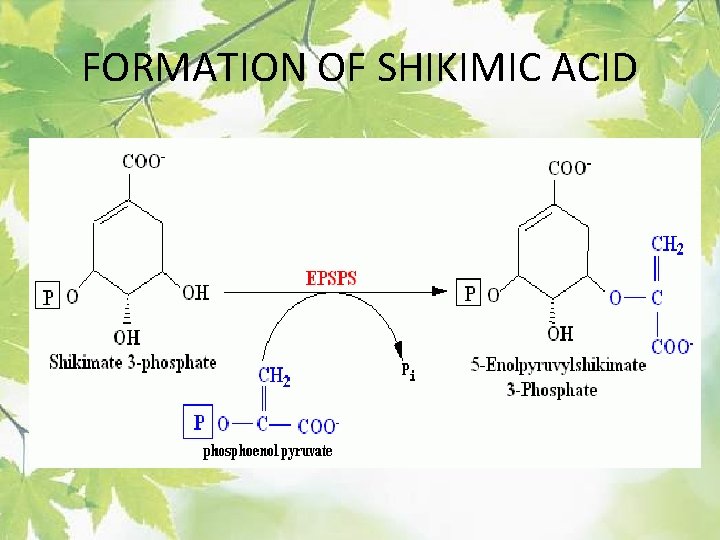
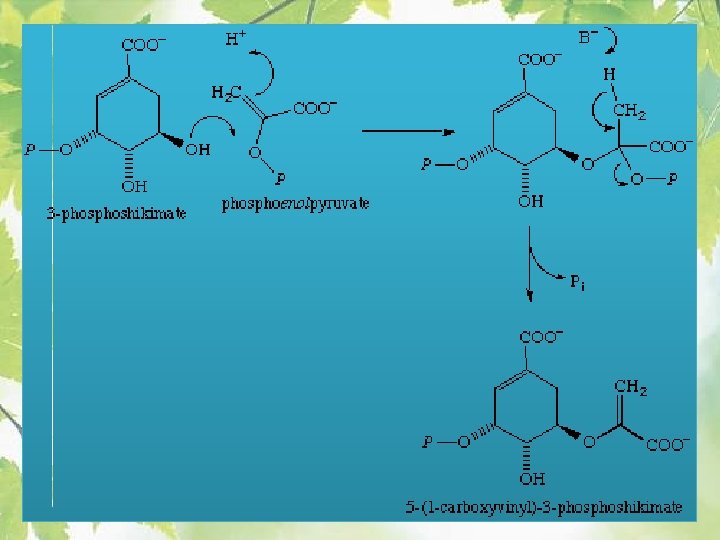
FORMATION OF SHIKIMIC ACID 5 -Enolpyruvylshikimate 3 -Phosphate Synthase (EPSPS) is the sixth enzyme of the shikimate pathway. It catalyzes the reversible formation of 5 -enolpyruvylshikimate-3 - phosphate (EPSP) from shikimate 3 -phosphate and PEP.
FORMATION OF SHIKIMIC ACID
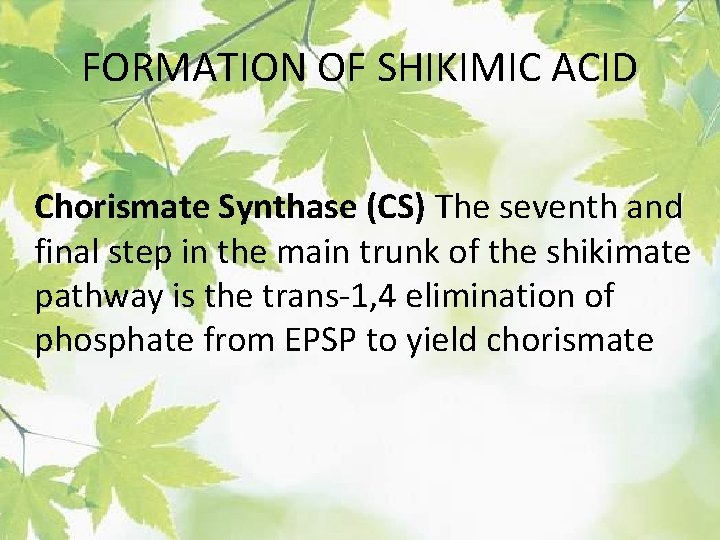
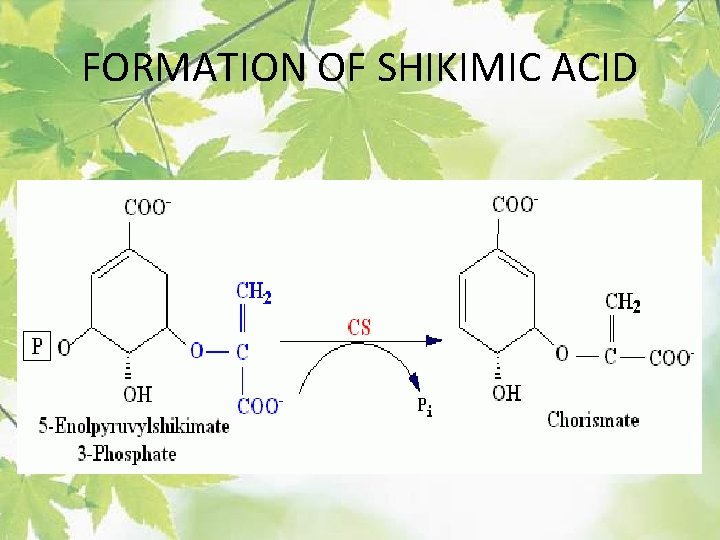
FORMATION OF SHIKIMIC ACID Chorismate Synthase (CS) The seventh and final step in the main trunk of the shikimate pathway is the trans-1, 4 elimination of phosphate from EPSP to yield chorismate
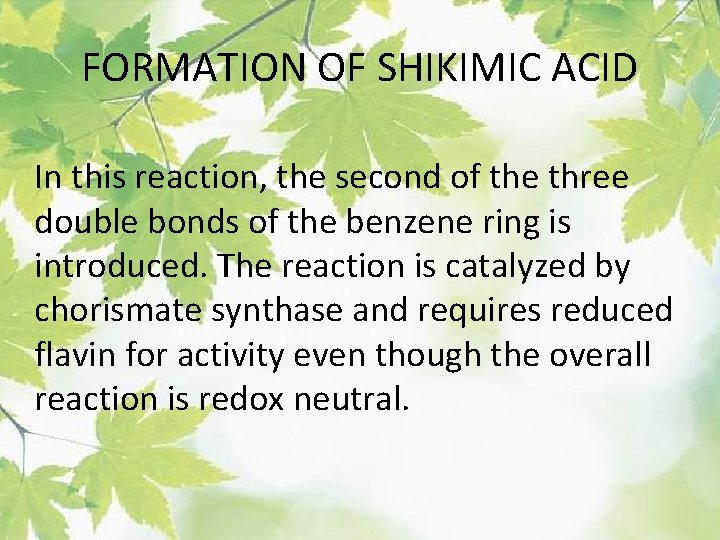
FORMATION OF SHIKIMIC ACID In this reaction, the second of the three double bonds of the benzene ring is introduced. The reaction is catalyzed by chorismate synthase and requires reduced flavin for activity even though the overall reaction is redox neutral.
FORMATION OF SHIKIMIC ACID
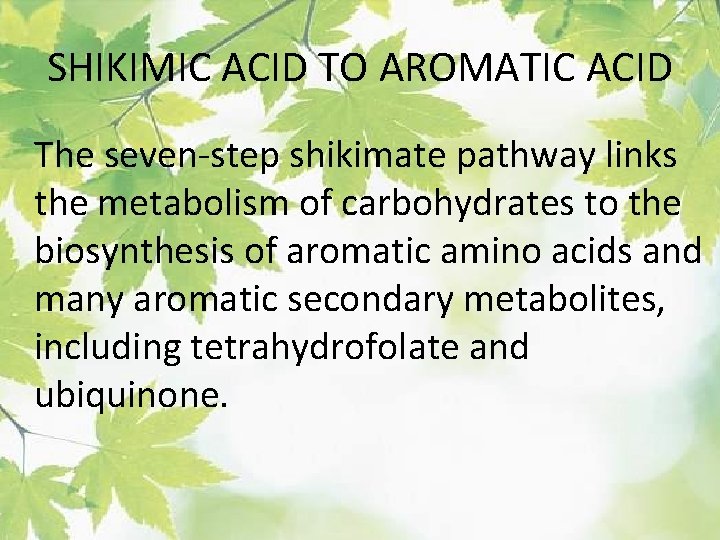
SHIKIMIC ACID TO AROMATIC ACID The seven-step shikimate pathway links the metabolism of carbohydrates to the biosynthesis of aromatic amino acids and many aromatic secondary metabolites, including tetrahydrofolate and ubiquinone.
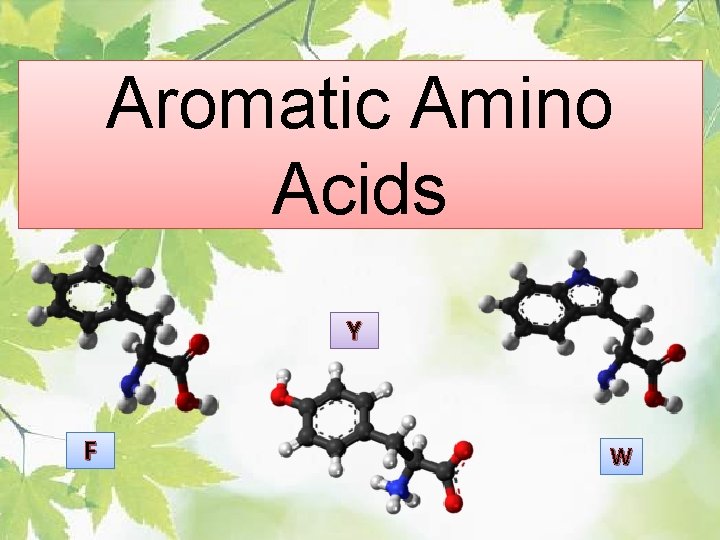
Aromatic Amino Acids Y F W
Aromatic Amino Acids 1. What are aromatic amino acids? Aromatic Amino Acids are amino acids that include an aromatic ring. Example includes: Phenylalanine, Tryptophan, Histidine, Tyrosine (but only F, W, Y can be synthesized by Shikimate pathway)
The Aromatic Family q. In plants and microorganism: Phe, Tyr, and Trp q Precursors are: ü PEP ü ERYTHROSE-4 -PHOSPHATE ü CHORISMATE
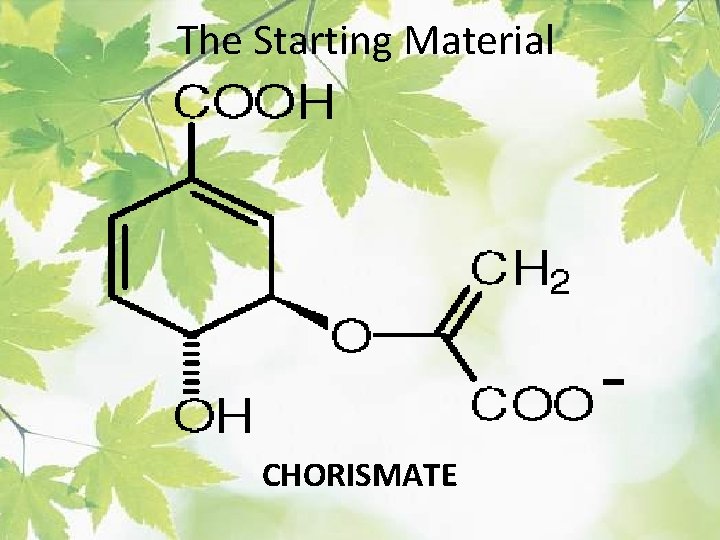
The Starting Material CHORISMATE
Enzymes Isomerase is an enzyme that catalyzes the structural rearrangement of isomers. Mutase: catalyzes the shifting of a functional group from one position to another within the same molecule. Transferase: catalyzes the transfer of a functional group (methyl or phosphate)from one molecule to another
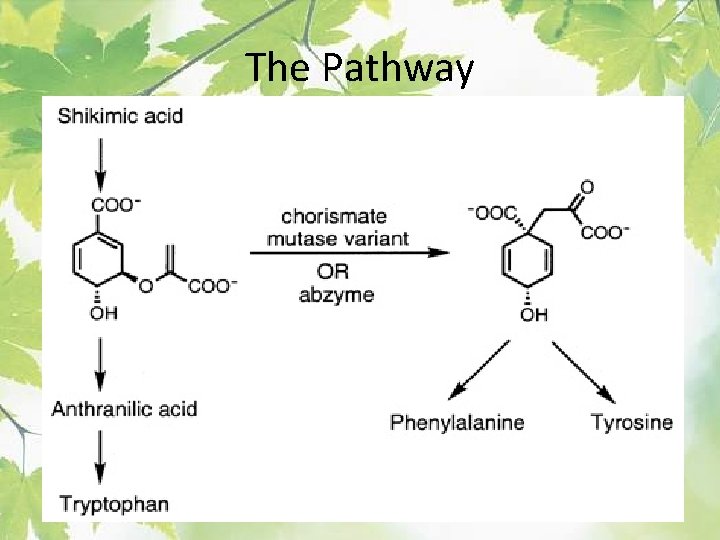
The Pathway
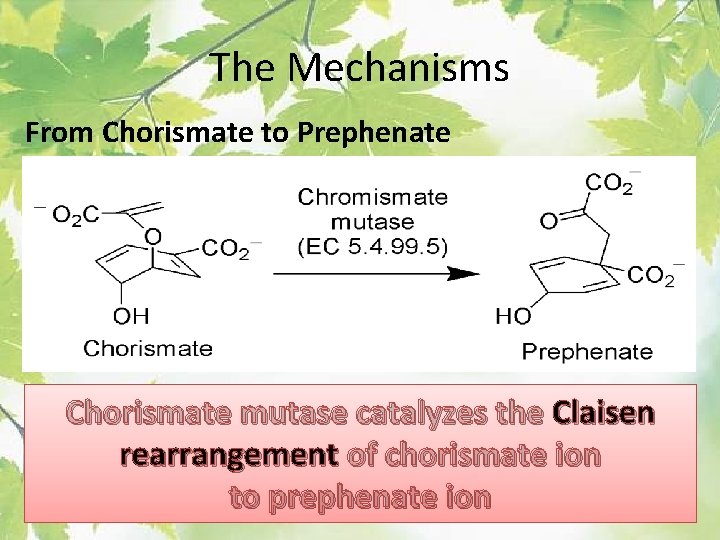
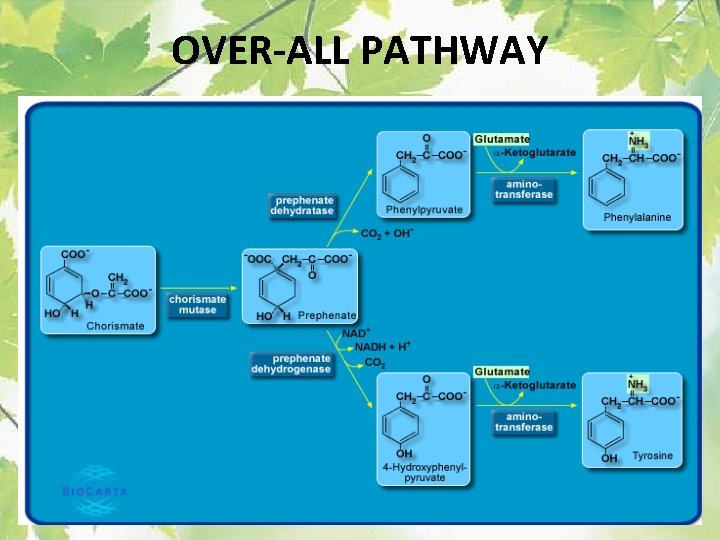
The Mechanisms From Chorismate to Prephenate Chorismate mutase catalyzes the Claisen rearrangement of chorismate ion to prephenate ion
The Mechanisms What is Claisen Rearrangement? üClaisen Rearrangement is a powerful carbon-carbon bondforming chemical reaction discovered by Rainer Ludwig Claisen.
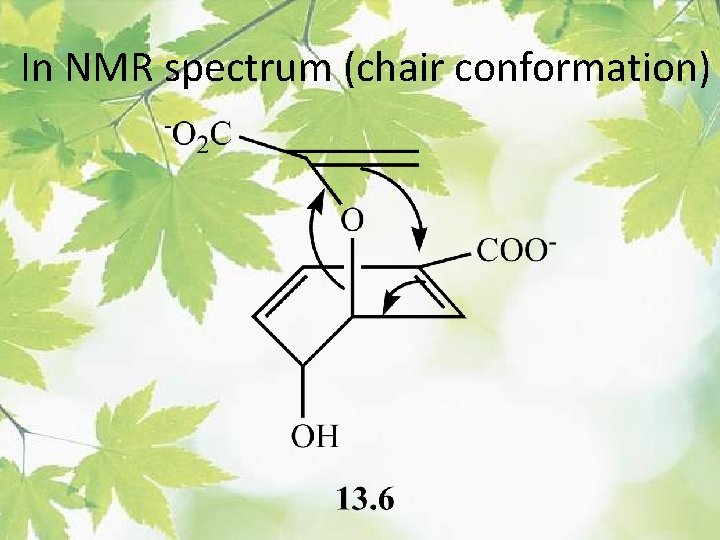
In NMR spectrum (chair conformation)
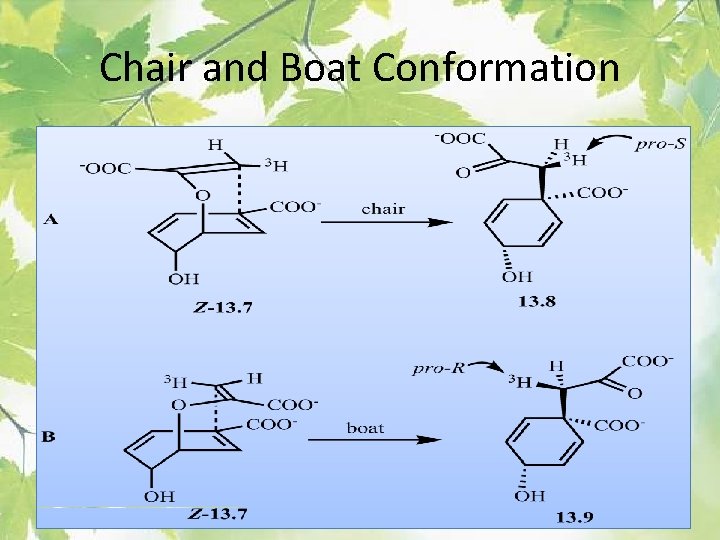
Chair and Boat Conformation
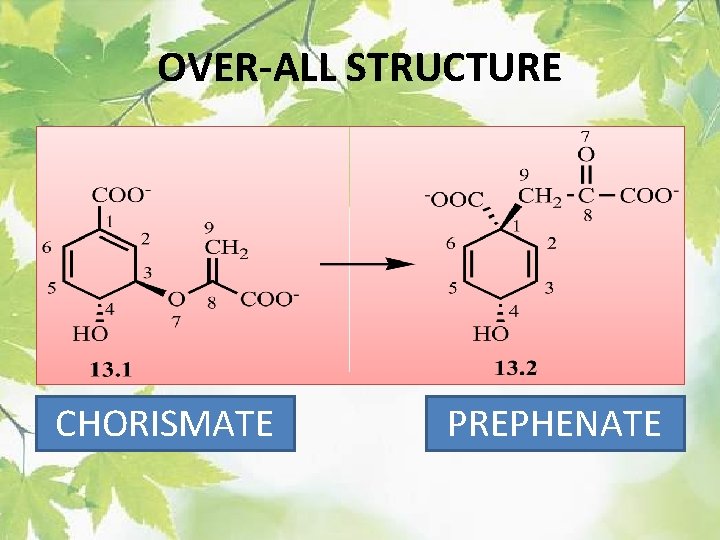
OVER-ALL STRUCTURE CHORISMATE PREPHENATE
Phenylalanine Biosynthesis
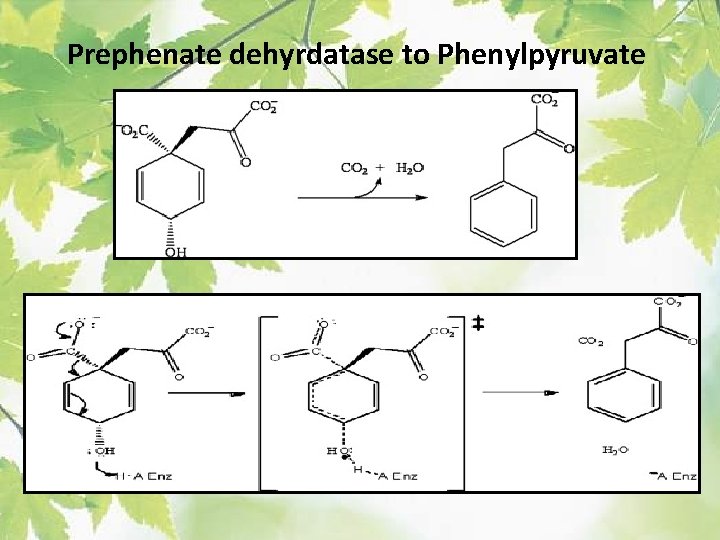
Prephenate dehyrdatase to Phenylpyruvate
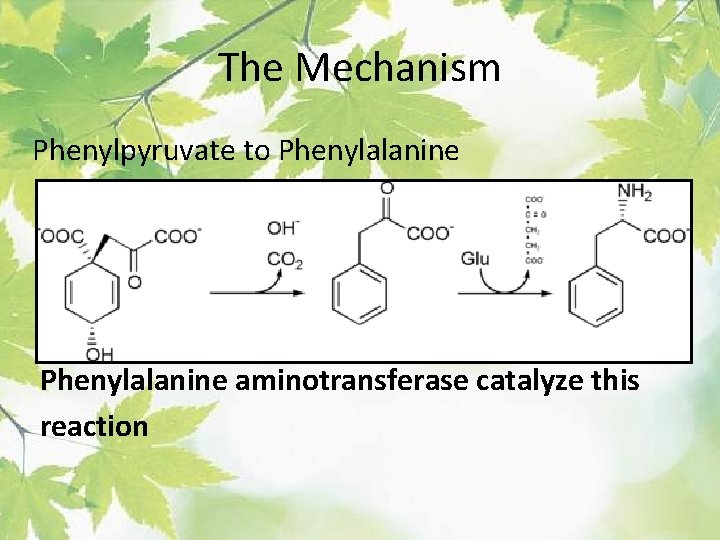
The Mechanism Phenylpyruvate to Phenylalanine aminotransferase catalyze this reaction
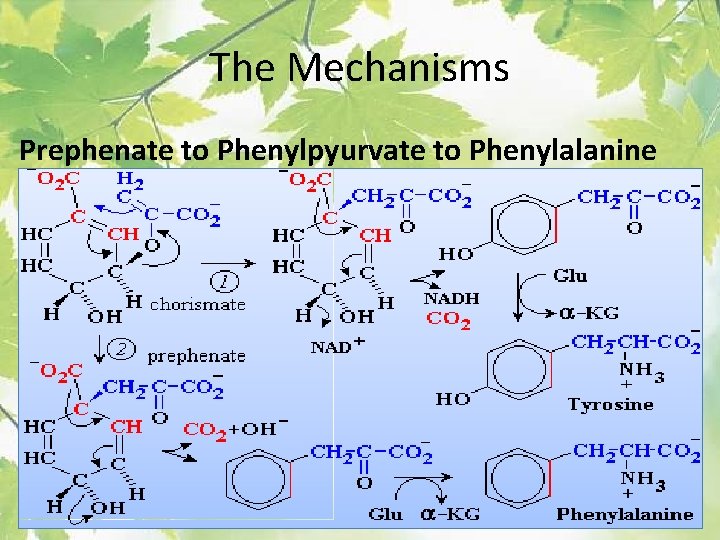
The Mechanisms Prephenate to Phenylpyurvate to Phenylalanine
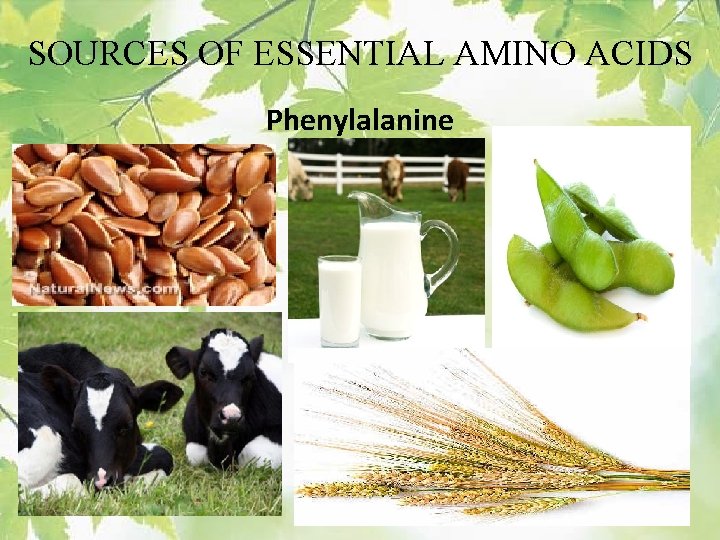
SOURCES OF ESSENTIAL AMINO ACIDS Phenylalanine
Tyrosine Biosynthesis
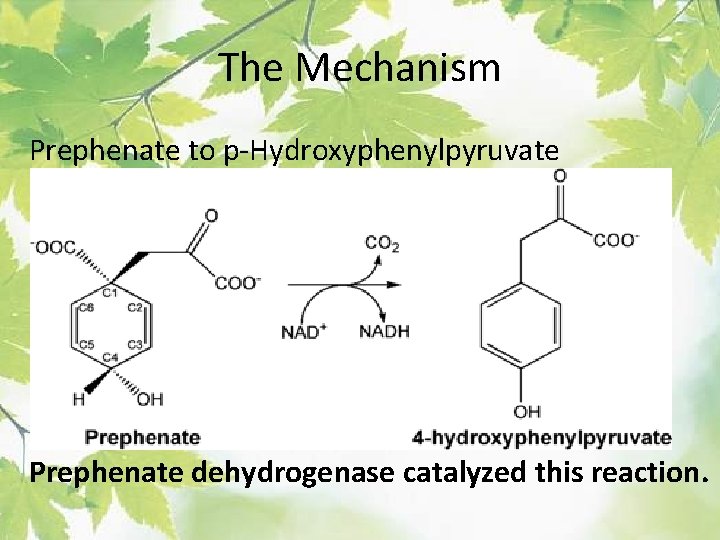
The Mechanism Prephenate to p-Hydroxyphenylpyruvate Prephenate dehydrogenase catalyzed this reaction.
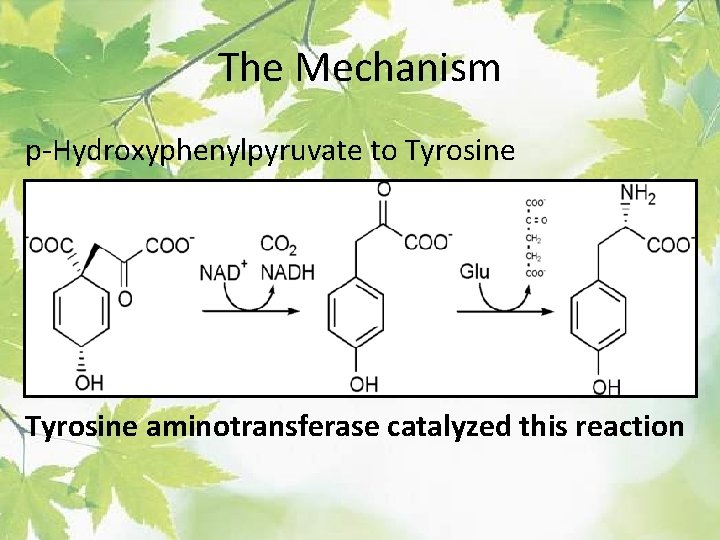
The Mechanism p-Hydroxyphenylpyruvate to Tyrosine aminotransferase catalyzed this reaction
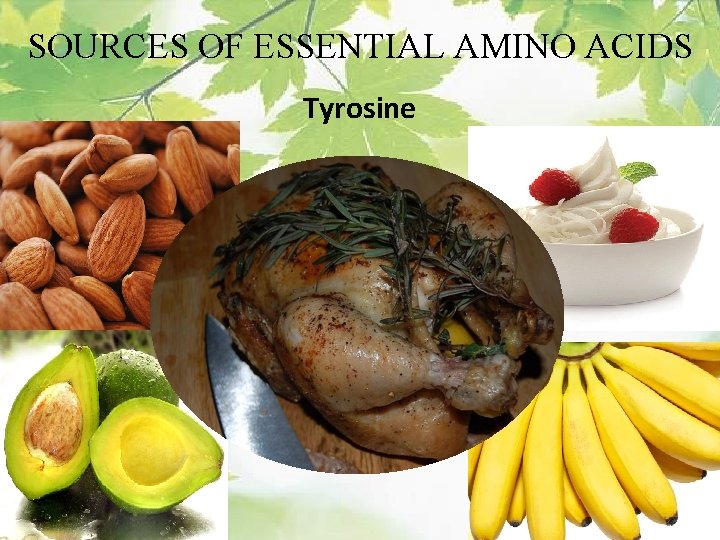
SOURCES OF ESSENTIAL AMINO ACIDS Tyrosine
OVER-ALL PATHWAY
Tryptophan Biosynthesis
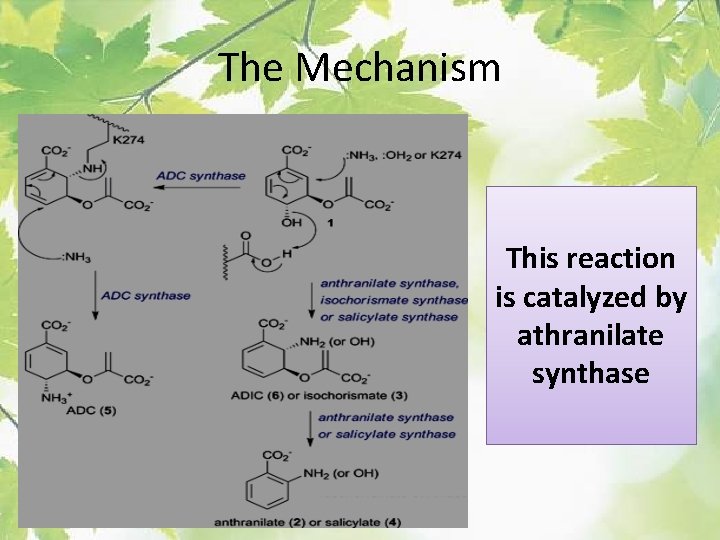
The Mechanism This reaction is catalyzed by athranilate synthase
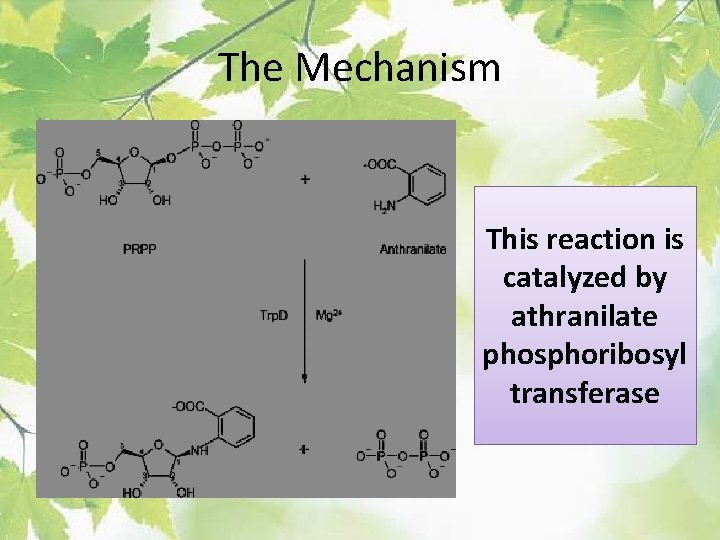
The Mechanism This reaction is catalyzed by athranilate phosphoribosyl transferase
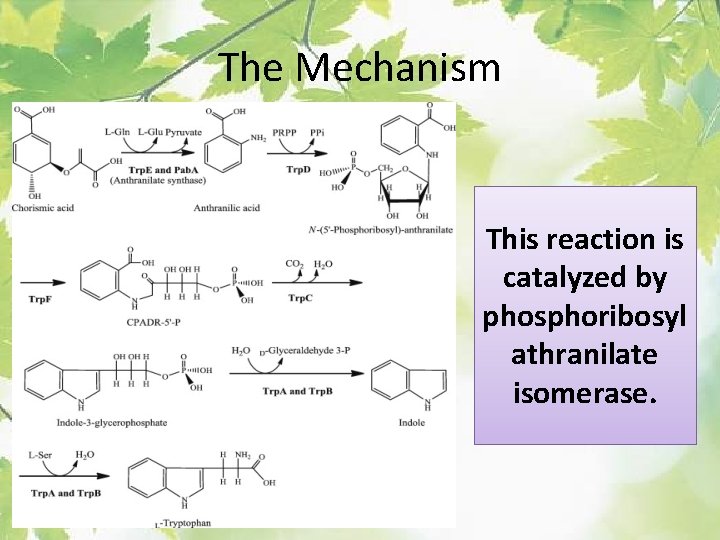
The Mechanism This reaction is catalyzed by phosphoribosyl athranilate isomerase.
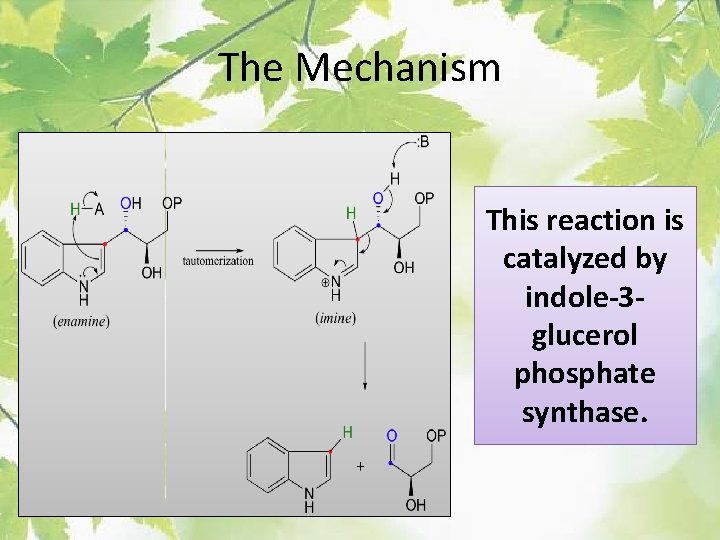
The Mechanism This reaction is catalyzed by indole-3 glucerol phosphate synthase.
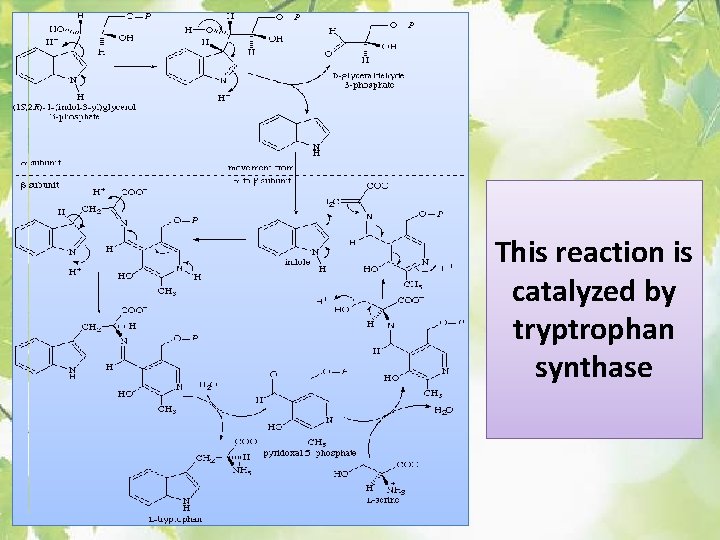
This reaction is catalyzed by tryptrophan synthase
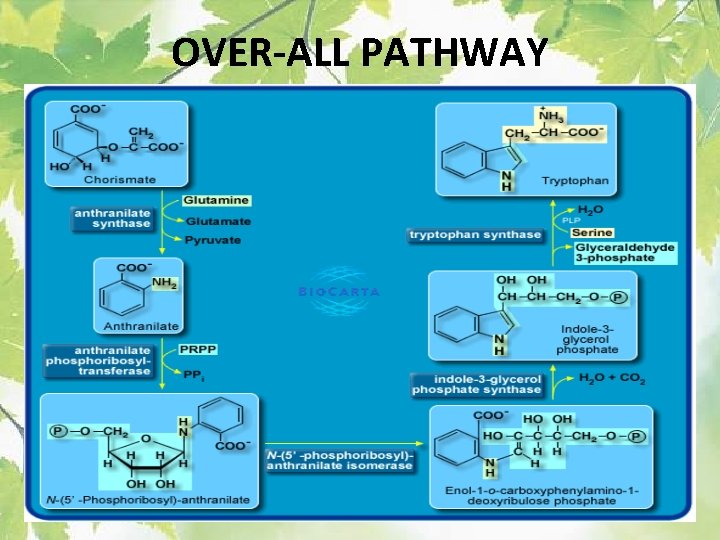
OVER-ALL PATHWAY
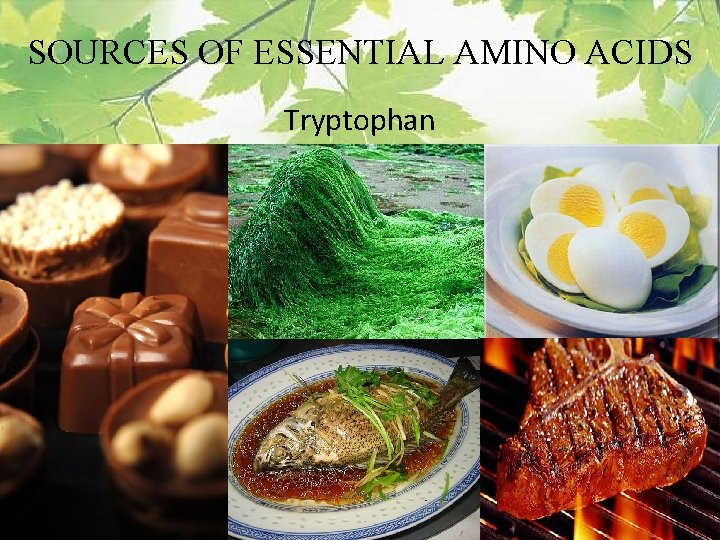
SOURCES OF ESSENTIAL AMINO ACIDS Tryptophan
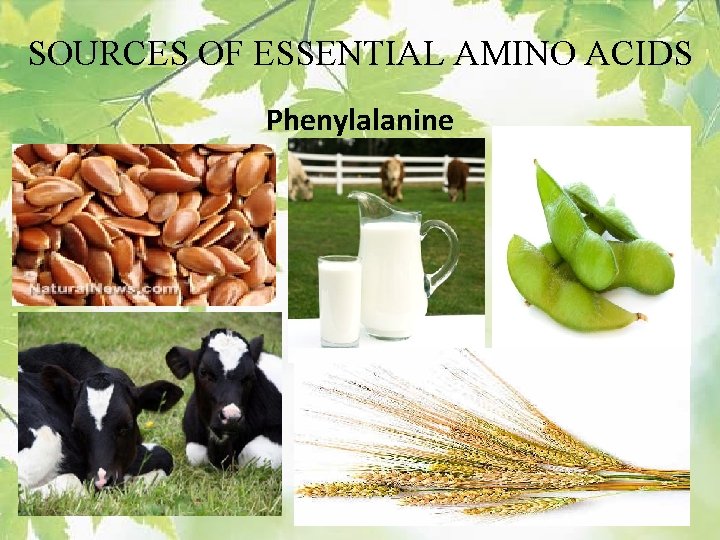
SOURCES OF ESSENTIAL AMINO ACIDS Phenylalanine
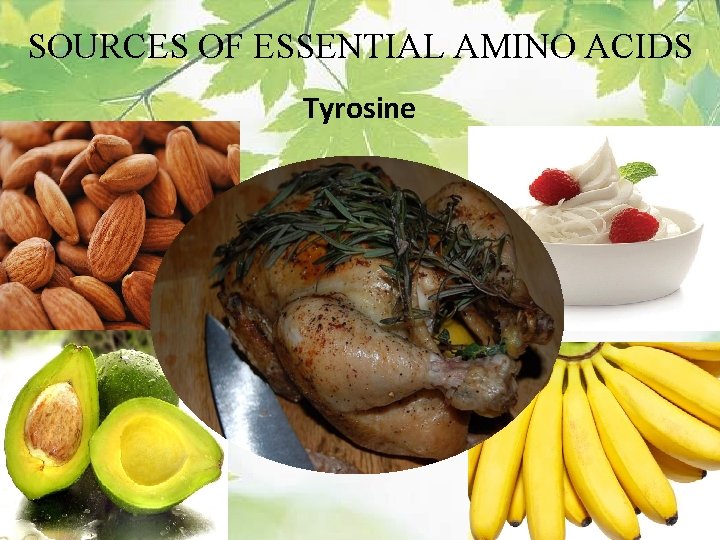
SOURCES OF ESSENTIAL AMINO ACIDS Tyrosine
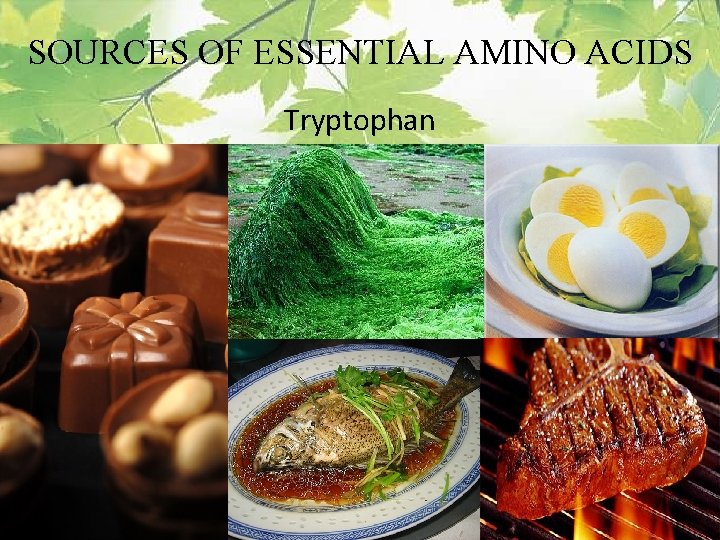
SOURCES OF ESSENTIAL AMINO ACIDS Tryptophan
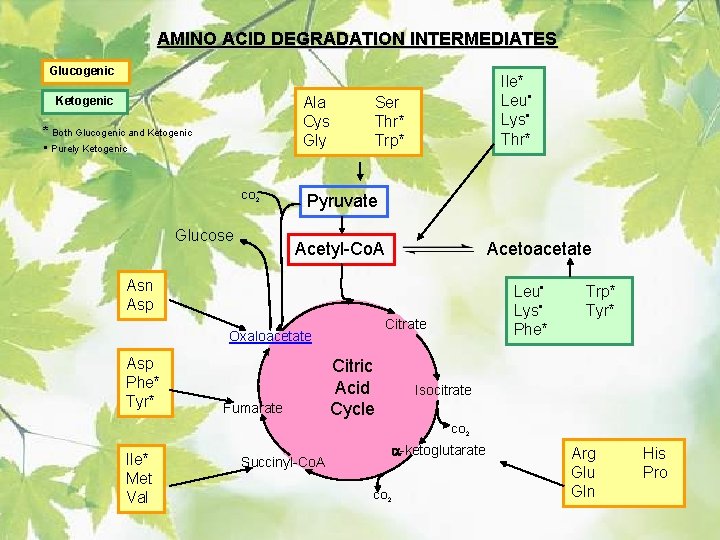
AMINO ACID DEGRADATION INTERMEDIATES Glucogenic Ala Cys Gly Ketogenic * Both Glucogenic and Ketogenic • Purely Ketogenic CO 2 Glucose Ile* Leu • Lys • Thr* Ser Thr* Trp* Pyruvate Acetyl-Co. A Acetoacetate Asn Asp Citrate Oxaloacetate Asp Phe* Tyr* Fumarate Leu • Lys • Phe* Citric Acid Cycle Trp* Tyr* Isocitrate CO 2 Ile* Met Val Succinyl-Co. A a-ketoglutarate CO 2 Arg Glu Gln His Pro
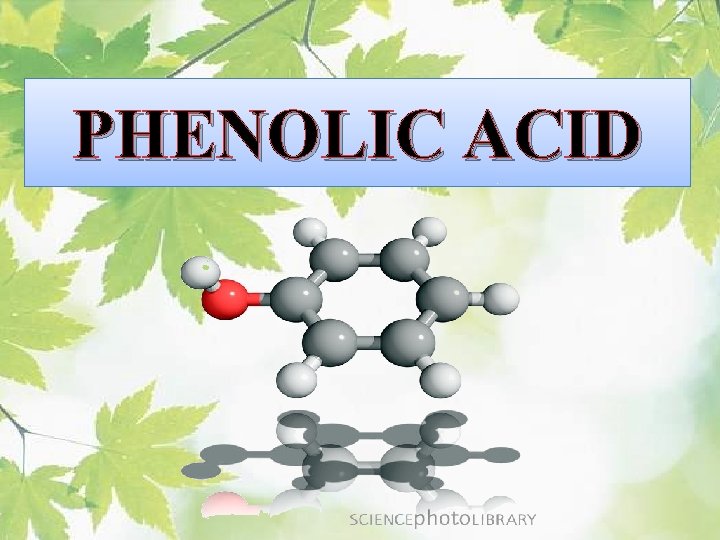
PHENOLIC ACID
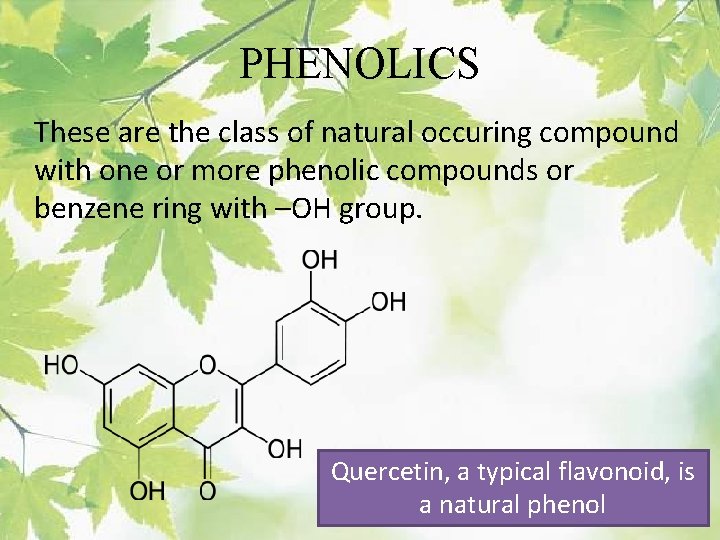
PHENOLICS These are the class of natural occuring compound with one or more phenolic compounds or benzene ring with –OH group. Quercetin, a typical flavonoid, is a natural phenol
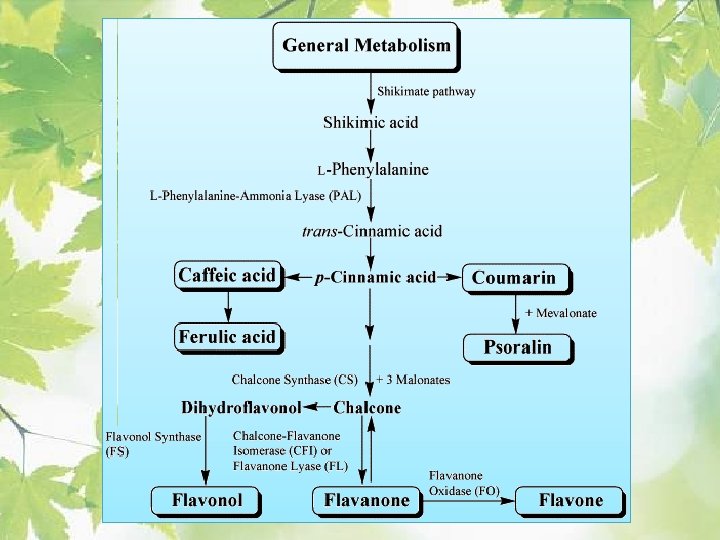
BIOSYNTHESIS OF PHENOLICS Most of the natural phenols are derived from secondary plant metabolism of the shikimic acid pathway, malic acid pathway or both.
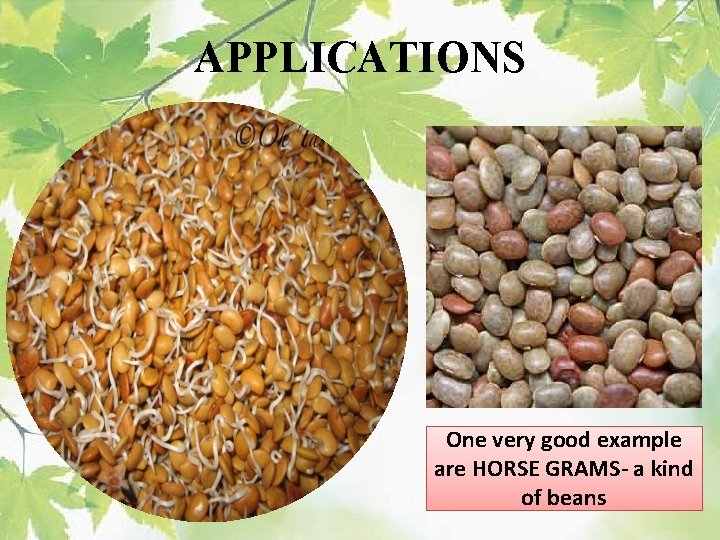
APPLICATIONS One very good example are HORSE GRAMS- a kind of beans
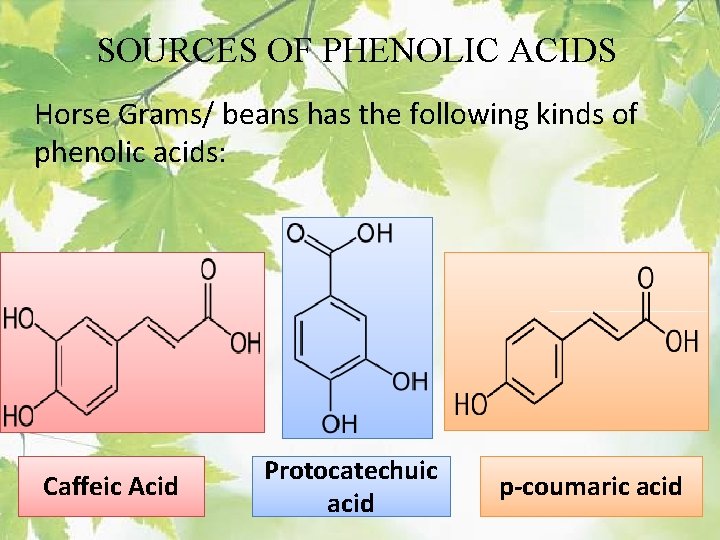
SOURCES OF PHENOLIC ACIDS Horse Grams/ beans has the following kinds of phenolic acids: Caffeic Acid Protocatechuic acid p-coumaric acid

Thank You for Listening !
- Slides: 77