
The Meson Test Beam Facility Erik Ramberg LRP
The Meson Test Beam Facility Erik Ramberg LRP Meeting – Oct. 30, 2003 Delivering MI beam to MTBF User area layout Operational characteristics Detectors Current test beam MOU’s
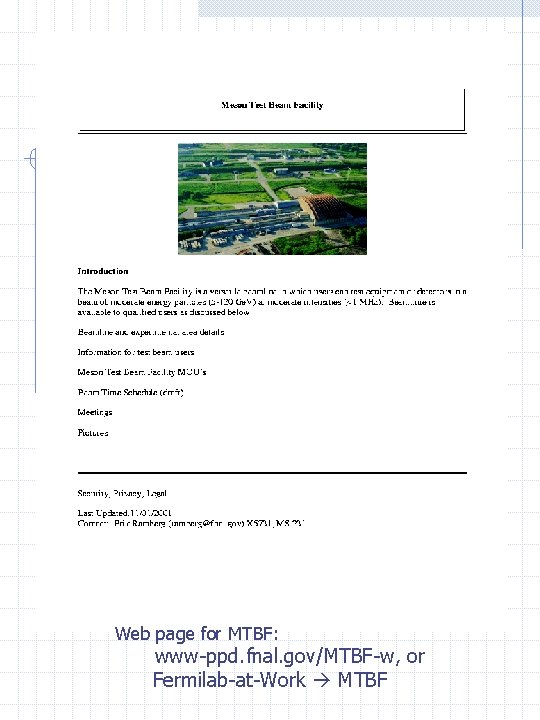
Web page for MTBF: www-ppd. fnal. gov/MTBF-w, or Fermilab-at-Work MTBF
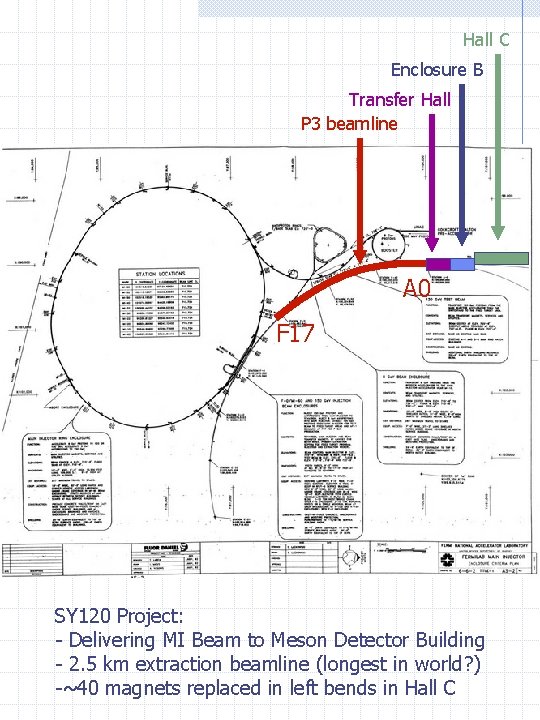
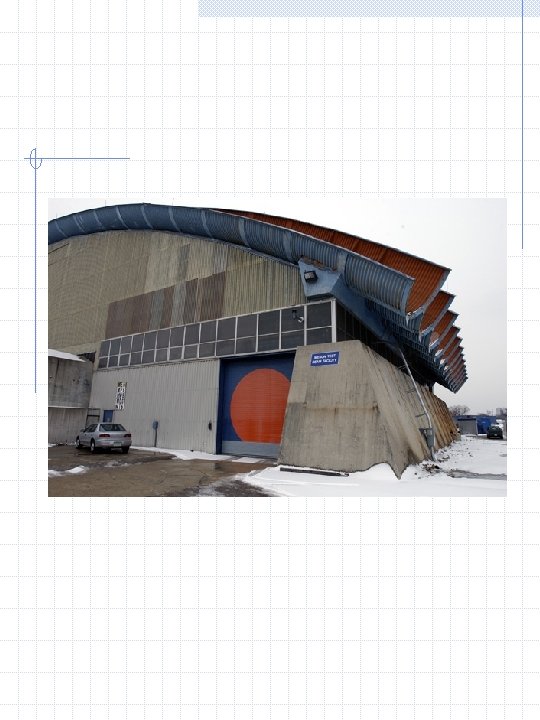
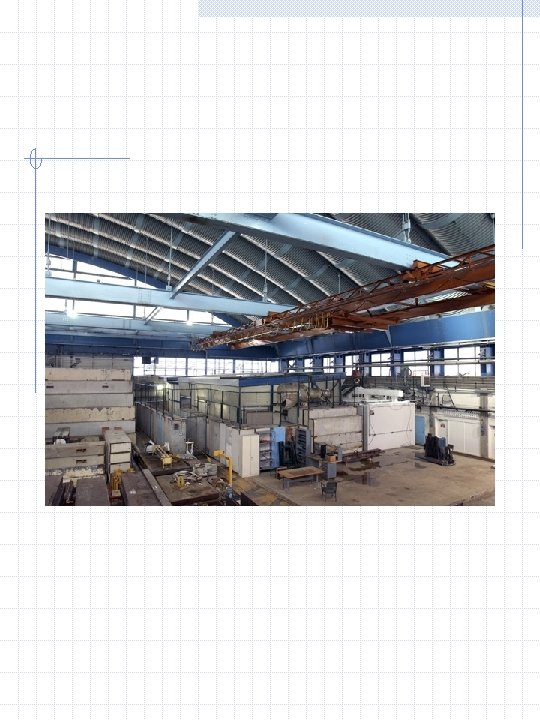
Hall C Enclosure B Transfer Hall P 3 beamline A 0 F 17 SY 120 Project: - Delivering MI Beam to Meson Detector Building - 2. 5 km extraction beamline (longest in world? ) -~40 magnets replaced in left bends in Hall C

Operational Characteristics There are two operational modes: n Proton Mode: We tune all bend magnets for 120 Ge. V. To reduce flux in user areas, we have to turn off focusing quadrupoles and insert pinhole collimator. Rates will be on the order of 700 k. Hz. n Secondary, or ‘Pion’ Mode: We will vary the tune of the bend magnets according to momentum needed. Quads will be in focusing mode and pinhole collimator will be out. Maximum momentum will be 80 Ge. V, with rates on the order of 50 k. Hz. . Lowest momentum tune is on the order of 3 -5 Ge. V. Beamline has secondary targets and sweepers to tune for electrons, but lore indicates that better electron flux can be obtained by just tuning for low momentum and using particle i. d. Beamstop between MT 6 A and MT 6 B can filter for muons in the second user area. An upstream beam stop can be used to select for muons in both areas. Spot sizes can probably be made as small as 3 -5 mm square and as large as 5 cm square.
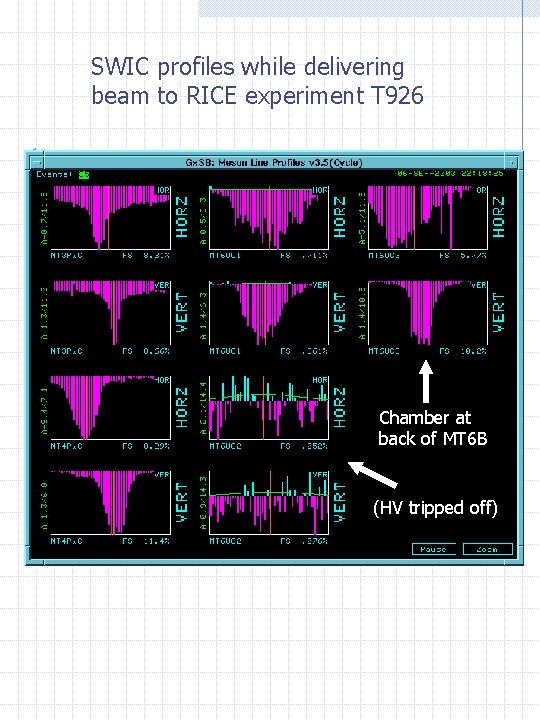
SWIC profiles while delivering beam to RICE experiment T 926 Chamber at back of MT 6 B (HV tripped off)
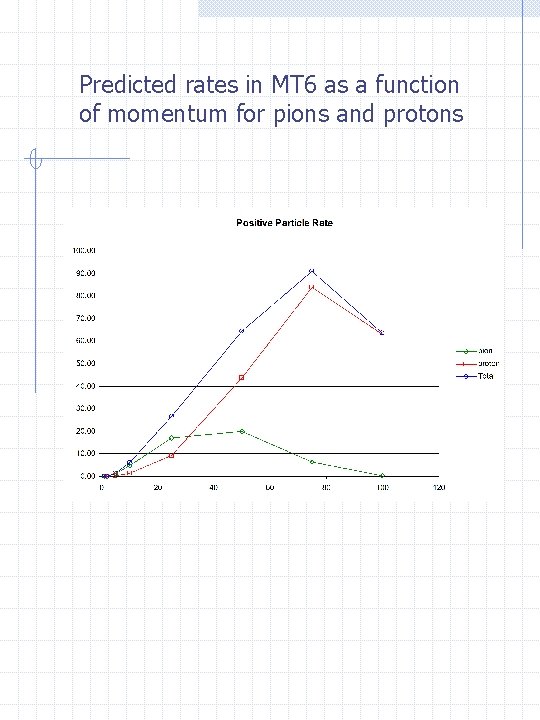
Predicted rates in MT 6 as a function of momentum for pions and protons
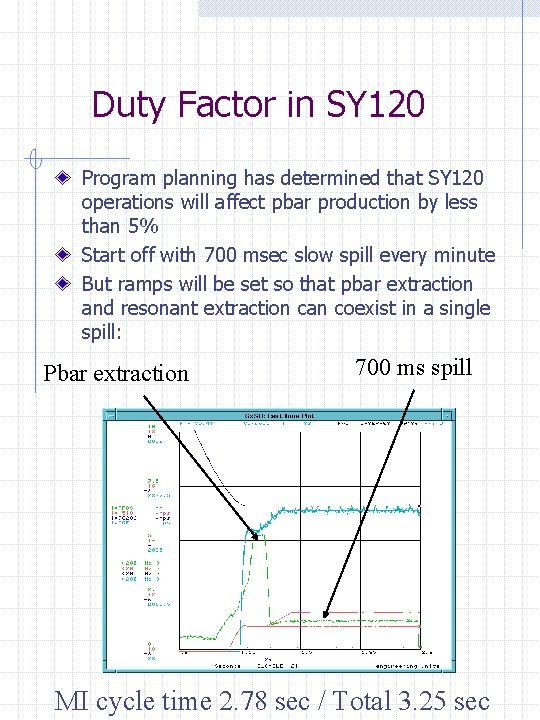
Duty Factor in SY 120 Program planning has determined that SY 120 operations will affect pbar production by less than 5% Start off with 700 msec slow spill every minute But ramps will be set so that pbar extraction and resonant extraction can coexist in a single spill: Pbar extraction 700 ms spill MI cycle time 2. 78 sec / Total 3. 25 sec
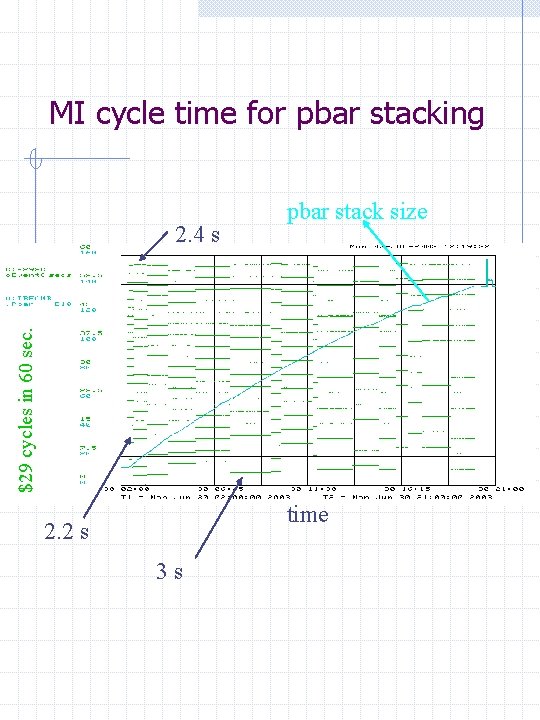
MI cycle time for pbar stacking $29 cycles in 60 sec. 2. 4 s pbar stack size time 2. 2 s 3 s
Facility Detectors Two beamline threshold Cerenkov counters can be operated independently for good particle i. d. (50’ and 80’ long) Two stations of X, Y silicon strip detectors are installed. Three 0. 5 mm pitch MWPC into DAQ Three 1. 0 mm pitch MWPC into the accelerator ACNET control system. DAQ will be minimum bias triggered during the spill. The data from scintillators, Cerenkov counters, silicon and MWPC go into event buffers. Buffers are read out during and after the spill and this data will be accessible to experimenters.
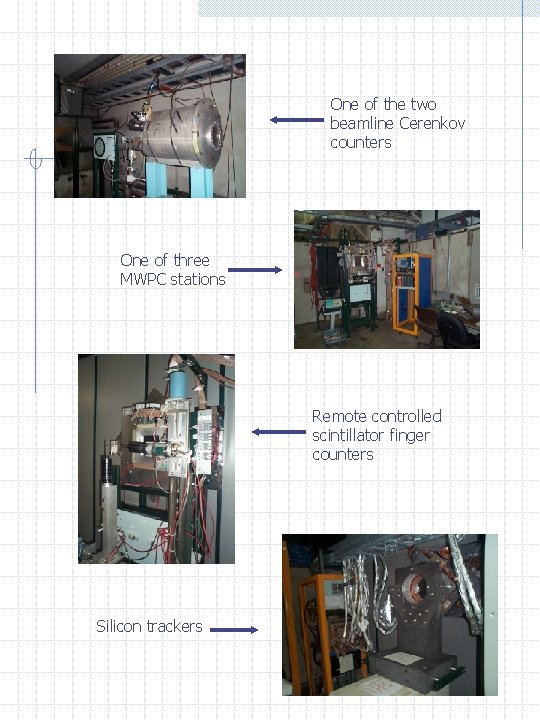
One of the two beamline Cerenkov counters One of three MWPC stations Remote controlled scintillator finger counters Silicon trackers
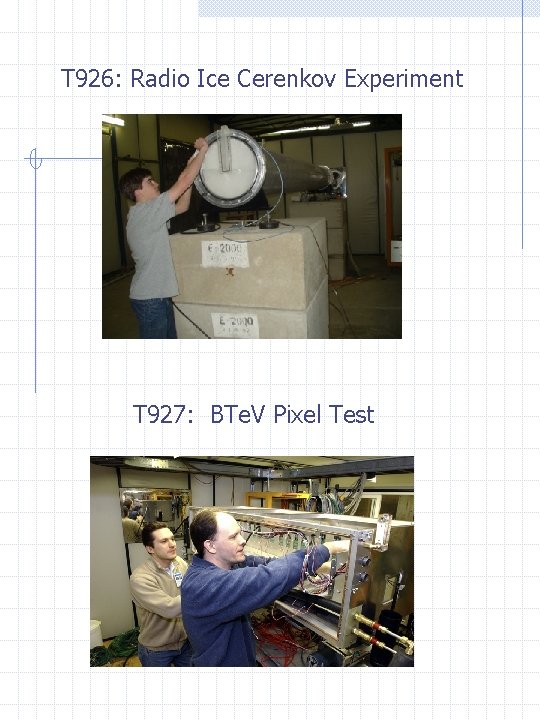
T 926: Radio Ice Cerenkov Experiment T 927: BTe. V Pixel Test
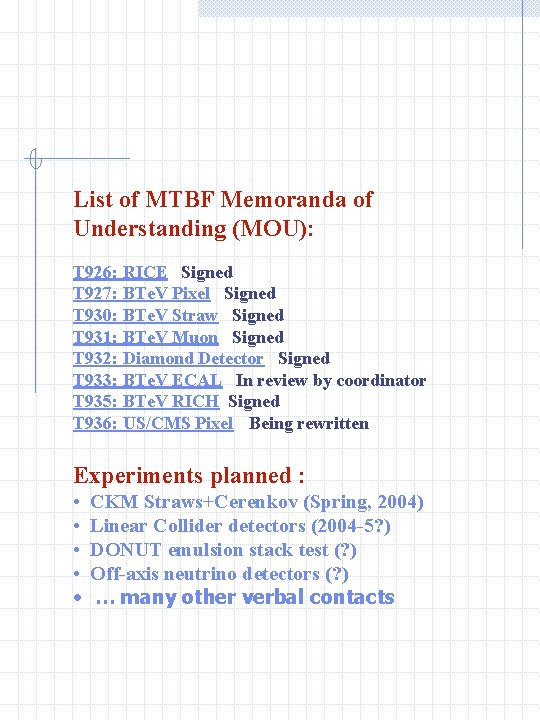
List of MTBF Memoranda of Understanding (MOU): T 926: RICE Signed T 927: BTe. V Pixel Signed T 930: BTe. V Straw Signed T 931: BTe. V Muon Signed T 932: Diamond Detector Signed T 933: BTe. V ECAL In review by coordinator T 935: BTe. V RICH Signed T 936: US/CMS Pixel Being rewritten Experiments planned : • • • CKM Straws+Cerenkov (Spring, 2004) Linear Collider detectors (2004 -5? ) DONUT emulsion stack test (? ) Off-axis neutrino detectors (? ) … many other verbal contacts
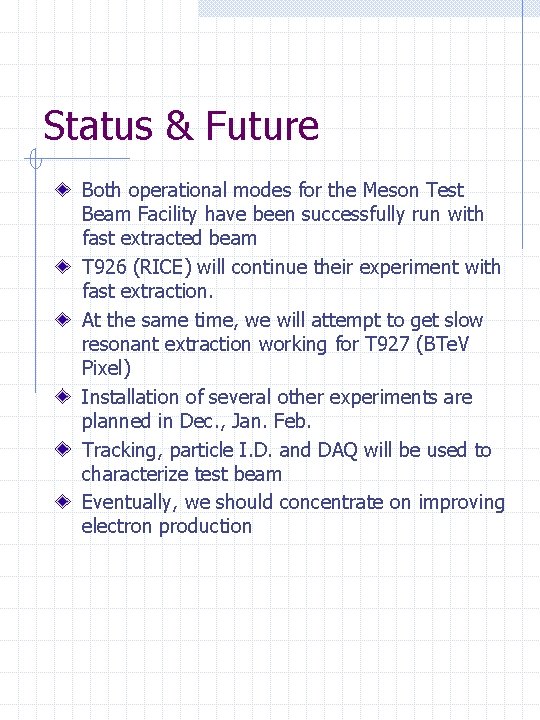
Status & Future Both operational modes for the Meson Test Beam Facility have been successfully run with fast extracted beam T 926 (RICE) will continue their experiment with fast extraction. At the same time, we will attempt to get slow resonant extraction working for T 927 (BTe. V Pixel) Installation of several other experiments are planned in Dec. , Jan. Feb. Tracking, particle I. D. and DAQ will be used to characterize test beam Eventually, we should concentrate on improving electron production
- Slides: 17