
The Mediterranean The Middle East 2000 500 B
The Mediterranean & The Middle East, 2000 -500 B. C. E. John Ermer World History Miami Beach Senior High School
The Iron Age �The Mediterranean Sea provides vehicle for cultural ex. �New cultures and civilizations emerge in Middle East �Interactions b/w civilizations increases � 2000 s B. C. E. : Many civilizations begin using Iron �Easier to make than bronze, one metal rather than an alloy �Harder and sharper than bronze �Must be heated to higher temperature than bronze �With the Iron Age also came large scale use of horses � Horses allow for quicker and farther travel—empire building
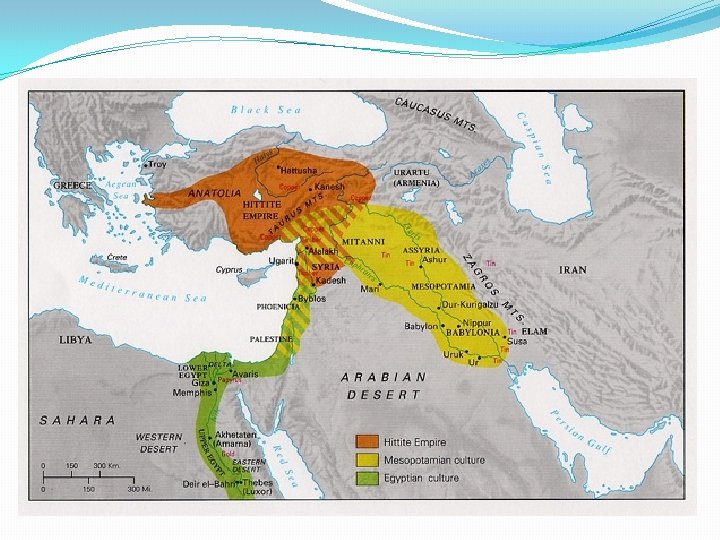
The Cosmopolitan Middle East �The Late Bronze Age �Egypt and Mesopotamia conquered by outsiders � Outsiders either cast out or assimilated into dominant culture �New, large territorial states emerge to dominate Mid. East � Egypt, Babylon (Mesopotamia), Hittite Empire, Phoenicia, Palestine �Cosmopolitan �A time of widely shared cultures and lifestyles � High level of trade and diplomatic relations � High standard of living for elite groups �Conflict between centers of power for control of resources
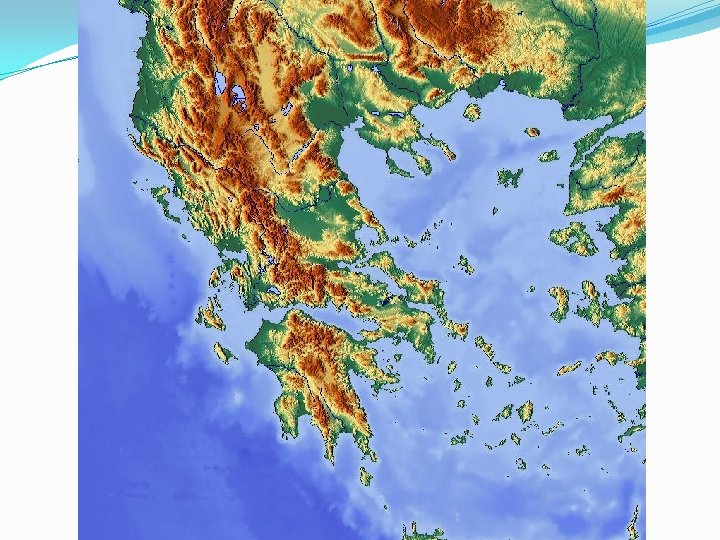
The Aegean World �Geography �Greece and the islands of the Aegean & Ionian seas �Mountainous, mostly rocky, arid climate �Limited arable land, in plains between mountain ranges � Grains, grapevines, olive trees � Food, lumber, metals must be imported by ancient Greeks �Sea travel is easier than overland, trade is paramount
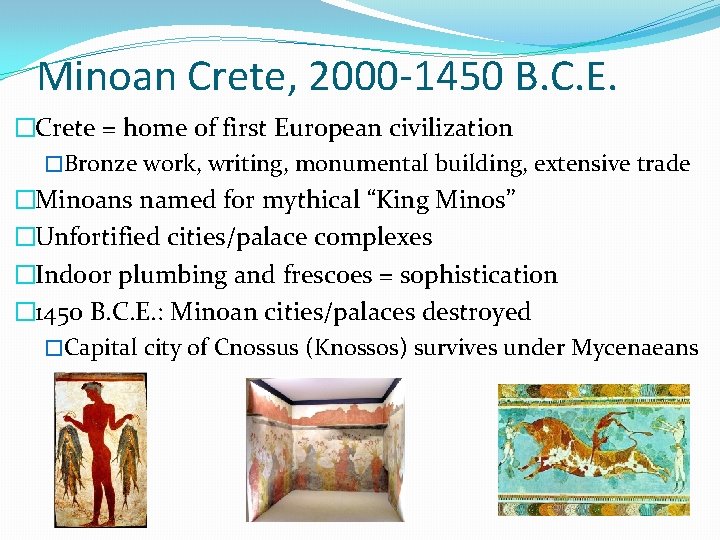
Minoan Crete, 2000 -1450 B. C. E. �Crete = home of first European civilization �Bronze work, writing, monumental building, extensive trade �Minoans named for mythical “King Minos” �Unfortified cities/palace complexes �Indoor plumbing and frescoes = sophistication � 1450 B. C. E. : Minoan cities/palaces destroyed �Capital city of Cnossus (Knossos) survives under Mycenaeans
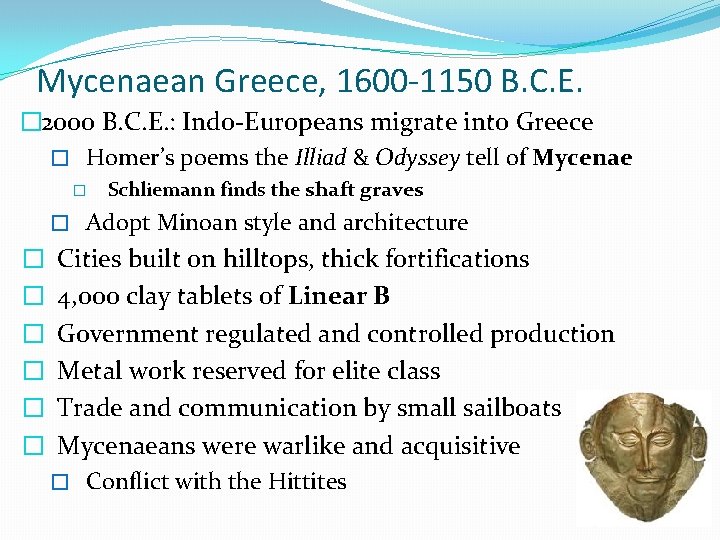
Mycenaean Greece, 1600 -1150 B. C. E. � 2000 B. C. E. : Indo-Europeans migrate into Greece � Homer’s poems the Illiad & Odyssey tell of Mycenae � Schliemann finds the shaft graves � Adopt Minoan style and architecture � � � Cities built on hilltops, thick fortifications 4, 000 clay tablets of Linear B Government regulated and controlled production Metal work reserved for elite class Trade and communication by small sailboats Mycenaeans were warlike and acquisitive � Conflict with the Hittites
Moving & Shaking � 1200 B. C. E. : Mass migrations across the Mediterranean �c. 1200: Hittite kingdom collapses, Ugarit destroyed � 1190: Ramesses III of Egypt battles “Sea People” �Egypt loses control of Palestine, Syria, and Nubia �Egypt falls to possible Mycenaean invasion �c. 1175: Mycenaean civilization collapses �Mediterranean & Middle East enter a Dark Age �Economic and political collapse leads to long, deep decline �War brings limited trade, much poorer societies �Loss of artistic & technical skills, writing/education declines �Loss of writing, artistic & technical skills
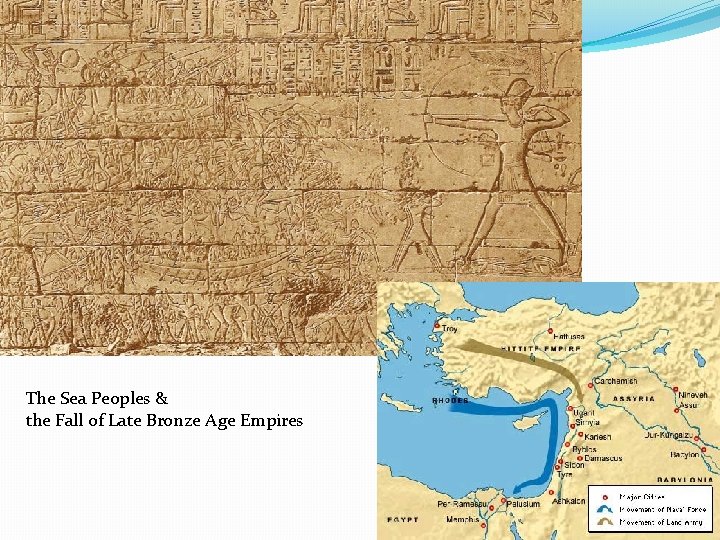
The Sea Peoples & the Fall of Late Bronze Age Empires
Phoenician Colonization of the Mediterranean—Carthage � 900 B. C. E. : Tyre colonizes Cyprus for copper, trade route �Phoenician Triangle: N. Africa, S. Spain, W. Italy, Sicily, Malta � Conflict with Greeks, Sicily is main battleground �Carthage becomes powerful Phoenician colony (N. Africa) �Comes to dominate many other Phoenician colonies �Population of 400, 000 (one of world’s largest cities) �Naval power dominates western Mediterranean � Sailed the Atlantic, sourced tin as far away as England � Trade with Sub-Saharan Africa �Used Numidians, Iberians, and Gauls as merceniaries �Direct control of Iberia & Sardinia, system of protectorates
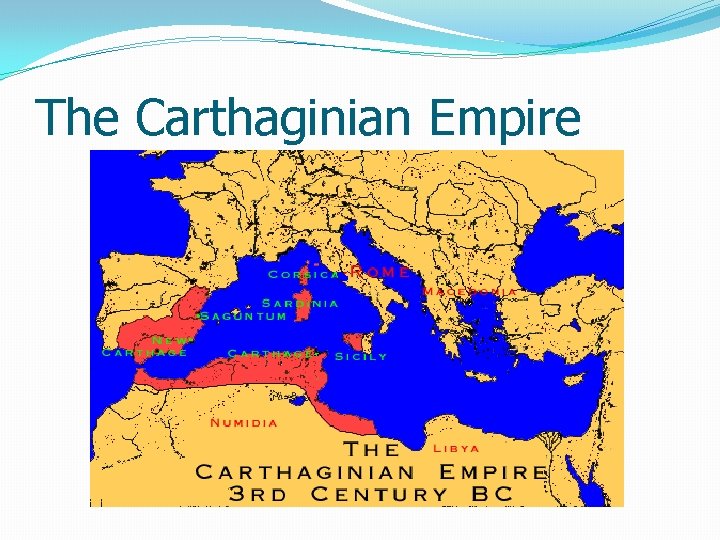
The Carthaginian Empire
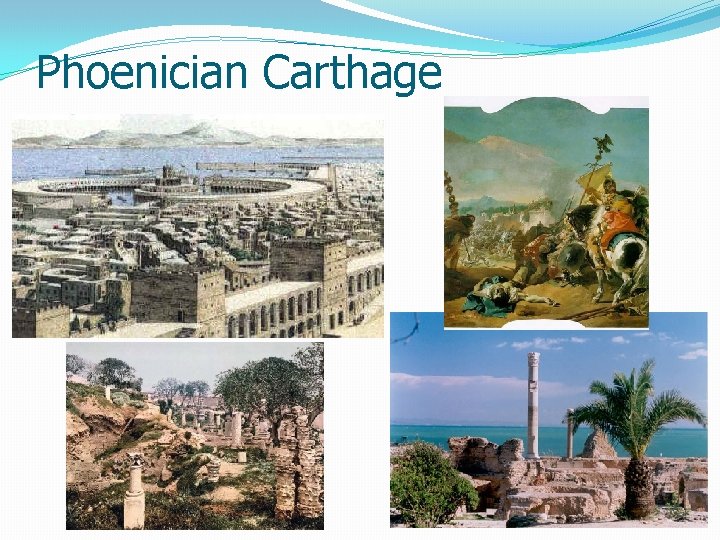
Phoenician Carthage
- Slides: 13