
The medical interview By dr latifa marie 1
The medical interview By : dr. latifa marie 1
The medical interview The main purpose: to gather all basic information pertinent to the patient’s illness, and the patient’s adaptation to illness. Tamás Fenyvesi 2
What is spoken of as a ‘clinical picture’ is not just a photograph of a man sick in bed; it is an impressionistic painting of the patient surrounded by his home, his work, his relations, his friends, his joys, sorrows, hopes, and fears. (Peabody, 1927) 3
What the patient thinks is happening, what kind of impact does the illnnes bear on work, family, financial situation. 4
Communication is the key to a successful interview. Ask questions freely. Permit the patient to tell his/her story in his/her own words. 5
If the story is very vague use direct questions: “How…” “Where…” “When…” is better than “Why…” Patients like to respond to questions in a way that will satisfy the doctor! 6
Treat the patient with respect, take care not to contradict the pt. You should refrain from trying to impose your own moral standards on the pt. 7
Remember the „rule of five vowels” Audition: listen carefully Evaluation: sorting out of relevant Inquiry: additional question in the relevant problems Observation: notice…. . . nonverbal communication (b. l. ) Understanding: the patient’s concerns 8
Beware!!! The management may have a different approach 9
10
The medical interview is the basis of the good doctorpatient relationship Flexible - spontaneous - not interrogating It is a powerful diagnostic tool. 11
Conducting an interview 1. Greeting and introduction “Mr. Smith, I’m John Taylor a medical student. I’ve been asked to interview and examine you. ” “Dear” or “Grandpa” are not to be used. 12
2. Start with a very general “open-ended” question e. g. : “What problem has brought you to the hospital? ” Do not start with reading of previous medical reports!! Persue the problems with more specific open-ended questions: “Tell me more about your chest pain. ” 13
3. Direct questions to specific facts learned during the openended questions: where? when? how? 14
Symptoms (what the patient feels, e. g. pain) are considered in the classic „seven dimensions”: 1. Bodily location: “Where in your back? ” “Do you feel it anywhere else? ” 2. Quality: “What does it feel like? ” “Was it sharp, dull or aching? ” 15
3. Quantity: “How many pills do you use? ” “What do you mean by a lot? ” 4. Chronology: “When did you first notice it? ” “How long did it last? ” “Have you had the pain since that time? ” 16
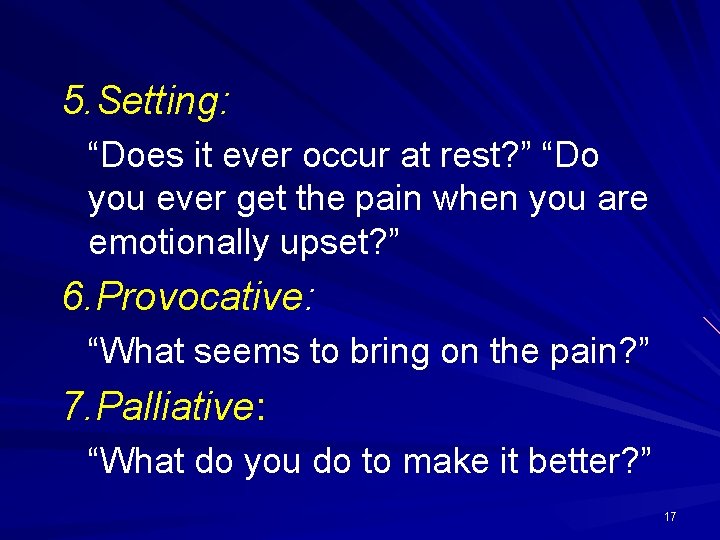
5. Setting: “Does it ever occur at rest? ” “Do you ever get the pain when you are emotionally upset? ” 6. Provocative: “What seems to bring on the pain? ” 7. Palliative: “What do you do to make it better? ” 17

Question types to be avoided 1. Yes or no question in general problems: ” is your work satisfying? ” The patient may want to please the doctor 2. Suggestive question: “Do you feel the pain in your left arm, when you get it in your chest? ” 18
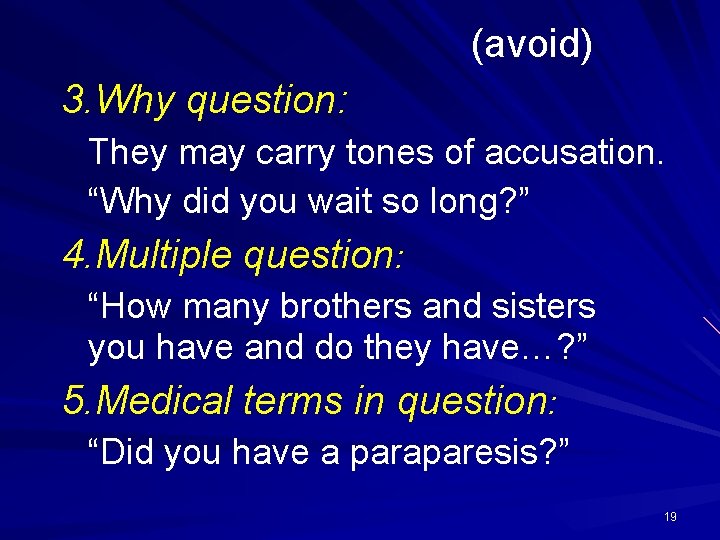
(avoid) 3. Why question: They may carry tones of accusation. “Why did you wait so long? ” 4. Multiple question: “How many brothers and sisters you have and do they have…? ” 5. Medical terms in question: “Did you have a paraparesis? ” 19
Do not write extensive notes during the interview, it distracts you from observing the pt’s facial expressions, b. l. 20
Next step Silence - 2 minutes “What are you thinking about? ” “You are saying…” Facilitation Verbal or non-verbal 21
Confrontation “Why are you so silent? ” “You look upset. ” Interpretation “You seem to be quite happy about that. ” 22
Support “I understand. ” Reassurance “You are improving steadily. ” Empathy It is understanding, not an emotional state of sympathy. 23
Be aware of the patient who asks, “I have a friend with…. , what do you think about…. . ? ” The question is probably related to the pt’s own concerns. 24
“The doctor may also learn more about the illness from the way the patient tells the story than from the story itself” James B. Herrick 1861 -1954 25
Each patient brings a different challenge: silent overtalkative seductive angry insatiable ingratiating aggressive help rejecting demanding 26
Format of the history Source and reliability Patient or else? ‘hetero-anamnesis’ Chief complaint The patient’s brief statement why he/she sought medical attention. History of present illness What, when, how, where, which, who and why 27
Past medical history General state of health Past illnesses Hospitalizations Injuries Surgery Allergies Immunisations 28
Occupational and environmental history Exposure to disease-producing substances More than just listing the jobs duration protective devices? medical screening? 29
Biographical information Family history Information about the health of the entire family diseases in the family 30
Genetic implication hypertension diabetes MI Psychosocial history Education, life style, sexual history (a very sensitive problem, depends very much on the gender of doctor and patient) 31
Review of systems It is all the many symptoms that may have been overlooked in the history of present illness and in the past medical history. It is best organized from the head down to the extremities. These questions should be asked in a way that the patient could answer just “yes” or “no”. We need further questioning in case of “yes”. 32
At this phase it is best to have a checklist. Customize clinical narrative to electronic medical record (EMC) 33
Chest pain “Where is the pain? ” “Does it radiate? ” “Where? ” “For how long have you had the pain? ” “Do you have recurrent episodes of pain? ” 34
“What is the duration? ” “How often do you get the pain? ” “What do you do to make it better? ” “What makes it worse? Breathing? Lying flat? moving your arms or neck? ” “How would you describe the pain? ” Let the patient describe it! And then ask: “burning? … pressing? … crushing? … dull? … aching? … throbbing sharp? … constricting? … sticking? ” 35
“Does the pain occur at rest? … with exertion? … after eating? … when moving your motional strain? … during with arms? … sex? ” “Is the pain associated with shortness of breath? … palpitations? … nausea or vomiting? … coughing? . . . fever? … leg pain? coughing up blood? ” “When was the last episode of your chest pain? ” 36
As you notice: to put the right questions you have to know the typical symptoms of the suspected disease!! e. g. heart failure: 37
The accuracy may be influenced in different ways. The history is not well enough reproducible. 1. Different physicians ask the questions in different way, and interpret the answers differently. 38
2 Patients often give frankly different answers to the very same question. student resident consultant (awkward situation) Careful use of clear questions is essential. 39
At this stage : review the documentation of past medical history 40
History is the key to doctor-patient relationship and to DIAGNOSIS! 41
The written history is a summary of the information obtained during the interview: Chief complaint History of present illness Past medical history Family history Psychosocial history Review of systems (not in preprinted format) 42

“ To study the phenomenon of disease without books is to sail an uncharted sea, while to study books without patients is not to go sea at all” William Osler 43
“. . . For the secret of the care of the patient is in caring for the patient. ” Francis Weld PEABODY, 1881 -1927 44
Closing the Interview Before closing the interview ask the patient if there is anything else he or she would like to discuss or if there any questions. The clinician then proceeds with the physical examination. Interestingly, some patients become quite talkative during the examination. They seem reassured by the physician's touch and may feel more at ease than when sitting face to face during the interview. 45
Examination of a specific body region or system may remind the patient of previously forgotten details of considerable diagnostic importance. The alert physician will take the stethoscope from his or her ears long enough to hear what the patient has to say. 46
Patient management RAPRIOP Reassurance and Explanation Advice Prescription Referral Investigation Observation Prevention and Health Promotion 47
Diagnosing and Solving Problems in the Interview Problems with the patient (for example, intense emotional reactions, altered mental status, unrealistic fantasies about the doctor). Problems with the interviewer (for example, an overly judgmental attitude, too directive an approach in questioning, failure to listen to the patient). Problems with the physician–patient relationship (for example, a language barrier, failure to negotiate a shared goal for the encounter). 48

Thank you 49

50
- Slides: 50