
The Medical and Surgical Treatment of Chronic Rhinitis


- Slides: 30
The Medical and Surgical Treatment of Chronic Rhinitis R. Moulton-Barrett, MD
Defination of Chronic Rhinitis symptoms of : • • nasal congestion rhinorrhoea anosmia sneezing or itchy nose lasting > 3 months in one year 40 million people in USA 50% seek medical advise 50% allergic in origin 6 million dollars spent on decongestants / yr.
Physiology of Nasal Congestion 3 portions: Flow: vestibule respiratory ( 92 % by area: 120 sq cm's) and olfactory Inspiratory - laminar, above inferior turbinate Expiratory - circum-laminar to paranasal sinuses Vestibule: 1/3 nasal resistance ( by acoustic rhinometry and MRI ) Nasal Valve: 2/3's total nasal resistance ( 0. 72 cm 2 ) the most narrow portion of the nasal cavity
Anatomy of the Inferior Turbinate Nerve: Post-ganglionic pterygopalatine ganglion fibres Inf Post Lat branch of Greater Palatine Nerve Artery: Single branch of sphenopalatine artery enters 1 -1. 5 cm's from posterior superior bone travels anteriorly along superior periosteum Swelling: 40% of blood: through spongy submucosal venous tissue containing small vessels with leaky basement membranes 60% of the blood passes through a/v shunts: Sympathetic dependent - reduces can overdrive by parasympathetics + engorges not histamine sensitive
Measurement of Nasal Resistance Acoustic Rhinometry • assesses cross-sectional area andgeometry • (experimental) Hilberg 1989 Posterior Rhinometry • Resistance = Pressure/Flow: disputed in terms of value Myrind N, 1980. Measurement of nasal airway resistance -is it only for article writers. Clinical Otolaryngol 5: 161 -163.
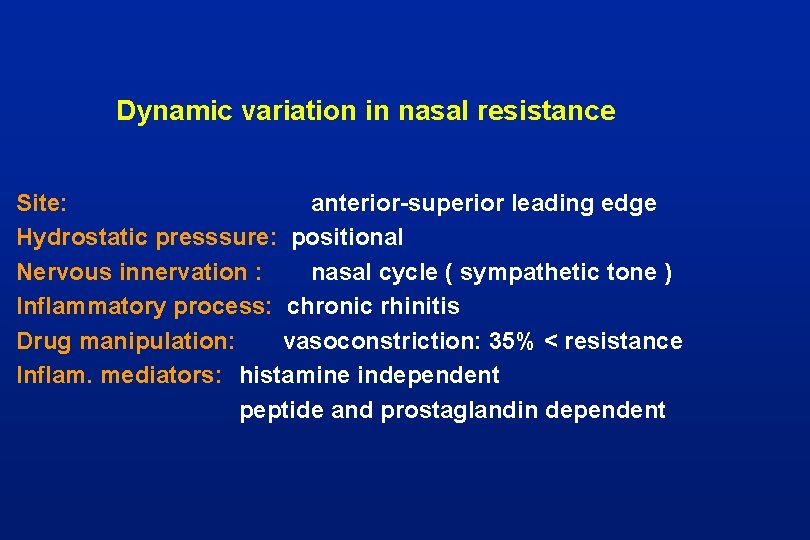
Dynamic variation in nasal resistance Site: anterior-superior leading edge Hydrostatic presssure: positional Nervous innervation : nasal cycle ( sympathetic tone ) Inflammatory process: chronic rhinitis Drug manipulation: vasoconstriction: 35% < resistance Inflam. mediators: histamine independent peptide and prostaglandin dependent
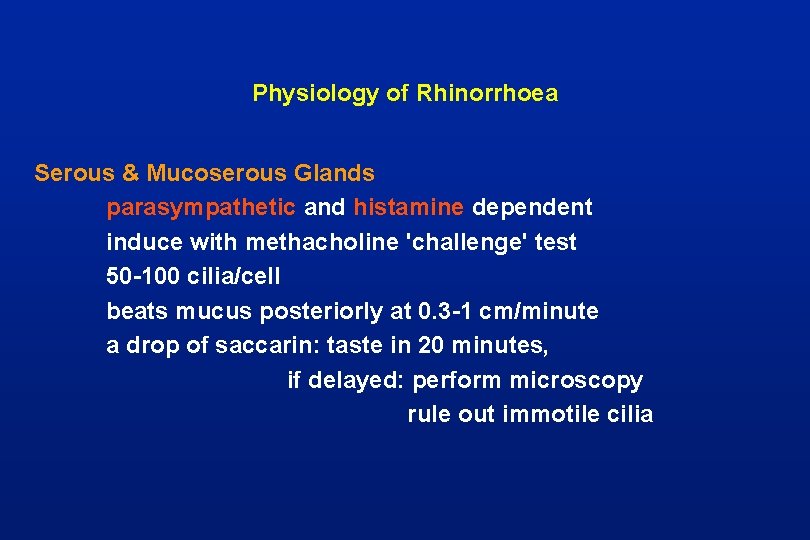
Physiology of Rhinorrhoea Serous & Mucoserous Glands parasympathetic and histamine dependent induce with methacholine 'challenge' test 50 -100 cilia/cell beats mucus posteriorly at 0. 3 -1 cm/minute a drop of saccarin: taste in 20 minutes, if delayed: perform microscopy rule out immotile cilia
Sneezing and Itching Histamine related: released by mastcells eosinophils & most importantly basophil cells Success of therapy: antihistamine/cromoglycate: proportional to histamine in nasal smears > mast, eosinophil, basophil cells, in vitro histamine release in response to allergens
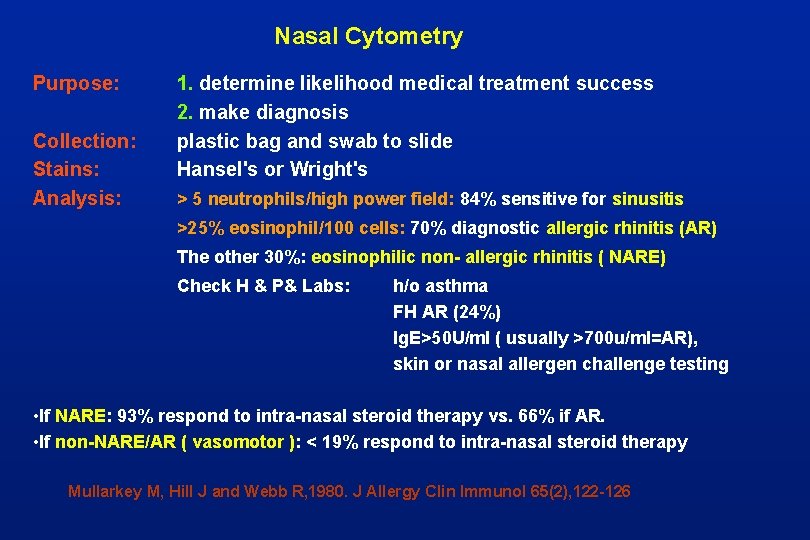
Nasal Cytometry Purpose: Collection: Stains: Analysis: 1. determine likelihood medical treatment success 2. make diagnosis plastic bag and swab to slide Hansel's or Wright's > 5 neutrophils/high power field: 84% sensitive for sinusitis >25% eosinophil/100 cells: 70% diagnostic allergic rhinitis (AR) The other 30%: eosinophilic non- allergic rhinitis ( NARE) Check H & P& Labs: h/o asthma FH AR (24%) Ig. E>50 U/ml ( usually >700 u/ml=AR), skin or nasal allergen challenge testing • If NARE: 93% respond to intra-nasal steroid therapy vs. 66% if AR. • If non-NARE/AR ( vasomotor ): < 19% respond to intra-nasal steroid therapy Mullarkey M, Hill J and Webb R, 1980. J Allergy Clin Immunol 65(2), 122 -126
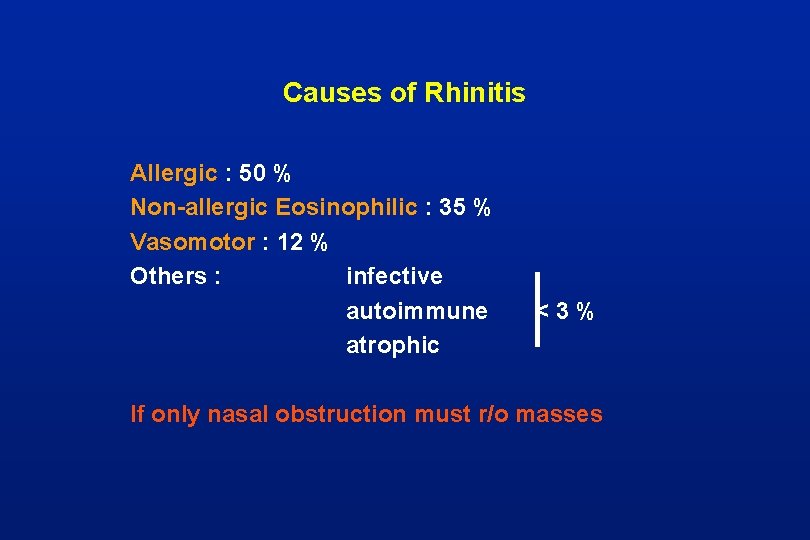
Causes of Rhinitis Allergic : 50 % Non-allergic Eosinophilic : 35 % Vasomotor : 12 % Others : infective autoimmune atrophic <3% If only nasal obstruction must r/o masses
Allergic Nasal Challenge Test • Primary phase: 5 -30 seconds later sneezing occurs histamine dependent secondary to basophil degranulation then delayed intra-nasal eosinophilia • Secondary phase: 7 hours later also caused by basophil degranulation and parasympathetic overdrive histamine independent • If the allergen is rechallenged there may be 100 x's greater response
Seasonal primary and secondary phases • when pollen counts are >50/cubic meter April-May: oak May-August: birch April-August: ragweed • or when in-home dust countsare elevated: Dermatophygoides pteronyssinus or farinae : fans mattress covers wash carpets open windows dusting humidifiers
Vasomotor Rhinitis Secondary to: parasympathetic excess or sympathetic reduction • Drugs – rhinitis medicamentosa topical cocaine and oxymetolazone produces prolonged vasoconstriction followed by reactive hyperemia via down regulation: alpha 1 & 2 blockage – antihypertensive medications: vasodilators ie. alpha blockers • Hormonal – – estrogenic - BCP & Gravidarum: estrogenic cholinesterase inhibition acromegaly hypothyroidism: responds to thyroxine and old man's drip: responds to testosterone
Medical Therapy Intra-Nasal Steroids • Most useful agent: 60 -75% benefit all causes chronic rhinitis placebo 20% benefit • Inhibits: mast cell migration into nasal mucosa basophil cell, not eosinophil cell degranulation • least effect on: parasympathetic tone non-histamine related rhinorrhoea of VR • S/E: freon causes drying crusting and bleeding ( 5% ) aqueous propylene glycol produce burning ( 5% ) very rare side - effects of septal perforation - blindness • Little benefit for VMR • positioning the patient
Medical therapy Anti-histamines • Have little effect on nasal blockage since histamine independent • Inhibit primary phase reactive symptoms • As effective as steroids for seasonal AR for sneezing & rhinorrhoea
Cromoglycate • Inhibition of protein kinase C leads to reduced degranulation • Has no place in the treatment of NARE or vasomotor rhinitis • Limits phase 1 symptoms and poor for congestion • Use 4 -6 times daily • Though newest drug 'Nedocromil" may reduce nasal obstruction in allergic rhinitis
Ipratropium bromide • Few side-effects since not absorbed by mucosa • Inhibits c-GMP synthesis which causes decreased glandular secretion • 400 ug QID may produce cracking and bleeding • 80 ug QID is equally effective in reducing rhinorrhea but not sneezing or obstruction •
Immunotherapy • Mechanism: cytokine related inhibition of basophil sensitivity via T cells rather than blocking Ig. G antibodies • " May be initiated at any time " during medical therapy for AR Gordon, 1992. O-HNS 107; 6(2), pg. 861 • Degree of success is multi-factorial and of particular importance is allergen avoidance therapy • 90% of asthmatics with positive skin and nasal challenge tests benefited by mold immunotherpy ( Goode states: 75%) • Yet intra-nasal steroids are better tolerated and more effective in therapy for seasonal AR
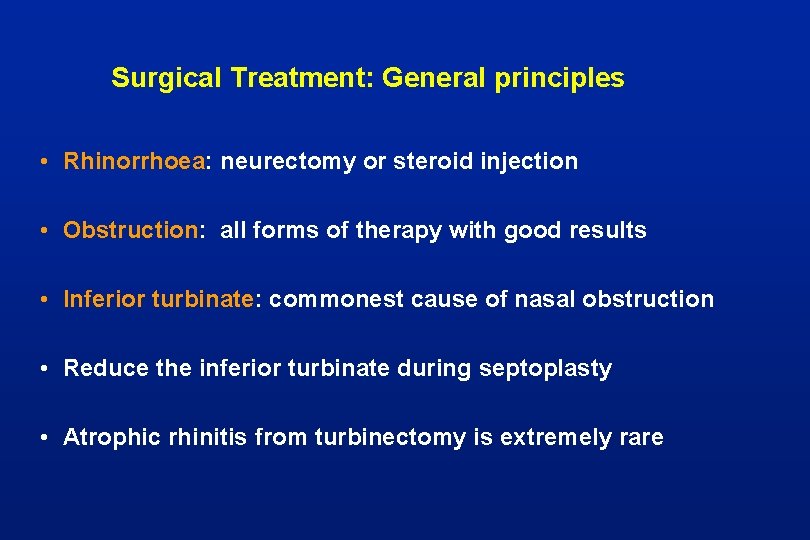
Surgical Treatment: General principles • Rhinorrhoea: neurectomy or steroid injection • Obstruction: all forms of therapy with good results • Inferior turbinate: commonest cause of nasal obstruction • Reduce the inferior turbinate during septoplasty • Atrophic rhinitis from turbinectomy is extremely rare
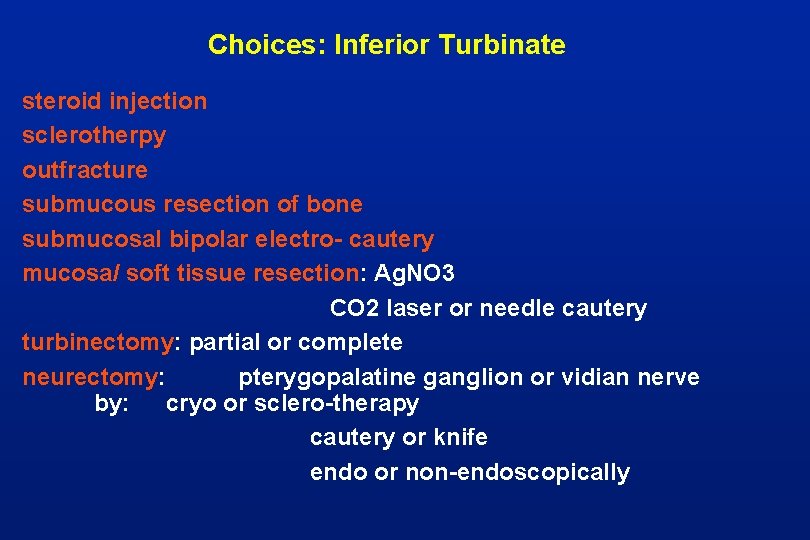
Choices: Inferior Turbinate steroid injection sclerotherpy outfracture submucous resection of bone submucosal bipolar electro- cautery mucosa/ soft tissue resection: Ag. NO 3 CO 2 laser or needle cautery turbinectomy: partial or complete neurectomy: pterygopalatine ganglion or vidian nerve by: cryo or sclero-therapy cautery or knife endo or non-endoscopically
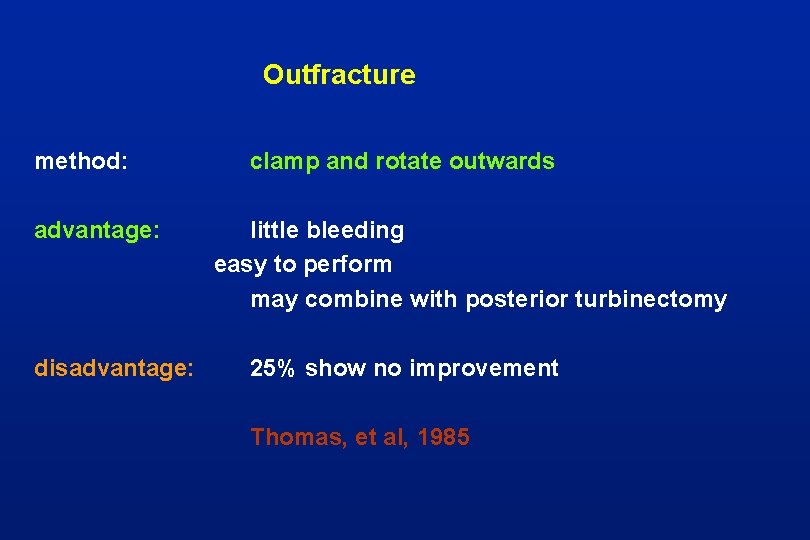
Outfracture method: advantage: disadvantage: clamp and rotate outwards little bleeding easy to perform may combine with posterior turbinectomy 25% show no improvement Thomas, et al, 1985
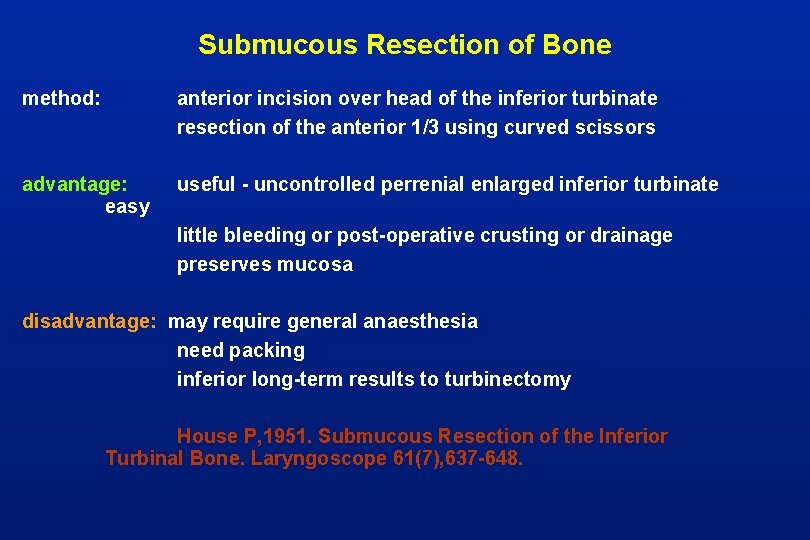
Submucous Resection of Bone method: anterior incision over head of the inferior turbinate resection of the anterior 1/3 using curved scissors advantage: easy useful - uncontrolled perrenial enlarged inferior turbinate little bleeding or post-operative crusting or drainage preserves mucosa disadvantage: may require general anaesthesia need packing inferior long-term results to turbinectomy House P, 1951. Submucous Resection of the Inferior Turbinal Bone. Laryngoscope 61(7), 637 -648.
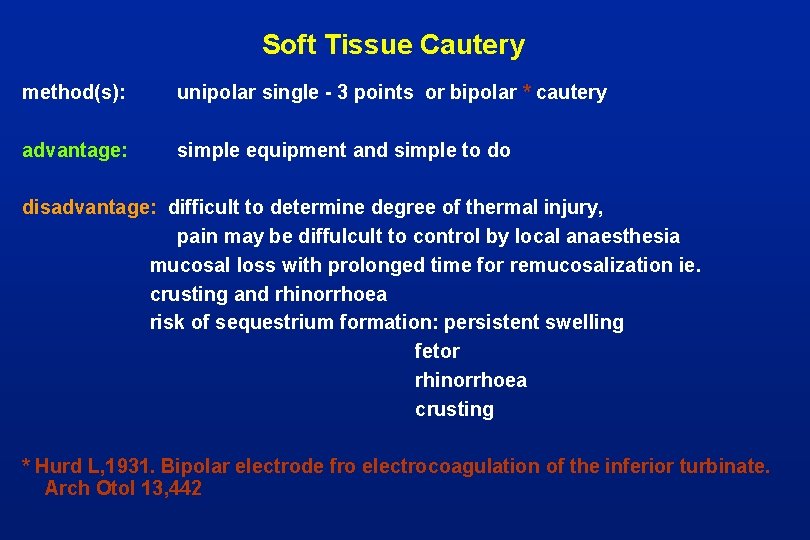
Soft Tissue Cautery method(s): unipolar single - 3 points or bipolar * cautery advantage: simple equipment and simple to do disadvantage: difficult to determine degree of thermal injury, pain may be diffulcult to control by local anaesthesia mucosal loss with prolonged time for remucosalization ie. crusting and rhinorrhoea risk of sequestrium formation: persistent swelling fetor rhinorrhoea crusting * Hurd L, 1931. Bipolar electrode fro electrocoagulation of the inferior turbinate. Arch Otol 13, 442
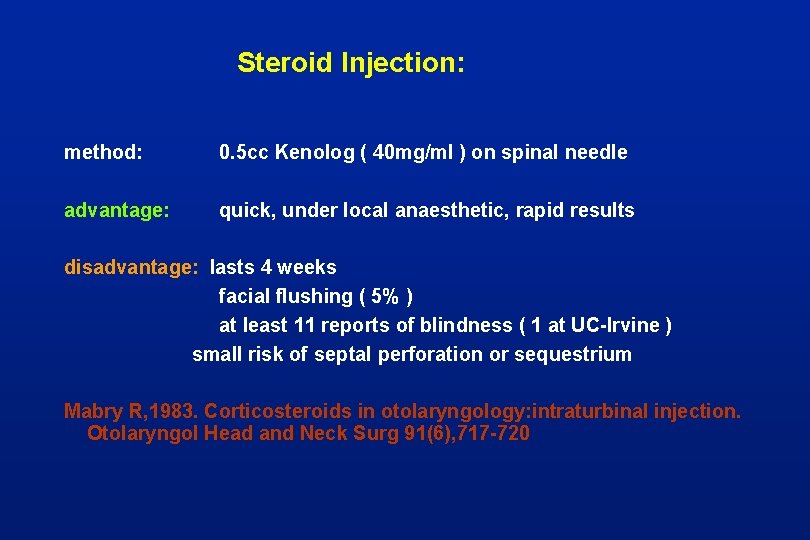
Steroid Injection: method: 0. 5 cc Kenolog ( 40 mg/ml ) on spinal needle advantage: quick, under local anaesthetic, rapid results disadvantage: lasts 4 weeks facial flushing ( 5% ) at least 11 reports of blindness ( 1 at UC-Irvine ) small risk of septal perforation or sequestrium Mabry R, 1983. Corticosteroids in otolaryngology: intraturbinal injection. Otolaryngol Head and Neck Surg 91(6), 717 -720
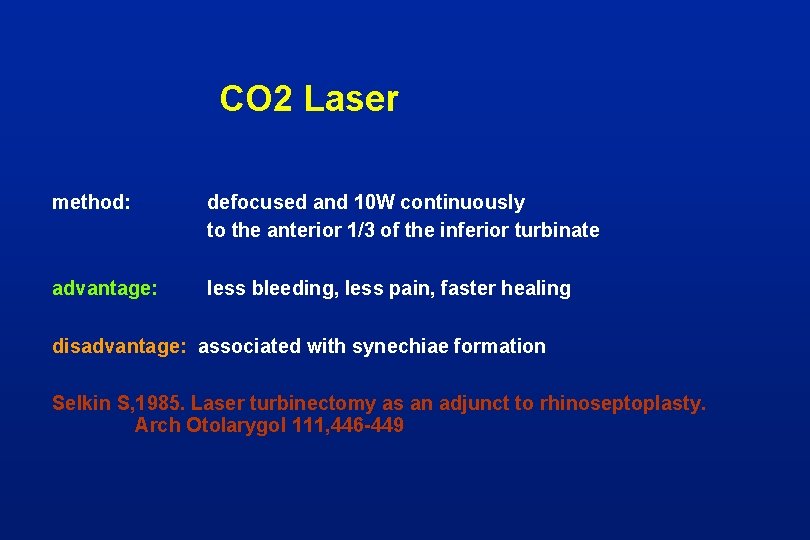
CO 2 Laser method: defocused and 10 W continuously to the anterior 1/3 of the inferior turbinate advantage: less bleeding, less pain, faster healing disadvantage: associated with synechiae formation Selkin S, 1985. Laser turbinectomy as an adjunct to rhinoseptoplasty. Arch Otolarygol 111, 446 -449
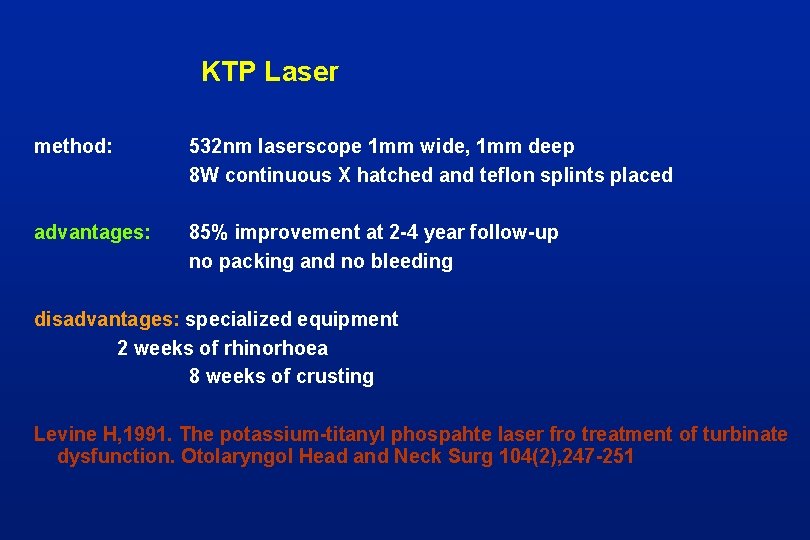
KTP Laser method: 532 nm laserscope 1 mm wide, 1 mm deep 8 W continuous X hatched and teflon splints placed advantages: 85% improvement at 2 -4 year follow-up no packing and no bleeding disadvantages: specialized equipment 2 weeks of rhinorhoea 8 weeks of crusting Levine H, 1991. The potassium-titanyl phospahte laser fro treatment of turbinate dysfunction. Otolaryngol Head and Neck Surg 104(2), 247 -251
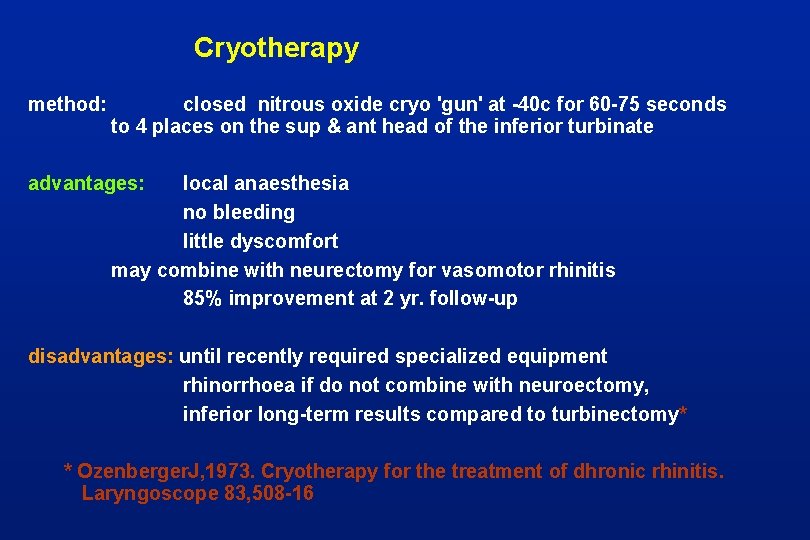
Cryotherapy method: closed nitrous oxide cryo 'gun' at -40 c for 60 -75 seconds to 4 places on the sup & ant head of the inferior turbinate advantages: local anaesthesia no bleeding little dyscomfort may combine with neurectomy for vasomotor rhinitis 85% improvement at 2 yr. follow-up disadvantages: until recently required specialized equipment rhinorrhoea if do not combine with neuroectomy, inferior long-term results compared to turbinectomy* * Ozenberger. J, 1973. Cryotherapy for the treatment of dhronic rhinitis. Laryngoscope 83, 508 -16
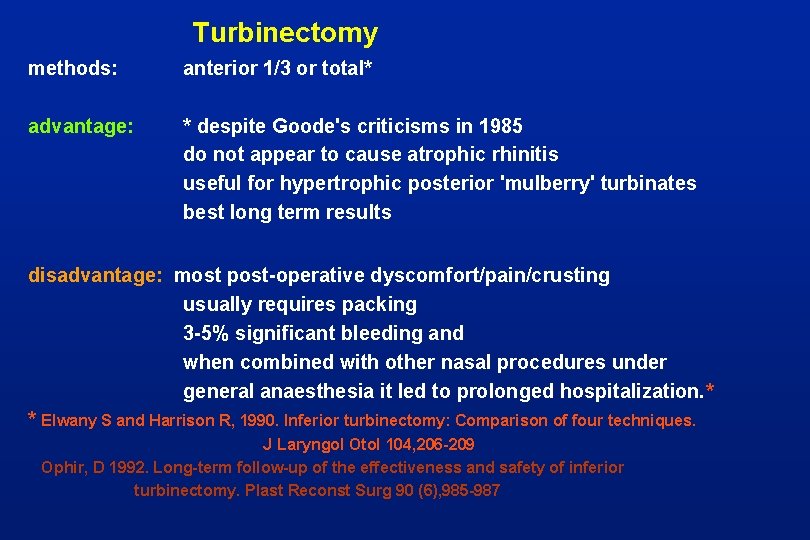
Turbinectomy methods: anterior 1/3 or total* advantage: * despite Goode's criticisms in 1985 do not appear to cause atrophic rhinitis useful for hypertrophic posterior 'mulberry' turbinates best long term results disadvantage: most post-operative dyscomfort/pain/crusting usually requires packing 3 -5% significant bleeding and when combined with other nasal procedures under general anaesthesia it led to prolonged hospitalization. * * Elwany S and Harrison R, 1990. Inferior turbinectomy: Comparison of four techniques. J Laryngol Otol 104, 206 -209 Ophir, D 1992. Long-term follow-up of the effectiveness and safety of inferior turbinectomy. Plast Reconst Surg 90 (6), 985 -987
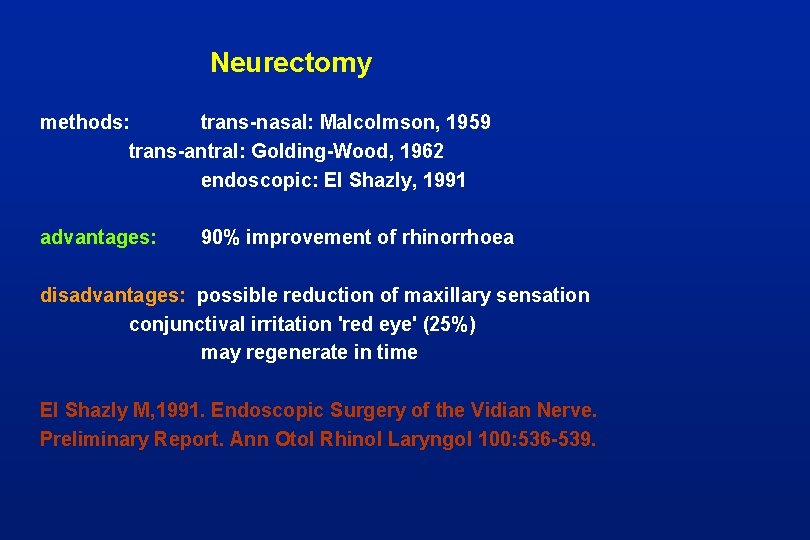
Neurectomy methods: trans-nasal: Malcolmson, 1959 trans-antral: Golding-Wood, 1962 endoscopic: El Shazly, 1991 advantages: 90% improvement of rhinorrhoea disadvantages: possible reduction of maxillary sensation conjunctival irritation 'red eye' (25%) may regenerate in time El Shazly M, 1991. Endoscopic Surgery of the Vidian Nerve. Preliminary Report. Ann Otol Rhinol Laryngol 100: 536 -539.
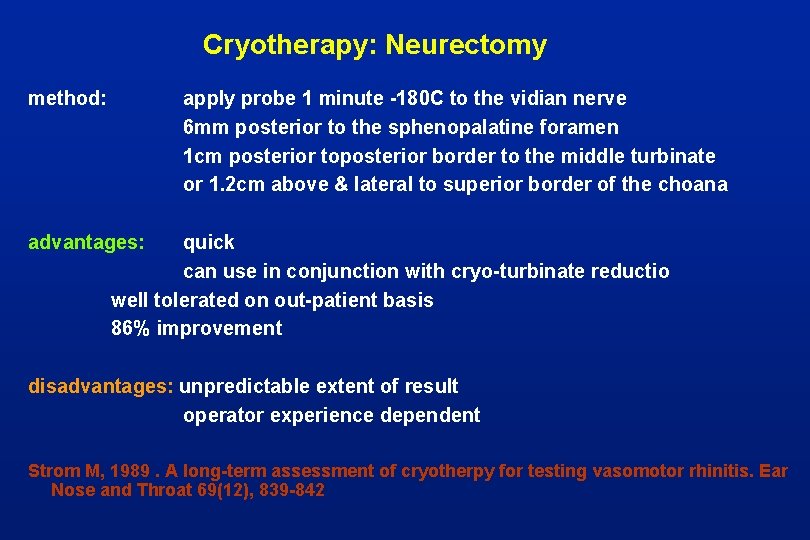
Cryotherapy: Neurectomy method: apply probe 1 minute -180 C to the vidian nerve 6 mm posterior to the sphenopalatine foramen 1 cm posterior toposterior border to the middle turbinate or 1. 2 cm above & lateral to superior border of the choana advantages: quick can use in conjunction with cryo-turbinate reductio well tolerated on out-patient basis 86% improvement disadvantages: unpredictable extent of result operator experience dependent Strom M, 1989. A long-term assessment of cryotherpy for testing vasomotor rhinitis. Ear Nose and Throat 69(12), 839 -842