
The mechanism of producing speech sounds Modifications of
- Slides: 14
The mechanism of producing speech sounds. Modifications of consonants in connected speech
Plan: 1. The mechanism of producing speech sounds; 2. Modifications of consonants in connected speech. 3. Direction of Assimilation. Prepared by Krechkovska Oxana
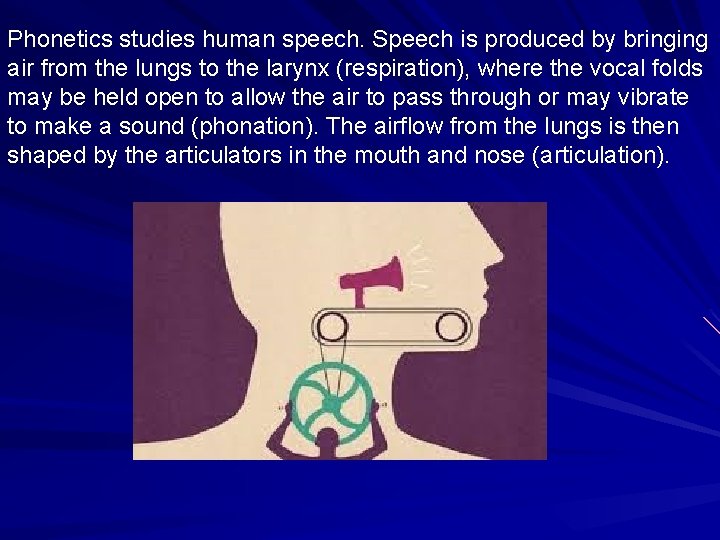
Phonetics studies human speech. Speech is produced by bringing air from the lungs to the larynx (respiration), where the vocal folds may be held open to allow the air to pass through or may vibrate to make a sound (phonation). The airflow from the lungs is then shaped by the articulators in the mouth and nose (articulation).
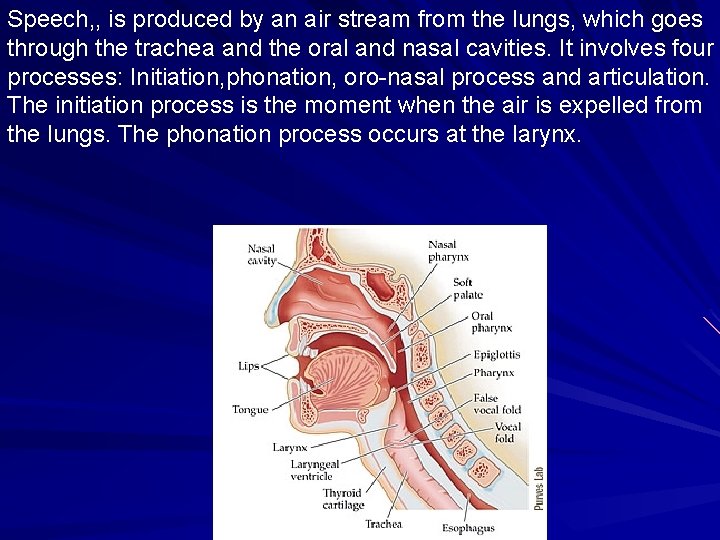
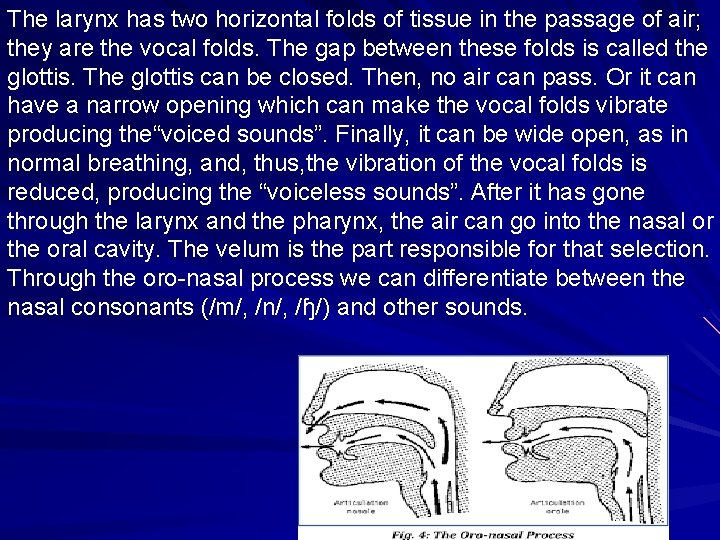
Speech, , is produced by an air stream from the lungs, which goes through the trachea and the oral and nasal cavities. It involves four processes: Initiation, phonation, oro-nasal process and articulation. The initiation process is the moment when the air is expelled from the lungs. The phonation process occurs at the larynx.
The larynx has two horizontal folds of tissue in the passage of air; they are the vocal folds. The gap between these folds is called the glottis. The glottis can be closed. Then, no air can pass. Or it can have a narrow opening which can make the vocal folds vibrate producing the“voiced sounds”. Finally, it can be wide open, as in normal breathing, and, thus, the vibration of the vocal folds is reduced, producing the “voiceless sounds”. After it has gone through the larynx and the pharynx, the air can go into the nasal or the oral cavity. The velum is the part responsible for that selection. Through the oro-nasal process we can differentiate between the nasal consonants (/m/, /n/, /ɧ/) and other sounds.
Finally, the articulation process is the most obvious one: it takes place in the mouth and it is the process through which we can differentiate most speech sounds. In the mouth we can distinguish between the oral cavity, which acts as a resonator, and the articulators, which can be active or passive: upper and lower lips, upper and lower teeth, tongue (tip, blade, front, back) and roof of the mouth (alveolar ridge, palate and velum). So, speech sounds are distinguished from one another in terms of the place where and the manner how they ar articulated. So the three mechanisms that we use to produce speech are: • respiration at the lungs, • phonation at the larynx, and • articulation in the mouth.
Modifications of consonants in connected speech. Speech is performed in larger units: words, phrases and texts. There are very big differences between pronouncing a word in isolation and a word in connected speech. There is a problem of defining the phonetic status of sounds in connected speech. As a result there are some processes of phonetic changes in connected speech: • assimilation; • linking; • vowel reduction; • elision. The ability to produce English with an English-like pattern of stress and rhythm involves stress-timing (= the placement of stress only on selected syllables)
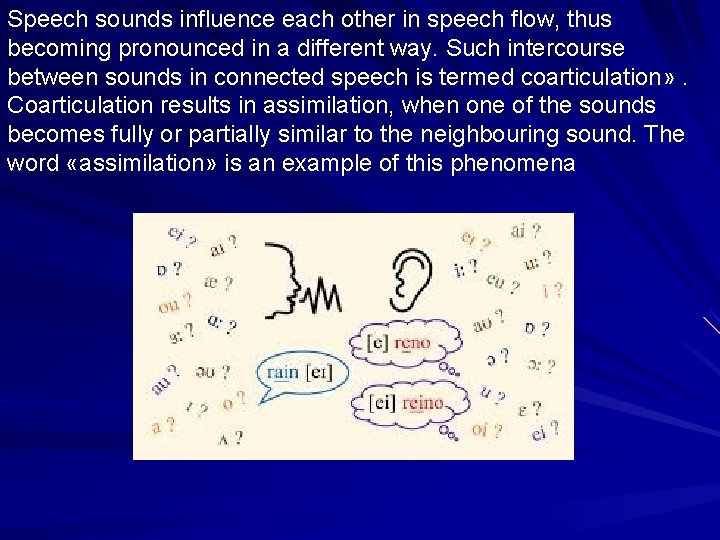
Speech sounds influence each other in speech flow, thus becoming pronounced in a different way. Such intercourse between sounds in connected speech is termed coarticulation» . Coarticulation results in assimilation, when one of the sounds becomes fully or partially similar to the neighbouring sound. The word «assimilation» is an example of this phenomena
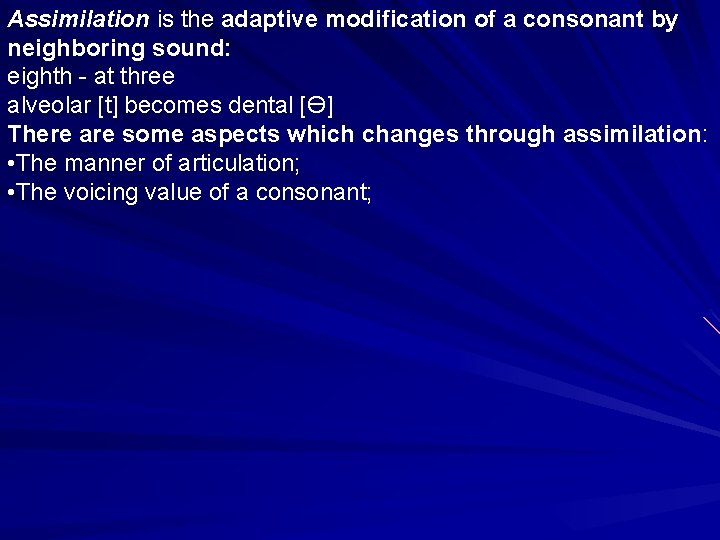
Assimilation is the adaptive modification of a consonant by neighboring sound: eighth - at three alveolar [t] becomes dental [Ɵ] There are some aspects which changes through assimilation: • The manner of articulation; • The voicing value of a consonant;
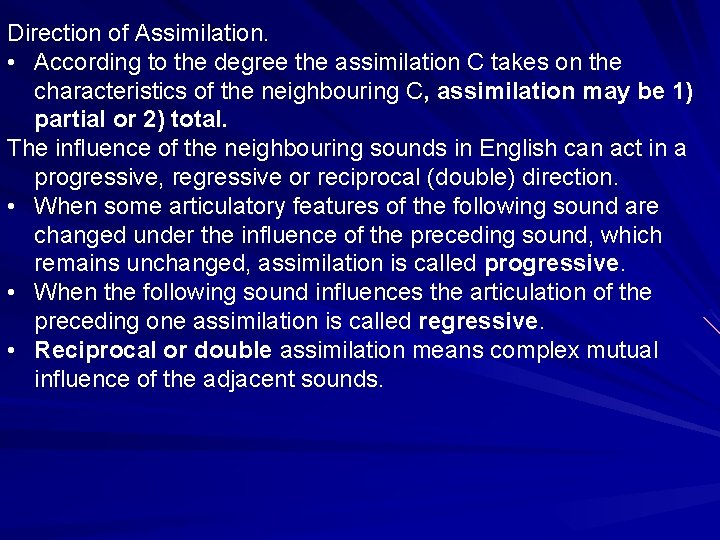
Direction of Assimilation. • According to the degree the assimilation C takes on the characteristics of the neighbouring C, assimilation may be 1) partial or 2) total. The influence of the neighbouring sounds in English can act in a progressive, regressive or reciprocal (double) direction. • When some articulatory features of the following sound are changed under the influence of the preceding sound, which remains unchanged, assimilation is called progressive. • When the following sound influences the articulation of the preceding one assimilation is called regressive. • Reciprocal or double assimilation means complex mutual influence of the adjacent sounds.
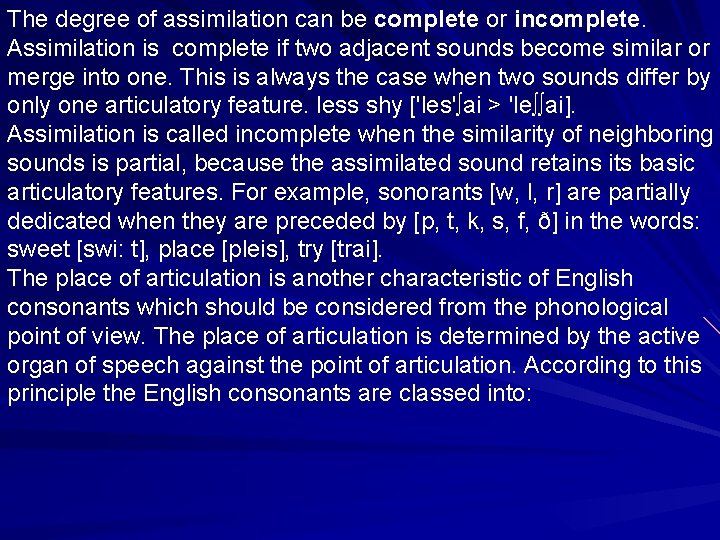
The degree of assimilation can be complete or incomplete. Assimilation is complete if two adjacent sounds become similar or merge into one. This is always the case when two sounds differ by only one articulatory feature. less shy ['les'∫ai > 'le∫∫ai]. Assimilation is called incomplete when the similarity of neighboring sounds is partial, because the assimilated sound retains its basic articulatory features. For example, sonorants [w, l, r] are partially dedicated when they are preceded by [p, t, k, s, f, ð] in the words: sweet [swi: t], place [pleis], try [trai]. The place of articulation is another characteristic of English consonants which should be considered from the phonological point of view. The place of articulation is determined by the active organ of speech against the point of articulation. According to this principle the English consonants are classed into:
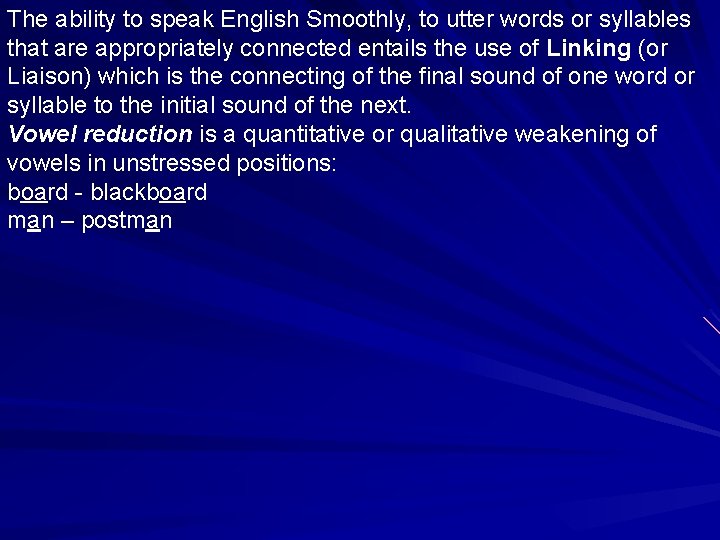
The ability to speak English Smoothly, to utter words or syllables that are appropriately connected entails the use of Linking (or Liaison) which is the connecting of the final sound of one word or syllable to the initial sound of the next. Vowel reduction is a quantitative or qualitative weakening of vowels in unstressed positions: board - blackboard man – postman
Elision is a complete loss of sounds, both vowels and consonants. Consonants can be modified according to the place of articulation: assimilation takes place when a sound changes its character in order to look like a neighboring sound and the characteristic which is involved in this is almost always a place of articulation: Compression. Sometimes a sequence of sounds in English has two possible pronunciations: either as two separate syllables, or compressed into a single syllable
Weakening/Reduction In some circumstances a strong vowel becomes weak: • in related words: anatomic [ænæ'tɔmik] – anatomy [ə'nætəmi]; • in affixes: president ['prezidənt] – preside [pri'zaid]; • variant pronunciations: Monday ['m٨ ndei] – ['m٨ ndi]; • in function words: from [frɔm] – [frəm]. Weakform words are alternate forms of words so reduced in their articulation that they consist of a different set of phonemes. Most often the weak form differs from the strongform by containing a weak vowel resultant from reduction or by elision of one or more of its phonemes.