
The Mechanism by which Pseudomonas chlororaphis Phage 201
The Mechanism by which Pseudomonas chlororaphis Phage 201ϕ 2 -1 Proteins are Sorted within the Phage -Formed Proteinaceous Shell Cash Frost
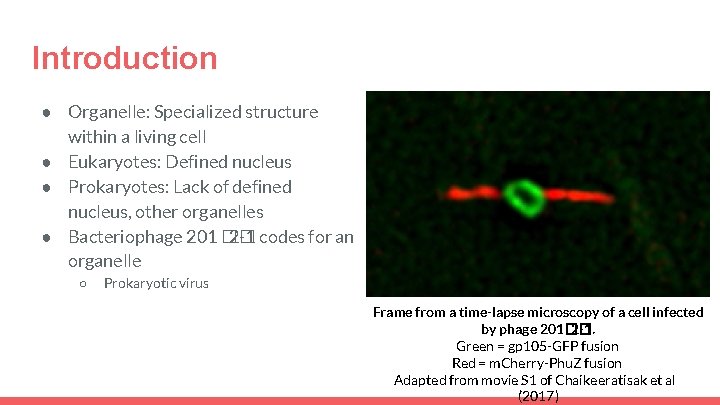
Introduction ● Organelle: Specialized structure within a living cell ● Eukaryotes: Defined nucleus ● Prokaryotes: Lack of defined nucleus, other organelles ● Bacteriophage 201 �� 2 -1 codes for an organelle ○ Prokaryotic virus Frame from a time-lapse microscopy of a cell infected by phage 201�� 2 -1. Green = gp 105 -GFP fusion Red = m. Cherry-Phu. Z fusion Adapted from movie S 1 of Chaikeeratisak et al (2017)
Experiment Goal: Determine if an amino acid sequence is responsible for phage protein access into the proteinaceous shell formed during infection
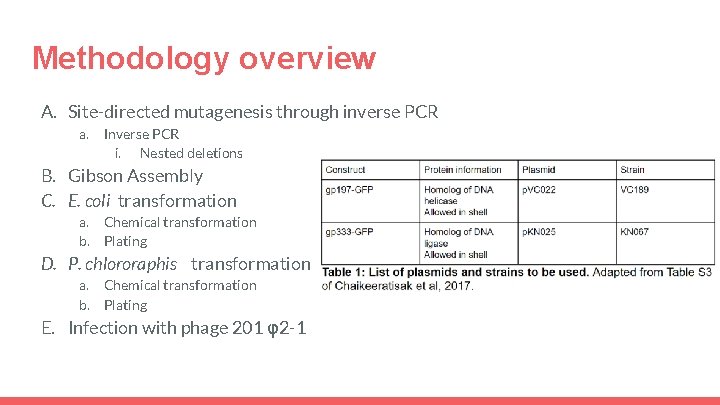
Methodology overview A. Site-directed mutagenesis through inverse PCR a. Inverse PCR i. Nested deletions B. Gibson Assembly C. E. coli transformation a. b. Chemical transformation Plating D. P. chlororaphis transformation a. b. Chemical transformation Plating E. Infection with phage 201 φ2 -1
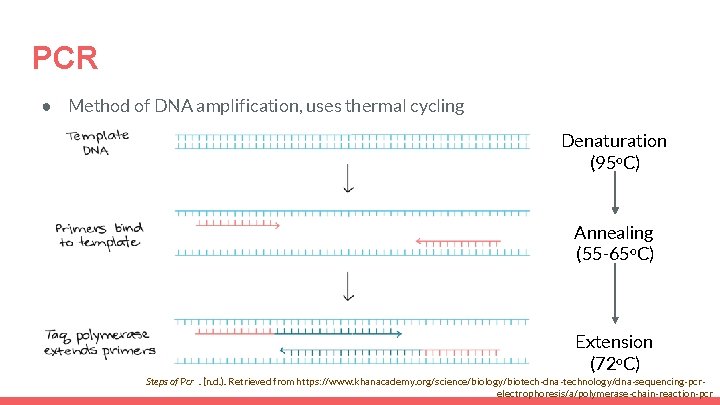
PCR ● Method of DNA amplification, uses thermal cycling Denaturation (95 o. C) Annealing (55 -65 o. C) Extension (72 o. C) Steps of Pcr. (n. d. ). Retrieved from https: //www. khanacademy. org/science/biology/biotech-dna-technology/dna-sequencing-pcrelectrophoresis/a/polymerase-chain-reaction-pcr
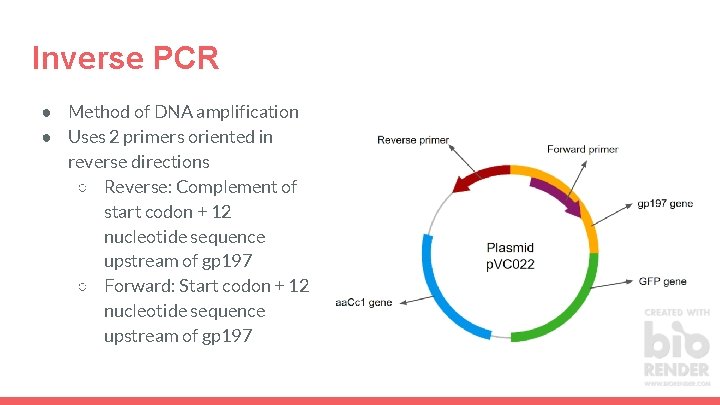
Inverse PCR ● Method of DNA amplification ● Uses 2 primers oriented in reverse directions ○ Reverse: Complement of start codon + 12 nucleotide sequence upstream of gp 197 ○ Forward: Start codon + 12 nucleotide sequence upstream of gp 197
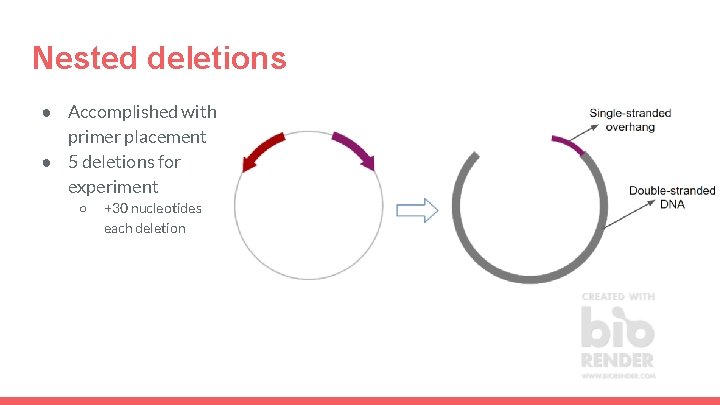
Nested deletions ● Accomplished with primer placement ● 5 deletions for experiment ○ +30 nucleotides each deletion
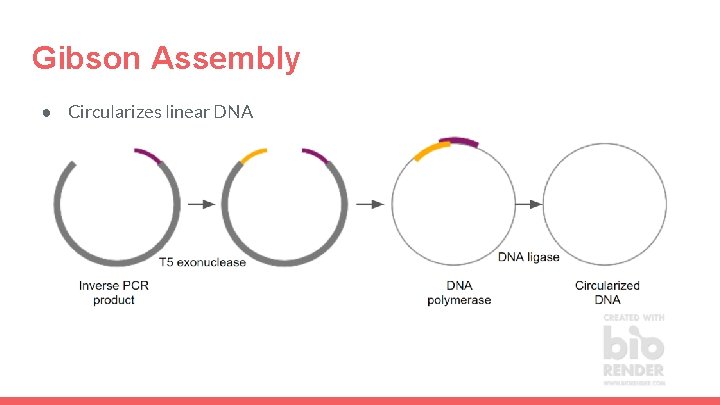
Gibson Assembly ● Circularizes linear DNA
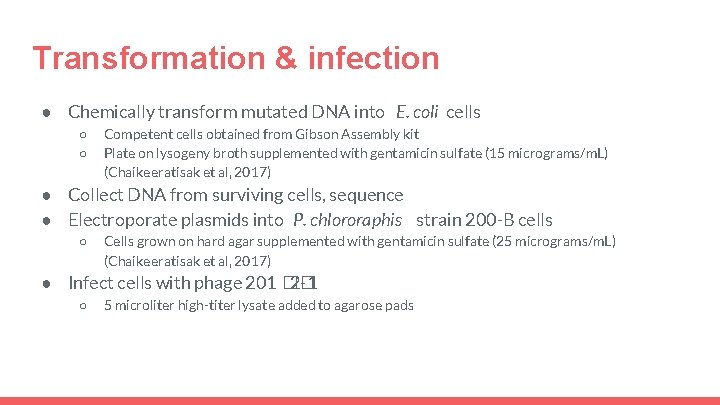
Transformation & infection ● Chemically transform mutated DNA into E. coli cells ○ ○ Competent cells obtained from Gibson Assembly kit Plate on lysogeny broth supplemented with gentamicin sulfate (15 micrograms/m. L) (Chaikeeratisak et al, 2017) ● Collect DNA from surviving cells, sequence ● Electroporate plasmids into P. chlororaphis strain 200 -B cells ○ Cells grown on hard agar supplemented with gentamicin sulfate (25 micrograms/m. L) (Chaikeeratisak et al, 2017) ● Infect cells with phage 201 �� 2 -1 ○ 5 microliter high-titer lysate added to agarose pads
Results & discussion ● Proteins will lose access to shell or not ● If they do lose access, implies a deleted sequence was involved with determining protein access to shell ● If access is not lost, could mean the deletions didn’t extend far enough into nucleotide sequence
- Slides: 10