
THE MECHANICS OF FIBRE REINFORCEMENT l Due to
THE MECHANICS OF FIBRE REINFORCEMENT l Due to the difference between the properties of reinforcing particles and the material make the predicting of the mechanical properties of a composite materials a complex task. l Composite material has complex distributions of stress and strain at the microscopic levels.
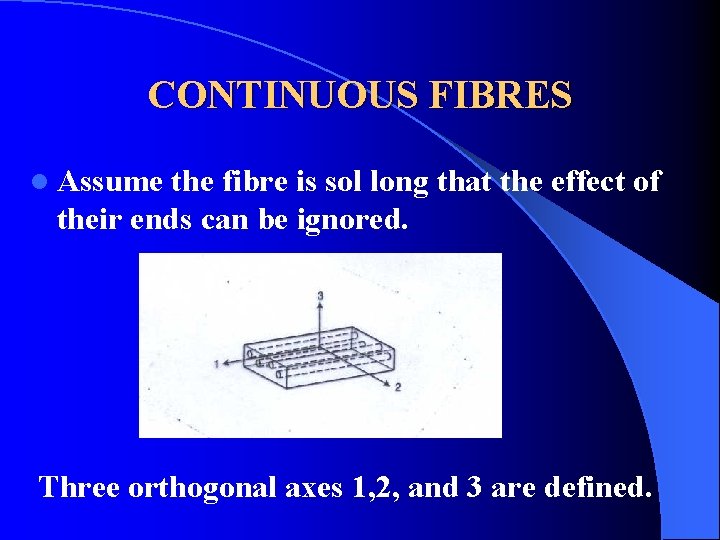
CONTINUOUS FIBRES l Assume the fibre is sol long that the effect of their ends can be ignored. Three orthogonal axes 1, 2, and 3 are defined.
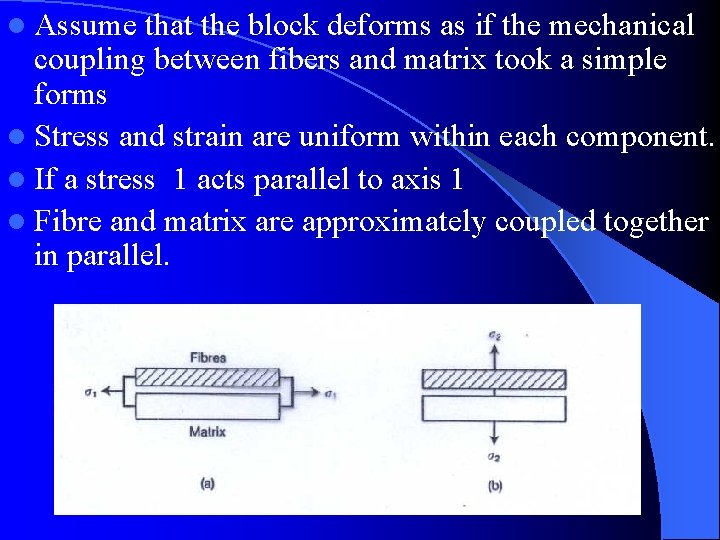
l Assume that the block deforms as if the mechanical coupling between fibers and matrix took a simple forms l Stress and strain are uniform within each component. l If a stress 1 acts parallel to axis 1 l Fibre and matrix are approximately coupled together in parallel.
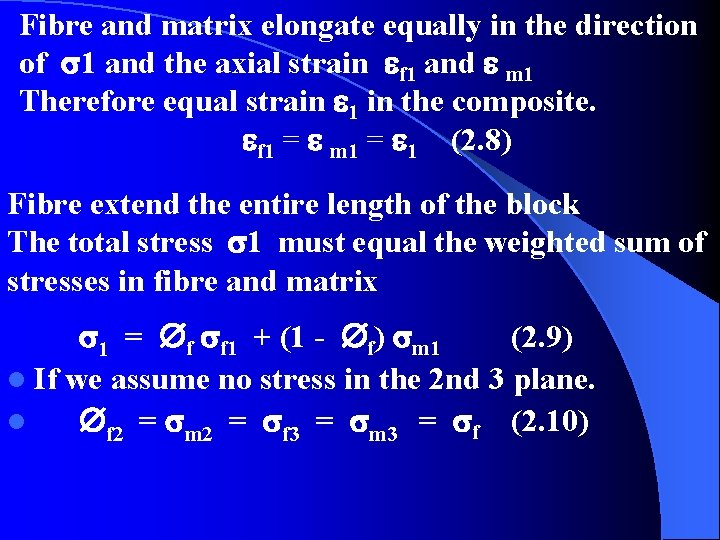
Fibre and matrix elongate equally in the direction of 1 and the axial strain f 1 and m 1 Therefore equal strain 1 in the composite. f 1 = m 1 = 1 (2. 8) Fibre extend the entire length of the block The total stress 1 must equal the weighted sum of stresses in fibre and matrix 1 = f f 1 + (1 - f) m 1 (2. 9) l If we assume no stress in the 2 nd 3 plane. l f 2 = m 2 = f 3 = m 3 = f (2. 10)
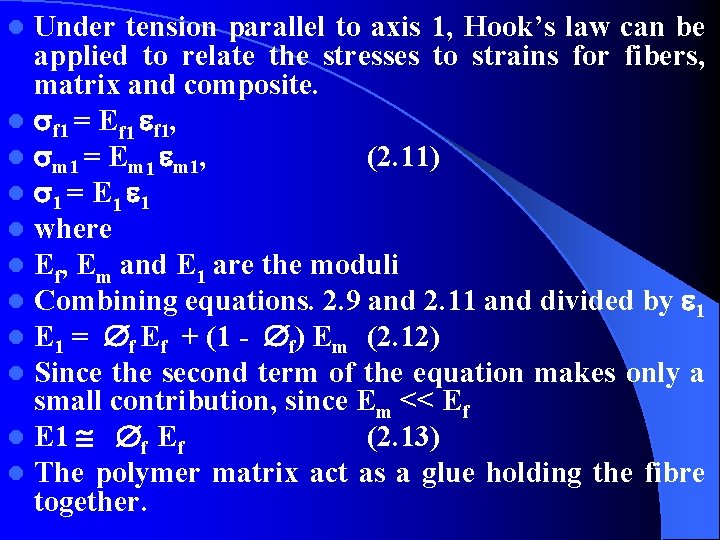
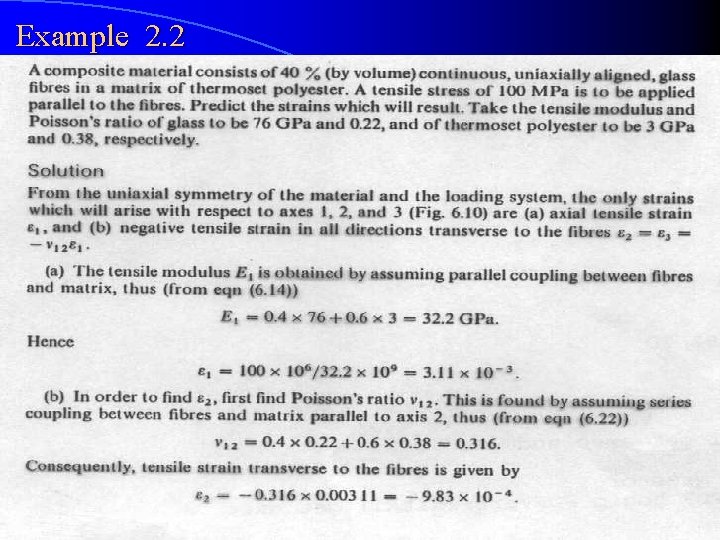
Under tension parallel to axis 1, Hook’s law can be applied to relate the stresses to strains for fibers, matrix and composite. l f 1 = Ef 1 f 1, l m 1 = Em 1 m 1, (2. 11) l 1 = E 1 1 l where l Ef, Em and E 1 are the moduli l Combining equations. 2. 9 and 2. 11 and divided by 1 l E 1 = f Ef + (1 - f) Em (2. 12) l Since the second term of the equation makes only a small contribution, since Em << Ef l E 1 f Ef (2. 13) l The polymer matrix act as a glue holding the fibre together. l
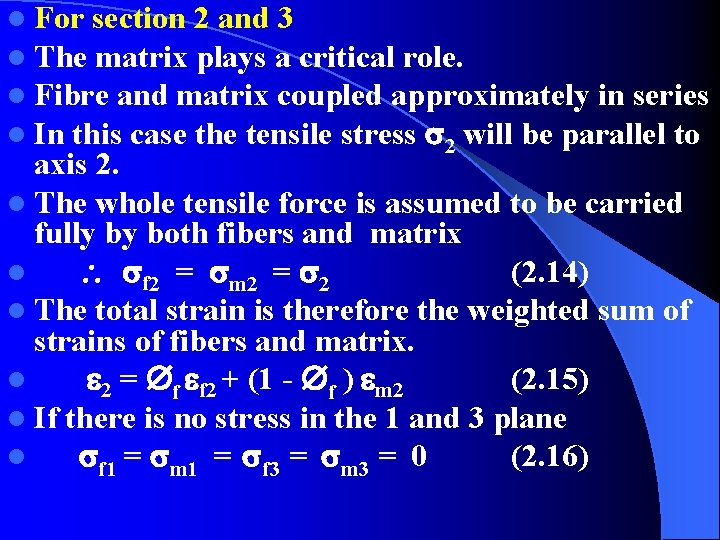
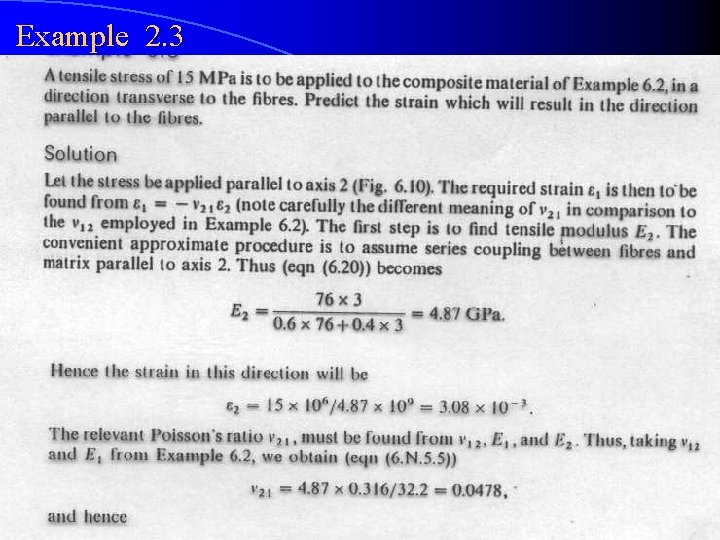
l For section 2 and 3 l The matrix plays a critical role. l Fibre and matrix coupled approximately in series l In this case the tensile stress 2 will be parallel to axis 2. l The whole tensile force is assumed to be carried fully by both fibers and matrix l f 2 = m 2 = 2 (2. 14) l The total strain is therefore the weighted sum of strains of fibers and matrix. l 2 = f f 2 + (1 - f ) m 2 (2. 15) l If there is no stress in the 1 and 3 plane l f 1 = m 1 = f 3 = m 3 = 0 (2. 16)
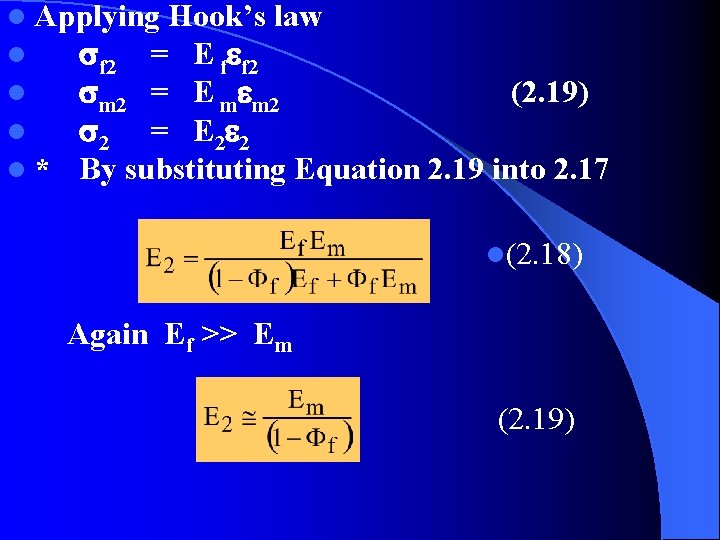
l Applying Hook’s law l f 2 = E f f 2 l m 2 = E m m 2 l 2 = E 2 2 l * By substituting Equation (2. 19) 2. 19 into 2. 17 l(2. 18) Again Ef >> Em (2. 19)
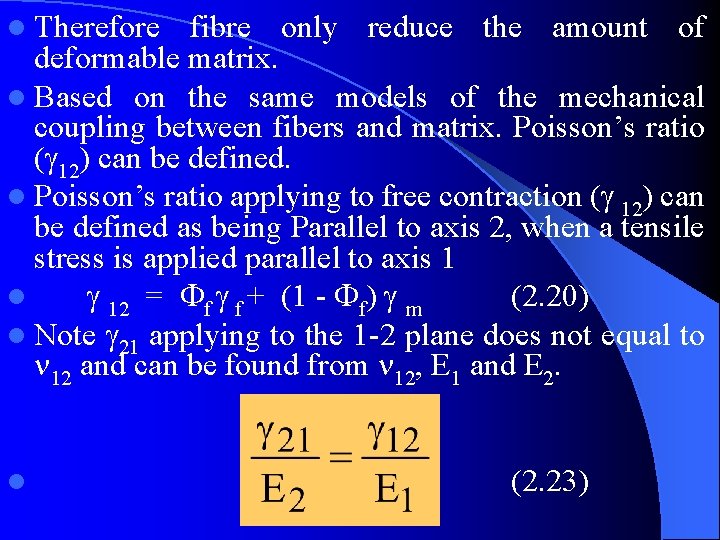
l Therefore fibre only reduce the amount of deformable matrix. l Based on the same models of the mechanical coupling between fibers and matrix. Poisson’s ratio ( 12) can be defined. l Poisson’s ratio applying to free contraction ( 12) can be defined as being Parallel to axis 2, when a tensile stress is applied parallel to axis 1 l 12 = f f + (1 - f) m (2. 20) l Note 21 applying to the 1 -2 plane does not equal to 12 and can be found from 12, E 1 and E 2. l (2. 23)
Example 2. 2
Example 2. 3
Thank You See You Next Lecture
- Slides: 11