
The measurement of particles their sizes and composition

- Slides: 18
The measurement of particles (their sizes and composition) 10/25/05
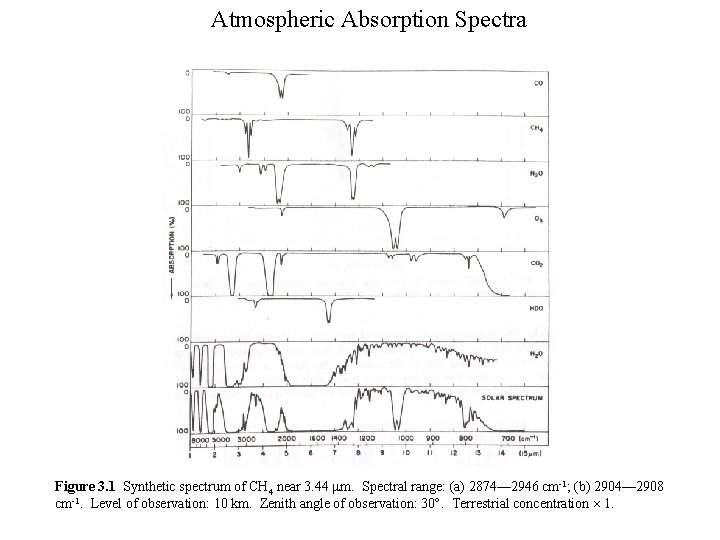
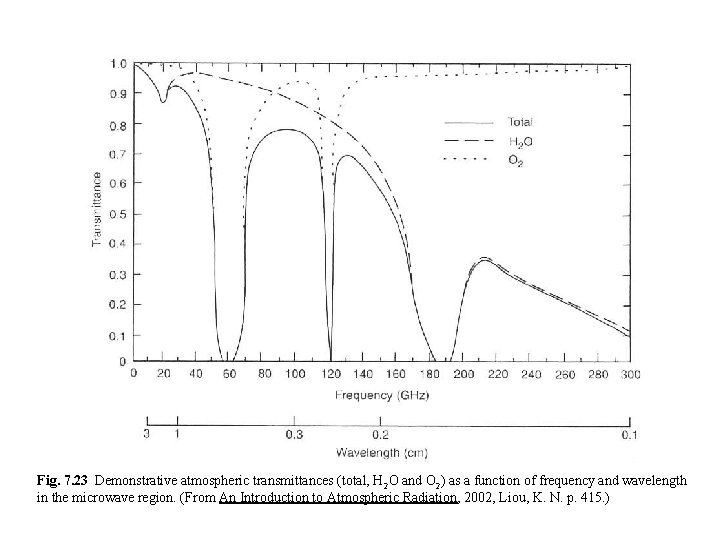
Atmospheric Absorption • Absorption and scattering occur when the material can resonate with the incoming E-M wave. This can be from electronic transitions, vibrations and rotations. • Rule of thumb - Atmospheric gases absorb in UV (electronic transitions) very little in the Visible, at selected frequencies in IR (vibrations) and Microwave (rotations) • Cloud drops are very strong absorbers in the IR, requiring very little LWC or IWC to appear “black”. They scatter in the Visible but absorb relatively little.
Atmospheric Absorption Spectra Figure 3. 1 Synthetic spectrum of CH 4 near 3. 44 m. Spectral range: (a) 2874— 2946 cm-1; (b) 2904— 2908 cm-1. Level of observation: 10 km. Zenith angle of observation: 30. Terrestrial concentration 1.
Fig. 7. 23 Demonstrative atmospheric transmittances (total, H 2 O and O 2) as a function of frequency and wavelength in the microwave region. (From An Introduction to Atmospheric Radiation, 2002, Liou, K. N. p. 415. )
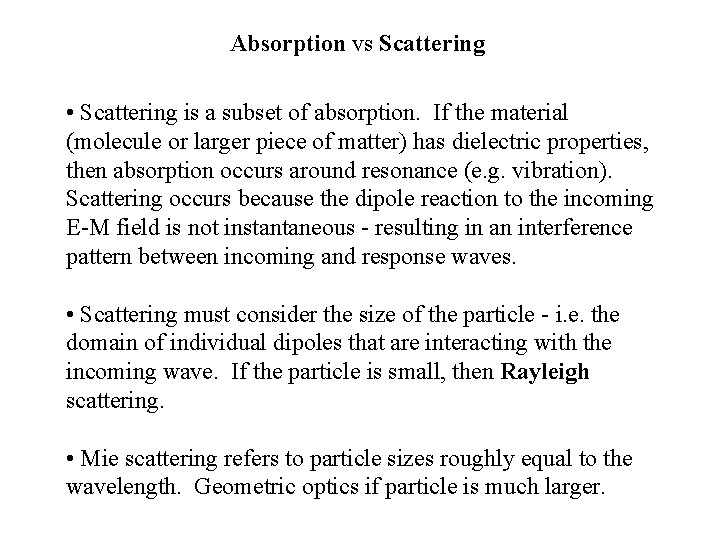
Absorption vs Scattering • Scattering is a subset of absorption. If the material (molecule or larger piece of matter) has dielectric properties, then absorption occurs around resonance (e. g. vibration). Scattering occurs because the dipole reaction to the incoming E-M field is not instantaneous - resulting in an interference pattern between incoming and response waves. • Scattering must consider the size of the particle - i. e. the domain of individual dipoles that are interacting with the incoming wave. If the particle is small, then Rayleigh scattering. • Mie scattering refers to particle sizes roughly equal to the wavelength. Geometric optics if particle is much larger.
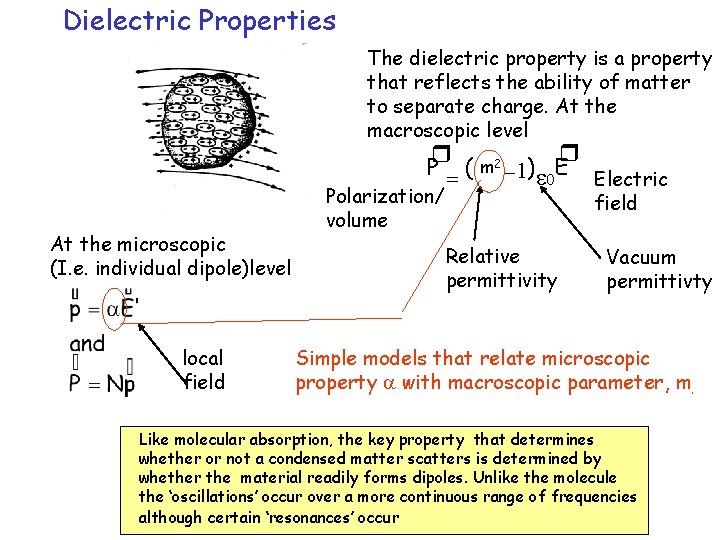
Dielectric Properties Insert 13. 1 The dielectric property is a property that reflects the ability of matter to separate charge. At the macroscopic level r P =( At the microscopic (I. e. individual dipole)level local field Polarization/ volume r E 0 Electric m 2 -1) Relative permittivity field Vacuum permittivty Simple models that relate microscopic property with macroscopic parameter, m. Like molecular absorption, the key property that determines whether or not a condensed matter scatters is determined by whether the material readily forms dipoles. Unlike the molecule the ‘oscillations’ occur over a more continuous range of frequencies although certain ‘resonances’ occur
Refractive Index The dielectric constant r is also directly related to the refractive index. m=n-i The real part of the refractive index relates to the phase of the oscillatory EM field, the complex part to attenuation (absorption) of the amplitude of the oscillation
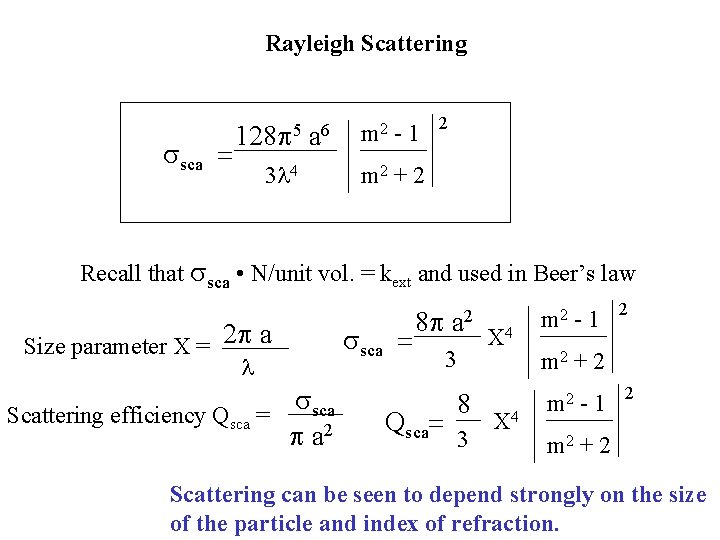
Rayleigh Scattering ssca = 128 p 5 a 6 3 l 4 m 2 - 1 2 m 2 + 2 Recall that ssca • N/unit vol. = kext and used in Beer’s law Size parameter X = 2 p a l ssca Scattering efficiency Qsca = p a 2 ssca = 8 p Qsca= a 2 3 8 3 X 4 m 2 - 1 2 m 2 + 2 Scattering can be seen to depend strongly on the size of the particle and index of refraction.
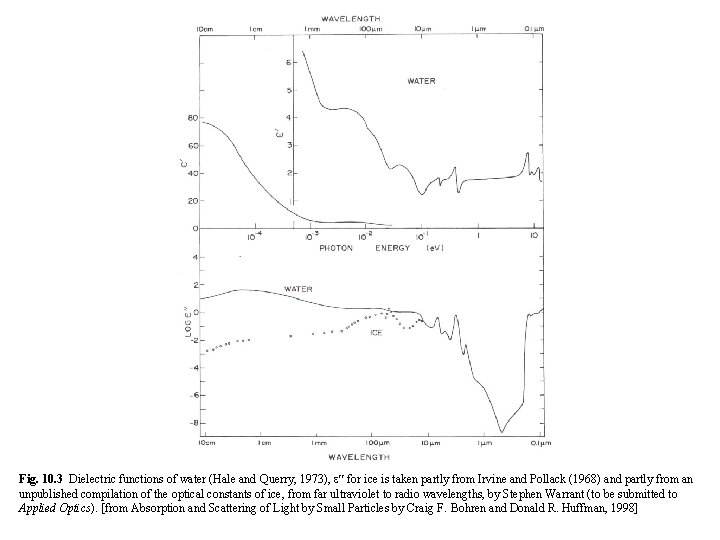
Fig. 10. 3 Dielectric functions of water (Hale and Querry, 1973), for ice is taken partly from Irvine and Pollack (1968) and partly from an unpublished compilation of the optical constants of ice, from far ultraviolet to radio wavelengths, by Stephen Warrant (to be submitted to Applied Optics). [from Absorption and Scattering of Light by Small Particles by Craig F. Bohren and Donald R. Huffman, 1998]
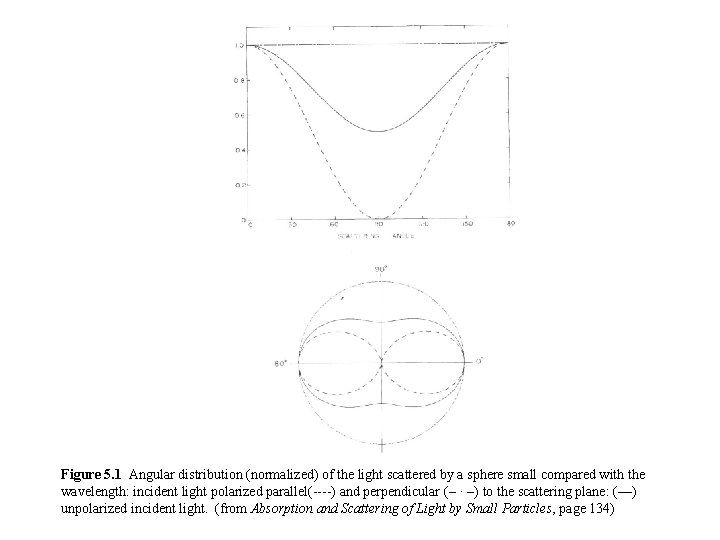
Figure 5. 1 Angular distribution (normalized) of the light scattered by a sphere small compared with the wavelength: incident light polarized parallel(----) and perpendicular (– · –) to the scattering plane: (—) unpolarized incident light. (from Absorption and Scattering of Light by Small Particles, page 134)
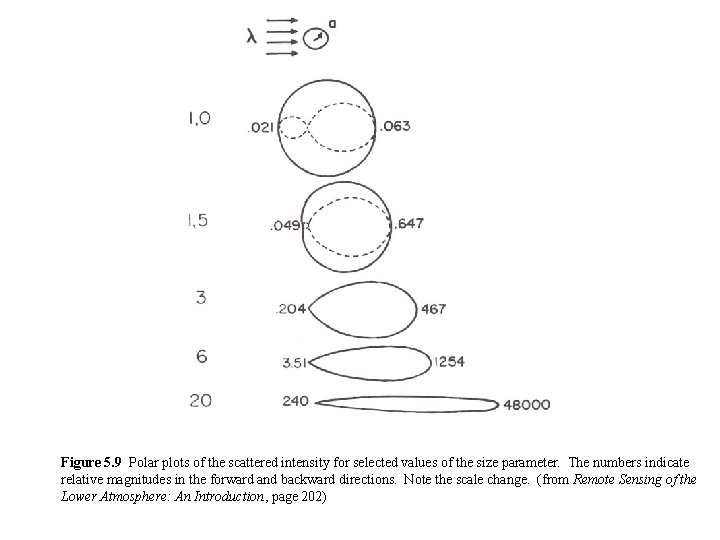
Figure 5. 9 Polar plots of the scattered intensity for selected values of the size parameter. The numbers indicate relative magnitudes in the forward and backward directions. Note the scale change. (from Remote Sensing of the Lower Atmosphere: An Introduction, page 202)
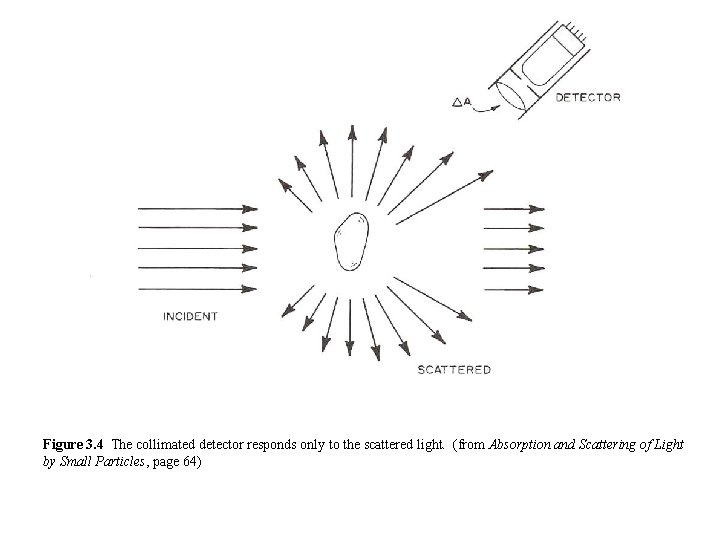
Figure 3. 4 The collimated detector responds only to the scattered light. (from Absorption and Scattering of Light by Small Particles, page 64)
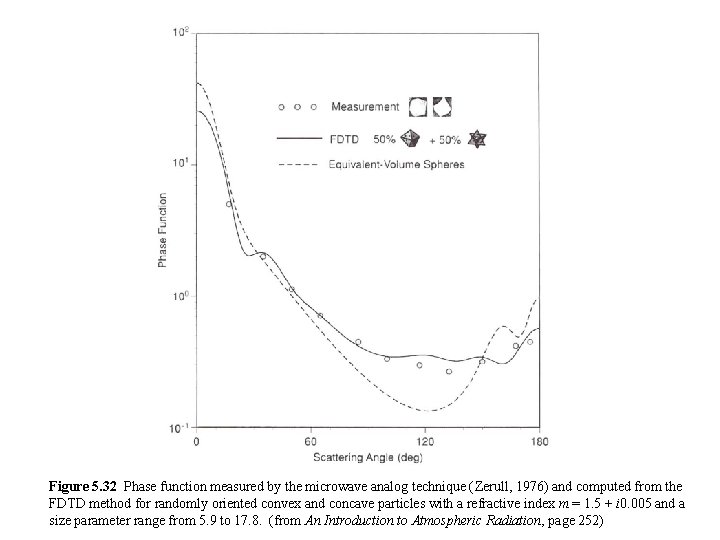
Figure 5. 32 Phase function measured by the microwave analog technique (Zerull, 1976) and computed from the FDTD method for randomly oriented convex and concave particles with a refractive index m = 1. 5 + i 0. 005 and a size parameter range from 5. 9 to 17. 8. (from An Introduction to Atmospheric Radiation, page 252)
Particle detectors • Can try to capture and examine under microscope. • If we know the sizes (e. g. we sorted them), then can find the index of refraction and try to guess composition. • If we know the material, can use the strong size dependence to infer particle sizes. • Can use scattering phase function to say something about sizes as well. Details depend upon the sensor and principle being used. Too numerous to list.
Video Disdrometer & its cousins • Shine a laser (typically short wavelength) across a gap and measure the shadow created by scattering from particles passing through the gap. Visible does not scatter much, but any reduction in intensity demarks a particle. Can also use IR beams. • UV interferometer - use 2 different wavelengths. The ratio of received intensity is proportional to the mean size of atmospheric aerosols. [complications arise when the sizes are not unique but distributed across a range of unknown sizes).
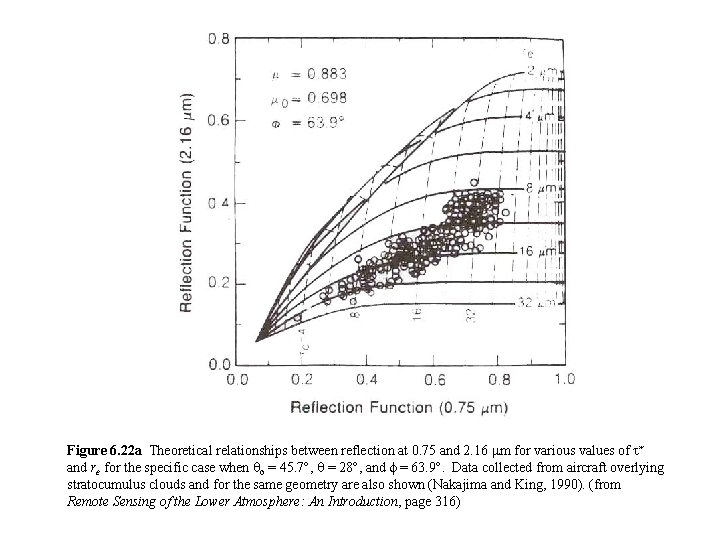
Figure 6. 22 a Theoretical relationships between reflection at 0. 75 and 2. 16 m for various values of and re for the specific case when o = 45. 7 , = 28 , and = 63. 9. Data collected from aircraft overlying stratocumulus clouds and for the same geometry are also shown (Nakajima and King, 1990). (from Remote Sensing of the Lower Atmosphere: An Introduction, page 316)
Summary • If the index of refraction (particle composition) is known, and the sizes are known, and the particle is small compared to wavelength, then we can exactly predict scattering. If we measure scattering, kext, can be used to infer one of the above. • If particles get bigger, scattering is more complex. Must additionally assume that particles are sphere (usually denoted as Mie scattering). Can use more complex theory but then we must know shape also. • Matters simplify again for geometric optics but shape of particle is part of the cross section.
Calibration methods Coincident overpasses: Provides robust estimates of relative biases among sensors. The methods requires that geophysical parameters be derived to convert Tb among sensors unless these are identical. This generally limits the applicability to non-raining oceanic scenes. Temporal variations can be tracked as long as statistics remain robust (~3 mo. ) Vicarious calibration: Use naturally occurring lower bound on Tb in microwave window channels as a stationary statistic, derived from large ensemble histograms, to constrain calibration at cold end of dynamic range. Use well understood dependence of the lower bound on incidence angle, frequency and polarization to constrain relative calibration between different sensor types. Channel transformation: Algorithms have been derived for the direct conversion of oceanic brightness temperatures from one sensor to the viewing parameters of another without specifying the geophysical parameters. This way more degrees of freedom then the four generally used (WV, CLW, WS, SST) can be retained. Simulations indicate this is a more accurate approach. Geophysical parameter estimation: Looks at stability of retrieved geophysical parameters which can be very sensitive indicators of Tb differences. Can make use of in-situ observations to examine absolute calibration and account for any trends in the data. Retrieval uncertainties and sparse in-situ observations make it difficult to discern calibration problems that are orbital in nature. Sensor engineering: Stratify errors in calibration, as determined by all of the above methods, with respect to sensor parameters (e. g. critical component temperatures or the mean Tb in antenna sidelobes) and revisit hardware calibration model. Revise and/or re-tune to eliminate the correlation of calibration errors with sensor parameters.