
The measurement of nuclear modification factor with ALICE

- Slides: 18
The measurement of nuclear modification factor with ALICE at LHC Beomkyu Kim
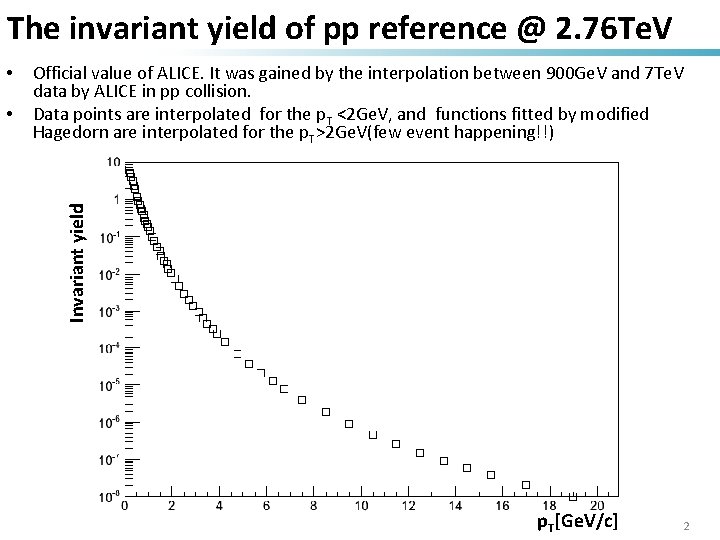
The invariant yield of pp reference @ 2. 76 Te. V • Official value of ALICE. It was gained by the interpolation between 900 Ge. V and 7 Te. V data by ALICE in pp collision. Data points are interpolated for the p. T <2 Ge. V, and functions fitted by modified Hagedorn are interpolated for the p. T>2 Ge. V(few event happening!!) Invariant yield • p. T[Ge. V/c] 2
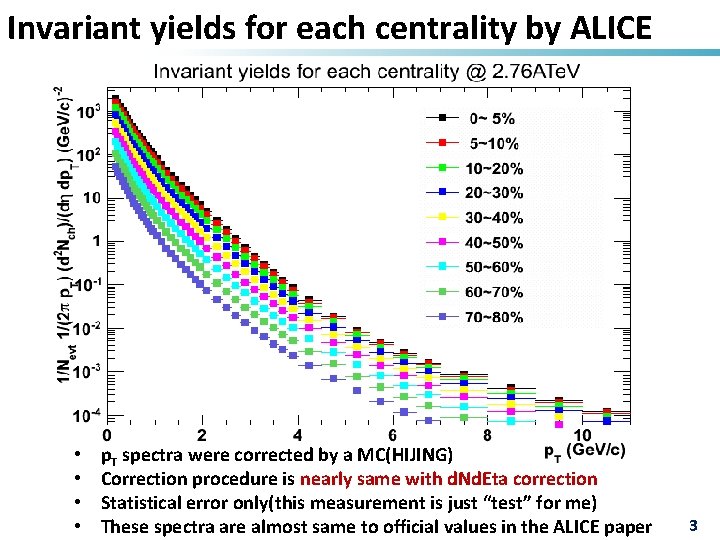
Invariant yields for each centrality by ALICE • • p. T spectra were corrected by a MC(HIJING) Correction procedure is nearly same with d. Nd. Eta correction Statistical error only(this measurement is just “test” for me) These spectra are almost same to official values in the ALICE paper 3
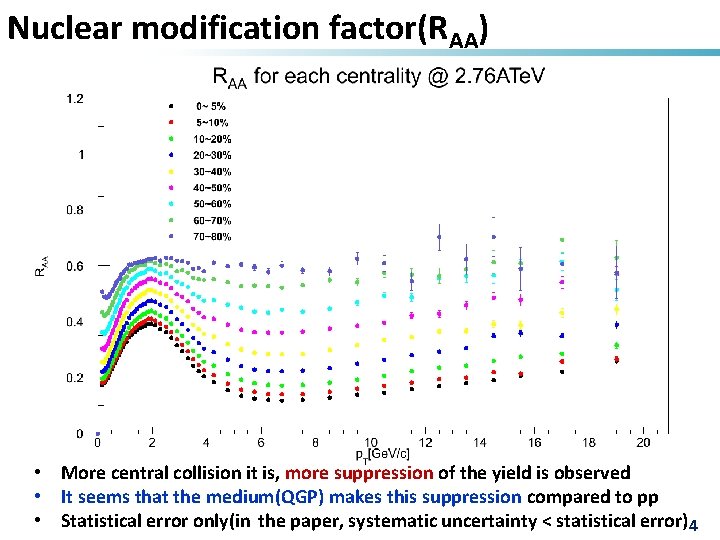
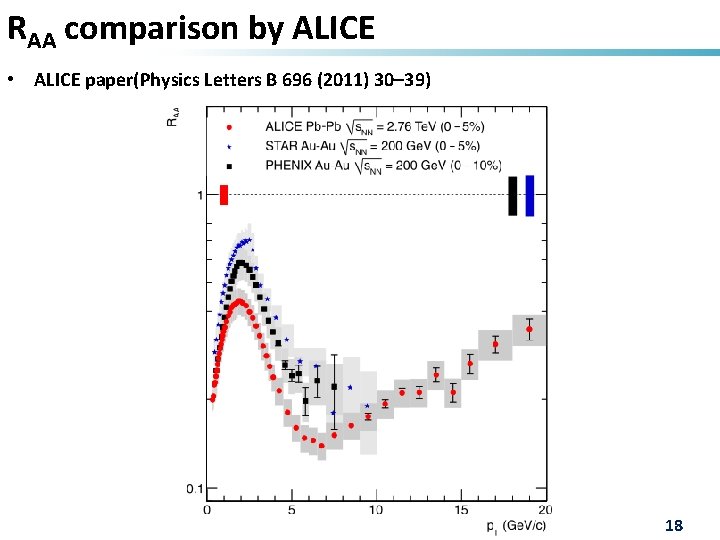
Nuclear modification factor(RAA) • More central collision it is, more suppression of the yield is observed • It seems that the medium(QGP) makes this suppression compared to pp • Statistical error only(in the paper, systematic uncertainty < statistical error)4
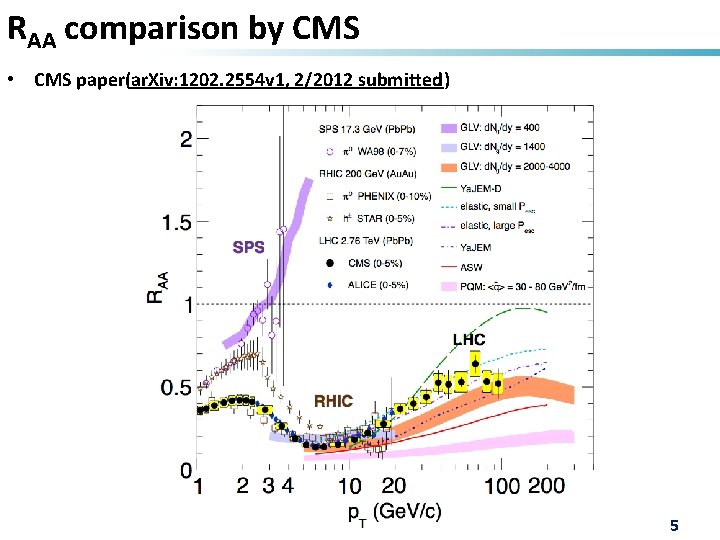
RAA comparison by CMS • CMS paper(ar. Xiv: 1202. 2554 v 1, 2/2012 submitted) 5
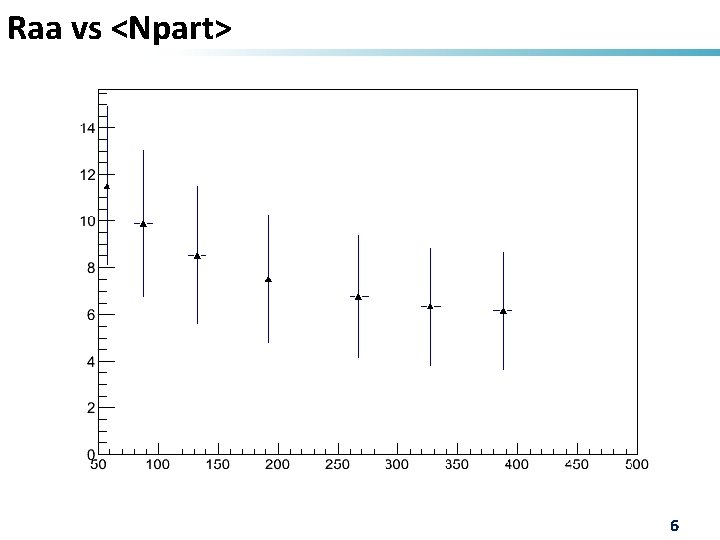
Raa vs <Npart> 6
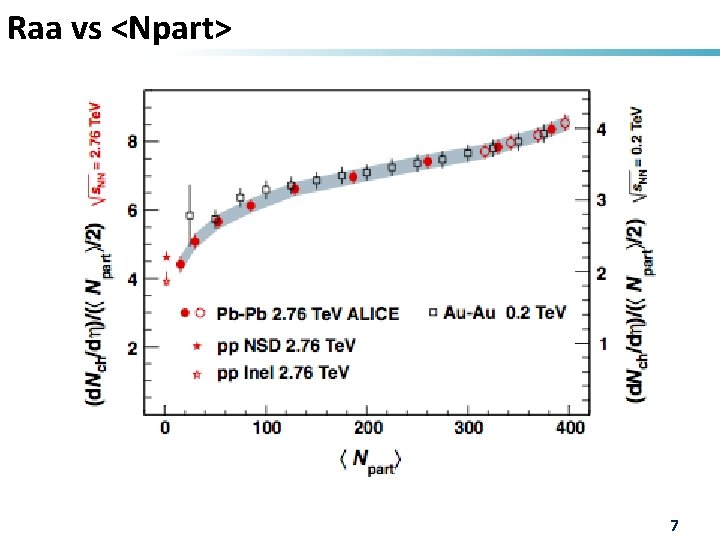
Raa vs <Npart> 7
Summary • d. Nd. Eta measurements – With new tracking methods(less particle loss) – New data points update for η density @ 0. 9 & 7 Te. V – It’s planed to update the data for 8 Te. V in this year – This is a intermediate step for high multiplicity events in pp • The p. T spectra & the nuclear modification factor – Very famous measurement proving the existence of “QGP” state in heavy ion experiment – This can be easily measured by using almost same correction procedure as like d. Nd. Eta 8
BACKUP
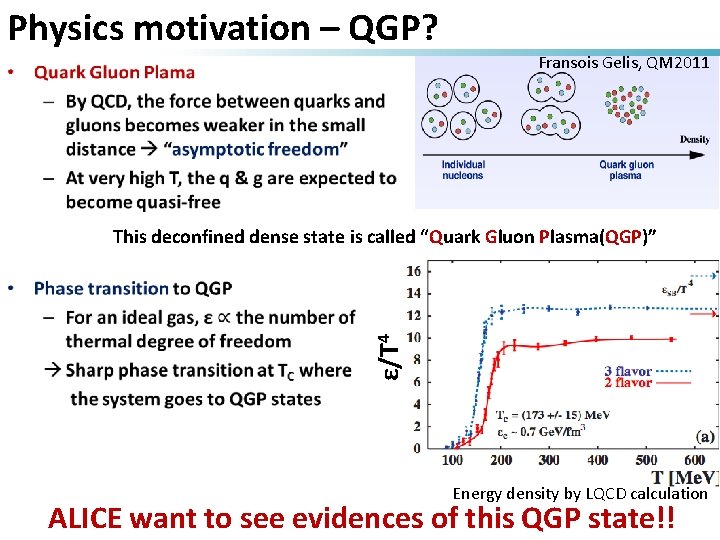
Physics motivation – QGP? Fransois Gelis, QM 2011 ε/T 4 This deconfined dense state is called “Quark Gluon Plasma(QGP)” Energy density by LQCD calculation ALICE want to see evidences of this QGP state!!
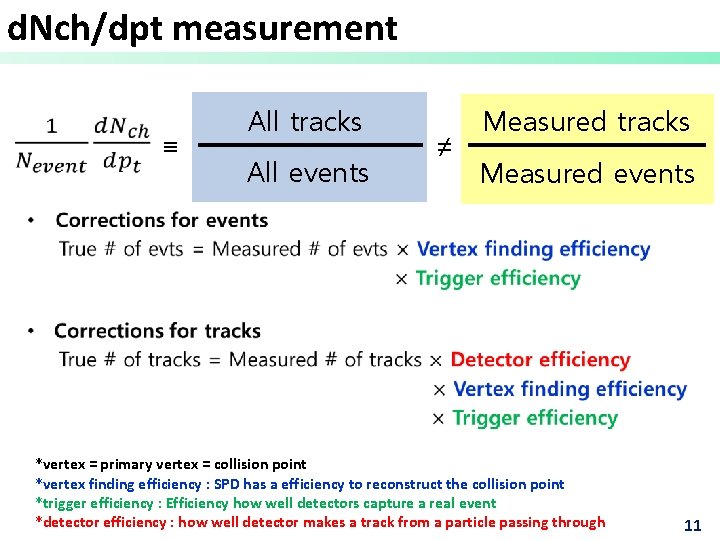
d. Nch/dpt measurement ≡ All tracks All events ≠ Measured tracks Measured events *vertex = primary vertex = collision point *vertex finding efficiency : SPD has a efficiency to reconstruct the collision point *trigger efficiency : Efficiency how well detectors capture a real event *detector efficiency : how well detector makes a track from a particle passing through 11
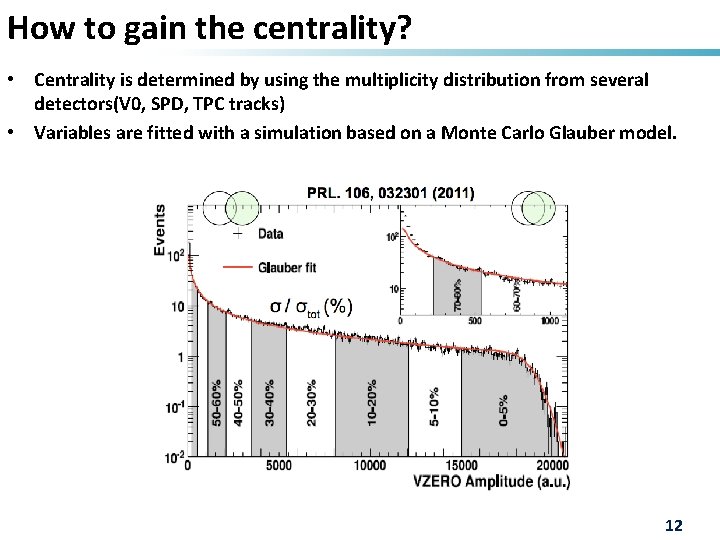
How to gain the centrality? • Centrality is determined by using the multiplicity distribution from several detectors(V 0, SPD, TPC tracks) • Variables are fitted with a simulation based on a Monte Carlo Glauber model. 12
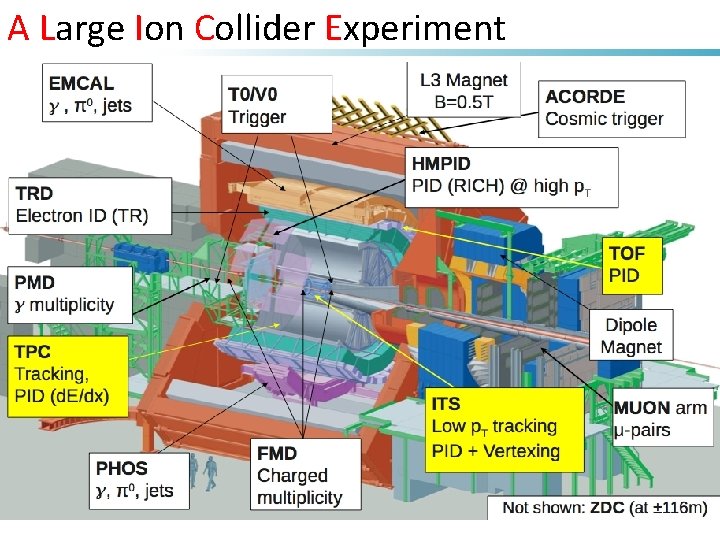
A Large Ion Collider Experiment
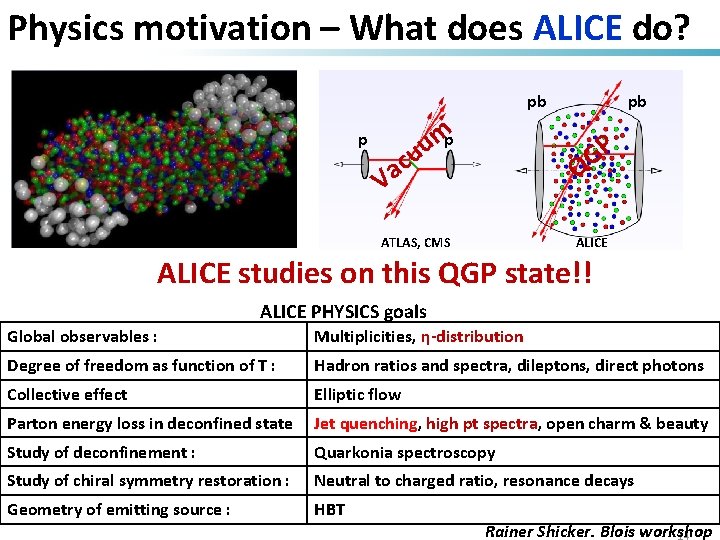
Physics motivation – What does ALICE do? pb mp u u c a p pb P G Q V ALICE ATLAS, CMS ALICE studies on this QGP state!! ALICE PHYSICS goals Global observables : Multiplicities, η-distribution Degree of freedom as function of T : Hadron ratios and spectra, dileptons, direct photons Collective effect Elliptic flow Parton energy loss in deconfined state Jet quenching, high pt spectra, open charm & beauty Study of deconfinement : Quarkonia spectroscopy Study of chiral symmetry restoration : Neutral to charged ratio, resonance decays Geometry of emitting source : HBT Rainer Shicker. Blois workshop 14
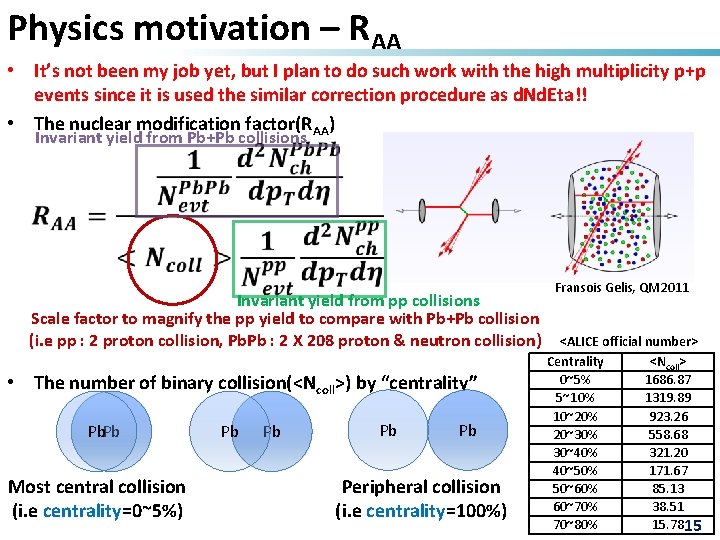
Physics motivation – RAA • It’s not been my job yet, but I plan to do such work with the high multiplicity p+p events since it is used the similar correction procedure as d. Nd. Eta!! • The nuclear modification factor(RAA) Invariant yield from Pb+Pb collisions Invariant yield from pp collisions Scale factor to magnify the pp yield to compare with Pb+Pb collision (i. e pp : 2 proton collision, Pb. Pb : 2 X 208 proton & neutron collision) • The number of binary collision(<Ncoll>) by “centrality” Pb. Pb Most central collision (i. e centrality=0~5%) Pb Pb Peripheral collision (i. e centrality=100%) Fransois Gelis, QM 2011 <ALICE official number> Centrality <Ncoll> 0~5% 1686. 87 5~10% 1319. 89 10~20% 923. 26 20~30% 558. 68 30~40% 321. 20 40~50% 171. 67 50~60% 85. 13 60~70% 38. 51 70~80% 15. 7815
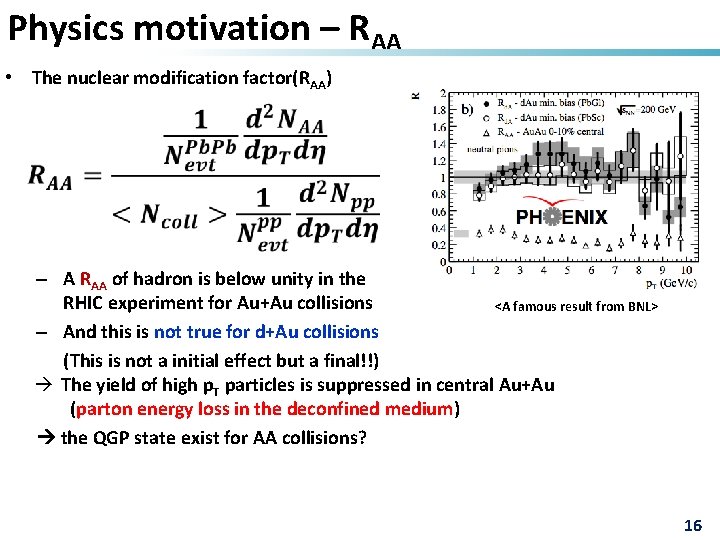
Physics motivation – RAA • The nuclear modification factor(RAA) – A RAA of hadron is below unity in the RHIC experiment for Au+Au collisions <A famous result from BNL> – And this is not true for d+Au collisions (This is not a initial effect but a final!!) à The yield of high p. T particles is suppressed in central Au+Au (parton energy loss in the deconfined medium) the QGP state exist for AA collisions? 16
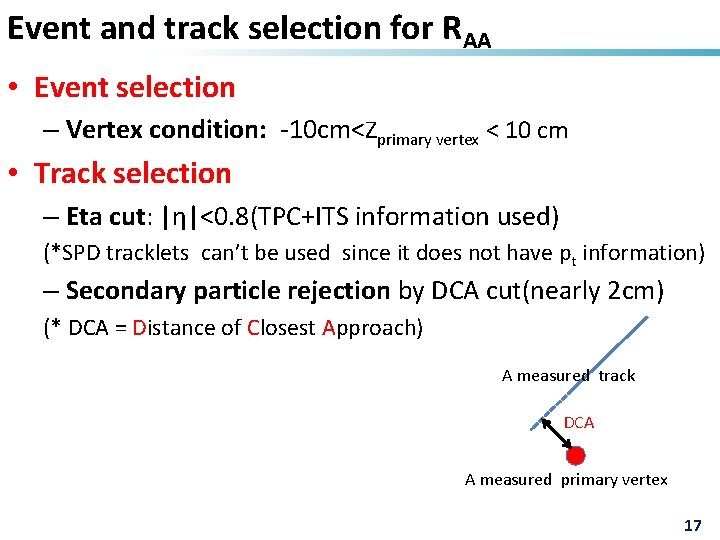
Event and track selection for RAA • Event selection – Vertex condition: -10 cm<Zprimary vertex < 10 cm • Track selection – Eta cut: |η|<0. 8(TPC+ITS information used) (*SPD tracklets can’t be used since it does not have pt information) – Secondary particle rejection by DCA cut(nearly 2 cm) (* DCA = Distance of Closest Approach) A measured track DCA A measured primary vertex 17
RAA comparison by ALICE • ALICE paper(Physics Letters B 696 (2011) 30– 39) 18